

The world’s freshwater habitats are home to countless vibrant species, but few shine as brilliantly as the Electric Yellow Cichlid ( Labidochromis caeruleus ). Imagine a fish that looks like it’s been painted with a highlighter or infused with a tiny bolt of lightning—that’s the stunning visual impact of this diminutive creature. Known for its intense, almost neon-yellow body and striking black fin accents, this African gem has captivated aquarists and biologists alike.
Why is this little fish so fascinating? Beyond its sheer aesthetic appeal, the Electric Yellow Cichlid offers a window into the incredible biodiversity and complex social dynamics of the Great Rift Valley lakes. Its relatively peaceful nature (for a cichlid!) and unique foraging strategies make it a standout species, truly a golden bolt in the aquatic world.
💡 Facts
Here are 5 intriguing and less common facts about the Electric Yellow Cichlid:
- Not All Yellow: While the most popular form is brilliant yellow, the species name caeruleus actually means “sky blue.” This refers to a less common, light-blue variant found in certain areas of the lake. The Electric Yellow coloration is a specific regional morph.
- The Cave Dweller: In the wild, they are often found near rocky areas and caves. They are known as rock-dwelling cichlids or mbuna, which is a local classification that means “rock-fish” in the Tonga language of Malawi.
- Mouthbrooders Supreme: The females are diligent maternal mouthbrooders. After spawning, the female scoops up the fertilized eggs and carries them in her mouth for up to 30 days until they hatch and become free-swimming. During this time, she does not eat.
- The “Nipper”: Their diet relies on periphyton, the complex community of algae and microorganisms that cling to rocks. They possess a unique mouth structure that allows them to “nip” and scrape this layer off the rock surfaces.
- A Recent Discovery: Compared to many species, the Electric Yellow Cichlid was only scientifically described relatively recently, in 1956, by ichthyologist Ethelwynn Trewavas.
🔬 Species
The Electric Yellow Cichlid is a textbook example of explosive speciation within a single, isolated ecosystem.
| Classification Level | Group |
| Kingdom | Animalia (Animals) |
| Phylum | Chordata (Vertebrates) |
| Class | Actinopterygii (Ray-finned fishes) |
| Order | Cichliformes (Cichlids and allies) |
| Family | Cichlidae (Cichlids) |
| Genus | Labidochromis |
| Species | Labidochromis caeruleus |
The Labidochromis genus belongs to the Mbuna group of Lake Malawi cichlids. The general Mbuna group contains hundreds of species, all characterized by their rock-dwelling habitat and specialized feeding on periphyton. Related species in the same genus include:
- Labidochromis sp. “Hongi”: A purple-bodied mbuna with orange accents, often found in similar habitats.
- Labidochromis freibergi: A light blue or white species with black vertical bars.
🎨 Appearance
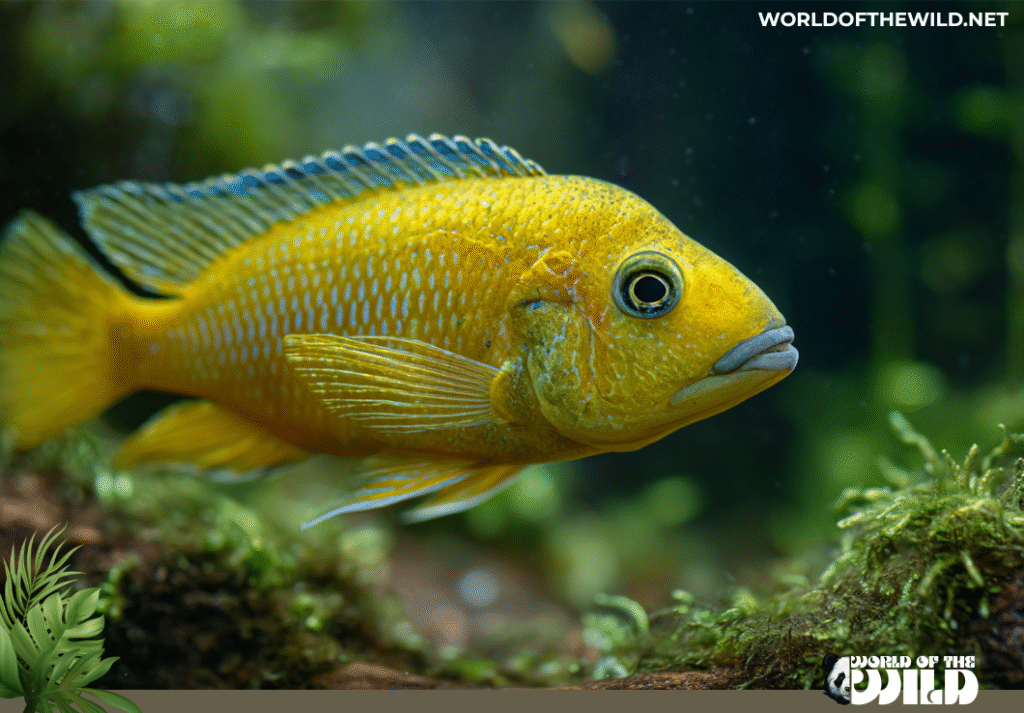
The Electric Yellow Cichlid is instantly recognizable due to its intense coloration and streamlined form.
- Size: They are relatively small for a cichlid, typically reaching 3 to 4 inches (7.5 to 10 cm) in length in captivity, though they can be slightly smaller in the wild.
- Weight: They are light and slender, generally weighing only a few ounces.
- Color: The body is a startling, uniform neon or electric yellow. This vibrant color is consistent across the entire body, extending to the pelvic, pectoral, and caudal (tail) fins.
- Distinctive Features: The most defining contrast is the deep black striping along the top edge of the dorsal fin and the anal fin. Adult males may display slightly more intense black coloration and often grow slightly larger than females. They possess a terminal mouth with conical teeth, perfectly adapted for picking at algae and small invertebrates.
🎭 Behavior
The Electric Yellow Cichlid is known for a personality that is a refreshing departure from the aggressive reputation of many other mbuna cichlids.
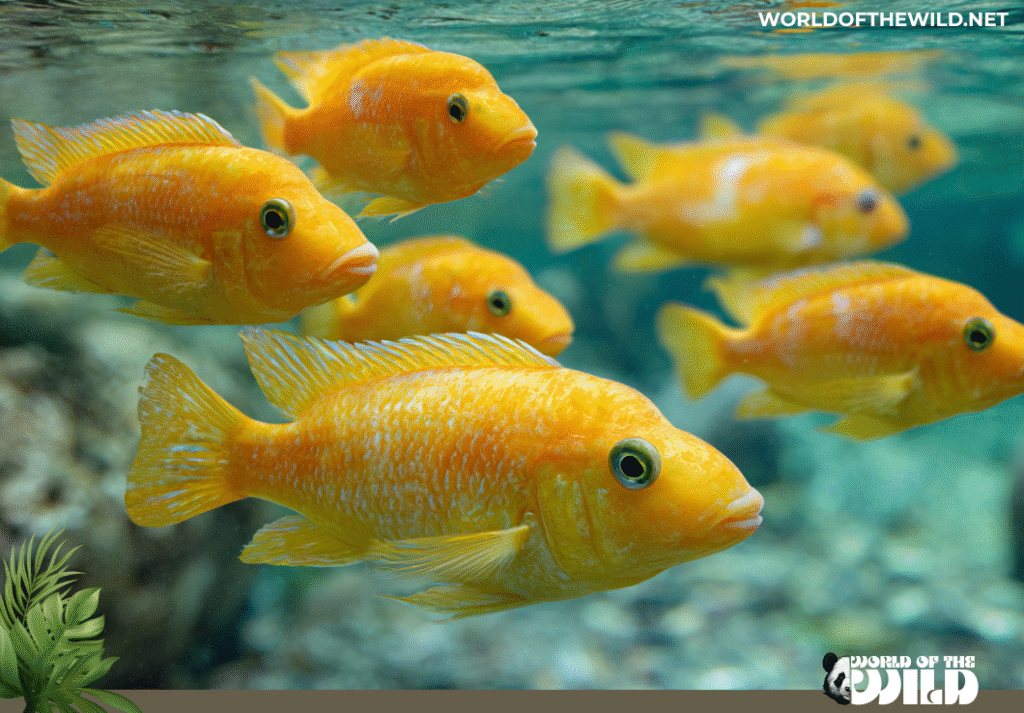
- Social Behavior: While they are primarily solitary foragers in the wild, they are social enough to live in loose communities. In an aquarium setting, they thrive in groups, reducing stress and aggression. Males are moderately territorial, especially when establishing a breeding site, but are far less aggressive than their cousins.
- Communication: Like most cichlids, they communicate through a combination of body posturing, such as flaring fins to display dominance or attract a mate, and subtle color changes.
- Notable Adaptations: Their unique feeding method is a major behavioral adaptation. They spend the day “nipping” at the biofilm on submerged rocks. They are incredibly inquisitive and are known to inspect every crevice and surface, which is a key foraging technique that helps them find small, hidden invertebrates. They are generally active throughout the day.

📜 Evolution
The Electric Yellow Cichlid is a relatively young species, a product of one of the most astonishing evolutionary events on the planet: the rapid and ongoing speciation within Lake Malawi in East Africa.
Lake Malawi, part of the Great Rift Valley, formed only 1 to 2 million years ago. Its cichlids, including L. caeruleus, are believed to have evolved from a small number of ancestral riverine cichlids that colonized the lake.
- Evolutionary Milestones: The key milestone was the adaptation of the pharyngeal jaws and mouth structure, allowing them to exploit the massive food source of periphyton growing on the submerged rocks (the “Aufwuchs”). The diversification into the Mbuna group, including the Labidochromis genus, is an example of adaptive radiation, where a single ancestor rapidly evolves into numerous species, each specialized to a different ecological niche within the rocky littoral zone. The development of distinct color morphs, such as the electric yellow, is also a critical evolutionary step, aiding in species recognition and reproductive isolation.
🌍 Habitat
The Electric Yellow Cichlid is an endemic species, meaning it is naturally found in only one specific location in the world.
- Geographic Range: Their entire natural range is the central and northern areas of Lake Malawi in East Africa. This massive lake is bordered by the countries of Malawi, Mozambique, and Tanzania.
- Specific Environment: They inhabit the rocky littoral zone—the shallow, near-shore areas characterized by large, submerged rock piles, boulders, and caves. This environment provides abundant shelter from predators and a massive surface area for the growth of their primary food source, the periphyton. They are typically found at depths ranging from 10 to 40 meters.
🍽️ Diet
- Dietary Classification: Primarily an omnivore that skews heavily toward herbivory, but with an important carnivorous component.
- Primary Food Sources:
- Periphyton (Algae/Biofilm): Their main diet consists of the algae and microorganisms (diatoms, cyanobacteria) they scrape from the rocky substrate.
- Small Invertebrates: Crucially, they also consume the small insect larvae, tiny crustaceans, and copepods that live within the periphyton mat. This provides necessary protein.
- Foraging Method: They use their specialized jaws to “graze” the rocks. They swim up to a surface, extend their snout, and nip or comb the algae, effectively stripping the rock face clean. They are not open-water hunters; their food is harvested directly from the substrate.
🚨 Predators and Threats
Despite their small size, the Electric Yellow Cichlid faces pressure from both natural hunters and human activity.
- Natural Predators: In Lake Malawi, their main predators are larger, piscivorous (fish-eating) cichlids, such as species from the genus Fossorochromis and Nimbochromis. They also have to evade aquatic birds, monitor lizards, and the occasional otter. Their strategy is to dart into the protective cover of the rock crevices.
- Anthropogenic Threats:
- Over-Collection: They are highly prized in the global aquarium trade, leading to intense collection pressure in certain areas.
- Habitat Degradation: While deep in the lake, near-shore environments are vulnerable to increasing sedimentation from deforestation and agriculture on the lake’s shores, which can smother the rocky habitat and algae growth.
- Pollution: Runoff from farming and urban areas introduces nutrients and pollutants that disrupt the natural chemistry of the lake.
🧬 Reproduction and Life Cycle
Reproduction in the Electric Yellow Cichlid, like all mbuna, is a highly specialized and fascinating process involving mouthbrooding.
- Mating Rituals: The male establishes a territory, usually centered around a flat rock or cave entrance, and courts the female with vibrating displays (shimmering). He leads the willing female to the breeding site, where she lays a small clutch of eggs.
- Spawning and Gestation: The female lays the eggs and immediately scoops them into her mouth. The male has egg-spots (yellow/orange spots that look like eggs) on his anal fin. As the female attempts to take the “eggs” on his fin into her mouth, he releases his sperm, fertilizing the eggs inside her mouth. This is the hallmark of mouthbrooding. The female carries the eggs and then the developing fry (offspring) for approximately 3 to 4 weeks (21-30 days).
- Offspring and Parental Care: When the fry are large enough to be free-swimming, the female releases them. For a few days, she may let the fry retreat back into her mouth for safety when a predator approaches. After this brief period, parental care ceases, and the young must fend for themselves.
- Lifespan: Their average lifespan in the wild is unknown but likely shorter due to predation. In a well-maintained aquarium, they can live for 6 to 10 years.
📈 Population
The Electric Yellow Cichlid remains a relatively stable species in its native environment.
- Conservation Status: The species is currently listed as Least Concern (LC) by the International Union for Conservation of Nature (IUCN) Red List.
- Global Population Estimate: Due to the difficulty of counting populations in the vast, deep lake, a precise global population is unavailable. However, they are described as common in the areas where they are found, particularly the Nkhata Bay and Mara Rocks regions.
- Population Trends: While local populations may be subject to collection pressure, the overall trend is considered stable across its extensive range in Lake Malawi. The primary concern is not a crisis-level decline but rather the potential for long-term habitat degradation impacting the entire endemic cichlid community.
🌟 Conclusion
The Electric Yellow Cichlid, with its unmistakable neon glow and relatively mellow disposition, is more than just a beautiful aquarium fish; it is a vital, living thread in the complex, ancient tapestry of Lake Malawi. Its specialized behavior, from the meticulous scraping of rock algae to the devoted practice of maternal mouthbrooding, showcases the incredible power of evolution in an isolated ecosystem. Classified as Least Concern today, this species serves as a glowing ambassador for the lake’s fragile biodiversity.
The golden bolt of Labidochromis caeruleus reminds us that the preservation of this unique habitat is paramount. We must support sustainable aquarium practices and conservation efforts around Lake Malawi to ensure that this brilliant, indigenous life continues to light up the Great Rift Valley for generations to come.