

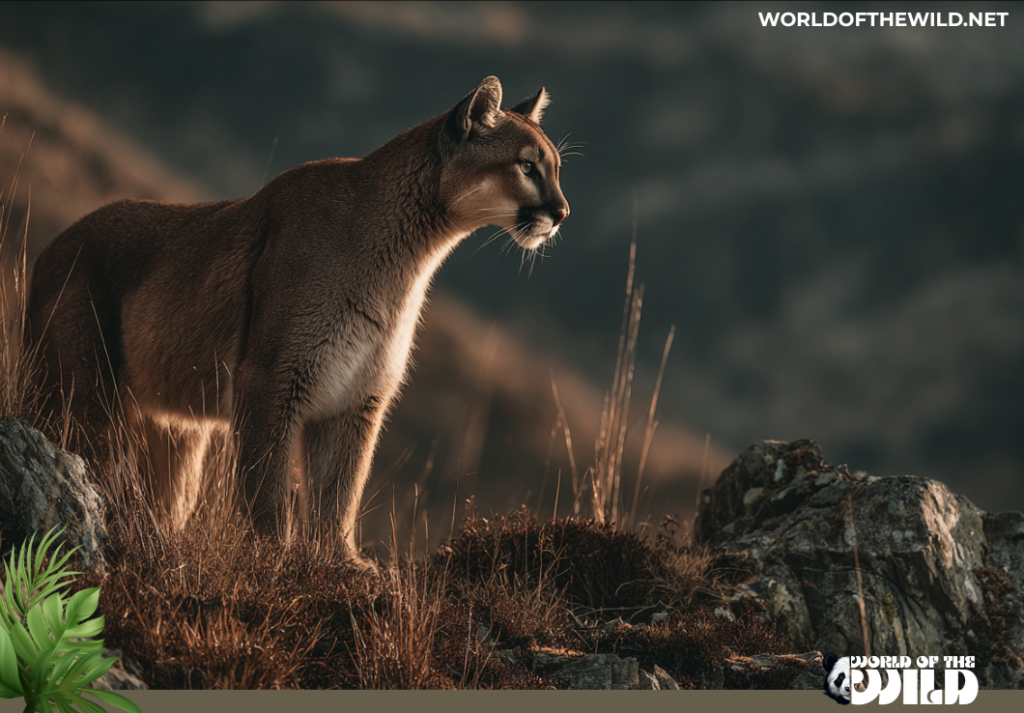
In the fading light of dusk, a tawny shadow moves silently across a rocky outcrop, its muscular form barely disturbing the mountain air. The puma—known by more names than perhaps any other animal on Earth—is a phantom of the Americas, capable of vanishing into landscapes ranging from Canadian forests to Patagonian steppes. This remarkable cat holds the distinction of having the largest geographic range of any terrestrial mammal in the Western Hemisphere, yet most people will never glimpse one in the wild. The puma’s ability to thrive in such diverse environments, combined with its powerful hunting prowess and solitary mystique, makes it one of nature’s most captivating apex predators and a symbol of wilderness itself.
Facts
- Master of Many Names: The puma holds the Guinness World Record for the animal with the most names, boasting over 40 different monikers in English alone, including cougar, mountain lion, panther, catamount, and puma.
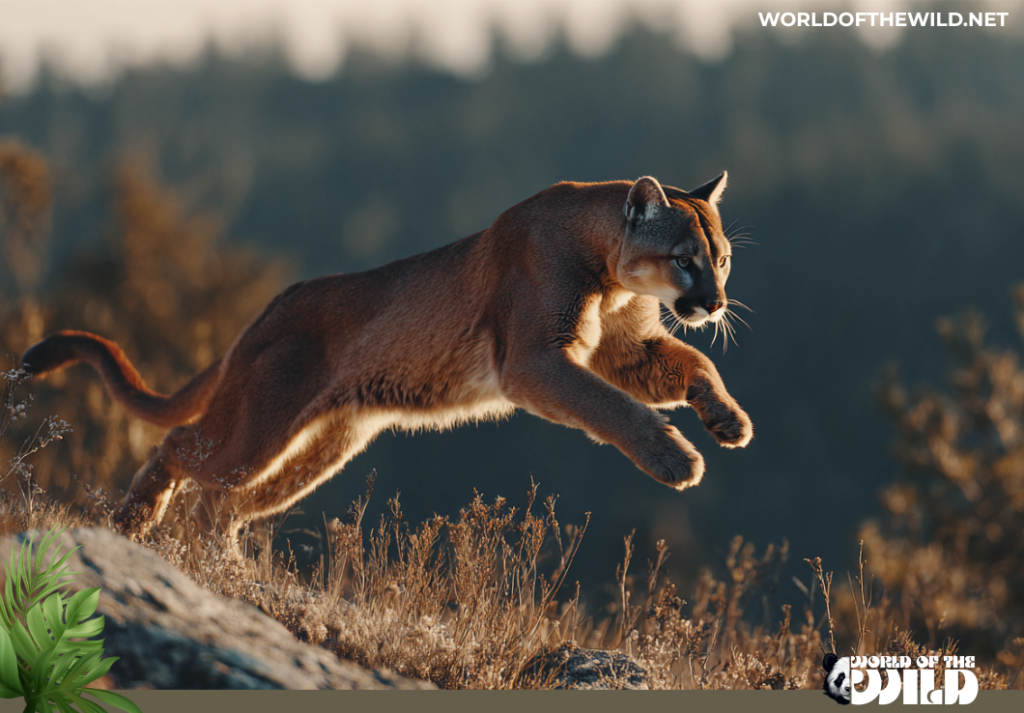
- Incredible Leapers: Pumas can leap vertically up to 18 feet into the air and horizontally up to 40-45 feet in a single bound, making them among the most athletic of all cats.
- Purr, Don’t Roar: Despite their large size, pumas cannot roar like lions or tigers. Instead, they purr, chirp, whistle, and produce an eerie scream, placing them among the “small cats” scientifically, despite their impressive stature.
- Solitary by Nature: Adult pumas are so solitary that they actively avoid each other except during mating, with males maintaining territories that overlap with multiple females but never with other males.
- Born Spotted: Puma kittens are born with spotted coats and blue eyes, which fade as they mature, providing camouflage during their vulnerable early months.
- Second Largest Cat in the Americas: Only the jaguar surpasses the puma in size among New World cats, yet the puma has a far more extensive range.
- No Subspecies Consensus: While traditionally classified into numerous subspecies, modern genetic studies suggest North American pumas show remarkably little genetic variation, challenging traditional subspecies classifications.
Sounds of the Puma
Species
Taxonomic Classification:
- Kingdom: Animalia
- Phylum: Chordata
- Class: Mammalia
- Order: Carnivora
- Family: Felidae
- Genus: Puma
- Species: Puma concolor
The puma’s taxonomic journey has been complex and contentious. Historically, zoologists recognized up to 32 subspecies based on geographic location and minor morphological differences. However, modern genetic analysis has dramatically simplified this classification. In 2017, the Cat Classification Task Force of the Cat Specialist Group recognized only two subspecies: Puma concolor concolor (South American puma) and Puma concolor couguar (North American puma, which includes the critically endangered Florida panther population).
The Florida panther (Puma concolor coryi), once considered a distinct subspecies, represents a genetically isolated population adapted to subtropical environments. This population nearly went extinct in the 1990s, with fewer than 30 individuals remaining, but has since recovered to over 200 through intensive conservation efforts and genetic rescue through the introduction of Texas pumas.
Interestingly, the puma’s closest living relatives are not other large cats but rather the cheetah and the jaguarundi, with all three sharing a common ancestor that lived in the Americas.
Appearance
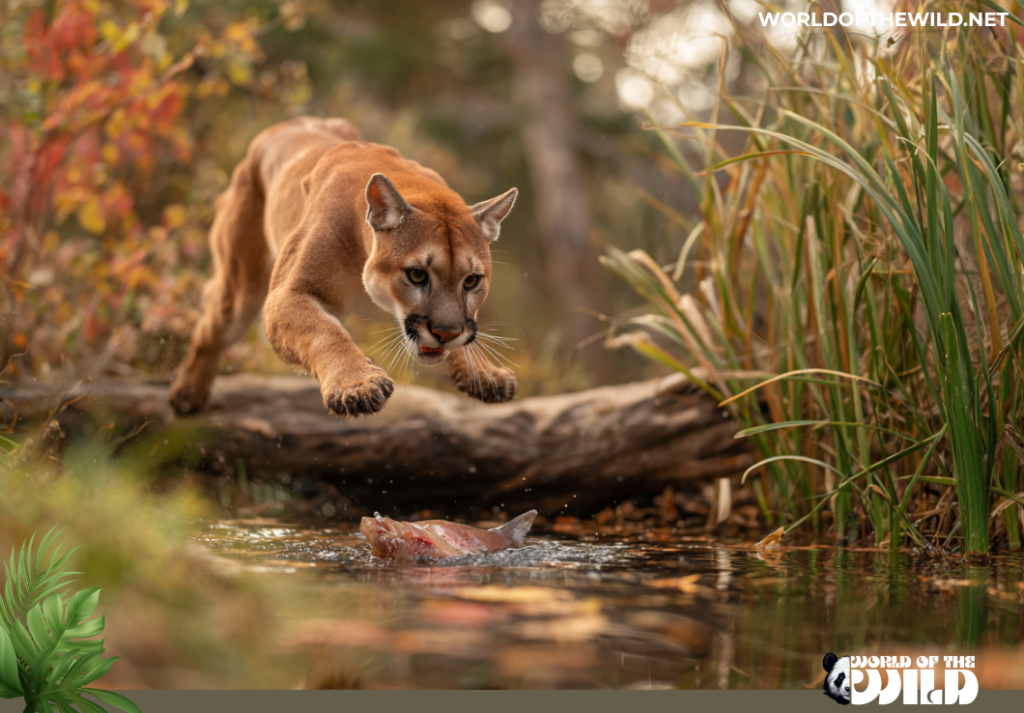
The puma is a study in sleek, efficient design. Adult males typically measure 6 to 8 feet in length from nose to tail tip and stand 24 to 35 inches at the shoulder, weighing between 115 to 220 pounds. Females are notably smaller, weighing 64 to 140 pounds. The largest pumas are found in the northern and southern extremes of their range, following Bergmann’s rule, which states that body size increases in colder climates.
The puma’s coat is remarkably uniform in color, ranging from tawny or reddish-brown to silvery-grey, with lighter underparts colored cream or white. This monochromatic coloration—from which their species name “concolor” derives, meaning “one color”—provides excellent camouflage across varied terrain. The face features distinctive white markings around the muzzle, chin, and throat, with black patches flanking the nose and dark tips on the ears and tail.
Their body is powerfully built yet graceful, with a small, rounded head relative to body size, and a remarkably long, thick tail measuring 25 to 37 inches that serves as a counterbalance during high-speed chases and dramatic leaps. The hind legs are notably longer and more muscular than the forelegs, an adaptation that provides extraordinary jumping ability. Large paws house retractable claws, and the toe pads are exceptionally large, acting as natural snowshoes in northern territories while providing silent movement across any terrain.
Their eyes are large and round, typically golden-brown or yellow-green, providing excellent vision including strong night vision. The backs of their eyes contain a reflective layer called the tapetum lucidum, which causes their eyes to glow when caught in light.
Behavior
The puma epitomizes the solitary hunter, operating alone throughout most of its life except during brief mating encounters and the extended period females spend raising cubs. These cats are primarily crepuscular and nocturnal, most active during dawn and dusk, though they may hunt during the day in areas with minimal human disturbance.
Adult males maintain vast territories ranging from 25 to over 400 square miles, depending on prey density and terrain. They mark these territories with scrapes—piles of dirt, leaves, or snow scraped together with urine or feces deposited on top—and scratch marks on trees. Males patrol these boundaries regularly and will fight fiercely with intruders, sometimes to the death. Female territories are smaller, typically 8 to 100 square miles, and may overlap with other females and the territory of one dominant male.
Communication among these solitary cats is sophisticated despite their infrequent interactions. Beyond scent marking, pumas produce a remarkable array of vocalizations. They cannot roar due to the ossification of their hyoid bone, but they hiss, growl, purr loudly, chirp to communicate with cubs, and produce a terrifying screaming call, particularly during mating season, that sounds remarkably like a human in distress. This scream has been the source of countless legends and misidentified “monster” reports throughout history.
Pumas are ambush predators par excellence, relying on stealth rather than endurance. They may stalk prey for extended periods, moving with extraordinary patience and silence, before launching a powerful burst-speed attack. They can reach speeds of 40-50 mph in short bursts and use their powerful hind legs to spring onto prey from distances up to 40 feet. The killing technique is precise: a bite to the back of the neck that severs the spinal cord or a suffocating throat grip.
After a successful kill, pumas typically drag their prey—sometimes animals much heavier than themselves—to a secluded location where they cover it with debris to hide it from scavengers. They return to feed over several days, consuming up to 10 pounds of meat in a single meal.
Intelligence is evident in their hunting strategies, which adapt to terrain and prey type. They learn quickly and can modify their behavior based on experience, including adjusting their activity patterns to avoid humans or selecting different hunting locations based on seasonal prey movements.

Evolution
The evolutionary story of the puma is a tale of intercontinental adventure and adaptation. The genus Puma originated in North America approximately 8.5 million years ago during the late Miocene epoch. The puma lineage, which includes the modern puma, jaguarundi, and the extinct species, diverged from other cat lineages around this time.
Fossil evidence suggests that the immediate ancestor of modern pumas evolved in North America during the Pliocene, approximately 3-4 million years ago. As the Isthmus of Panama formed around 3 million years ago, creating a land bridge between North and South America, pumas were among the first large predators to migrate south during the Great American Biotic Interchange, rapidly spreading throughout South America.
During the Pleistocene ice ages, North America was home to several large cat species, including saber-toothed cats and the American lion. The puma coexisted with these mega-predators by occupying a different ecological niche, focusing on medium-sized prey and utilizing its superior agility. When these larger competitors went extinct approximately 10,000-12,000 years ago, possibly due to climate change and the extinction of their primary prey (megafauna), the puma expanded its own prey base and range.
Interestingly, genetic studies reveal that North American pumas show remarkably low genetic diversity, suggesting a population bottleneck occurred around 10,000 years ago, possibly during the same climate events that eliminated the megafauna. The surviving pumas then recolonized North America from a South American refuge, which explains why North and South American populations are so genetically similar despite their vast geographic separation.
This evolutionary history has produced an incredibly adaptable predator, capable of surviving in diverse environments that would challenge more specialized species—a resilience that serves the species well in the modern era.
Habitat
The puma boasts the most extensive range of any large terrestrial mammal in the Western Hemisphere, stretching from the Canadian Yukon at 60°N latitude to the southern Andes of Chile and Argentina at 50°S latitude. This remarkable 110-degree span of latitude encompasses nearly every habitat type imaginable in the Americas.
In North America, pumas historically ranged across the entire continent but are now primarily found in the western United States and Canada, with small populations in Florida and rare individuals occasionally wandering into Midwestern states. They inhabit the Rocky Mountains, Sierra Nevada, coastal mountains of California and Oregon, the deserts of the American Southwest, and the boreal forests of Canada. The Florida panther population occupies subtropical forests, swamps, and marshlands—a dramatically different environment from their mountain-dwelling western relatives.
Central American pumas live in tropical and subtropical forests, including both rainforests and dry forests, from Mexico through Panama. In South America, they occupy the Amazon rainforest, the Pantanal wetlands, the Cerrado savannas of Brazil, the high-altitude Andes mountains, the Patagonian steppes, and the temperate forests of Chile and Argentina.
The unifying factor across these diverse habitats is not a specific environment but rather three key requirements: sufficient prey populations, adequate cover for stalking, and in modern times, minimal human disturbance. Pumas are generalist habitat users, equally at home in dense forests, open grasslands, rocky canyons, swamps, or mountains, from sea level to altitudes exceeding 14,000 feet in the Andes. They prefer areas with complex topography—rocks, cliffs, dense vegetation, or broken terrain that provides stalking cover.
This habitat flexibility has been both a blessing and a challenge. While it allows pumas to survive in varied environments, it also brings them into frequent conflict with humans, particularly in areas where wildland-urban interfaces expand into traditional puma territory.
Diet
The puma is an obligate carnivore and an opportunistic predator, adapting its diet to whatever prey is most abundant in its territory. This dietary flexibility is key to its success across such varied habitats.
In North America, deer—including white-tailed deer, mule deer, and elk—constitute the primary prey, typically comprising 60-80% of the diet in areas where they’re abundant. A single puma may kill a deer every one to two weeks. However, their menu is remarkably diverse: they hunt smaller prey including raccoons, rabbits, hares, porcupines, beavers, coyotes, bobcats, birds, and even rodents. In some regions, they specialize in bighorn sheep, mountain goats, or wild horses. The Florida panther population preys heavily on wild hogs, white-tailed deer, raccoons, and alligators.
In South America, the diet shifts based on available fauna. They hunt guanacos, vicuñas, capybaras, agoutis, pacas, armadillos, marsh deer, and various bird species. In the Andes, they’ve been documented taking down adult llamas and even small cattle.
Pumas employ the classic ambush strategy of stalking to within close range—typically 50 feet or less—before launching a explosive sprint and leap. They target the prey’s neck, using their powerful jaws to deliver a fatal bite that either breaks the cervical vertebrae or closes the windpipe. For larger prey, they may hold the suffocating bite for several minutes until the animal expires.
An adult puma requires approximately 8-10 pounds of meat daily, though they don’t eat every day. Instead, they gorge after a kill, consuming up to 20-30% of their body weight if they haven’t eaten recently, then fast while stalking their next meal. They cache larger kills under leaves, dirt, or snow, returning over 3-10 days to feed until the carcass is consumed or spoiled.
Remarkably, pumas are also accomplished fishers in certain regions and will occasionally consume vegetation, though plant material represents only an incidental part of their diet, likely consumed for digestive purposes.
Predators and Threats
As apex predators, adult pumas face few natural enemies. However, their cubs are vulnerable to various predators including bears, wolves, jaguars (in overlapping territories), coyotes, and even other male pumas, which sometimes kill cubs to bring females back into estrus. Adult pumas will occasionally engage in lethal territorial battles with each other, and in rare cases, jaguars or packs of wolves may kill an adult puma.
The far greater threats to pumas are anthropogenic—caused by human activities. Habitat loss and fragmentation represent the most pervasive threat. As human development expands into wildlands, puma territory shrinks and becomes fragmented, isolating populations and reducing genetic diversity. Roads fragment habitat, causing direct mortality through vehicle strikes and creating barriers to movement between populations.
Human-wildlife conflict remains a significant issue. Pumas occasionally prey on livestock, leading to retaliatory killings by ranchers. While such predation is relatively rare and often involves old, injured, or inexperienced pumas that can’t hunt wild prey effectively, it generates intense animosity in agricultural communities. In some jurisdictions, pumas can still be hunted for sport or killed to protect livestock.
Trophy hunting, while regulated, removes individuals from populations and can disrupt social structure. When territorial males are killed, it can lead to an influx of transient males, temporarily increasing livestock predation and human encounters as animals compete for territory.
Rodenticides and other poisons intended for pest control can bioaccumulate in pumas that eat poisoned prey, causing secondary poisoning. In California, this has become a significant mortality factor for pumas living near urban areas.
Climate change poses emerging threats by altering prey distributions, changing vegetation patterns, and potentially forcing pumas into increased conflict with humans as they follow shifting prey populations. Increased wildfire frequency in western North America destroys habitat and kills prey species.
The Florida panther faces unique threats including small population size leading to inbreeding depression, diseases, and habitat loss from continuing development in southern Florida.
Perhaps most insidiously, human persecution has instilled wariness in pumas. Populations exposed to heavy hunting pressure show altered behavior patterns—becoming more nocturnal and avoiding areas with human presence even when suitable habitat and prey exist.
Reproduction and Life Cycle
Pumas are polygynous and non-seasonal breeders, meaning they can mate year-round, though births often peak during spring and summer when prey is most abundant. Females reach sexual maturity at approximately 2-3 years of age, while males mature slightly later at 3 years but may not successfully breed until securing a territory at 4-6 years old.
The mating ritual begins when a female enters estrus, which lasts about 8 days and may recur every 23 days if she doesn’t conceive. She advertises her receptivity through increased scent marking, vocalizations including the haunting screams, and leaving scrapes throughout her territory. Males detect these signals and may travel considerable distances to locate her.
When a male finds a receptive female, the pair engages in a brief courtship lasting 1-6 days. During this period, they remain together constantly, mating multiple times—sometimes dozens of times per day. The male displays surprisingly gentle behavior, and the pair may engage in mutual grooming and play-like activities. After mating concludes, the male departs, taking no role in raising the offspring.
The gestation period lasts approximately 90-96 days (roughly three months). As her time approaches, the pregnant female seeks out a secure den site—typically a cave, rocky outcrop, dense thicket, or fallen log pile—lined with vegetation. She gives birth to a litter of 1-6 cubs (typically 2-4), each weighing about one pound and measuring 12 inches long.
Newborn cubs are born blind, helpless, and covered with dark spots and ringed tails—markings that fade at 9-16 months of age. Their blue eyes open at around 10 days. For the first two months, cubs remain hidden in the den, nursing every 4-6 hours while the mother hunts nearby. She moves them to new den sites every few weeks to avoid predators attracted by scent.
At approximately two months, cubs begin accompanying their mother outside the den, learning to eat meat brought back from kills. For the next 10-18 months, they remain with her, learning essential hunting skills through observation and play. This extended apprenticeship is crucial—cubs observe their mother’s stalking techniques, killing methods, and prey selection.
Young pumas become independent at 12-24 months, when the mother drives them away (often because she’s pregnant again). These newly independent subadults enter a dangerous period called dispersal, traveling long distances—sometimes over 100 miles—to establish their own territories. Males typically disperse farther than females. This period has high mortality rates due to starvation, conflicts with territorial adults, vehicle strikes, and encounters with humans.
Females may establish territories overlapping their mother’s range, while males must find unoccupied territory or displace existing residents. Those unable to secure territory become transients, wandering nomadically with limited access to prey and mating opportunities.
In the wild, pumas live 8-13 years on average, though some individuals reach 18-20 years. Captive pumas may live into their mid-20s. Lifespan is heavily influenced by prey availability, human persecution, disease, and injuries sustained during hunts or territorial battles.

Population
The International Union for Conservation of Nature (IUCN) currently classifies the puma as Least Concern on the Red List, reflecting its wide distribution and relatively stable overall population. However, this global assessment masks significant regional variation and concerns.
Global population estimates are challenging due to the puma’s elusive nature and vast range, but scientists estimate between 50,000 to 100,000 individuals exist across North and South America. Some experts suggest the number may be higher, particularly in South America where vast tracts of remote habitat remain largely unsurveyed.
In North America, populations are stable or increasing in many western states and provinces, with an estimated 30,000-40,000 individuals. However, they remain absent from much of their historic range east of the Mississippi River, though rare dispersing individuals occasionally appear. The Florida panther represents a conservation success story—rebounding from fewer than 30 individuals in the 1990s to approximately 200 today, though this isolated population remains classified as Critically Endangered due to its small size and limited genetic diversity.
South American populations are less well-studied but generally considered stable, particularly in protected areas and remote regions. The largest populations exist in Brazil, Argentina, and Chile. However, pumas face increasing pressure from habitat conversion for agriculture, particularly in the Amazon basin and Brazilian Cerrado.
Population trends vary by region. In areas with strong wildlife management, limited hunting regulations, and connected habitats, populations are stable or growing. Conversely, regions experiencing rapid development, intensive agriculture, or unrestricted persecution show declining populations.
Key threats to population stability include ongoing habitat fragmentation, which creates isolated populations vulnerable to genetic problems, road mortality, which may remove 5-10% of some populations annually, and human-wildlife conflict, particularly in expanding urban-wildland interfaces.
Conservation measures showing success include wildlife corridors connecting fragmented habitats, reduced trophy hunting quotas, compensation programs for ranchers who lose livestock, and public education reducing persecution. Protected areas provide core habitat, though many populations exist primarily outside park boundaries, requiring landscape-level conservation approaches.
Conclusion
The puma stands as a testament to evolutionary adaptability and resilience, having survived ice ages, megafauna extinctions, and human expansion to remain one of the Americas’ most successful large predators. From the frozen forests of Canada to the windswept steppes of Patagonia, these magnificent cats navigate our modern world with the same stealth and grace their ancestors employed millions of years ago. Their ability to thrive in mountain ranges, forests, swamps, and even peripherally around human settlements demonstrates not weakness but extraordinary evolutionary success.
Yet the challenges ahead are substantial. As human development continues fragmenting wildlands and climate change reshapes ecosystems, pumas will need every ounce of their remarkable adaptability. The species’ fate ultimately rests not in their ability to adapt—they’ve proven that repeatedly—but in our willingness to share the landscape with apex predators that require vast territories and abundant prey.
The ghost cat’s continued presence enriches our ecosystems, maintaining crucial ecological balance as a keystone predator. Their survival asks us to embrace coexistence, to see these encounters not as threats but as privileges—glimpses of wilderness that still exists if we choose to protect it. The puma has adapted to our world; now we must adapt our relationship with theirs. Every wildlife corridor preserved, every connected habitat protected, and every informed community that chooses understanding over fear writes another chapter in the puma’s remarkable story—a story we have the power to ensure continues for generations to come.
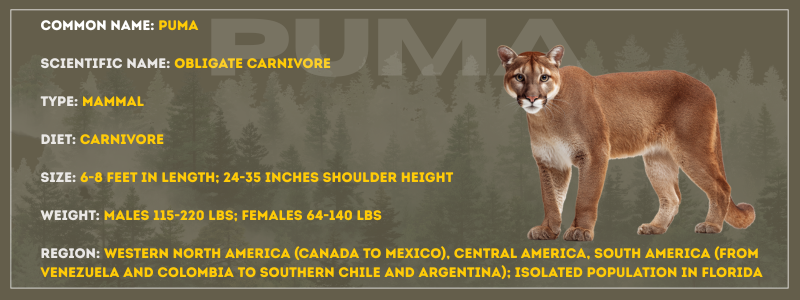
Scientific Name: Puma concolor
Diet Type: Obligate Carnivore
Size: 6-8 feet in length (including tail); 24-35 inches shoulder height
Weight: Males 115-220 lbs; Females 64-140 lbs
Region Found: Western North America (Canada to Mexico), Central America, South America (from Venezuela and Colombia to southern Chile and Argentina); isolated population in Florida
Hungry for More? The hunt doesn’t end here. Dive into our complete collection of Big Cat guides and articles.