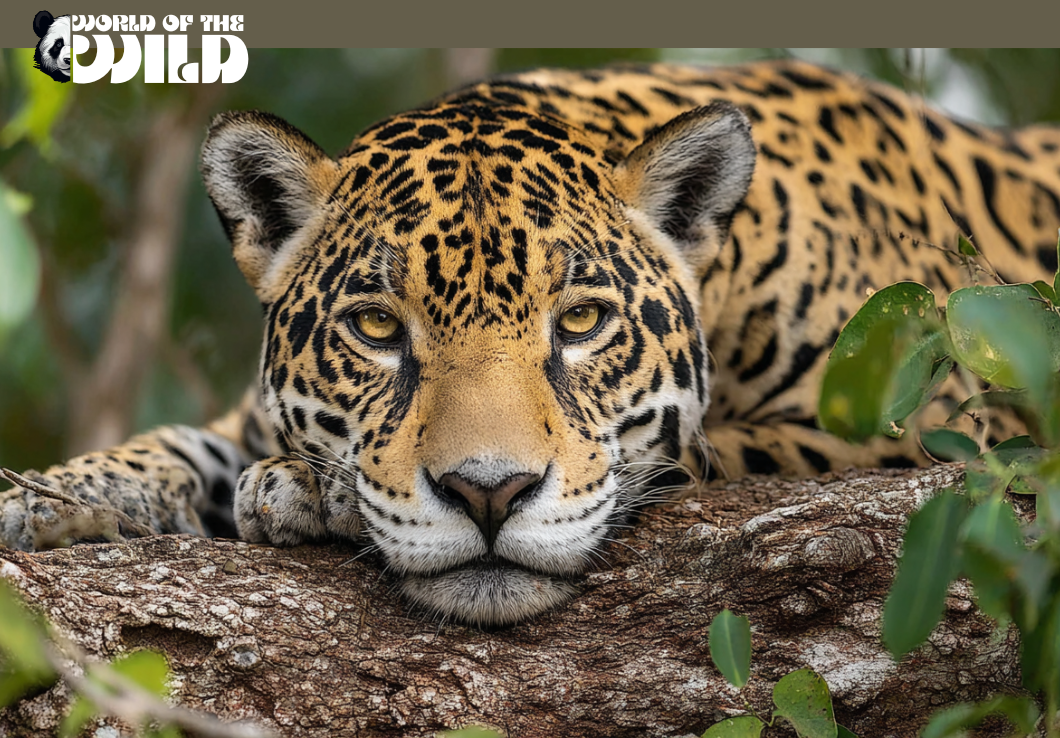

In the dappled shadows of a Central American rainforest, a muscular form moves with liquid silence through the undergrowth. Golden eyes fixed on the river below, the jaguar waits with ancient patience before launching into the water with explosive power. Unlike nearly every other big cat on Earth, this apex predator doesn’t fear water—it commands it. The jaguar represents one of nature’s most successful evolutionary designs: a solitary hunter so perfectly adapted to its environment that it has reigned supreme across the Americas for millions of years.
The jaguar fascinates not only because of its raw power and beauty, but because it embodies the wild heart of the Americas itself. As the largest cat in the Western Hemisphere and the third-largest in the world, the jaguar plays an irreplaceable role in maintaining the ecological balance of forests from Mexico to Argentina, making it both an ecological cornerstone and a cultural icon worthy of our attention and protection.
Facts
- Jaguars possess the most powerful bite force relative to body size of any big cat, capable of crushing turtle shells and even piercing through skull bones—a hunting technique no other feline regularly employs.
- Unlike most cats, jaguars are exceptional swimmers and have been observed swimming across wide rivers and even hunting caimans underwater, using their powerful jaws to pierce the reptile’s armored hide.
- The name “jaguar” comes from the indigenous Tupi-Guarani word “yaguara,” meaning “he who kills with one leap,” reflecting the respect and awe these animals commanded among native peoples.
- Jaguars have the shortest tail relative to body length of any big cat, which aids in balance when navigating through dense forest undergrowth and climbing trees.
- Black jaguars (often called “black panthers”) aren’t a separate species but rather melanistic individuals whose spots are still visible under certain lighting—up to 6% of jaguar populations exhibit this coloration.
- A jaguar’s roar is distinctively different from other big cats, consisting of a series of grunting coughs called “sawing” that can be heard up to two miles away through dense forest.
- Jaguars are cultural keystone species that appear in the mythology of virtually every indigenous culture throughout their range, from the Olmecs to the Maya to Amazonian tribes, often associated with shamanism and spiritual power.
Sounds of the Jaguar
Species
Kingdom: Animalia
Phylum: Chordata
Class: Mammalia
Order: Carnivora
Family: Felidae
Genus: Panthera
Species: Panthera onca
The jaguar belongs to the genus Panthera, which includes the other “roaring cats”: lions, tigers, leopards, and snow leopards. Within Panthera onca, scientists currently recognize several regional populations that may represent distinct subspecies, though taxonomic classification remains debated.
Historically, up to eight subspecies were proposed based on geographic distribution and minor morphological differences. However, recent genetic studies suggest fewer distinct subspecies exist. The most commonly recognized populations include the North American jaguar (ranging into the southwestern United States), the Central American jaguar, and several South American populations including the Pantanal jaguar (which tends to be larger), the Amazon jaguar, and others distributed across the continent.
The Pantanal jaguars of Brazil are notably larger than their Central American counterparts, possibly due to abundant prey availability. Conversely, jaguars from dense rainforest habitats tend to be smaller and darker. These variations reflect the species’ remarkable adaptability across diverse ecosystems spanning two continents.
Appearance
The jaguar is a powerfully built cat that exudes raw strength. Males typically measure 5.6 to 6.1 feet in length (not including the tail) and stand approximately 25 to 30 inches at the shoulder. They generally weigh between 125 to 250 pounds, though exceptionally large individuals in the Pantanal region can exceed 300 pounds. Females are noticeably smaller, usually weighing 30-35% less than males.
The jaguar’s coat is a masterpiece of natural camouflage, featuring a golden-tan to reddish-yellow base color adorned with distinctive rosettes—large, irregular spots that contain smaller spots within them. This pattern differs from the leopard’s solid rosettes, making jaguars identifiable by their more complex markings. The underside is white or cream-colored, and the tail features bold black bands.
What truly sets the jaguar apart is its muscular build. With a massive head, powerful jaws, and a compact, stocky body, the jaguar appears more robust than the more slender leopard. The jaw muscles are extraordinarily developed, giving the head an almost square appearance. Their legs are short and powerful, built for explosive strength rather than sustained speed, and their paws are proportionally large, aiding in swimming and climbing.
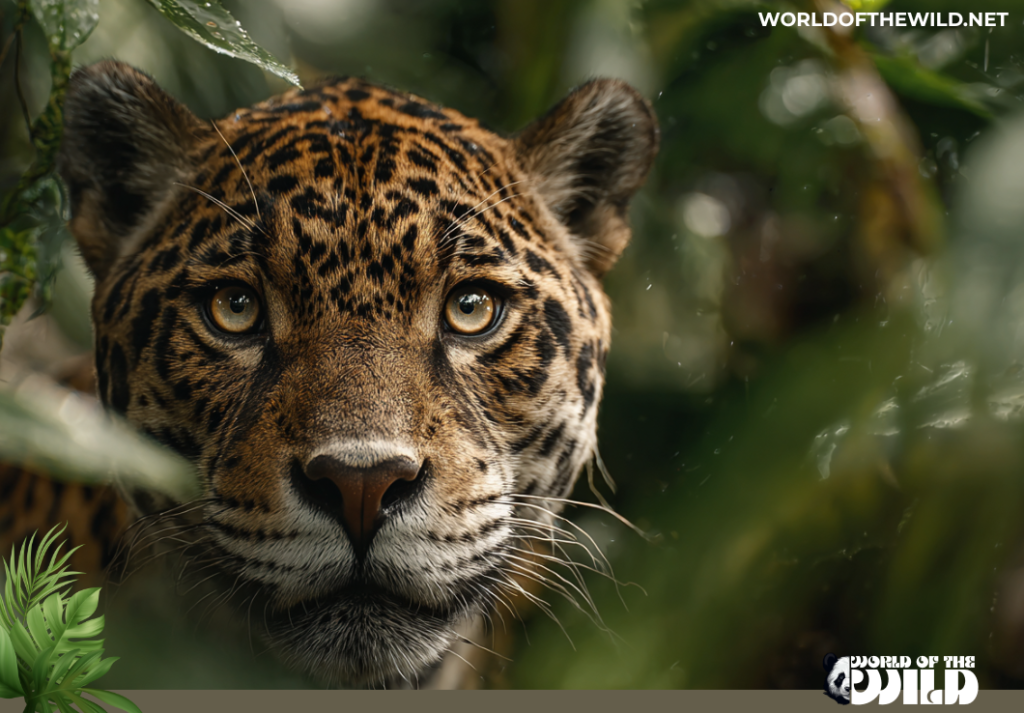
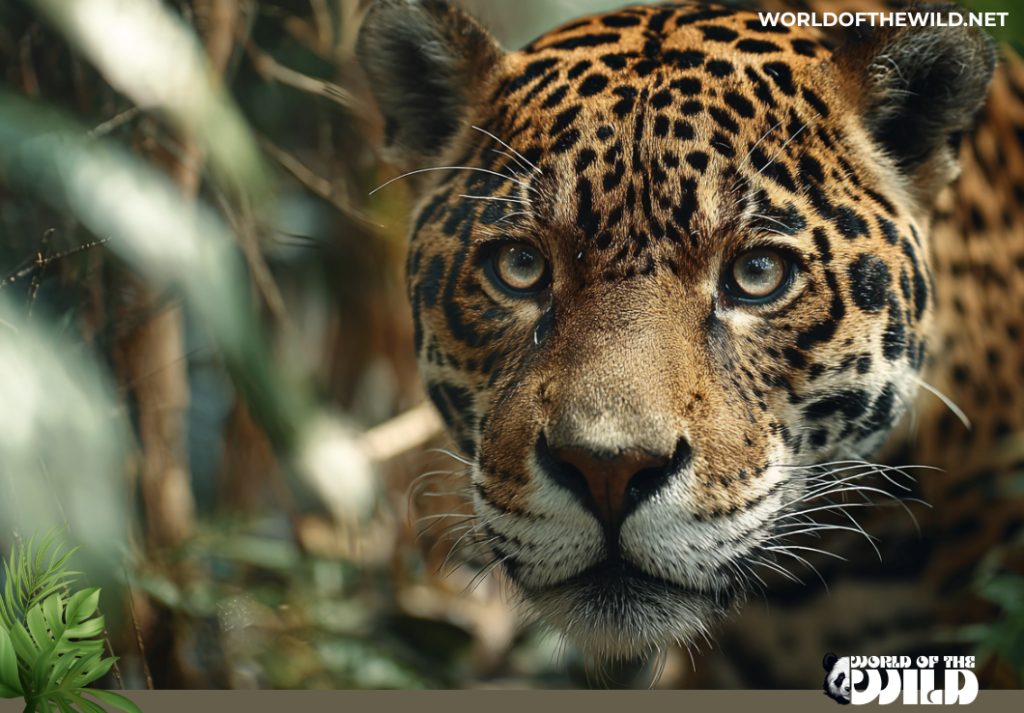
The tail is relatively short compared to other big cats, measuring 18 to 30 inches, and serves as a counterbalance during complex movements through three-dimensional forest environments. Their eyes are golden-yellow to amber, with round pupils that dilate widely for exceptional night vision.
Behavior
Jaguars are predominantly solitary and crepuscular, meaning they’re most active during dawn and dusk, though they will hunt at any time of day or night depending on prey availability. Each individual maintains a large territory that it marks with urine, feces, and tree scratchings. Male territories can span 10 to 60 square miles, while females occupy smaller ranges of 6 to 25 square miles. These territories often overlap with those of the opposite sex, but adult jaguars of the same gender rarely tolerate each other within their domains.
Communication among jaguars involves vocalizations, scent marking, and visual signals. Their distinctive roar serves to advertise territory and potentially attract mates. Unlike the sustained roar of lions, jaguar vocalizations consist of a series of hoarse coughs or grunts. They also produce a variety of other sounds including growls, meows, and a unique “chuffing” sound made through the nose as a friendly greeting.
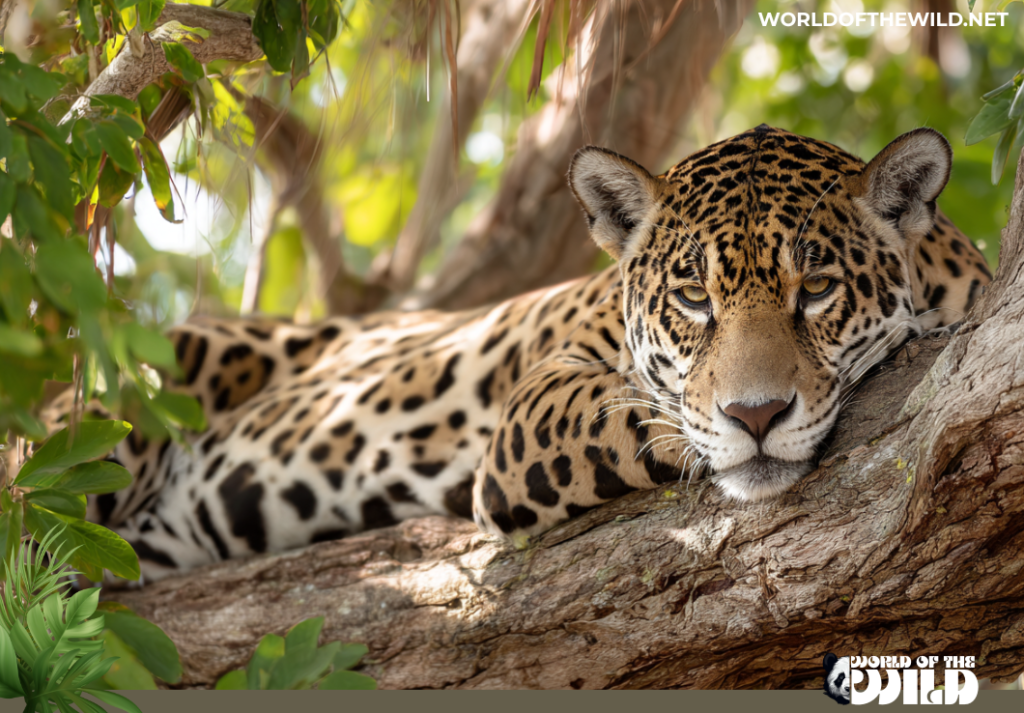
Jaguars demonstrate remarkable intelligence and behavioral flexibility. They’re excellent climbers and will rest in trees during the heat of the day, though they spend most of their time on the ground. Their swimming ability is exceptional—they regularly cross rivers and have been documented swimming for miles. This aquatic proficiency allows them to exploit food sources unavailable to other large predators.
Perhaps their most remarkable behavioral adaptation is their hunting technique. While most big cats kill prey through suffocation (biting the throat), jaguars often employ a skull bite, using their powerful jaws to pierce directly through the temporal bones of the skull or the back of the neck, killing instantly. This technique is particularly effective against armored prey like turtles, caimans, and armadillos. They’ve also been observed fishing, scooping fish from rivers with their powerful paws.
Evolution
The jaguar’s evolutionary story is a tale of intercontinental migration and adaptation. The genus Panthera originated in Asia approximately 10.8 million years ago during the late Miocene epoch. Early pantherines spread across Africa, Asia, and eventually into the Americas.
The jaguar lineage specifically diverged from other Panthera species around 3.8 to 3.5 million years ago. The immediate ancestor of modern jaguars likely crossed the Bering land bridge from Asia into North America during the Early Pleistocene, approximately 2.5 million years ago, making the jaguar one of the earliest big cats to colonize the New World.
Once in the Americas, jaguars evolved and spread throughout North, Central, and South America. Fossil evidence reveals that jaguars once ranged as far north as the Pacific Northwest and across the southern United States. During the Pleistocene, North America was home to a larger subspecies, Panthera onca augusta (sometimes classified as a separate species, Panthera augusta), which was about 15-20% larger than modern jaguars and coexisted with other impressive predators like the American lion and saber-toothed cats.
The formation of the Panamanian land bridge around 3 million years ago allowed jaguars to colonize South America, where they found a continent rich with prey and relatively few competing predators. This expansion was part of the Great American Biotic Interchange. As the climate changed following the last ice age and megafauna populations declined, jaguar ranges contracted, and the large North American populations disappeared, leaving the species primarily in Central and South America.
The jaguar’s closest living relative is the leopard, with which it shared a common ancestor. Despite their similar appearance, these species evolved on different continents and developed distinct adaptations to their respective environments—the leopard becoming lighter and more adapted to various terrains including open savannas, while the jaguar became more robust and specialized for forested and wetland habitats.
Habitat
Jaguars once ranged from the southwestern United States through Central America and across most of South America, down to northern Argentina. Today, their range has been significantly reduced but still spans from Mexico through Central America and across the Amazon basin to northern Argentina and Paraguay. Occasional individuals still wander into the southwestern United States, particularly Arizona and New Mexico, from breeding populations in northern Mexico.
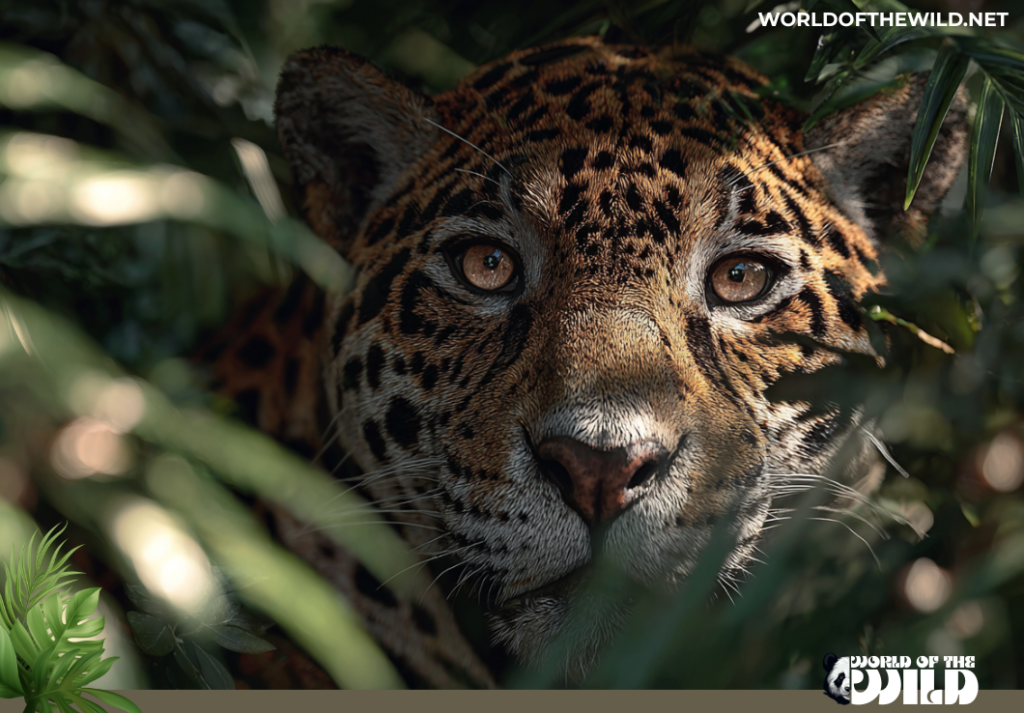
The jaguar is primarily a forest dweller, showing strong preference for dense tropical and subtropical rainforests where thick vegetation provides cover for their ambush-hunting style. However, they demonstrate remarkable habitat flexibility, also thriving in seasonally flooded wetlands, dry deciduous forests, scrubland, and even grasslands near water sources. The Pantanal wetlands of Brazil, Paraguay, and Bolivia host one of the healthiest jaguar populations, where these cats have adapted to a semi-aquatic lifestyle.
Water is a critical component of jaguar habitat. Unlike most cats, jaguars actively seek aquatic environments and are rarely found far from rivers, swamps, or lagoons. They require habitats with abundant prey, sufficient cover for hunting, and access to water for drinking, swimming, and hunting aquatic prey. The dense vegetation of tropical forests provides ideal stalking cover, while the multitude of rivers and streams offer both transportation corridors and hunting grounds.
Jaguars can adapt to varying altitudes, from sea level up to approximately 7,200 feet in the Andes, though they’re most abundant in lowland forests and wetlands. They prefer areas with minimal human disturbance, as they’re sensitive to habitat fragmentation and require large, connected territories to maintain viable populations.
Diet
Jaguars are obligate carnivores and apex predators with one of the most diverse diets of any big cat. Scientists have documented jaguars preying on at least 85 different species, demonstrating their opportunistic hunting strategy and ecological importance.
The jaguar’s primary prey varies by region and habitat. In forested areas, they commonly hunt peccaries, capybaras, deer (including white-tailed deer, brocket deer, and marsh deer), tapirs, and various species of monkeys. In wetland environments like the Pantanal, they’re exceptional hunters of caimans and can take spectacled caimans, yacare caimans, and even young black caimans. They’re also adept at catching green anacondas, though these encounters can be dangerous for both predator and prey.
One of the jaguar’s most remarkable dietary adaptations is its ability to prey on heavily armored animals that most predators avoid. They regularly hunt and consume giant river turtles, cracking through their shells with their powerful jaws. Similarly, they prey on armadillos, including the giant armadillo, again using their exceptional bite force to penetrate protective armor.
Jaguars also hunt smaller prey when larger animals are scarce, including agoutis, pacas, coatis, birds, fish, and even reptiles and amphibians. In some regions, they’ve been observed catching fish by sweeping them from the water with their paws or diving after them. They’ll also scavenge when opportunities arise, though this represents a small portion of their diet.
Their hunting method typically involves stalking prey through dense cover, then ambushing with a short, explosive charge. Unlike cheetahs, which rely on speed, or lions, which may pursue prey over distance, jaguars depend on stealth, power, and their devastating bite. They often kill with a single bite to the skull or neck, and they’re strong enough to drag prey weighing as much as themselves up into trees or to secluded feeding locations.
Predators and Threats
As apex predators, adult jaguars face virtually no natural predation. Occasionally, large anacondas might prey on young, inexperienced jaguars, and there are rare documented cases of aggressive encounters with large caimans, but these are exceptional circumstances. The jaguar’s most significant threats are overwhelmingly human-caused.
Habitat loss and fragmentation represent the primary threat to jaguar populations. Deforestation for agriculture, cattle ranching, logging, and development has eliminated vast swaths of jaguar habitat, particularly in Central America and the Atlantic Forest of Brazil, where less than 10% of original habitat remains. This fragmentation isolates populations, preventing gene flow and making local extinctions more likely.
Human-wildlife conflict poses an immediate threat in areas where jaguars and humans overlap. Jaguars occasionally prey on livestock, leading ranchers to kill them in retaliation. Despite estimates suggesting that jaguars account for less than 1% of livestock deaths in most areas, they’re often scapegoated for larger losses. This retaliatory killing has decimated populations in many regions.
Illegal poaching remains a persistent problem. Jaguars are killed for their beautiful pelts, despite international protections. More recently, there’s been growing concern about the illegal trade in jaguar fangs, teeth, and bones, driven largely by demand in Asian markets where they’re used as substitutes for tiger parts in traditional medicine and as status symbols.
Infrastructure development, including road construction and hydroelectric dams, further fragments habitat and increases jaguar mortality through vehicle strikes. Roads also facilitate access to previously remote areas, enabling illegal hunting and accelerating deforestation.
Climate change poses an emerging long-term threat. Altered rainfall patterns, increased drought frequency, and changing prey distributions may all affect jaguar populations, particularly in already-marginal habitats. Rising temperatures and extreme weather events could also impact breeding success and cub survival.
Reproduction and Life Cycle
Jaguars are polygamous and solitary, with males and females only coming together for brief mating periods. Breeding can occur year-round, though in some regions there may be seasonal peaks. Female jaguars reach sexual maturity between two and three years of age, while males mature slightly later, around three to four years.
When a female comes into estrus, which lasts approximately 6-17 days, she becomes more vocal and may increase scent marking to advertise her receptivity. She may also temporarily tolerate a male’s presence in her territory. Males detect these signals and will seek out receptive females, sometimes traveling considerable distances. During this time, pairs may stay together for several days to a week, mating multiple times.
The gestation period lasts approximately 93-105 days, after which the female gives birth to a litter of typically one to four cubs, with two being most common. Birth usually occurs in a secluded den, which might be located in dense vegetation, a cave, or under the roots of a fallen tree. The cubs are born blind and helpless, weighing just 1.5 to 2 pounds each. Their eyes open after about two weeks.
Female jaguars are devoted mothers, providing all parental care with no involvement from males. Cubs nurse for approximately five to six months but begin eating meat around three months of age when their mother brings them prey. The mother teaches her cubs essential hunting skills, gradually allowing them to accompany her on hunts and practice techniques on smaller prey.
Young jaguars remain dependent on their mother for 1.5 to 2 years, learning the complex skills necessary for survival, including hunting techniques, territorial behavior, and the art of being an apex predator. After this period, the mother will enter estrus again, and the young jaguars must disperse to find their own territories. This is a dangerous time, as young jaguars must navigate unfamiliar terrain, avoid established territorial adults, and learn to hunt efficiently on their own.
In the wild, jaguars typically live 12-15 years, though they can reach up to 20 years in protected conditions. In captivity, with regular food and veterinary care, they can live into their early to mid-20s. Mortality is highest among dispersing subadults and older individuals who can no longer effectively hunt or defend territories.
Population
The jaguar is currently classified as “Near Threatened” on the IUCN Red List, a status that reflects both the species’ relatively wide distribution and the significant threats it faces. This classification represents a concerning trend, as jaguar populations have declined by approximately 20-25% over the past three generations (roughly 21 years), and this decline is projected to continue.
Estimating the global jaguar population is challenging due to their elusive nature and vast range, but scientists estimate there are approximately 64,000 mature individuals remaining in the wild. However, this number masks dramatic regional variations. Central American populations are small and highly fragmented, with countries like El Salvador having lost jaguars entirely. The North American population is nearly extinct, with only occasional transient individuals crossing from Mexico into Arizona and New Mexico.
The Amazon basin holds the largest remaining jaguar populations, though even here, habitat loss and fragmentation pose growing threats. The Pantanal wetlands of Brazil maintain one of the healthiest populations due to relatively intact habitat and successful ecotourism that provides economic incentives for conservation. In contrast, the Atlantic Forest jaguars have been reduced to isolated fragments, with populations numbering in the dozens rather than hundreds.
Population trends vary by region but are generally declining except in a few well-protected areas. The jaguar’s range has contracted by approximately 50% from its historical distribution, with the most dramatic losses occurring in the northern and southern extremes of its range and in Central America.
Conclusion
The jaguar stands as a testament to the power and beauty of American wildlife, a species that has roamed the Western Hemisphere for millions of years and played an irreplaceable role in shaping the ecosystems it inhabits. From its unmatched bite force to its aquatic prowess, from its cultural significance to its ecological importance as an apex predator, the jaguar represents everything wild and wonderful about the forests and wetlands of the Americas.
Yet this magnificent animal faces an uncertain future. Habitat loss continues to fragment its range, human-wildlife conflict persists, and climate change looms as an additional threat. The jaguar’s survival depends on our collective commitment to conservation—protecting corridors that connect fragmented habitats, supporting communities that coexist with jaguars, and valuing intact ecosystems over short-term economic gains.
The fate of the jaguar is intimately tied to the fate of the forests and wetlands it inhabits. By protecting jaguars, we protect entire ecosystems and the countless species that depend on them. The question facing us is simple yet profound: Will future generations know the jaguar only through history, or will they have the privilege of sharing a world with this remarkable predator? The answer depends on the choices we make today.
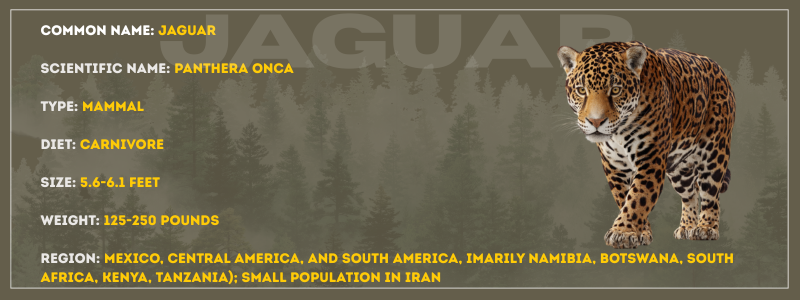
Scientific name: Panthera onca
Diet type: Carnivore
Size: 5.6-6.1 feet in length (body); 25-30 inches tall at shoulder
Weight: 125-250 pounds (males); 85-175 pounds (females)
Region found: Mexico, Central America, and South America (Amazon basin, Pantanal, and scattered populations from northern Argentina to northern Mexico; historically ranged into the southwestern United States)
Hungry for More? The hunt doesn’t end here. Dive into our complete collection of Big Cat guides and articles.