
In the clear streams and rocky pools of Central America, a small fish with bold black and white stripes patrols its territory with the tenacity of a creature ten times its size. The Convict Cichlid, named for its prison uniform-like pattern, may be diminutive in stature, but it punches well above its weight class when it comes to personality, intelligence, and sheer determination. This remarkable freshwater fish has captivated aquarium enthusiasts for decades while thriving in its native waters through a combination of aggressive territoriality, devoted parenting, and remarkable adaptability. What makes this striped warrior truly fascinating isn’t just its striking appearance or feisty temperament—it’s the window it provides into complex fish behavior, showing us that even small creatures can exhibit sophisticated social structures, problem-solving abilities, and parental care that rivals many larger vertebrates.
Facts
- Color-Changing Champions: Female Convict Cichlids develop vibrant orange or red patches on their bellies during breeding season, transforming from monochrome to multicolored in a matter of days.
- Devoted Co-Parents: Unlike many fish species, both male and female Convict Cichlids actively participate in raising their young, taking turns guarding eggs and shepherding fry—behavior more commonly associated with birds or mammals.
- Biparental Mouthbrooding: In emergencies, Convict Cichlid parents will scoop their babies into their mouths to protect them from predators, then release them once danger passes.
- Surprisingly Long-Lived: While many small aquarium fish live only a year or two, Convict Cichlids can survive for 8-10 years with proper care, outlasting many larger species.
- Invasive Success Story: Their incredible adaptability has allowed escaped or released Convict Cichlids to establish populations far from their native range, including in Australia, Asia, and even warm springs in the United States.
- Tool Users: Research has documented Convict Cichlids moving pebbles and small rocks to create barriers and redirect water flow in their territories—a form of environmental manipulation rare among fish.
- Personality Recognition: Studies suggest Convict Cichlids can recognize individual tank mates and respond differently to familiar versus unfamiliar fish, demonstrating sophisticated social cognition.
Species
Kingdom: Animalia
Phylum: Chordata
Class: Actinopterygii (ray-finned fishes)
Order: Cichliformes
Family: Cichlidae
Genus: Amatitlania
Species: Amatitlania nigrofasciata
The Convict Cichlid belongs to the diverse Cichlidae family, which contains over 1,600 species worldwide. Within the genus Amatitlania, several closely related species share similar characteristics. The most notable relatives include Amatitlania siquia (Sajica Cichlid), which inhabits similar Central American waters but displays more subdued coloration, and Amatitlania kanna, a species discovered more recently in Panama. Taxonomic revision has been ongoing in this group; the Convict Cichlid was previously classified under the genus Archocentrus and before that, Cichlasoma, reflecting the complex evolutionary relationships within Central American cichlids. Some aquarists recognize color variants including the leucistic “Pink Convict” or “White Convict,” though these are not distinct subspecies but rather captive-bred morphs resulting from selective breeding for reduced pigmentation.
Appearance
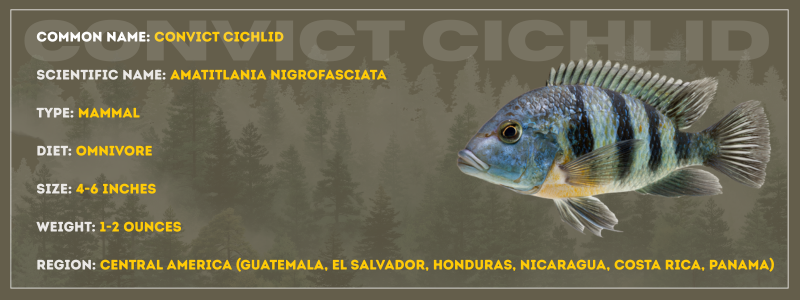
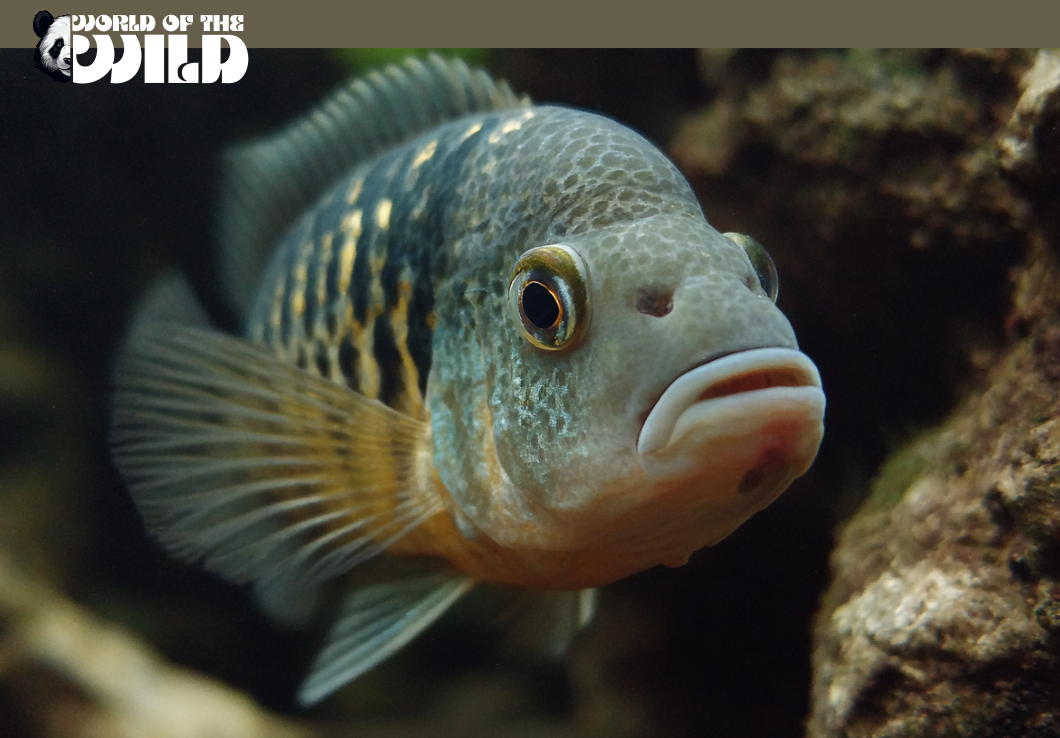
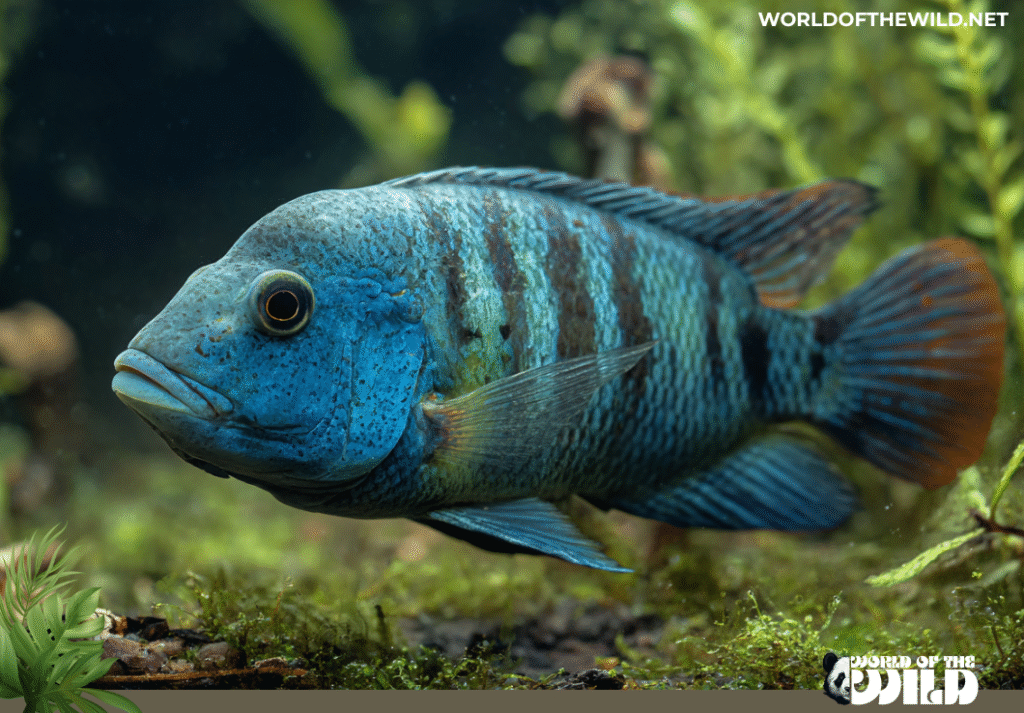
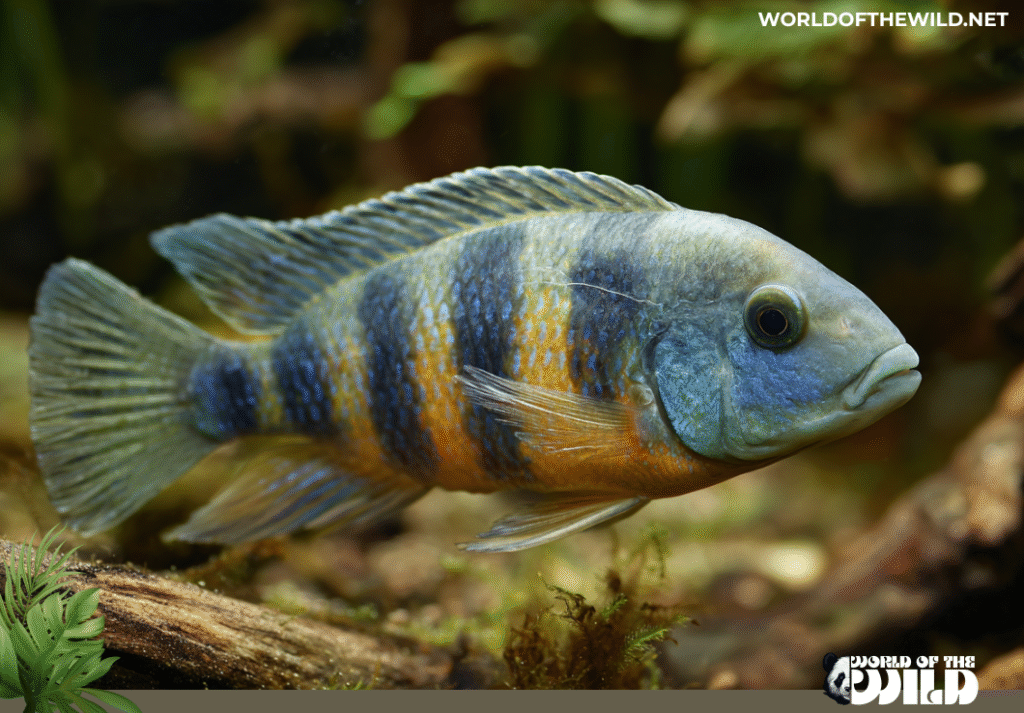
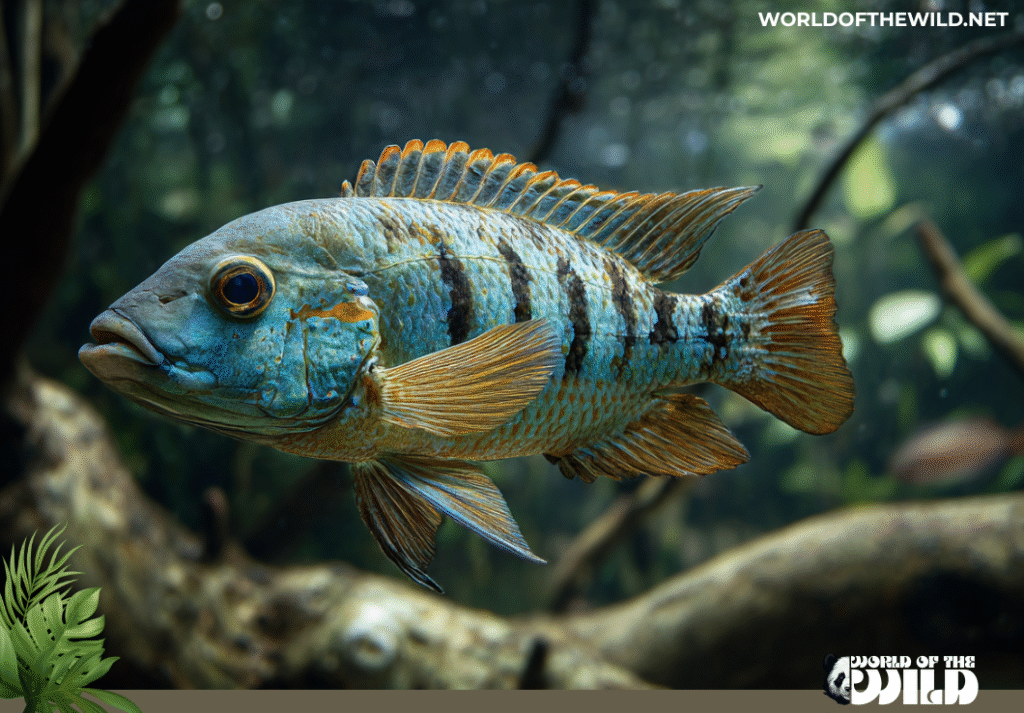
The Convict Cichlid is a compact, robust fish typically reaching 4-6 inches in length, with males growing slightly larger than females and sometimes achieving lengths up to 6 inches. Their bodies are laterally compressed and oval-shaped, built for maneuvering through rocky crevices and navigating complex underwater terrain. The most distinctive feature is their striking vertical barring pattern—eight to nine bold black or dark gray stripes against a blue-gray, white, or silvish background, creating the prison uniform appearance that inspired their common name.
Sexual dimorphism is pronounced in this species. Males develop a distinctive nuchal hump (a pronounced forehead bulge) as they mature, along with longer, more pointed dorsal and anal fins that can extend into elegant filaments. Females remain smaller, lack the prominent hump, and develop the characteristic orange, red, or yellow coloring on their bellies and throats during breeding periods, making gender identification relatively straightforward.
Their fins are generally translucent gray with occasional blue or green iridescent highlights, particularly visible under proper lighting. The eyes are large and expressive, typically dark with a metallic ring. Some individuals display blue-green iridescence along their scales, particularly noticeable in healthy, well-maintained specimens. The caudal fin is rounded, and the pectoral fins are small but constantly in motion, giving these fish their characteristic hovering swimming style.
Behavior
Convict Cichlids exhibit remarkably complex behavior for their size, displaying social intelligence and personality traits that have made them subjects of numerous behavioral studies. These fish are highly territorial, establishing and vigorously defending specific areas within their habitat. A breeding pair will claim a territory of several square feet, aggressively driving away fish many times their size—a behavior that has earned them a reputation as the “bullies” of community aquariums.
Their social structure revolves around monogamous or semi-monogamous pair bonds. Once a male and female form a pair, they often remain together through multiple breeding cycles, working cooperatively to defend territory, excavate spawning sites, and raise offspring. Communication between pairs involves a sophisticated array of visual signals: body tilts, fin displays, color changes, and jaw movements that convey everything from courtship intentions to territorial warnings.
Daily activity patterns show these fish are diurnal, most active during daylight hours. They spend considerable time exploring their environment, moving substrate materials, investigating crevices, and constantly monitoring their territory for intruders. Convict Cichlids demonstrate problem-solving abilities, learning to navigate obstacles, recognize feeding times, and even distinguish between individuals—both other fish and human caretakers.
Perhaps most remarkable is their parental behavior. Both parents participate actively in egg care, fanning them with their fins to provide oxygen, removing fungused eggs, and guarding the clutch around the clock. Once fry hatch, parents shepherd the tiny fish in cloud-like schools, with one parent often leading the group to feeding areas while the other guards from behind. Parents will attack hands, nets, or other fish that venture too close, showing fearless protection of their offspring that persists for several weeks.
Evolution
The Convict Cichlid’s evolutionary story is intimately tied to the geological history of Central America and the broader radiation of cichlid fishes across the globe. Cichlids likely originated in Africa during the Cretaceous period, over 100 million years ago, with various lineages dispersing to South America and India during the breakup of Gondwana. The family’s presence in Central America represents a later colonization event from South American ancestors following the formation of the Panamanian land bridge approximately 3-4 million years ago.
Central American cichlids, including the Amatitlania genus, underwent rapid adaptive radiation once they reached these new habitats, diversifying into numerous species that filled various ecological niches. The ancestors of modern Convict Cichlids likely evolved their distinctive territorial and biparental care behaviors as adaptations to the rocky stream environments they inhabited, where suitable spawning sites were limited and predation pressure was high. The evolution of intense parental care provided a significant survival advantage, allowing higher offspring survival rates in environments with numerous predators.
Molecular studies suggest the Amatitlania genus diverged from other Central American cichlid lineages relatively recently in evolutionary terms—within the past few million years. The genus shows evidence of rapid speciation, with different species adapting to specific river systems and microhabitats throughout Central America. The Convict Cichlid’s success stems partly from evolutionary adaptations that made them generalists: they can tolerate varying water conditions, consume diverse food sources, and adapt their behavior to different environmental pressures. This evolutionary flexibility explains their ability to thrive both in native habitats and as invasive species in far-flung locations.
Habitat
The natural range of the Convict Cichlid extends from Guatemala through El Salvador, Honduras, Nicaragua, Costa Rica, and into western Panama, making them one of the most widespread cichlids in Central America. They inhabit both Pacific and Atlantic drainage systems, showing remarkable adaptability to different water chemistry conditions.
These fish thrive in warm, flowing freshwater environments, particularly favoring streams, small rivers, and rocky pools with moderate to swift current. Their ideal habitat features numerous rocks, caves, and crevices that provide shelter and spawning sites. Water temperatures in their native range typically range from 75-80°F, though they can tolerate slightly cooler or warmer conditions. The substrate in natural habitats is usually rocky or gravelly, which the fish excavate and rearrange to create territories and nesting sites.
Convict Cichlids prefer areas with some aquatic vegetation, fallen logs, and complex underwater structure that provides both hiding places and territorial boundaries. They’re found from near-surface areas down to depths of several feet, adapting their behavior based on available habitat and competition from other species. The water in their native streams tends to be slightly alkaline to neutral (pH 6.5-8.0) with moderate hardness.
Notably, their habitat tolerance has allowed them to become established in non-native regions. Populations now exist in warm water systems in Australia, various Asian countries including Singapore and Taiwan, and even in geothermal springs in the western United States, where they survive in heated waters that would be uninhabitable during colder months if not for the thermal activity.
Diet
Convict Cichlids are opportunistic omnivores with a dietary flexibility that contributes significantly to their success both in the wild and as aquarium inhabitants. Their natural diet consists of a diverse array of food items, making them adaptable feeders capable of exploiting whatever resources are most readily available.
In their native streams, these fish consume insects and insect larvae, small crustaceans, worms, plant matter including algae, detritus, and occasionally smaller fish or fish eggs. They forage throughout their territory, picking at rocks for aufwuchs (the layer of algae and small organisms growing on surfaces), sifting through substrate for invertebrates, and opportunistically capturing small prey items that drift within their reach.
Their feeding strategy combines active hunting with grazing behavior. Convict Cichlids will pursue and capture moving prey like insect larvae or small shrimp, demonstrating quick reflexes and coordinated attacks. Simultaneously, they spend considerable time scraping algae and biofilm from rocks and plants, contributing to their omnivorous classification. This dietary flexibility means they can survive in environments where specialist feeders might struggle, adapting their intake based on seasonal availability and local conditions.
Parent fish exhibit interesting feeding behavior modifications during breeding periods, with one parent often leaving the fry group briefly to forage while the other maintains guard duty. Once fry are free-swimming, parents have been observed “chewing” larger food items and spitting out smaller particles for their offspring—a fascinating behavior that aids young fish in their early feeding stages.
Predators and Threats
In their natural Central American habitats, Convict Cichlids face predation from various larger fish species, including pike cichlids (Crenicichla species), larger predatory cichlids, catfish, and other piscivorous fish that inhabit the same waterways. Aquatic birds such as herons and kingfishers also prey upon these fish, particularly in shallow water areas. Additionally, water snakes and other riparian predators opportunistically feed on Convict Cichlids when the opportunity arises.
The species’ aggressive territorial defense and biparental care evolved partially as responses to this predation pressure. Their bold striping may serve as a warning signal to potential predators or as a visual disruption pattern that makes individuals harder to track in the dappled light of rocky streams. The intense parental protection significantly increases offspring survival rates despite the numerous threats facing vulnerable fry.
Anthropogenic threats to wild Convict Cichlid populations include habitat degradation through agricultural runoff, deforestation leading to increased sedimentation in streams, and pollution from industrial and domestic sources. Dam construction and water diversion projects throughout Central America have altered many river systems, fragmenting populations and changing flow patterns that these fish depend upon. Climate change poses additional concerns through altered rainfall patterns, temperature increases, and more frequent extreme weather events that can impact stream habitats.
Interestingly, the Convict Cichlid faces a paradoxical conservation situation. While wild populations in some native areas experience pressure from habitat loss, the species itself is not threatened with extinction due to its abundance, wide distribution, and success in the aquarium trade. Conversely, in regions where they’ve been introduced, Convict Cichlids themselves become a threat to native ecosystems, competing with indigenous species and sometimes preying upon native fish fry.
Reproduction and Life Cycle
Convict Cichlids are prolific breeders with fascinating reproductive behavior that showcases sophisticated biparental care rarely seen in fish. Sexual maturity is reached relatively early, typically between 6-8 months of age, though some individuals may breed even younger under optimal conditions.
The courtship ritual begins with males establishing territories and intensifying their coloration, while receptive females develop their characteristic bright orange or reddish belly coloration. The male performs elaborate displays, including fin spreading, lateral displays (showing his full body size to the female), and gentle nudging. Once a pair forms, they cooperatively select a spawning site—typically a flat rock surface within a cave, under an overhang, or in a sheltered crevice that can be easily defended.
Before spawning, both parents meticulously clean the chosen surface, removing debris and algae. The female then deposits between 100-300 eggs (though some clutches may contain up to 500) in neat rows on the prepared substrate, with the male immediately following to fertilize them. The eggs are adhesive and stick firmly to the surface.
Both parents guard the eggs intensively, taking turns fanning them with their pectoral fins to ensure proper oxygenation and water circulation. They remove any eggs that develop fungus and maintain constant vigilance against potential threats. The eggs hatch in approximately 3-4 days, depending on water temperature, emerging as wrigglers with attached yolk sacs.
The parents then move the wrigglers to pre-excavated pits in the substrate, continuing their protective care. After another 5-7 days, the fry become free-swimming and form a tight school shepherded by both parents. This parental care continues for several weeks, with adults leading the fry cloud to feeding areas and fiercely defending them against all threats. As the fry grow and become more independent, parental attention gradually wanes, though some protection may continue for a month or more.
Convict Cichlids can breed multiple times per year—every 6-8 weeks under optimal conditions—making them extraordinarily productive. In aquarium settings, controlling their breeding can become a challenge due to their readiness to spawn. Individual fish typically live 8-10 years in captivity with proper care, though wild specimens may have shorter lifespans due to predation and environmental stresses.
Population
The Convict Cichlid is currently classified as Least Concern by conservation organizations, indicating that the species faces no immediate threat of extinction. This favorable status reflects their wide distribution across Central America, large population sizes, and remarkable adaptability to varying environmental conditions.
Estimating precise global population numbers for wild Convict Cichlids is challenging due to their extensive range and presence in numerous isolated stream systems. However, the species remains abundant throughout most of its native range, with healthy populations documented in protected areas and even in moderately degraded habitats. Their ability to tolerate a range of water quality conditions and their aggressive territoriality help them persist even as some other more sensitive species decline.
Population trends vary by region. In some areas experiencing significant deforestation and stream habitat degradation, local populations may be declining or experiencing fragmentation. However, these localized decreases haven’t significantly impacted the species’ overall abundance. The Convict Cichlid’s popularity in the aquarium trade ensures that captive populations number in the hundreds of thousands or millions globally, providing an insurance population should wild stocks ever face serious threats.
An important consideration is their status as an invasive species in non-native regions. Established populations in Australia, Asia, and North America demonstrate the species’ capacity to thrive beyond its natural range, though this success creates ecological management challenges in those regions where they may outcompete native fish species.
Conclusion
The Convict Cichlid stands as a testament to the complexity and sophistication possible in even the smallest of creatures. This striped dynamo challenges our assumptions about fish intelligence, showing us that sophisticated parenting, problem-solving, and social cognition aren’t reserved for mammals and birds alone. From their native Central American streams to aquariums worldwide, these resilient fish have demonstrated remarkable adaptability while maintaining the fierce dedication to family that makes them unique among freshwater species.
While their conservation status remains secure, the Convict Cichlid reminds us that even abundant species deserve our attention and respect. Their success in the face of habitat degradation should not make us complacent about protecting Central America’s freshwater ecosystems—the same environments that harbor countless less adaptable species now facing genuine extinction threats. By appreciating and studying creatures like the Convict Cichlid, we gain insights into the intricate web of behaviors and adaptations that allow life to flourish in diverse environments. Whether you encounter these fish in their natural habitat, observe them in an aquarium, or simply read about their remarkable biology, the Convict Cichlid offers an invitation to look closer at the natural world and recognize that every species, no matter how small or seemingly common, has a story worth telling and a role worth preserving.
Scientific Name: Amatitlania nigrofasciata
Diet Type: Omnivore
Size: 4-6 inches (10-15 cm)
Weight: 1-2 ounces (28-56 grams)
Region Found: Central America (Guatemala, El Salvador, Honduras, Nicaragua, Costa Rica, Panama)