
Imagine a fish that has remained virtually unchanged for over 100 million years, a living relic from the age of dinosaurs, patrolling the murky waters of Florida’s swamps and rivers. The Florida Gar is precisely that—a prehistoric predator with an armor-plated body and needle-sharp teeth that slices through the water like a torpedo. This remarkable fish represents one of nature’s most successful designs, having survived countless environmental changes while maintaining its distinctive appearance and hunting prowess. Beyond its intimidating appearance, the Florida Gar plays a crucial role in maintaining the ecological balance of freshwater ecosystems throughout the southeastern United States, making it a species worthy of both our fascination and our respect.
Facts
- Breathing Champions: Florida Gars possess a modified swim bladder that functions like a primitive lung, allowing them to gulp air at the water’s surface and survive in oxygen-depleted waters where other fish would perish.
- Toxic Eggs: The eggs of Florida Gars are highly toxic to humans and other mammals due to the presence of ichthyotoxin, a protein that causes severe illness if consumed, serving as a natural defense mechanism against predators.
- Ambush Artists: These fish can remain completely motionless for extended periods, resembling floating logs, before exploding into action with lightning-fast strikes that catch prey off guard.
- Temperature Tolerant: Florida Gars can tolerate water temperatures ranging from near-freezing to over 90°F, demonstrating remarkable physiological adaptability.
- Scale Armor: Their ganoid scales are so tough and diamond-shaped that Native Americans and early settlers used them as arrowheads and decorative items.
- Nighttime Hunters: While they hunt during the day, Florida Gars are particularly active feeders during twilight and nighttime hours when their prey is most vulnerable.
- Longevity Leaders: These fish can live for 10-18 years in the wild, with some individuals in captivity reaching over 20 years of age.
Species
The Florida Gar belongs to an ancient lineage that stretches back through geological time:
Kingdom: Animalia
Phylum: Chordata
Class: Actinopterygii (ray-finned fishes)
Order: Lepisosteiformes
Family: Lepisosteidae
Genus: Lepisosteus
Species: Lepisosteus platyrhincus
The Florida Gar is one of seven living species in the gar family, which represents one of the oldest groups of ray-finned fishes still in existence. Its closest relative is the Spotted Gar (Lepisosteus oculatus), with which it occasionally hybridizes in areas where their ranges overlap. Other notable relatives include the Alligator Gar (Atractosteus spatula), the largest member of the family, and the Longnose Gar (Lepisosteus osseus). While some taxonomists have debated whether the Florida Gar deserves species status or should be considered a subspecies of the Spotted Gar, current consensus maintains its distinction based on geographic distribution, morphological differences, and genetic analysis.
Appearance
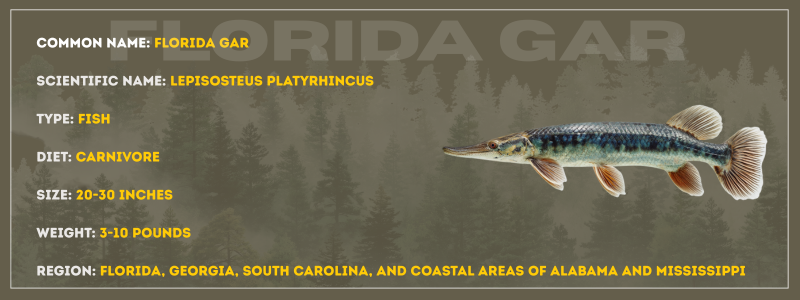
The Florida Gar cuts an unmistakably prehistoric figure in the water. Adults typically reach lengths of 20-30 inches, though exceptional specimens may grow up to 52 inches long. Their weight ranges from 3-10 pounds, with larger individuals occasionally exceeding this range. The body is elongated and cylindrical, covered in tough, diamond-shaped ganoid scales that create an armor-like coating ranging from olive-brown to dark brown on the dorsal surface, transitioning to cream or yellowish-white on the belly.
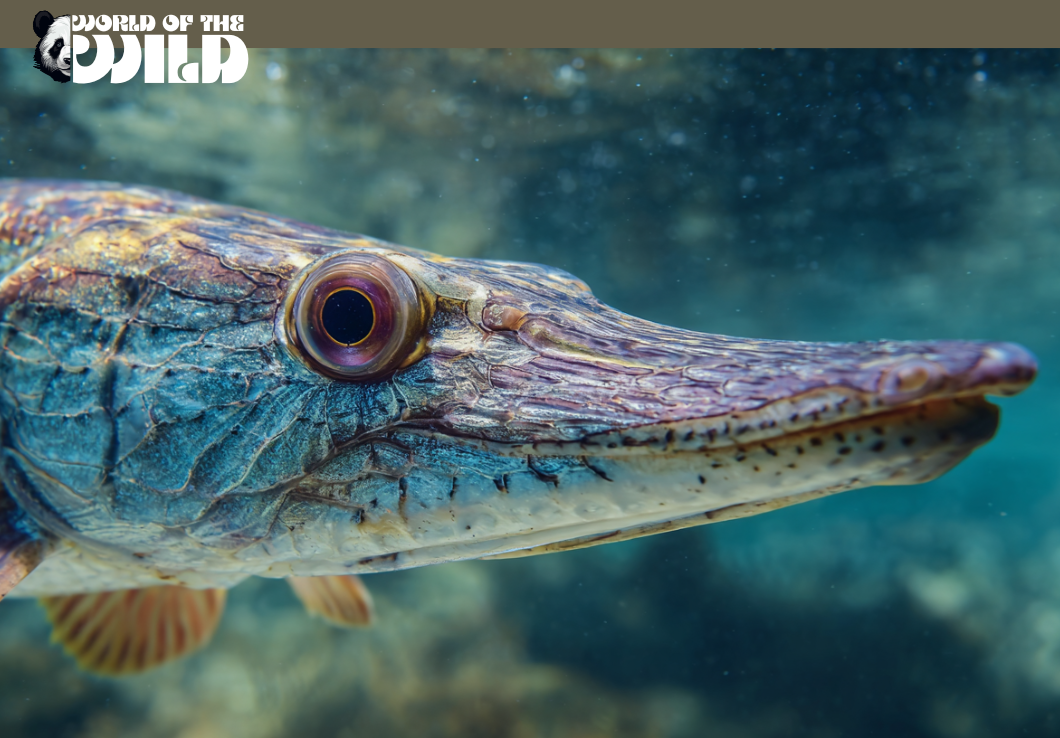
The head is perhaps the most distinctive feature—long, broad, and flattened like a duck’s bill, earning it the occasional nickname “billfish.” This snout is shorter and wider than that of other gar species, a key identifying characteristic. The mouth bristles with numerous needle-like teeth arranged in multiple rows, perfectly designed for grasping slippery prey. Large, round eyes sit high on the head, providing excellent vision for detecting movement both above and below the waterline.
Dark spots irregularly pattern the body, head, and all fins, creating a mottled camouflage effect that helps the gar blend into its aquatic environment. The fins themselves are positioned far back on the body—the dorsal and anal fins sit near the tail, providing powerful propulsion for sudden bursts of speed. A rounded, heterocercal tail completes the torpedo-like profile that makes this predator such an efficient hunter.

Behavior
Florida Gars exhibit a fascinating blend of patient ambush tactics and explosive predatory strikes. These largely solitary fish spend much of their time floating motionless near the surface or suspended in mid-water, resembling logs or submerged branches. This behavior serves dual purposes: conserving energy and positioning themselves for surprise attacks. When prey ventures within range, the gar unleashes a lightning-fast sideways slash of its toothy snout, impaling or stunning its target.
Despite their solitary nature, Florida Gars are not particularly territorial and can occasionally form loose aggregations, especially in areas with abundant food or suitable spawning habitat. They demonstrate a unique breathing behavior that sets them apart from most other fish—regularly rising to the surface to gulp air with an audible pop. This adaptation allows them to thrive in warm, stagnant waters where dissolved oxygen levels would be lethal to other species.
Communication among Florida Gars is limited, relying primarily on visual cues and body positioning. During spawning season, males become more interactive, using physical nudges and positioning to court females. Their intelligence manifests in their hunting strategies and ability to learn the patterns of prey populations in their home range. They’ve been observed adjusting their ambush locations based on the time of day and seasonal prey movements.
One particularly notable adaptation is their ability to remain out of water for brief periods, using their air-breathing capability to survive temporary droughts or move between isolated pools during low-water conditions. This remarkable resilience has contributed significantly to their evolutionary success.
Evolution
The Florida Gar belongs to one of the most ancient lineages of bony fish still swimming in modern waters. The family Lepisosteidae first appeared in the fossil record during the Early Cretaceous period, approximately 145 million years ago, making gars contemporaries of the dinosaurs. These fish represent a remarkable example of evolutionary stasis—their body plan has remained largely unchanged for over 100 million years, a testament to the effectiveness of their design.
Fossil evidence suggests that gars were once far more diverse and widespread than they are today, with species inhabiting waters across North America, Europe, Africa, and Asia. The group reached its peak diversity during the Cretaceous and Eocene periods. However, climatic changes and competition from more modern fish groups led to a contraction of their range and diversity. Today, all surviving gar species are restricted to North America and Central America.
The Florida Gar itself likely diverged from the Spotted Gar relatively recently in evolutionary terms, probably during the Pleistocene epoch within the last 2 million years. Geographic isolation of populations in the Florida peninsula during periods of high sea levels likely drove this speciation event. The shorter, broader snout of the Florida Gar compared to its ancestors represents an adaptation to the specific prey communities and habitat structures found in Florida’s unique freshwater ecosystems.
Gars are classified as “living fossils,” though this term can be misleading. While their basic body plan has remained stable, they have undergone subtle evolutionary refinements that help them compete successfully in modern aquatic environments. Their air-breathing capability, evolved from a modified swim bladder, represents an ancient adaptation that has proven remarkably valuable in surviving the environmental challenges of shallow, warm-water habitats.

Habitat
The Florida Gar is endemic to the southeastern United States, with its primary distribution centered in the Florida peninsula. Its range extends from the Ochlockonee River drainage westward along the Florida panhandle and northward into southern Georgia and South Carolina. The species occasionally appears in coastal regions of Alabama and Mississippi, though these represent the western limits of its distribution.
This species shows a strong preference for slow-moving or standing freshwater bodies with abundant aquatic vegetation. Natural habitats include rivers, streams, canals, lakes, ponds, and marshes, particularly those with muddy or sandy bottoms and plenty of submerged logs or vegetation that provide ambush opportunities. Florida Gars thrive in the state’s spring-fed rivers, cypress swamps, and the extensive wetlands of the Everglades ecosystem.
Water clarity matters less to Florida Gars than to many fish species—they readily inhabit both clear springs and murky, tannin-stained blackwater systems. What they require most is warm water, with optimal temperatures ranging from 70-85°F, though they can tolerate much wider temperature variations. Their air-breathing capability allows them to colonize habitats that other predatory fish cannot, including shallow, vegetation-choked ponds and ditches where oxygen levels drop dangerously low during hot summer months.
Florida Gars demonstrate some habitat flexibility, occasionally entering brackish waters in coastal areas, though they show a clear preference for purely freshwater environments. During drought conditions, they concentrate in deeper pools and channels, while high-water periods allow them to disperse into flooded marshes and floodplains where prey is abundant.
Diet
The Florida Gar is an opportunistic carnivore with a diet consisting primarily of fish. These apex predators employ an ambush hunting strategy, remaining motionless until prey ventures within striking distance. Their long, tooth-filled jaws are perfectly designed for seizing and holding slippery fish, which they typically swallow headfirst after subduing them with a powerful bite.
Primary prey species include mosquitofish, sailfin mollies, killifish, sunfish, and other small to medium-sized fish that share their habitat. Juvenile Florida Gars consume more invertebrates, including insects, crayfish, and shrimp, gradually shifting to a fish-dominated diet as they grow larger. Studies of stomach contents reveal that Florida Gars are not particularly selective feeders—they’ll consume virtually any fish species of appropriate size that presents an opportunity.
Their hunting technique relies heavily on patience and precision. A Florida Gar will hover motionless, often near cover such as submerged logs, lily pads, or aquatic vegetation. When a fish swims past, the gar executes a lightning-fast sideways sweep of its head, using its snout like a club to stun prey before grasping it with its numerous teeth. Unlike many predatory fish that chase down prey, gars rely almost entirely on the element of surprise.
Florida Gars feed most actively during dawn, dusk, and nighttime hours when prey fish are less vigilant. However, they’re opportunistic feeders and will strike at any time if a favorable opportunity presents itself. Their air-breathing capability allows them to hunt effectively in oxygen-poor waters where potential prey fish are stressed and easier to catch. During cooler months, their metabolism slows and feeding activity decreases accordingly, though they never enter true hibernation.
Predators and Threats
As apex predators in many of their habitats, adult Florida Gars face few natural threats. American alligators represent their primary predator, capable of crushing even large gars with their powerful jaws. Great blue herons, ospreys, and bald eagles occasionally prey on juvenile gars, though the fish’s tough scales and sharp teeth make them challenging targets. Larger predatory fish, including other adult gars, may consume small juveniles.
Human activities pose far more significant threats to Florida Gar populations than natural predation. Habitat destruction ranks as the most serious concern—the draining of wetlands, channelization of rivers, and development of waterfront property has eliminated or degraded vast areas of suitable habitat. Water pollution from agricultural runoff, sewage, and industrial discharge degrades water quality and can accumulate in gar tissues over time.
Many Florida Gars fall victim to misidentification and misunderstanding. Anglers occasionally kill them as “trash fish,” mistakenly believing they harm game fish populations. While gars do consume some game fish, research indicates their impact is minimal and they play an important role in controlling prey fish populations, which ultimately benefits overall ecosystem health. This persecution based on misconceptions has led to unnecessary mortality in some areas.
Climate change presents emerging threats through altered water temperatures, changing precipitation patterns, and increased frequency of extreme weather events. Rising sea levels threaten coastal freshwater habitats by introducing saltwater intrusion. Additionally, the introduction of non-native species, particularly predatory fish and aquatic vegetation, can alter ecosystem dynamics in ways that affect gar populations.
Dam construction and water control structures fragment populations and restrict the gars’ access to spawning habitats. The modification of natural water level fluctuations—critical for triggering spawning and providing nursery habitat for young fish—disrupts their reproductive cycle and reduces recruitment success.

Reproduction and Life Cycle
Florida Gars reach sexual maturity at 2-3 years of age, typically when they reach lengths of 12-14 inches. Spawning occurs during spring months, from February through April, triggered by rising water temperatures and increasing day length. Optimal spawning temperatures range from 68-78°F, and gars often wait for seasonal floods that inundate vegetated marshes and floodplains, creating ideal nursery habitat.
Males arrive at spawning sites first, often in shallow, vegetated areas with abundant aquatic plants or submerged roots. When females arrive, courtship begins with males swimming alongside females, nudging them and positioning themselves to encourage egg release. Spawning is a group activity—a single female may be accompanied by multiple males who compete for the opportunity to fertilize her eggs.
The female deposits her bright green, adhesive eggs among aquatic vegetation or along the roots of shoreline plants. A single female can produce 5,000-35,000 eggs, depending on her size. The adhesive coating allows eggs to stick to vegetation, protecting them from being washed away by currents. The bright green coloration comes from the same toxin that makes the eggs poisonous, serving as a warning to potential egg predators.
Eggs hatch in 4-9 days, depending on water temperature. The larvae emerge with an adhesive organ on their snout that allows them to attach to vegetation, remaining there while they absorb their yolk sac. After 5-8 days, the young gars, now about 0.4 inches long, begin free-swimming and actively hunting tiny invertebrates. They remain in shallow, vegetated nursery areas where they find both food and refuge from predators.
Growth is relatively rapid during the first few years of life, with young gars adding several inches per year. Growth rates slow as fish mature, with older individuals growing very slowly. In the wild, Florida Gars can live 10-18 years, though captive specimens have reached over 20 years. Throughout their lives, they continue to grow, with the oldest and largest individuals representing the most successful survivors in their populations.
Population
The Florida Gar is currently classified as Least Concern by the International Union for Conservation of Nature (IUCN). This designation reflects the species’ relatively stable populations and wide distribution throughout its range. However, this classification doesn’t mean the species faces no challenges—rather, it indicates that current threats haven’t yet caused range-wide population declines severe enough to warrant a higher conservation status.
Estimating precise population numbers for Florida Gars is challenging due to their habitat preferences and behavior. They often inhabit murky, heavily vegetated waters where standard fish survey techniques are less effective. Based on available data, the species remains common to abundant throughout much of its core range in Florida, though local populations have experienced declines in areas where habitat degradation has been severe.
Population trends vary by region. In protected areas and well-managed water bodies, Florida Gar populations appear stable or even increasing. However, in heavily developed regions, particularly around major urban centers and in intensively farmed agricultural areas, populations have declined. The fragmentation of freshwater habitats has created isolated populations that may be vulnerable to local extirpation from individual catastrophic events.
Several factors contribute to the species’ current stability. Florida Gars reproduce prolifically, with females producing thousands of eggs annually. Their adaptability to various freshwater habitats and their air-breathing capability allows them to colonize and persist in environments where other predatory fish struggle. Additionally, their longevity means that adult fish contribute to reproduction over many years, providing population resilience.
Monitoring efforts suggest that maintaining current population levels will require continued habitat protection and restoration, particularly of spawning and nursery habitats. While not currently threatened, the Florida Gar serves as an indicator species for freshwater ecosystem health—declining gar populations often signal broader environmental problems affecting entire aquatic communities.
Conclusion
The Florida Gar stands as a remarkable testament to evolutionary success, a prehistoric predator that has survived and thrived through millions of years of environmental change. These armored fish represent far more than curiosities from the past—they’re vital components of healthy freshwater ecosystems, top predators that help maintain the balance of aquatic communities throughout the southeastern United States. Understanding and appreciating the Florida Gar challenges us to look beyond first impressions and recognize the ecological importance of species that might seem alien or even frightening.
The continued survival of the Florida Gar depends on our commitment to protecting and restoring the wetlands, rivers, and lakes that sustain them. Every preserved marsh, every restored floodplain, and every cleaner waterway contributes to the future of these ancient fish. As climate change and human development accelerate, the need for conscious conservation action becomes ever more urgent. The Florida Gar has survived for over 100 million years—whether it survives the next century depends largely on choices we make today. By supporting wetland conservation, advocating for responsible water management, and educating others about the value of all native species, we can ensure that future generations will still encounter these fascinating living fossils in Florida’s wild waters.
Scientific Name: Lepisosteus platyrhincus
Diet Type: Carnivore
Size: 20-30 inches (up to 52 inches)
Weight: 3-10 pounds
Region Found: Florida, Georgia, South Carolina, and coastal areas of Alabama and Mississippi