
Imagine a creature so stunning that divers pause mid-swim to admire its flowing elegance, yet so deadly that a single brush against its spines can send even experienced swimmers to the hospital. The lionfish represents one of nature’s most captivating paradoxes—a fish whose extraordinary beauty masks both lethal defensive capabilities and an even more troubling role as one of the ocean’s most successful invasive species. With its elaborate fan of venomous spines and zebra-like stripes rippling through tropical waters, the lionfish commands attention wherever it appears. But beneath this mesmerizing exterior lies a story of ecological disruption, evolutionary ingenuity, and the complex relationship between human activity and marine ecosystems. Understanding the lionfish means grappling with questions about biodiversity, invasive species management, and the delicate balance that sustains life beneath the waves.
Facts
- Venomous, Not Poisonous: Lionfish deliver venom through their spines when threatened, but their flesh is completely safe to eat and is considered quite delicious, making them a target for “eat the invader” conservation campaigns.
- Insatiable Appetites: A single lionfish can reduce juvenile fish populations on a reef by up to 79% in just five weeks, consuming prey at rates that far exceed native predators.
- Ballooning Stomachs: Lionfish possess expandable stomachs that can increase to 30 times their normal size, allowing them to gorge on dozens of small fish in a single feeding session.
- Nocturnal Hunters with Daylight Activity: While primarily hunting at dawn and dusk, lionfish are opportunistic feeders that will strike at prey throughout the day and night, making them exceptionally efficient predators.
- Living on the Edge: Lionfish have been discovered at depths ranging from less than one foot to over 1,000 feet (300+ meters), demonstrating remarkable adaptability to different pressure and light conditions.
- Rapid Reproduction Machines: Female lionfish can release up to 2 million eggs per year, with spawning occurring every few days during peak breeding season—a reproductive rate that dwarfs most reef fish.
- Immune to Their Own Venom: Lionfish can safely interact with each other during mating and territorial disputes without risk of envenomation, suggesting highly specialized biochemical adaptations.
Species
Kingdom: Animalia
Phylum: Chordata
Class: Actinopterygii (Ray-finned fishes)
Order: Scorpaeniformes
Family: Scorpaenidae (Scorpionfishes)
Genus: Pterois
Species: Pterois volitans (Red Lionfish) and Pterois miles (Devil Firefish)
The genus Pterois encompasses approximately a dozen recognized species, though two species dominate discussions about lionfish: the red lionfish (Pterois volitans) and the devil firefish (Pterois miles). These two species are so similar in appearance that they’re often difficult to distinguish without close examination, and both have become invasive in Atlantic waters. Other notable species within the genus include the clearfin lionfish (Pterois radiata), the spotfin lionfish (Pterois antennata), and the Hawaiian lionfish (Pterois sphex). Each species exhibits the characteristic venomous spines and elaborate finnage, though they vary in size, coloration, and geographic distribution. The dwarf lionfish (Dendrochirus species), while closely related, belong to a separate genus and tend to be smaller with slightly different behavioral patterns. Genetic studies have revealed that the invasive Atlantic populations primarily derive from P. volitans, with some contribution from P. miles, creating what some researchers consider a hybrid super-predator combining traits from both species.

Appearance
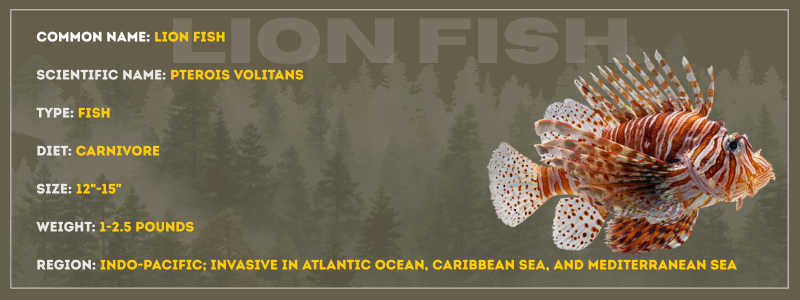
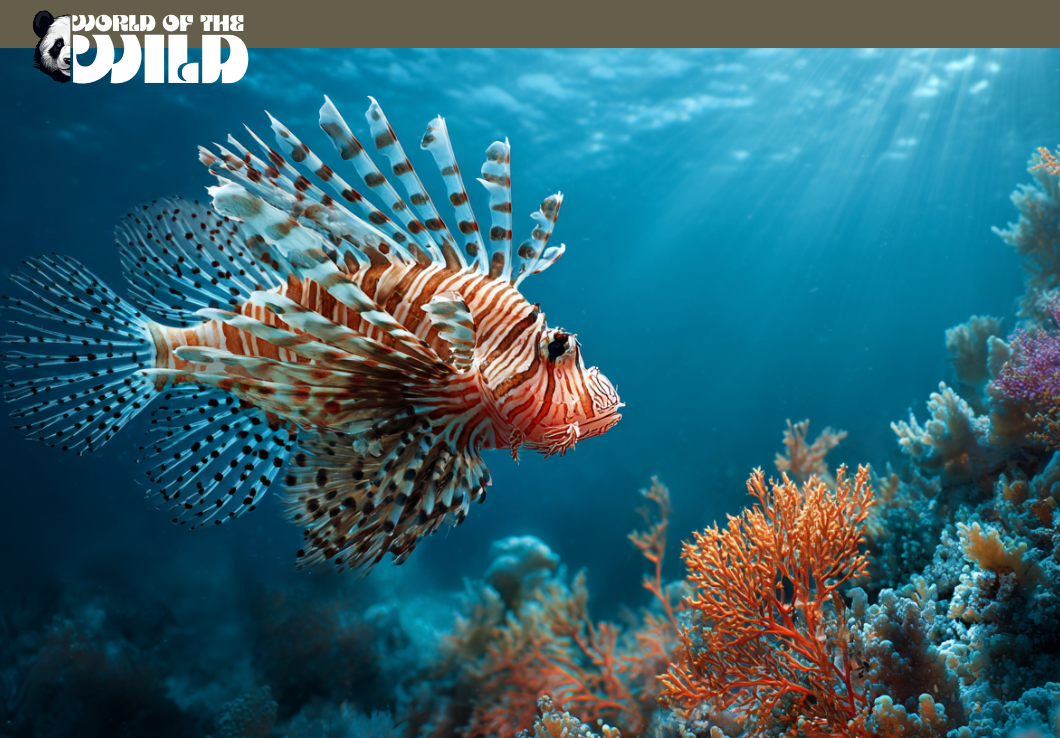
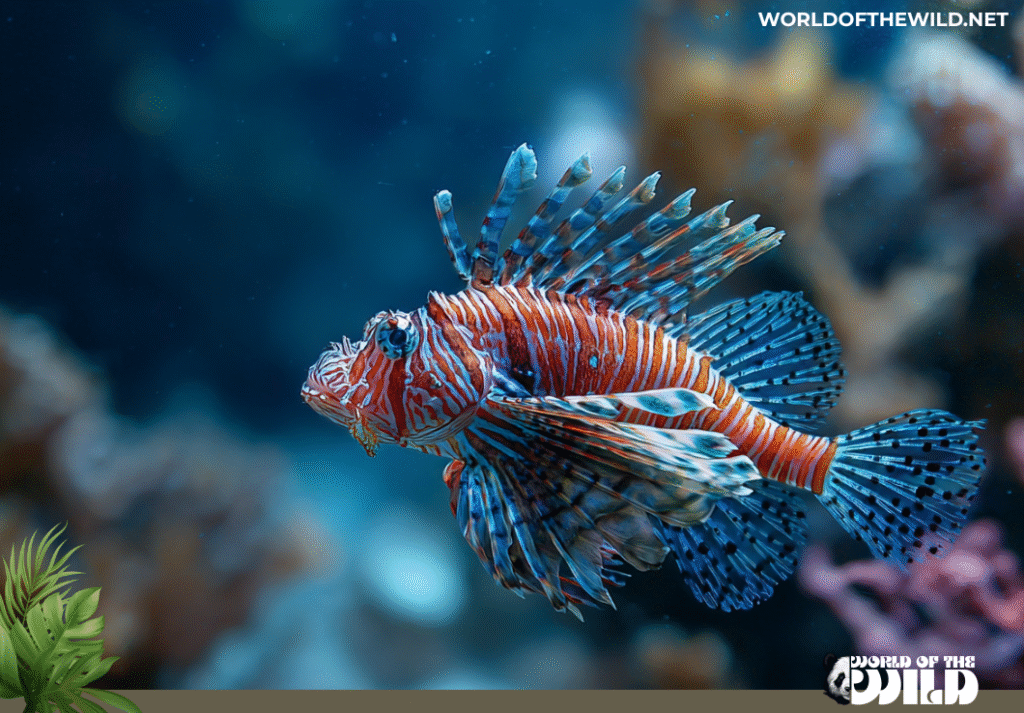
The lionfish presents one of the ocean’s most theatrical displays of form and color. Its body, typically ranging from 12 to 15 inches in length and weighing between one and two-and-a-half pounds, features alternating bands of red, maroon, brown, and white stripes that create a striking zebra-like pattern. These bands aren’t merely decorative—they serve as disruptive coloration that breaks up the fish’s outline when viewed against complex reef backgrounds. The most distinctive feature is undoubtedly the elaborate array of elongated fin rays that extend from the dorsal, pelvic, and anal fins like the feathers of some exotic bird. These fan-like appendages can span significantly wider than the body itself, with some rays extending several inches beyond the fish’s core.
The lionfish possesses 13 venomous dorsal spines, two venomous pelvic spines, and three venomous anal spines—18 defensive weapons in total. These spines are connected to venom glands and are covered by a thin sheath of skin that ruptures upon contact, injecting venom into any perceived threat. The head features fleshy tentacles above the eyes called cirri, which vary in development among individuals and may play a role in sensory perception. Large, prominent eyes provide excellent vision for hunting in low-light conditions, while the wide mouth can expand dramatically to engulf prey. The pectoral fins are broad, translucent, and typically feature elaborate patterns of spots and bands. During hunting, lionfish can spread these fins to their maximum extent, creating a visual barrier that helps corral prey into confined spaces where escape becomes impossible.
Behavior
Lionfish exhibit behavioral patterns that reflect their status as ambush predators supremely adapted to reef environments. During daylight hours, they often remain relatively stationary, hovering near crevices, ledges, or under coral overhangs where their ornate appearance blends with the complex reef architecture. However, this apparent inactivity masks constant vigilance—lionfish are continuously monitoring their surroundings for prey opportunities. When hunting, they employ a remarkably methodical approach, using their large pectoral fins to slowly herd small fish into corners or against reef walls. Once prey is trapped, the lionfish strikes with explosive speed, creating a powerful suction that draws the victim into its cavernous mouth in mere milliseconds.
These fish are generally solitary, though they may tolerate conspecifics when not actively defending territories or competing for food. Males establish and defend territories during breeding seasons, performing elaborate courtship displays that involve circling females, fin displays, and distinctive swimming patterns. Communication occurs through body language and positioning rather than vocalizations. Lionfish demonstrate surprising boldness around larger fish and even divers, showing little fear and often holding their ground rather than fleeing when approached. This fearlessness likely stems from confidence in their venomous defenses—few predators in their native range dare challenge them.
Their hunting success derives partly from their patient, energy-efficient approach. Rather than actively chasing prey across the reef, lionfish let their prey come to them or slowly maneuver into striking position. They can remain nearly motionless for extended periods, resembling harmless pieces of reef structure until the critical moment of attack. In invasive populations, this behavior has proven devastatingly effective, as Atlantic prey species have no evolutionary experience with this hunting strategy and fail to recognize lionfish as threats until it’s too late.
Evolution
The evolutionary lineage of lionfish traces back through the Scorpaenidae family, a diverse group of venomous fish that emerged during the Paleogene period, roughly 50 to 60 million years ago. Scorpaeniformes, the broader order to which lionfish belong, represents an ancient radiation of fish that developed venomous spines as a defensive adaptation—a strategy that has proven remarkably successful across diverse marine environments. The elaborate fin extensions and vibrant coloration patterns seen in modern lionfish likely evolved more recently, perhaps within the last several million years, as specialized adaptations for their particular ecological niche as ambush predators on Indo-Pacific reefs.
Fossil evidence for lionfish specifically remains sparse, as the delicate bones and fins of these fish rarely preserve well in the fossil record. However, comparative anatomy and molecular genetics have allowed researchers to reconstruct their evolutionary relationships. Lionfish appear most closely related to other scorpionfishes and rockfishes, sharing common ancestors with these groups before diverging into their distinctive form. The evolution of their venom delivery system represents a refinement of defenses found throughout the scorpaenid family, with lionfish developing particularly efficient glands and spine structures.
The split between Pterois volitans and Pterois miles likely occurred relatively recently in evolutionary terms, possibly within the last few million years as populations became isolated in different parts of the Indo-Pacific basin. The remarkable similarity between these species suggests they share a very recent common ancestor. Interestingly, the hybrid vigor observed in Atlantic invasive populations, where both species have interbred, demonstrates that they haven’t diverged enough to create reproductive barriers—a situation that has inadvertently created an even more adaptable invasive predator. This evolutionary plasticity, combined with their generalist predatory strategy, has made lionfish extraordinarily successful colonizers of new environments.
Habitat
In their native range, lionfish inhabit the tropical and subtropical waters of the Indo-Pacific region, spanning from the western coast of Australia through Southeast Asia, around India, and across the islands of the Pacific Ocean to French Polynesia. They thrive in the Red Sea and have been documented as far north as southern Japan and as far south as Lord Howe Island off Australia. These fish demonstrate remarkable habitat flexibility within marine environments, occupying coral reefs, rocky outcrops, lagoons, harbors, and artificial structures like shipwrecks and oil platforms. They’ve been found from the shallow tidepools of reef flats, where water depth measures mere inches during low tide, down to mesophotic reefs at depths exceeding 1,000 feet.
The invasive population tells a dramatically different geographic story. First documented in Atlantic waters off Florida in 1985, likely the result of aquarium releases during Hurricane Andrew or earlier deliberate introductions, lionfish have since spread throughout the Western Atlantic, Caribbean Sea, and Gulf of Mexico with alarming speed. By the early 2000s, they had established breeding populations along the entire U.S. East Coast from Florida to North Carolina. The invasion continued southward through the Caribbean islands and along the Central and South American coasts, reaching as far south as Brazil. They’ve also penetrated the Mediterranean Sea, with established populations documented off the coasts of Lebanon, Cyprus, and throughout the Eastern Mediterranean.
Within these regions, lionfish show strong preferences for structured habitats that provide both hunting opportunities and shelter. Coral reefs offer ideal conditions, with their complex three-dimensional architecture creating numerous ambush points and prey concentrations. They readily colonize artificial reefs, jetties, and offshore platforms, sometimes in higher densities than on natural reefs. Mangrove systems, seagrass beds, and hard-bottom habitats also support lionfish populations. Water temperature appears to be a primary limiting factor for their distribution—they require temperatures generally above 50°F (10°C) for long-term survival, though they can tolerate brief cold snaps. Salinity tolerance also limits their range, as they’re strictly marine and cannot survive in freshwater or even significantly brackish conditions.
Diet
Lionfish are voracious carnivores with catholic tastes that encompass an enormous variety of small marine organisms. Their diet consists primarily of small fish, with studies documenting over 70 different prey species in their stomachs. They show particular preference for juvenile fish, targeting young snappers, groupers, parrotfish, wrasses, damselfishes, and countless other reef fish species. Beyond fish, lionfish readily consume crustaceans including shrimp, crabs, and lobsters, particularly juveniles of commercially important species. They also prey upon cephalopods and various other invertebrates when opportunities arise.
The hunting strategy of lionfish combines patience with explosive action. They employ their elaborate pectoral fins as herding tools, slowly spreading these fan-like appendages to create barriers that funnel prey into confined spaces against reef structures or into corners where escape routes disappear. This technique, called “corralling,” proves remarkably effective with naive prey. Once positioned, the lionfish orients its body toward the target and, in a movement almost too quick to see, opens its mouth while simultaneously flaring its gill covers. This creates an intense negative pressure that literally sucks the prey item into the mouth—a suction feeding mechanism measured at strike speeds of just 10 milliseconds.
Feeding occurs opportunistically throughout the day and night, though peak activity typically happens during crepuscular periods at dawn and dusk when many prey species are most active or most vulnerable. Lionfish can survive extended periods without food, but when prey is abundant, they gorge themselves, sometimes consuming dozens of small fish in a single session. Their expandable stomachs allow for this feast-or-famine approach. In invasive populations, their feeding rate substantially exceeds that of native predators, with some individuals consuming prey equivalent to their own body weight every few days. This intense predation pressure, combined with the lack of learned avoidance behavior in Atlantic prey species, has resulted in dramatic reductions in juvenile fish populations on invaded reefs, fundamentally altering community structure and ecosystem function.
Predators and Threats
In their native Indo-Pacific range, lionfish face predation from several large marine species that have evolved alongside them and developed strategies to overcome their venomous defenses. Groupers, particularly large Nassau and tiger groupers, occasionally prey on lionfish, typically consuming them whole to avoid the venomous spines. Moray eels have been observed hunting lionfish, using their muscular bodies to pin the fish while consuming them headfirst. Some species of sharks, including Caribbean reef sharks and nurse sharks, will opportunistically feed on lionfish. Cornetfish and frogfish also occasionally consume smaller lionfish. However, these predation events remain relatively uncommon, as the venomous spines provide effective deterrence against most would-be predators.
The situation differs dramatically in invaded Atlantic waters, where lionfish initially encountered virtually no natural predators. Native predators had no evolutionary experience with lionfish and failed to recognize them as prey, contributing to the explosive population growth of the invasion. Recent research suggests this may be slowly changing, with some groupers and moray eels beginning to recognize lionfish as food sources, particularly in areas where human divers have repeatedly presented speared lionfish to these predators. However, natural predation remains insufficient to control invasive populations.
Anthropogenic threats to lionfish vary significantly between native and invasive populations. In the Indo-Pacific, lionfish face the same pressures affecting most reef fish: habitat degradation from coastal development, coral bleaching events driven by climate change, destructive fishing practices, and pollution. The aquarium trade creates some collection pressure on wild populations, though lionfish breed readily in captivity. Ocean acidification threatens the coral reef ecosystems upon which lionfish depend.
Paradoxically, in invaded regions, humans represent the primary and most significant predator, with organized culling efforts attempting to control lionfish populations. Spearfishing tournaments, commercial harvesting programs, and recreational fishing specifically target lionfish. These removal efforts, while locally effective, have failed to significantly reduce overall invasive populations due to the species’ rapid reproduction and deep-water refuge populations beyond diver reach. The development of markets for lionfish as food has created economic incentives for harvesting, representing one of the few potentially sustainable approaches to managing the invasion.
Reproduction and Life Cycle
Lionfish possess a reproductive strategy characterized by remarkable fecundity and frequency. Sexual maturity arrives relatively quickly, with individuals capable of breeding by the time they reach approximately seven to eight inches in length, typically around one year of age. In tropical waters where temperatures remain consistently warm, breeding occurs year-round, though there may be seasonal peaks in activity. In subtropical regions at the northern and southern extremes of their range, reproduction shows more pronounced seasonality, concentrating in warmer months.
Courtship begins with males establishing and defending small territories, often around prominent reef features. When a receptive female approaches, the male initiates an elaborate courtship ritual involving parallel swimming, circling behaviors, and dramatic displays of his fins. The male darkens in coloration and may perform a distinctive “shivering” motion. If the female accepts, the pair ascends together in the water column, typically during evening hours around sunset. At the apex of this ascent, both fish release their gametes simultaneously—the female releasing two gelatinous mucus balls containing thousands of eggs, while the male releases sperm to fertilize them. These egg masses can contain anywhere from 12,000 to 15,000 eggs each, and females may spawn every three to four days during peak breeding season, producing an estimated 2 million eggs annually.
The fertilized eggs drift in the open ocean as part of the plankton, hatching within approximately 36 hours depending on water temperature. The larvae that emerge are tiny, translucent, and bear little resemblance to adult lionfish. They spend several weeks in the pelagic larval stage, drifting with currents and feeding on microscopic organisms while developing. This planktonic stage serves as the primary dispersal mechanism for lionfish, allowing them to spread across vast oceanic distances—a factor that contributed significantly to their rapid invasion of Atlantic waters.
After roughly 25 to 40 days, the larvae undergo metamorphosis, settling onto reef habitats as juvenile fish measuring less than half an inch long. At this stage, they begin to develop the characteristic venomous spines and color patterns, though these features remain incompletely formed. Juveniles grow rapidly when food is abundant, reaching several inches within months. Throughout their lives, lionfish continue growing, with growth rates slowing as they age. In the wild, lionfish can live for approximately 10 to 15 years, though individuals in invaded regions with fewer predators may achieve slightly longer lifespans. Males and females show no significant differences in size or lifespan, unusual among many fish species where one sex often outgrows the other.

Population
The conservation status and population dynamics of lionfish present a unique situation that differs dramatically between native and invasive regions. In their native Indo-Pacific range, lionfish are listed as Least Concern by the International Union for Conservation of Nature (IUCN). They maintain stable populations throughout most of their historical range, showing no immediate signs of significant decline. Precise population estimates for the Indo-Pacific prove difficult to calculate given the vast geographic range and diverse habitats occupied, but the species appears healthy and widespread throughout these waters.
The invasive Atlantic, Caribbean, and Gulf of Mexico populations tell an entirely different story—one of explosive growth and ecosystem disruption. Population estimates suggest that lionfish densities in invaded regions now exceed those in their native range by several orders of magnitude in some locations. Studies have documented densities of over 400 lionfish per hectare on some Caribbean reefs, compared to typical Indo-Pacific densities of just a few individuals per hectare. The total invasive population likely numbers in the millions of individuals, though exact counts remain speculative given the challenges of surveying underwater populations across such vast areas.
Population trends show continued expansion of the invasion’s geographic footprint, with lionfish steadily colonizing new areas and deeper habitats. While intensive removal efforts have achieved local reductions, particularly in heavily-dived areas with active culling programs, these successes haven’t translated to region-wide population control. Reproductive rates so dramatically exceed removal rates that populations quickly rebound when culling pressure relaxes. Mathematical models suggest that sustained removal of 25-35% of the population annually would be necessary to achieve meaningful control, a target that remains unrealistic across most of the invaded range.
Conclusion
The lionfish embodies one of nature’s most striking contradictions: a creature of extraordinary beauty that has become an agent of ecological disruption, a testament to evolutionary success that now threatens the very ecosystems it has conquered. In their native waters, these magnificent fish represent a perfectly adapted predator, integrated into complex reef communities through millions of years of coevolution. Yet their accidental introduction to Atlantic waters has created one of the most consequential marine invasions in recorded history, fundamentally altering Caribbean and Western Atlantic reef ecosystems with cascading effects that continue to unfold.
Understanding lionfish means confronting uncomfortable truths about human impacts on marine environments—how a few aquarium releases or ship ballast water discharges can trigger ecological transformations across entire ocean basins. But it also reveals the resilience and adaptability of marine ecosystems, the dedication of conservation communities working to mitigate damage, and the potential for innovative solutions like creating sustainable fisheries from invasive species. The lionfish invasion serves as both a cautionary tale and a call to action, reminding us that ocean health depends on vigilant stewardship, responsible pet ownership, and proactive ecosystem management.
Whether you encounter lionfish while diving tropical reefs or on a dinner plate as part of “invasive species cuisine,” recognize that these fish represent more than just an exotic curiosity. They are ambassadors for broader conversations about invasive species, ecosystem resilience, and humanity’s relationship with the ocean. By supporting lionfish removal efforts, promoting public awareness, and advocating for policies that prevent future invasions, each of us can contribute to protecting the remarkable biodiversity of our planet’s marine environments.