
Introduction
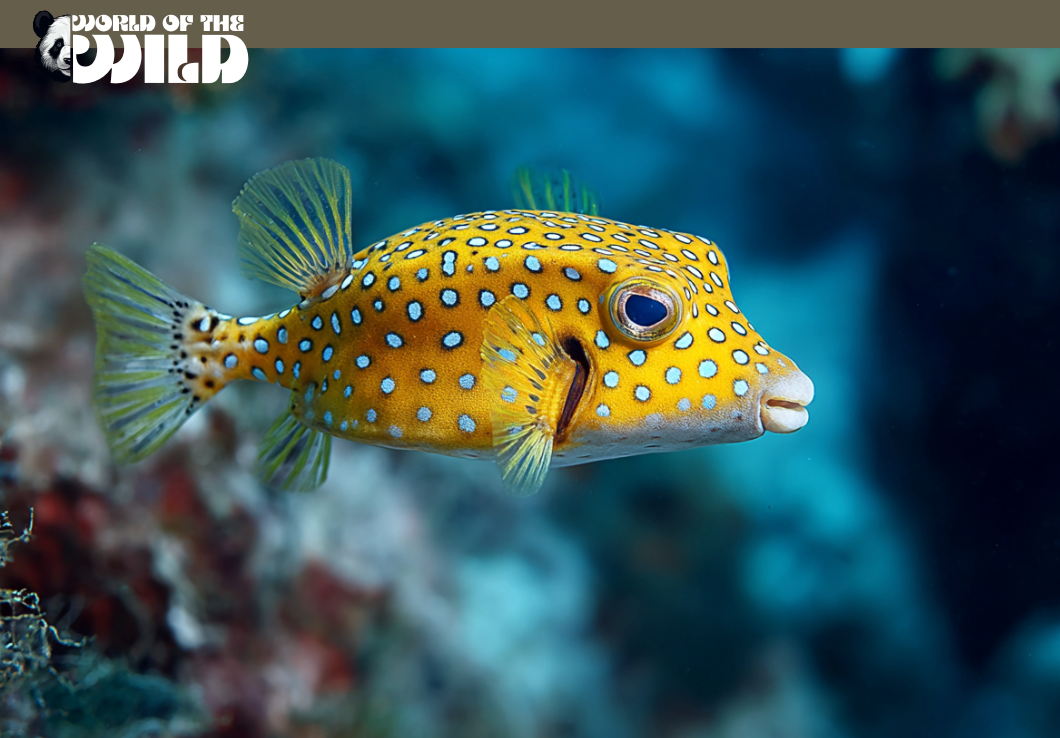
Imagine a small, bright yellow cube, polka-dotted with black, floating gracefully through a tropical coral reef. No, it’s not a misplaced children’s toy—it’s one of the ocean’s most charismatic and bizarre residents: the Yellow Spotted Boxfish (Ostracion cubicus).
With its unique, angular body shape and eye-popping coloration, the boxfish is an undeniable showstopper. But this little marine marvel is more than just a pretty face. It holds one of the ocean’s most potent chemical weapons, a mucus-based toxin, that it can deploy in an instant. This combination of adorable appearance and deadly defense mechanism makes the Yellow Spotted Boxfish a truly fascinating and significant creature in the vibrant ecology of the Indo-Pacific reefs.
Facts
Here are a few quick, intriguing facts about the Yellow Spotted Boxfish:
- A Living Cube: The boxfish’s body is encased in a rigid, bony, triangular or cubical carapace (shell), made from modified scales called scutes that are fused together. This skeleton-on-the-outside design gives it its distinctive shape.
- A Toxin-Wielding Tank: When stressed or threatened, the boxfish releases a potent neurotoxin called Ostracitoxin (also known as Pahutoxin) from its skin’s mucus glands. This detergent-like substance is highly toxic to other fish—and even to the boxfish itself in an enclosed space!
- Hovercraft Fins: Lacking a flexible body, the boxfish relies on a unique locomotion style called Ostraciiform swimming. It uses small, constant movements of its dorsal, anal, and pectoral fins for propulsion and steering, giving it a characteristic, almost helicopter-like hover.
- The Ultimate Glow-Up: Juveniles are a brilliant, almost neon yellow with black spots. As they mature, the yellow fades to a drab olive, brown, or blue-grey, and the black spots become smaller and more numerous, a dramatic change that helps them blend into deeper reefs.
- Boxfish Love: The genus name, Ostracion, comes from the Greek word ostrakon, meaning “shell” or “tile,” a clear reference to its hard, protective casing.
- Masters of Miniature: Their small mouth is tipped with fleshy lips and a set of brush-like teeth, perfectly adapted for nibbling tiny invertebrates and algae off rocks and coral.
Species
The Yellow Spotted Boxfish belongs to the following taxonomic classification:
| Level | Classification |
| Kingdom | Animalia |
| Phylum | Chordata |
| Class | Actinopterygii (Ray-finned fishes) |
| Order | Tetraodontiformes |
| Family | Ostraciidae (Boxfishes) |
| Genus | Ostracion |
| Species | Ostracion cubicus |
Related Species:
The family Ostraciidae, or boxfishes, includes around 29 species. The closest relatives in the genus Ostracion include:
- Ostracion meleagris (Whitespotted Boxfish): Similar in body shape but with a dark brown or black body covered in white spots. Males also have a dramatic blue coloration on the sides.
- Ostracion trachys (Rough Boxfish): A rare species found only in the Seychelles.
- Ostracion immaculatus (Bluespotted Boxfish): Found in the waters around Japan, this species is typically dark brown with small, scattered blue spots.
Appearance
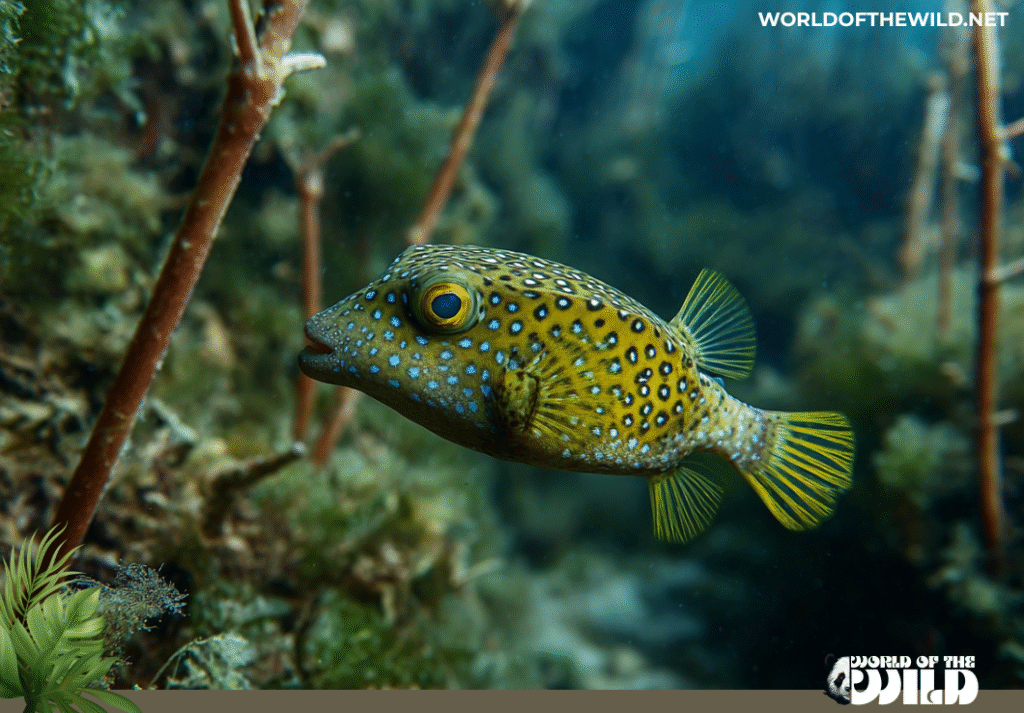
The Yellow Spotted Boxfish is truly unmistakable.
- Size and Weight: They typically grow to about 45 cm (18 inches), though some males can reach 50 cm (20 inches). Their weight is relatively light for their size, largely due to their unique skeletal structure.
- Distinctive Features: The most defining characteristic is the bony carapace that forms its box-like shape. Only the snout, fins, and tail are mobile. They have a small, puckered mouth and distinctive ridges above their eyes.
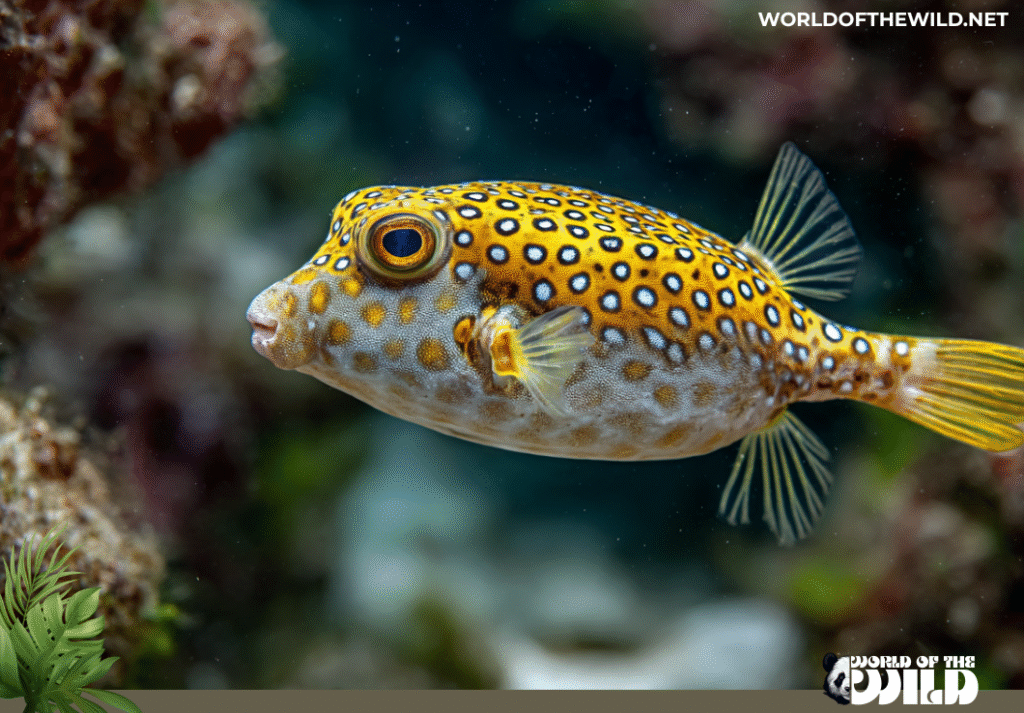
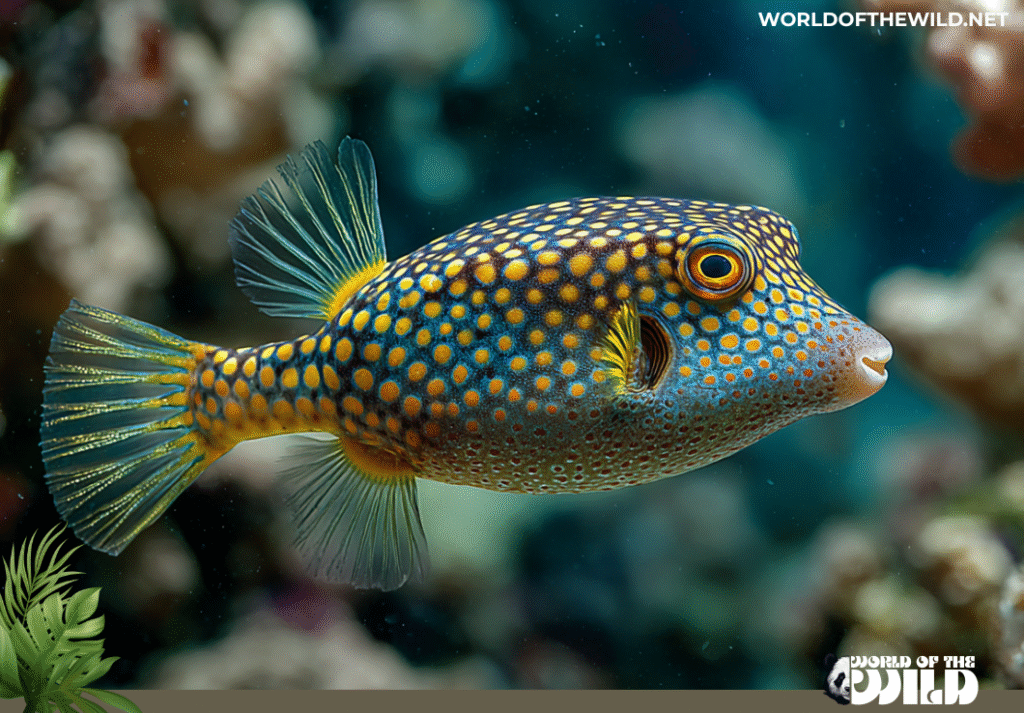
- Coloration: Juveniles are a striking, uniform bright yellow with numerous small, jet-black spots, making them incredibly conspicuous. As they age, this vibrant yellow transitions to a duller brownish, olive, or bluish-grey. Mature males often display bright blue markings on their sides, indicating sexual maturity and dominance.
Behavior
The boxfish’s behavior is as unique as its look.
- Social Behavior: Ostracion cubicus is typically a solitary fish, though they can occasionally be seen in small, loose aggregations. They are generally territorial, with dominant males maintaining a harem of one or two females within their established home range.
- Daily Rhythms: They are diurnal (active during the day), spending their time foraging along the reef. At night, they seek shelter in coral crevices or under ledges to avoid nocturnal predators.
- Communication: Communication is primarily visual (through color displays) and chemical (via pheromones, and of course, the potent toxin).
- Unique Adaptation (Toxicity): The release of Ostracitoxin is a critical, life-saving adaptation. This self-defense mechanism is a last resort, quickly killing or stunning potential predators in the surrounding water column.
Evolution
The boxfishes are part of the Order Tetraodontiformes, an ancient and diverse group of ray-finned fishes that includes pufferfish, triggerfish, and filefish.
- Key Ancestors: The Tetraodontiformes lineage dates back to the Eocene epoch (around 56 to 34 million years ago). Early ancestors likely possessed bony plates and defensive spines.
- Evolutionary Milestone: The carapace is the family’s most significant evolutionary development. This fusion of dermal bone plates into a rigid, protective shell offered an incredible defense advantage, compensating for their slow, awkward swimming style. This “armor” allowed them to evolve the toxic defense later, as they had already overcome the vulnerability of slow movement. The boxfish shape is an example of convergent evolution, where its unique form is a result of selective pressures for defense.
Habitat
The Yellow Spotted Boxfish is a creature of the tropical Indo-Pacific.
- Geographic Range: Its expansive range covers the Red Sea, East Africa, and extends eastward through the Indian Ocean to the islands of the Central Pacific, and north to Japan and south to New South Wales, Australia.
- Specific Environment: They are an iconic resident of coastal coral reefs and lagoons. Juveniles prefer sheltered inner reef areas and rubble bottoms, often hiding amongst branching corals or soft corals. Adults typically inhabit slightly deeper, seaward reefs, from the shallow water down to depths of about 40-50 meters (130-165 feet). They require a complex, well-structured reef environment for foraging and protection.
Diet
The Yellow Spotted Boxfish is an omnivore with a preference for small benthic invertebrates.
- Primary Food Sources: Their diet consists mainly of:
- Small, sessile (immobile) invertebrates like tunicates, sponges, and segmented worms.
- Crustaceans (tiny crabs and shrimp).
- Algae and turf that they meticulously graze off rocks and coral surfaces.
- Foraging: They are slow, deliberate feeders, using their small, fleshy lips and pointed teeth to nip and graze food from hard surfaces. Their ability to hover precisely makes them effective at picking off tiny food items without damaging the coral structure.
Predators and Threats
The boxfish’s powerful defenses mean it has few natural predators, but human-caused threats are significant.
- Natural Predators: Due to their toxicity and bony armor, large predators often leave boxfish alone. However, some large, specialized reef hunters may occasionally prey on them, including sharks and large, fast-moving pelagic fish that can swallow them whole before the toxin is released.
- Anthropogenic Threats:
- Climate Change: Rising sea temperatures cause coral bleaching, destroying the intricate reef structures that boxfish (especially juveniles) rely on for shelter and food sources.
- Habitat Degradation: Coastal development, pollution, and destructive fishing practices (like dynamite fishing) directly damage and fragment their reef habitat.
- Pet Trade: Their striking appearance makes them highly sought after in the aquarium trade. While captive breeding is challenging, many are collected directly from the wild, adding pressure to local populations.
Reproduction and Life Cycle
Boxfish reproduction is a delicate, reef-dependent process.
- Mating Rituals: The Yellow Spotted Boxfish is a protogynous sequential hermaphrodite, meaning some individuals may start as female and later change to male, though this is not fully established in O. cubicus. Mating often occurs at sunset; the male will engage in a courtship display with the female, involving a dance-like ascent into the water column.
- Gestation and Offspring: They are pelagic spawners. The female releases tiny, buoyant eggs, and the male simultaneously fertilizes them. There is no parental care; the eggs float away and hatch into larvae.
- Life Cycle: The larval stage floats in the open ocean currents. Once they mature into the distinctive juvenile boxfish, they settle onto the reef.
- Average Lifespan: They are estimated to have a lifespan of around 4-8 years in the wild, though this can vary.
Population
Fortunately, for now, the Yellow Spotted Boxfish is not considered to be in immediate danger.
- Current Conservation Status: According to the IUCN Red List of Threatened Species, the Yellow Spotted Boxfish is currently listed as Least Concern (LC).
- Global Population Estimate: Due to their widespread distribution and common occurrence across the Indo-Pacific, their global population is considered stable and abundant.
- Significant Population Trends: While generally stable, local populations can be severely affected by major coral bleaching events or large-scale habitat destruction, which can lead to localized declines.
Conclusion
The Yellow Spotted Boxfish is truly a marvel of evolutionary design—a bizarre, armored, and deceptively beautiful resident of the coral reef. From its larval stage floating in the vast ocean to its adult life as a slow-moving, toxin-wielding cube, Ostracion cubicus is a testament to the endless creativity of nature.
While its conservation status is currently stable, the fate of this dazzling die is inextricably linked to the health of the world’s coral reefs. By supporting sustainable ecotourism, demanding responsibly sourced seafood, and advocating for strong climate action, we can all play a part in ensuring this tiny, toxic jewel continues to hover through the tropical seas for generations to come.