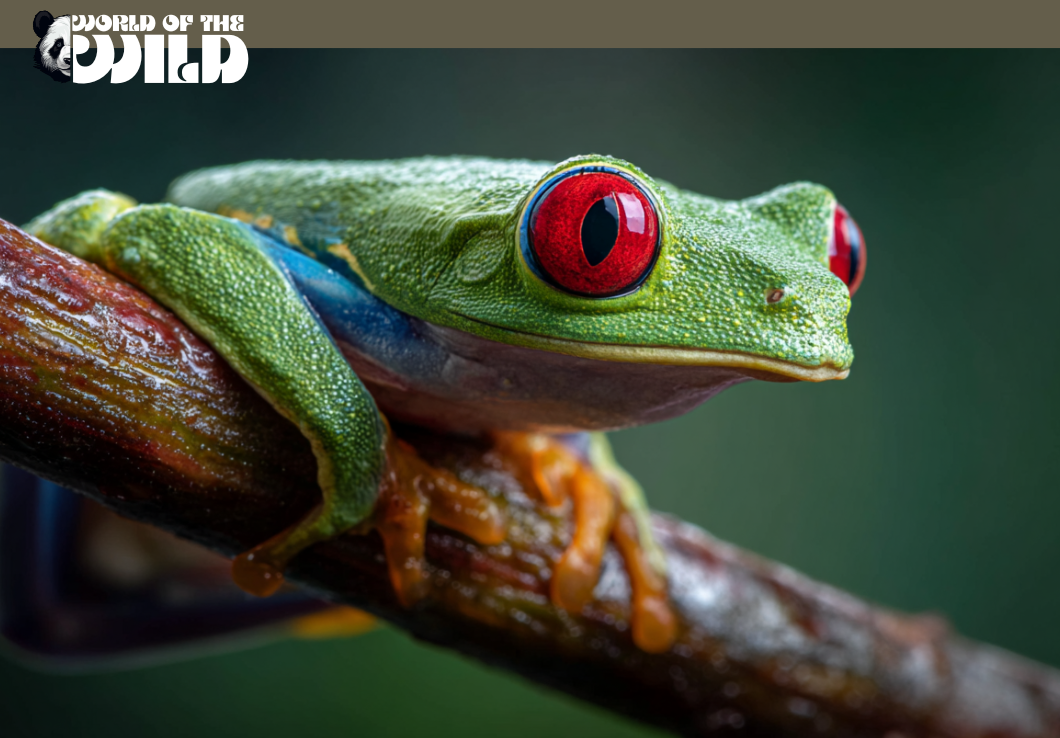

Imagine the dense, emerald labyrinth of a Central American rainforest at night. Suddenly, two enormous, blood-red eyes flash in the darkness, a brilliant contrast to the creature’s vibrant green body. This is the Red-Eyed Tree Frog (Agalychnis callidryas), a living jewel that has captivated scientists, photographers, and nature lovers around the globe.
More than just a pretty face, this frog is an icon of the Neotropics and a brilliant example of nature’s artistry and evolutionary ingenuity. Its startling coloration is not a warning of venom, but a spectacular defense mechanism known as startle coloration or flash coloration, a key to its survival in a world full of hungry predators. This article will take you deep into the life and lore of the rainforest’s most famous amphibian.
💡 Fascinating Facts
Here are a few quick, less-common facts that showcase the incredible nature of the Red-Eyed Tree Frog:
- No Poison, All Show: Unlike many brightly colored amphibians, the Red-Eyed Tree Frog is not venomous. Its vibrant color is a bluff—a sensory shock to deter a potential predator long enough for the frog to leap away.
- A ‘Sleeping Beauty’ Camouflage: During the day, it practices crypsis (camouflage) by tucking its limbs close to its body, folding its brightly colored feet underneath, and closing its red eyes. This makes it look like a uniform green leaf.
- The ‘Vibrational Dance’: Male frogs may engage in vibrational signaling—a subtle jiggling of their bodies—to communicate with other males and claim territory on a leaf without alerting predators.
- Egg-Hatching on Demand: Tadpoles have the astonishing ability to hatch early if they sense danger. If a snake or wasp attempts to eat the egg clutch, the embryos can quickly wriggle out of their jelly and drop into the water below—sometimes days before their due date!
- Suction Cup Prowess: The frog’s toe pads secrete a non-sticky, adhesive mucus that, combined with the microscopic structure of the skin and toe pad, allows them to cling effortlessly to smooth, vertical surfaces like waxy leaves and glass.
🔬 Species Classification
The Red-Eyed Tree Frog’s place in the biological world is as follows:
| Classification Rank | Group Name |
| Kingdom | Animalia |
| Phylum | Chordata |
| Class | Amphibia |
| Order | Anura (Frogs and Toads) |
| Family | Hylidae (Tree Frogs) |
| Genus | Agalychnis |
| Species | Agalychnis callidryas |
Related Species
The genus Agalychnis contains several other stunning species often referred to as ‘Leaf Frogs.’ The Red-Eyed Tree Frog (A. callidryas) is closely related to species such as:
- Agalychnis dacnicolor (Mexican Leaf Frog): Lacks the vibrant blue/yellow striping of its famous cousin, often displaying a more uniform green body.
- Agalychnis spurrelli (Spurrell’s Leaf Frog): Known for its slender body and subtle color variations, residing further south in the rainforests of Colombia and Ecuador.
- Agalychnis moreletii (Morelet’s Tree Frog): Distinguished by its all-black or dark ventral surfaces and sometimes referred to as the Black-Eyed Tree Frog.
✨ Appearance
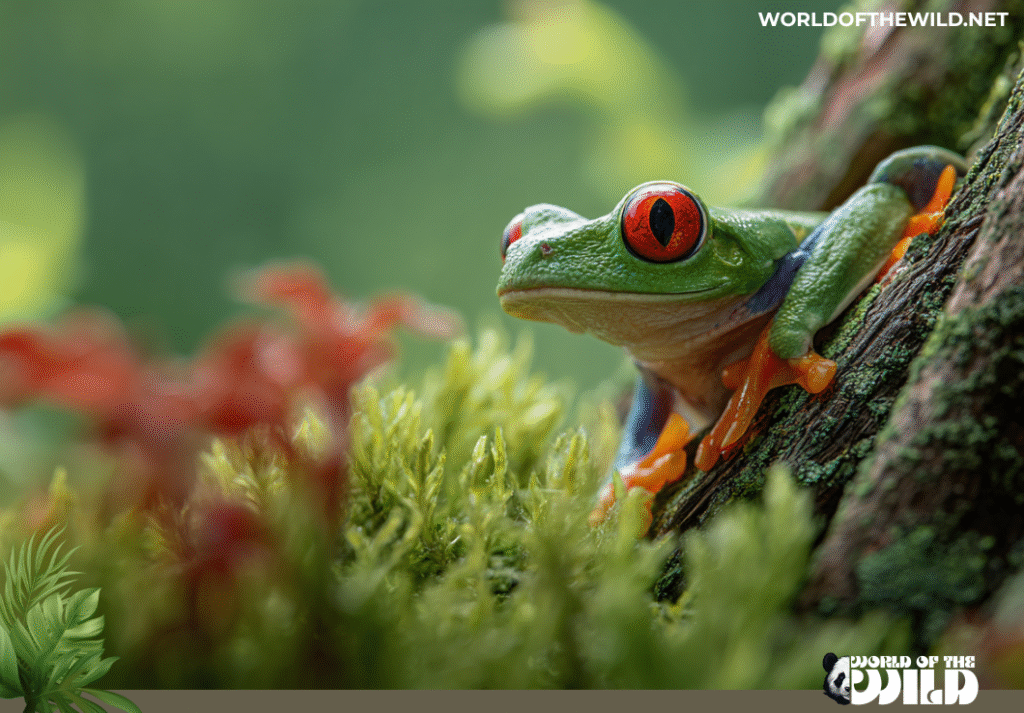
The Red-Eyed Tree Frog is instantly recognizable due to its spectacular, almost neon-like coloration, making it one of the world’s most photogenic amphibians.
- Size and Weight: These are relatively small frogs. Females are typically larger than males, reaching lengths of about $2.5$ to $3$ inches (6 to $8$ cm), while males are generally $2$ inches (5 cm) or less. They are incredibly light, weighing only a few ounces.
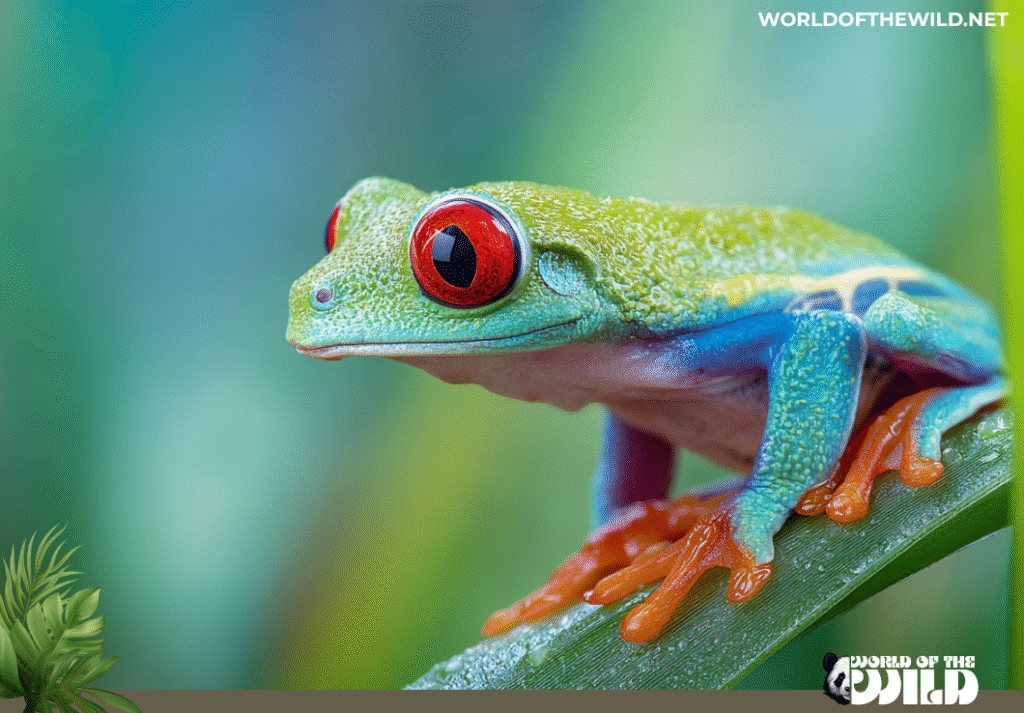
- Color: The primary dorsal (back) color is a brilliant, leafy green. The flanks (sides) are a striped riot of deep blue and bright yellow, though this can vary regionally, sometimes appearing blue/white or orange/yellow.
- Distinctive Features:
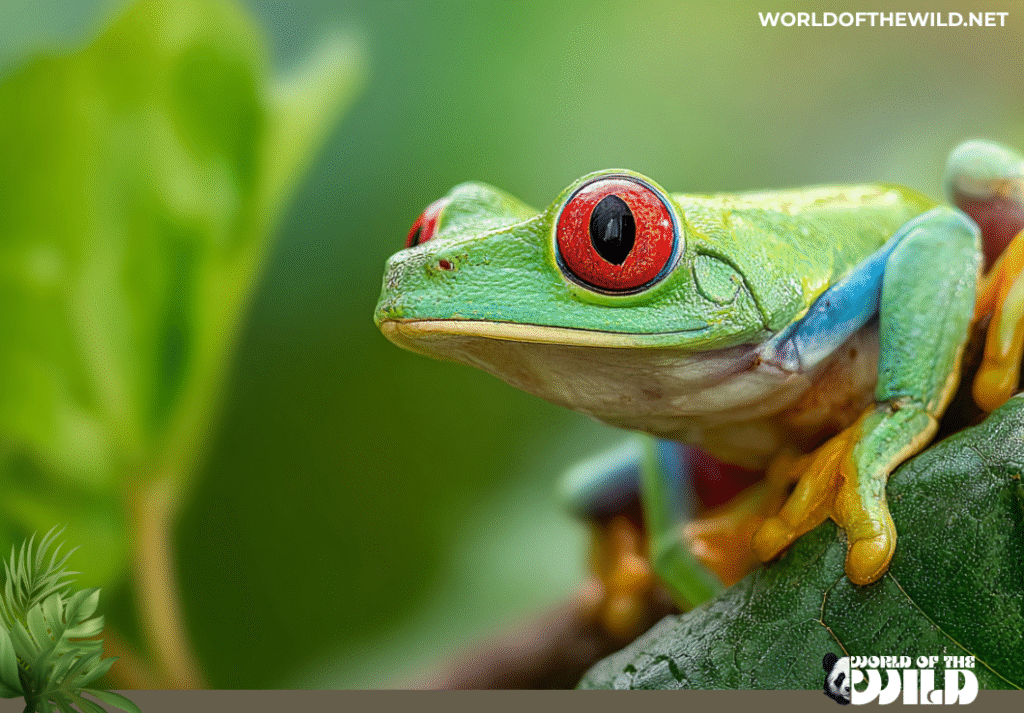
- The Eyes: The most striking feature is the huge, protuberant, scarlet-red eyes with vertical pupils, which are used in its startle defense.
- Feet and Toes: Their large toe pads are a vibrant orange or red and are highly specialized for gripping smooth surfaces.
🗣️ Behavior
The Red-Eyed Tree Frog is a textbook example of a nocturnal and arboreal creature, meaning it is active at night and lives exclusively in the trees.
- Daily Routine: During the day, they remain motionless, clinging to the underside of leaves with their limbs tucked in and eyes closed, relying entirely on their green camouflage for safety (crypsis). They emerge at dusk to begin hunting and mating.
- Social and Communication: They are generally solitary outside of the breeding season. Males use an elaborate repertoire of calls to attract females and establish territory. The most common is a soft “chack-chack-chack” sound. They also use the unique vibrational signaling mentioned earlier to communicate over short distances.
- Unique Adaptation (Startle Display): When threatened by a nocturnal predator (like a snake), the frog springs to life. It opens its enormous red eyes, unfurls its blue-and-yellow-striped flanks, and extends its orange feet. This sudden explosion of color and pattern is meant to momentarily confuse or scare the predator, giving the frog precious milliseconds to jump to safety.
🕰️ Evolution
Amphibians are one of the most ancient groups of vertebrates, tracing their lineage back to the first tetrapods that crawled onto land.
- Key Ancestors: The lineage of Agalychnis belongs to the family Hylidae (Tree Frogs), a diverse group that is believed to have originated in the Cretaceous period, tens of millions of years ago. The general Anura (frog) order has a fossil record stretching back over 200 million years.
- Evolutionary Milestone: The distinct evolutionary trait for Agalychnis callidryas is its remarkable combination of crypsis (daytime camouflage) and aposematism (the startle warning flash) which is unique because the frog is not poisonous. This defense mechanism is an excellent example of behavioral adaptation to a heavily predated, arboreal environment. The development of specialized toe pads for a life spent entirely on smooth, wet leaves was another critical milestone.
🌳 Habitat
The Red-Eyed Tree Frog is restricted to the tropical rainforests of the New World.
- Geographic Range: Their range extends across the lowland rainforests of Central America, from southern Mexico (Yucatán Peninsula) through Belize, Guatemala, El Salvador, Honduras, Nicaragua, Costa Rica, and Panama, and into a small part of northern Colombia.
- Specific Environment: They are an arboreal, strictly tropical species. Their habitat is specifically the trees and shrubs that overhang permanent or semi-permanent bodies of water (e.g., ponds, slow-moving streams) within the humid lowland or pre-montane rainforest. They rarely descend to the forest floor, living their entire lives within the canopy and sub-canopy layers, where they find the moisture and foliage necessary for survival and reproduction.
🍴 Diet
The Red-Eyed Tree Frog is a carnivore.
- Food Sources: As an opportunistic hunter, its diet consists primarily of small, soft-bodied arthropods, including:
- Crickets
- Moths
- Flies
- Locusts
- Small spiders
- Hunting: They are sit-and-wait predators. At night, the frog remains motionless on a leaf. When a suitable prey item comes close, the frog uses its excellent night vision to track it, then quickly extends its long, sticky tongue to snatch the meal and pull it back into its mouth.
🛡️ Predators and Threats
Natural Predators
Despite their defenses, Red-Eyed Tree Frogs are prey for several jungle inhabitants:
- Snakes: Specifically arboreal, or tree-dwelling, snakes like the Blunt-headed Tree Snake (Imantodes cenchoa) and various cat-eyed snakes.
- Spiders: Large, tree-dwelling spiders and tarantulas.
- Bats: Some species of bats are known to target and consume tree frogs.
- Wasps: The Tachinid Fly larvae are known to parasitize the egg clutches.
Anthropogenic Threats
The primary threats to the Red-Eyed Tree Frog are human-caused:
- Habitat Loss: The most severe threat is the rapid deforestation of Central American rainforests for logging, agriculture, and cattle ranching. Since the frog is so closely tied to forest canopy above water, loss of this specific habitat is devastating.
- Pesticides: Amphibians absorb substances readily through their thin, permeable skin, making them extremely vulnerable to agricultural runoff and the use of pesticides near their habitat.
- Climate Change: Changes in rainfall and temperature can affect the delicate humidity levels and breeding cycles necessary for the frog’s survival.
- Pet Trade: While currently not a major threat to wild populations, historical collection for the exotic pet trade did put pressure on certain local populations.
🥚 Reproduction and Life Cycle
Reproduction is a spectacular event for this species, occurring during the rainy season.
- Mating Rituals: The female is attracted by the male’s nocturnal calling chorus. Once a pair is formed, they engage in amplexus (the mating embrace) on a leaf that hangs directly over water.
- Gestation/Egg Laying: The female deposits a clutch of up to 40-50 eggs in a jelly mass on the underside of a leaf. The eggs are green and are wrapped in a clear jelly. The female will sometimes wrap the leaf around the egg mass to hide it.
- Offspring and Life Cycle:
- Tadpoles: After about 6-10 days, the eggs hatch, and the tadpoles drop into the water below, completing the critical journey from leaf to pool. They are filter feeders and scavengers during this stage, which lasts several weeks to a few months.
- Metamorphosis: The tadpoles undergo metamorphosis, developing lungs and limbs, and emerge onto land as tiny froglets, ready to climb the trees.
- Lifespan: In the wild, their average lifespan is estimated to be around 4 to 5 years, though they have been known to live up to 10 years in captivity.
📈 Population and Status
- Conservation Status: The Red-Eyed Tree Frog is currently listed as Least Concern (LC) on the IUCN Red List of Threatened Species.
- Population Estimate: Due to its wide geographic range and the fact that it is still commonly found in protected areas, a precise global estimate is difficult, but the population is considered stable across its range, though it is declining in areas with rapid deforestation.
- Population Trends: While the species as a whole is classified as stable, local populations are known to undergo significant declines when their specific riparian (waterside) habitat is destroyed or polluted. It remains an important bio-indicator of the health of the Central American rainforest.
🎯 Conclusion: An Icon Worth Protecting
The Red-Eyed Tree Frog is a marvel of evolutionary design—a perfect blend of camouflage, dazzling display, and a unique, water-dependent lifecycle. It is a charismatic, non-poisonous ambassador for the incredible biodiversity of the Neotropical rainforest.
However, its fate is inextricably linked to the fate of its habitat. Though currently listed as Least Concern, the continued and rapid pace of rainforest destruction means this status could change rapidly. Protecting this captivating amphibian is about more than just preserving one species; it’s about safeguarding the entire ecosystem that allows such stunning life forms to thrive.
We must recognize that the Red-Eyed Tree Frog’s bright future depends entirely on the shadow of the canopy we choose to leave standing.