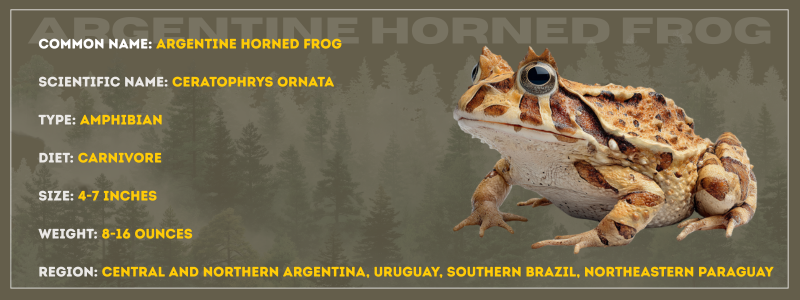

Imagine a creature so voracious that it will attempt to eat almost anything that moves within striking distance, including animals nearly its own size. Meet the Argentine Horned Frog, a rotund amphibian that looks like it was designed by an animator with a fondness for grumpy cartoon characters. With its impossibly wide mouth, perpetual scowl, and horn-like projections above its eyes, this South American ambush predator has earned colorful nicknames like “Pac-Man frog” and “Argentine wide-mouthed frog.” Despite its comical appearance, this amphibian is a formidable hunter with a bite strong enough to draw blood from unwary handlers. The Argentine Horned Frog represents a fascinating example of evolutionary specialization, having transformed into a living bear trap that sits motionless for days, waiting for prey to wander too close to its cavernous jaws.
Facts
- Nearly Half Mouth: The Argentine Horned Frog’s mouth spans approximately 50% of its entire body length, giving it one of the most extreme mouth-to-body ratios in the amphibian world.
- Cannibalistic Tendencies: These frogs are so aggressive and opportunistic that they frequently attempt to eat other frogs of their own species, including siblings, if housed together.
- Screaming Defense: When threatened, Argentine Horned Frogs can emit surprisingly loud, high-pitched screams that startle potential predators and sound remarkably unsettling coming from such a small creature.
- Teeth-like Projections: Unlike most frogs, they possess tooth-like odontoid projections on their lower jaw that help them grip struggling prey, making escape nearly impossible once captured.
- Sedentary Lifestyle: These frogs are among the laziest amphibians on Earth, sometimes remaining completely motionless in the same spot for weeks, only moving when hunger becomes unbearable.
- Protective Cocoon: During dry seasons, they can create a protective cocoon of shed skin layers and mucus, remaining dormant underground for months until rains return.
- Deceptive Pupils: Their unusual horizontal pupils with a triangular or heart-shaped appearance give them excellent binocular vision for judging striking distance despite their sedentary hunting style.
Sounds of the Argentine Horned Frog
Species
Kingdom: Animalia
Phylum: Chordata
Class: Amphibia
Order: Anura
Family: Ceratophryidae
Genus: Ceratophrys
Species: Ceratophrys ornata
The genus Ceratophrys contains eight recognized species of horned frogs, all native to South America. The Argentine Horned Frog (C. ornata) is one of the most well-known and commonly kept in captivity. Other notable species include the Surinam Horned Frog (C. cornuta), the Cranwell’s Horned Frog (C. cranwelli), and the Brazilian Horned Frog (C. aurita). These species share similar body plans and hunting strategies but differ in coloration, size, and geographic distribution.
While no subspecies of C. ornata are formally recognized, considerable color variation exists across its range, with populations from different regions displaying distinct patterns ranging from bright greens and yellows to more subdued browns and olives. Hybridization between C. ornata and C. cranwelli occasionally occurs both in the wild where their ranges overlap and commonly in captivity, producing offspring with intermediate characteristics.
Appearance
The Argentine Horned Frog is a stocky, almost spherical amphibian with an appearance that prioritizes function over grace. Adults typically measure between 4 to 6 inches in length, with females considerably larger than males. The largest specimens can reach lengths approaching 7 inches. Their weight varies significantly based on feeding and seasonal conditions, but healthy adults generally weigh between 8 to 16 ounces, with well-fed captive specimens occasionally exceeding one pound.
Their most distinctive feature is their enormously wide mouth, which creates the illusion that the frog is little more than an animated set of jaws with legs. The body is round and flattened, with short, stubby limbs that seem almost comically inadequate for the bulk they must support. The hind legs are muscular but the frog rarely leaps, using them primarily for digging backward into substrate.
The “horns” that give this species its common name are actually pointed skin projections that extend above each eye, resembling small, fleshy spikes. These projections may help break up the frog’s outline when buried, making it less recognizable as prey approaches. The eyes themselves are large and positioned high on the head, allowing the frog to remain almost completely buried while still monitoring its surroundings.
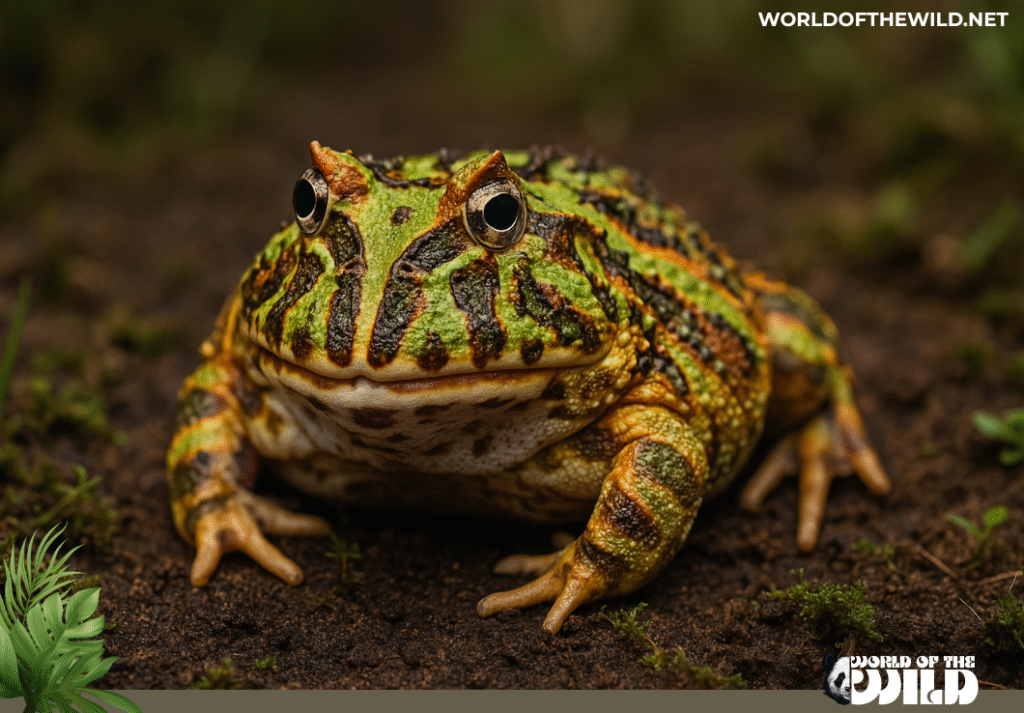
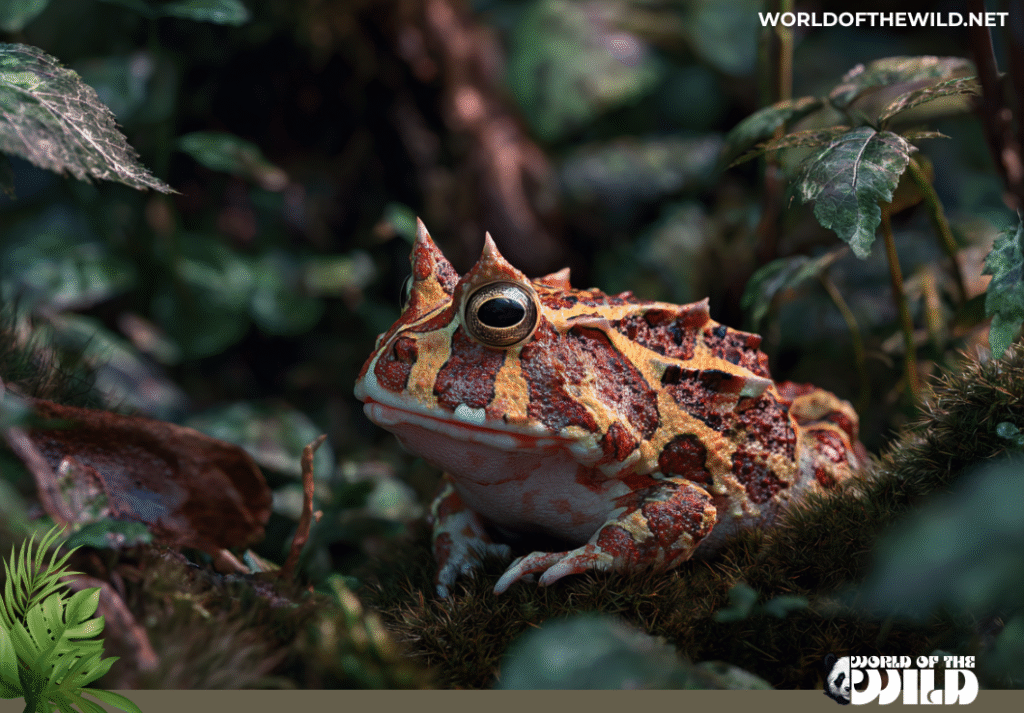
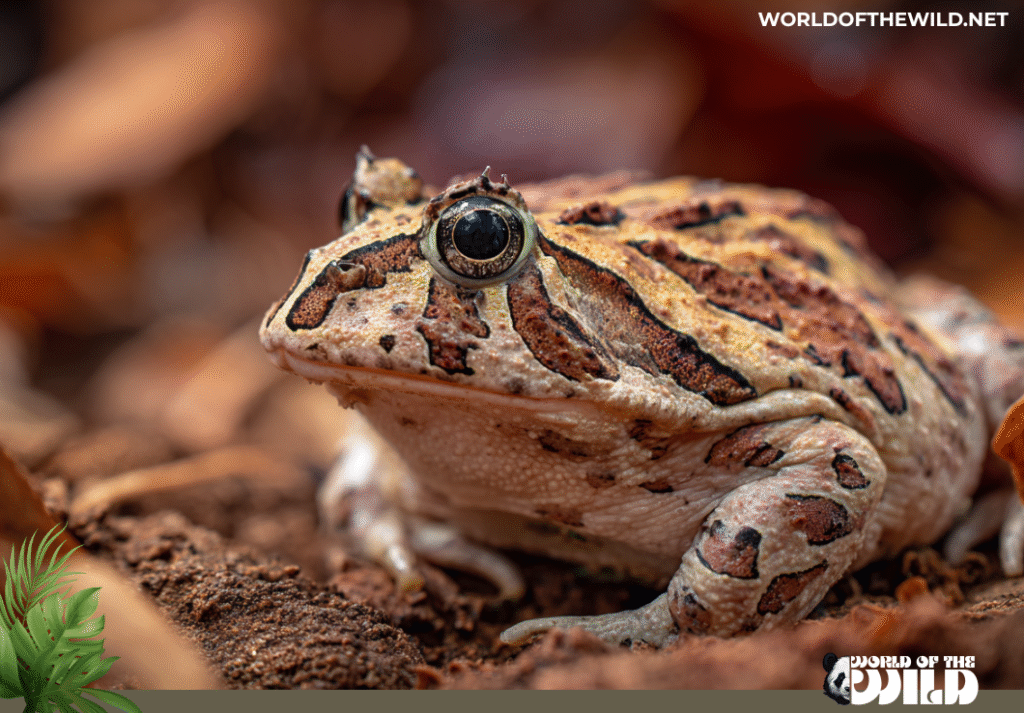
Coloration is highly variable and serves as excellent camouflage. The base color ranges from bright lime green to deep forest green, or from tan to dark brown. This background is overlaid with irregular darker markings, spots, and sometimes reddish or orange accents. The ventral surface is typically cream or white, sometimes with darker mottling. The skin has a rough, slightly bumpy texture with numerous small tubercles scattered across the dorsal surface.
Sexual dimorphism is pronounced, with females growing substantially larger than males. Males can be identified by their darker throat coloration and, during breeding season, the development of nuptial pads on their thumbs.
Behavior
The Argentine Horned Frog epitomizes the ambush predator lifestyle. These frogs are extraordinarily sedentary, spending the vast majority of their time partially or completely buried in leaf litter, soil, or mud with only their eyes and horns protruding. They can remain in this position for days or even weeks without moving, displaying patience that would impress a sniper. This behavior conserves energy while maximizing hunting opportunities.
Their hunting strategy is brutally simple: wait motionless until prey ventures within striking range, then explode forward with surprising speed, engulfing the victim in their cavernous mouth. The strike occurs in a fraction of a second, with the frog lunging forward and opening its jaws simultaneously. Once prey is captured, the frog uses its powerful jaws and tooth-like projections to maintain its grip while swallowing the meal whole, often using its front legs to push particularly large items into its mouth.
Argentine Horned Frogs are strictly solitary and highly territorial. They show no social behavior and will aggressively defend their chosen ambush site from other frogs, including members of their own species. Their aggressive nature extends to virtually anything that moves, and they will attempt to bite fingers, sticks, or other objects that come near them, even when not hungry. This defensive aggression is accompanied by their distinctive screaming behavior.
Despite their reluctance to move, these frogs are accomplished burrowers. They dig backward into substrate using a shuffling motion of their powerful hind legs, rocking side to side until they sink into the ground. This behavior serves multiple purposes: creating ambush positions, avoiding temperature extremes, and finding refuge during dry periods.
Communication is minimal in this species. Males produce low-frequency calls during breeding season that sound like a deep, resonant moo or bellow. Aggressive encounters may involve gaping displays where the frog opens its mouth to maximum width to appear more threatening, often while inflating its body to increase its apparent size.
Intelligence in Argentine Horned Frogs is difficult to assess, but they demonstrate basic learning abilities, particularly regarding feeding schedules in captivity. They can recognize feeding times and show anticipation behaviors. However, their cognitive abilities appear limited compared to more active amphibians, likely reflecting their specialized, sedentary lifestyle.
Evolution
The family Ceratophryidae represents an ancient lineage of South American frogs that diverged from other frog families during the Late Cretaceous period, approximately 70 to 80 million years ago. This family evolved in isolation on the South American continent during a time when it was separated from other landmasses, leading to the development of unique characteristics not found in frogs elsewhere.
The genus Ceratophrys likely emerged during the Oligocene epoch, around 30 million years ago, as South America’s grasslands and savannas began to expand. The ancestors of modern horned frogs evolved to exploit these new environments, developing their characteristic wide mouths and ambush hunting strategies to capture the increasingly diverse insect and small vertebrate fauna of these habitats.
The evolution of their extreme morphology represents a classic example of specialization. The progressive enlargement of the mouth relative to body size allowed these frogs to exploit prey items much larger than those available to other frogs of similar body size. This evolutionary trend toward larger mouths was accompanied by corresponding changes in skull structure, jaw musculature, and digestive capabilities.
The characteristic horns above the eyes likely evolved as camouflage enhancements, breaking up the frog’s outline when buried and possibly mimicking leaf stems or other vegetation features. Some researchers suggest they may also provide minimal protection for the eyes when pursuing prey through dense vegetation or leaf litter.
Fossil evidence for horned frogs is sparse due to the poor preservation potential of amphibian remains in their preferred tropical and subtropical habitats. However, molecular phylogenetic studies have helped reconstruct their evolutionary relationships and divergence times. These studies suggest that the various Ceratophrys species diverged from one another during the Miocene epoch, between 5 and 15 million years ago, as geographic barriers formed across South America.
The evolution of the Argentine Horned Frog’s sedentary lifestyle and explosive feeding strategy represents an alternative evolutionary path to that taken by more active predatory frogs. Rather than evolving greater speed or agility, these frogs invested in patience, powerful jaws, and the ability to consume exceptionally large prey items in a single feeding event.
Habitat
The Argentine Horned Frog inhabits a broad range across central and northern Argentina, Uruguay, southern Brazil, and northeastern Paraguay. This distribution spans approximately 1,500 miles north to south, making it one of the more widespread horned frog species. The range extends from subtropical regions near the Brazilian border southward into the temperate grasslands of central Argentina.
These frogs primarily occupy the Pampas, the vast temperate grasslands that dominate much of Argentina and Uruguay. They also inhabit the transition zones between the Pampas and the Gran Chaco, a semi-arid lowland region characterized by scrub forests and thorn forests. In the northern portions of their range, they can be found in the more humid Atlantic Forest margins and seasonally flooded grasslands.
Their specific habitat requirements center on areas with loose, easily penetrable soil or abundant leaf litter that facilitates their burrowing lifestyle. They favor grasslands with scattered shrubs, forest edges, agricultural lands, and disturbed areas where vegetation provides cover but doesn’t completely shade the ground. They require access to temporary or permanent water bodies for breeding but spend most of their lives on land at considerable distances from water.
The climate across their range varies from subtropical with year-round warmth and moisture in the north to temperate with distinct seasons in the south. Argentine Horned Frogs have adapted to significant seasonal variation, including periodic droughts and temperature fluctuations. During hot, dry periods or cold winters, they burrow deep into the soil and enter a state of dormancy, sometimes remaining underground for months.
These frogs show remarkable tolerance for human-modified habitats and can be found in pastures, croplands, roadside ditches, and even suburban gardens where suitable microhabitats exist. This adaptability has likely contributed to their relatively stable population status despite extensive habitat modification across their range.
Elevation range for the species is typically from sea level to approximately 3,300 feet, though they are most common in lowland areas. They avoid dense forests where the canopy prevents adequate ground-level light penetration and areas with heavy clay soils that are difficult to burrow into.
Diet
The Argentine Horned Frog is an opportunistic carnivore with a feeding strategy that can be summarized as “if it moves and can fit in my mouth, it’s food.” Their diet composition varies with the frog’s size, habitat, and seasonal prey availability, but the defining characteristic of their feeding ecology is the consumption of remarkably large prey items relative to their body size.
Juveniles primarily consume insects and other invertebrates, including crickets, grasshoppers, beetles, earthworms, and various larvae. As they grow, their diet shifts toward larger prey items. Adult Argentine Horned Frogs regularly consume other frogs and toads, including members of their own species. They also prey on small mammals such as mice and young rats, small birds that forage on the ground, lizards, snakes (including venomous species), and large insects.
Their feeding behavior is characterized by minimal energy expenditure punctuated by explosive strikes. The frog remains motionless, relying on its camouflage to avoid detection by approaching prey. When a suitable prey item enters the strike zone, typically within two to three inches of the frog’s mouth, the frog lunges forward with remarkable speed. The attack is over in less than a second, with the prey engulfed in the cavernous mouth before it can react.
The frog’s hunting success depends heavily on its camouflage and patience rather than active pursuit. They do not chase prey that escapes the initial strike but simply return to their waiting position. This strategy is energetically efficient in environments where prey is abundant enough that the sit-and-wait approach proves productive.
Once prey is captured, the strong jaw muscles and tooth-like projections prevent escape. The frog uses its eyeballs, which can be retracted into the head, to help push food down the throat. For particularly large meals, the front legs are employed to stuff the prey into the mouth. Argentine Horned Frogs can consume prey up to half their own body size, and their stomach capacity is impressive relative to their body mass.
Feeding frequency varies with temperature, prey availability, and the size of previous meals. After consuming a large prey item, an Argentine Horned Frog may not feed again for several weeks. During cooler months or dry seasons when they are dormant, they may fast for months.
Predators and Threats
Despite their aggressive nature and willingness to bite, Argentine Horned Frogs face predation from various animals, particularly when young or during vulnerable periods. Natural predators include large snakes, particularly caimans and larger tegu lizards, birds of prey such as hawks and owls, large wading birds like herons and storks, and carnivorous mammals including opossums, coatis, and armadillos. Adult frogs are less vulnerable due to their size and powerful bite, but juveniles and eggs experience higher predation rates.
Their primary defense against predators is crypsis—remaining motionless and relying on camouflage. When camouflage fails, they employ aggressive displays, inflating their bodies to appear larger and opening their mouths to expose the bright interior and emit threatening calls or screams. If these displays don’t deter the threat, they will bite vigorously, which can be surprisingly effective against many predators.
Anthropogenic threats pose more significant challenges to the species than natural predation. Habitat loss represents the primary human-caused threat, with extensive conversion of grasslands to agricultural monocultures reducing available habitat. The Pampas region has experienced some of the most complete habitat transformation of any ecosystem in South America, with over 70% of original grassland converted to cropland or pasture.
Agricultural intensification brings additional threats beyond direct habitat loss. Pesticide and herbicide applications kill both the frogs and their prey base. Agrochemical runoff contaminating wetlands and temporary pools used for breeding affects tadpole survival and development. Heavy machinery used in farming directly kills frogs that have burrowed into agricultural soils.
Climate change presents emerging threats through altered precipitation patterns. The species depends on seasonal rainfall to trigger breeding and maintain suitable soil moisture for burrowing. Increased frequency and severity of droughts could reduce breeding success and force frogs to remain dormant for longer periods, potentially impacting population recruitment.
Road mortality affects populations in areas where roads bisect habitats or lie between terrestrial habitats and breeding sites. The frogs’ sedentary nature means they cross roads slowly when they do move, making them vulnerable to vehicle strikes.
Collection for the international pet trade has historically impacted some populations, though most frogs in the trade today are captive-bred. Nonetheless, wild collection continues in some areas, potentially affecting local population densities.
Unlike many amphibian species worldwide, Argentine Horned Frogs appear relatively resistant to chytridiomycosis, the fungal disease that has devastated numerous frog populations globally. However, they are not immune, and emerging infectious diseases remain a potential future threat.
Reproduction and Life Cycle
Argentine Horned Frogs are explosive breeders, reproducing in response to heavy rainfall events during the warmer months, typically from spring through early autumn in their range. Males migrate to temporary pools, flooded grasslands, or shallow pond margins and begin calling to attract females. The call is a deep, resonant bellowing that carries considerable distances across the wet grasslands.
Females, attracted by male calls, approach breeding aggregations. Males do not establish territories but engage in scramble competition, with multiple males sometimes attempting to amplify with a single female. The successful male grasps the female in an axillary amplexus, with his forelegs positioned just behind her front legs. This amplexus can last several hours.
As the female deposits eggs, the male fertilizes them externally. A single clutch can contain between 1,000 and 2,000 eggs, deposited in floating masses attached to aquatic vegetation. The eggs are small, approximately 0.05 inches in diameter, surrounded by a jelly-like matrix that swells upon contact with water. The egg masses float at the water surface or rest just below it.
Development is rapid, taking advantage of the temporary nature of many breeding pools. Eggs hatch in approximately two to three days, depending on temperature. The larvae that emerge are small, initially feeding on algae and organic detritus. As they grow, tadpoles become increasingly carnivorous, consuming smaller tadpoles, aquatic insects, and other available protein sources. This early cannibalism is common and may represent an adaptation to the uncertain duration of their aquatic habitat.
The tadpoles are distinctive, with round bodies, powerful tails, and large mouths. They grow rapidly when food is abundant, reaching metamorphosis in approximately four to six weeks under optimal conditions. However, development time can extend significantly in cooler temperatures or when food is scarce.
Metamorphosis produces tiny froglets, approximately 0.5 to 0.75 inches in length, that are miniature versions of adults. These young frogs immediately adopt the ambush predation lifestyle, though their prey consists of fruit flies, pinhead crickets, and other tiny invertebrates. Juvenile growth rates depend heavily on feeding frequency and temperature but under good conditions, they can reach adult size within one to two years.
Sexual maturity is reached at approximately two to three years of age, though this varies with environmental conditions and food availability. Females typically mature slightly later than males but grow to larger sizes.
In the wild, average lifespan is estimated at six to eight years, though many individuals likely perish before reaching this age due to predation, disease, or environmental challenges. In captivity, with consistent food, appropriate temperatures, and protection from predators, Argentine Horned Frogs regularly live 10 to 15 years, with exceptional individuals reaching 20 years.
The life cycle shows remarkable boom-and-bust dynamics tied to rainfall patterns. During drought years, adult frogs remain dormant underground and no reproduction occurs. When heavy rains return, mass breeding events can produce enormous numbers of young frogs, temporarily boosting populations before mortality and competition reduce numbers to sustainable levels.
Population
The Argentine Horned Frog is currently classified as Least Concern by the International Union for Conservation of Nature (IUCN), last assessed in 2010. This classification reflects the species’ broad distribution, presumed large total population, tolerance for modified habitats, and ability to persist in agricultural landscapes. However, the population is believed to be experiencing a gradual decline, though not at rates that would qualify the species for a threatened category.
Precise global population estimates are not available for this species, as is the case for most amphibians. Population density studies in suitable habitats suggest densities can range from 10 to 100 individuals per acre in optimal habitat during favorable conditions, though densities in degraded or marginal habitats may be much lower. Extrapolating from these densities across the species’ extensive range suggests a total population potentially numbering in the millions, though this is highly speculative.
Population trends vary regionally. In some areas of intensive agriculture, particularly where large-scale monoculture has completely replaced native grasslands and agrochemical use is heavy, local populations have declined significantly or disappeared entirely. Conversely, in areas where traditional grazing practices maintain grassland structure and wetlands remain intact, populations appear stable.
The species faces no immediate extinction risk, but long-term monitoring is needed to detect potential population changes. The IUCN notes that while the species is not currently threatened, ongoing habitat modification and potential future climate impacts warrant continued attention.
One positive factor for the species’ conservation outlook is its adaptability. Unlike amphibians that require pristine habitats or very specific environmental conditions, Argentine Horned Frogs can persist in moderately disturbed environments, including pastures and agricultural land with vegetated margins and seasonal water bodies. This resilience has likely buffered the species against the dramatic declines seen in more specialized amphibians.
The species’ popularity in the pet trade has resulted in well-established captive breeding programs, ensuring that wild populations are not significantly impacted by collection and providing insurance populations should wild populations decline dramatically in the future.
Conclusion
The Argentine Horned Frog stands as a testament to nature’s capacity for creating specialized predators perfectly adapted to their ecological niches. This rotund amphibian, with its comically oversized mouth and grumpy expression, represents a masterclass in patient, efficient predation. From the Pampas grasslands to the edges of subtropical forests, these ambush specialists demonstrate that success in nature doesn’t always require speed or agility—sometimes, exceptional patience and devastating strike capability prove equally effective.
While currently stable, the Argentine Horned Frog’s future depends on maintaining the grassland and wetland ecosystems it calls home. As agricultural intensification continues across South America and climate patterns shift, these frogs serve as indicators of ecosystem health. Their ability to persist in modified landscapes offers hope, but we must ensure that habitat modification doesn’t cross thresholds beyond which even adaptable species cannot survive. By protecting grassland remnants, maintaining sustainable agricultural practices, and preserving the seasonal wetlands essential for breeding, we can ensure that future generations will continue to encounter these remarkable frogs—the grumpy, patient hunters that prove nature’s solutions to survival challenges are endlessly creative.
Scientific Name: Ceratophrys ornata
Diet Type: Carnivore
Size: 4-6 inches (10-15 cm), up to 7 inches (18 cm)
Weight: 8-16 ounces (227-454 grams)
Region Found: Central and northern Argentina, Uruguay, southern Brazil, northeastern Paraguay