
Introduction
Gazing up at the vast expanse of the sky, there is one silhouette that instantly commands respect: the Golden Eagle (Aquila chrysaetos). With a wingspan that can rival a small hang glider and a gaze that seems to pierce the soul, this magnificent raptor is more than just a bird; it is a symbol of power, freedom, and the wild heart of nature. Across cultures, from the legions of Rome to the tribes of North America, the Golden Eagle has been revered as an avian deity and a messenger of the gods.
This article delves deep into the life of the Golden Eagle, exploring its spectacular adaptations, ancient lineage, and the challenges it faces in the modern world. Its significance lies not only in its predatory dominance but as a crucial indicator of healthy, untouched ecosystems across the Northern Hemisphere. Prepare to meet the true emperor of the air.
Fast Facts
Here are 5 intriguing and lesser-known facts about the Golden Eagle:
- Ancient Hunters: Golden Eagles have been domesticated for falconry for millennia, particularly in parts of Central Asia where they are traditionally used to hunt large prey like wolves and foxes—a practice that continues to this day.
- Monogamous Builders: A pair of eagles will often maintain and refurbish several nest sites (aeries) within their territory, rotating between them over different years. Some of these nests can be used for decades and grow massive, weighing up to a ton!
- The “Golden” Detail: The species name chrysaetos literally translates from Greek as ‘golden eagle,’ referring to the distinctive golden-brown lanceolate feathers on the back of its head and neck.
- Bone Breakers: When hunting large animals, they employ a technique known as “pouncing” or stooping from incredible heights, often targeting the head or spine. They are also known to drop tortoises onto rocks to break their shells!
- Sensory Superpower: An eagle’s eyesight is legendary. It is estimated to be 4 to 8 times better than a human’s, allowing them to spot a rabbit from a distance of over 2 miles (3.2 km).

Species
The Golden Eagle holds a prominent place within the class of birds of prey:
| Classification Level | Group |
| Kingdom | Animalia |
| Phylum | Chordata |
| Class | Aves |
| Order | Accipitriformes |
| Family | Accipitridae |
| Genus | Aquila |
| Species | A. chrysaetos |
The species Aquila chrysaetos is widely distributed across the Holarctic and has six recognized subspecies, which mainly differ in size and coloration according to their geographic location:
- A. c. chrysaetos: Eurasia (Europe, Siberia).
- A. c. canadensis: North America (Alaska, Canada, contiguous U.S.).
- A. c. japonica: Japan and Korea.
- A. c. daphanea: Central Asia (from Iran to China, often the largest).
- A. c. homeyeri: Iberian Peninsula and North Africa.
- A. c. kamtschatica: Eastern Siberia (sometimes merged with A. c. canadensis).
Appearance
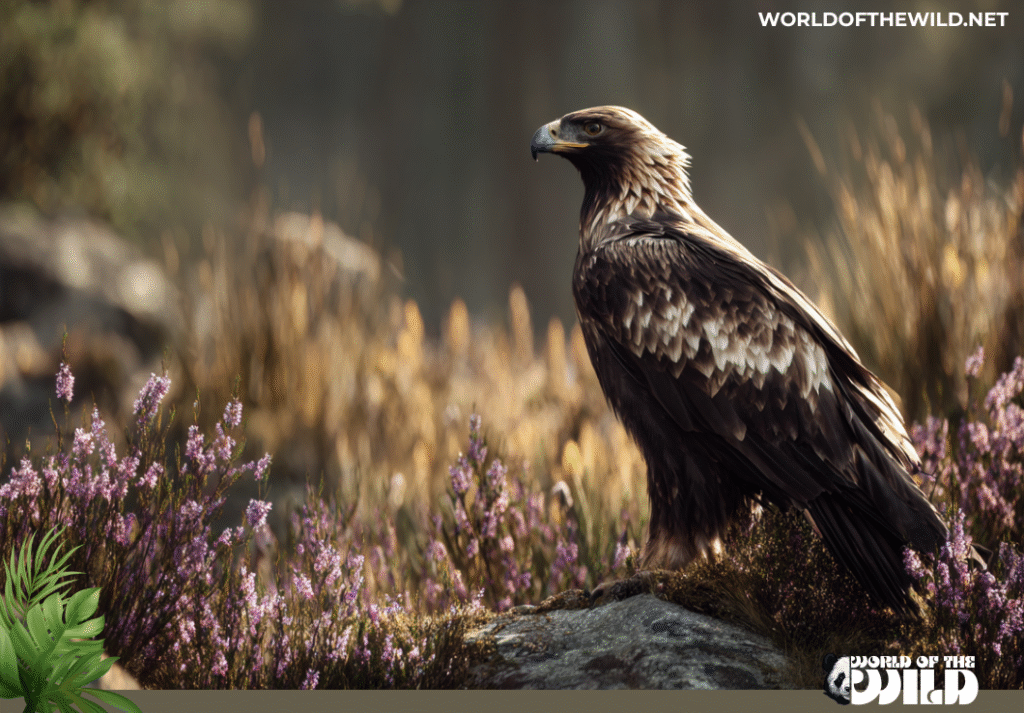
The Golden Eagle is among the largest and most powerful raptors in the world.
- Size and Weight: The average length of the body is between 2.2 and 3.3 feet (66–100 cm). Males typically weigh 6.8 to 11.5 pounds (3.1–5.2 kg), while the slightly larger females can weigh up to 8.1 to 15.1 pounds (3.7–6.8 kg).
- Wingspan: Their majestic wingspan generally ranges from 6 to 7.5 feet (1.8 to 2.3 meters), providing a massive surface area for soaring on thermals.
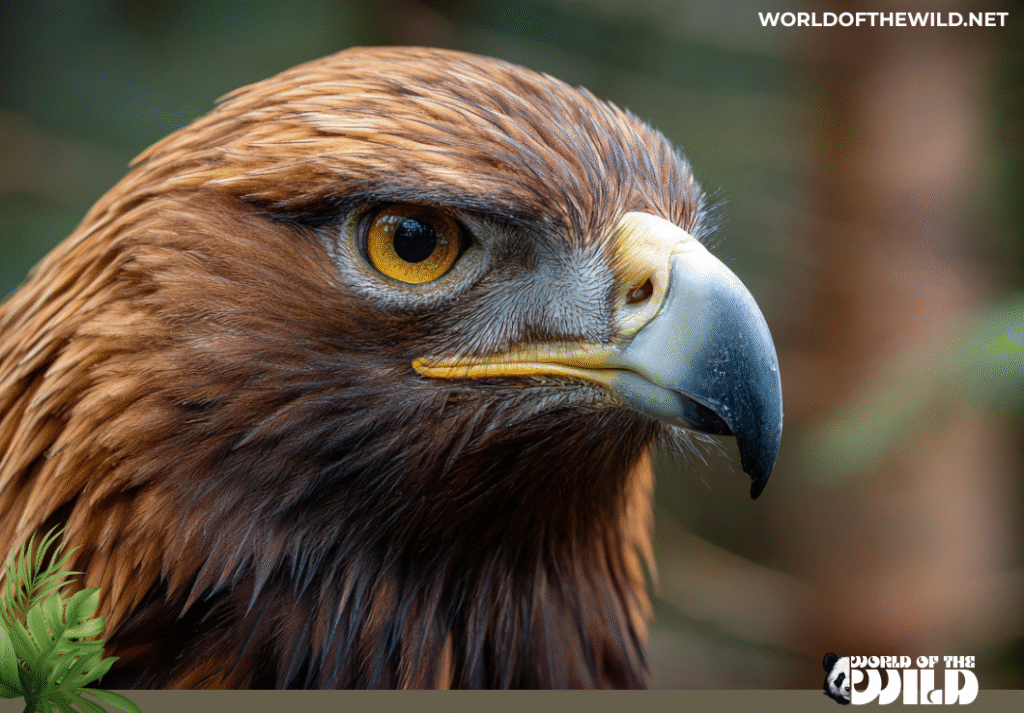
- Coloration and Distinctive Features: Adults are a deep, uniform dark brown across their bodies. Their most distinctive feature is the patch of contrasting golden-brown or tawny, lanceolate feathers on the back of the neck and crown—the source of their common name. They possess a massive, hooked bill, powerful legs, and formidable, razor-sharp talons. Juvenile eagles have white patches at the base of the tail and sometimes on the wings, which they lose completely after their fifth or sixth year.
Behavior
Golden Eagles are typically solitary or found in monogamous pairs that maintain vast territories, often defending them fiercely year-round.
- Daily and Social Behaviors: Much of their day is spent soaring, patrolling their territory, or perched atop high vantage points to survey the landscape for prey. The pair bond is strong, often lasting for life. Mates engage in spectacular aerial courtship displays, involving impressive undulating sky-dances and breathtaking dives.
- Communication: Their vocalizations are surprisingly minimal for such a large bird. They typically use a variety of high-pitched, thin whistles, yelps, or chirps, mainly near the nest. Their most critical form of communication, however, is visual, using their flight and posture to signal ownership and dominance.
- Notable Adaptations: The stoop, or hunting dive, is their most notable action. They can reach speeds approaching 150 mph (240 km/h) in a dive, making them one of the fastest animals on Earth. They also exhibit remarkable intelligence and learned behaviors, such as cooperative hunting strategies where one bird distracts the prey while the other attacks.
Evolution
The genus Aquila belongs to a group known as the booted eagles (eagles with feathered legs), which have a long evolutionary history.
- Ancient Lineage: The earliest known fossil records for the Aquila genus date back to the late Miocene epoch, suggesting their ancestors were already established millions of years ago.
- Evolutionary Milestones: The Golden Eagle is considered one of the most ancient living members of its genus. Its success is attributed to its massive size, which allowed it to occupy the niche of a top avian predator capable of taking down large prey—a critical advantage in fluctuating Ice Age ecosystems. Its Holarctic distribution suggests it successfully colonized vast new territories, adapting its hunting techniques and diet to various environments from mountains to deserts. The Golden Eagle represents an ancient lineage of apex raptors, relatively unchanged in its supreme design for aerial hunting.
Habitat
Golden Eagles have one of the largest geographical ranges of any raptor, living throughout the Holarctic region (North America, Europe, Asia, and North Africa).
- Geographic Range: From the Alaskan tundra to the arid steppes of Mongolia and the mountains of Morocco.
- Specific Environment: They are adaptable but prefer environments that offer a mix of open country and elevated areas. This includes:
- Mountainous regions and high elevations.
- Open moorlands, plateaus, and rolling hills.
- Cliffs, canyons, and steep rock faces for nesting and roosting.They thrive where human development is minimal, ensuring clear lines of sight for hunting and undisturbed nesting sites.
Diet
The Golden Eagle is a pure carnivore, an opportunistic and powerful apex predator.
- Primary Food Sources: Their diet is varied, but the vast majority consists of small to medium-sized mammals. Key prey includes:
- Rabbits and hares (often the primary food source).
- Ground squirrels, marmots, and prairie dogs.
- Game birds (grouse, pheasants).
- Mid-sized mammals like foxes, young deer, and even domestic livestock (though rarely).
- Carrion (especially in winter).
- Hunting/Foraging: The eagle primarily hunts by soaring high and then initiating a rapid, powerful stoop when prey is sighted. They strike with incredible force, using their massive talons to instantly dispatch the animal. They may also employ low-altitude contour flight to surprise prey in open country.
Predators and Threats
As an apex predator, adult Golden Eagles have few natural predators.
- Natural Predators: While rare, a larger eagle (like the Harpy Eagle in the few places where their ranges overlap) or sometimes a Goshawk may pose a threat to fledglings. The primary natural threat is to eggs and nestlings from mammals like wolverines, bears, or raccoons, depending on the region.
- Anthropogenic Threats (Human-Caused):
- Habitat Loss and Fragmentation: The expansion of human settlements, resource extraction, and development encroaches on their vast required territories and breeding sites.
- Wind Energy Development: Eagles are highly susceptible to collision with turbine blades, especially when these facilities are built along migration or foraging routes.
- Persecution (Historical and Current): Despite legal protections, some eagles are still illegally shot, trapped, or poisoned due to perceived conflicts with livestock and game animals.
- Lead Poisoning: Eagles often scavenge on carrion left by hunters (e.g., gut piles) that contain lead bullet fragments, leading to chronic and fatal lead poisoning.
Reproduction and Life Cycle
Golden Eagles are generally monogamous, forming pair bonds that can last for many years, often for life.
- Mating Rituals and Gestation: Courtship involves elaborate aerial displays, which reaffirm the pair bond. In the early spring (February–April), the female lays 1 to 4 eggs, typically 2.
- Parental Care and Offspring: The female handles the bulk of the incubation, which lasts 40 to 45 days. The male provides food. A common phenomenon called cainism often occurs, where the older, stronger nestling kills its younger sibling(s) to monopolize the food provided by the parents. Fledging (first flight) occurs at 10 to 12 weeks. The young remain dependent on the parents for food and training for another 1 to 3 months.
- Life Cycle and Lifespan: They reach sexual maturity at around 4 to 7 years. In the wild, their average lifespan is 20 to 25 years, but individuals in captivity have been known to live for over 45 years.
Population
The Golden Eagle is currently classified by the IUCN Red List as Least Concern (LC).
- Global Population Estimate: The global population is estimated to be large, likely in the tens of thousands of mature individuals (perhaps 100,000 to 200,000 birds).
- Population Trends: While globally classified as Least Concern, the population trend is generally considered decreasing in some parts of its range, particularly in Europe and the eastern U.S., due to the threats mentioned above. However, its overall stability across its massive range prevents a more threatened classification. Conservation efforts, like the management of protected areas and the removal of lead ammunition from hunting, are critical to ensuring the species remains robust.
Conclusion
The Golden Eagle is an unparalleled example of evolutionary perfection, a raptor whose power, eyesight, and mastery of the air have allowed it to thrive across half the globe for millennia. From its regal golden mantle to its breakneck stooping speed, every aspect of its life story speaks to the wild, untamed forces of nature.
However, even the most formidable creatures are vulnerable to the subtle but relentless pressures of the modern world. The shadow of wind turbines, the threat of lead, and the loss of its open hunting grounds pose continuous challenges. We must recognize the Golden Eagle as a crucial bellwether for the health of our remote ecosystems. Its fate is inextricably linked to our commitment to preserving the wild spaces it calls home. Let us ensure that this Monarch of the Sky continues to grace our horizons for generations to come.