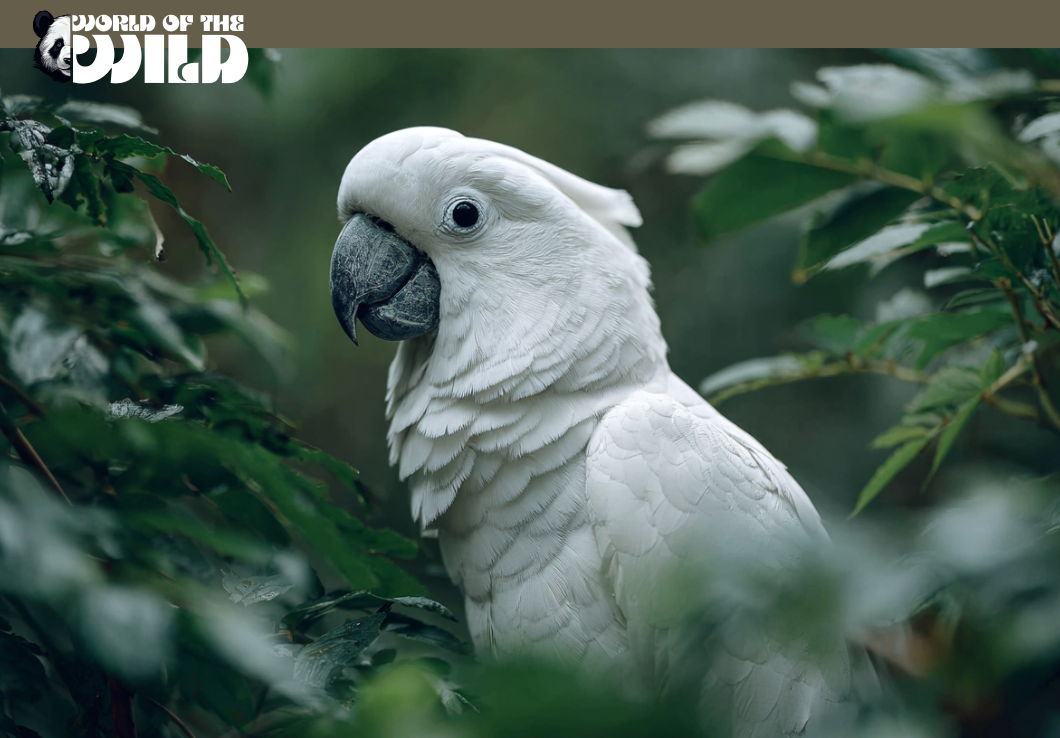

In the lush canopy of Indonesia’s tropical forests, a flash of salmon-pink catches the eye—a magnificent Moluccan Cockatoo extending its spectacular crest in a display of pure avian artistry. Known locally as “raja kakatua” or “king of the cockatoos,” this charismatic parrot is among the most beloved and striking members of the cockatoo family. With their affectionate personalities, impressive intelligence, and stunning appearance, Moluccan Cockatoos have captivated humans for centuries. Yet behind their beauty lies a species facing serious conservation challenges, making them not just fascinating subjects of natural history, but urgent reminders of our responsibility to protect the world’s biodiversity.
Facts
- Loudest Birds on Earth: Moluccan Cockatoos can produce calls reaching up to 135 decibels—louder than a rock concert and comparable to a jet engine at takeoff. Their vocalizations can be heard over three miles away in their native forests.
- Lifelong Monogamy: These birds form exceptionally strong pair bonds, often mating for life and remaining devoted to their partners for decades. Pairs engage in mutual preening and synchronized movements throughout their lives.
- Tool Users: Moluccan Cockatoos demonstrate remarkable problem-solving abilities and have been observed crafting and using tools to extract food, manipulate objects, and even as weapons during territorial disputes.
- Powder Down Producers: Unlike most birds, they produce a fine white powder from specialized feathers that helps waterproof their plumage and keep it in pristine condition, giving them a distinctive soft texture.
- Dancing Ability: Research has confirmed that Moluccan Cockatoos can genuinely move to the beat of music, making them one of the few non-human animals capable of rhythmic synchronization.
- Extreme Longevity: In captivity, these birds regularly live 60-80 years, with some individuals documented living beyond 90 years, often outliving their human caretakers.
- Crop Milk Production: Like pigeons, parent Moluccan Cockatoos produce a nutritious substance called crop milk to feed their young during the first weeks of life.
Species
The Moluccan Cockatoo belongs to the following taxonomic classification:
- Kingdom: Animalia
- Phylum: Chordata
- Class: Aves
- Order: Psittaciformes
- Family: Cacatuidae
- Genus: Cacatua
- Species: Cacatua moluccensis
The Moluccan Cockatoo is part of the white cockatoo group within the genus Cacatua, which includes approximately 11 species. Its closest relatives include the Umbrella Cockatoo (Cacatua alba), found on nearby Indonesian islands, and the Salmon-crested Cockatoo populations that some taxonomists consider separate subspecies. Unlike some cockatoo species that have developed multiple distinct subspecies across varied ranges, the Moluccan Cockatoo is generally considered monotypic, meaning it has no formally recognized subspecies. However, slight variations in size and coloration have been noted among populations from different islands within the Moluccas archipelago.
Appearance
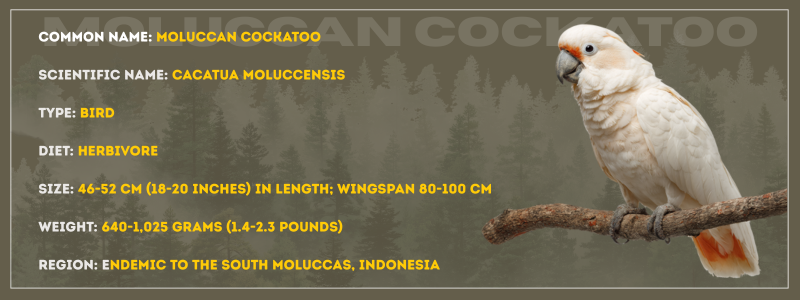
The Moluccan Cockatoo is a large and strikingly beautiful parrot, measuring 46-52 centimeters in length from beak to tail tip, with an impressive wingspan reaching 80-100 centimeters. Adults typically weigh between 640-1,025 grams, with males generally slightly larger and heavier than females, though the size difference is subtle.
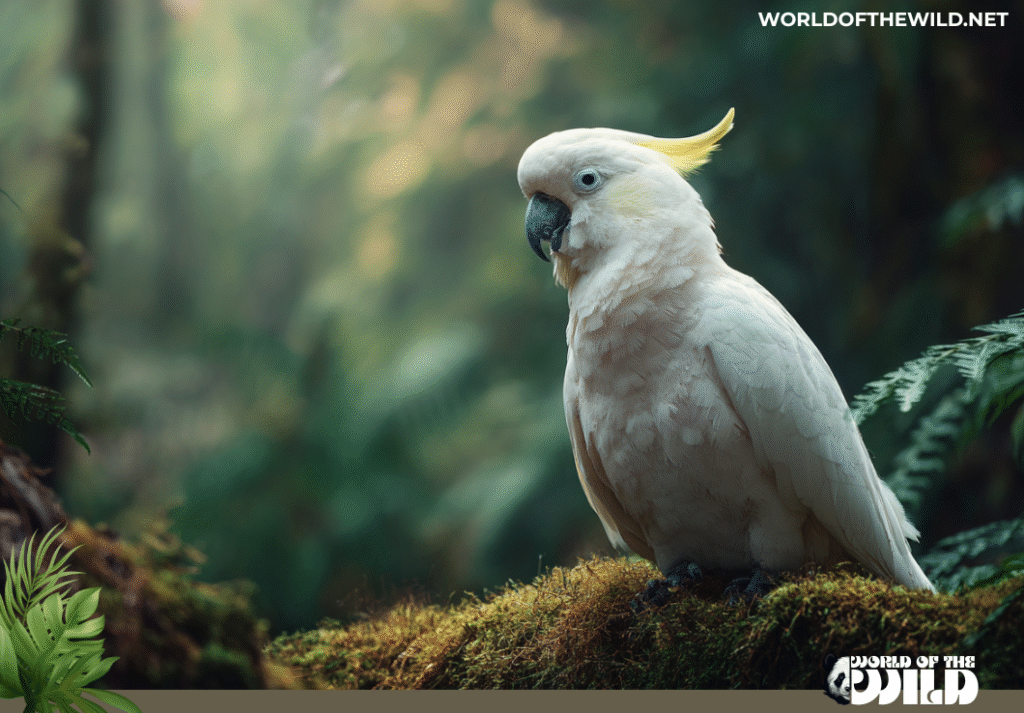
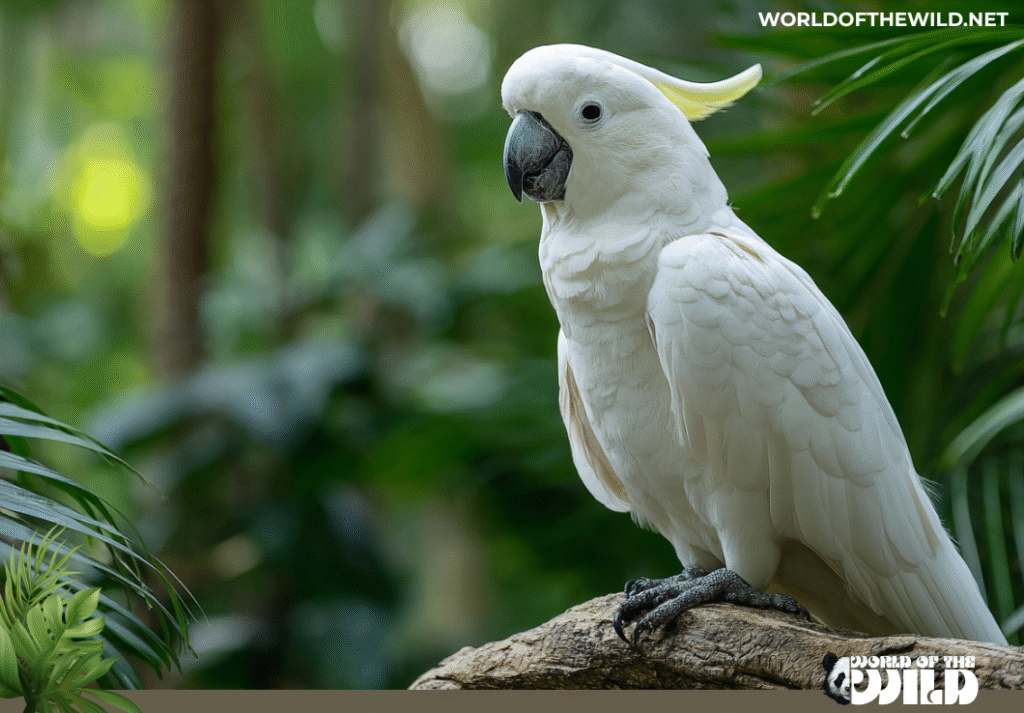
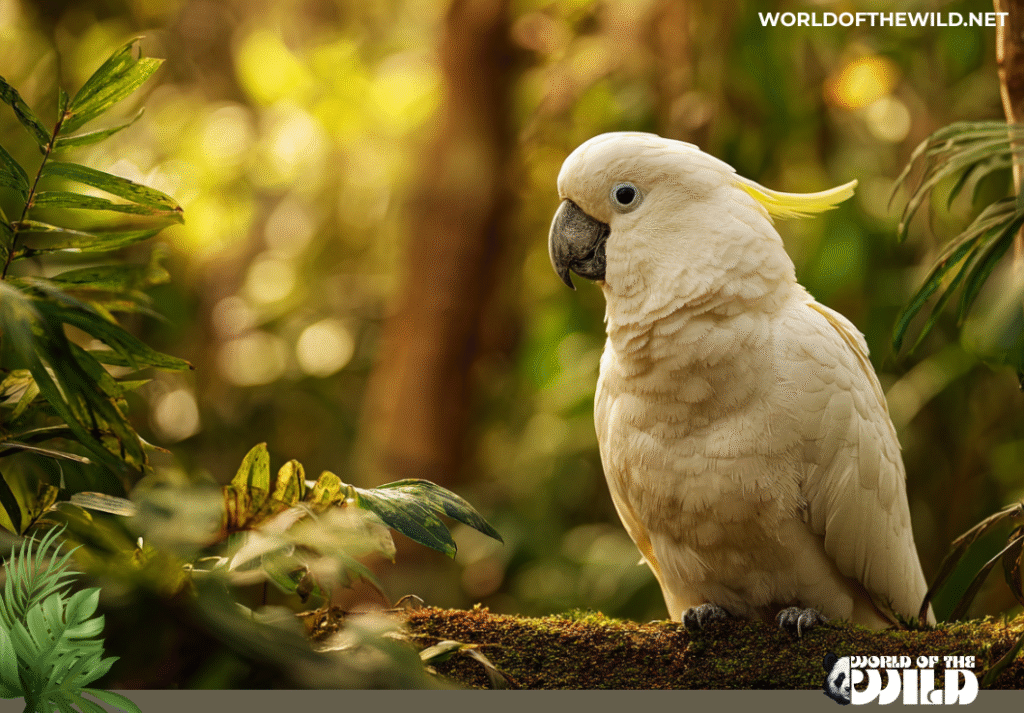
The plumage is predominantly white with a delicate peachy or salmon-pink suffusion throughout, particularly noticeable on the face, neck, and undersides of the wings and tail. This soft blush of color intensifies when the bird is excited or displaying. The most spectacular feature is undoubtedly the broad, retractable crest, which displays vibrant salmon-pink to deep coral-red inner feathers when raised, creating a stunning fan-shaped display. When lowered, the crest lies flat against the head, with only white outer feathers visible.
The beak is large, powerful, and black or dark gray, capable of exerting tremendous crushing force to crack the hardest nuts and seeds. The eyes are dark brown in males and reddish-brown in females—one of the few reliable ways to distinguish sexes in this species. The legs and zygodactyl feet (two toes facing forward, two backward) are gray, perfectly adapted for grasping branches and manipulating objects with remarkable dexterity.
Juvenile Moluccan Cockatoos resemble adults but have slightly duller coloration and shorter crest feathers, with eye color being the most reliable indicator of age and sex as birds mature.
Behavior
Moluccan Cockatoos are highly social, intelligent, and emotionally complex birds with behaviors that rival those of great apes in sophistication. In the wild, they are typically found in pairs or small family groups, though they may gather in larger flocks of 20-50 individuals at abundant food sources or roosting sites. These flocks demonstrate complex social hierarchies and maintain long-term relationships between individuals.
Their daily routine begins at dawn with loud vocalizations that serve to strengthen pair bonds and announce territorial boundaries. Morning hours are spent foraging in the forest canopy, where pairs or small groups move through the trees with agile climbing and short, powerful flights. During the heat of midday, they rest in shaded areas, engaging in extensive mutual preening sessions that reinforce social bonds and maintain feather condition.
Communication among Moluccan Cockatoos is remarkably sophisticated, involving a wide repertoire of vocalizations including whistles, screeches, growls, and softer contact calls. They also use body language extensively—crest position indicates emotional state, with a raised crest signaling excitement, alarm, or aggression, while wing displays and head bobbing play roles in courtship and social interaction.
Intelligence is a hallmark of this species. Studies have demonstrated their ability to solve multi-step puzzles, understand cause-and-effect relationships, and even demonstrate insight learning—solving problems through mental planning rather than trial and error. They can recognize themselves in mirrors, showing self-awareness, and they demonstrate object permanence and basic counting abilities. In captivity, they can learn to mimic human speech and sounds from their environment, though they’re not as prolific talkers as some other parrot species.
Moluccan Cockatoos are also remarkably playful throughout their lives, engaging in acrobatic displays, object manipulation, and social games. This playfulness is thought to serve important roles in developing problem-solving skills and maintaining social cohesion.
Evolution
The evolutionary history of cockatoos traces back approximately 50-60 million years to the early Paleogene period, shortly after the extinction of non-avian dinosaurs. Fossil evidence and molecular studies suggest that the cockatoo family (Cacatuidae) diverged from other parrots early in parrot evolution, making them one of the most ancient parrot lineages.
The ancestors of modern cockatoos likely originated in Australasia, during a time when the Australian continent was still connected to Antarctica as part of Gondwana. As continents drifted apart and the Australian-Indonesian archipelago formed, cockatoo populations became isolated on different landmasses, leading to the diversification we see today.
The Moluccan Cockatoo’s evolution was shaped by its island environment in the Maluku Islands of Indonesia. Island isolation drove the development of its distinctive characteristics—the vibrant salmon-pink coloration likely evolved through sexual selection, as individuals with more striking crests gained mating advantages. The species’ powerful beak evolved in response to the hard nuts and seeds available in its forest habitat, while its intelligence developed as an adaptation to finding and exploiting scattered, seasonal food resources in complex rainforest environments.
Molecular clock analyses suggest that the white cockatoo group, to which the Moluccan Cockatoo belongs, diverged from other cockatoo lineages approximately 20-30 million years ago during the Oligocene and Miocene epochs. The specific emergence of Cacatua moluccensis as a distinct species likely occurred within the last several million years as the Indonesian archipelago took its modern form and volcanic activity created isolated island populations.
Habitat
The Moluccan Cockatoo is endemic to the South Moluccas in eastern Indonesia, with its range restricted to the islands of Seram, Ambon, Saparua, and Haruku. This limited geographic distribution makes the species particularly vulnerable to habitat changes and human pressures.
These birds inhabit lowland tropical rainforests and montane forests, typically at elevations below 1,000 meters, though they occasionally range to higher altitudes. Their preferred habitat consists of primary and mature secondary forests with tall, dense canopy coverage that provides abundant food sources and suitable nesting sites. They show a particular preference for areas near forest edges, river valleys, and partially cleared areas where fruiting trees are abundant.
The forest environment of the Moluccas is characterized by high biodiversity, heavy rainfall distributed throughout the year, and a complex multi-layered canopy structure. These forests feature emergent trees reaching 40-50 meters in height, creating the tall cavities essential for Moluccan Cockatoo nesting. The understory is dense with palms, ferns, and flowering plants, while the canopy provides the fruits, nuts, and seeds that form the birds’ diet.
Moluccan Cockatoos require large territories and old-growth trees with natural cavities for breeding, making intact forest habitat absolutely essential for their survival. They demonstrate strong site fidelity, often returning to the same roosting and nesting sites year after year, sometimes for generations.
Diet
Moluccan Cockatoos are primarily herbivorous, with a diet consisting mainly of fruits, nuts, seeds, flowers, and nectar. Their powerful beaks are perfectly adapted to their feeding ecology, allowing them to access food sources unavailable to smaller-beaked species.
Their primary food sources include the fruits and nuts of various native trees such as kanari nuts, various palm fruits, figs, and durian. They feed extensively on coconuts, using their impressive beak strength to tear open the tough outer husk and crack the inner shell—a feat requiring tremendous force. Seeds from various forest trees, including those from the Canarium family, form another staple food source.
The diet varies seasonally based on fruit availability. During fruiting seasons, they may focus heavily on particular abundant food sources, while during leaner periods they supplement with flowers, buds, leaf shoots, and insect larvae extracted from tree bark. They occasionally consume soil from mineral licks, likely to obtain essential minerals and to help neutralize toxins found in some of their food plants.
Moluccan Cockatoos are primarily canopy feeders, spending most of their foraging time high in the trees. They are remarkably acrobatic, often hanging upside down from branches to reach fruits and using their feet to manipulate food items while eating. They typically feed in the early morning and late afternoon, with peak activity coinciding with cooler temperatures.
Their feeding behavior plays an important ecological role in their forest ecosystem. As they consume fruits and seeds, they serve as seed dispersers, helping to regenerate the forest. Their habit of dropping partially eaten fruits also provides food for ground-dwelling animals.
Predators and Threats
In their natural habitat, adult Moluccan Cockatoos face relatively few natural predators due to their size, powerful beaks, and alertness. However, eggs and chicks are vulnerable to arboreal predators including monitor lizards, tree snakes, and occasionally birds of prey such as hawks and eagles. Introduced predators like rats have also become significant threats to nesting success on some islands.
The far greater threats to Moluccan Cockatoos are anthropogenic in nature. Habitat loss represents the primary danger facing the species. Large-scale logging operations, agricultural conversion for coconut and palm oil plantations, and human settlement expansion have dramatically reduced the available old-growth forest habitat. Between 1972 and 2014, Seram lost approximately 15% of its forest cover, with degradation continuing at alarming rates.
The illegal wildlife trade poses an equally devastating threat. Moluccan Cockatoos have been heavily targeted for the international pet trade due to their beauty, intelligence, and affectionate nature. Thousands of birds have been captured from the wild over the past decades, with smuggling operations continuing despite legal protections. The removal of breeding adults from wild populations has had cascading effects on population viability.
Climate change presents an emerging threat, potentially altering rainfall patterns, affecting food availability, and increasing the frequency of extreme weather events that can destroy nesting sites and reduce breeding success. Rising sea levels may also impact low-lying coastal forest habitats.
Additional pressures include persecution by farmers who view them as crop pests when they feed on coconut plantations, traditional hunting for feathers and cultural purposes in some communities, and competition for nest cavities from introduced species like European honeybees.
Reproduction and Life Cycle
Moluccan Cockatoos are monogamous, forming pair bonds that typically last for life. Courtship involves elaborate displays where males raise their magnificent salmon-pink crests, bob their heads, spread their wings, and perform vocal displays while dancing for the female. Pairs engage in mutual preening, feeding behaviors, and synchronized movements that strengthen their bond.
The breeding season typically occurs during the drier months, roughly from December to March, though timing can vary based on local conditions and food availability. Nesting sites are located in cavities of large, old-growth trees, typically at heights of 10-30 meters above the ground. Competition for suitable cavities is intense, and pairs may defend the same nesting site for many years.
The female usually lays 2-3 white eggs, though clutches of just one egg are not uncommon. Incubation lasts approximately 28-30 days and is shared by both parents, though the female typically spends more time on the nest while the male guards and provides food. Both parents are highly protective of the nest and will aggressively defend it against potential threats.
Chicks hatch altricial—blind, naked, and completely dependent on parental care. Both parents feed the young through regurgitation, initially providing crop milk before transitioning to partially digested seeds and fruits. The young develop slowly, with feathers emerging after several weeks and eyes opening around 2-3 weeks of age.
Fledging occurs at approximately 12-14 weeks of age, but the young remain dependent on their parents for several months afterward, learning essential foraging and social skills. Young birds typically stay with their parents for up to a year, and sexual maturity is not reached until 4-6 years of age.
In the wild, Moluccan Cockatoos can live 40-60 years, though many individuals likely experience shorter lifespans due to predation, disease, and environmental pressures. In captivity with proper care, they routinely live 60-80 years, with exceptional individuals reaching their 90s, making them among the longest-lived bird species.
Population
The Moluccan Cockatoo is currently classified as Vulnerable on the IUCN Red List of Threatened Species, reflecting serious concerns about population decline and ongoing threats. Previous assessments classified the species as Endangered, and without effective conservation intervention, further deterioration of status remains a significant risk.
Estimating precise population numbers for wild Moluccan Cockatoos is challenging due to their remote island habitat and the cryptic nature of their forest environment. Current estimates suggest a total wild population of approximately 2,500-10,000 mature individuals, though some researchers believe actual numbers may be even lower. The population trend is decreasing, with declines estimated at 30-50% over the past three generations (roughly 60 years).
The largest remaining population is found on Seram Island, where forest habitat remains relatively extensive in some areas. However, even on Seram, the species has become locally extinct in many areas where it was formerly common. Populations on Ambon, Saparua, and Haruku are critically small and highly fragmented, facing imminent risk of local extinction.
Several conservation initiatives are underway to protect remaining populations. These include habitat protection through national park designation, anti-poaching patrols to combat illegal trapping, community education programs, and captive breeding efforts to reduce pressure on wild populations. International trade is regulated under CITES Appendix I, which prohibits commercial trade in wild-caught individuals.
Conclusion
The Moluccan Cockatoo stands as a testament to the incredible beauty and complexity that evolution has produced in Indonesia’s island ecosystems. From its spectacular salmon-crested display to its remarkable intelligence and emotional depth, this species embodies the wonder of the natural world. Yet the challenges facing wild populations remind us that beauty alone cannot protect a species from the pressures of habitat destruction and exploitation.
The survival of the Moluccan Cockatoo depends on our collective commitment to preserving Indonesia’s remaining rainforests and ending the illegal wildlife trade. Every old-growth tree that falls diminishes the available nesting sites these birds desperately need. Every bird captured for the pet trade leaves a gap in the forest that cannot be filled for generations. By supporting conservation organizations, choosing not to purchase wild-caught parrots, and raising awareness about the plight of endangered species, we can all play a role in ensuring that future generations will still hear the magnificent calls of wild Moluccan Cockatoos echoing through the forests of the Moluccas. The king of the cockatoos deserves nothing less than our very best efforts to secure its kingdom for centuries to come.
Scientific Name: Cacatua moluccensis
Diet Type: Herbivore (frugivore/granivore)
Size: 46-52 cm (18-20 inches) in length; wingspan 80-100 cm
Weight: 640-1,025 grams (1.4-2.3 pounds)
Region Found: Endemic to the South Moluccas, Indonesia (Seram, Ambon, Saparua, and Haruku islands)