
Introduction
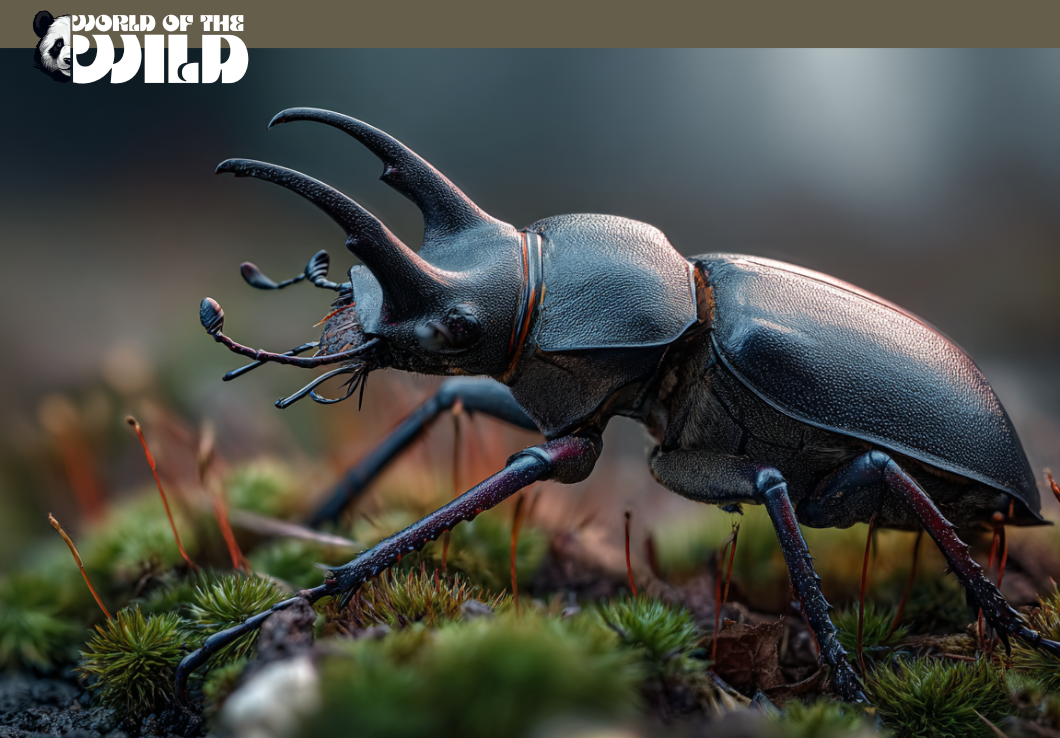
Picture a creature straight out of a forgotten fable, a miniature, armored warrior with formidable, antler-like jaws that command respect. This is the Stag Beetle (Lucanus cervus), a magnificent insect whose very appearance captivates the imagination. Often considered the largest terrestrial beetle in Europe, the male stag beetle, with its imposing mandibles, is one of nature’s most stunning examples of sexual dimorphism. It is a vital, yet often overlooked, recycler of decaying wood, playing a crucial role in maintaining the health of our woodlands. Join us as we delve into the hidden life of this fascinating, but increasingly vulnerable, woodland giant.
Facts
Here are 5 quick, intriguing, and less common facts about the Stag Beetle:
- Jaws for Show, Not for Go: The male’s enormous mandibles, which resemble the antlers of a male deer (hence the name “stag”), are primarily used for wrestling with rival males over females and prime feeding sites, not for aggressive biting of other creatures.
- The Long, Hidden Childhood: A Stag Beetle spends the vast majority of its life—up to 5 to 7 years—underground as a larva, silently feeding on decaying wood before emerging for its brief adult life.
- Silent Communication: During its larval stage, the grub communicates with its siblings by making audible squeaking or clicking sounds called stridulation, rubbing its legs together to signal its presence.
- A Brief Flight: Despite their size, adult stag beetles are capable of flight, though they are often described as being clumsy or awkward flyers, frequently observed flying low to the ground at dusk during warm summer evenings.
- A “Rare” Treat: In some cultures, particularly historical European societies, the Stag Beetle was associated with various superstitions, sometimes viewed as a symbol of protection, and in others, mistakenly believed to carry fire.

Species
👑 Classification
The Stag Beetle belongs to a well-defined taxonomic hierarchy:
| Rank | Taxon |
| Kingdom | Animalia (Animals) |
| Phylum | Arthropoda (Arthropods) |
| Class | Insecta (Insects) |
| Order | Coleoptera (Beetles) |
| Family | Lucanidae (Stag Beetles) |
| Genus | Lucanus |
| Species | L. cervus (European Stag Beetle) |
🌳 Related Species
The family Lucanidae contains over 1,200 known species globally. The genus Lucanus itself includes many striking members, but a few notable relatives outside of the European Stag Beetle (L. cervus) include:
- Odontolabis cuvera (Golden Stag Beetle): Found in Southeast Asia, known for its incredible size and striking, often reddish-brown and black, coloration.
- Dorcus titanus (Giant Stag Beetle): One of the largest beetles in the world, distributed across Asia, famed for its exceptionally strong, curved mandibles.
- Platycerus species (Small Stag Beetles): A genus of smaller, metallic-colored stag beetles found in temperate regions, often overlooked but equally important for decomposition.
Appearance
The Stag Beetle is a large, sturdy insect. The males of the European Stag Beetle (L. cervus) are the most striking, reaching lengths of up to 7.5 cm (3 inches), including their mandibles, making them the largest terrestrial beetle in Europe. Females are smaller, typically reaching lengths of only 3-5 cm.
- Size and Weight: The males are significantly larger and heavier than the females.
- Color: The beetle has a distinct coloration; the head and thorax are usually glossy black, while the elytra (hardened forewings) are a rich, chestnut-brown or mahogany color.
- Distinctive Features:
- Male Mandibles (Antlers): The most defining feature. These are massive, curved, and have small, tooth-like projections. They are modified mouthparts that look formidable but are generally not strong enough to harm a person; they’re used like wrestling props.
- Female Mandibles: The female’s mandibles are much smaller and appear more practical and sharp, as she uses them to dig and bore into wood to lay her eggs.
- Antennae: Both sexes possess characteristic elbowed antennae with a fan-like cluster of small plates at the tip, which they can open and close for smelling.

Behavior
🏃 Daily and Social Life
Stag beetles are largely solitary creatures, especially as adults. The adult phase is primarily focused on mating and, for the female, egg-laying. They are crepuscular or nocturnal, meaning they are most active during the twilight hours of dawn and dusk, or throughout the night, particularly during warm summer months (late May to early August).
🥋 Noteworthy Adaptations
- Mandible Wrestling: The male’s most notable behavior is the ritualistic fighting using their large mandibles. Two males will face off and try to lift and flip the opponent onto its back. The winner earns the right to mate with the female or access a coveted food source.
- Sap Feeding: Adult beetles often feed by licking up tree sap. They are attracted to wounded or oozing trees, or fermenting fruit. They may use their small, specialized mouthparts underneath their large mandibles for this purpose.
- Burrowing: Females are excellent diggers, using their small, strong mandibles to bore into decaying wood or soil near it to lay their eggs safely, ensuring the larvae have immediate access to food.
Evolution
Stag beetles belong to one of the most ancient lineages of insects. The Order Coleoptera (beetles) is the largest order of insects, with its origins stretching back to the Permian period, over 280 million years ago.
The family Lucanidae is part of the Scarabaeiformia infraorder, which includes scarab beetles and chafers, sharing a common ancestor that evolved from earlier, less-specialized beetles. Key milestones in the stag beetle’s evolution include:
- The Rise of Decay Eaters: Their specialized larval diet of decaying wood (saproxylic diet) evolved alongside the development of vast forests in the Mesozoic era, allowing them to exploit a rich, stable, and relatively predator-free niche.
- Sexual Selection: The evolution of the male’s exaggerated mandibles is a classic example of sexual selection, where a feature (even if cumbersome) is strongly favored by females or gives a male a competitive advantage over rivals, leading to its extreme development over evolutionary time.
Habitat
🌎 Geographic Range
The European Stag Beetle (L. cervus) has a wide, though fragmented, distribution across much of Europe, extending from southern Scandinavia down to North Africa and eastwards into parts of Iran. Key populations are found in the UK (mostly the southeast), France, Germany, and Spain.
🌲 Specific Environment
Stag beetles are saproxylic—meaning they depend on decaying wood at some stage of their life cycle. Their preferred habitat is:
- Broadleaf Woodlands: Deciduous forests, especially oak, beech, and cherry, which provide the large amounts of decaying wood needed for their long larval stage.
- Old Parkland and Gardens: They can also thrive in managed parkland, large gardens, and orchards, provided there are plenty of old stumps, logs, and wood chips buried in the soil.
- Warm, Moist Soil: The female lays her eggs in or near rotting wood that is partially buried in the soil, which helps maintain the moisture and temperature necessary for the grubs’ long development.
Diet
🍽️ Diet Type
The Stag Beetle’s diet changes drastically between its life stages:
- Larva (Grub): Herbivore/Detritivore. The primary and most significant diet phase. The large, C-shaped grubs feed almost exclusively on decaying, white-rotted wood that is breaking down in the soil or in stumps. They rely on the fungi within the wood to partially break it down, making the cellulose and lignin digestible.
- Adult: Herbivore. Adults have very limited feeding requirements. They consume tree sap and the juice of fermenting, overripe fruit, which they lap up using brush-like structures under their mandibles. They do not eat solid wood.
🍴 Foraging
The adult’s foraging is simple: they fly at dusk to locate trees wounded by other insects or animals, or where sap naturally oozes out, and they settle to feed. The larvae, by contrast, spend years in a single location, continuously burrowing through and consuming the decaying wood around them.

Predators and Threats
🦊 Natural Predators
While the hard, armored shell of the adult provides some defense, and the subterranean life of the larva protects it from many threats, natural predators include:
- Birds: Crows, magpies, and other large birds often prey on slow-moving adult stag beetles.
- Mammals: Foxes, badgers, and hedgehogs will opportunistically eat both the adult beetles and the grubs they unearth.
- Parasites: Some flies, mites, and parasitic wasps can target the larvae.
🚧 Anthropogenic Threats (Human-Caused)
The greatest dangers to the Stag Beetle are directly linked to human activities:
- Habitat Loss and Fragmentation: The wholesale clearance of ancient woodlands and the “tidying” of gardens and parks (removing old stumps, fallen logs, and dead wood) eliminates the critical food source and nursery for the larvae. This is the primary threat.
- Pesticides: Chemical sprays and pesticides used in gardens and agriculture can be toxic to both the adult beetles and the larvae.
- Road Mortality: Adults, especially males in flight looking for mates, are often killed by traffic on roads that fragment their habitat.
- Misconceptions: Fear of the formidable-looking beetle can sometimes lead to people killing them, though they are completely harmless to humans.
Reproduction and Life Cycle
💖 Mating Rituals
Mating typically occurs in the summer (June to August). Males engage in dramatic, often slow-motion, wrestling matches with their mandibles to establish dominance and win the right to mate with a female.
🥚 Offspring and Life Cycle
The Stag Beetle undergoes complete metamorphosis (egg $\rightarrow$ larva $\rightarrow$ pupa $\rightarrow$ adult).
- Egg: After mating, the female digs into the soil, usually near rotting wood, and lays her eggs (30-50 eggs).
- Larva (Grub): The C-shaped grub hatches and spends the next 4 to 7 years feeding on decaying wood. This is the longest and most critical stage. The larvae are large, reaching up to 10 cm.
- Pupa: Once fully grown, the larva forms a large, fist-sized earthen cocoon (pupal chamber) in the soil next to the rotting wood. It then pupates, undergoing transformation into the adult form.
- Adult: The adult beetle emerges from the pupa in late autumn, but often remains in the pupal chamber over winter, only emerging to the surface the following summer to mate. The adult lifespan is very brief, lasting only a few weeks to a few months.
Population
🛡️ Conservation Status
The conservation status of the European Stag Beetle (L. cervus) varies across its range, but internationally it is classified on the IUCN Red List as Near Threatened (NT).
- In some regions, particularly the UK, it is highly protected and listed as a vulnerable species, facing significant declines.
📉 Population Trends
The global population is difficult to estimate precisely due to the beetle’s hidden lifestyle, but the general trend across Europe is one of decline. The primary driver of this decline is the removal of deadwood from forests, parks, and gardens, essentially destroying their larval food source and nursery. Efforts like log piles and designated deadwood habitats are crucial for supporting local populations.
Conclusion
The Stag Beetle, with its armored physique and majestic, antler-like mandibles, is far more than just a giant garden insect—it is an ancient and essential worker of our woodlands. Its long, hidden larval life as a diligent decomposer highlights the critical importance of deadwood in a healthy ecosystem, a resource too often cleared away by human hands.
To secure the future of the Knight of the Forest Floor, we must shift our perception of “untidiness” in nature. By leaving behind a fallen log, keeping an old stump, or creating a simple log pile, we are providing a nursery for the next generation of this magnificent beetle. We must learn to love and preserve the ‘messy’ parts of our environment, for that is where the Stag Beetle makes its home and performs its vital, quiet work.