
There are snakes, and then there is the Black Mamba. Few creatures on Earth command the same cocktail of awe, dread, and fascination as Dendroaspis polylepis — a reptile so deadly, so fast, and so eerily intelligent in its behavior that it has earned a mythological status far beyond its African homeland. It is the longest venomous snake on the African continent, one of the fastest land snakes in the world, and the bearer of a neurotoxic venom so potent that, without antivenom, a single bite carries a mortality rate approaching 100%. And yet, despite its terrifying reputation, the Black Mamba is a creature of remarkable elegance — a precision-engineered predator that has spent millions of years perfecting the art of survival. Whether you encounter it in the pages of wildlife literature, on a nature documentary, or, if you are extremely unlucky, in the wild savannas of sub-Saharan Africa, one thing is certain: the Black Mamba demands your attention.
Facts
- The name is a bluff. The Black Mamba is not actually black. Its skin ranges from olive to brownish-gray. The “black” refers to the inky, coal-dark interior of its mouth — which it dramatically gapes open as a warning display when threatened.
- It can outrun a sprinting human over short distances. The Black Mamba has been recorded moving at speeds of up to 12.5 miles per hour (20 km/h), making it the fastest land snake on Earth. Most people, especially in a state of panic, cannot consistently outpace it.
- A single bite can deliver enough venom to kill ten adult humans. The snake injects between 100 and 400 milligrams of venom per strike, and as little as 10–15 milligrams is considered a lethal dose for an adult.
- It strikes multiple times in rapid succession. Unlike many snakes that deliver a single defensive bite, the Black Mamba may strike two, three, or more times in one encounter, dramatically increasing the venom load delivered to a victim.
- It can raise a third of its body off the ground. When confronting a threat, the Black Mamba rears up to chest height on a human, opening its distinctive black mouth — a behavior designed to intimidate rather than immediately attack.
- Untreated bites cause death within 7 to 15 hours. The venom attacks the nervous system with catastrophic speed, causing a cascade of symptoms from tingling and dizziness to respiratory paralysis and cardiac arrest.
- Despite its fearsome reputation, it prefers retreat over confrontation. Given the chance, a Black Mamba will almost always choose escape. Its aggression is largely defensive — it attacks when cornered, startled, or threatened.
Species
The Black Mamba belongs to one of the most well-defined and studied lineages of venomous snakes in the world.
Full Taxonomic Classification:
| Rank | Classification |
|---|---|
| Kingdom | Animalia |
| Phylum | Chordata |
| Class | Reptilia |
| Order | Squamata |
| Family | Elapidae |
| Genus | Dendroaspis |
| Species | Dendroaspis polylepis |
The genus Dendroaspis, meaning “tree snake” in Greek, contains four recognized mamba species. The Black Mamba (D. polylepis) is the largest and most terrestrial of the group. Its closest relatives include the Eastern Green Mamba (Dendroaspis angusticeps), the Western Green Mamba (Dendroaspis viridis), and Jameson’s Mamba (Dendroaspis jamesoni) — all of which are smaller, more arboreal, and generally less aggressive. The Black Mamba is currently recognized as having no distinct subspecies, though regional size and coloration variation has been noted across its geographic range.
Appearance
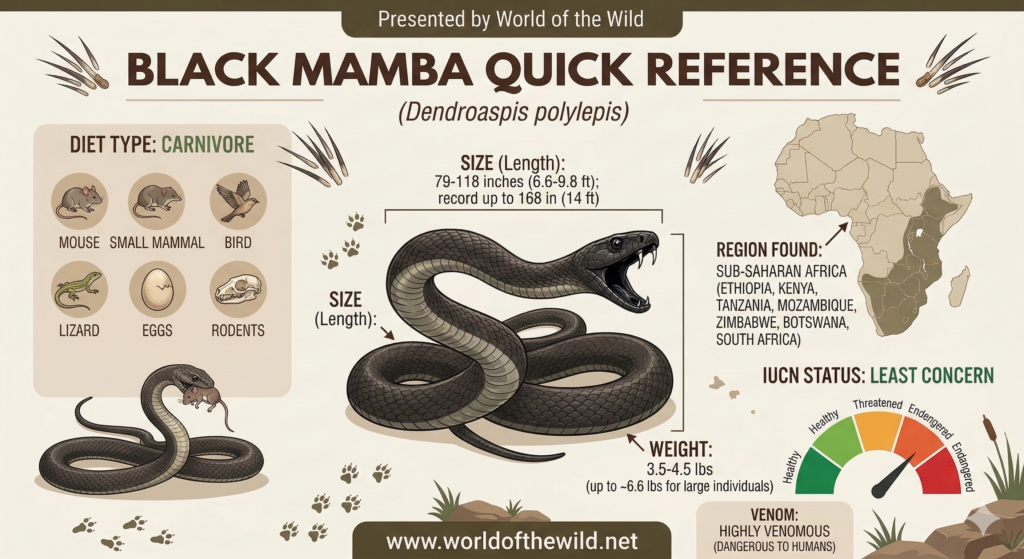
The Black Mamba is a snake of imposing dimensions. Adults typically measure between 6.6 and 9.8 feet in length (2 to 3 meters), though exceptional individuals have been recorded at lengths of up to 14 feet (4.3 meters), making it the longest venomous snake in Africa. Despite its length, the Black Mamba is slender and graceful, with a lean, muscular build that contributes to its extraordinary speed.
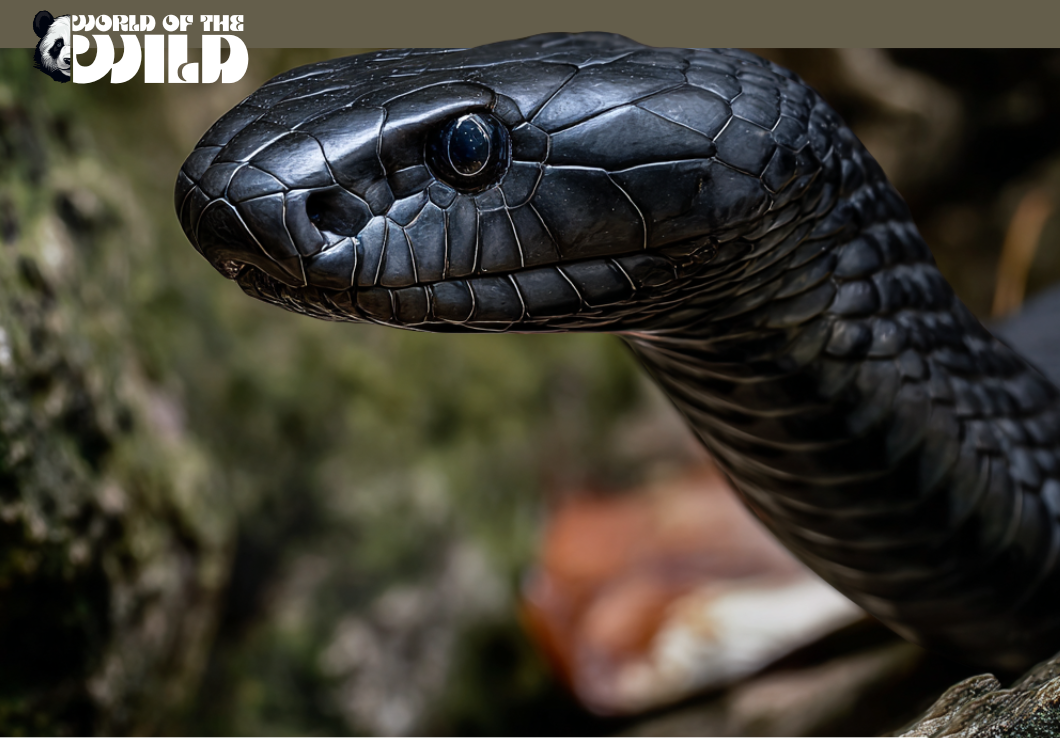
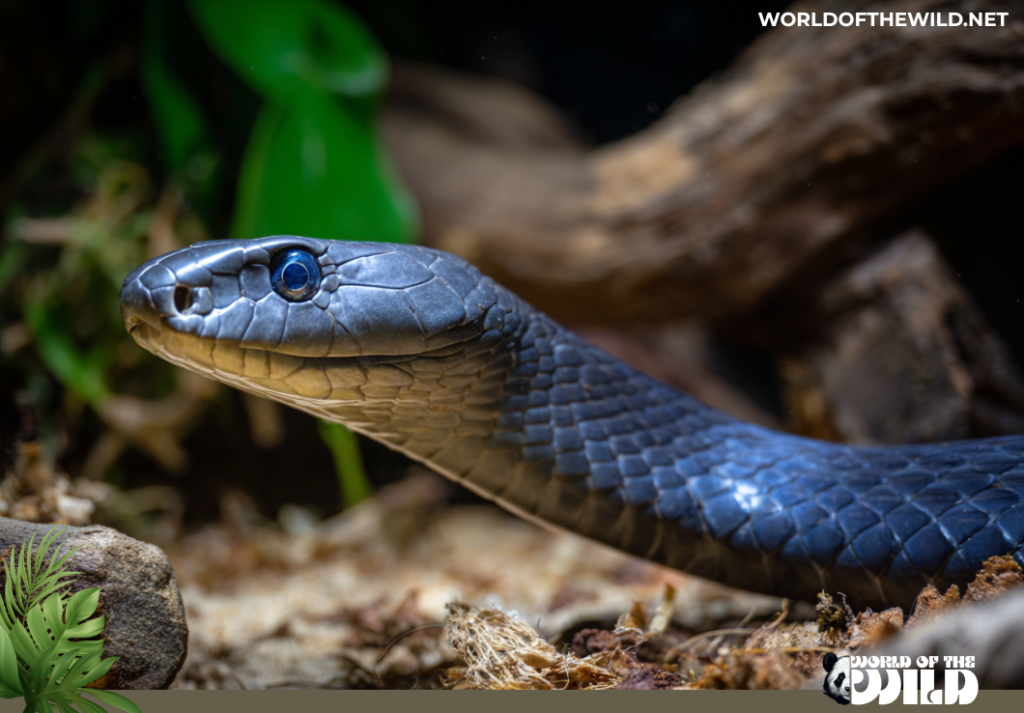
Its scales are smooth and give off a subtle sheen, ranging in color from pale grayish-brown and olive to dark brown or gunmetal gray. The belly is typically a creamy white or pale yellow. Juvenile snakes tend to be lighter and may darken with age. The head is long, narrow, and coffin-shaped — a distinctive silhouette that makes identification relatively straightforward for experienced observers. The eyes are medium-sized with rounded pupils and a fixed, cold gaze framed by large scales above.
The defining feature, and the origin of the common name, is the interior of the mouth: a startling, jet-black coloration that the snake exposes in a wide gape when threatened. This gaping display, combined with the raised anterior third of its body and a flattened neck, makes for one of the most recognizable and chilling threat postures in the animal kingdom.
Behavior
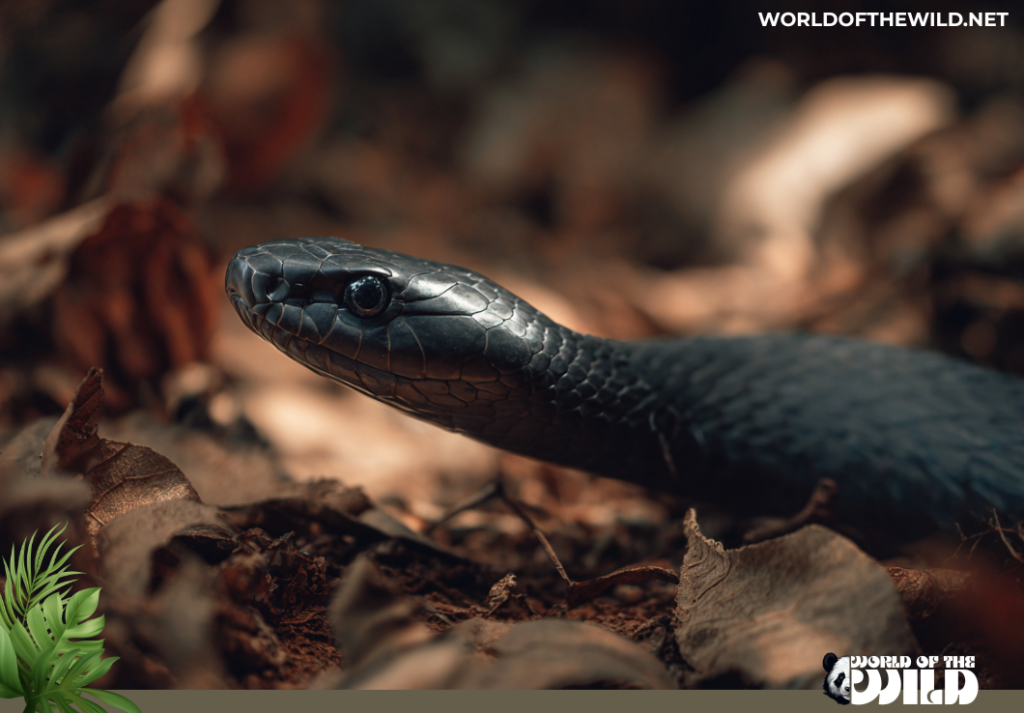
The Black Mamba is primarily diurnal, hunting and moving during the day and retreating to a permanent lair — often a termite mound, a hollow tree, or a rocky outcrop — at night. Unlike many snakes, it tends to return to the same retreat site repeatedly, displaying a degree of site fidelity rarely seen in reptiles.
It is a largely solitary animal, interacting with others of its species mainly during the breeding season. However, it is not entirely asocial — pairs or small groups have occasionally been found sharing a den site during cooler months. Communication between individuals is primarily chemical, through the detection of pheromones via the vomeronasal (Jacobson’s) organ. Like all snakes, the Black Mamba “tastes” the air by flicking its forked tongue to collect chemical signals, which are then delivered to this sensory organ in the roof of the mouth.
Its intelligence is difficult to quantify but is widely acknowledged by herpetologists and field researchers. It is quick to learn threat associations, adapts its escape routes, and displays a measured, calculated response to danger rather than blind aggression. When confronted, it goes through a clear escalation sequence: attempting to escape first, then rearing up and gaping its mouth, hissing loudly, and only striking if the threat persists. This behavioral sophistication — knowing when to flee and when to fight — is one of the hallmarks of its ecological success.
Evolution
The evolutionary history of the Black Mamba reaches back into the deep past of the Elapidae family, one of the most successful and diverse families of venomous snakes on Earth. Elapids — which include cobras, mambas, taipans, and sea snakes — are believed to have originated in Asia during the Eocene epoch, approximately 40 to 50 million years ago, before dispersing across the globe through the movement of continental landmasses and climate-driven range expansions.
The mamba lineage (Dendroaspis) is thought to have diverged from ancestral elapid stock sometime in the Oligocene or early Miocene, roughly 25 to 35 million years ago, as Africa became increasingly arid and the continent’s ecosystems began shifting from dense tropical forest to the open savannas and woodland mosaics we recognize today. This ecological shift is likely a key driver of the Black Mamba’s terrestrial lifestyle — unlike its arboreal green mamba cousins, D. polylepis is well-adapted to open ground, a niche that rewards speed and aggression.
Fossil evidence for mambas specifically is sparse, as snake skeletons are fragile and poorly preserved over geological time. However, molecular phylogenetic studies have illuminated the relationships between mamba species and their broader elapid relatives, confirming that all four mamba species share a common African ancestor and that the split between the Black Mamba and the green mamba lineages represents an ancient divergence tied to habitat specialization.
The evolution of its venom is an extraordinary story in itself. The dendrotoxins and other components of Black Mamba venom represent millions of years of biochemical refinement — a complex cocktail shaped by predator-prey arms races and the challenges of subduing increasingly fast and alert prey.
Habitat
The Black Mamba is found across a broad swath of sub-Saharan Africa, ranging from southern Ethiopia and Somalia in the north, down through Kenya, Tanzania, and Uganda, through Mozambique, Zimbabwe, and Botswana, and into the northeastern regions of South Africa. It is notably absent from the dense rainforests of Central Africa, a habitat preference that underscores its affinity for open, dryer environments.
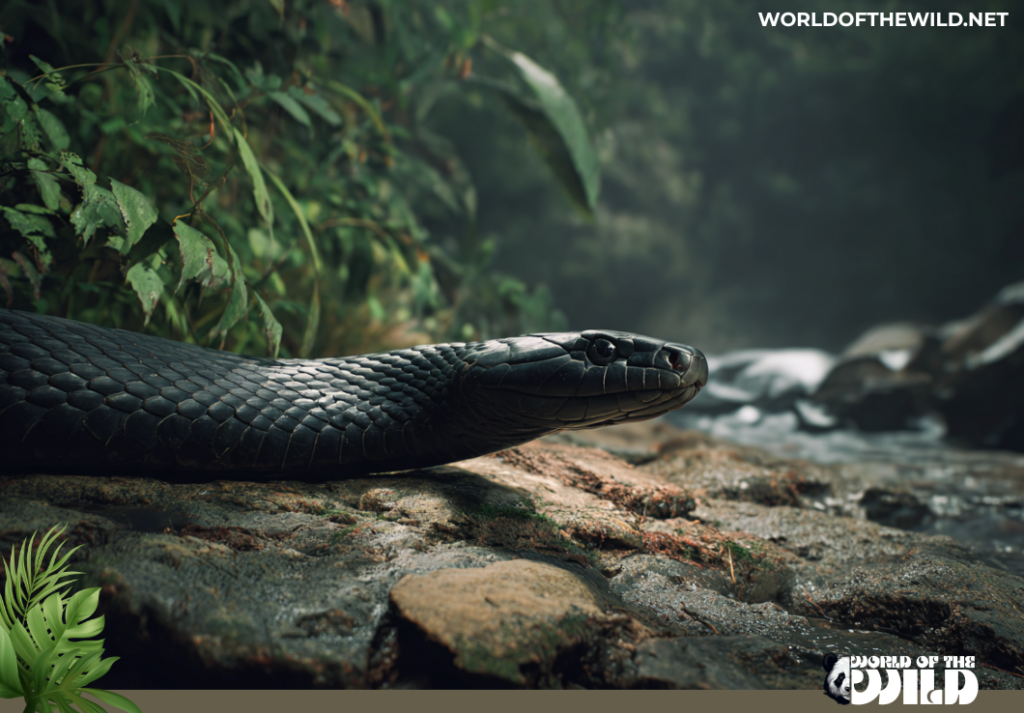
Within its range, the Black Mamba favors savanna, open woodland, rocky hillsides, and scrubland. It thrives in transitional zones where grass gives way to sparse tree cover — environments that offer both open ground for speed and movement and enough structural complexity (rock outcroppings, termite mounds, hollow trees) to provide shelter and denning sites. It is rarely found in montane regions or true forest, though it may utilize forest edges.
Elevationally, it tends to be a lowland to mid-elevation species, most commonly encountered below 5,000 feet (1,500 meters) above sea level. Seasonal temperature and rainfall patterns strongly influence its activity levels — like all ectothermic reptiles, it becomes less active during cooler periods and more so during the warm, humid months that coincide with peak prey availability.
Diet
The Black Mamba is a strict carnivore and an active, pursuit-based predator. Its primary prey consists of small to medium-sized mammals, particularly rodents such as rats, mice, and squirrels, as well as birds and their eggs. Juveniles frequently prey on smaller lizards and smaller rodents, gradually shifting toward larger prey as they grow.
Unlike ambush predators that wait motionless for prey to wander into range, the Black Mamba actively hunts, using its speed, visual acuity, and chemosensory tongue to track and chase down quarry. When prey is located, the snake strikes with explosive speed, delivering one or more venomous bites. Rather than constricting its prey, the Black Mamba relies entirely on the rapid action of its venom to incapacitate the target — and the venom acts fast. Prey typically collapses within minutes, sometimes seconds, depending on the animal’s size and the venom load received. The snake then swallows its meal whole, head-first, using the flexibility of its remarkably elastic jaw ligaments.
Digestion is slow and metabolically intensive. After a large meal, a Black Mamba may not need to feed again for several days or even weeks, spending that time in a warm, sheltered location while its physiology processes the nutrients.
Predators and Threats
Despite its fearsome arsenal, the Black Mamba is not without natural enemies. The most formidable is the Egyptian mongoose (Herpestes ichneumon), an extraordinarily agile mammal with a partial genetic resistance to elapid venom. Secretary birds (Sagittarius serpentarius) and large raptors such as martial eagles (Polemaetus bellicosus) are also known to prey on Black Mambas, using aerial attack strategies that neutralize the snake’s ground-based speed advantage. Large monitor lizards, honey badgers, and even other snakes occasionally target juveniles or smaller individuals.
Human-caused threats, however, represent the most significant and growing danger to Black Mamba populations. Habitat loss driven by agricultural expansion, urbanization, and deforestation is steadily eroding the open savanna and woodland environments the species depends on. As human settlements push deeper into formerly wild landscapes, encounters between people and Black Mambas increase — encounters that almost invariably end with the snake being killed out of fear, regardless of whether it posed an actual threat.
Climate change adds another layer of concern, as shifts in rainfall patterns and temperature regimes alter prey availability and suitable habitat ranges. Persecution based on its fearsome reputation remains a persistent issue; in many communities, the cultural and psychological fear of the Black Mamba leads to indiscriminate killing, even of non-venomous snakes mistaken for mambas.
Reproduction and Life Cycle
The Black Mamba breeds once a year, typically during the spring and early summer months of September through February in the Southern Hemisphere. During the breeding season, males engage in dramatic combat rituals — intertwining their bodies and wrestling to pin one another to the ground in a test of strength and endurance. These bouts, which can last for hours, are rarely lethal; the loser simply retreats.
After mating, the female lays a clutch of 6 to 17 elongated, leathery eggs in a warm, humid location such as a rotting log, termite mound, or burrow. Unlike many reptiles that abandon their eggs immediately, the female may remain near the clutch for a brief period, though she provides no active incubation or protection. Eggs hatch after approximately 80 to 90 days, and the hatchlings emerge fully formed and immediately venomous, measuring between 16 and 24 inches (40 to 60 cm) in length.
Young Black Mambas are entirely independent from birth. They receive no parental care and must immediately fend for themselves — hunting small lizards and rodents while simultaneously avoiding the many predators that target juveniles. Growth is rapid in the first few years of life. Sexual maturity is typically reached between 2 and 3 years of age.
In the wild, Black Mambas are estimated to live between 11 and 20 years, though captive individuals have been recorded living beyond that range under controlled conditions.
Population
The Black Mamba is currently classified as Least Concern on the IUCN Red List of Threatened Species, reflecting the fact that, across its broad sub-Saharan range, populations remain relatively stable and widespread. The species does not face the acute, range-wide population collapse that would warrant a more threatened listing.
However, “Least Concern” should not be mistaken for “without concern.” Regional population declines have been documented in areas of intensive agricultural development, dense human settlement, and repeated persecution. There is no precise global population estimate available for the species — a gap that itself reflects the difficulty of censusing a secretive, solitary reptile across such a vast and ecologically varied landscape. What researchers do know is that local densities vary enormously, with some protected areas supporting robust populations while surrounding unprotected land has seen significant attrition.
Ongoing monitoring programs in South Africa, Kenya, and other range countries continue to track population dynamics, and organizations such as the African Snakebite Institute work to reduce human-wildlife conflict through education and awareness campaigns aimed at reshaping the cultural narrative around this extraordinary serpent.
Conclusion
The Black Mamba is, by any measure, one of the most extraordinary animals on Earth. It is fast enough to outpace a sprinting human, venomous enough to kill in under a day, intelligent enough to choose flight over fight in most encounters, and old enough — evolutionarily speaking — to have outlasted entire epochs of ecological upheaval. Its current “Least Concern” status on the IUCN Red List is a testament to its resilience, but it is not a guarantee of its future security.
As human populations expand across sub-Saharan Africa and wild habitats continue to shrink, the margin of safety for the Black Mamba — and for every other species sharing those landscapes — grows thinner. The key to coexistence lies in education: dispelling the myths, acknowledging the ecological value of apex predators, and building communities that see conservation not as an obstacle to development but as a foundation for it.
The Black Mamba does not need our sympathy. It needs our respect. And in return for that respect, it offers us something invaluable — a reminder that the natural world operates according to rules far older than our own, and that the creatures who perfected those rules deserve a place in the world we are reshaping.
Quick Reference
| Scientific Name | Dendroaspis polylepis |
| Diet Type | Carnivore (rodents, small mammals, birds, lizards) |
| Size | 79–118 inches (6.6–9.8 ft); record up to 168 in (14 ft) |
| Weight | 3.5–4.5 lbs (up to ~6.6 lbs for large individuals) |
| Region Found | Sub-Saharan Africa (Ethiopia, Kenya, Tanzania, Mozambique, Zimbabwe, Botswana, South Africa) |