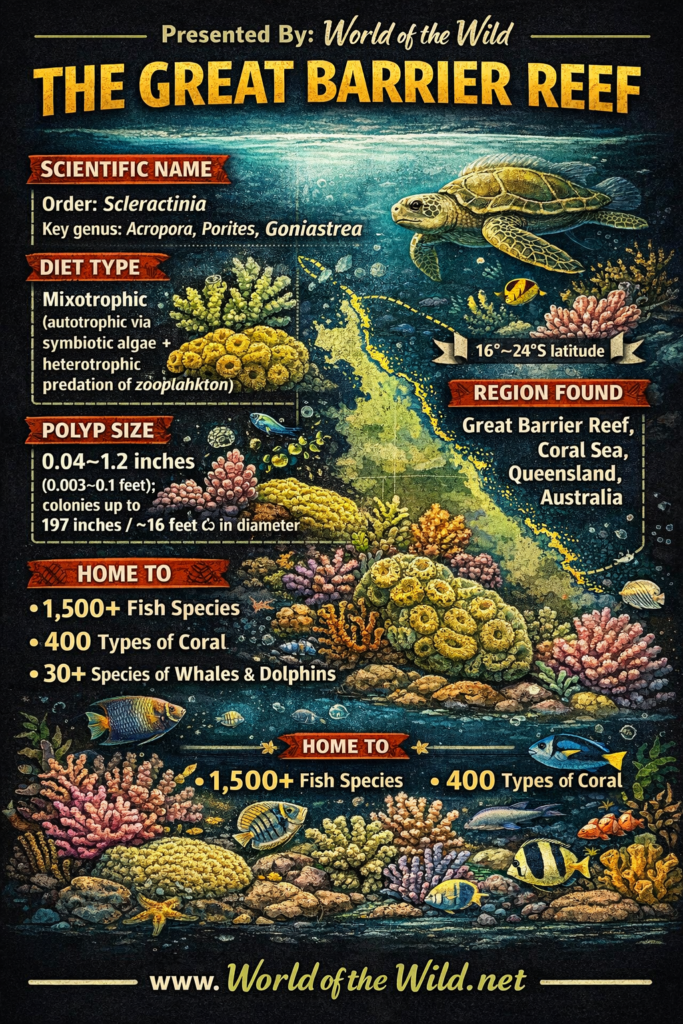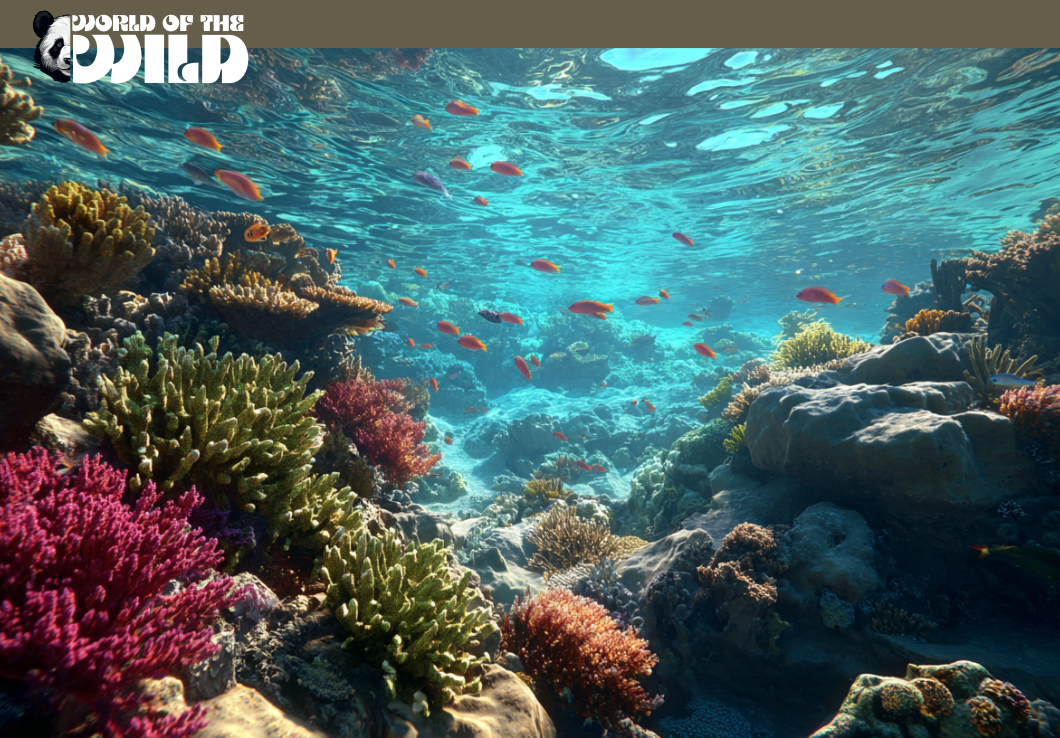

Stretching over 2,300 kilometers along the northeastern coast of Australia, the Great Barrier Reef is the largest living structure on Earth — so vast it can be seen from outer space. But the true wonder isn’t the sheer scale of it. It’s the fact that this entire breathtaking world was built, grain by grain and polyp by polyp, by some of the smallest and most deceptively simple animals on the planet: coral.
Yes, coral is an animal. Not a rock. Not a plant. A living, breathing, reproducing creature that, in partnership with microscopic algae, has engineered an underwater metropolis that shelters roughly 25% of all marine species. The Great Barrier Reef’s corals are among the most ecologically important organisms on Earth — and among the most imperiled. Understanding them isn’t just a matter of scientific curiosity. It’s an act of urgency.
Facts
- Coral is an animal, not a plant or mineral. Each coral structure is composed of thousands of tiny animals called polyps, which are closely related to jellyfish and sea anemones.
- The Great Barrier Reef hosts over 600 species of coral, ranging from fast-growing branching corals to slow, boulder-like brain corals that can live for over 500 years.
- Coral polyps are mostly nocturnal feeders. During the day, they retract into their calcium carbonate skeletons; at night, they extend their tentacles to catch zooplankton.
- The calcium carbonate skeleton of a coral grows at a rate of just 0.3 to 10 centimeters per year, depending on the species — meaning some of the reef’s largest structures took thousands of years to form.
- Coral fluorescence is real and spectacular. Many Great Barrier Reef corals produce bright fluorescent proteins — glowing in greens, reds, and oranges — which may function as a kind of sunscreen or as a way to regulate photosynthesis in their symbiotic algae.
- A single coral polyp can clone itself, creating entire colonies through asexual budding, yet the reef also reproduces sexually in one of nature’s most extraordinary mass events.
- The Great Barrier Reef is estimated to be between 6,000 and 8,000 years old in its current form, though coral systems in the region date back as far as 500,000 years.
Species
Reef-building corals belong to the following taxonomic hierarchy:
| Rank | Classification |
|---|---|
| Kingdom | Animalia |
| Phylum | Cnidaria |
| Class | Anthozoa |
| Order | Scleractinia |
| Family | Multiple (e.g., Acroporidae, Faviidae, Poritidae) |
| Genus | Multiple (e.g., Acropora, Porites, Goniastrea) |
| Species | Over 600 on the GBR alone |
The corals of the Great Barrier Reef belong primarily to the Order Scleractinia — the stony or hard corals — which are the primary reef-builders. Within this group, several key families dominate the reef’s character:
- Acroporidae — Home to the iconic Acropora genus, including staghorn (Acropora cervicornis-like species) and tabletop corals. These are among the fastest-growing corals on the reef and provide critical structural complexity. Acropora alone accounts for over 150 species on the GBR.
- Poritidae — The long-lived, slow-growing boulder corals of the genus Porites. These massive, dome-shaped corals can live for centuries and serve as natural climate archives, recording centuries of ocean temperature in their layered skeletons.
- Faviidae / Merulinidae — Brain corals and star corals, known for their labyrinthine surface patterns. Species like Goniastrea and Platygyra are characteristic features of the mid-reef zones.
- Fungiidae — Mushroom corals, uniquely free-living and not attached to substrate, which grants them an unusual degree of mobility.
- Soft Corals (Order Alcyonacea) — While not reef-builders themselves, genera like Dendronephthya and Sarcophyton add vivid color and ecological texture to the reef community.
Appearance
To the untrained eye, a coral colony might look like an ornate rock formation. Look closer, and a breathtaking living architecture reveals itself.
Individual coral polyps are tiny — typically between 1 and 3 millimeters in diameter, though some solitary species can reach several centimeters. Each polyp resembles a small sac with a central mouth surrounded by a ring of stinging tentacles. They secrete a hard exoskeleton of calcium carbonate (aragonite), and as colonies grow, these skeletons accumulate into the towering structures we recognize as coral.
The colors of coral are largely derived from their symbiotic algae, zooxanthellae, which produce pigments ranging from golden-brown to olive green. However, corals also express their own fluorescent proteins, producing startling neon greens, deep reds, electric purples, and vivid oranges — particularly visible under blue-spectrum or ultraviolet light. When coral bleaches (losing its zooxanthellae), what remains is the ghostly white calcium skeleton beneath.
In terms of growth forms, GBR corals display extraordinary architectural diversity:
- Branching corals (like Acropora) form intricate tree- and antler-like structures reaching up to 2 meters in height.
- Massive/boulder corals (like Porites) form dense, rounded heads that can grow to 5 meters or more in diameter over centuries.
- Plate and table corals spread horizontally, forming broad flat platforms that shade the reef below.
- Encrusting corals lay flat against hard substrate, forming living veneers across rock and rubble.
- Foliose corals develop thin, leaf-like or scroll-shaped blades.
Behavior
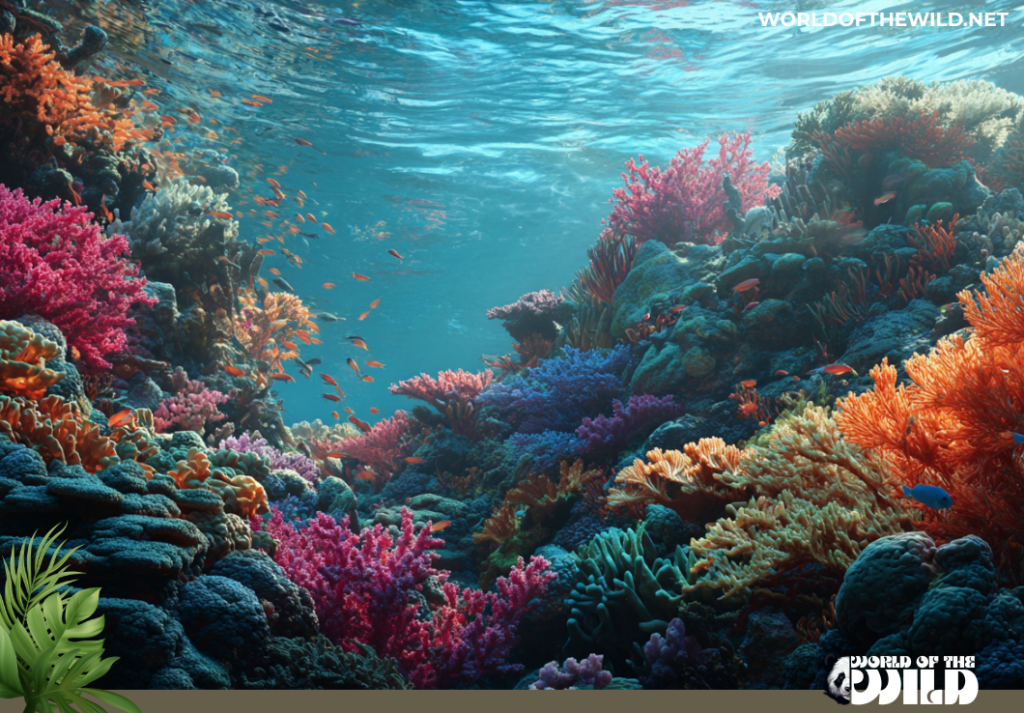
Coral may not sprint, roar, or migrate, but it is far from passive. Coral colonies are dynamic, responsive organisms engaged in a constant low-level struggle for survival, space, and resources.
Feeding primarily happens at night. As darkness falls across the reef, thousands of polyps simultaneously extend their translucent tentacles into the water column. Armed with specialized stinging cells called nematocysts — the same weapon used by their jellyfish cousins — they paralyze and capture zooplankton, bacteria, and organic particles drifting past.
Chemical warfare is a regular feature of coral life. Many species exude mucus laced with toxic compounds to deter neighboring corals from overgrowing them. Some even extend mesenterial filaments — essentially digestive organs — outside their bodies to chemically digest encroaching rivals.
Symbiosis with zooxanthellae is perhaps the most behaviorally significant relationship in coral biology. These microscopic algae live within coral tissue and, through photosynthesis, supply up to 90% of the coral’s energy needs. In return, the coral provides the algae with shelter and the carbon dioxide they need to photosynthesize. This relationship makes coral deeply sensitive to light and temperature — both of which govern the algae’s productivity.
Corals also engage in competitive and cooperative colony dynamics. Within a single Acropora colony, polyps are interconnected by living tissue called the coenosarc, allowing nutrients to be shared across the entire structure.
Evolution
The evolutionary story of corals is ancient, complex, and marked by catastrophic near-extinctions that make today’s crisis feel eerily familiar.
Reef-building corals first appeared in the Triassic Period, approximately 240 million years ago, following the Permian-Triassic mass extinction that wiped out earlier coral lineages. These early scleractinians colonized warm, shallow seas and began the slow work of reef construction that would eventually shape entire ocean ecosystems.
Before modern stony corals, the seas were dominated by tabulate and rugose corals — entirely separate groups that flourished during the Paleozoic Era and went extinct at the Permian boundary 252 million years ago. The ancestral cnidarian lineage, however, extends far further back — simple cnidarians appear in the fossil record over 600 million years ago.
The Great Barrier Reef in its current form is geologically young, having taken shape during the Holocene as sea levels rose after the last Ice Age. However, coral communities have existed in the Australian region for far longer, with fossil evidence of ancient reef systems in Queensland dating back hundreds of thousands of years.
One of the most significant evolutionary milestones in coral history was the acquisition of zooxanthellae — the photosynthetic partnership that unlocked reef-building on a massive scale. This symbiotic relationship, which evolved in the Triassic or possibly earlier, gave corals access to a reliable internal energy source that turbo-charged skeletal growth and made the construction of towering reef structures possible.
Habitat
The Great Barrier Reef occupies the Coral Sea off the coast of Queensland, Australia, spanning from the tip of Cape York Peninsula in the north to just south of Bundaberg in the south. This reef system encompasses over 344,400 square kilometers of marine park, incorporating not a single reef but approximately 2,900 individual reef structures and 900 islands.
Corals thrive in very specific conditions:
- Water temperature: 23–29°C (73–84°F). Even a sustained 1–2°C rise above average summer maximums can trigger bleaching.
- Depth: Most reef-building corals grow in the photic zone — the sunlit upper 30 meters of the ocean — where their zooxanthellae can photosynthesize.
- Water clarity: Corals need clear water with low turbidity so that light penetrates effectively.
- Salinity: Normal marine salinity of around 32–37 parts per thousand is essential.
- Substrate: Hard corals require a firm, rocky surface to anchor on.
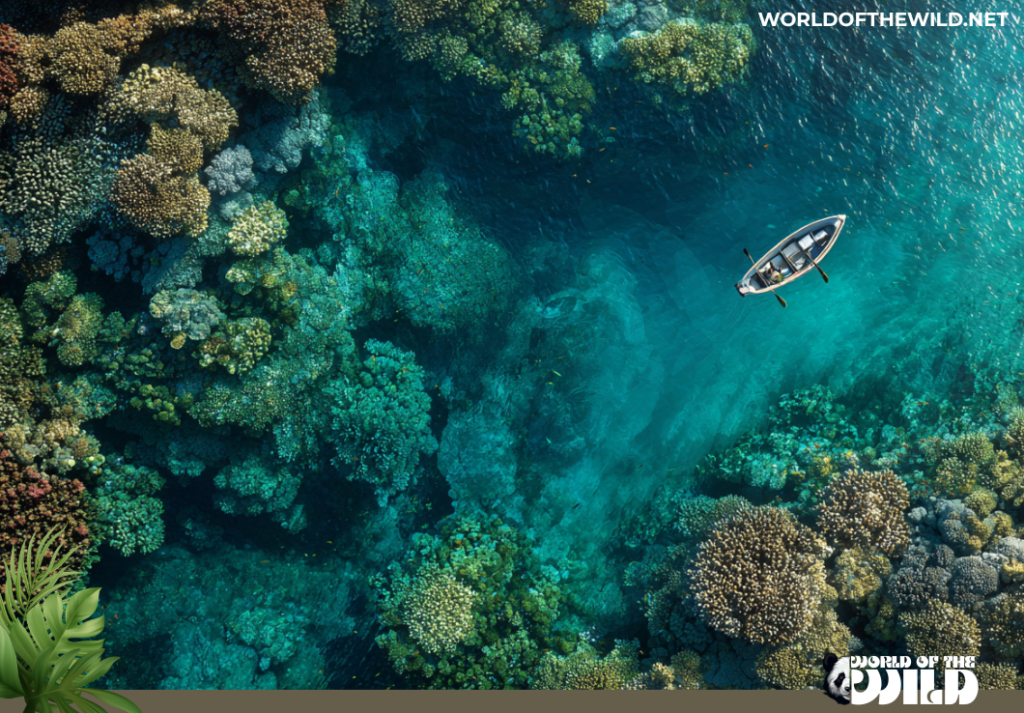
Within the Great Barrier Reef, different coral communities occupy distinct zones — from the exposed outer reef slope, battered by ocean swells and dominated by robust encrusting and branching species, to the sheltered lagoon and back-reef zones, where more delicate table corals and soft corals flourish in calmer conditions.
Diet
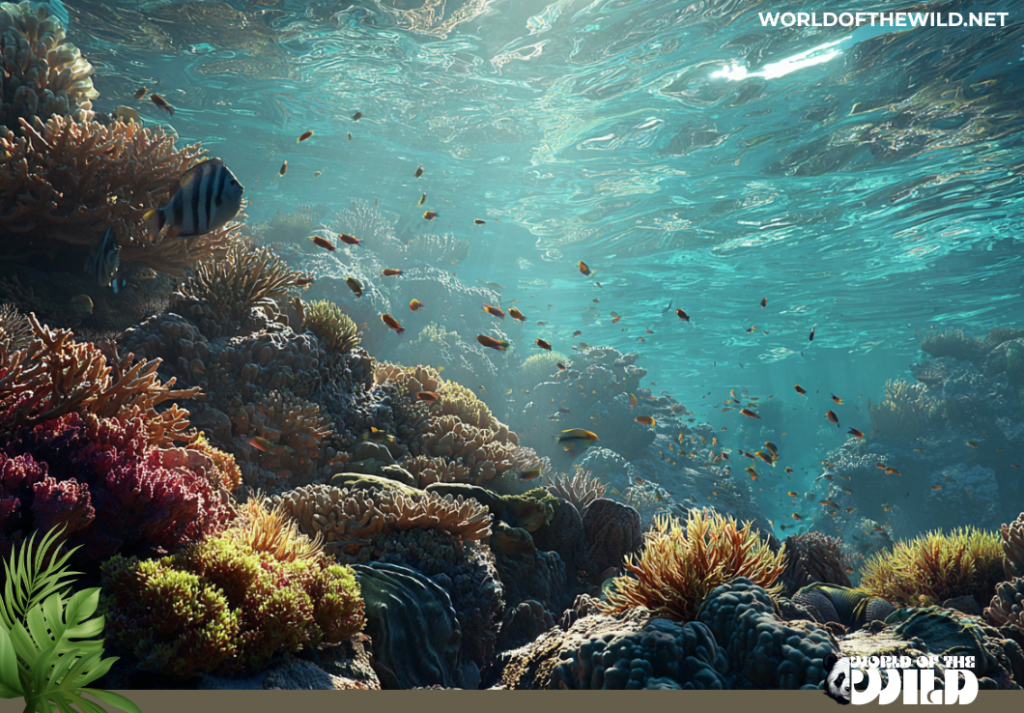
Corals are mixotrophic — they feed through two complementary pathways that together provide a complete nutritional profile.
Autotrophic nutrition comes via the zooxanthellae living in their tissues. These algae photosynthesize using sunlight, producing sugars, amino acids, and lipids that are directly transferred to the coral host. In clear, well-lit waters, this single source can supply the vast majority of a coral’s caloric needs.
Heterotrophic nutrition kicks in at night and during periods of reduced light. Polyps extend their tentacles to actively capture:
- Zooplankton (copepods, amphipods, small crustacean larvae)
- Phytoplankton
- Dissolved organic matter absorbed directly through the body wall
- Bacteria and marine snow — tiny particles of organic detritus
Some larger-polyped corals, like Fungia and Lobophyllia, are capable of capturing and consuming small fish and invertebrates. Corals also obtain nitrogen and phosphorus — nutrients not supplied by photosynthesis — almost exclusively through heterotrophic feeding, making nighttime predation nutritionally critical even on the sunniest reefs.
Predators and Threats
Natural Predators
Coral has no shortage of natural enemies. On a healthy reef, these relationships are kept in check by ecological balance, but when predator populations surge — often due to human disruption — the consequences can be devastating.
- Crown-of-Thorns Starfish (Acanthaster planci) — The reef’s most notorious predator. This large, venomous starfish everts its stomach over coral colonies and digests the polyps externally. Outbreaks have devastated vast swaths of the GBR, killing coral faster than it can recover.
- Parrotfish — Using powerful beak-like teeth, parrotfish bite off chunks of coral to access the algae within, producing the fine white sand that blankets the reef floor. In moderation, this is ecologically neutral; in excess, it stresses coral populations.
- Corallivorous snails — Species like Drupella and the infamous Collector Urchin graze directly on coral tissue.
- Butterfly fish — Many species in the family Chaetodontidae feed exclusively on coral polyps.
Human-Caused Threats
The threats posed by human activity dwarf anything the natural world throws at coral:
- Climate change and ocean warming — Rising sea temperatures cause mass coral bleaching events. The GBR has experienced five mass bleaching events since 1998, including consecutive bleachings in 2016, 2017, 2020, 2022, and 2024. The 2024 event was the most extensive ever recorded.
- Ocean acidification — As the ocean absorbs excess CO₂, it becomes more acidic, weakening the calcium carbonate skeletons that corals depend on and slowing reef growth.
- Runoff and water quality — Agricultural runoff delivering excess nutrients, sediment, and pesticides from Queensland’s farming industry smothers corals and promotes algal overgrowth.
- Coastal development — Dredging, land clearing, and port construction increase turbidity and physically damage reef structures.
- Overfishing — Removing herbivorous fish disrupts the ecological balance that keeps algae from overrunning coral.
- Illegal collection — The live coral and marine aquarium trade has historically removed specimens and associated species from reef ecosystems.
Reproduction and Life Cycle
Coral reproduces in two remarkable ways — one quietly persistent, the other one of the most spectacular natural events on Earth.
Asexual Reproduction
Throughout the year, coral colonies grow by budding — polyps divide to produce genetically identical daughter polyps that remain attached to the parent colony. This is how a colony expands, slowly adding new surface area and structural complexity over years and decades. Fragments broken off by storms or physical disturbance can also settle and regrow — a process exploited in modern coral restoration programs.
Sexual Reproduction — The Spawning Event
Once a year, typically in the evenings following the full moon in November or December, the Great Barrier Reef participates in one of nature’s most astonishing mass events: synchronized broadcast spawning. In a coordinated chemical response triggered by water temperature, lunar cycle, and day length, hundreds of coral species simultaneously release massive clouds of eggs and sperm bundles into the water column.
The ocean above the reef turns milky with billions of gametes. Fertilization happens in open water, producing free-swimming planula larvae that drift on currents for days to weeks. Eventually, successful larvae settle on a hard substrate, metamorphose into tiny polyps, and begin secreting their calcium carbonate base — starting the next generation of reef.
Lifespan
The lifespan of coral varies enormously by species. Individual polyps within a colony live for a few years, but the colony itself is functionally immortal through continuous budding. Some Porites boulder corals on the GBR have been alive for 500 years or more, making them among the longest-lived animals on Earth.
Population
IUCN Conservation Status
Coral species on the Great Barrier Reef carry a range of IUCN designations. Many Acropora species are listed as Endangered or Vulnerable. The GBR coral community as a whole is considered severely threatened, and in 2022, UNESCO recommended — though ultimately did not proceed with formally designating — the GBR as “in danger,” citing climate change as the primary driver of decline.
Population Trends
The trends are sobering. Long-term monitoring by the Australian Institute of Marine Science (AIMS) has tracked coral cover across the GBR for decades:
- Hard coral cover on the GBR declined sharply in the 2010s and early 2020s due to back-to-back bleaching events and Crown-of-Thorns outbreaks.
- Surveying following the 2022 bleaching event found that only the northern third of the reef had escaped with relatively high coral cover.
- Some recovery has been observed in northern sections, demonstrating that coral can rebound — but only if warming pauses long enough.
- Scientists estimate that at current global warming trajectories, 90% of the world’s coral reefs — including much of the GBR — could be functionally lost by 2050.
Active coral restoration programs, including micro-fragmentation, coral gardening, and assisted evolution projects, are underway on the GBR, offering cautious but genuine hope.
Conclusion
The corals of the Great Barrier Reef are not merely beautiful. They are foundational — to marine biodiversity, to the fishing industries that feed millions, to the tourism economy that supports Australian coastal communities, and to the stability of entire ocean ecosystems. They are also a living barometer of our planet’s health, and right now, that barometer is falling.
The story of reef coral is ultimately a story about time. These organisms built the world’s largest living structure across millennia, one microscopic skeleton at a time. They have survived ice ages, sea level shifts, and multiple mass extinctions. What they cannot survive — at least not on any timescale meaningful to human civilization — is the pace of change we are now imposing on the ocean.
The good news is that coral is resilient when given the chance. The reefs that have been protected from local stressors — where water quality is managed, fishing is regulated, and runoff is controlled — bleach less severely and recover more quickly. The most powerful thing any of us can do is to demand, loudly and persistently, the climate action and marine protection policies that give these ancient architects of the sea a fighting chance.
The Great Barrier Reef has been building its masterpiece for thousands of years. It deserves the opportunity to keep going.
Quick Reference Table
| Scientific Name | Order: Scleractinia; Key genus: Acropora, Porites, Goniastrea |
| Diet Type | Mixotrophic (autotrophic via symbiotic algae + heterotrophic predation of zooplankton) |
| Polyp Size | 0.04–1.2 inches (0.003–0.1 feet); colonies up to 197 inches / ~16 feet in diameter |
| Weight | Individual polyps: negligible (micrograms); large Porites colonies: hundreds of pounds |
| Region Found | Great Barrier Reef, Coral Sea, Queensland, Australia (16°S–24°S latitude) |