
Imagine standing on a sun-drenched volcanic island, surrounded by the otherworldly silence of ancient lava fields, when a slow, deliberate movement catches your eye. Emerging from a thicket of prickly pear cactus is a creature so massive, so unhurried, and so utterly ancient in appearance that it seems to have wandered straight out of the Jurassic period. The giant tortoise moves with a kind of noble indifference to the world around it — and why wouldn’t it? These animals have been perfecting the art of survival for millions of years, long before humans ever set foot on the islands they call home.
Giant tortoises are among the most extraordinary animals on the planet. They are the heaviest living reptiles on land, capable of living well beyond a century, and have played a starring role in some of the most pivotal chapters of natural history — including inspiring Charles Darwin’s thinking on evolution. Yet despite their storied past and iconic status, many people know surprisingly little about the depth and complexity of these magnificent creatures. From their intricate social dynamics to their role as ecological engineers, giant tortoises are far more than the slow, lumbering symbols of longevity they’re often reduced to. They are living testaments to resilience, adaptation, and the breathtaking diversity of life on Earth.
Facts
Here are some lesser-known but utterly fascinating facts about giant tortoises that may surprise even the most seasoned nature enthusiast:
- They can survive over a year without food or water. Giant tortoises have an extraordinarily efficient metabolism and can store large amounts of water and fat in their bodies, allowing them to endure extended periods of drought or food scarcity — a trait that, tragically, made them ideal “living provisions” for sailors who would store them in ship holds for months.
- They are a keystone species and ecosystem engineers. Giant tortoises disperse seeds across vast distances through their droppings and create pathways through dense vegetation, essentially sculpting the landscape around them. Without them, the ecological balance of their island habitats would collapse.
- They can identify individual humans. Research at zoos and sanctuaries has demonstrated that giant tortoises can recognize and respond differently to specific humans, suggesting a level of individual cognition that surprises many people.
- They weren’t always confined to islands. The ancestors of giant tortoises once roamed continental landmasses across the globe, including Europe, Asia, Africa, and the Americas. The island populations we know today are the last surviving remnants of a once much wider distribution.
- Their growth rings can tell their age — but only up to a point. Like trees, young giant tortoises develop growth rings on their scutes (the sections of their shell). However, once they reach full maturity, these rings become too worn to count accurately, making precise age determination difficult in very old individuals.
- A famous tortoise named Harriet may have been handled by Charles Darwin himself. Harriet, a giant tortoise who lived at the Australia Zoo until her death in 2006 at an estimated age of 175, was long believed to have been collected during Darwin’s 1835 voyage — though this claim remains contested by historians.
- They produce infrasonics. During mating season, male giant tortoises produce deep, resonant vocalizations that fall partly in the infrasonic range — sounds so low in frequency they can be felt as vibrations rather than heard.
Species
Classification:
- Kingdom: Animalia
- Phylum: Chordata
- Class: Reptilia
- Order: Testudines
- Family: Testudinidae
- Genus: Chelonoidis (Galápagos species) and Aldabrachelys (Aldabra species)
- Species: Multiple (see below)
The term “giant tortoise” broadly refers to very large terrestrial tortoises within the family Testudinidae, with the two most significant living populations found in the Galápagos Islands and the Aldabra Atoll.
Galápagos Giant Tortoise (Chelonoidis niger complex): This is arguably the most well-known group, and taxonomists have recognized multiple distinct species within what was once treated as a single species. Currently, researchers recognize up to 13 living species across the Galápagos archipelago, each associated with a specific island or volcanic region. Notable among these are Chelonoidis nigra (Isabela Island), Chelonoidis hoodensis (Española Island), and Chelonoidis donfaustoi (eastern Santa Cruz Island), which was only formally described as a new species in 2015.
Aldabra Giant Tortoise (Aldabrachelys gigantea): Native to the Aldabra Atoll in the Seychelles, this is the world’s largest tortoise by population size — with over 100,000 individuals remaining. While not as morphologically diverse as the Galápagos group, the Aldabra tortoise is a remarkable conservation success story and is considered the last surviving Indian Ocean giant tortoise lineage following the extinction of all Mascarene Island species.
Extinct relatives worth noting include the tortoises of the Mascarene Islands (Rodrigues, Réunion, and Mauritius), all driven to extinction by human activity in the 17th–19th centuries, as well as massive continental species like Megalochelys atlas of Asia, which could weigh up to 1,000 pounds.
Appearance
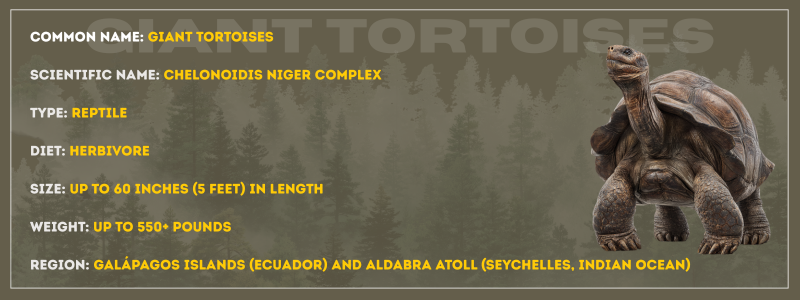
Giant tortoises are, in a word, imposing. Adult males of the largest Galápagos species can reach lengths of up to 5 feet (about 60 inches) from the tip of their beak to the end of their shell, and weigh anywhere from 400 to over 550 pounds. Females are noticeably smaller, typically reaching about 3 feet in length and weighing around 150–200 pounds. Aldabra giant tortoises are similarly sized, with large males reaching around 550 pounds in exceptional cases.
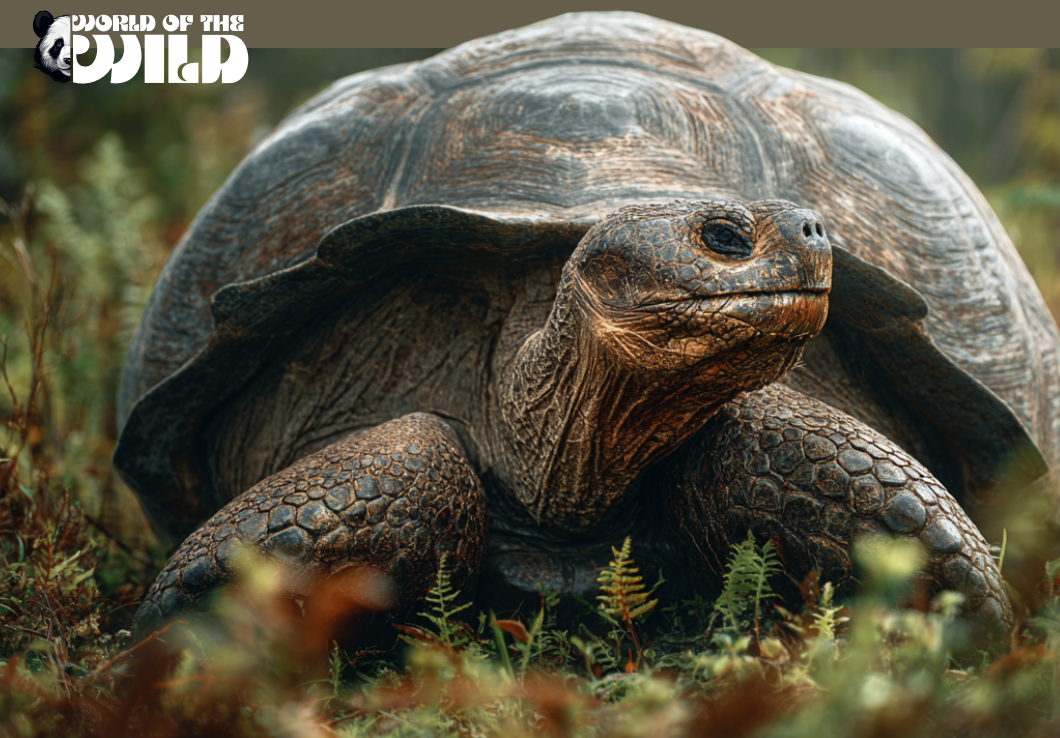
Their most defining physical feature is, of course, the shell — or more precisely, the carapace (the domed upper section) and the plastron (the flat lower section). The shell is not a separate structure but is fused directly to the tortoise’s spine and ribcage, making it a permanent, living part of the animal. Depending on the species and island of origin, the carapace can take on notably different shapes: some are highly domed and rounded like a smooth boulder, while others — particularly those from drier islands with taller vegetation — have a distinctive “saddleback” shape, where the front of the shell curves upward like a saddle, allowing the tortoise to extend its neck higher to reach elevated food sources. This is one of the most elegant examples of morphological adaptation in the animal kingdom.
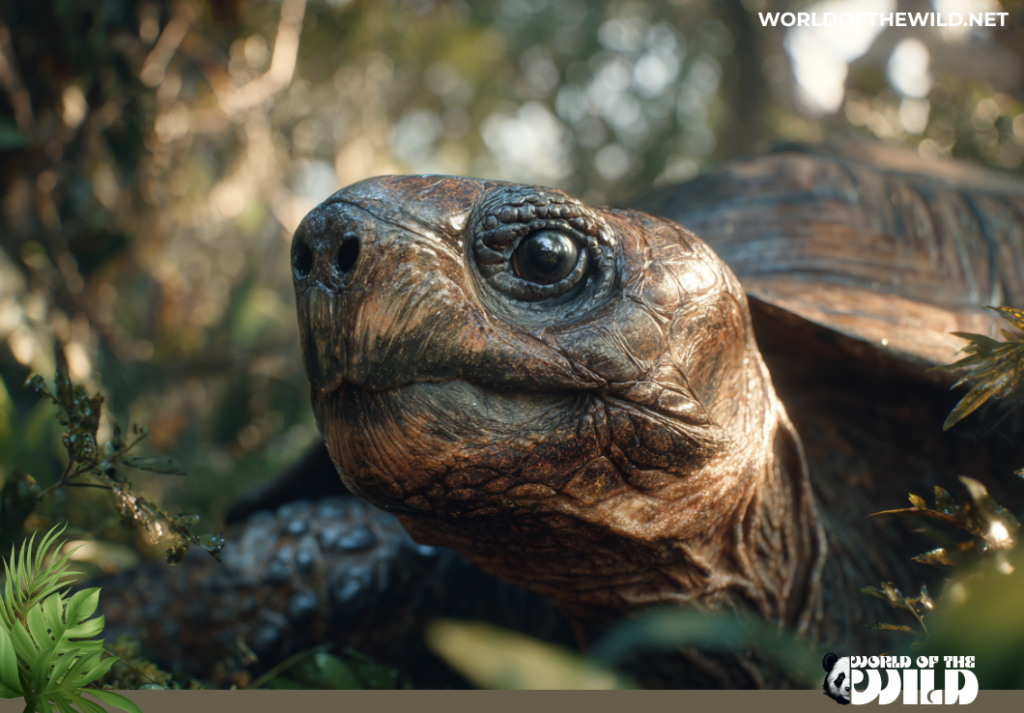
The coloring of giant tortoises is generally dark — ranging from charcoal gray to deep brownish-black — across both the shell and the exposed skin. Their skin is thick, wrinkled, and heavily scaled, especially around the legs and neck, providing protection against abrasion and desiccation. Their legs are stout, columnar, and elephant-like, capable of supporting enormous body weight across rugged terrain. The head is relatively small in proportion to the body, with sharp, keratinous beaks rather than teeth, well-suited for cropping vegetation.
Behavior
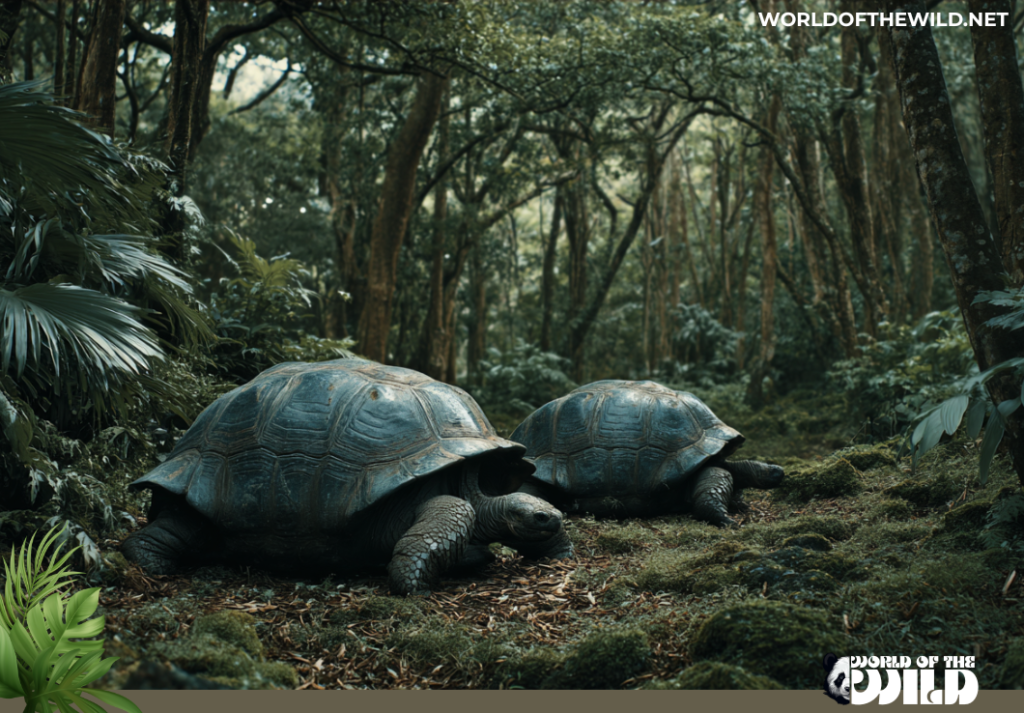
Giant tortoises are often described as solitary, but the reality is more nuanced. While they do not form tight social bonds or cohesive groups, they are not entirely antisocial either. On islands with abundant resources, they frequently congregate in the same areas — wallowing in muddy pools, feeding on the same vegetation patches, or resting in the shade together with apparent tolerance for one another’s proximity. This is better described as passive aggregation than true social behavior.
Their daily routine is governed largely by thermoregulation. As ectotherms (cold-blooded animals), giant tortoises rely on external heat sources to regulate their body temperature. They typically begin their days by basking in the morning sun to warm up, then spend the majority of the daylight hours feeding. During the hottest part of the afternoon, they seek shade or submerge themselves in mud wallows and freshwater pools, which also helps regulate temperature and may provide relief from parasites. Activity tapers off in the evening, and they often sleep in the same location for extended periods.
One of the most behaviorally significant aspects of giant tortoises is their migratory pattern. On islands like Santa Cruz in the Galápagos, tortoises undertake seasonal migrations between lowland coastal zones and highland areas, tracking the availability of food as seasons change. These journeys can span several miles and are remarkably consistent from year to year — some individuals have been observed following the same routes across decades.
Communication among giant tortoises is limited but meaningful. Males during mating season produce loud, guttural bellowing calls. Hissing is used as a defensive signal when threatened. And while vision plays a role in social recognition, smell appears to be their dominant sense, used to identify individuals, locate food, and navigate their environment.
Their intelligence, while modest by mammalian standards, is greater than their reputation suggests. Studies have shown they can learn simple tasks, remember environmental cues, and demonstrate problem-solving behavior — traits that serve them well in the dynamic island ecosystems they inhabit.
Evolution
The story of giant tortoise evolution is one of continental drift, island colonization, and the relentless pressure of natural selection. The family Testudinidae, to which all tortoises belong, has a fossil record stretching back roughly 50–60 million years. Large-bodied tortoises — capable of reaching what we would recognize as “giant” sizes — appear in the fossil record from multiple continents by the Oligocene and Miocene epochs, roughly 10–30 million years ago.
The phenomenon of island gigantism, whereby animals that colonize isolated islands tend to evolve toward larger body sizes over generations, largely explains the extremes of size seen in modern giant tortoises. Isolated from mainland predators and competitors, ancestral tortoise populations colonizing volcanic island chains were free to grow larger, benefiting from reduced predation pressure and, in some cases, taking advantage of ecological niches otherwise filled by large herbivorous mammals.
The Galápagos giant tortoises are believed to have descended from a common ancestor that rafted from the South American mainland approximately 2–3 million years ago — a remarkable natural dispersal event given the over 600-mile distance involved. From a single founding population, tortoises colonized the various islands of the archipelago over successive millions of years, diverging into distinct species shaped by each island’s unique ecology. The saddleback versus domed shell morphologies evolved independently multiple times across different islands — a stunning example of convergent evolution driven by vegetation type and height.
The Indian Ocean giant tortoises followed a parallel but independent evolutionary trajectory. Aldabrachelys gigantea is thought to be related to Malagasy tortoise lineages and colonized the Aldabra Atoll and surrounding islands through oceanic dispersal, with the Aldabra population surviving the extinction of all other Indian Ocean giants due to the relative inaccessibility of the atoll.
Habitat
Giant tortoises today occupy two main geographic regions: the Galápagos Archipelago in the eastern Pacific Ocean (approximately 600 miles west of Ecuador) and the Aldabra Atoll in the western Indian Ocean (part of the Seychelles, roughly 700 miles southwest of the Tanzanian coast).
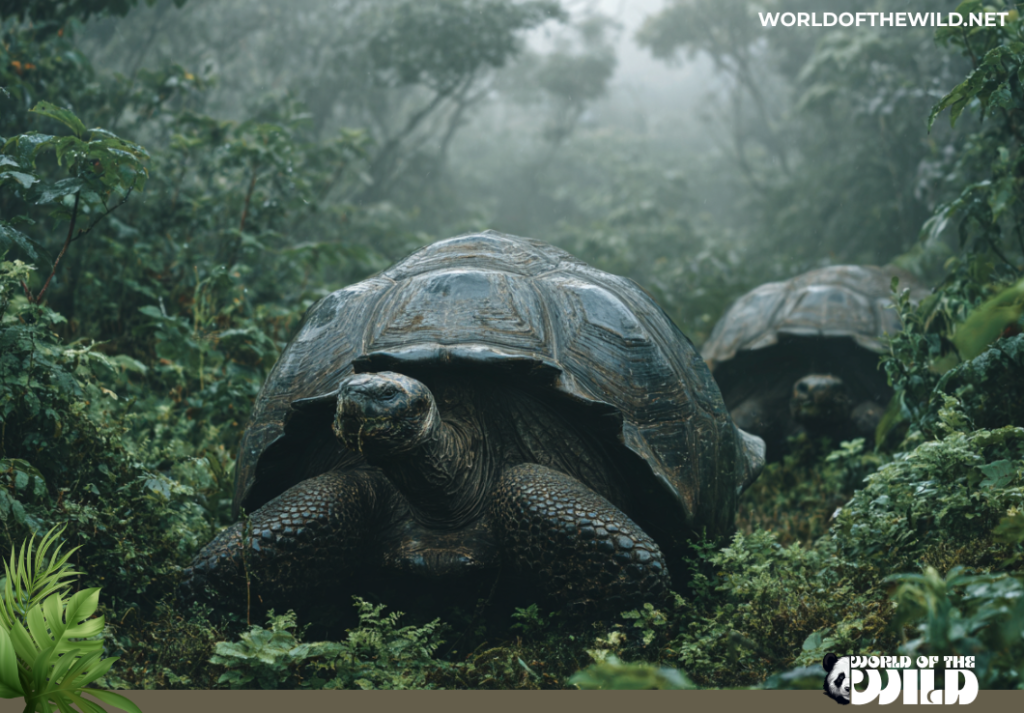
In the Galápagos, tortoise habitat varies dramatically by island and elevation. Coastal lowland zones tend to be arid, covered in sparse cactus scrubland, volcanic rock, and dry grasses. As elevation increases, the vegetation transitions through zones of scalesia forests, fern-sedge communities, and humid Miconia shrublands. Giant tortoises use all of these zones depending on the season, their physiological needs, and the morphological adaptations of their particular species. The volcanic origin of the islands means tortoises navigate lava fields, steep calderas, and crater lakes as part of their natural environment.
The Aldabra Atoll presents a different but equally challenging habitat: a coral limestone atoll sitting barely above sea level, with a mosaic of mangrove forests, coastal scrub, grasslands known as “champignon” (mushroom-shaped formations of weathered limestone), and mixed scrub woodland. The tortoise population here is largely concentrated on the main island of Grande Terre, where seasonal freshwater availability dictates much of their movement.
Both environments are defined by seasonality — wet and dry seasons that profoundly influence food and water availability — and by the volcanic or coral geological foundations that shape the terrain. Giant tortoises are built for exactly these kinds of variable, resource-limited island environments.
Diet
Giant tortoises are strict herbivores, consuming an impressive variety of plant material with methodical patience. Their diet is extraordinarily broad, encompassing grasses, leaves, flowers, fruits, cacti (pads and fruit alike), lichens, and berries. On the Galápagos, the Opuntia cactus is a particularly important food source, providing both nutrition and moisture — giant tortoises have been observed biting into the thick pads and consuming the water-rich tissue within.
Foraging is largely opportunistic and driven by seasonal availability. Tortoises in highland areas favor tender grasses and leafy vegetation during the wet season, when the highlands are lush and green. During the dry season, they may migrate to lower elevations or rely more heavily on fallen fruits and drought-resistant plants. On Aldabra, tortoises have been observed consuming bones and other tortoises’ carcasses on rare occasions, suggesting their herbivore status may be slightly flexible when mineral nutrition is scarce — though this is uncommon and opportunistic rather than habitual.
Their feeding is accomplished entirely with their sharp, toothless beak, which works like a pair of scissors to crop vegetation efficiently. The digestive system of giant tortoises is slow but highly effective, extracting maximum nutrition from often low-quality plant material. This efficiency, combined with their ability to store fat and water, allows them to survive extended periods between meals — a trait that served them well in environments where food availability could be highly seasonal and unpredictable.
Predators and Threats
Natural Predators
Adult giant tortoises have virtually no natural predators. Their massive size, thick shells, and the relative isolation of their island habitats have historically protected them from large-scale predation. However, eggs and hatchlings are considerably more vulnerable. On the Galápagos, Galápagos hawks (Buteo galapagoensis) prey on hatchlings, as do feral pigs, rats, and dogs — none of which are native to the islands. In their ancestral environments, before human-introduced species arrived, young tortoises likely had few significant predators beyond some avian raptors.
Human-Caused Threats
The story of giant tortoise decline is deeply and painfully tied to human activity, and it is one of the most consequential conservation tragedies in island biogeography. Several species and subspecies have already been driven to extinction, including:
Direct exploitation: From the 16th to 19th centuries, whalers, buccaneers, and merchant ships harvested Galápagos tortoises by the tens of thousands. Sailors discovered that tortoises could survive in ship holds for over a year without food or water, making them the ultimate “living larder.” Estimates suggest that over 100,000 tortoises were removed from the Galápagos during this period alone.
Invasive species: This remains the single greatest ongoing threat to Galápagos tortoises. Introduced rats and pigs consume eggs and hatchlings with devastating efficiency, suppressing recruitment of new individuals into the population. Feral goats have destroyed vegetation across entire islands, eliminating food sources and nesting habitat. Invasive plants alter the character of habitats that tortoises depend on.
Habitat destruction: Agricultural expansion, infrastructure development, and human settlement on inhabited Galápagos islands have reduced and fragmented tortoise habitat significantly.
Climate change: Shifts in precipitation patterns, increased frequency and intensity of El Niño events, and rising sea levels (particularly threatening to the low-lying Aldabra Atoll) pose serious long-term risks to both tortoise habitat and food availability.
Disease: While not yet a catastrophic threat, emerging infectious diseases represent a growing concern, particularly as the climate changes and human activity brings new pathogens into contact with isolated populations.
Reproduction and Life Cycle
Giant tortoises reach sexual maturity relatively late — typically between 20 and 40 years of age — a life history trait consistent with their extraordinary longevity. Mating season varies by species and location but generally coincides with the drier periods of the year.
Male competition for females can be intense and surprisingly aggressive for an animal with such a laid-back reputation. Males will engage in extended combat, attempting to raise their heads as high as possible and bite at competitors. The male that can elevate his head the highest is typically dominant, and in some cases, rivals with saddleback shells — which allow greater neck extension — have an inherent advantage over domed-shell individuals in these contests.
Copulation is accompanied by the remarkable deep bellowing vocalizations mentioned earlier, which can be heard at considerable distances. After mating, females undertake migrations to traditional nesting sites — often specific sandy, sun-exposed slopes they return to year after year.
Females excavate flask-shaped nests in the soil using their hind legs, depositing clutches of 2 to 16 hard-shelled, golf ball-sized eggs. Incubation takes approximately 4 to 8 months depending on temperature and species, and the sex of hatchlings is determined by nest temperature — a phenomenon known as temperature-dependent sex determination, common across many reptile groups. Warmer nests produce more females; cooler nests produce more males.
Hatchlings emerge at roughly the size of a tennis ball and are immediately independent — there is no parental care whatsoever. The first years of life are the most dangerous, with hatchlings vulnerable to predation, desiccation, and the difficulty of finding food in often harsh environments. Those that survive to adulthood have extraordinary longevity ahead of them. Giant tortoises routinely live 100 years or more in the wild, and many captive individuals have exceeded 150 years, making them among the longest-lived vertebrates on Earth.
Population
The conservation status of giant tortoises varies significantly by species. As a general group, the Galápagos giant tortoises are listed on the IUCN Red List with individual species ranging from Vulnerable to Critically Endangered depending on population size and trajectory.
The overall Galápagos tortoise population across all species is estimated at approximately 10,000–15,000 individuals today — a stark recovery from the historical low of perhaps 3,000 individuals in the mid-20th century, but still drastically reduced from pre-human contact levels thought to have exceeded 200,000–300,000 individuals. Several subspecies and species have already been completely lost, including Chelonoidis abingdonii (Pinta Island tortoise), whose last known representative, the famous “Lonesome George,” died in June 2012.
The Aldabra giant tortoise stands as a remarkable conservation bright spot, with a population estimated at over 100,000 individuals — the largest population of any giant tortoise in the world. The Aldabra Atoll’s designation as a UNESCO World Heritage Site and its management as a strict nature reserve have been central to this success.
Significant conservation efforts are underway in the Galápagos, led by the Galápagos National Park and the Charles Darwin Foundation. Captive breeding programs have successfully reared thousands of tortoises and repatriated them to their native islands. Invasive species eradication campaigns — particularly goat and rat removal — have dramatically improved conditions on several islands. In a remarkable development, genetic analysis has identified tortoises on Isabela Island that carry significant genetic material from extinct species, opening the door to possible “resurrection” breeding programs to restore lost lineages.
Conclusion
The giant tortoise is more than a biological curiosity or a symbol of ancient endurance — it is a living archive of evolutionary history, an ecological cornerstone, and a humbling reminder of the fragility of life in isolated, bounded environments. These animals survived millions of years of planetary change only to face their most severe crisis in the last few centuries, brought on entirely by one species: us. The extinction of several tortoise species and the near-collapse of many more is a wound that conservation biology is still working to heal.
But the story of the giant tortoise is also, importantly, one of hope. The recovery of Galápagos populations from the brink of collapse, the stunning success of Aldabra’s protected population, and the innovative genetic work being done to restore lost lineages all speak to what is possible when human ingenuity and commitment are directed toward preservation rather than destruction.
The giant tortoise asks nothing from us except the space to exist — to move slowly through its sun-warmed island world, to graze on ancient plants, and to carry the weight of geological time on its back for another century or more. The least we can offer in return is the will to ensure that it can.
If this article moved you, consider supporting organizations like the Galápagos Conservancy, the Charles Darwin Foundation, or the Nature Seychelles Trust, all of whom are doing critical work to secure the future of these irreplaceable animals. The giants of the Earth deserve nothing less than our best effort.
Quick Facts
| Scientific Name | Chelonoidis niger complex (Galápagos); Aldabrachelys gigantea (Aldabra) |
| Diet Type | Herbivore |
| Size | Up to 60 inches (5 feet) in length |
| Weight | Up to 550+ pounds (males); 150–200 pounds (females) |
| Region Found | Galápagos Islands (Ecuador) and Aldabra Atoll (Seychelles, Indian Ocean) |