
Long before monkeys and apes rose to dominate the primate family tree, a group of wide-eyed, long-tailed creatures quietly ruled the forests of what would one day become an island fortress called Madagascar. These are the lemurs — part fairy tale, part fossil record, part living emergency — and they are unlike anything else on Earth.
With their enormous reflective eyes glowing in the dark, their haunting calls echoing through misty forests, and their peculiar upright “sunbathing” poses that look more like yoga than animal behavior, lemurs have captivated scientists, wildlife enthusiasts, and casual observers for centuries. The name itself comes from the Latin lemures, meaning “spirits of the night” or “ghosts” — a nod to the ghostly appearance and nocturnal habits of some species that so unsettled early European explorers.
But lemurs are far more than atmospheric curiosities. They are the most diverse group of primates on the planet, the most threatened mammals on Earth, and a living window into what early primate evolution looked like roughly 60 million years ago. To understand lemurs is to understand where we, as primates, came from — and to reckon with the urgent question of whether we can save them before they vanish.
Facts
Here are some surprising and lesser-known facts about lemurs that reveal just how extraordinary these animals truly are:
- Lemurs are the world’s most endangered mammals. More than 98% of all lemur species are threatened with extinction, making them the most imperiled mammalian group on the planet according to the IUCN Red List.
- They have a built-in comb. Lemurs possess a structure called a “tooth comb” — a set of forward-pointing lower teeth fused together — which they use for grooming fur and scraping resins from trees. It functions exactly as its name suggests.
- Females are in charge. Across almost all lemur species, females are socially dominant over males — a rarity among primates. Female lemurs get first choice of food, mates, and sleeping spots, and males rarely challenge them.
- Some lemurs hibernate. Fat-tailed dwarf lemurs are the only primates known to undergo true hibernation. They store fat in their tails before the dry season and can sleep for up to seven months, dramatically slowing their heart rate and metabolism.
- They communicate through scent in complex ways. Lemurs have scent glands on their wrists, chests, and genitals. The ring-tailed lemur’s famous “stink fights” — where males rub scent on their tails and wave them at rivals — are an elaborate form of chemical warfare that can last for hours.
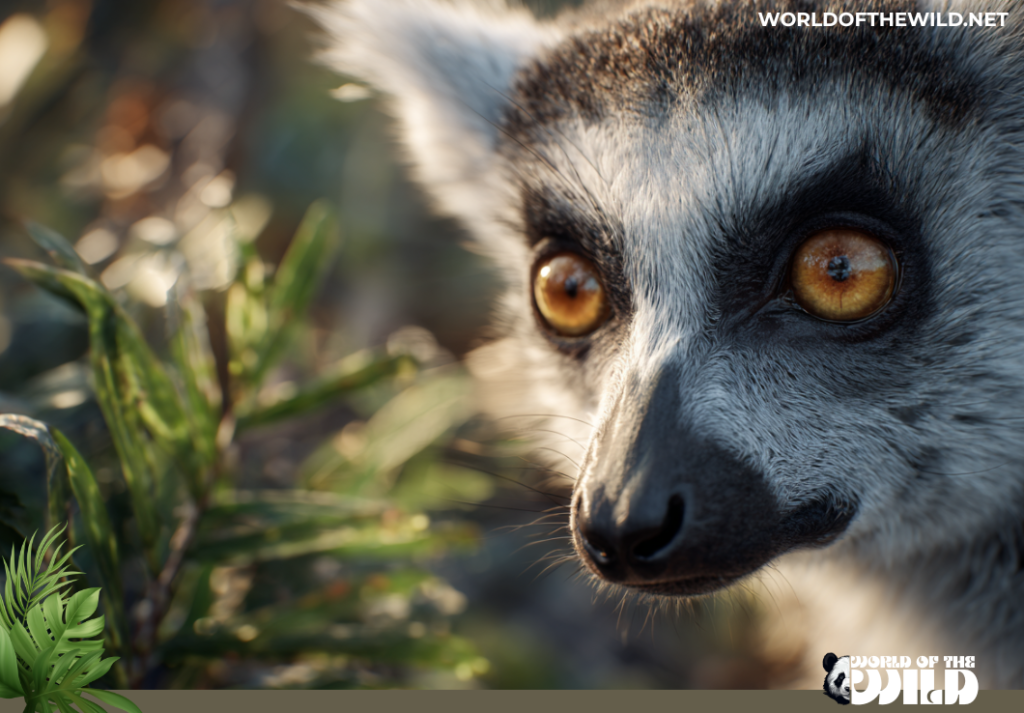
- A lemur’s eyes shine because of a mirror-like layer behind the retina. Called the tapetum lucidum, this structure reflects light back through the photoreceptors, giving lemurs exceptional night vision and causing their eyes to glow vividly when caught in a beam of light.
- They may have crossed the ocean on natural rafts. Lemurs’ ancestors are thought to have drifted from mainland Africa to Madagascar approximately 50–60 million years ago, likely on floating mats of vegetation — one of the most remarkable oceanic dispersal events in mammalian history.
Species
Classification:
| Rank | Classification |
|---|---|
| Kingdom | Animalia |
| Phylum | Chordata |
| Class | Mammalia |
| Order | Primates |
| Suborder | Strepsirrhini |
| Infraorder | Lemuriformes |
| Families | 5 extant families |
Lemurs are not a single species but rather an entire infraorder — Lemuriformes — containing over 100 recognized species and subspecies. They are divided into five living families:
Lemuridae is the largest and most familiar family, containing some of the most recognizable lemurs. It includes the ring-tailed lemur (Lemur catta), the black-and-white ruffed lemur (Varecia variegata), and the red-fronted brown lemur (Eulemur rufifrons). These are generally medium-to-large, diurnal or cathemeral animals.
Indriidae contains the largest living lemurs, including the indri (Indri indri) — the only lemur without a long tail — and the various sifaka species (Propithecus spp.), which are celebrated for their spectacular sideways leaping locomotion on the ground.
Cheirogaleidae encompasses the smallest lemurs, including mouse lemurs (Microcebus spp.), which are among the smallest primates in the world, and dwarf lemurs (Cheirogaleus spp.), which include those hibernating fat-tailed species.
Lepilemuridae, the sportive lemurs, contains a single genus (Lepilemur) of small, nocturnal, vertical clingers that are highly territorial and largely folivorous.
Daubentoniidae is a monotypic family containing only the aye-aye (Daubentonia madagascariensis), one of the most bizarre mammals on Earth. With its rodent-like incisors, bat-like ears, and elongated skeletal middle finger, the aye-aye is so unusual that taxonomists long debated whether it was even a primate.
There is also one extinct family, Archaeolemuridae (the monkey lemurs), and several other extinct forms that included animals as large as gorillas, all wiped out after human arrival in Madagascar within the last 2,000 years.
Appearance
Lemurs come in a staggering range of shapes, sizes, and color patterns that reflect their spectacular evolutionary radiation across Madagascar’s diverse habitats.
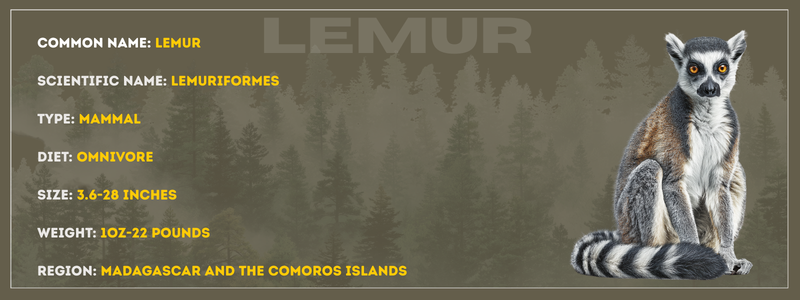
The smallest lemur — Madame Berthe’s mouse lemur (Microcebus berthae) — measures just 3.6 to 4.5 inches (9–11 cm) in body length and weighs barely an ounce (30 grams), making it the world’s tiniest primate. At the other extreme, the indri can reach 28 inches (70 cm) in length and weigh up to 22 pounds (10 kg).
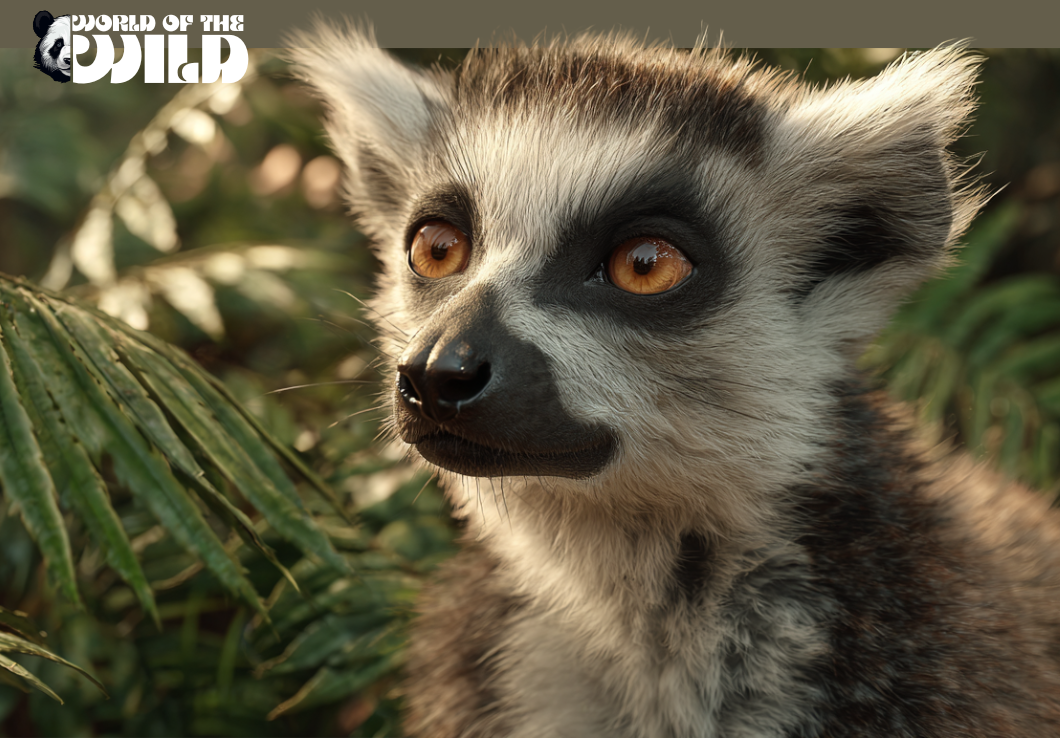
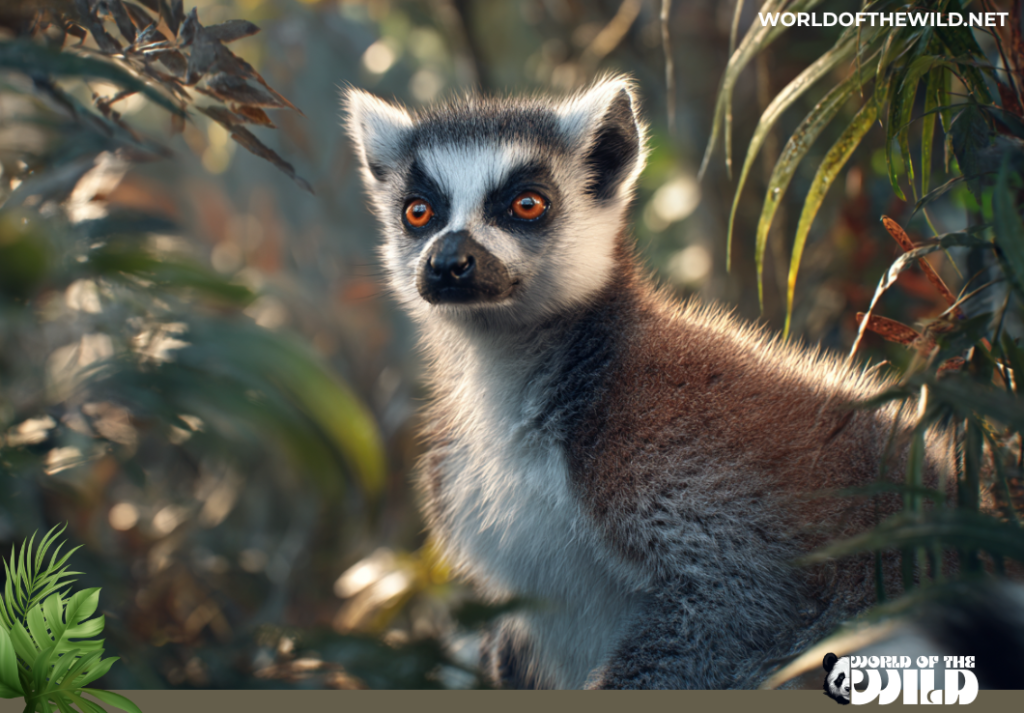
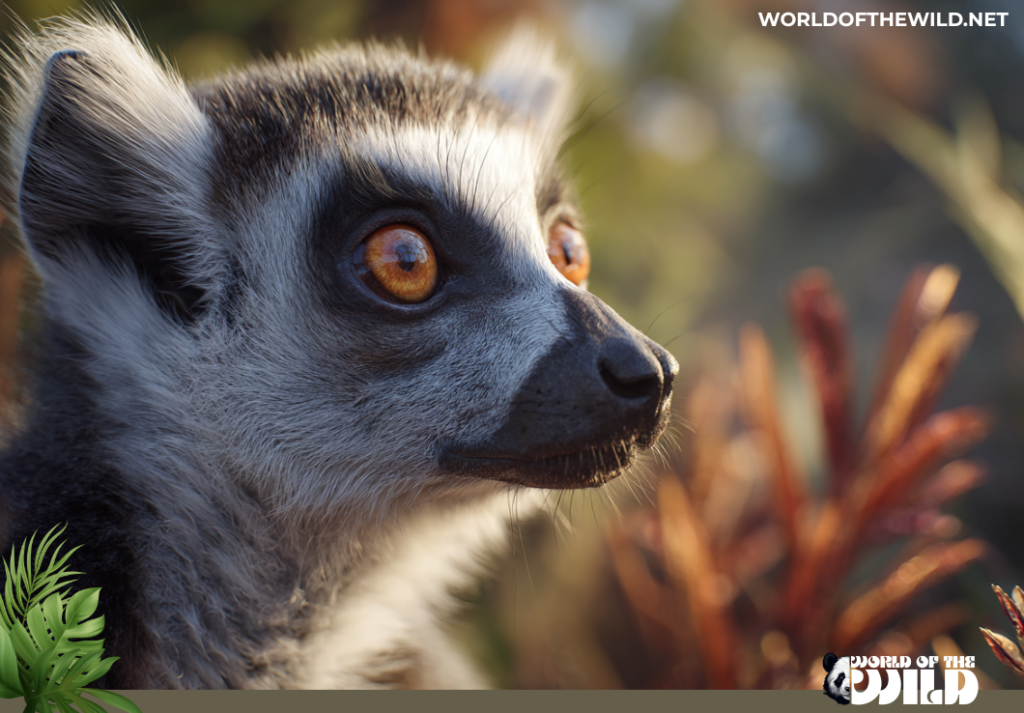
The ring-tailed lemur, arguably the most iconic species, is immediately recognizable by its striking black-and-white banded tail, which can be longer than its body, and its contrasting black face mask set against pale grey and white fur. The animal’s orange-amber eyes are large and luminous, perfectly adapted for gathering light.
Ruffed lemurs display some of the most dramatic coat patterns in the primate world, with bold patches of black and white or red and white, depending on the species. Sifakas, by contrast, are often described as ethereally beautiful — the Coquerel’s sifaka (Propithecus coquereli), for instance, is cloaked in white with patches of deep chestnut on the chest and limbs.
Most lemurs share certain anatomical features: a moist, dog-like nose (rhinarium) connected to the upper lip, the comb-like arrangement of lower front teeth, and a grooming claw on the second toe of each foot. Their hands and feet are grasping and nimble, adapted for life in the trees, and their long tails — present in most species — serve primarily as balance aids and communication tools rather than prehensile gripping appendages.
Behavior
Lemur behavior is as diverse as their appearance, but several traits cut across the group and set them apart from other primates.
Most lemur species are highly social, living in groups that range from small family units of two to five individuals in sportive lemurs to large, multi-male, multi-female troops of 15 to 25 in ring-tailed lemurs. Within these groups, social bonds are maintained through extensive mutual grooming, vocalizations, and scent marking. Female dominance — where females have priority access to resources and can displace males with minimal resistance — is a defining social feature across the order and remains one of the more fascinating anomalies in primate behavioral ecology.
Communication in lemurs is rich and multi-modal. They use vocalizations that range from the indri’s haunting, whale-like wail — audible up to 2 miles (3 km) away — to the bark-like alarm calls of ring-tails. Scent marking through glands distributed across the body plays an equally important role, conveying information about individual identity, reproductive status, and territorial boundaries. Visual signals, including tail-waving and postural displays, round out their communicative repertoire.
One of the most remarkable behavioral adaptations is the ring-tailed lemur’s “sunbathing” posture — sitting upright with arms spread wide and belly exposed to the morning sun, a behavior called thermoregulation or sun-basking, which helps warm their bodies after cold nights in the dry southern forests.
Many lemurs are also cathemeral — active in both day and night — an unusual trait among mammals that seems to be an adaptation to the unpredictable, resource-limited environment of Madagascar.
Evolution
The evolutionary story of lemurs is one of the most dramatic in all of mammalian history, characterized by an unlikely oceanic voyage, millions of years of isolation, and an explosive diversification that produced one of nature’s most remarkable experiments in primate evolution.
The ancestors of modern lemurs were small, tree-dwelling primates that diverged from other primates during the Eocene epoch, approximately 54 to 58 million years ago. Fossil evidence and molecular clock data suggest that a small group of these ancestral primates — likely resembling today’s mouse lemurs — made the crossing from mainland Africa to Madagascar between 50 and 60 million years ago. This journey, covering roughly 250 miles (400 km) of open ocean, is believed to have been made on rafts of matted vegetation. Crucially, the crossing appears to have happened only once, or perhaps a very small number of times, with all living Malagasy lemurs descending from this founding population.
Once on Madagascar, isolated from the predators, competitors, and evolutionary pressures of the mainland, these ancestral lemurs underwent an extraordinary adaptive radiation — diversifying to fill the ecological niches that, on continental landmasses, are occupied by a wide variety of other mammals. Different lineages became specialized as frugivores, folivores, insectivores, and even wood-boring foragers (the aye-aye), paralleling adaptations seen in squirrels, woodpeckers, and monkeys elsewhere in the world.
Before humans arrived on Madagascar roughly 2,000 years ago, the island hosted a far richer lemur fauna. The giant subfossil lemurs — including Archaeoindris fontoynonti, a gorilla-sized lemur that may have reached 350 pounds (160 kg), and Palaeopropithecus, a sloth-like lemur that hung upside-down from branches — represented the apex of this evolutionary radiation. These megafauna disappeared rapidly after human colonization, almost certainly driven to extinction by hunting and habitat clearance.
Habitat
Lemurs are found exclusively on Madagascar and the nearby Comoros Islands, making them one of the most geographically restricted large mammal groups on Earth. Madagascar itself — the world’s fourth-largest island, roughly the size of Texas — sits off the southeastern coast of Africa and harbors an extraordinary level of biodiversity: approximately 90% of its wildlife, including all of its lemurs, exists nowhere else on the planet.
Within Madagascar, lemurs occupy virtually every forested habitat the island offers, and their distribution closely mirrors the island’s dramatic ecological diversity. The eastern rainforests, fed by moisture-laden trade winds from the Indian Ocean, are the richest lemur habitats and home to the greatest species diversity. Here, in a layered canopy of extraordinary complexity, dozens of species coexist by partitioning food resources and vertical forest zones.
The dry deciduous forests of the west, which experience a pronounced dry season and shed their leaves annually, harbor a distinct lemur community adapted to seasonal food scarcity — including hibernating dwarf lemurs and the peculiar, cactus-navigating ring-tailed lemurs of the southern spiny desert.
The spiny forest of the arid south, dominated by endemic Didiera succulents and baobabs, is the home range of the ring-tailed lemur and several mouse lemur species that must survive months with almost no rainfall. The high plateau montane forests, though heavily degraded, support indri and various sifaka populations in cooler, cloud-forest conditions.
What all these habitats share is their vulnerability: Madagascar has lost approximately 90% of its original forest cover since humans arrived, and the forests that remain are fragmented, degraded, and under continuous pressure.
Diet
Lemurs span the full spectrum of dietary strategies — herbivores, omnivores, and highly specialized feeders are all represented within the group.
The majority of lemur species are primarily herbivorous with omnivorous tendencies. Fruit forms the dietary cornerstone for most medium-to-large species, supplemented by leaves, flowers, nectar, seeds, bark, and occasionally invertebrates. The ruffed lemurs are particularly important seed dispersers in Madagascar’s rainforests, swallowing large seeds that few other animals can process, earning them the title of “gardeners of the forest.”
Folivory — leaf-eating — is the primary dietary strategy for sifakas and sportive lemurs. Leaves are abundant but difficult to digest, so these species have evolved specialized digestive systems and spend considerable time resting to process their fibrous diet. Sportive lemurs have been observed engaging in cecotrophy — re-ingesting their own fecal pellets — to extract maximum nutrition from tough plant matter.
The aye-aye occupies perhaps the most specialized dietary niche in the lemur world. It uses its elongated, skeletal middle finger to tap on tree bark, listening for hollow chambers made by wood-boring grubs, then gnaws through the bark with its chisel-like incisors and uses that same spindly finger to extract the larvae. This technique is functionally identical to that used by woodpeckers — a stunning example of convergent evolution.
Mouse lemurs and dwarf lemurs are largely insectivorous and frugivorous, supplementing their diet with small vertebrates, gecko eggs, and nectar. Ring-tailed lemurs are versatile generalists, foraging on the ground as well as in trees and consuming a wide variety of fruits, leaves, bark, sap, and even the occasional insect or small vertebrate.
Predators and Threats
Natural Predators
Despite their island isolation, lemurs face a number of natural predators. The most formidable is the fossa (Cryptoprocta ferox), Madagascar’s largest native carnivore — a sleek, cat-like mammalian predator that is agile enough to hunt lemurs both on the ground and through the forest canopy. Fossas are the primary large predators of medium-to-large lemurs.
Other natural threats include Madagascar ground boas, which prey on smaller species and infants, birds of prey such as the Madagascar harrier-hawk and the Henst’s goshawk, and large-eared tenrecs that occasionally take mouse lemurs. Some introduced predators — dogs, cats, and rats brought by humans — have also become significant pressures.
Human-Caused Threats
The existential threat to lemurs, however, is overwhelmingly human in origin. Habitat destruction is the primary driver of lemur decline. Madagascar is one of the poorest countries in the world, and slash-and-burn agriculture (tavy), illegal logging for precious hardwoods such as rosewood and ebony, charcoal production, and cattle ranching have devastated the island’s forests. At current rates of deforestation, much of Madagascar’s remaining forest could disappear within decades.
Hunting has historically been a significant threat, particularly to larger lemur species. Although fady (cultural taboos) protect some species in certain regions, enforcement is inconsistent, and bushmeat hunting has intensified in areas of poverty and food insecurity.
Live capture for the pet trade is a growing problem, with lemurs taken illegally from the wild and sold within Madagascar and internationally. The wildlife tourism industry has also created problematic incentives, with some facilities keeping lemurs in semi-captive conditions that undermine wild populations.
Climate change is an emerging and accelerating threat. Changes in rainfall patterns, increasing drought frequency in the south, and intensifying cyclone seasons are disrupting the delicate seasonal rhythms that lemur reproduction and hibernation depend upon.
Reproduction and Life Cycle
Lemur reproduction is tightly governed by photoperiod — the changing length of daylight hours — a strategy that synchronizes births with the most resource-abundant period of the year. Most lemur species have highly seasonal breeding, with mating occurring during a narrow window of just a few weeks, triggered by increasing day length as the dry season transitions toward the wet season.
Female lemurs typically have only one breeding period per year, and the duration of their receptivity can be extraordinarily brief — female ring-tailed lemurs are in estrus for as little as 24 hours. Male lemurs compete intensely during this window, with rival males engaging in scent battles, vocalizations, and occasional physical confrontations, though the females ultimately determine who mates with them.
Gestation periods vary considerably across the group, ranging from 60 days in mouse lemurs to approximately 165 days in indri. Litter sizes also vary: mouse lemurs and dwarf lemurs regularly produce twins or triplets, while larger species such as sifakas and indri typically give birth to a single infant.
Maternal investment is substantial. Infants are born in a relatively precocial state compared to most primates, but they rely heavily on their mothers for warmth, nutrition, and transport. In many species, mothers “park” their infants on branches while foraging, returning to nurse them. As young lemurs grow, they are carried on the mother’s back or belly. Allomothering — care of infants by individuals other than the mother — is common in many species, helping to distribute the cost of raising offspring.
Lemurs reach sexual maturity at approximately 2 to 3 years in smaller species and 4 to 5 years in larger ones. Lifespans in the wild are generally 15 to 25 years for medium and large species, while mouse lemurs may live 10 to 15 years. In captivity, some lemurs have lived well past 30 years.
Population
Lemurs collectively hold one of the most alarming conservation status profiles of any mammalian group on Earth. According to the most recent IUCN Red List assessments:
- 31% of lemur species are Critically Endangered
- 47% are Endangered
- 20% are Vulnerable
- Less than 2% qualify as Least Concern
These figures mean that more than 98% of all lemur species face some level of extinction risk — an unprecedented statistic among mammals and a damning indictment of the pressures facing Madagascar’s ecosystems.
Total population estimates are difficult to establish across the more than 100 species, but populations for many of the most endangered species are alarmingly small. The silky sifaka (Propithecus candidus), for example, is estimated to have fewer than 250 mature individuals remaining in the wild. Several newly described species of bamboo lemur exist in populations of only a few hundred animals. Even the relatively common ring-tailed lemur, though more resilient than many relatives, has seen its wild population decline sharply — estimated at between 2,000 and 2,400 individuals as of recent surveys, down from populations in the tens of thousands just decades ago.
The trajectory is deeply troubling. Despite decades of conservation effort, deforestation rates in Madagascar have continued, political instability has repeatedly undermined protected area management, and the economic pressures that drive habitat destruction remain unaddressed at a systemic level. However, there is reason for measured hope: new species continue to be discovered, community-based conservation programs have shown success in some areas, and international funding for lemur conservation has grown substantially.
Conclusion
Lemurs are extraordinary by almost any measure — ancient, behaviorally rich, ecologically indispensable, and achingly beautiful. They represent 60 million years of primate evolution, an experiment in isolation that produced one of the most diverse and specialized mammalian radiations the world has ever seen. They are, in every meaningful sense, irreplaceable.
And they are disappearing.
The convergence of poverty, political instability, and habitat destruction on one of the world’s most biodiverse islands has created a conservation crisis without parallel in the mammalian world. More than 100 species, shaped across tens of millions of years, now teeter at the edge of extinction within a single human lifetime. The loss of the lemurs would not merely be a tragedy for wildlife lovers — it would represent an irreversible impoverishment of life’s diversity on Earth, the erasure of an entire branch of the primate tree that holds answers to questions about our own evolutionary origins we have not yet thought to ask.
The good news is that it is not too late. Madagascar’s forests, though diminished, still stand in substantial patches. Many lemur species, given habitat protection and reduced hunting pressure, show the capacity to recover. The tools of conservation biology — protected areas, community engagement, captive breeding for the most critical species, sustainable development alternatives for local communities — are available and, where resourced properly, effective.
The question is not whether we can save the lemurs. The question is whether we will — and whether we will act before the ghosts of Madagascar become something far more permanent.
Quick Reference
| Attribute | Details |
|---|---|
| Scientific Name | Order: Lemuriformes (Ring-tailed lemur: Lemur catta) |
| Diet Type | Omnivore (primarily herbivorous; varies by species) |
| Size | 3.6 inches to 28 inches (9 cm to 70 cm) body length, excluding tail |
| Weight | 1 oz to 22 lbs (30 g to 10 kg), depending on species |
| Region Found | Madagascar and the Comoros Islands (off southeast Africa) |