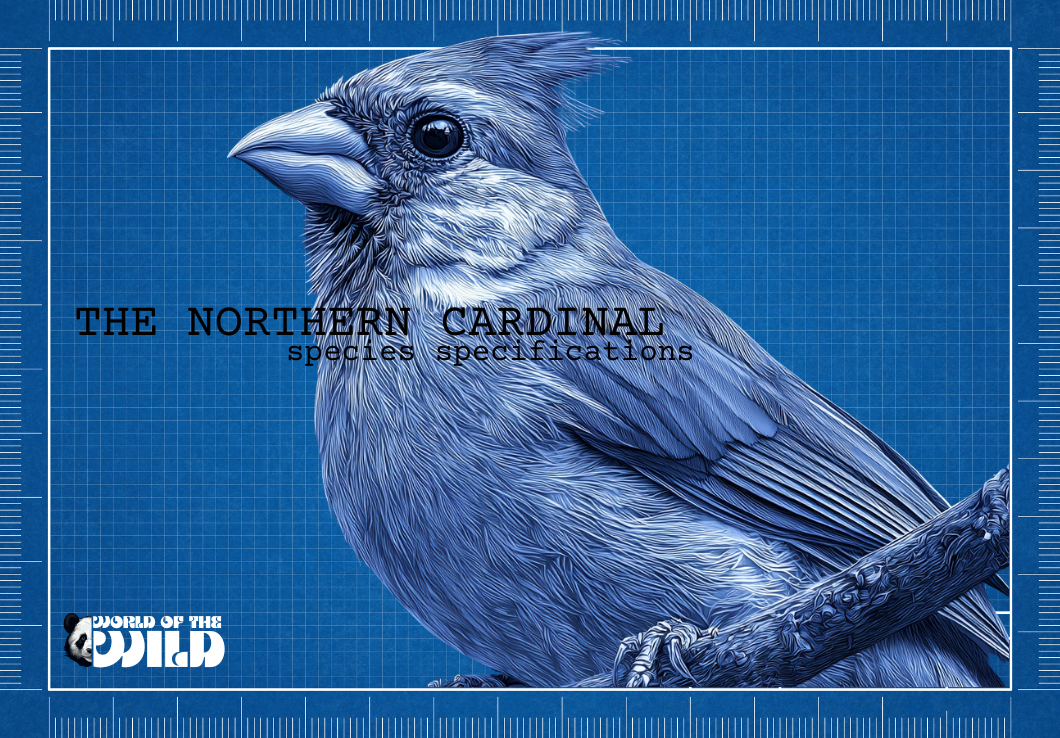

Specifications & Field Reference
Scientific Classification
- Kingdom: Animalia
- Phylum: Chordata
- Class: Aves
- Order: Passeriformes
- Family: Cardinalidae
- Genus: Cardinalis
- Species: C. cardinalis
- Binomial Name: Cardinalis cardinalis (Linnaeus, 1758)
PHYSICAL SPECIFICATIONS
Dimensions
- Total Length: 21–23 cm (8.3–9.1 inches)
- Wingspan: 25–31 cm (9.8–12.2 inches)
- Tail Length: 9.0–11.4 cm
- Bill Length: 1.5–1.7 cm (stout, conical)
Mass
- Average Weight: 33–65 g (1.2–2.3 oz)
- Male Average: 45 g
- Female Average: 42 g
Sexual Dimorphism
Male Plumage:
- Brilliant red throughout entire body
- Black face mask extending from forehead to upper throat
- Distinctive red crest on crown
- Coral-red conical bill
- Dark gray to black legs and feet
Female Plumage:
- Warm brown to olive-brown base coloration
- Reddish tinge on wings, crest, and tail
- Dull red-orange bill
- Minimal dark coloring on face
- Same crest structure as male
Juvenile Characteristics
- Resembles adult female
- Darker, more brownish bill
- Less prominent crest
- Males begin showing red feathers at approximately 12 weeks
DISTRIBUTION & HABITAT
Geographic Range
- Native Range: Eastern and central North America, parts of Central America
- Northern Limit: Southern Canada (Ontario, Quebec)
- Southern Limit: Northern Guatemala and Belize
- Western Expansion: Range has expanded westward over past century into Arizona, New Mexico, California
Habitat Preferences
- Edge habitats and woodland borders
- Shrubby areas with dense undergrowth
- Residential gardens and suburban parks
- Riparian corridors
- Forest clearings with thick vegetation
- Elevation: Sea level to 2,000 m, occasionally higher
- Habitat Type: Non-migratory; occupies same territory year-round
Territory Size
- Breeding territory: 0.8–3.5 hectares (2–9 acres)
- Territory defended by both male and female
BEHAVIORAL SPECIFICATIONS
Vocalization
Song Characteristics:
- Loud, clear whistled phrases
- Typical pattern: series of descending “cheer-cheer-cheer” or “birdy-birdy-birdy”
- Song duration: 2–3 seconds per phrase
- Frequency range: 2–8 kHz
- Both males and females sing (unusual among North American songbirds)
- Repertoire: 10–15 distinct song variations per individual
Call Notes:
- Sharp metallic “chip” alarm call
- Contact calls between pairs
Flight Pattern
- Short, fluttering flight style
- Typical flight speed: 20–30 mph
- Reluctant to fly long distances
- Flies low when moving between cover
Feeding Behavior
- Foraging method: Ground foraging and low vegetation gleaning
- Active feeding periods: Dawn and dusk, also midday in winter
- Uses strong bill to crack seeds and hulls
- Often visits feeding stations in pairs or small groups
DIETARY SPECIFICATIONS
Primary Diet Composition (varies seasonally)
Adults:
- Seeds and grains: 90% of diet (winter)
- Insects and invertebrates: 30% (summer, breeding season)
- Fruits and berries: Supplemental, seasonal
Preferred Food Items:
- Sunflower seeds (especially black oil)
- Safflower seeds
- Cracked corn
- Wild grape
- Dogwood berries
- Beetles, grasshoppers, cicadas
- Caterpillars, especially during breeding
Nestling Diet:
- Almost exclusively insects for first 10 days
- Gradually transition to seeds after fledging
Water Requirements
- Requires daily water access
- Frequent bathers year-round
REPRODUCTION SPECIFICATIONS
Breeding Season
- Period: March through September
- Peak activity: April through July
- Clutches per season: 2–3 (occasionally 4)
Nest Construction
- Builder: Female (male may provide materials)
- Location: Dense shrubs or small trees, 1–4 meters above ground
- Structure: Compact cup of twigs, bark strips, grasses, rootlets
- Lining: Fine grasses, hair
- Construction time: 3–9 days
- Nest dimensions: Outer diameter 10 cm, inner cup 7 cm wide × 5 cm deep
Egg Specifications
- Clutch size: 2–5 eggs (typically 3)
- Egg coloration: Grayish or greenish white with brown, gray, or purple speckles
- Egg dimensions: 26 × 19 mm
- Egg weight: 4.5–5.0 g
- Laying interval: One egg per day
Incubation & Development
- Incubation period: 11–13 days (average 12.5 days)
- Incubation: Female only
- Nestling period: 9–11 days
- Fledgling dependence: 25–56 days post-fledging
- Sexual maturity: One year
LIFESPAN & SURVIVAL
Longevity
- Average lifespan (wild): 3 years
- Maximum recorded age: 15 years, 9 months (banding record)
- Typical breeding lifespan: 5–6 years
Survival Rates
- Annual adult survival: ~60%
- First-year survival: ~40%
- Nest success rate: ~40–50%
Primary Mortality Factors
- Predation (domestic cats, hawks, snakes)
- Window collisions
- Severe weather events
- Vehicle strikes
CONSERVATION STATUS
Population Status
- IUCN Red List: Least Concern
- Population trend: Stable to increasing
- Estimated global population: 100–200 million individuals
- North American population: Approximately 130 million (Partners in Flight estimate)
Conservation Notes
- One of the most abundant songbirds in North America
- Benefits from suburban development and bird feeders
- Protected under Migratory Bird Treaty Act
- No significant conservation threats identified
DISTINCTIVE IDENTIFICATION FEATURES
Field Marks for Positive Identification
- Male: Only completely red bird with prominent crest in range
- Female: Brownish bird with red-tinted wings and crest, thick pinkish bill
- Both sexes: Thick, conical orange-red to red bill
- Prominent pointed crest (often raised when alert)
- Long tail
Similar Species & Differentiation
- Pyrrhuloxia (Cardinalis sinuatus): Gray body, shorter crest, yellow bill
- Summer Tanager (male): No crest, no black face, different bill shape
- Hepatic Tanager (male): No crest, darker bill
STATE BIRD DESIGNATION
The Northern Cardinal serves as the official state bird for seven U.S. states (more than any other species): Illinois, Indiana, Kentucky, North Carolina, Ohio, Virginia, and West Virginia.
Want to learn more about the Northern Cardinal? Be sure to visit the Cardinal page for in-depth information.