
Imagine standing on the Great Plains centuries ago, watching the earth itself seem to move as a dark, rumbling mass stretches from horizon to horizon. This was the American bison—North America’s largest land mammal and an icon so powerful it nearly defined an entire continent. Once numbering in the tens of millions, these magnificent creatures shaped the landscape, sustained indigenous cultures for millennia, and embodied the wild spirit of the American frontier. Today, the bison stands as both a symbol of devastating near-extinction and a beacon of conservation hope. Their story is one of resilience, ecological importance, and the complex relationship between humans and nature—a tale that continues to unfold across prairies, parks, and preserves throughout North America.
Facts
- Built-in Snowplow: Bison use their massive heads as snow plows, swinging them side to side to clear snow up to three feet deep to reach grass underneath, unlike most grazing animals that would starve in such conditions.
- Surprising Speed: Despite weighing up to 2,000 pounds, bison can run at speeds of 35-40 mph, jump six feet vertically, and pivot quickly—making them faster than horses over short distances.
- Living History: American bison are one of the few Ice Age megafauna to survive to modern times; they’ve roamed North America for over 100,000 years, witnessing the extinction of mammoths, saber-toothed cats, and giant ground sloths.
- Thermal Adaptation Masters: Bison fur is so well-insulated that snow can accumulate on their backs without melting, and their thick winter coats can have guard hairs up to 12 inches long on their heads and shoulders.
- Yellowstone’s Only Continuous Population: The bison herd in Yellowstone National Park is the only population that has lived continuously on its original habitat since prehistoric times without being transplanted.
- Natural Ecosystem Engineers: Bison create “wallows”—shallow depressions where they roll in dirt—that become seasonal ponds supporting insects, amphibians, and birds, while their selective grazing promotes prairie biodiversity.
- The Great Comeback: In 1889, only 1,091 bison remained in all of North America; today, there are approximately 500,000, making it one of conservation’s greatest success stories, though most are commercially raised rather than wild.
Species
Kingdom: Animalia
Phylum: Chordata
Class: Mammalia
Order: Artiodactyla
Family: Bovidae
Genus: Bison
Species: Bison bison
The American bison belongs to the same genus as the European bison (Bison bonasus), though they are distinct species that diverged hundreds of thousands of years ago. Within Bison bison, two subspecies are recognized:
Plains Bison (Bison bison bison): The more numerous and widespread subspecies, characterized by a smaller, more rounded hump and shorter hair on the forelegs and beard. Plains bison once dominated the grasslands from Canada to Mexico and are the subspecies most commonly seen in commercial herds and many conservation areas today.
Wood Bison (Bison bison athabascae): Larger than their plains cousins, wood bison sport a taller, more square-shaped hump positioned farther forward on their shoulders, longer legs, and a less pronounced beard. They evolved in the boreal forests and parklands of northwestern Canada and Alaska. Wood bison were thought extinct until a small population was discovered in 1957 in northern Canada. They remain the rarer subspecies, with focused conservation efforts ongoing.
Both subspecies can interbreed, and many modern bison populations contain genetic mixing from historical hybridization efforts, though pure herds of each subspecies are maintained for conservation purposes.
Appearance
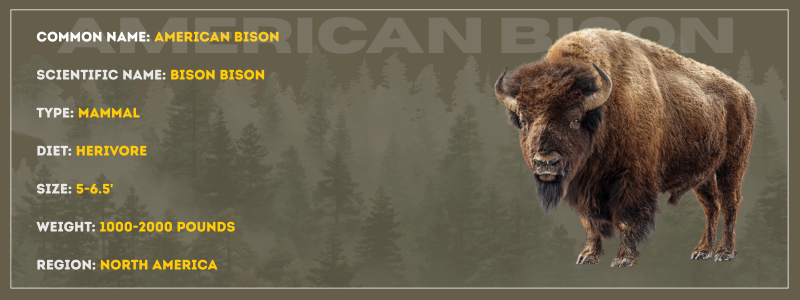
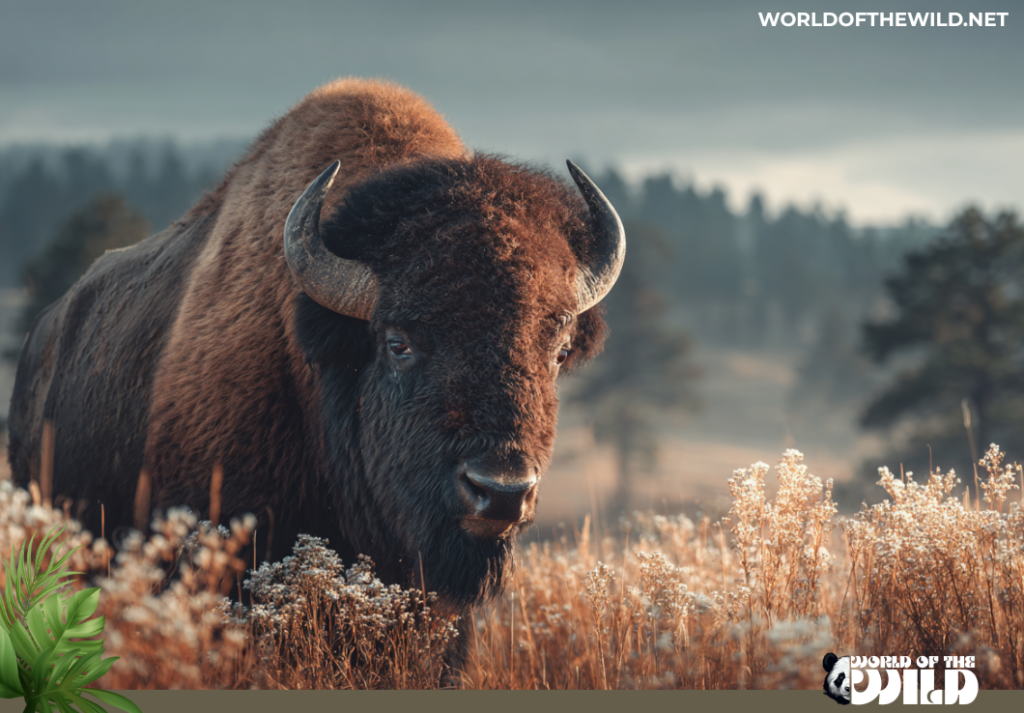
The American bison is an imposing animal built for survival in harsh prairie and woodland environments. Adult males (bulls) stand 5.5 to 6.5 feet tall at the shoulder and can weigh between 1,000 to 2,000 pounds, with exceptional individuals reaching 2,500 pounds. Females (cows) are considerably smaller, typically weighing 800 to 1,100 pounds and standing about 5 feet at the shoulder.
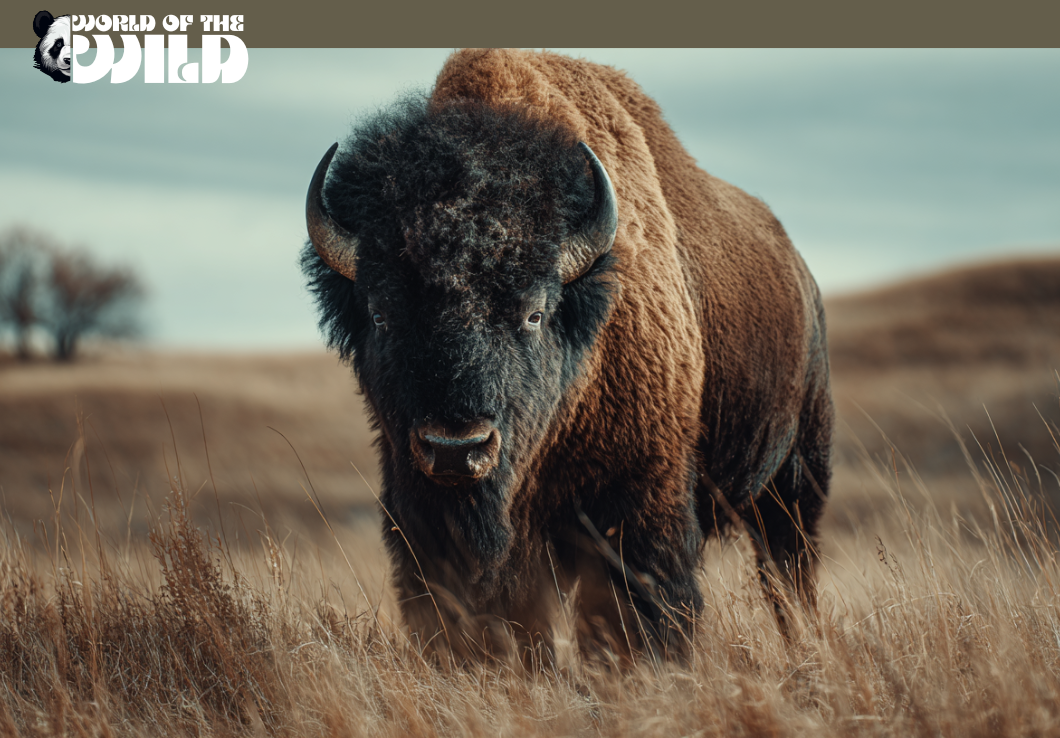
Their most distinctive feature is the massive, humped shoulders—higher than their hindquarters—created by elongated vertebrae supporting powerful neck and shoulder muscles. This asymmetrical build gives bison their characteristic profile and provides the strength needed for plowing through deep snow. The head is enormous and blocky, with a broad forehead covered in thick, curly hair that forms a distinctive “cap” between the horns.
Both sexes possess permanent, curved horns that grow throughout their lives, though bulls’ horns are thicker and can reach up to two feet in length, curving upward and inward. These serve as formidable weapons during rutting season battles.
Bison are cloaked in two layers of hair: a dense, fine underfur and longer, coarse guard hairs. Their coloration is typically dark brown to black on the massive front half, including the head, shoulders, and forelegs, while the hindquarters are covered in shorter, lighter brown fur. This two-toned appearance becomes most pronounced in summer when they shed their heavy winter coats in large, shaggy patches that drape from their bodies like tattered clothing.
The tail is relatively short with a tuft at the end, and when raised vertically, it signals agitation—a warning to give the animal space. Their legs, while appearing short relative to their massive body, are surprisingly long and powerful, ending in cloven hooves adapted for both running and digging.
Behavior
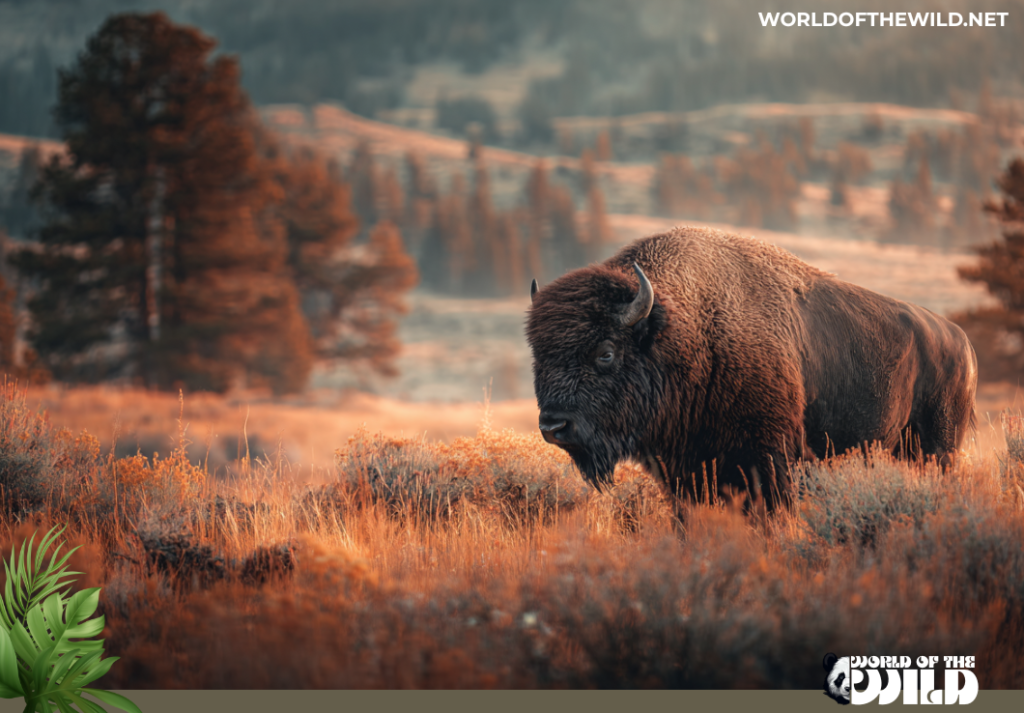
American bison are fundamentally social animals, organizing themselves into fluid groups that vary by season and sex. During most of the year, females and their offspring form maternal herds that can range from a few dozen to several hundred individuals, while mature bulls either live solitary lives or form small bachelor groups. These groups merge during the summer breeding season into massive mixed herds.
Within herds, bison establish social hierarchies, though these are relatively subtle compared to many other bovids. Dominance is usually established through posturing, head-to-head pushing matches, and displays rather than serious fighting, except during the rut. A distinctive behavior is “wallowing”—bison roll vigorously in dirt depressions, coating themselves in dust. This serves multiple purposes: removing loose fur, deterring biting insects, and possibly applying dust as a sunscreen or external parasite control.
Communication among bison is surprisingly nuanced. They use a range of vocalizations including grunts, snorts, bellows, and the distinctive roar of bulls during breeding season that can carry for miles across the prairie. Body language is equally important—tail position, ear orientation, and head movements all convey intention and emotional state.
Despite their placid appearance while grazing, bison are remarkably alert and possess excellent senses of smell and hearing, though their eyesight is relatively poor. They can be unpredictable and dangerous; seemingly calm bison can charge with little warning if they feel threatened, using their massive heads as battering rams. Their intelligence should not be underestimated—they remember grazing areas, water sources, and migration routes, with this knowledge passed down through generations.
Bison are highly adapted to extreme weather. Rather than seeking shelter during blizzards, they often face into the wind, allowing their heavily-insulated front quarters to bear the brunt of the storm while their more lightly-furred hindquarters remain protected. In summer heat, they seek out water and shade, becoming more active during cooler morning and evening hours.
Evolution
The bison’s evolutionary story is a testament to adaptation and survival through dramatic climate shifts. The genus Bison originated in Eurasia approximately 2-3 million years ago during the Pliocene epoch. The earliest bison ancestors were much smaller than modern forms, standing only about three feet tall at the shoulder.
Bison first entered North America roughly 195,000 to 135,000 years ago via the Bering Land Bridge during a glacial period when lowered sea levels connected Asia to Alaska. These early colonizers were Bison priscus (steppe bison), which were larger than modern bison, with longer, less curved horns spanning up to seven feet from tip to tip. These animals thrived in the cold, dry grasslands south of the Pleistocene ice sheets.
Around 10,000 years ago, as the Ice Age ended and the climate warmed, Bison priscus evolved into two lineages: Bison occidentalis (ancient bison) and eventually into the modern Bison bison we see today. This evolution involved a dramatic decrease in body size and horn size—modern bison are roughly 25% smaller than their Pleistocene ancestors. This size reduction likely occurred as the environment shifted from cold, arid steppe to warmer, more forested and grassland environments.
Interestingly, genetic studies reveal that American bison survived at least two severe population bottlenecks during the Ice Age, which reduced genetic diversity but proved their adaptability. They coexisted with and outlasted numerous megafauna species including mammoths, mastodons, ground sloths, and ancient horses that went extinct at the end of the Pleistocene.
The split between plains and wood bison subspecies occurred relatively recently in evolutionary terms, likely within the last few thousand years, as populations adapted to either open grassland or forest-parkland environments.
Habitat
Historically, American bison occupied one of the largest ranges of any land mammal in the Western Hemisphere, stretching from northern Canada to Mexico and from the Rocky Mountains to the Appalachian Mountains. However, they were most abundant on the Great Plains—the vast grassland ecosystem extending from Alberta and Saskatchewan in Canada south through Montana, the Dakotas, Wyoming, Nebraska, Kansas, Oklahoma, and into Texas.
Plains bison dominated the shortgrass and mixed-grass prairie regions, thriving in open landscapes characterized by rolling terrain, periodic drought, harsh winters, and frequent fires. These grasslands feature hot summers, cold winters with temperature extremes ranging from over 100°F to -40°F, and annual precipitation between 10 and 30 inches. The deep-rooted perennial grasses of these prairies proved ideal for bison grazing patterns, and the animals themselves helped maintain the ecosystem through their grazing, wallowing, and fertilization.
Wood bison evolved in the aspen parklands and boreal forests of northwestern Canada and Alaska—a different environment characterized by mixed forest and meadow habitats, longer winters, greater precipitation, and different vegetation communities including more browse (woody plants) mixed with grasses and sedges.
Bison require several habitat components: open areas for grazing, water sources for drinking (they need water daily), and sufficient space for their movements. Historically, some bison populations were migratory, following seasonal patterns to access the best forage and avoid deep snow, though the extent of these migrations is still debated by scientists.
Today, bison are confined to a tiny fraction of their historical range—primarily in national and state parks, wildlife refuges, tribal lands, and private ranches. The largest conservation herds are found in Yellowstone National Park (Wyoming, Montana, Idaho), Wood Buffalo National Park (Northwest Territories and Alberta, Canada), and various locations across the Great Plains.
Diet
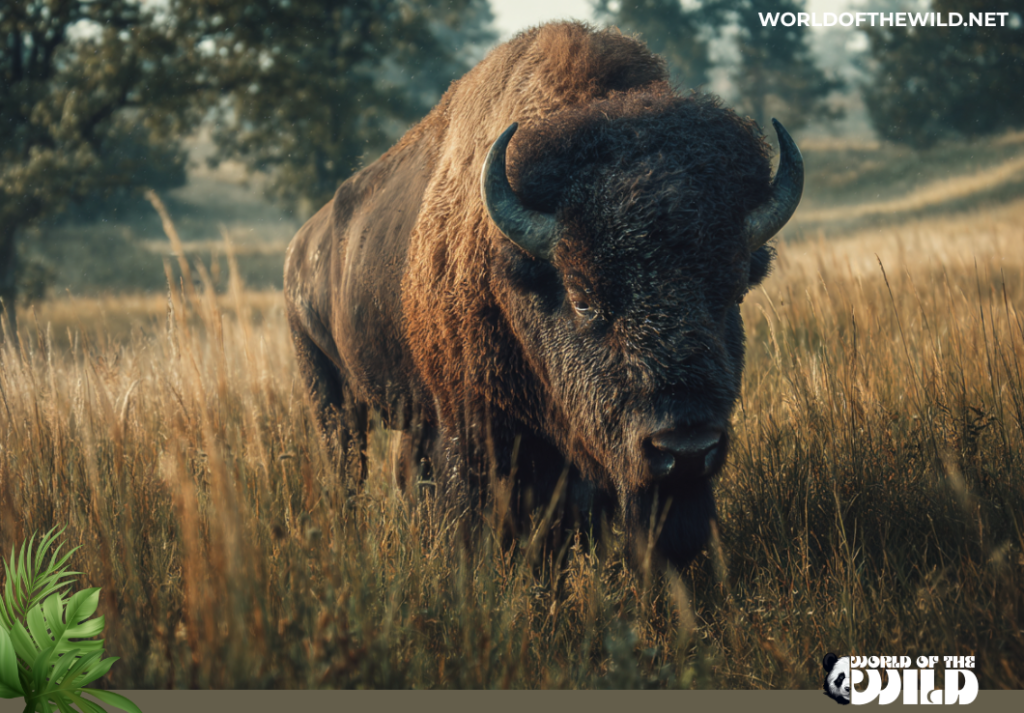
American bison are obligate herbivores, specifically classified as grazing ruminants. Their diet consists almost entirely of grasses and sedges, though they supplement with other vegetation depending on availability and season. Plains bison prefer grasses including blue grama, buffalo grass, wheat grasses, and prairie cordgrass, while wood bison consume more sedges, lichen, and browse from willow and other woody plants.
As ruminants, bison have a four-chambered stomach that allows them to digest tough, fibrous plant material through fermentation. They are “bulk feeders,” meaning they consume large quantities of relatively low-quality forage rather than selecting only the most nutritious plants. An adult bison eats approximately 1.6% of its body weight in forage daily—about 30 pounds of vegetation for a 2,000-pound bull.
Bison employ a “graze and rest” pattern: they feed intensively for several hours, then rest and ruminate (rechew their cud), alternating throughout the day. Their broad muzzles and mobile lips allow them to crop grasses very close to the ground, and their thick skulls enable them to clear snow to access frozen vegetation in winter.
Seasonal variations strongly affect diet quality and composition. Spring and summer provide lush, protein-rich new growth, leading to weight gain and optimal body condition. Fall offers cured grasses that, while lower in protein, still provide adequate nutrition. Winter is the most challenging time, when bison must work harder to access lower-quality forage beneath snow cover, often losing 10-20% of their body weight before spring.
Water is essential—bison drink once or twice daily when possible, consuming 5-10 gallons. They’ve been observed pawing through ice up to eight inches thick to reach water, and they eat snow when liquid water is unavailable.
Predators and Threats
In the wild ecosystem, adult bison face relatively few natural predators due to their size and formidable defenses. Gray wolves are the primary natural predator, typically targeting calves, elderly, sick, or injured individuals. Packs of wolves can occasionally kill healthy adults, but this requires coordinated effort and still carries significant risk to the wolves. Grizzly bears occasionally prey on bison, particularly calves in spring, though they more commonly scavenge bison carcasses.
Historically, the now-extinct American lion and dire wolf also preyed on bison during the Pleistocene. Indigenous peoples hunted bison sustainably for thousands of years, developing sophisticated techniques including communal drives over cliff jumps (buffalo jumps) and surrounds.
The most catastrophic threat to bison came from European-American settlers in the 19th century. Commercial hunting, encouraged by government policy aimed at subduing Native American tribes by destroying their primary food source, led to one of the fastest large-mammal population collapses in recorded history. Between 1830 and 1889, bison numbers plummeted from an estimated 30-60 million to fewer than 1,100 individuals. Millions of bison were killed for their hides, with carcasses left to rot on the prairies. Railroad construction further fragmented populations, and tongues were harvested as delicacies.
Modern threats are more subtle but significant:
Habitat Loss and Fragmentation: Bison now occupy less than 1% of their historical range, restricted to small, often isolated populations unable to express natural migratory behaviors.
Genetic Bottleneck: The near-extinction created severe genetic bottlenecks. Additionally, many bison herds were crossbred with cattle in the late 1800s and early 1900s, and cattle genes persist in numerous populations, including some conservation herds.
Disease: Brucellosis, a bacterial disease likely transmitted from cattle to bison, affects some populations (notably in the Greater Yellowstone Ecosystem) and complicates management due to livestock industry concerns about transmission back to cattle.
Management Conflicts: Bison that leave designated areas face culling or hazing, limiting population growth and natural range expansion. Conflicts with agricultural interests over land use and disease concerns restrict bison restoration efforts.
Climate Change: Altered precipitation patterns, increased drought frequency, and changing vegetation communities may impact bison habitat quality and distribution.
Reproduction and Life Cycle
The bison reproductive cycle is synchronized with seasonal patterns to optimize calf survival. The breeding season, known as the rut, occurs from mid-July through September, peaking in late July and early August. During this dramatic period, the normally placid bulls undergo a transformation, becoming aggressive competitors for mating rights.
Bulls engage in bellowing contests that can be heard for miles, wallow more frequently, and engage in head-to-head pushing matches and occasional violent charges at rivals. Dominant bulls attempt to “tend” estrous cows, following closely and defending them from other males. Breeding is brief but may occur multiple times with the same pair over several hours.
The gestation period lasts approximately 285 days (roughly 9.5 months), with most calves born in late April through May, perfectly timed for spring grass growth. Cows leave the herd temporarily to give birth in isolated areas. Nearly all births are single calves, though twins occur in less than 1% of pregnancies.
Bison calves, weighing 30-70 pounds at birth, are remarkably precocial—able to stand within 30 minutes and run within hours. They’re born with reddish-orange fur that gradually darkens to brown over three months, earning them the endearing nickname “red dogs.” This coloration may help mothers identify their own calves in the herd.
Calves nurse for 7-12 months but begin grazing within weeks of birth. Maternal care is intensive; cows are fiercely protective, and the entire herd will rally to defend calves from predators. Calves remain close to their mothers for their first year, and young females may stay with the maternal herd for life, while young bulls depart at 2-3 years of age.
Sexual maturity arrives at 2-3 years for females and 3-6 years for males, though bulls rarely get opportunities to breed before age 6 due to competition from larger, older males. Peak breeding age for bulls is 7-12 years.
In the wild, bison can live 15-20 years, occasionally reaching their mid-20s. Captive animals have lived beyond 30 years. Lifespan is influenced by the harsh winters, predation, injuries sustained during the rut, and dental wear—older bison with worn teeth struggle to process enough vegetation and may die from malnutrition.
Population
The American bison’s conservation status is complex and varies by subspecies and population type. The International Union for Conservation of Nature (IUCN) lists the species as Near Threatened overall, reflecting its complicated recovery story.
Current population estimates suggest approximately 500,000 bison exist in North America, but this number requires important context. The vast majority—perhaps 95%—are commercial animals raised on private ranches for meat production, essentially livestock. Only about 20,000-25,000 bison live in conservation herds managed primarily for their ecological and genetic value rather than commercial purposes.
Even more critically, only about 5,000 bison exist in truly wild populations that roam freely across large landscapes without significant human intervention. Yellowstone National Park’s herd of roughly 5,000 animals represents the largest and most important wild population.
Plains Bison (B. b. bison): More numerous, with most commercial herds and several significant conservation populations. Notable conservation herds exist in Yellowstone, Wind Cave National Park (South Dakota), and various tribal and federal lands.
Wood Bison (B. b. athabascae): Listed as Near Threatened to Threatened depending on jurisdiction. Only about 11,000 wood bison exist, with the largest population in Wood Buffalo National Park, Canada. This subspecies faces greater conservation challenges due to smaller numbers, more limited habitat, and ongoing disease concerns.
Population trends are cautiously positive in terms of raw numbers but concerning from an ecological perspective. While total bison numbers have increased dramatically from the 1889 low point, the majority exist in small, managed herds lacking genetic diversity and unable to fulfill their ecological role as landscape engineers. Fewer than a dozen populations exceed 1,000 animals, and none approach the historic herd sizes that shaped prairie ecosystems.
Conservation challenges include: limited suitable habitat, political and economic resistance to range expansion, genetic contamination from cattle hybridization (affecting up to 90% of herds), diseases like brucellosis, and the difficulty of maintaining the vast landscape-scale processes that historically shaped bison ecology.
The most ambitious conservation goal—identifying and protecting multiple large-scale conservation herds of genetically pure bison that can roam freely and maintain their ecological functions—remains unfulfilled but is actively pursued by organizations like the Wildlife Conservation Society, the National Park Service, and various tribal nations.
Conclusion
The American bison stands as a powerful reminder of both nature’s resilience and humanity’s capacity for both destruction and restoration. From evolutionary survivor of the Ice Age to near-victim of extinction, and now to a symbol of conservation possibility, the bison’s journey mirrors our evolving relationship with the natural world. While half a million bison now roam North America—a remarkable recovery from the 1,091 that remained in 1889—true conservation success demands more than numbers. It requires restored landscapes where these magnificent animals can once again thunder across vast grasslands, shape ecosystems through their grazing and wallowing, and live as they have for over 100,000 years—free and wild.
The challenge ahead is not simply keeping bison alive but allowing them to be truly bison: genetically pure, ecologically functional, and integrated into the landscapes they helped create. This means supporting tribal bison restoration efforts, advocating for expanded habitat and wildlife corridors, and recognizing that the fate of bison is intertwined with the fate of North America’s grassland ecosystems. Every bison herd represents not just animals saved but a living connection to a wild continent that existed before highways and fences carved it into pieces. By protecting the bison, we protect not only an icon but also a fundamental piece of North American natural heritage—and perhaps, we rediscover our own place within the natural world rather than merely beside it.
Scientific Name: Bison bison
Diet Type: Herbivore (Grazer)
Size: 5-6.5 feet tall at shoulder (bulls); 5 feet (cows)
Weight: 1,000-2,000 lbs (bulls); 800-1,100 lbs (cows)
Region Found: North America (historically from Canada to Mexico, now primarily in protected areas and ranches across the Great Plains, Rocky Mountain region, and boreal forests of northwestern Canada)