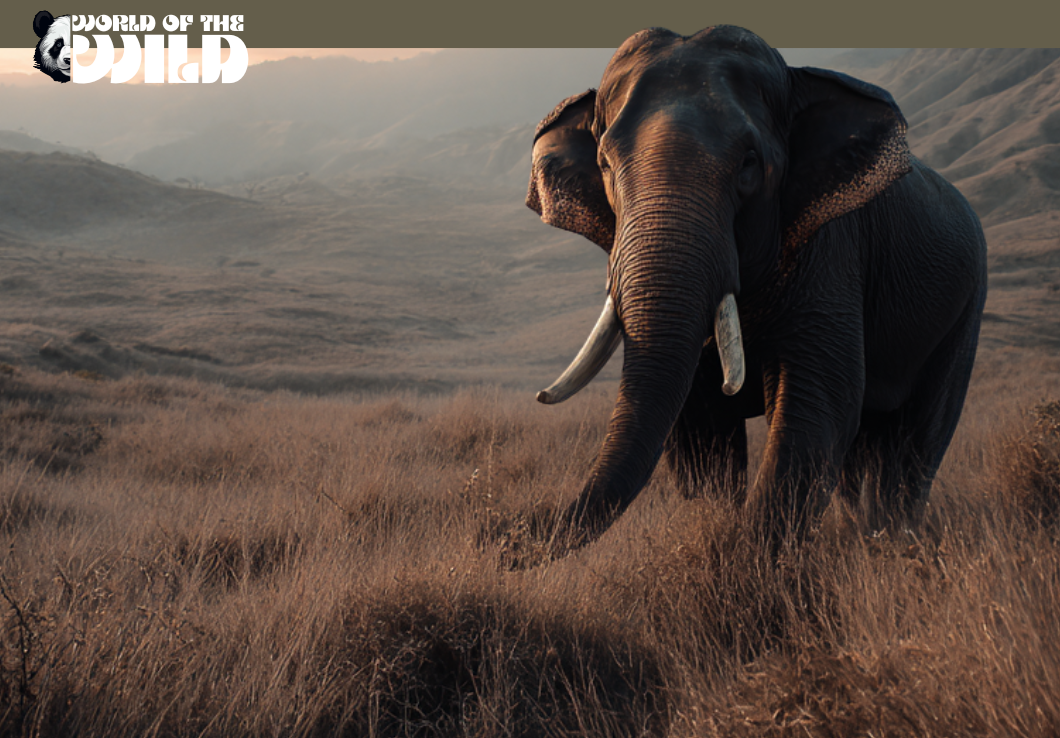

Imagine standing in the dense green shade of a South Asian forest as the ground trembles slightly beneath your feet. A rustling of branches, a low rumble that you feel more in your chest than hear with your ears, and then — emerging from the tree line — a creature of immense proportions and unmistakable grace. The Asian elephant moves with a kind of quiet authority that makes it immediately clear you are in the presence of something ancient, something extraordinary.
The Asian elephant (Elephas maximus) is more than just the largest land animal on the continent that bears its name. It is a keystone species, a cultural icon, a cognitive marvel, and a living link to an age when megafauna dominated the earth. Revered in religion, celebrated in art, and central to the ecosystems it inhabits, this magnificent animal occupies a place in the natural and human world unlike almost any other. Yet it faces a precarious future, squeezed between the relentless march of human development and the slow erosion of the wild spaces it calls home. To understand the Asian elephant is to understand both the wonder of the natural world and the urgency of protecting it.
Facts
Here are some lesser-known facts that reveal just how remarkable Asian elephants truly are:
- Elephants can “hear” with their feet. They detect infrasonic vibrations through sensitive nerve endings in their feet and trunks, allowing them to sense the rumbles of other elephants and even distant thunderstorms through the ground.
- Their trunks contain over 40,000 individual muscles — yet not a single bone. This makes the trunk one of the most precise and powerful tools in the animal kingdom, capable of uprooting a tree or delicately picking up a single coin from the floor.
- Asian elephants are one of the few non-human animals to pass the mirror self-recognition test, placing them in an elite group alongside great apes, dolphins, and magpies as animals with demonstrable self-awareness.
- A single elephant can consume up to 300 pounds of food in a single day, yet despite this volume, their digestive systems are surprisingly inefficient — they absorb only about 44% of what they eat, which means their dung is incredibly seed-rich and vital for forest regeneration.
- Female Asian elephants may not have visible tusks at all. Unlike African elephants, where both sexes commonly grow large tusks, most female Asian elephants and even many males are tuskless, a trait that has become increasingly common due to selective pressure from ivory poaching.
- Elephants mourn their dead. They are known to return to the bones of deceased relatives, touching and turning them over with their trunks in behavior that researchers believe reflects genuine grief or a form of remembrance.
- The temporal gland, located between the eye and ear, is unique to elephants. It secretes a fluid called temporin during periods of heightened emotion or stress, and in males during musth — a state of elevated testosterone that can make them unpredictable and aggressive.
Species
Asian elephants belong to one of the most storied lineages in the animal kingdom:
Kingdom: Animalia Phylum: Chordata Class: Mammalia Order: Proboscidea Family: Elephantidae Genus: Elephas Species: Elephas maximus
The species is divided into four recognized subspecies, each occupying a distinct geographic range. The Indian elephant (Elephas maximus indicus) is the largest subspecies and the most widespread, found across the Indian subcontinent and into Southeast Asia. The Sri Lankan elephant (Elephas maximus maximus) is the largest of all the subspecies in terms of body size and is found exclusively on the island of Sri Lanka, where it also tends to be darker in complexion. The Sumatran elephant (Elephas maximus sumatranus) is the smallest of the three main subspecies, with a more rounded back and proportionally larger ears suited to its humid rainforest home on the Indonesian island of Sumatra. The fourth subspecies, the Borneo pygmy elephant (Elephas maximus borneensis), is the smallest and most genetically distinct of all, with a notably rounder face, larger ears relative to its body, and a characteristically gentle temperament. Genetic studies suggest it may have been isolated on Borneo for thousands of years.
The Asian elephant’s closest living relative is not the African elephant, but rather the extinct woolly mammoth (Mammuthus primigenius), with which it shares a remarkably recent common ancestor in geological terms.
Appearance
The Asian elephant is an animal of impressive and unmistakable stature. Adult males, known as bulls, typically stand between 8.2 and 9.8 feet tall at the shoulder and can weigh anywhere from 8,800 to 11,000 pounds, though exceptionally large individuals have tipped the scales even higher. Females are noticeably smaller, generally reaching 7.5 to 8.5 feet in height and weighing between 5,500 and 7,700 pounds.
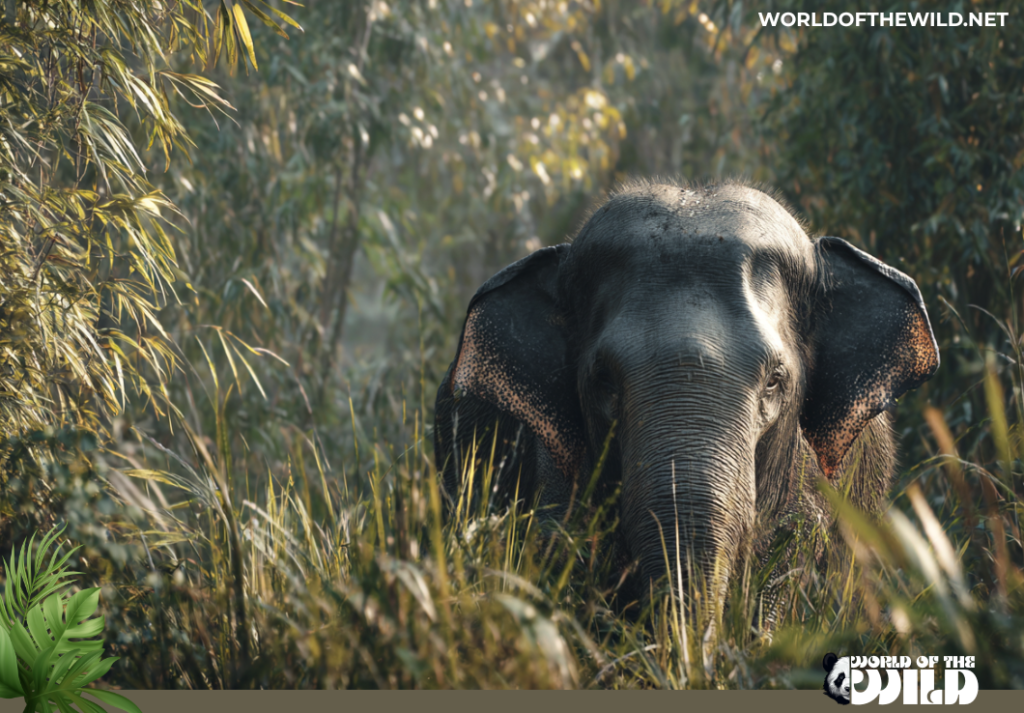
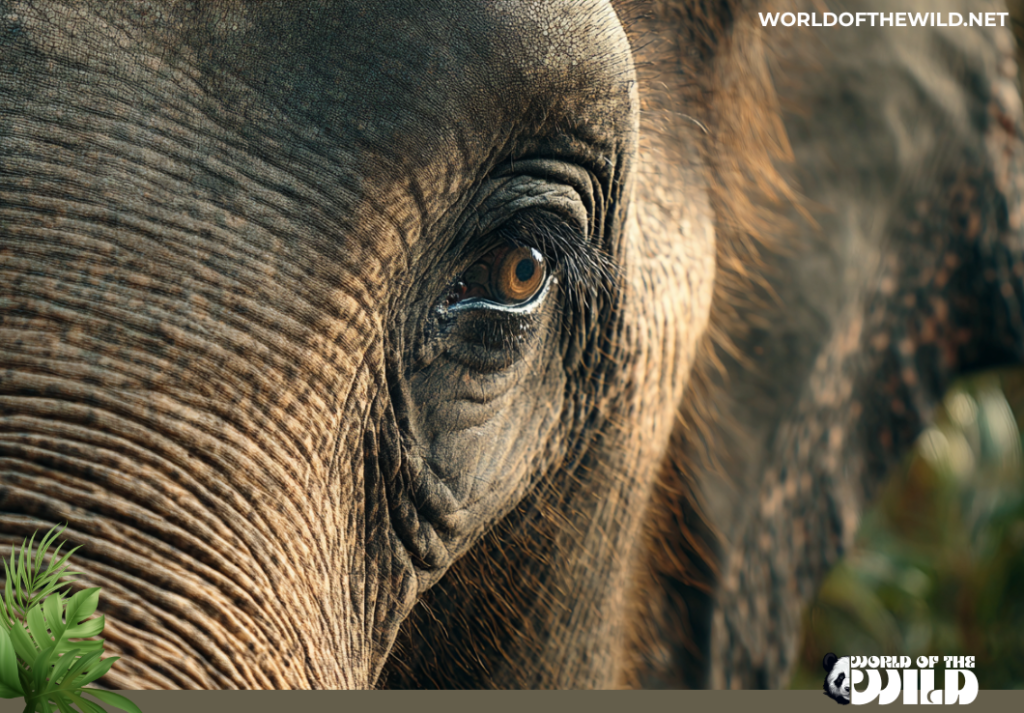
The skin is a medium to dark gray, often mottled with depigmented pink patches, particularly around the ears, trunk, and face — a feature that becomes more pronounced with age and varies between individuals and subspecies. Unlike their African counterparts, Asian elephants have a distinctly domed head with two prominent bumps on the crown, a more rounded, arched back, and notably smaller, more rounded ears. The ears of Asian elephants are often said to roughly resemble the shape of the Indian subcontinent.
The trunk is perhaps the animal’s most iconic feature — a elongated fusion of the nose and upper lip that can stretch to seven feet in length. At its tip, Asian elephants possess a single “finger,” compared to the two found on African elephants, giving them a slightly different grip. Tusks, when present, curve outward and upward and are composed of ivory — a modified form of tooth. The feet are broad and padded with a fatty, cushion-like tissue that helps distribute the animal’s enormous weight and muffles the sound of its footfalls. Most Asian elephants have five toenails on the front feet and four on the back.
Behavior
Asian elephants are intensely social animals, living in close-knit family groups of five to twenty individuals led by the oldest and most experienced female, called the matriarch. Her accumulated knowledge — of water sources, migration routes, and how to respond to threats — is genuinely vital to the survival of the herd. When a matriarch dies, the loss can be destabilizing; younger, less experienced leaders may make poorer decisions in times of drought or danger.
The herds are composed primarily of related females and their young. Adult males generally live semi-solitary lives, joining female groups only for mating purposes. They establish loose dominance hierarchies among themselves, and older bulls are known to play an important social role in keeping younger, more testosterone-fueled males in check.
Communication is extraordinarily sophisticated. Elephants use a rich repertoire of vocalizations — rumbles, roars, screams, and chirps — many of which fall in the infrasound range, below the threshold of human hearing. These low-frequency calls can travel for miles through dense forest, allowing groups to maintain contact across vast distances. Body language, chemical signaling through scent glands and urine, and even seismic vibrations felt through the ground all supplement their vocal communication.
Their intelligence is exceptional by any measure. Asian elephants have demonstrated the ability to use tools, solve multi-step puzzles, display empathy toward distressed companions, engage in cooperative problem-solving, and even show a rudimentary understanding of pointing — a gesture that most animals, including chimpanzees, typically fail to grasp. They have been observed holding vigils over dead family members and showing visible signs of distress when confronted with the bones of deceased individuals.
Daily life revolves largely around feeding, which occupies up to 19 hours a day. The remaining time is spent resting, socializing, and drinking — elephants consume up to 50 gallons of water daily. Bathing and mud-wallowing are also important activities, serving both social and thermoregulatory functions while protecting the skin from parasites and sunburn.
Evolution
The evolutionary history of the elephant is one of the great stories of mammalian life on Earth. The order Proboscidea — the group that encompasses all elephants, past and present — originated in Africa approximately 55 to 60 million years ago, in the early Eocene epoch. The earliest known proboscideans, such as Eritherium and Phosphatherium, were small, tapir-like creatures with no trunk and little resemblance to modern elephants.
Over tens of millions of years, Proboscidea diversified explosively into dozens of families and hundreds of species. Key milestones in this radiation include the evolution of the trunk — likely beginning as an elongated upper lip and nose used for grasping food and water — and the progressive development of large, continuously growing tusks. Molar teeth in elephants evolved toward a highly distinctive pattern of ridged enamel plates, ideally suited for grinding the coarse vegetation that formed their diet.
The family Elephantidae, containing all living elephants and their closest extinct relatives, appeared roughly 6 to 7 million years ago. The genus Elephas itself emerged in Africa and then spread into Asia during the late Miocene and Pliocene epochs. Elephas hysudrindicus and Elephas namadicus, both extinct Asian species, are considered close relatives and possible ancestors of the modern Asian elephant. Elephas namadicus was particularly impressive, potentially being the largest elephant species to have ever lived.
The woolly mammoth, which diverged from the Elephas lineage roughly 6 million years ago, shared glacial-era landscapes with early humans. Most elephant relatives disappeared during the mass megafaunal extinctions at the end of the Pleistocene, around 10,000 to 12,000 years ago — extinctions driven by a combination of climate change and human hunting pressure. The Asian and African elephants are the sole survivors of what was once a remarkably diverse and globally distributed group.
Habitat
Asian elephants historically ranged across a vast swath of the continent, from the Tigris-Euphrates river system in western Asia all the way east to China’s Yangtze River basin, and from the foothills of the Himalayas south to the tip of the Malay Peninsula and across to the islands of Sri Lanka, Sumatra, and Borneo. Today, that range has been reduced to fragmented patches across 13 countries: India, Sri Lanka, Thailand, Myanmar, Malaysia, Indonesia, Bhutan, Nepal, Bangladesh, Cambodia, Laos, Vietnam, and China.
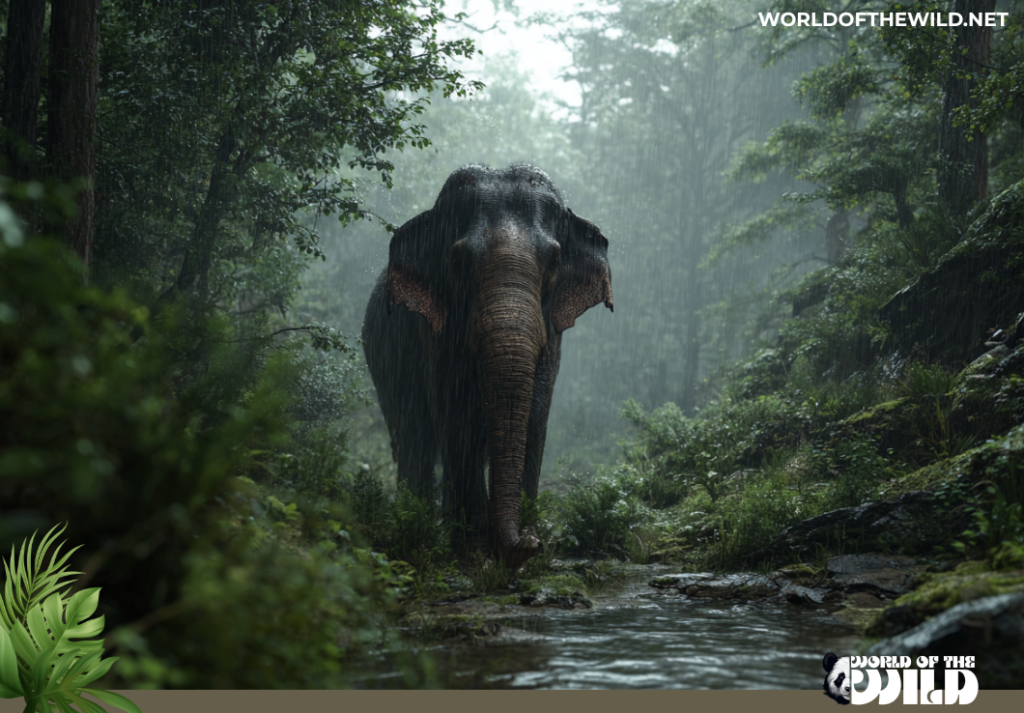
They are highly adaptable animals, capable of living in a variety of forested and grassland environments. Their preferred habitats include tropical and subtropical moist broadleaf forests, dry deciduous forests, scrublands, and grasslands — often at the transitional edges between forest and open areas, where vegetation is both dense enough to offer cover and rich enough to sustain their enormous appetites. Elevation is no barrier; they have been recorded at altitudes exceeding 10,000 feet in the Himalayas.
Access to water is a fundamental requirement. Elephants are never found far from reliable water sources, and their movements are often structured around rivers, water holes, and seasonal watering points. In landscapes fragmented by agriculture and human settlements, this need for water can bring them into direct and often dangerous conflict with people.
Diet
Asian elephants are strict herbivores with an appetite that reflects their size. They consume an astonishing variety of plant matter — grasses, leaves, bark, roots, fruits, and bamboo — with the specific composition of their diet shifting by season, habitat, and geographic location. During the wet season, when grasses are lush and abundant, grasses may make up the bulk of their intake. During the dry season, they rely more heavily on bark stripped from trees and foliage from higher branches.
Their trunks allow them to reach vegetation from ground level up to about 20 feet high, and they will use their tusks and even their entire body weight to push over trees and access otherwise unreachable food. Mineral licks — patches of earth rich in sodium and other minerals — are important supplementary food sources, and elephants will travel considerable distances and even excavate caves to access mineral-rich soil.
Their inefficient digestion, while seemingly a disadvantage, plays a crucial ecological role. Seeds pass through the gut largely intact, making elephants among the most important seed dispersers in Asian forests. Some tree species rely almost exclusively on elephants to spread their seeds effectively, and the loss of elephants from a forest can ripple through plant communities for generations.
Predators and Threats
In the wild, adult Asian elephants have virtually no natural predators, their size rendering them invulnerable to almost all other animals. However, young calves — especially newborns — can fall prey to tigers, lions (historically), and, in some regions, packs of dholes (Asian wild dogs). The herd’s protective instincts are intense, and adults will form a defensive circle around calves when threats are perceived.
The far more significant threats are human-driven. Habitat loss is the primary driver of the species’ decline. Across its range, forests are being cleared for agriculture — particularly rice, palm oil, tea, and rubber plantations — as well as for timber extraction, road construction, and expanding human settlements. This fragmentation does not just reduce the total area available to elephants; it breaks up populations into isolated pockets, limiting genetic exchange and making local extinction events more likely.
Human-elephant conflict is a devastating consequence of this fragmentation. As elephants move through landscapes now dominated by farmland, they raid crops — a behavior that, while rational from the elephant’s perspective, can destroy a family’s entire livelihood in a single night. Retaliatory killings, poaching, and accidental deaths from electrified fences and train strikes claim hundreds of elephants each year across the range.
Poaching remains a significant pressure, particularly targeting tusked males for ivory, though the lower tusk prevalence in Asian elephant populations compared to African ones means that selective hunting pressure has actually driven an evolutionary increase in tusklessness over recent decades — a sobering example of human activity reshaping a species in real time.
Captivity also poses complex welfare and conservation questions. Tens of thousands of Asian elephants live in captivity across Asia, used in tourism, religious ceremonies, and logging operations. The conditions of captivity vary enormously, but the capture of wild elephants for use in these industries has historically been deeply damaging to wild populations.
Reproduction and Life Cycle
Asian elephant reproduction is a slow, deliberate affair — one of the reasons the species is so vulnerable to population decline. Females become sexually mature between the ages of 9 and 12 but typically do not produce their first calf until their mid-teens. Males reach sexual maturity around the same age but are generally not successful at mating until they are in their 30s, when they are large and experienced enough to compete with other bulls.
Mating is preceded by a period of courtship in which males in musth — a periodic state of heightened reproductive hormones — seek out receptive females. Musth is accompanied by temporal gland secretions, dribbling urine, and a notable change in behavior and demeanor. Dominant musth males are given wide berth by other males and are strongly preferred by females as mates.
The gestation period of the Asian elephant is the longest of any land animal — approximately 22 months, nearly two years. This extended pregnancy allows calves to be born at a highly developed stage. Newborns typically weigh between 200 and 300 pounds and are able to stand and walk within hours of birth. The entire herd participates in caring for and protecting calves, with females other than the mother — called “allomothers” — playing an active role in the calf’s upbringing.
Calves nurse for up to four years and remain dependent on their mothers and the broader family group for much of their early life. The bonds formed within the herd are lifelong for females, who spend their entire lives within the same family unit. Males leave or are gradually pushed out of the natal group as they reach adolescence, typically between the ages of 10 and 15.
In the wild, Asian elephants can live to around 60 to 70 years of age, though their lifespan is ultimately limited by their teeth. Like all elephants, they produce only six sets of molars over their lifetime. When the final set is worn down — typically in their mid-fifties to early sixties — the animal can no longer chew food effectively and gradually weakens. In captivity, some individuals have been reported to live into their seventies or even eighties with appropriate dental care and diet modification.
Population
The Asian elephant is currently classified as Endangered on the IUCN Red List of Threatened Species — a designation that reflects both the severity of its decline and the ongoing threats it faces. Estimates of the global wild population vary, but most current assessments place the number between 40,000 and 50,000 individuals, with approximately 60% of that total found in India. This represents a dramatic reduction from historical numbers; it is estimated that the species has lost at least half of its population and the vast majority of its range over the past three generations.
Population trends are broadly negative across most of the species’ range, though localized conservation successes offer some hope. In India, populations in well-protected corridors such as the Nilgiri Biosphere Reserve have shown signs of stability or modest growth. In Sumatra and Borneo, however, the situation is considerably more dire, with the Sumatran subspecies in particular considered Critically Endangered.
Captive populations number an additional 15,000 to 20,000 individuals across Asia, though captive animals contribute little to wild population recovery and often face significant welfare challenges.
Conclusion
The Asian elephant is, in every sense, an extraordinary being. It is one of the most intelligent animals on the planet, a cornerstone of Asian ecosystems, a creature with a rich emotional and social life, and a living reminder of an age when the world was home to giants we could scarcely imagine. It has walked alongside human civilization for millennia — worshipped, worked, and wondered at — and yet today it stands at a crossroads, its future uncertain.
The good news is that the tools to save it exist. Protected wildlife corridors, community-based conflict mitigation programs, anti-poaching enforcement, and sustainable land-use planning have all demonstrated real-world results. What has often been lacking is the collective will to prioritize a species that inconveniently shares space with some of the world’s most densely populated and fastest-growing nations.
The fate of the Asian elephant will ultimately be determined not by its own resilience — which is considerable — but by the choices humans make in the coming decades. In protecting the elephant, we protect entire forest ecosystems, the water cycles they regulate, the communities that depend on them, and something harder to quantify but no less real: the irreplaceable sense that the world is richer, stranger, and more wonderful for having these animals in it. That is worth fighting for.
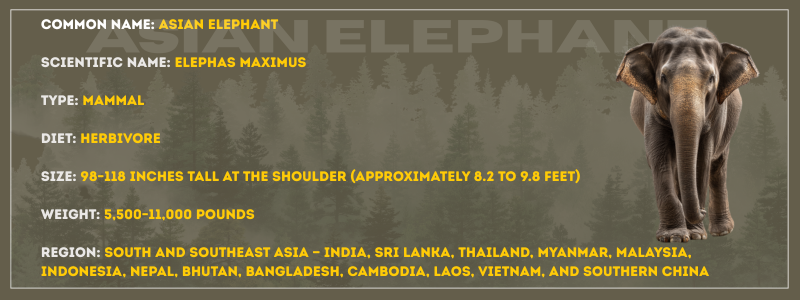
Scientific Name: Elephas maximus
Diet Type: Herbivore
Size: 98–118 inches tall at the shoulder (approximately 8.2 to 9.8 feet)
Weight: 5,500–11,000 pounds (females to males)
Region Found: South and Southeast Asia — India, Sri Lanka, Thailand, Myanmar, Malaysia, Indonesia, Nepal, Bhutan, Bangladesh, Cambodia, Laos, Vietnam, and southern China