
Slicing through murky canal waters in Bangkok or basking on riverbanks across Southeast Asia, the Asian water monitor commands attention wherever it appears. This prehistoric-looking reptile, with its forked tongue flicking and muscular tail propelling it through water with surprising grace, represents one of nature’s most successful lizard designs. As the second-largest lizard species on Earth, the Asian water monitor has thrived for millions of years by mastering both land and water environments. These remarkable creatures embody the perfect intersection of ancient lineage and modern adaptability, making them one of the most fascinating reptiles inhabiting our planet today. From their ability to hold their breath underwater for extended periods to their surprising intelligence and problem-solving skills, Asian water monitors continue to captivate scientists and wildlife enthusiasts alike.
Facts
- Aquatic Athletes: Asian water monitors can remain submerged for up to 30 minutes and are capable of sleeping underwater, using their specialized breathing techniques to stay hidden from threats.
- Urban Survivors: Unlike many wildlife species that flee human development, Asian water monitors have thrived in urban environments, with significant populations living in cities like Bangkok, Singapore, and Manila, where they navigate canals and even sewage systems.
- Tail Weaponry: Their powerful tails, which make up more than half their total body length, can be wielded as devastating whips capable of delivering painful strikes to predators or rivals, and they use them for balance when standing on hind legs.
- Carrion Connoisseurs: These monitors possess stomach acids strong enough to digest bones, scales, and even some toxic materials, allowing them to consume carrion that would sicken most other animals.
- Thermal Regulation Masters: Despite being cold-blooded, Asian water monitors can regulate their body temperature through behavioral adaptations, shuttling between sun and shade with precision to maintain optimal functioning.
- Intelligence Indicators: Research has demonstrated that monitor lizards possess cognitive abilities comparable to some mammals, including object permanence, counting skills, and the ability to learn through observation.
- Chemical Communicators: Their forked tongues collect scent particles from the air and water, delivering them to a specialized sensory organ called the Jacobson’s organ, giving them a three-dimensional map of chemical information about their environment.
Species
Taxonomic Classification:
- Kingdom: Animalia
- Phylum: Chordata
- Class: Reptilia
- Order: Squamata
- Family: Varanidae
- Genus: Varanus
- Species: Varanus salvator
The Asian water monitor belongs to the diverse family Varanidae, which includes all monitor lizards worldwide. Within the species Varanus salvator, taxonomists recognize several subspecies, though classification continues to be refined through genetic research. The most commonly recognized subspecies include Varanus salvator salvator (the nominate subspecies found throughout much of the range), Varanus salvator bivittatus (the two-striped water monitor from Java, Bali, and surrounding islands), Varanus salvator andamanensis (endemic to the Andaman Islands), and Varanus salvator marmoratus (found in the Philippines, though some researchers elevate this to full species status as Varanus marmoratus).
Asian water monitors are closely related to other members of the Varanus genus, including the mangrove monitor (Varanus indicus), the emerald tree monitor (Varanus prasinus), and their famous cousin, the Komodo dragon (Varanus komodoensis). The genus Varanus contains approximately 80 species distributed across Africa, Asia, and Australia, making it one of the most successful lizard groups on the planet.
Appearance
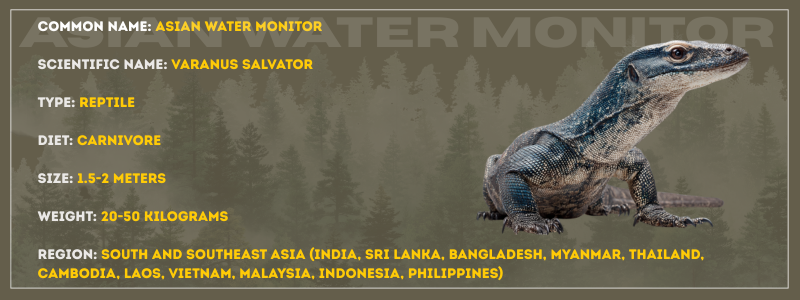
The Asian water monitor presents an imposing and distinctly prehistoric appearance. Adults typically measure between 1.5 to 2 meters in total length, though exceptional individuals can exceed 3 meters and weigh up to 50 kilograms or more. Males generally grow larger and more robust than females, with broader heads and more muscular builds.
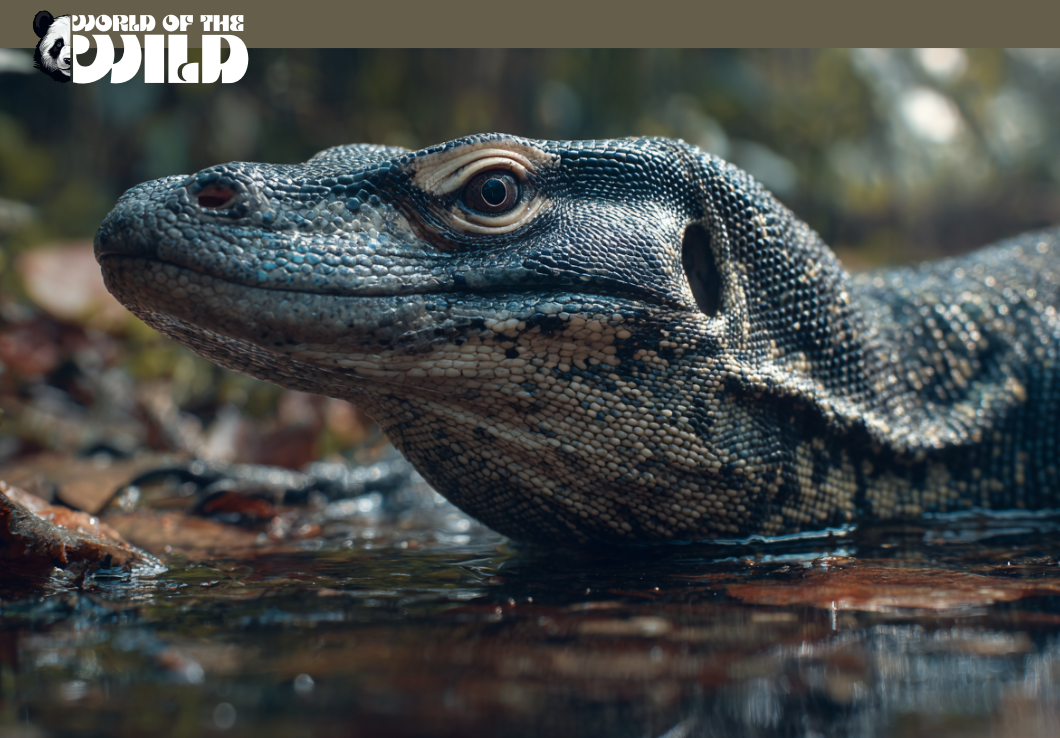
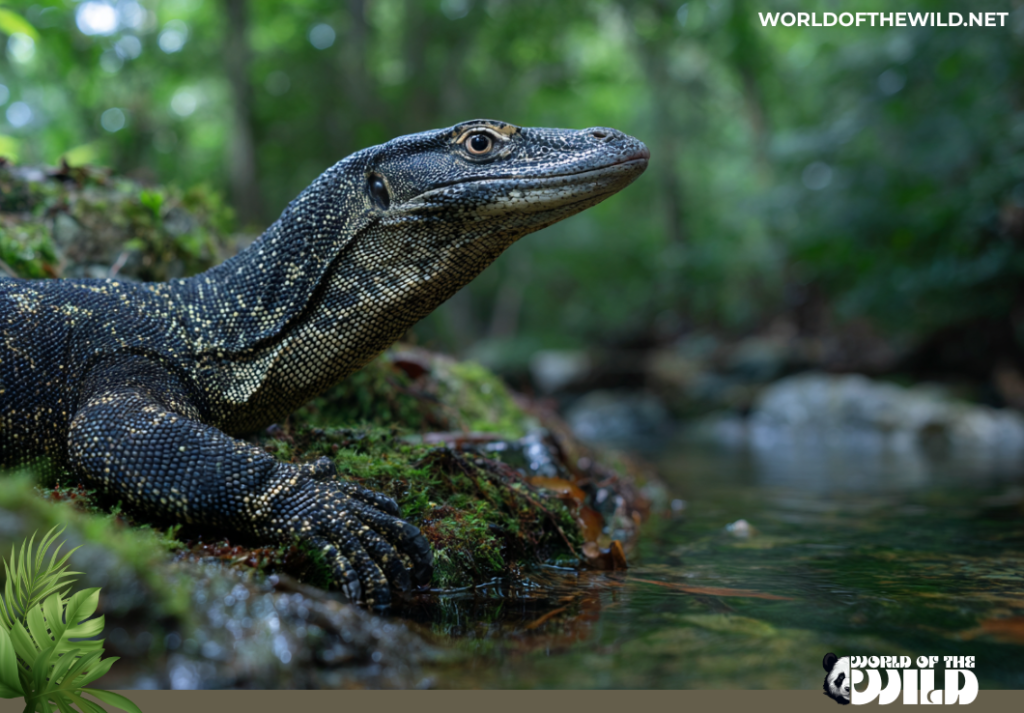
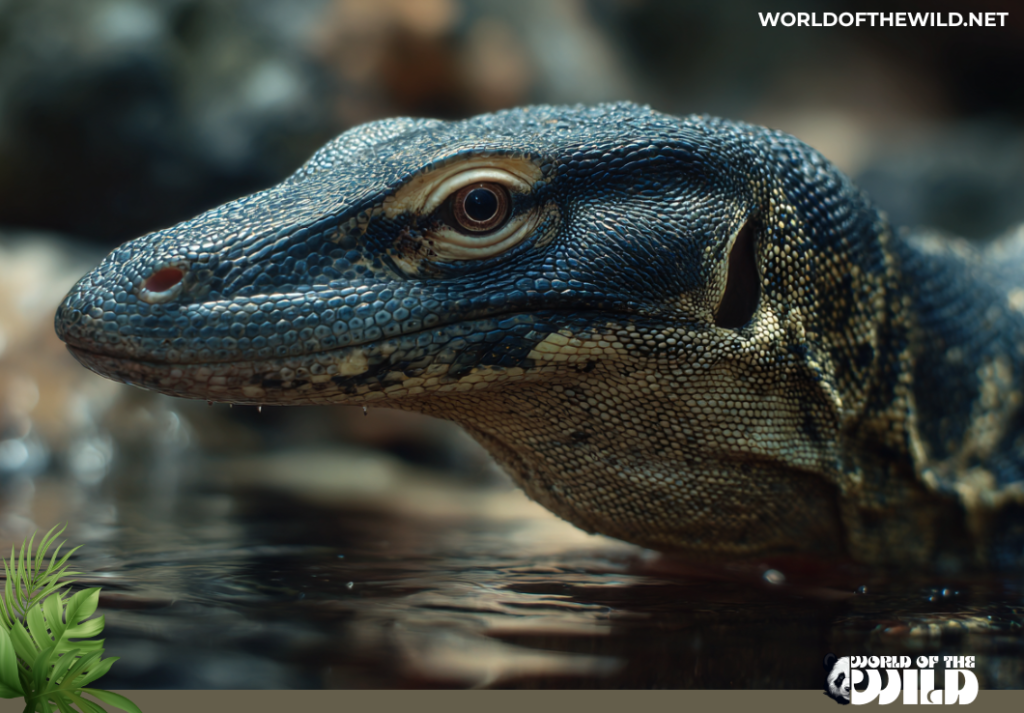
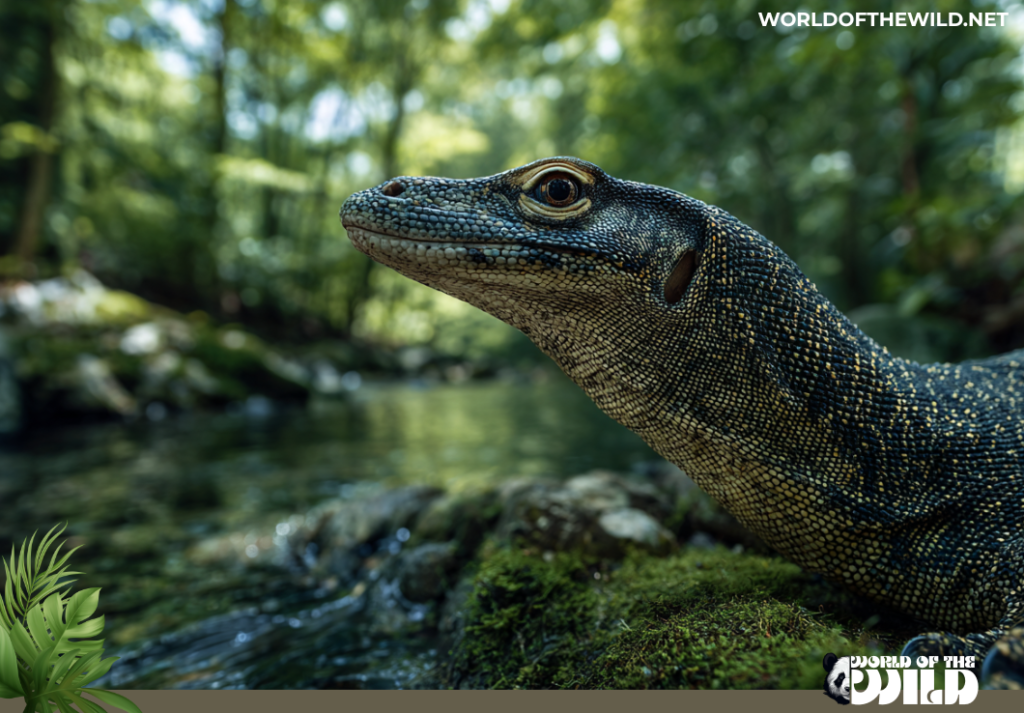
Their bodies are powerfully constructed, featuring muscular limbs equipped with strong, curved claws designed for climbing, digging, and grasping prey. The head is elongated and somewhat flattened, with a pointed snout and nostrils positioned high on the nose—an adaptation for remaining mostly submerged while breathing. Their eyes are alert and intelligent, with round pupils and excellent vision that helps them detect movement both above and below water.
The coloration of Asian water monitors varies considerably across their range and changes with age. Juveniles often display striking patterns of bright yellow or cream-colored spots and bands against a dark brown or black background, providing camouflage in dappled forest environments. As they mature, these vivid markings typically fade, and adults develop a more subdued appearance with dark olive, brown, or gray base coloration marked with lighter irregular spots or bands. The skin appears rough and pebbly, covered in small, bead-like scales called osteoderms that provide armor-like protection.
Perhaps their most distinctive feature is the tail, which comprises 50-60% of the total body length. This appendage is laterally compressed—flattened from side to side—creating a powerful swimming organ that undulates with serpentine grace through the water. The tail also features a ridge of enlarged scales along its upper edge, giving it a distinctly dragon-like appearance.
Behavior
Asian water monitors exhibit complex and intelligent behaviors that set them apart from many other reptile species. They are primarily diurnal, meaning most active during daylight hours, though in urban areas or during extremely hot weather, they may shift to crepuscular patterns, becoming more active during dawn and dusk.
These lizards are generally solitary outside of breeding season, though they may occasionally tolerate one another when abundant food sources are available. They establish loose territories, particularly males, which they mark with secretions from glands on their thighs and defend through impressive displays. When confronting rivals or threats, monitors may rise up on their hind legs, inflate their throats, hiss loudly, and lash their tails. If these displays fail to deter an opponent, combat may ensue, with males grappling while standing upright in wrestling matches that can last several minutes.
Communication occurs through multiple channels. Beyond visual displays, they produce hissing and huffing sounds and rely heavily on chemical communication through their sophisticated vomeronasal system. Their forked tongues constantly sample the environment, flicking in and out rapidly to gather chemical information about food, mates, and potential dangers.
Asian water monitors demonstrate remarkable intelligence for reptiles. Captive individuals have learned to count, distinguish between different quantities of food items, and solve complex problems to access rewards. They exhibit curiosity and exploratory behavior uncommon in reptiles, investigating novel objects and situations with apparent interest. Some research suggests they may even recognize individual humans and modify their behavior accordingly.
Their relationship with water is central to their lifestyle. They are powerful swimmers, using their tails for propulsion while their limbs remain close to the body. They frequently hunt in water, diving to capture fish, crustaceans, and other aquatic prey. When threatened on land, they often flee to the nearest body of water, where they can remain submerged for extended periods, breathing through just their nostrils while hiding from predators.
These monitors are also accomplished climbers despite their large size, using their strong claws to scale trees in search of bird nests, fruits, or safe basking spots. They are opportunistic and adaptable, quickly learning to exploit new food sources, which explains their success in urban environments where they’ve learned to raid garbage bins, fish markets, and even outdoor restaurants.
Evolution
The evolutionary story of monitor lizards stretches back deep into the Mesozoic Era. The family Varanidae emerged approximately 90-100 million years ago during the Late Cretaceous period, making them contemporaries of the dinosaurs. The earliest monitor lizards evolved in what is now Asia, and from there, the family diversified and spread across the Old World.
Fossil evidence suggests that ancestral monitor lizards were relatively small, arboreal creatures. Over millions of years, different lineages adapted to various ecological niches, producing the diverse array of monitor species we see today—from the tiny short-tailed monitor weighing just 20 grams to the massive Komodo dragon exceeding 150 kilograms.
The Asian water monitor’s specific lineage likely diverged from other monitor groups during the Miocene epoch, approximately 15-20 million years ago, as Southeast Asia’s geography was being shaped by tectonic activity and climate changes. The development of extensive river systems, wetlands, and coastal environments in this region provided ideal conditions for a semi-aquatic monitor to thrive and diversify.
One significant evolutionary adaptation in Asian water monitors is their enhanced swimming ability. The laterally compressed tail, webbed feet, and specialized muscle structure evolved to make them supremely efficient in aquatic environments. Their ability to close their nostrils and regulate breathing underwater represents millions of years of refinement.
The closest evolutionary relatives to Varanus salvator are other members of the Indo-Australian monitor clade, which includes the mangrove monitor and several species from New Guinea and Australia. Genetic studies suggest that water monitors share a relatively recent common ancestor with the Komodo dragon, despite their significant size difference and different ecological adaptations.
Interestingly, fossil evidence shows that gigantic monitor lizards once roamed Australia during the Pleistocene epoch. Varanus priscus (formerly Megalania), which went extinct approximately 50,000 years ago, may have reached lengths of up to 7 meters, representing the largest terrestrial lizard ever known. While not a direct ancestor of the Asian water monitor, these prehistoric giants demonstrate the remarkable evolutionary potential of the monitor lizard body plan.
Habitat
Asian water monitors enjoy one of the most extensive geographical ranges of any monitor lizard species. They inhabit a vast region across South and Southeast Asia, from eastern India and Sri Lanka through Bangladesh, Myanmar, Thailand, Cambodia, Laos, and Vietnam, extending through the Malay Peninsula to Indonesia, the Philippines, and as far south as some parts of the Sunda Islands. They’ve also been introduced to several locations outside their native range, including parts of Florida in the United States, where escaped or released pets have established breeding populations.
True to their name, Asian water monitors are almost always found in close proximity to water. They inhabit an impressive variety of aquatic and semi-aquatic environments, demonstrating remarkable ecological flexibility. Their preferred habitats include river systems from slow-moving lowland streams to larger river deltas, freshwater swamps and marshlands, mangrove forests along coastal areas, canals and irrigation systems, and the edges of lakes and ponds. They generally occur from sea level up to elevations of approximately 1,000 meters, though they’re most abundant in lowland areas.
Within these watery environments, they require specific habitat features. Suitable basking sites are essential—rocks, logs, low-hanging branches, or banks where they can regulate their body temperature by moving between sun and shade. They need burrow sites or crevices in riverbanks, hollow trees, or dense vegetation where they can shelter from extreme weather and predators. Access to both aquatic and terrestrial hunting grounds allows them to exploit diverse food sources.
The vegetation surrounding their aquatic habitats varies considerably across their range. In Southeast Asia, this often includes tropical rainforest, bamboo groves, agricultural lands, and increasingly, urban green spaces. Mangrove forests provide particularly important habitat, offering rich feeding opportunities among the muddy substrates and tidal waters.
What’s particularly remarkable about Asian water monitors is their adaptation to human-modified landscapes. Unlike many species that decline with urbanization, these monitors have proven themselves to be highly successful urban survivors. Major cities throughout Southeast Asia host significant monitor populations living in urban canals, parks, golf courses, and waterways. In Singapore, they’re commonly seen in the city’s many drainage canals and park reservoirs. Bangkok’s khlongs (canals) teem with monitors that have adapted to feed on urban waste and fish in polluted waters. This adaptability has made them one of the few large reptiles that can claim success in the Anthropocene.
Diet
Asian water monitors are carnivores, though their dietary habits are better described as opportunistic scavenging and predation. They possess one of the most varied diets of any monitor species, consuming virtually any animal matter they can overpower or scavenge, making them important components of their ecosystem as both predators and consumers of carrion.
Their primary prey items include fish, which they catch both in open water and in shallow pools; crustaceans such as crabs and crayfish; mollusks including snails and freshwater mussels; amphibians, particularly frogs and their tadpoles; reptiles, including snakes, smaller lizards, and turtle eggs; birds, especially ground-nesting species and their eggs and nestlings; and small to medium-sized mammals such as rodents, bats, and young of larger species.
These monitors are active hunters, employing several strategies depending on the prey and environment. In water, they swim stealthily, using their excellent underwater vision to spot fish and aquatic animals before lunging forward with surprising speed. On land, they use their keen sense of smell to locate prey, tracking scent trails to nests, burrows, or carrion. They’ve been observed digging extensively to unearth turtle eggs, raid rodent burrows, or excavate beetle larvae from rotting logs.
Scavenging constitutes a significant portion of their diet, particularly for larger individuals. Their powerful stomach acids allow them to safely consume decomposing meat that would be dangerous for many other animals. In natural settings, they feed on dead fish, drowned animals, and carcasses left by larger predators. In urban environments, this scavenging behavior has expanded to include human food waste, discarded fish from markets, and even pet food left outdoors.
Their feeding mechanics are impressive to observe. They possess sharp, recurved teeth designed to grip struggling prey, and powerful jaw muscles deliver a strong bite. Unlike snakes, they cannot swallow prey whole if it’s too large; instead, they use their claws to tear chunks from larger items or violently shake smaller prey to break bones and facilitate swallowing. They’ve also been observed using a tactic called “pharyngeal packing,” where they tilt their heads back and use their throats to manipulate food deeper into their gullet.
Juveniles tend to focus on smaller prey items—insects, small fish, frogs, and lizards—gradually expanding their diet as they grow. Large adult monitors can tackle more formidable prey, including moderate-sized snakes and even young crocodiles, though such predation events are relatively rare.
Predators and Threats
Despite their impressive size and defensive capabilities, Asian water monitors face predation throughout their lives, though vulnerability decreases dramatically with age and size.
Natural Predators:
Juvenile and young monitors are most vulnerable and fall prey to a variety of predators. Crocodilians, particularly saltwater crocodiles and false gharials, hunt water monitors of all sizes in shared aquatic habitats. Large snakes, including pythons and king cobras, occasionally consume monitors, particularly smaller individuals. Birds of prey such as eagles and large hawks take juveniles that venture into the open. Large carnivorous fish may ambush monitors swimming in deeper waters. On land, wild cats, including leopards and fishing cats, occasionally prey on monitors. Even large monitor lizards sometimes exhibit cannibalism, with adults consuming smaller individuals.
Adult monitors have far fewer natural predators due to their size, powerful defensive abilities, and willingness to fight back. Their tail-whipping defense, sharp claws, strong bite, and aggressive posturing make them formidable opponents that most predators prefer to avoid. When cornered, they can deliver serious wounds to attackers.
Anthropogenic Threats:
Human activities pose far more significant threats to Asian water monitor populations than natural predation. Habitat destruction ranks as the primary concern, with wetland drainage for agriculture and development, mangrove deforestation for aquaculture and coastal development, and river pollution from industrial and agricultural runoff degrading or eliminating vital habitat.
In many parts of their range, monitors face direct exploitation. Their skin is valued in the leather trade for making bags, belts, shoes, and other products, with hundreds of thousands of monitors killed annually for this purpose. In some regions, their meat is consumed, and various body parts are used in traditional medicine, though these practices are less common than with some other monitor species.
The wildlife trade also impacts populations, with monitors captured for the international pet trade. While captive breeding supplies many pet monitors, wild collection continues in some areas. Persecution by humans remains an ongoing problem; in urban and agricultural areas, monitors are often killed out of fear, misunderstanding, or because they’re perceived as pests raiding chicken coops or fish farms.
Climate change presents emerging threats through altered rainfall patterns affecting wetland habitats, rising sea levels threatening coastal mangrove populations, and temperature changes potentially affecting sex ratios (as in some reptiles, incubation temperature determines offspring sex).
Road mortality has become increasingly significant as road networks expand through monitor habitat, with many individuals killed while crossing roads between water bodies or foraging areas. Vehicle strikes are now a leading cause of death in some populations, particularly in Thailand and Malaysia where monitors frequently cross roads.
Reproduction and Life Cycle
Asian water monitors follow a seasonal reproductive pattern, though timing varies across their extensive range depending on local climate conditions. In most regions, mating occurs during the drier months, with eggs laid at the beginning of the wet season to coincide with optimal hatching conditions and abundant food for juveniles.
Mating Rituals:
The breeding season brings dramatic changes in monitor behavior. Males become more aggressive and territorial, engaging in ritual combat for access to females. These contests involve two males rearing up on their hind legs and grappling with their front limbs while attempting to push each other down—a behavior called “clinch fighting.” These wrestling matches can be intense but rarely result in serious injury, with the weaker male typically retreating once dominance is established.
Courtship itself involves the male closely following a receptive female, frequently tongue-flicking to assess her reproductive status. He may scratch at her back and sides with his claws, and if she’s receptive, mating occurs with the male positioning himself alongside or over the female. Copulation can last from several minutes to over an hour.
Nesting and Eggs:
Approximately four to six weeks after mating, the female begins searching for an appropriate nesting site. Unlike some reptiles that dig simple holes, female water monitors often select termite mounds or decaying logs, excavating chambers within these structures. The decomposing material or termite activity provides both protection and warmth for developing eggs. In areas without suitable natural sites, females may dig burrows in riverbanks or use human-made structures.
A typical clutch contains 10-40 eggs, though exceptional cases of over 60 eggs have been recorded. The eggs are elongated and leathery, measuring approximately 6-8 centimeters in length. After laying, the female typically covers the nest and departs, providing no further parental care. In termite mounds, the termites often repair the damage, effectively sealing the eggs inside the chamber.
Incubation and Hatching:
Incubation periods vary with temperature but typically last 6-10 months. The eggs develop slowly in the protected chamber, with the temperature and humidity influencing development rate and potentially sex determination, though research on temperature-dependent sex determination in this species remains inconclusive.
When ready to hatch, the young monitors use a specialized egg tooth to slice through the leathery shell. If eggs were laid in termite mounds, juveniles must excavate their way out or wait for heavy rains to soften the termite-repaired walls. Hatchlings emerge measuring approximately 25-40 centimeters in total length, already possessing the distinctive yellow and black banding pattern.
Juvenile Development:
Newly hatched monitors are immediately independent and must fend for themselves. They face extraordinary predation pressure during this vulnerable stage, with mortality rates exceeding 90% in the first year. Survivors spend most of their time in trees and dense vegetation, where their smaller size allows escape from terrestrial predators.
Young monitors grow relatively quickly on a diet of insects and small vertebrates, adding approximately 30-50 centimeters per year under optimal conditions. They reach sexual maturity at approximately 3-4 years of age, by which time they typically measure 1-1.5 meters in length.
Lifespan:
In the wild, Asian water monitors that survive to adulthood can live 12-15 years, with some individuals possibly reaching 20 years. In captivity, where they face no predators and receive regular food and veterinary care, they commonly live 15-20 years, with exceptional individuals surpassing 25 years.
Population
The Asian water monitor currently holds a conservation status of Least Concern on the IUCN Red List, reflecting its wide distribution, relatively large population, and remarkable adaptability to human-altered landscapes. However, this overall assessment masks significant regional variation and ongoing population pressures that warrant continued monitoring.
Population Estimates:
Precise global population numbers remain unknown due to the species’ extensive range and the difficulty of surveying secretive, semi-aquatic reptiles. However, researchers estimate that hundreds of thousands to potentially several million individuals exist across their native range. Some of the healthiest populations occur in protected areas throughout Southeast Asia, including numerous national parks and wildlife reserves in Thailand, Malaysia, and Indonesia.
Certain populations have shown remarkable resilience and even growth, particularly in urban environments. Singapore’s monitor population, for example, has thrived despite intensive urbanization, with some estimates suggesting thousands of individuals inhabit the city-state’s parks and waterways. Bangkok similarly hosts large urban populations that appear stable or increasing.
Population Trends:
Population trends vary dramatically by region. In heavily developed areas of Southeast Asia, populations in natural wetlands have declined due to habitat conversion, but these losses have been partially offset by monitors colonizing urban waterways and artificial habitats. In rural areas with intact wetlands and less intensive hunting pressure, populations generally remain stable.
The most concerning declines occur in regions where monitors face intense exploitation for the leather trade. Indonesia, which hosts the largest populations and permits regulated commercial harvest, exports hundreds of thousands of monitor skins annually. While current harvest levels appear sustainable for the overall population, local populations near harvest centers show signs of depletion, with smaller average body sizes and reduced encounter rates suggesting overharvesting.
The Philippines presents a complex case where some subspecies or populations may warrant higher conservation concern. Varanus salvator marmoratus, if recognized as distinct, faces more limited distribution and greater habitat pressure than mainland populations.
Conservation Measures:
Several factors contribute to the species’ current relative security. Their listing on CITES Appendix II requires international trade monitoring, though enforcement varies by country. Many protected areas across their range provide refugia for healthy populations. Their adaptability to human-modified environments provides buffer against habitat loss, unlike specialists that cannot persist in altered landscapes.
Changing attitudes toward monitors in urban areas have also helped. In Singapore, Thailand, and elsewhere, education campaigns have reduced persecution and increased tolerance of monitors in urban green spaces. Some cities now recognize monitors as providing ecosystem services by consuming rats and cleaning up carrion.
However, conservationists emphasize that “Least Concern” does not mean “no concern.” Continued monitoring remains essential, particularly regarding harvest sustainability, habitat protection for wetlands and mangroves, and climate change impacts. Several research and conservation initiatives now focus on better understanding urban monitor ecology, sustainable harvest levels, and population genetics to inform management decisions.
Conclusion
The Asian water monitor stands as a testament to the enduring success of the monitor lizard lineage—a prehistoric form perfected over millions of years into one of nature’s most versatile carnivorous reptiles. From pristine mangrove forests to the urban canals of Southeast Asia’s megacities, these impressive lizards demonstrate that adaptation and intelligence can sometimes triumph even as biodiversity faces unprecedented challenges.
Their story intertwines ancient evolutionary heritage with thoroughly modern resilience. While many species struggle to survive alongside human civilization, Asian water monitors have found opportunity amid our alterations of the landscape, turning urban waterways into corridors and human refuse into sustenance. Yet this adaptability should not breed complacency. The monitors thriving in city canals exist alongside populations facing exploitation, habitat destruction, and uncertain futures in the leather trade.
As we move forward in an era of rapid environmental change, the Asian water monitor serves as both inspiration and warning. They show us that wildlife can persist, adapt, and even flourish if given the chance, but they also remind us that even the most successful species remain vulnerable to overexploitation and habitat loss. Whether they continue to thrive or join the growing list of threatened species depends largely on our choices: how we manage wetlands, regulate wildlife trade, and make space for nature in our expanding cities.
The next time you see footage of a massive lizard navigating Bangkok’s canals or read about monitors in Singapore’s parks, remember that you’re witnessing a remarkable survivor—a creature that swam alongside dinosaurs, persisted through ice ages, and now navigates the Anthropocene with surprising grace. They deserve our respect, our protection, and our commitment to ensuring that these magnificent aquatic dragons continue to flourish for millions of years to come.
Scientific Name: Varanus salvator
Diet Type: Carnivore (opportunistic predator and scavenger)
Size: 1.5-2 meters (up to 3 meters in exceptional individuals)
Weight: 20-50 kilograms (larger individuals may exceed this)
Region Found: South and Southeast Asia (India, Sri Lanka, Bangladesh, Myanmar, Thailand, Cambodia, Laos, Vietnam, Malaysia, Indonesia, Philippines)