
Imagine a lizard so remarkable that it seems to defy the very laws of physics. In the lush rainforests of Central America, a creature races across the surface of rivers and streams, its feet pattering against the water at impossible speeds, leaving only ripples in its wake. This is no mythical beast from ancient legend, though it shares the name—this is the basilisk lizard, one of nature’s most spectacular performers. While medieval Europeans feared a serpentine monster whose gaze could turn victims to stone, the real basilisk is far more fascinating: a testament to evolutionary ingenuity that has mastered an ability most animals can only dream of. These “Jesus Christ lizards,” as locals call them, represent a perfect storm of anatomical adaptation, behavioral innovation, and pure survival instinct that has captivated scientists and nature enthusiasts alike.
Facts
- Water-walking champions: Basilisks can run across water for distances of up to 15 feet (4.5 meters) at speeds reaching 5 feet per second, slapping the surface approximately 20 times per second with their hind feet.
- Early bloomers: Unlike most lizards, young basilisks are more proficient water-runners than adults—juveniles can run much farther across water because they’re lighter and have a better surface-area-to-weight ratio.
- Triple-threat runners: They’re not just aquatic sprinters; basilisks are also excellent climbers and swimmers, making them uniquely versatile escape artists.
- Built-in snorkels: When diving to escape predators, basilisks can remain submerged for up to 30 minutes, waiting for danger to pass.
- Cranial fashion statements: Male basilisks sport elaborate head crests and sail-like fins along their backs and tails that serve both as display structures and potentially as thermoregulation aids.
- Egg-laying marathons: Female basilisks may lay multiple clutches per year, with each clutch containing between 2 and 18 eggs depending on the species and the female’s condition.
- Historic namesakes: Spanish conquistadors named these lizards after the legendary basilisk of European mythology, impressed by their distinctive crests and supposed “regal” bearing.
Species
Kingdom: Animalia
Phylum: Chordata
Class: Reptilia
Order: Squamata
Family: Corytophanidae
Genus: Basiliscus
The genus Basiliscus contains four recognized species, each with distinct characteristics and ranges:
Common Basilisk (Basiliscus basiliscus): The most widespread species, found from Mexico to Ecuador. It displays vibrant coloration with males featuring yellow eyes and prominent crests.
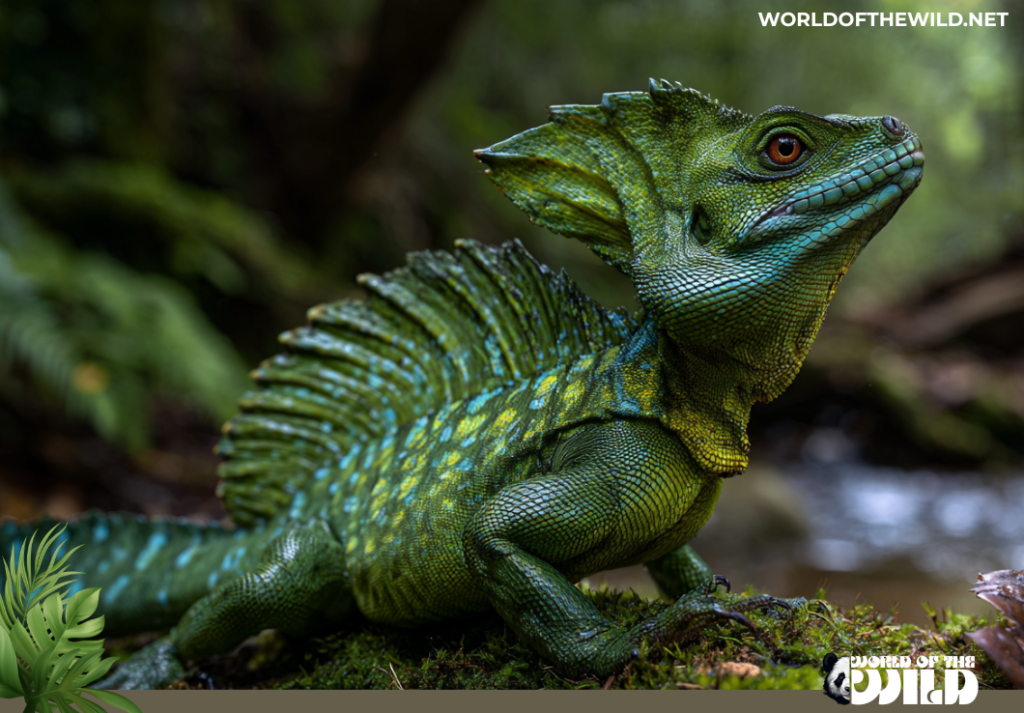
Green Basilisk or Plumed Basilisk (Basiliscus plumifrons): Perhaps the most visually striking species, sporting bright green coloration and elaborate double crests on males. Native to Central America from Honduras to Panama.
Brown Basilisk (Basiliscus vittatus): A more modestly colored species ranging from Mexico through Central America, and notably established as an invasive species in Florida since the 1960s.
Western Basilisk (Basiliscus galeritus): The least studied species, endemic to western Colombia and Ecuador, characterized by its relatively subdued coloration and smaller crests.
All four species share the remarkable ability to run bipedally across water, though they differ in size, coloration, and crest development.
Appearance
Basilisks are medium-sized lizards with distinctly athletic builds designed for speed and agility. Adults typically measure between 24 and 30 inches (60-76 cm) in total length, with their tails accounting for approximately 70-75% of their total body length. Males generally outsize females, weighing between 200 and 600 grams, while females typically weigh 135-300 grams.
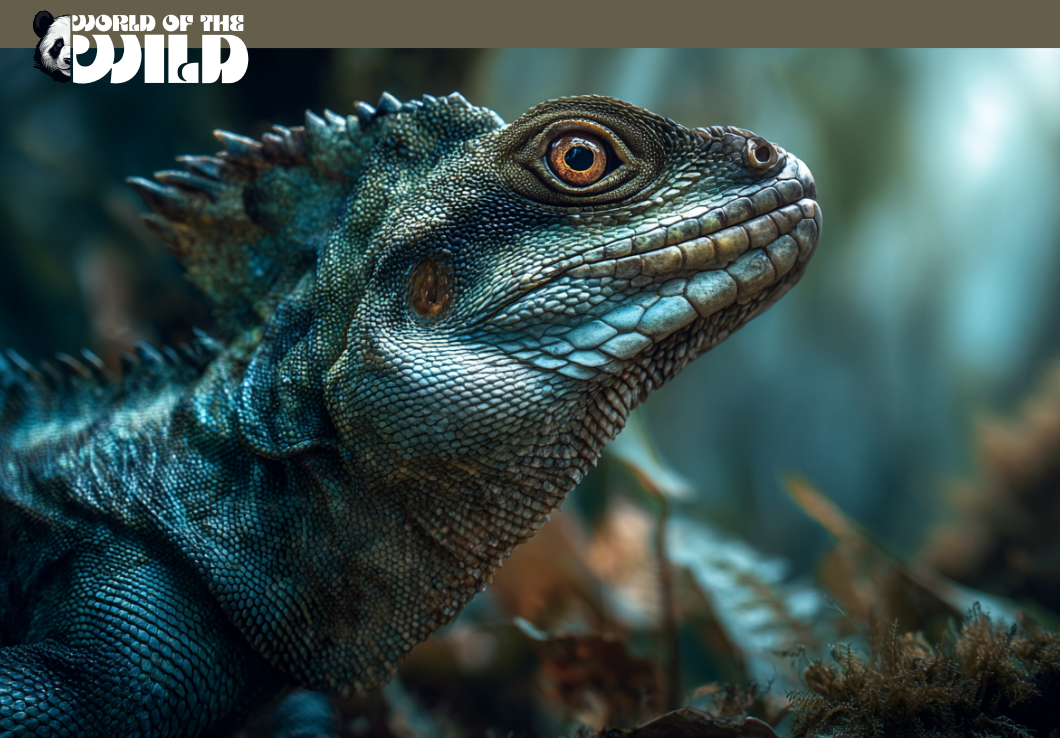
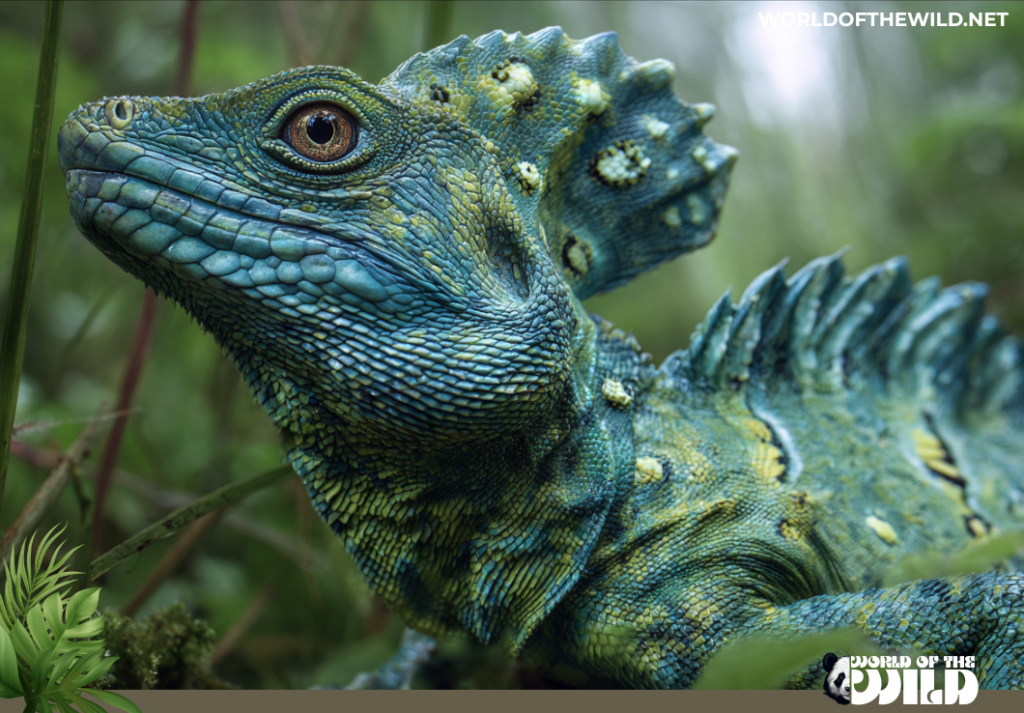
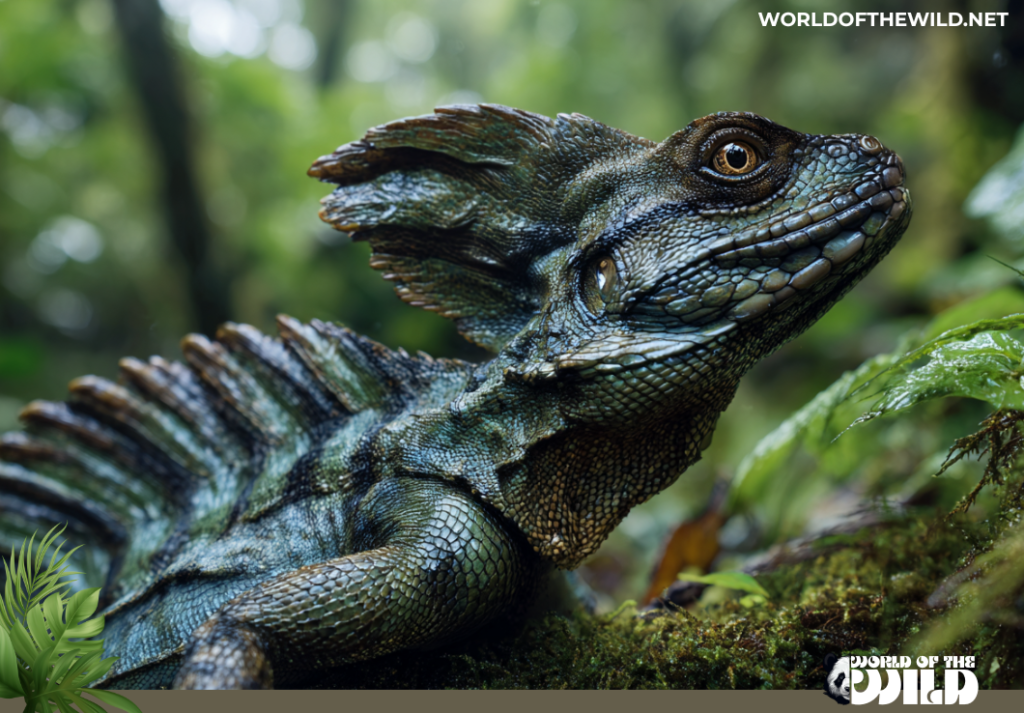
The most striking feature of basilisks, particularly in males, is their elaborate cranial and dorsal ornamentation. Males develop prominent head crests that rise vertically from the skull, along with large sail-like fins that extend along the back and tail. These structures are supported by elongated neural spines and can be quite dramatic in well-fed, mature specimens. Females and juveniles possess much smaller crests or none at all, making sexual dimorphism quite pronounced.
Coloration varies significantly by species. Green basilisks display brilliant emerald bodies with bright blue spots or markings, while common basilisks show olive to brown bodies with yellow or white lateral stripes. Brown basilisks are more subdued in their tan and brown patterns. All species have powerful hind legs that are noticeably longer and more muscular than their forelimbs, an adaptation crucial to their water-running ability.
The feet themselves are evolutionary marvels, featuring long toes equipped with fringes of skin that unfurl to create larger surface areas when slapping against water. These dermal lobes fold flat against the toes during terrestrial locomotion but deploy instantly when the lizard hits water, creating temporary pockets of air that prevent the foot from sinking.
Behavior
Basilisks are primarily diurnal creatures, most active during the warm morning and late afternoon hours when they hunt for food and bask in dappled sunlight. They’re semi-arboreal, spending considerable time in trees and vegetation overhanging water bodies—a strategic positioning that facilitates their famous escape behavior. When threatened, a basilisk will drop from its perch and sprint across the water’s surface on its hind legs, reaching the safety of vegetation on the opposite shore.
This bipedal water-running, scientifically termed “Glashütte locomotion,” involves a complex biomechanical sequence. The lizard must maintain a forward velocity of at least 1.5 meters per second to avoid sinking, slapping the water with its oversized hind feet to create air pockets that provide temporary support. Each footstrike drives both downward and backward, propelling the animal forward while keeping it above the surface. When the lizard slows or tires, it transitions smoothly into swimming.
Socially, basilisks exhibit a territorial hierarchy. Males establish territories that may overlap with multiple female home ranges, defending these areas from rival males through elaborate display behaviors. These displays involve head-bobbing, lateral compression of the body to appear larger, push-ups, and prominent exhibition of their colorful crests. Physical combat is relatively rare but does occur, typically involving biting and tail-lashing.
Communication among basilisks is primarily visual, relying on body postures, color displays, and movement patterns. They possess limited vocalization abilities, though they may produce soft hissing sounds when threatened. Their intelligence is typical for lizards—they demonstrate good spatial memory, particularly regarding escape routes and territorial boundaries, and can learn to recognize individual conspecifics.
Basilisks are also remarkably alert, possessing excellent vision that allows them to detect predators from considerable distances. This hypervigilance, combined with their explosive acceleration and water-running ability, makes them one of the most difficult lizards to capture in the wild.
Evolution
The evolutionary history of basilisks traces back to the broader radiation of iguanian lizards that occurred during the Mesozoic and early Cenozoic eras. The family Corytophanidae, which includes basilisks along with casque-headed lizards and helmeted iguanids, represents a distinct New World lineage that diverged from other iguanians approximately 66 to 90 million years ago, shortly before or after the extinction event that ended the age of dinosaurs.
The genus Basiliscus itself appears in the fossil record during the Miocene epoch, roughly 15-20 million years ago, though the precise timing of its origin remains debated among paleontologists. The water-running ability that defines these lizards is believed to have evolved as an escape mechanism in response to predation pressure in riparian environments. This adaptation required the coordinated evolution of multiple traits: enlarged hind limbs, elongated toes with specialized skin fringes, enhanced muscle power and fast-twitch muscle fiber composition, and the neural circuitry to execute complex high-speed bipedal locomotion.
Interestingly, the ability to run on water is not unique to basilisks—some other lizards, including certain iguanids and even some geckos, can achieve brief water-running, though none match the basilisk’s proficiency. This suggests that the basic biomechanical capability may have been present in ancestral iguanian lizards, with basilisks refining and perfecting it through natural selection.
The four modern species likely diverged from a common ancestor during the Pliocene epoch (5.3 to 2.6 million years ago), as geological changes fragmented their ranges and populations became isolated. The formation of the Central American land bridge during this period created new habitats and barriers that shaped the speciation of many Neotropical organisms, including basilisks.
Habitat
Basilisks are exclusively Neotropical reptiles, distributed throughout Central America and portions of northwestern South America. Their range extends from Jalisco and Veracruz in Mexico, southward through Guatemala, Belize, Honduras, Nicaragua, Costa Rica, and Panama, and into Colombia, Ecuador, and northern Peru. The brown basilisk has expanded its range beyond its natural distribution, establishing introduced populations in southern Florida where it thrives in suburban and urban waterways.
These lizards are obligate riparian species, meaning they require proximity to water bodies. They inhabit lowland tropical rainforests, wet forests, and deciduous forests, typically at elevations below 2,000 feet (600 meters), though some populations occur up to 3,900 feet (1,200 meters). The key habitat requirement is the presence of streams, rivers, ponds, or lakes bordered by dense vegetation.
The ideal basilisk habitat features slow-moving or still water bodies with abundant overhanging vegetation—typically including trees, shrubs, and vines that extend over the water’s edge. These plants serve multiple functions: they provide basking sites with quick escape routes to water, offer shade and thermoregulation opportunities, create hunting perches for ambushing prey, and supply cover from aerial predators. Basilisks strongly prefer areas where forest canopy creates dappled light rather than full exposure.
Within their territories, basilisks utilize different microhabitats throughout the day. Morning hours see them basking on exposed branches 3-6 feet above water, warming their bodies after the cool night. During peak heat, they retreat to shadier positions or lower to the ground. They typically sleep on thin branches overhanging water, a position that offers both safety from terrestrial predators and immediate access to their escape route if disturbed.
The health of riparian corridors is crucial to basilisk populations, and they serve as indicator species for the overall integrity of Central American waterway ecosystems.
Diet
Basilisks are opportunistic omnivores with a diet that shifts somewhat with age and opportunity. While they’re primarily insectivorous, they consume a surprisingly diverse array of food items, making them adaptable foragers capable of exploiting various food resources in their environment.
The bulk of their diet consists of arthropods, particularly insects. Beetles, grasshoppers, crickets, moths, butterflies, dragonflies, and their larvae feature prominently in basilisk stomach content analyses. They hunt using a combination of ambush predation and active foraging. From their arboreal perches, they watch for movement below, then drop down or rush forward with explosive speed to capture prey with their jaws. Their excellent eyesight allows them to detect even small insects from several feet away.
Beyond insects, basilisks regularly consume spiders, scorpions, and other arachnids. Small vertebrates also appear on the menu, particularly for larger individuals. They prey on smaller lizards (including juveniles of their own species in some cases), frogs, tadpoles, small snakes, and even nestling birds when accessible. Fish and small crustaceans found in shallow water provide additional protein sources.
The plant component of their diet includes flowers, leaves, fruits, and seeds, which become more important during periods when animal prey is scarce. This dietary flexibility provides resilience during seasonal fluctuations in prey availability.
Juvenile basilisks focus almost exclusively on small insects appropriate to their size, particularly gnats, flies, small beetles, and ant larvae. As they grow, their prey size range expands accordingly.
Basilisks are primarily diurnal hunters, most actively foraging during the mid-morning and late afternoon. They drink water regularly, either by lapping from surfaces or by opening their mouths to collect rain. Their diverse diet and adaptable foraging strategies contribute significantly to their success across varied habitats.
Predators and Threats
Basilisks face predation pressure from both terrestrial and aerial hunters throughout their lives. Their impressive array of anti-predator behaviors, including their famous water-running ability, evolved specifically in response to this constant threat.
Natural predators vary depending on the life stage of the basilisk. Eggs and hatchlings are vulnerable to snakes (particularly racers and whipsnakes), small carnivorous mammals such as coatis and opossums, and large predatory ants. Juvenile and adult basilisks face threats from a diverse predator guild including snakes (especially boa constrictors and various pit vipers), birds of prey (hawks, kites, and laughing falcons), herons and other wading birds, large fish such as bass and cichlids, crocodilians, large carnivorous mammals (ocelots, jaguarundis, tayras), and monitor lizards in some regions where they’ve been introduced.
The water-running escape behavior specifically counters ambush predators positioned along waterways. By explosively launching across water surfaces, basilisks can evade predators that would otherwise capture them during a swimming escape or pursuit along the shoreline.
Anthropogenic threats pose increasingly serious challenges to basilisk populations. Habitat loss through deforestation represents the primary concern, as logging operations and agricultural expansion eliminate the riparian forests basilisks require. Particularly devastating is the clearing of streamside vegetation, which removes both their hunting and escape infrastructure.
Water pollution from agricultural runoff, sewage, and industrial discharge degrades their aquatic habitats and reduces prey availability. Pesticide use has cascading effects, reducing insect populations that form the basilisk’s food base and potentially causing direct toxicological harm.
Climate change presents emerging threats through altered precipitation patterns that may dry up smaller water bodies, increased frequency of extreme weather events, and shifts in forest composition that could reduce habitat suitability.
Road mortality claims significant numbers of basilisks in areas where highways bisect their habitat, and urbanization brings introduced predators such as domestic cats and dogs. The pet trade also removes individuals from wild populations, though this is less significant than habitat-based threats.
Reproduction and Life Cycle
Basilisks exhibit a reproductive strategy typical of tropical lizards, with breeding activity possible year-round in equatorial populations, though it often peaks during the rainy season when food abundance is highest. In more seasonal environments at the northern and southern range limits, reproduction is more confined to warmer, wetter months.
Male basilisks reach sexual maturity at approximately 18-24 months of age, while females typically mature slightly earlier at 15-18 months. Breeding is preceded by elaborate courtship rituals in which males approach females with exaggerated head-bobbing displays, body push-ups, and prominent exhibition of their colorful crests and dewlaps. Males may circle females repeatedly, often gently biting the female’s neck or back before attempting copulation. Female receptivity is variable—uninterested females will flee, bite, or otherwise reject advances.
Following successful mating, females undergo a gestation period of approximately 55-65 days before laying eggs. Unlike many reptiles, basilisks do not guard their eggs. Instead, females dig nests in sandy or loose soil, typically in warm, sunny locations near water but above the flood line. Nest depth ranges from 6 to 10 inches depending on substrate and female size.
Clutch sizes vary considerably based on species, female size, and condition, ranging from 2 to 18 eggs, with larger, well-nourished females producing larger clutches. The eggs are elongated, measuring roughly 15-20mm by 8-10mm, with soft, leathery shells. Females may produce multiple clutches per breeding season—up to four or five in optimal conditions—though two to three clutches is more typical.
Incubation duration is temperature-dependent, lasting approximately 70-90 days at average tropical temperatures. Upon hatching, young basilisks are remarkably independent, receiving no parental care. Hatchlings measure 4-5 inches in total length and are miniature versions of adults, though lacking the elaborate crests and coloration of mature specimens.
Juvenile basilisks grow rapidly, approximately doubling in size during their first year. Growth rates slow considerably after sexual maturity but continue throughout life, though at decreasing rates. Their lifespan in the wild is estimated at 7-10 years, though few individuals likely reach maximum longevity due to predation pressure. In captivity with optimal conditions, basilisks can live 10-15 years.
Population
The conservation status of basilisk species varies, though none currently face imminent extinction risk according to the International Union for Conservation of Nature (IUCN). The Common Basilisk (Basiliscus basiliscus) and Brown Basilisk (Basiliscus vittatus) are both listed as Least Concern due to their relatively wide distributions, large population sizes, and presence in numerous protected areas. The Green Basilisk (Basiliscus plumifrons) is similarly classified as Least Concern, though its more restricted range warrants continued monitoring. The Western Basilisk (Basiliscus galeritus) is listed as Near Threatened, reflecting its limited distribution and ongoing habitat loss within its range.
Precise global population estimates for basilisk species are not available, as these lizards are challenging to census systematically across their forested, riparian habitats. However, within suitable habitat, basilisks can achieve relatively high population densities—studies have documented 10-30 individuals per hectare in prime habitat. Given the extent of appropriate habitat across Central America, total populations for the most widespread species likely number in the millions, though these numbers are declining.
Population trends appear stable in well-protected areas but are declining in regions experiencing active deforestation and habitat degradation. The rate of decline is difficult to quantify precisely but parallels the ongoing loss of lowland tropical forests in Central America, estimated at 1-2% annually in some regions.
Importantly, the brown basilisk’s invasive population in Florida demonstrates the species’ adaptability. Introduced accidentally in the 1960s, this population has expanded successfully, now occupying much of southern Florida from Miami to Tampa. While this represents a conservation concern for native Florida species, it also demonstrates the basilisk’s resilience when suitable habitat is available.
Protected areas throughout Central America provide critical refugia for basilisk populations. National parks and reserves in Costa Rica, Panama, Belize, and other countries protect significant basilisk habitat, helping ensure the long-term survival of these remarkable lizards.
Conclusion
The basilisk lizard stands as one of nature’s most captivating examples of evolutionary adaptation meeting survival necessity. These water-walking wonders have transformed a simple escape behavior into a physics-defying spectacle that continues to inspire scientists, engineers, and nature enthusiasts worldwide. Their ability to literally run on water—combined with their climbing prowess, swimming skills, and diverse diet—showcases the remarkable versatility that allows species to thrive in complex environments.
Yet the basilisk’s story also serves as a reminder of the fragility of specialized adaptations. These lizards’ intimate dependence on riparian corridors makes them vulnerable to the habitat degradation sweeping across Central America. While current populations remain stable in protected areas, the ongoing loss of streamside forests threatens to fragment and isolate basilisk populations, potentially jeopardizing their long-term survival.
As we marvel at slow-motion footage of basilisks sprinting across water surfaces, we should also recognize our responsibility to preserve the intricate ecosystems that make such wonders possible. Supporting rainforest conservation efforts, promoting sustainable land use practices in Central America, and reducing our collective impact on tropical watersheds are actions that will help ensure future generations can witness these living marvels. The basilisk has spent millions of years perfecting its incredible abilities—we must ensure it has the habitat to continue this evolutionary journey for millions more.
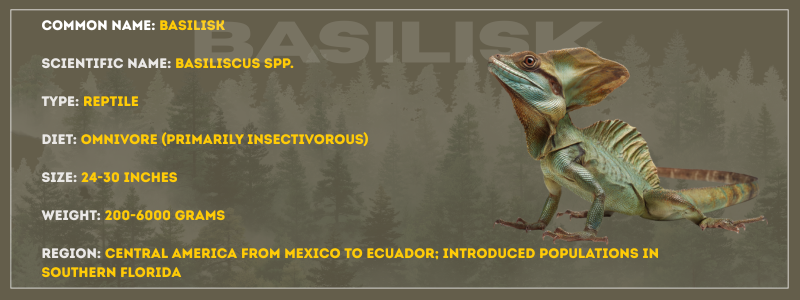
Scientific Name: Basiliscus spp. (most commonly Basiliscus basiliscus, B. plumifrons, B. vittatus, B. galeritus)
Diet Type: Omnivore (primarily insectivorous)
Size: 24-30 inches (60-76 cm) total length
Weight: 200-600 grams (males); 135-300 grams (females)
Region Found: Central America from Mexico to Ecuador; introduced populations in southern Florida