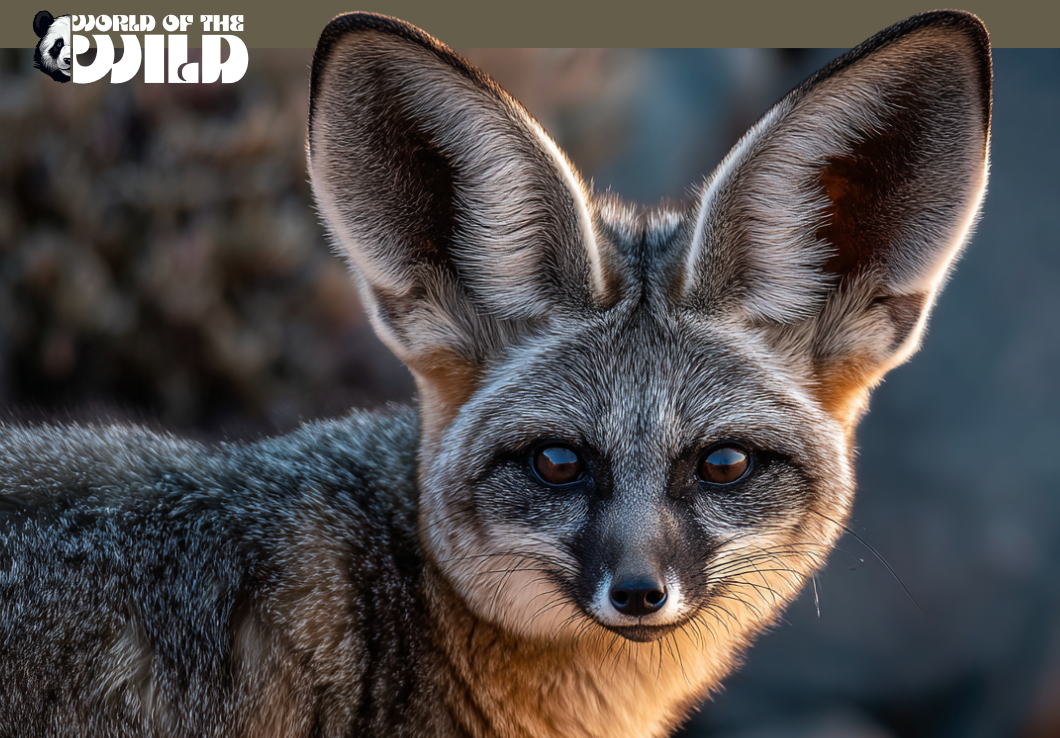

Imagine scanning the golden grasslands of the African savanna at dusk, when suddenly a pair of enormous ears — each nearly the size of a human hand — perk up from the scrub. Below those remarkable appendages sits one of Africa’s most endearing and underappreciated predators: the Bat-eared Fox. Neither quite what you’d expect from a fox nor what the name “bat” might conjure, this remarkable little canid occupies a uniquely fascinating corner of the animal kingdom, one where evolution took a sharp and creative turn.
The Bat-eared Fox is a creature of extremes. It has more teeth than almost any other land mammal on Earth, ears that function like satellite dishes tuned to the underground world, and a social life far more tender and cooperative than you might expect from a small African predator. It thrives in some of the continent’s harshest, driest landscapes, fueled almost entirely by insects, and yet it manages to be among the most successful small carnivores in its range. For anyone who loves wildlife, ecology, or just the sheer strangeness of what evolution can produce, the Bat-eared Fox is an absolute treasure.
Facts
Here are some of the most surprising and lesser-known facts about the Bat-eared Fox that will make you see this small canid in a whole new light:
- It may have more teeth than any other non-marsupial land mammal on Earth. While most members of the dog family have 42 teeth, the Bat-eared Fox can have anywhere from 46 to 50, an adaptation specifically evolved to process the enormous quantities of hard-shelled insects it consumes.
- Its ears are biological thermometers. Beyond their use in hunting, those enormous ears — packed with blood vessels near the surface — act as built-in radiators, dissipating excess body heat in the scorching African sun, much like the large ears of an elephant.
- The male is one of nature’s most devoted fathers. Bat-eared Fox fathers spend significantly more time guarding, grooming, and playing with their pups than the mother does, making them standout dads in the animal kingdom.
- They can hear beetle larvae moving underground. Their hearing is so acute that they can detect the faint sounds and vibrations of insect larvae burrowing beneath the soil surface, allowing them to pinpoint food that is completely invisible to the eye.
- A single fox can eat up to 1.15 million termites in a year. Given their near-total reliance on harvester termites and other insects, their annual consumption of invertebrates is staggering in both number and ecological significance.
- They can rotate their ears nearly 180 degrees, allowing them to triangulate the exact position of prey with remarkable precision before committing to a dig.
- Their scientific genus name, Otocyon, literally translates to “ear dog” in Greek — a fitting tribute to the feature that defines everything about how they live.
Species
The Bat-eared Fox occupies its own unique taxonomic niche within the animal world. Its full classification reads as follows:
Kingdom: Animalia Phylum: Chordata Class: Mammalia Order: Carnivora Family: Canidae Genus: Otocyon Species: Otocyon megalotis
What makes this classification especially interesting is that Otocyon is a monotypic genus, meaning the Bat-eared Fox is the sole living species within it. This makes it an evolutionary singleton, a lineage with no close living relatives in the same genus, representing a branch of the canid family tree that diverged long ago and charted its own remarkable course.
Within the species, two subspecies are recognized, separated by geography and subtle physical differences. Otocyon megalotis megalotis inhabits the southern African range, found across countries such as South Africa, Botswana, Namibia, and Zimbabwe. Otocyon megalotis virgatus occupies the East African range, ranging through Tanzania, Kenya, Uganda, Ethiopia, and Sudan. While physically very similar, these two populations are separated by a significant geographic gap roughly aligned with the Congo Basin and surrounding humid forests, which serve as an impassable barrier for a species so dependent on open, arid grasslands.
Appearance
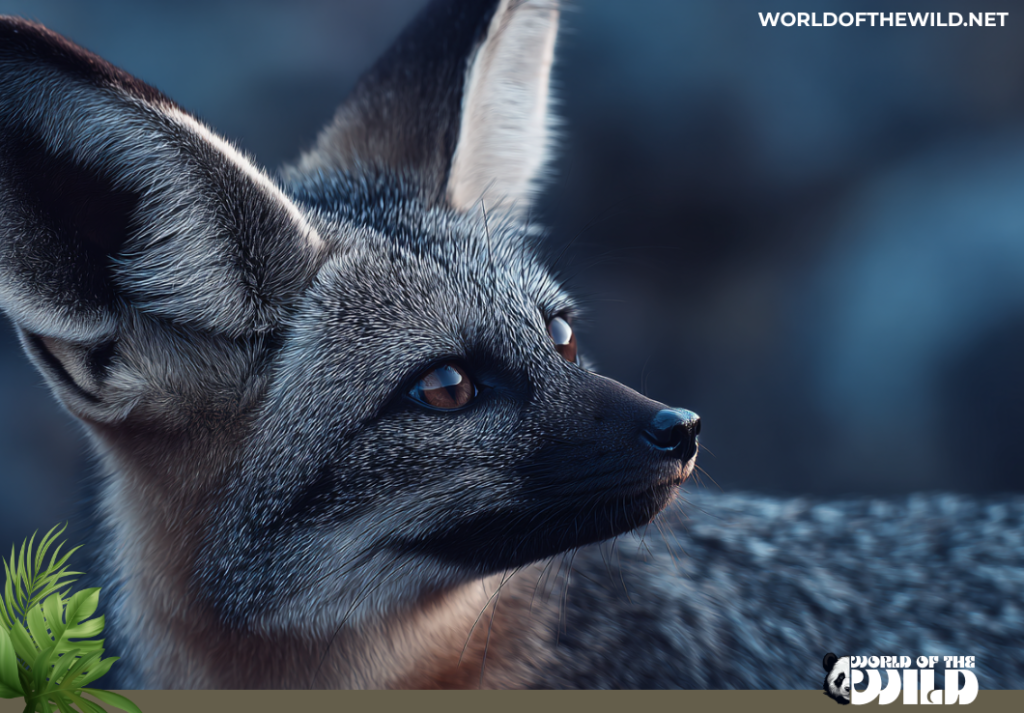
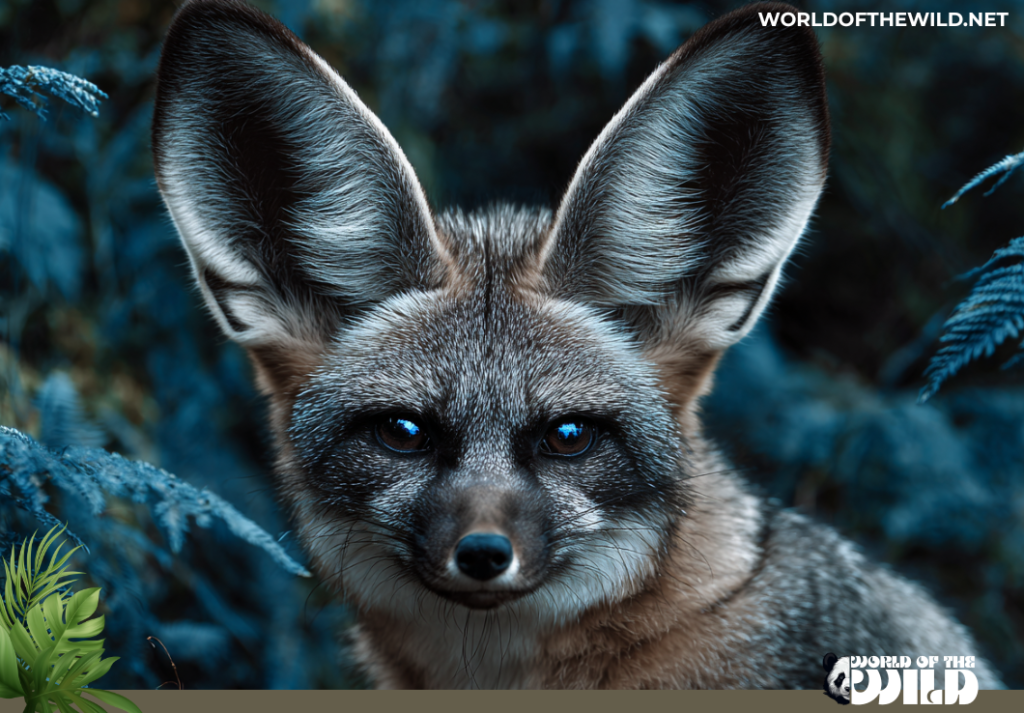
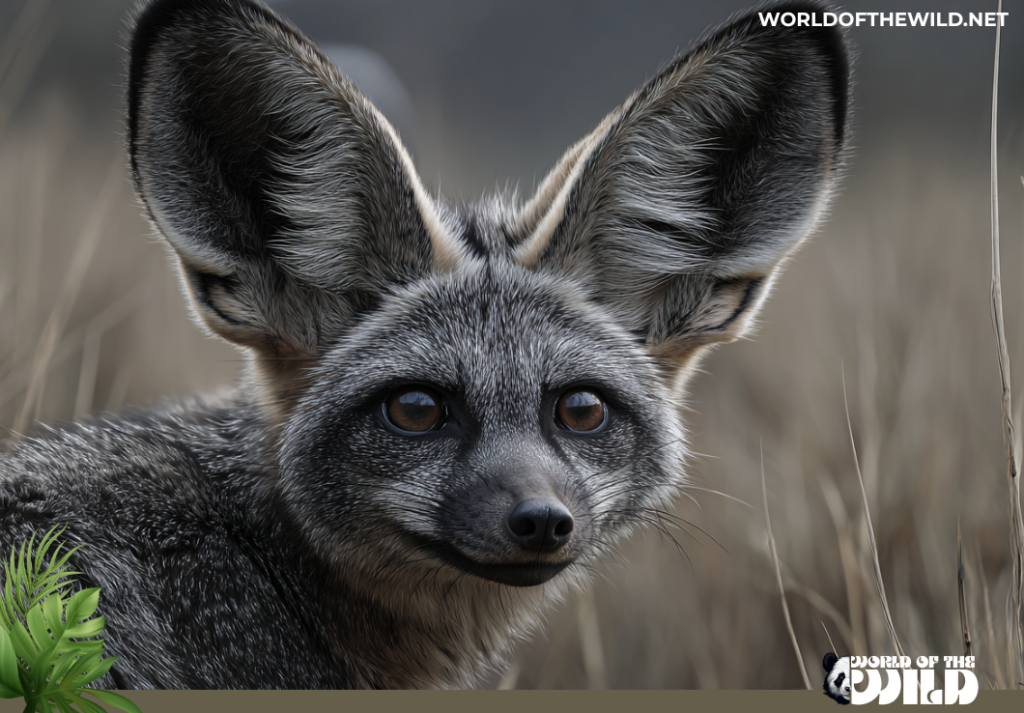
The Bat-eared Fox is a small, slender animal with a silhouette unlike almost anything else in the African bush. Its most immediately striking feature is, of course, those ears — enormous, oval, and upright, they can measure up to five inches in length and are visually disproportionate to the rest of the body in the most spectacular way. When the fox tilts and swivels them, independently of each other, the effect is both comical and deeply impressive.
The body is covered in dense, somewhat shaggy fur that is typically a grizzled silver-gray or tawny-gray along the back and flanks, providing excellent camouflage in the dry, dusty grasslands it calls home. The underparts are lighter and often pale buff or cream. One of its most distinctive markings is the black facial mask — dark patches surrounding the eyes and across the muzzle — contrasted by a pale forehead, giving the fox a somewhat raccoon-like, masked appearance. The legs and feet are uniformly black, as is the tip of the bushy tail, which is itself a mix of silver and black hairs. A dark dorsal stripe runs along much of the back.
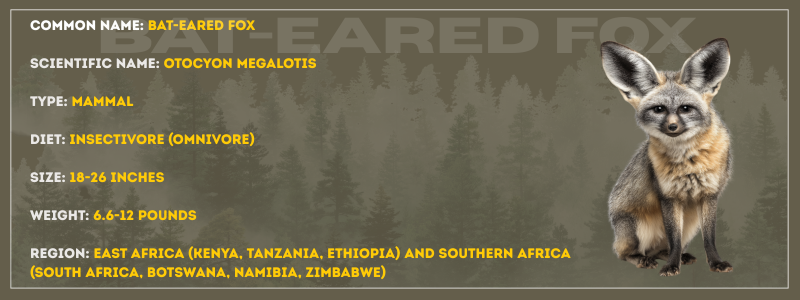
Adults typically measure between 18 and 26 inches in body length, with the tail adding another 9 to 13 inches. They stand roughly 12 inches at the shoulder. Weight ranges from around 6.6 to 12 pounds, with individuals from the southern African subspecies tending slightly larger. Males and females are similar in size with no dramatic sexual dimorphism. The limbs are relatively slender, built for quick, agile movement rather than sustained running, and the feet are equipped with sharp, sturdy claws well-suited to rapid digging.
Behavior
The Bat-eared Fox is predominantly nocturnal during the hot summer months, retreating underground during the heat of the day and emerging at dusk to forage through the night. In cooler winter months, however, the pattern shifts considerably, and foxes can be found active during daylight hours, making the most of the milder temperatures. This behavioral flexibility allows them to remain effective hunters year-round regardless of seasonal conditions.
Socially, Bat-eared Foxes are among the more cooperative of the small African canids. They are generally monogamous, forming long-term pair bonds, and often live in small family groups consisting of a mated pair and their offspring from one or more seasons. Groups rest together in underground dens — which they either dig themselves or borrow from aardvarks, springhares, or other burrowing animals — and engage in extensive social grooming, reinforcing the bonds within the group.
Communication among Bat-eared Foxes is multifaceted, involving vocalizations, body posture, and scent marking. Their calls range from soft whines and clucks used within the family group, to sharp barks issued as alarm signals when a predator is detected. Scent glands are used to mark territory boundaries, and individuals frequently investigate the scent markings of neighboring groups to monitor their social landscape.
Perhaps the most remarkable behavioral adaptation of the Bat-eared Fox is its foraging technique. When hunting, the fox moves slowly across the ground with its head tilted downward and those vast ears angled toward the earth, essentially listening for the vibrations and sounds of insects moving beneath the surface. Once a target is detected, the fox pauses, pinpoints the location with extraordinary precision, and then begins digging with rapid, efficient strokes. This “acoustic foraging” is one of the most refined versions of this hunting strategy seen in any land mammal.
Evolution
The Bat-eared Fox represents one of the more ancient and isolated lineages within the family Canidae. Fossil evidence suggests that the genus Otocyon has existed for at least four million years, with fossil specimens discovered in both Africa and parts of Eurasia. The species is considered a highly basal member of the dog family, meaning it branched off from the broader canid family tree at a relatively early stage, before many of the lineages leading to modern foxes, wolves, and jackals diverged.
Its most striking evolutionary departure from other canids is its dental formula. While virtually all members of Canidae possess 42 teeth, the Bat-eared Fox evolved additional molars — up to eight in the lower jaw and six in the upper — a trait found nowhere else in the family and seen in non-marsupial land mammals only in the most specialized insect-eaters. These extra teeth are thought to have co-evolved alongside the species’ increasing dependence on insects, particularly termites, allowing it to chew and process hard-bodied prey more efficiently. This dietary specialization happened over millions of years as African grasslands expanded and termite populations became an increasingly abundant and reliable food source.
The species’ enormous ears are also an evolutionary innovation, thought to have developed both for thermoregulation in hot, open environments and for the acoustic detection of prey. Together, these adaptations represent a fascinating case of a canid that evolved in a strikingly different direction from its carnivorous relatives, converging in some ways on insectivores rather than pursuing the path of a traditional predator.
Habitat
The Bat-eared Fox is an animal of open spaces. It is found exclusively in Africa and specifically in the continent’s arid and semi-arid grasslands, open savannas, and scrublands. These are typically areas characterized by short grass cover, sparse woody vegetation, and well-drained, often sandy soils that make den construction easier and allow harvester termites and other insects to thrive.
As noted earlier, the species exists in two geographically separate populations. The East African population is found primarily in the open grasslands and Acacia scrub of Kenya, Tanzania, Ethiopia, and surrounding countries, including iconic landscapes like the Serengeti and the Maasai Mara. The southern African population ranges across Botswana’s Kalahari, the arid grasslands of Namibia, much of South Africa’s Karoo and Highveld regions, and into Zimbabwe. In both ranges, the foxes tend to follow the distribution of harvester termites — especially Hodotermes species — which represent their primary prey. Where termites are abundant, foxes cluster; where termite activity declines, foxes are sparse.
The species avoids dense woodland, forest, wetlands, and any habitat with tall, thick grass that would impede their movement or obscure their auditory foraging. Altitude is typically not a limiting factor, and foxes can be found from sea-level plains up to about 10,000 feet in some East African highland plateaus.
Diet
The Bat-eared Fox is technically classified as an insectivore within the broader category of omnivore, and it is one of the most insect-dependent members of the entire dog family. Harvester termites (Hodotermes mossambicus in southern Africa) form the cornerstone of the diet and can account for up to 80% of what the fox eats in areas where these termites are active. In East Africa, the dung beetle plays an equally significant role, with adults and larvae both consumed enthusiastically.
Beyond termites and beetles, the Bat-eared Fox rounds out its diet with other insects including grasshoppers, crickets, scorpions, millipedes, and the larvae of various beetles. Small amounts of plant matter — wild fruits and berries — are occasionally consumed, as are small vertebrates such as lizards and rodents, though these represent a very minor component of the overall diet. Eggs and carrion are taken opportunistically when encountered.
The foraging technique is a masterpiece of sensory hunting. The fox walks slowly across the ground with its ears angled downward, listening for the acoustic signatures of insect activity below the surface. Upon detection, it freezes momentarily to triangulate the exact position, then launches into a burst of rapid digging — clearing soil with astonishing speed using its strong forelimbs — before snapping up the exposed prey with those numerous specialized teeth. A foraging fox can detect, dig, and consume a termite cluster in a matter of seconds before moving on to the next location.
Predators and Threats
Despite its adaptability, the Bat-eared Fox sits well within the prey range of many of Africa’s larger predators. Its primary natural predators include martial eagles and other large raptors that can spot the fox from altitude and dive before it can reach cover. Jackals, particularly black-backed jackals, frequently target both adult foxes and pups at den sites. Caracals, honey badgers, lions, and leopards will also take Bat-eared Foxes opportunistically, as will larger snake species such as pythons.
When threatened, the fox’s primary defense is flight to the nearest burrow, which it can reach with surprising speed for its size. The den itself is usually modified with multiple entrance tunnels to allow escape from different directions. Family members will sometimes mob small predators cooperatively to drive them away from the den, particularly when young pups are present.
On the human-caused threat front, the Bat-eared Fox faces a more complex and growing set of pressures. Habitat loss from agricultural expansion, overgrazing by livestock (which destroys the short-grass habitat that both the fox and its insect prey depend on), and rural settlement all reduce available territory. The species is also frequently caught in traps and snares set for other animals, a form of accidental but very real mortality known as bycatch in the context of bushmeat and vermin control.
Persecution by farmers is another significant issue, as the fox is sometimes mistakenly blamed for livestock predation — despite being almost entirely insectivorous — and shot or poisoned as a result. Road mortality is an increasing concern near human settlements, and rabies outbreaks in some regions can devastate local populations. Climate change poses a longer-term threat, as shifting rainfall patterns alter the availability of the termite colonies on which the fox’s survival depends.
Reproduction and Life Cycle
Bat-eared Foxes breed once a year, with mating typically occurring between June and August in southern Africa, slightly varying by region. The species is socially monogamous, and pair bonds are generally maintained across multiple breeding seasons. Courtship is relatively low-key, involving increased grooming between partners and scent-marking activity around the den site.
Gestation lasts approximately 60 to 75 days, and females give birth to litters of between two and six pups, with an average of around three or four. Pups are born blind and helpless inside the den, dependent entirely on parental care for their first several weeks of life. What makes Bat-eared Fox parental behavior so remarkable is the prominent role played by the father. While the mother nurses the pups in the early weeks, the male devotes an extraordinary amount of time to guarding the den entrance, warning of approaching predators, and engaging in play and social grooming with the developing young. As pups mature, the father’s contributions often exceed the mother’s in terms of direct time investment.
Pups begin emerging from the den at around three to four weeks of age and are weaned by around 15 weeks. Juveniles remain with their parents for several months, learning foraging techniques through observation and gradually joining the nightly hunting expeditions. Sexual maturity is reached at around eight to nine months. In the wild, Bat-eared Foxes typically live between five and nine years, though individuals in captivity have been documented reaching up to 13 years.
Population
The Bat-eared Fox is currently assessed as Least Concern on the IUCN Red List of Threatened Species, meaning it does not face an immediate risk of extinction at the species level. The global population is estimated in the hundreds of thousands, though precise numbers are difficult to ascertain given the wide and often remote range of the animal. Both the East African and southern African populations are considered stable overall, with the species remaining common across much of its natural range.
That said, “Least Concern” does not mean “without concern.” Localized population declines have been documented in areas experiencing intensive agricultural development, heavy livestock grazing, or persistent human persecution. In the southern reaches of its range, prolonged droughts associated with changing climate patterns have been linked to reduced termite activity and corresponding drops in fox numbers. Populations near urban areas or along major roads tend to be fragmented and more vulnerable.
The species does benefit from its presence in numerous protected areas and national parks across both its ranges, including the Serengeti, Kruger National Park, and the Central Kalahari Game Reserve, where populations are robust and relatively undisturbed.
Conclusion
The Bat-eared Fox is proof that the natural world never runs out of creative solutions. In a continent full of dramatic predators and iconic megafauna, this small, big-eared insect-hunter quietly goes about its business — listening to the ground, raising its pups with uncommon tenderness, and thriving in some of Africa’s most unforgiving landscapes. Its evolutionary story is one of specialization and ingenuity, a canid that turned away from the path of its carnivorous kin and found enormous success in the world beneath the grass.
While the species is currently stable, the pressures building around it — habitat loss, climate change, persecution, and road mortality — are real and deserve attention. Supporting conservation organizations working in African savanna ecosystems, advocating for responsible land management practices, and raising awareness of animals like the Bat-eared Fox all contribute to securing a future for the countless species that share its habitat. The next time you find yourself thinking about Africa’s great wildlife, spare a thought for the little fox with the extraordinary ears. It may not roar, charge, or tower over the savanna, but its story is no less extraordinary for that.
Quick Reference
| Scientific Name | Otocyon megalotis |
| Diet Type | Insectivore (Omnivore) |
| Body Length | 18 – 26 inches |
| Tail Length | 9 – 13 inches |
| Ear Length | Up to 5 inches |
| Weight | 6.6 – 12 pounds |
| Region Found | East Africa (Kenya, Tanzania, Ethiopia) and Southern Africa (South Africa, Botswana, Namibia, Zimbabwe) |