
There are few creatures in the natural world that command as much awe, mystery, and reverence as the black panther. Slipping silently through moonlit forests like a living shadow, this sleek and powerful cat has captivated human imagination for centuries — inspiring mythology, folklore, and a sense of primal wonder that few animals can match. But here’s the twist that surprises many people: the black panther isn’t actually a species at all. It’s a color variant, a stunning genetic anomaly that can appear within two of the world’s most iconic big cat species. What we call a “black panther” is nature’s most dramatic magic trick — a familiar animal made extraordinary by a single genetic switch.
That darkness, that inky, almost supernatural coat, is precisely what makes the black panther one of the most discussed, debated, and deeply misunderstood animals on the planet. Peel back the mystery, however, and what you find is even more remarkable than the legend.
Facts
- The black panther’s dark coat doesn’t actually eliminate its spots — in the right light, you can still see the rosette patterns beneath the surface of the fur, like a hidden tattoo revealed by the sun.
- Melanistic leopards are more commonly found in dense, humid forests in Southeast Asia, while melanistic jaguars are more prevalent in the deep Amazon rainforest — in both cases, the darkness provides a competitive advantage in low-light environments.
- The word “panther” comes from the Latin panthera and the Greek pánthēr, which some etymologists believe may have roots in Sanskrit meaning “the yellowish animal” — an ironic origin for a famously black creature.
- Black panthers have been documented to be slightly more aggressive and harder to observe than their spotted counterparts, which is why relatively little field research has been conducted directly on melanistic individuals in the wild.
- A black jaguar and a normally spotted jaguar can be born in the same litter, since melanism in jaguars is caused by a dominant gene mutation — meaning only one copy of the gene is needed to produce the dark coat.
- In leopards, melanism is caused by a recessive gene, meaning both parents must carry the mutation for a black cub to be born — making melanistic leopards rarer and more genetically specific.
- A rare “black panther” was confirmed on camera trap footage in Africa in 2019, the first verified photographic evidence of a melanistic leopard on the African continent in over 100 years.
Species
The black panther exists within the animal kingdom under the following biological classification:
Kingdom: Animalia Phylum: Chordata Class: Mammalia Order: Carnivora Family: Felidae Genus: Panthera Species: Panthera pardus (leopard) or Panthera onca (jaguar)
Since the black panther is not a species unto itself, understanding it requires understanding the two species that produce melanistic individuals.
The leopard (Panthera pardus) is the more widely distributed of the two and has nine recognized subspecies, including the African leopard (P. p. pardus), the Indian leopard (P. p. fusca), the Amur leopard (P. p. orientalis), the Arabian leopard (P. p. nimr), the Javan leopard (P. p. melas), and several others spread across Asia and Africa. Melanistic individuals appear most frequently among Indian and Javan leopard populations.
The jaguar (Panthera onca) is the third-largest big cat in the world and the largest in the Americas. While jaguars were once considered to have multiple subspecies, recent genetic research suggests the jaguar is best represented as a single species with regional population variations across Central and South America. Melanistic jaguars are found in relatively higher proportions in dense tropical forest zones.
A third, far rarer possibility exists: the melanistic puma (Puma concolor), also sometimes loosely called a black panther, particularly in North American folklore. However, no confirmed specimen of a wild melanistic puma has ever been documented, making this more legend than science.
Appearance
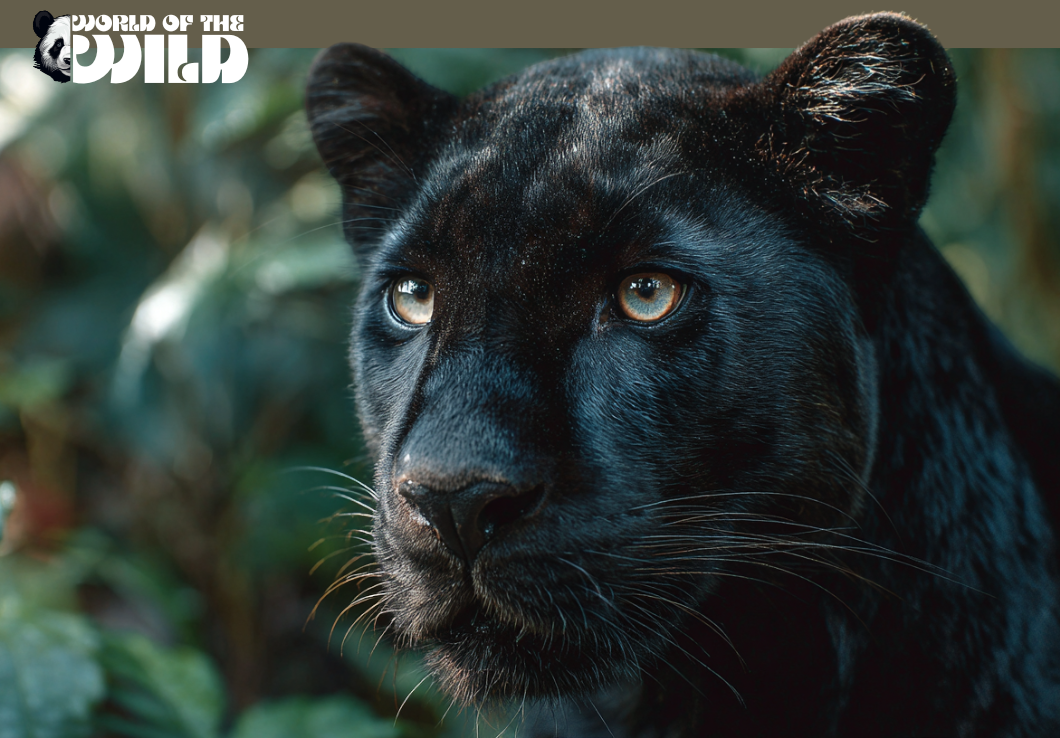
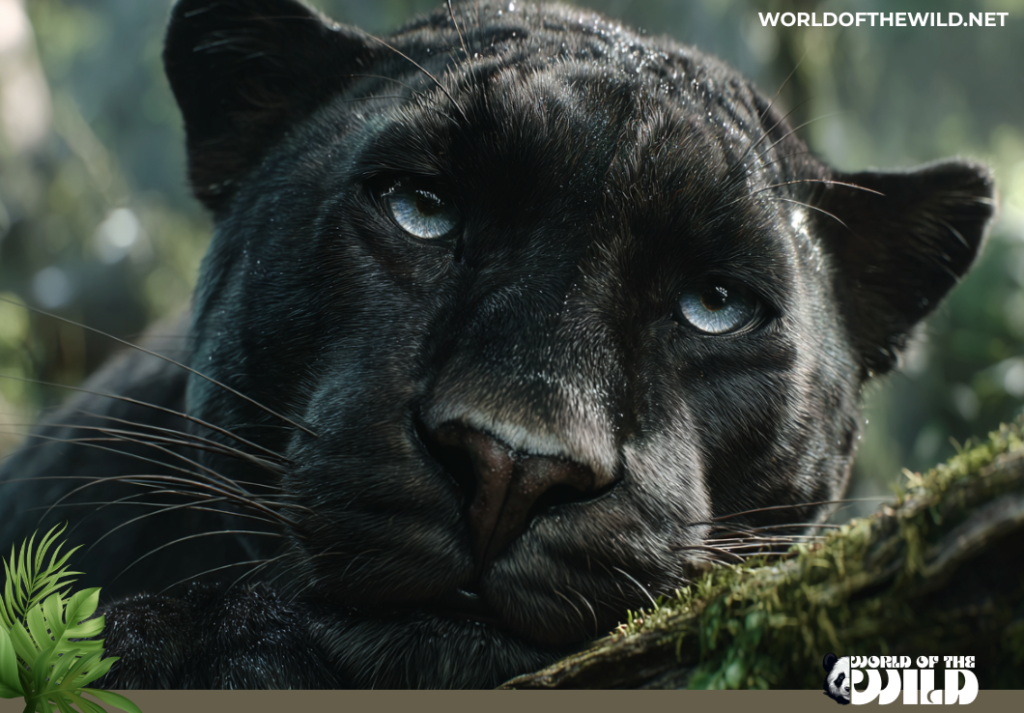
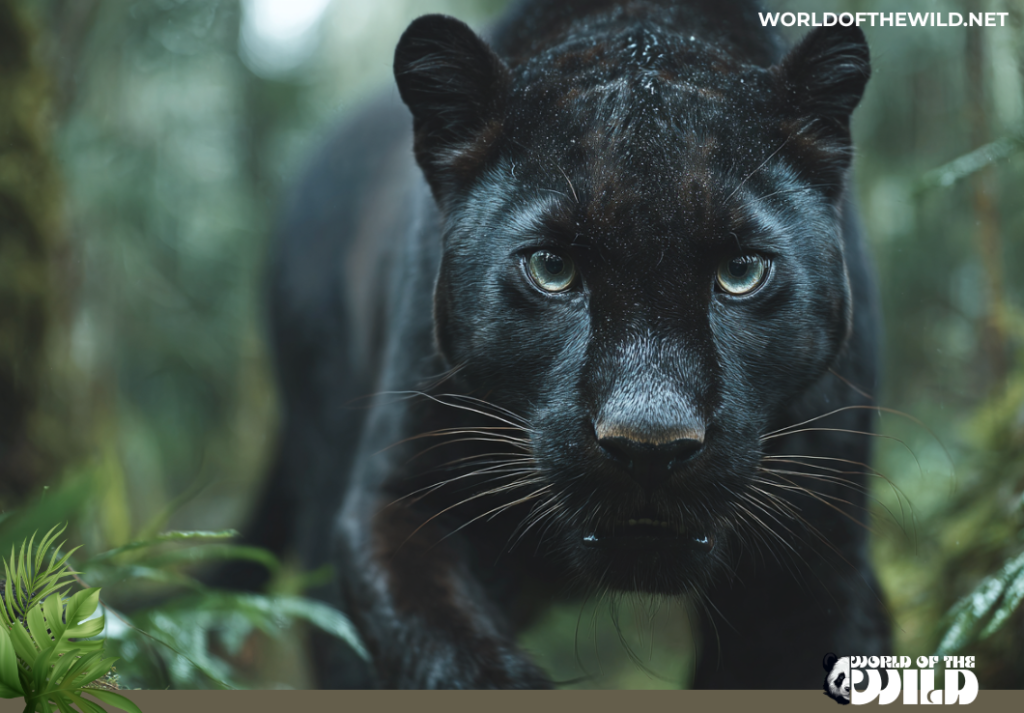
The most immediately striking feature of the black panther is, of course, its coat — a deep, lustrous black that absorbs light rather than reflecting it, giving the animal an almost otherworldly quality in both daylight and darkness. Despite appearing uniformly black, the fur actually retains the rosette or spot patterns of the parent species. Under direct sunlight or photographic flash, these ghost markings become visible, a phenomenon sometimes called “ghost striping” or “ghost spotting.”
The physical dimensions of a black panther depend entirely on which species it belongs to. Melanistic leopards are typically sleek, muscular, and medium-to-large in build, with males generally measuring between 4.25 and 6.25 feet in body length (not including the tail), with a long, graceful tail adding another 25 to 43 inches. They typically weigh between 66 and 200 pounds, with considerable variation depending on geographic region and prey availability. Females are noticeably smaller than males.
Melanistic jaguars are significantly stockier and more powerfully built, reflecting the jaguar’s status as a heavier, more robust cat than the leopard. Males can reach 5.5 to 6 feet in body length and weigh anywhere from 126 to over 250 pounds. Their build is broader through the chest and shoulders, with a rounder, more massive head and shorter legs relative to body size.
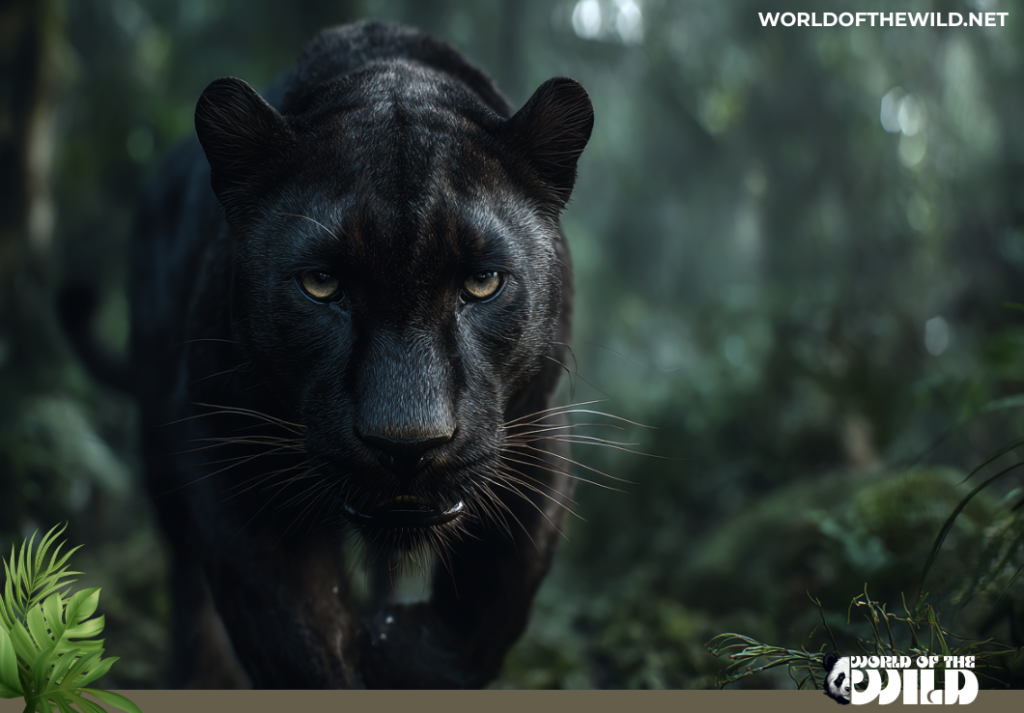
Both species share the hallmarks of the big cat family: large, forward-facing eyes adapted for low-light hunting, retractable claws, muscular limbs, and a long tail used for balance. The eyes of the black panther, often described as amber, green, or golden, stand out in dramatic contrast against the dark face — an arresting visual that has made the animal a symbol of power across many cultures.
Behavior
Black panthers, like their spotted counterparts, are fundamentally solitary animals. They are highly territorial, marking their home ranges with scent markings, scratch marks on trees, and vocalizations. These ranges can span anywhere from a few square miles to over 30 square miles, depending on prey density and habitat type.
They are predominantly nocturnal, though leopards in particular are known to be active during twilight hours as well. Their dark coat gives melanistic individuals a potential edge in nighttime hunting compared to spotted cats, as they are even harder to detect in low-light conditions — though scientific debate continues about the precise adaptive advantage of melanism in different environments.
Both leopards and jaguars are remarkably adaptable in their hunting strategies. Leopards are famous for hauling their kills up into trees to keep them away from scavengers like hyenas and lions — a feat of extraordinary strength, as they are capable of hoisting prey heavier than themselves several meters off the ground. Jaguars, by contrast, tend to cache kills on the ground or consume them near water.
Communication occurs through a variety of vocalizations. Leopards produce a distinctive rasping, sawing cough — unlike the roar of lions or tigers — while jaguars emit deep, guttural roars and grunts. Both species also communicate through physical scent marking and body language.
In terms of intelligence, both leopards and jaguars rank among the more cognitively flexible of the big cats. Their ability to adapt to diverse prey, environments, and even human-altered landscapes demonstrates a problem-solving capacity that has allowed them to survive in conditions where other large predators have failed.
Evolution
The Panthera lineage traces its roots back approximately 10 to 11 million years ago, with early felid ancestors emerging in Asia before radiating outward across multiple continents. The genus Panthera itself is estimated to have diverged from other felids around 6 to 10 million years ago.
The leopard’s evolutionary journey is particularly ancient and widespread. Fossil evidence suggests that early leopard-like cats existed in Africa and Eurasia as far back as 3.5 million years ago. The modern leopard (Panthera pardus) is considered one of the oldest and most evolutionarily successful of all the big cats, having survived multiple ice ages, dramatic climate shifts, and the extinction of many contemporaneous megafauna.
The jaguar shares a common ancestor with the leopard, lion, and tiger, with the Panthera lineage splitting from its closest relative — the snow leopard (Panthera uncia) — around 4 million years ago. Jaguars are believed to have crossed into the Americas from Eurasia via the Bering land bridge approximately 1.5 to 2 million years ago, where they evolved into the powerfully built apex predators of the Americas we see today.
Melanism itself — the genetic mutation responsible for the black panther’s coat — is believed to have arisen independently in multiple felid lineages over evolutionary time, suggesting it carries a selective advantage in certain environments. In dense forest ecosystems with low light and heavy vegetation, a darker coat may confer stealth advantages significant enough to be favored by natural selection across generations.
Habitat
Because the black panther is a color morph of either the leopard or jaguar, its habitat mirrors the remarkably broad range of those two species.
Melanistic leopards are most commonly found in the dense, humid tropical and subtropical forests of South and Southeast Asia, particularly in countries such as India, Malaysia, Sri Lanka, and Java. The thick canopy cover, dappled light, and dense undergrowth of these forests make the dark coat particularly advantageous. Melanistic leopards are far less common in the open savanna and woodland habitats of sub-Saharan Africa, where lighter coats blend better with golden grasses and dappled light.
Melanistic jaguars are concentrated primarily in the Amazon Basin and surrounding tropical rainforests of South America, with populations also found across Central America. The jaguar’s range extends from the southwestern United States (where sightings are exceptionally rare) through Mexico, into Central America, and across much of northern South America. Brazil’s Pantanal wetlands and the Amazon rainforest represent the jaguar’s strongholds, and it is within the darkest, most impenetrable regions of these ecosystems that melanistic individuals are proportionally most common.
Both species favor habitats with reliable water sources, dense cover for ambush hunting, and abundant prey. They demonstrate the kind of ecological flexibility that has made them survivors — leopards have been documented living on the outskirts of major cities in India and Africa, while jaguars roam territories that shift from dense rainforest to open grassland to seasonally flooded wetlands.
Diet
Both the leopard and the jaguar are obligate carnivores, meaning their bodies are designed exclusively to derive nutrition from animal prey. The black panther, regardless of which species it belongs to, is a highly opportunistic and skillful apex predator.
Leopards are among the most versatile hunters of any big cat, capable of taking prey ranging from small rodents, birds, and reptiles all the way up to medium-sized antelopes, wild pigs, baboons, and young wildebeest. In forested environments, they are known to prey heavily on primates and smaller forest deer. They hunt primarily through stealth and ambush, using dense vegetation to creep within striking distance before unleashing an explosive burst of speed and power.
Jaguars are equally impressive but favor somewhat larger prey items, reflecting their more powerful build. Their prey list includes capybaras, peccaries, deer, tapirs, caimans, anacondas, and even large river turtles — a testament to the jaguar’s uniquely powerful bite, which is the strongest of any big cat relative to body size. Unlike leopards and most other cats, jaguars frequently hunt in or near water and are strong swimmers that actively pursue aquatic prey.
Both species consume virtually every part of a kill, including bones in smaller prey, and return to large kills over multiple feeding sessions.
Predators and Threats
Natural Predators
Adult black panthers — whether leopard or jaguar — have very few natural predators. In Africa and parts of Asia, large lions and tigers will occasionally kill leopards, particularly if competing for the same territory or food resources. Hyena clans and packs of wild dogs can harass and potentially kill a leopard, especially one that has descended from a tree with a kill. Cubs and juveniles face a significantly broader range of threats, including predation by lions, tigers, wild dogs, and even large male leopards or jaguars of their own species.
In the Americas, the jaguar sits at the top of the food chain and faces no significant natural predators as an adult. Only large anacondas or caimans pose any conceivable threat, and such encounters are rare and typically contested.
Human-Caused Threats
The most significant threats to black panthers — and to the broader species that produce them — are entirely human in origin. Habitat destruction ranks as the primary driver of population decline. Deforestation for agriculture, particularly palm oil plantations in Southeast Asia and cattle ranching in the Amazon, has devastated and fragmented leopard and jaguar habitat on a catastrophic scale. As forests shrink, wild prey populations decline, which in turn pushes big cats into conflict with farming communities.
Poaching remains a serious concern, particularly for leopards whose skins, bones, and body parts are trafficked for use in traditional medicine and the illegal wildlife trade. Jaguars face similar pressures, with their teeth, paws, and skins increasingly targeted as demand from Asian markets grows.
Retaliatory killing by farmers and ranchers who lose livestock to big cats represents another persistent threat. Road networks, infrastructure development, and human settlement continue to break up the connectivity of wild habitats, creating isolated populations that are vulnerable to inbreeding and local extinction.
Reproduction and Life Cycle
Black panthers follow the same reproductive patterns as the broader species to which they belong. Both leopards and jaguars are non-seasonal breeders, capable of mating at any time of year, though births often cluster around periods of peak prey availability.
Mating involves a brief but intense period of courtship, during which males and females — usually solitary — come together. Females signal their receptivity through vocalizations and scent marking. Courtship can last several days and involves a great deal of physical contact, vocalizations, and occasional aggression. Once mating occurs, the male typically departs, and the female assumes all parental responsibilities.
The gestation period for leopards is approximately 90 to 105 days, while jaguars carry their young for roughly 93 to 105 days. Leopard litters typically consist of two to three cubs, while jaguar litters range from one to four, with two being the most common. Cubs are born blind and helpless, sheltered in dense thickets, caves, or rocky outcroppings.
Mothers are fiercely protective of their young, moving them frequently to prevent detection by predators. Cubs begin accompanying their mother on hunts at around three months of age and gradually develop their own hunting skills through observation and practice. Young leopards become independent at around 12 to 18 months of age, while jaguar cubs may stay with their mothers for up to two years.
In the wild, leopards typically live 12 to 17 years, and jaguars tend to survive for 12 to 15 years. In captivity, both species can live significantly longer, with individuals occasionally reaching their mid-twenties.
Population
The conservation status of the black panther is inseparable from the status of its parent species.
The leopard (Panthera pardus) is currently listed as Vulnerable on the IUCN Red List. While leopards as a whole are more numerous than many other big cat species — with estimates ranging between 200,000 and 250,000 individuals globally — many subspecies are in drastically worse shape. The Amur leopard, for instance, is considered one of the rarest cats on Earth, with fewer than 100 individuals remaining in the wild. The Javan leopard and Arabian leopard are also critically endangered, with populations numbering in the dozens or low hundreds. The proportion of those populations that are melanistic varies, but globally, black leopards are considered rare.
The jaguar (Panthera onca) is listed as Near Threatened on the IUCN Red List, with a global population estimated at between 64,000 and 173,000 individuals, though recent assessments lean toward the lower end of that range. Jaguar populations have declined significantly due to habitat loss across their historical range, and the species has been extirpated from approximately 40 percent of its former territory. Melanistic jaguars account for a small but ecologically significant portion of overall jaguar populations, particularly in dense forest habitats.
Both species show declining population trends in most parts of their range, making sustained conservation action urgent.
Conclusion
The black panther is more than a striking animal — it is a symbol of wildness, adaptability, and the enduring power of nature to surprise us. Whether stalking through the dense forests of Malaysia as a melanistic leopard or prowling the waterways of the Amazon as a melanistic jaguar, this extraordinary creature represents the pinnacle of millions of years of evolution refined to a razor’s edge.
But the shadow cast by the black panther today is not only one of beauty — it is one of urgency. As forests vanish, prey disappears, and human encroachment tightens, the spaces in which these animals can exist grow smaller and more fragile. Protecting the black panther means protecting entire ecosystems: the forests that store our carbon, the watersheds that sustain life, and the biodiversity that keeps our planet resilient.
These animals do not need our mythology to be magnificent. They need our action, our resources, and our commitment to sharing this world with the wild things that still call it home. The black panther has survived ice ages, shifting continents, and millennia of change. Whether it survives us depends entirely on what we choose to do next.
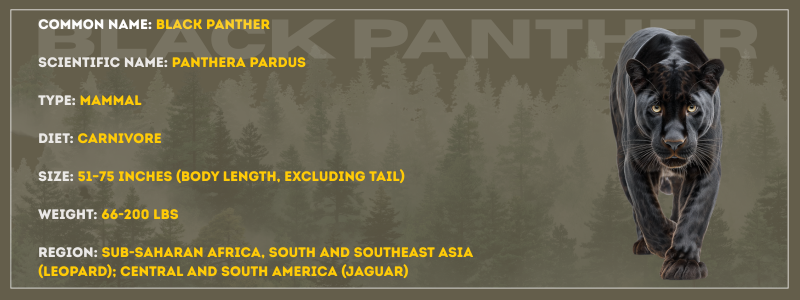
Scientific Name: Panthera pardus (melanistic leopard) / Panthera onca (melanistic jaguar)
Diet Type: Carnivore
Size: 51–75 inches (body length, excluding tail) for leopards; 66–72 inches for jaguars
Weight: 66–200 lbs (leopard); 126–250+ lbs (jaguar)
Region Found: Sub-Saharan Africa, South and Southeast Asia (leopard); Central and South America (jaguar)