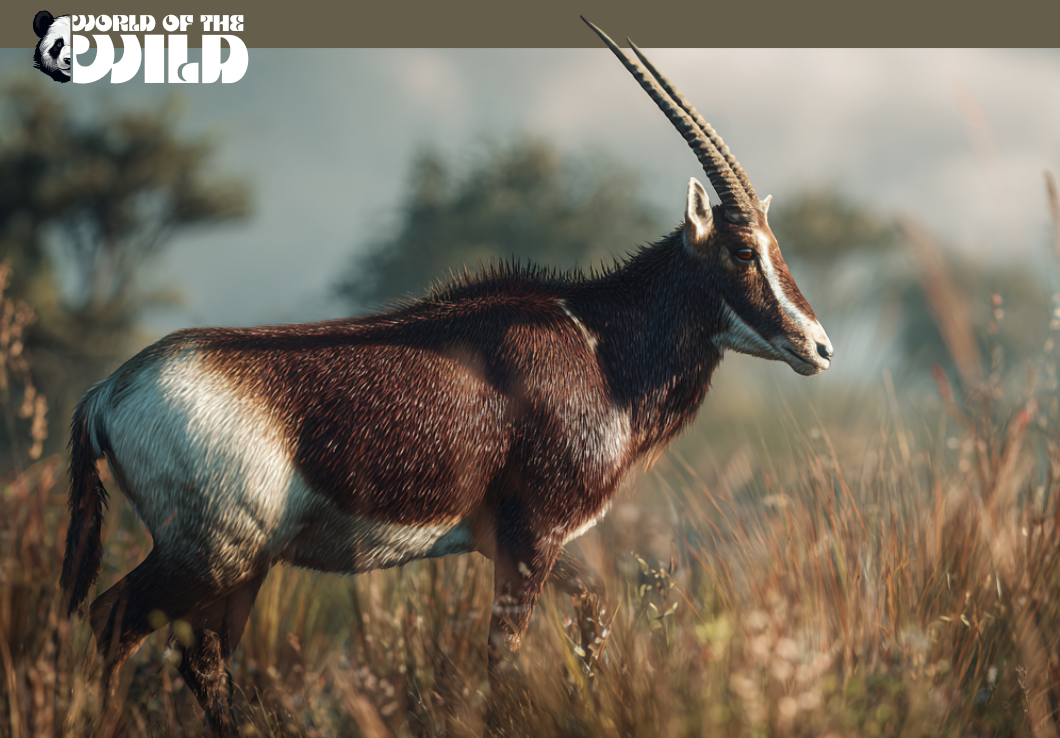

There is a particular stretch of South Africa’s Western Cape where the fynbos scrubland gives way to open coastal plains, and on a clear morning, you might catch a flash of deep chestnut-purple moving through the grass — a colour so rich and unusual it seems almost impossible in nature. That is the Bontebok: a medium-sized antelope with a coat like polished mahogany, a bold white blaze down its face, and a rump patch so brilliantly white it practically glows in the African sun. But the Bontebok is more than just a pretty face in an already spectacular continent full of them.
This is an animal that came within a whisker of vanishing from the Earth forever. By the early nineteenth century, relentless hunting and agricultural expansion had pushed the entire global population of Bontebok down to just seventeen individuals — a number so small it seems more fitting for a critically endangered fish in a remote mountain stream than for a large, charismatic mammal roaming the plains of southern Africa. That it exists today in healthy, growing numbers is one of conservation’s most quietly extraordinary success stories. The Bontebok is a testament to what determined human action can achieve, and a living reminder of how close we can come to losing something irreplaceable before we choose to act.
Facts
- The word “Bontebok” comes from Afrikaans and Dutch, meaning “colourful buck” or “spotted buck” — a fitting name for an antelope dressed in such a striking tri-colour wardrobe of dark brown, white, and iridescent purple.
- At its lowest recorded point in around 1837, the entire wild Bontebok population consisted of just seventeen animals, all protected on a single private farm owned by the Van der Byl family in South Africa’s Overberg region. Without this single act of private conservation, the species would almost certainly be extinct today.
- Bontebok produce a secretion from their preorbital glands — located just in front of their eyes — which they smear onto grass stems and shrubs to mark territory. It is a subtle but chemically complex form of communication that humans can barely detect but other Bontebok read with remarkable precision.
- Unlike many antelope species where only males grow horns, both male and female Bontebok sport lyre-shaped, ringed horns — though males tend to grow theirs significantly longer and more robust.
- The Bontebok is one of only two subspecies of Damaliscus pygargus; its close cousin, the Blesbok, looks so similar that the two were not formally recognised as distinct subspecies until relatively recently, and the differences between them were debated among naturalists for well over a century.
- Bontebok have a curious habit of aggregating near water during the heat of midday, not necessarily to drink, but simply to stand in the shade of riverine vegetation — a behavioural thermoregulation strategy that makes them appear lazier than they actually are.
- The species has an unusually restricted natural range compared to most African antelopes, historically confined to a narrow coastal strip in the southwestern tip of South Africa — a geographic isolation that made it especially vulnerable when European settlers arrived and began transforming the landscape.
Species
The Bontebok sits within one of the most biologically diverse and successful families in the mammalian world. Its full classification is as follows:
- Kingdom: Animalia
- Phylum: Chordata
- Class: Mammalia
- Order: Artiodactyla
- Family: Bovidae
- Subfamily: Alcelaphinae
- Genus: Damaliscus
- Species: Damaliscus pygargus
- Subspecies: Damaliscus pygargus pygargus (Bontebok)
The species Damaliscus pygargus contains two recognised subspecies. The Bontebok (D. p. pygargus) is the nominate subspecies and is restricted to the coastal and near-coastal lowlands of the Western Cape. Its counterpart, the Blesbok (D. p. phillipsi), is found across the interior highveld grasslands of South Africa and Lesotho and is considerably more numerous, with a population in the tens of thousands. The two subspecies are visually similar at a glance but differ in several consistent ways: the Bontebok has a more vivid coat with a continuous white blaze running from between the horns to the nose, white lower legs, and a more lustrous purplish sheen to its brown coat. The Blesbok’s blaze is typically interrupted by a brown band across the forehead, and its colouration is generally duller and less glossy.
Within the broader genus Damaliscus, the Bontebok’s nearest relatives include the Topi (D. lunatus), the Korrigum, and the Tsessebe (D. lunatus lunatus) — all fleet-footed, medium-to-large antelope adapted to open grassland environments across various parts of sub-Saharan Africa. The Alcelaphinae subfamily also includes the wildebeest, hartebeest, and Hirola, making the Bontebok part of a proud lineage of African plains specialists.
Appearance
The Bontebok is an antelope of genuinely striking beauty. Adults stand roughly 85 to 100 centimetres at the shoulder and measure between 140 and 160 centimetres in body length, placing them solidly in the medium-sized antelope category — comparable in stature to an impala but built slightly more robustly. Males are noticeably larger and heavier than females, weighing between 60 and 80 kilograms, while females typically weigh between 55 and 70 kilograms.
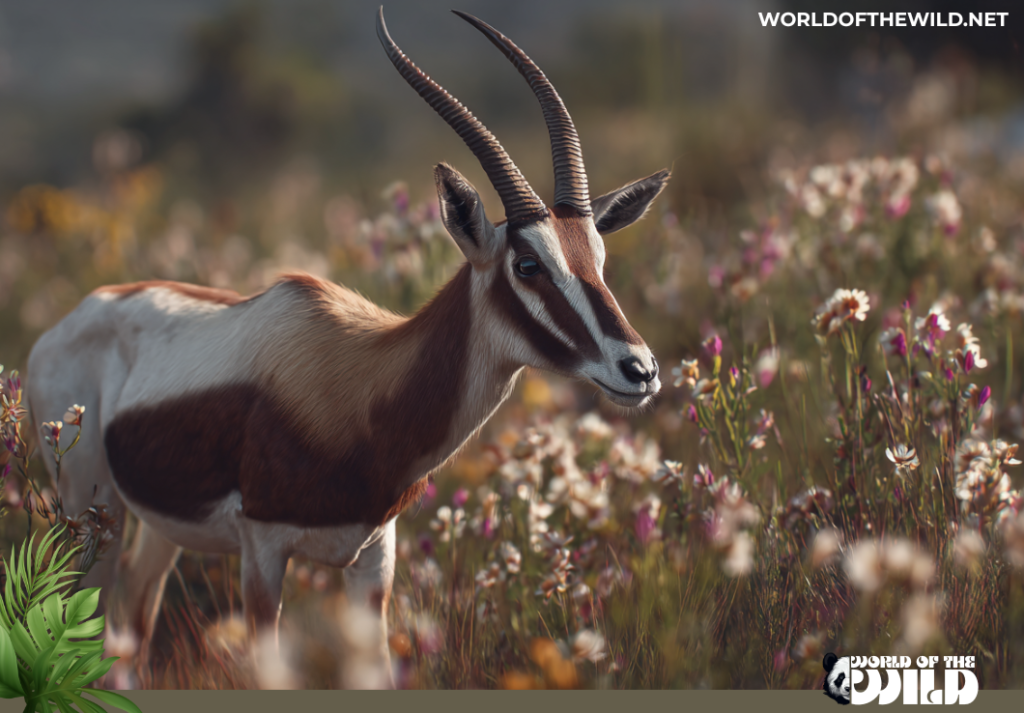
The coat is the Bontebok’s most immediately arresting feature. The main body colour is a deep, glossy reddish-brown to dark chocolate-brown, but in certain light — particularly in the morning or late afternoon sun — the flanks take on a magnificent purplish-chestnut iridescence that makes the animal look almost painted. This lustrous quality is due to the particular structure of the hair shaft and is one of the features that most reliably distinguishes the Bontebok from the somewhat duller Blesbok.
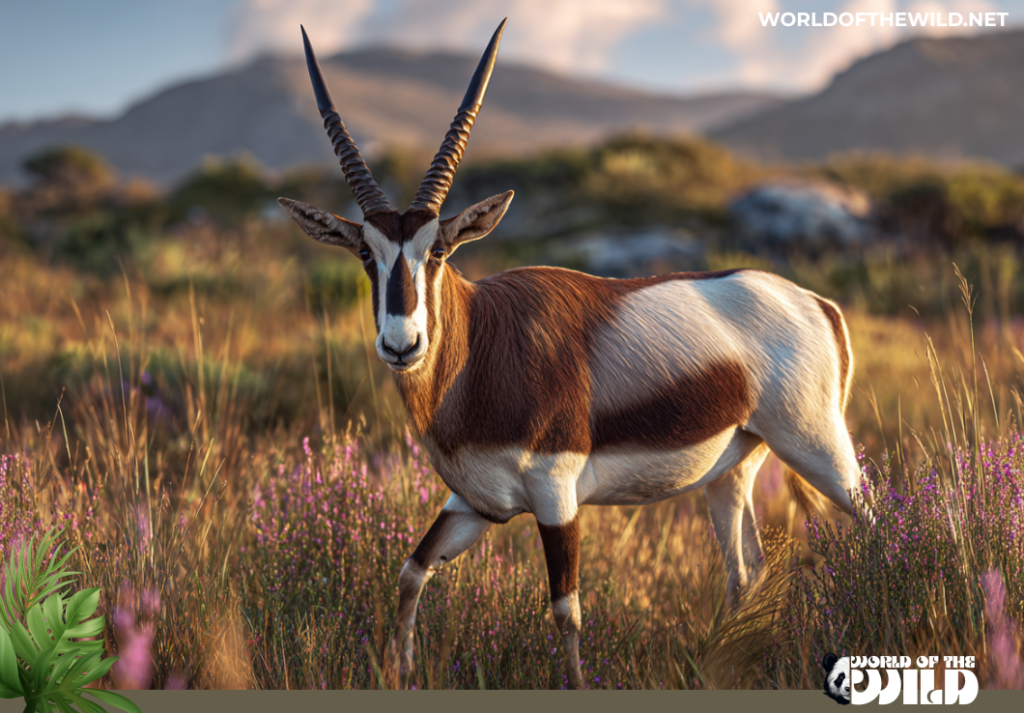
Set against this rich dark coat is a bold pattern of white markings. A broad, unbroken white blaze runs from between the base of the horns, down the entire length of the face, to the muzzle, giving the animal an almost mask-like facial appearance. The belly and inner thighs are white, as are the lower legs below the knee — so clean and bright they look freshly painted. The rump patch is extensive and brilliantly white, a feature referenced directly in the species’ scientific name: pygargus derives from the Greek for “white rump.” A short, tufted tail is also white, often held upright when the animal runs.
Both sexes carry horns, which are lyre-shaped, heavily ridged, and curve gently backward before sweeping inward and slightly forward at the tips. In males, horns can reach 50 centimetres or more in length; in females, they are slightly shorter and more slender. The eyes are large and dark, well-positioned on the sides of the head to provide the wide field of vision typical of prey animals.
Behavior
Bontebok are gregarious, social animals that live in herds, though the structure and composition of these herds shifts considerably depending on the season, the availability of resources, and the reproductive status of individuals. Outside of the breeding season, it is common to see bachelor herds of young males, nursery groups of females and their young, and solitary territorial males occupying and defending patches of prime grazing territory.
Territorial males are the most visually dramatic members of the species. A dominant male will stake out and fiercely defend a territory, performing elaborate displays to deter rivals and attract females. These displays include a stiff-legged trot known as “proud walking,” head-held-high posturing, and vigorous horn-to-ground rubbing. When two males do clash, they engage in dramatic pushing and shoving contests, locking horns and attempting to drive each other off. Serious injuries are rare, as most confrontations are resolved through display before they escalate.
Communication in Bontebok is multi-modal. Visual signals — postures, ear positions, tail carriage — convey a great deal of social information at close range. Vocalizations are relatively limited, consisting mainly of snorts and soft bleats used between mothers and calves or as alarm signals. Chemical communication, however, is highly developed. The preorbital gland secretion is used to mark grass stems and shrubs throughout the territory, creating an olfactory map that other Bontebok can read and interpret. Pedal glands between the hooves leave additional scent trails as the animals walk.
Bontebok are diurnal, meaning they are most active during the cooler morning and evening hours. During the heat of midday, they rest in shade when it is available, often gathering near water sources or areas of dense vegetation. They are alert, nervous animals with a wide field of vision and a strong flight response to potential predators — a trait that makes them remarkably fast off the mark despite their medium build.
One notable behavioural quirk is the species’ strong site fidelity. Both males and females show a tendency to return to the same grazing areas day after day, and herds rarely move great distances from their established ranges unless forced to by drought or other pressure. This predictability made them easy targets for hunters historically, and it remains a factor in management decisions in game reserves today.
Evolution
The Bovidae family to which the Bontebok belongs first appeared in the fossil record during the Miocene epoch, roughly 20 million years ago, coinciding with the spread of open grassland habitats across Africa and Eurasia. The subfamily Alcelaphinae — the group containing the Bontebok, wildebeest, and hartebeest — began diversifying significantly during the Pliocene and Pleistocene epochs, between about five million and one million years ago, as the African continent’s savannahs and open grasslands expanded and diversified.
The genus Damaliscus appears to have originated in southern and eastern Africa and is considered a relatively derived group within Alcelaphinae, meaning it represents a more recently evolved lineage compared to, say, the ancient-lineage hartebeests. Fossil evidence suggests that Damaliscus ancestors were already well-established in the region by the mid-Pleistocene, adapting to the specific vegetation communities and climatic conditions of sub-Saharan Africa.
The divergence of the Bontebok from its interior cousin the Blesbok is thought to have been driven by geographic isolation during the Pleistocene. As climate fluctuations repeatedly altered the landscape of southern Africa, populations of the ancestral Damaliscus pygargus type became separated: one group became isolated in the coastal lowlands of the southwestern Cape, where the unique fynbos biome and Renosterveld grasslands shaped the distinct traits we now associate with the Bontebok; the other population adapted to the interior highveld, becoming what we now call the Blesbok. The coastal population’s relative isolation and small geographic range meant it never achieved the population sizes of its inland relative, setting the stage for its vulnerability in historical times.
Habitat
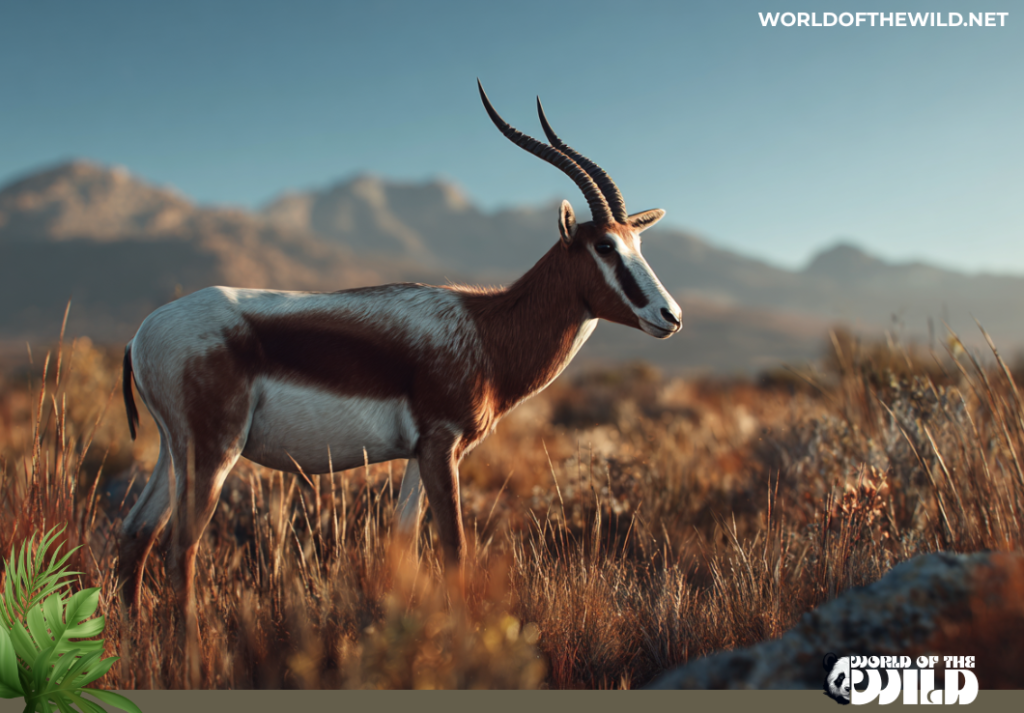
The Bontebok is one of the most geographically restricted large mammals in Africa. Its natural historical range was confined almost entirely to a narrow coastal belt in what is now the Western Cape province of South Africa, roughly between the Cape Peninsula in the southwest and the Breede River valley to the east — an area of perhaps a few thousand square kilometres in total. Today, through conservation and reintroduction programmes, the species’ range has been expanded modestly, but it still exists within a relatively small footprint compared to most African antelope.
The specific habitat favoured by the Bontebok is technically known as Renosterveld — a type of lowland shrubland and grassland unique to the Western Cape, dominated by renosterbos (Elytropappus rhinocerotis) shrubs, fine-leaved grasses, and a remarkable diversity of bulbous plants and wildflowers. This vegetation type is part of the Cape Floristic Region, one of the world’s six major floral kingdoms and one of the most botanically diverse areas on Earth relative to its size.
Within this habitat, Bontebok show a strong preference for areas with short to medium-length grass, avoiding tall rank grass and dense bush. They thrive in areas where fire or grazing by other animals has kept the vegetation relatively open, which allows them to see approaching predators and access the fine-leaved grasses they prefer. Access to fresh water is also important, and Bontebok rarely stray far from reliable water sources, particularly during the dry summer months. The mild, Mediterranean-type climate of the Western Cape — wet winters and dry summers — suits the species well, and it shows little tolerance for the extremes of heat and aridity that characterise much of the rest of sub-Saharan Africa.
Diet
The Bontebok is an obligate grazer and a herbivore, subsisting almost entirely on grasses. Unlike many antelope species that supplement their diet with browse (leaves, shoots, and shrubs), the Bontebok is highly selective and dedicated in its preference for grass, making it genuinely grass-dependent in a way that has significant implications for its habitat requirements.
It shows a strong preference for short, fine-leaved grasses over tall or coarse varieties, which is why the condition of the grassland in its habitat is so critical to its wellbeing. In the Renosterveld ecosystem, favoured grass species include various members of the genera Themeda, Cynodon, and Poa, depending on the season and local conditions. After fire clears an area of dead vegetation and stimulates the growth of fresh green shoots, Bontebok will congregate in the burn scar in large numbers to take advantage of the flush of new growth — a behaviour known as “fire following” that is common among African grazing animals.
Foraging typically occurs during the cooler parts of the day — morning, late afternoon, and into the early evening — interspersed with long periods of rumination during the hotter midday hours. Like all ruminants, Bontebok have a four-chambered stomach and regurgitate and re-chew their food to maximise nutrient extraction from plant material. They require access to fresh water daily and will drink morning and evening when conditions allow.
Predators and Threats
In their natural ecosystem, Bontebok would historically have faced predation from the large carnivores that once roamed the Cape region. Leopards were undoubtedly their primary natural predator within the fynbos biome, and caracal, African wild dog, and spotted hyena would also have taken animals opportunistically. Today, within fenced conservation areas, the primary predators Bontebok interact with are leopards and caracal, as well as black-backed jackals targeting newborn calves.
When a predator is detected, Bontebok typically respond with an immediate, high-speed sprint, relying on their impressive acceleration and agility to outrun threats in open terrain. The white rump patch, visible as a flashing signal when the animal runs, may serve as a warning signal to other herd members — a phenomenon seen in several antelope and deer species.
However, the greatest threats Bontebok face are not natural predators but human-caused pressures. Habitat loss is the most significant long-term concern. The Renosterveld lowlands that the Bontebok depends upon are among the most transformed and threatened vegetation types in South Africa. More than 80 percent of lowland Renosterveld has been converted to wheat and wine grape agriculture over the past few centuries, and what remains is highly fragmented. This transformation was the primary driver of the Bontebok’s historical decline to the edge of extinction.
A subtler but increasingly recognised threat is genetic introgression through hybridisation with the Blesbok. Where the two subspecies come into contact — particularly on private game farms where both are kept for hunting or game meat — they interbreed, producing fertile hybrids that blur the genetic distinction between the two forms. As demand for game ranching grows in South Africa, the risk of hybridisation threatens the long-term genetic integrity of the true Bontebok.
Climate change represents an emerging and poorly understood threat. The Western Cape is a recognised climate change hotspot, with projections indicating significant shifts in rainfall patterns, increased frequency of drought, and rising temperatures that could degrade the quality and extent of Renosterveld habitat in the coming decades.
Reproduction and Life Cycle
Bontebok have a well-defined breeding season, with most mating activity concentrated between January and March — the late summer and early autumn months in the Southern Hemisphere. This timing ensures that calves are born in spring, when fresh grass growth is at its most abundant and nutritious.
During the rut, territorial males become intensely active, herding receptive females within their territories and chasing away rival males with great energy. Males will approach females in a distinctive “low stretch” posture — neck extended, head held low — which is a common courtship display among antelope. Females are not always passive participants; they will test males with head-tossing and evasive manoeuvres that appear to evaluate male fitness before allowing mating.
The gestation period is approximately 240 days — roughly eight months. Females typically give birth to a single calf, with twin births being exceptionally rare. Calves are born with a lighter, more camouflaged coat than adults, which helps conceal them in their first weeks of life. In a strategy common among antelope, the calf “lies out” hidden in vegetation for the first few days after birth, with the mother returning several times a day to nurse it. This hiding behaviour reduces the risk of predation during the calf’s most vulnerable period.
Calves grow quickly on their mothers’ rich milk and begin sampling grass within a few weeks. They are weaned at around four to six months of age. Sexual maturity is reached at around one to two years, though males rarely hold territory and breed successfully until they are three to four years old and physically competitive. In the wild, Bontebok typically live for 10 to 12 years, though individuals in captivity and well-managed reserves have been recorded living to 17 years or beyond.
Population
The Bontebok is currently classified as Least Concern on the IUCN Red List of Threatened Species — a status that reflects its remarkable recovery from the brink of extinction, though it remains one of the rarer antelope species in Africa. The current global population is estimated at between 3,000 and 4,000 individuals, the vast majority of which are held in fenced private game reserves, national parks, and nature reserves in South Africa’s Western Cape and surrounding provinces.
The primary stronghold for the species remains Bontebok National Park, near Swellendam in the Western Cape, which was specifically established in 1931 to protect this critically endangered animal. Today, the park holds a carefully managed population that serves as a genetic reservoir and source population for reintroductions elsewhere. The De Hoop Nature Reserve and various private game farms across the Western Cape and Eastern Cape also hold significant numbers.
Population trends are generally positive since the mid-twentieth century, representing one of the more encouraging conservation turnarounds for any African mammal. However, “Least Concern” must be understood in context: the total population remains small by antelope standards, is heavily fragmented into isolated managed subpopulations, faces ongoing threats from habitat loss and hybridisation, and is almost entirely dependent on continued active management for its survival. There is no large, self-sustaining wild population roaming a pristine landscape. Every Bontebok alive today exists because humans chose — and continue to choose — to protect it.
Conclusion
The Bontebok is many things at once: a thing of genuine natural beauty, a specialist of a vanishing ecosystem, a creature shaped by millions of years of evolutionary pressure, and a species that came within a handful of individuals of ceasing to exist entirely. Its story carries all the hallmarks of a gripping conservation drama — a dramatic near-extinction, a small cast of heroes in the form of early conservationists and a protective farming family, and a partial but genuinely meaningful recovery.
Yet the Bontebok’s story is not finished. Its long-term survival depends on the continued preservation of the Renosterveld lowlands, one of the most botanically extraordinary but tragically underappreciated ecosystems in the world. It depends on vigilant genetic management to protect the subspecies’ integrity from dilution through hybridisation. And it depends on a broader societal commitment to treating the survival of other species not as a luxury, but as a moral obligation — and a measure of our own maturity as stewards of this planet.
The next time you read about an antelope or a wildflower or an ecosystem on the edge, remember that seventeen is not zero. Recovery is possible. But it requires us to act before we reach seventeen.
Quick Reference
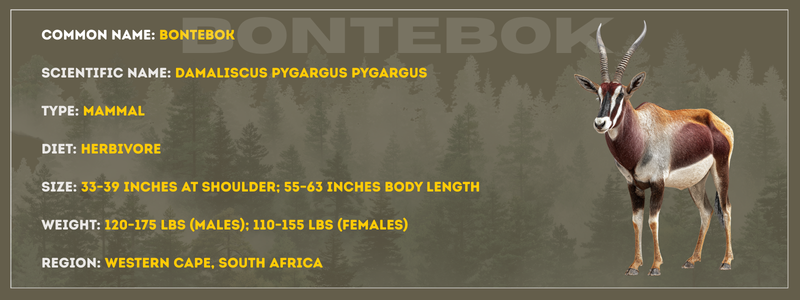
| Scientific Name | Damaliscus pygargus pygargus |
| Diet Type | Herbivore (obligate grazer) |
| Size | 33–39 inches at shoulder; 55–63 inches body length |
| Weight | 120–175 lbs (males); 110–155 lbs (females) |
| Region Found | Western Cape, South Africa |