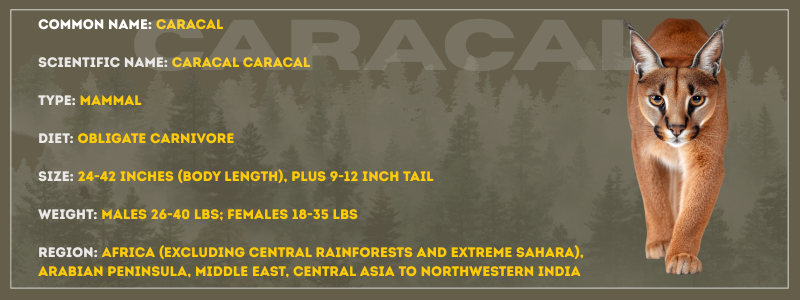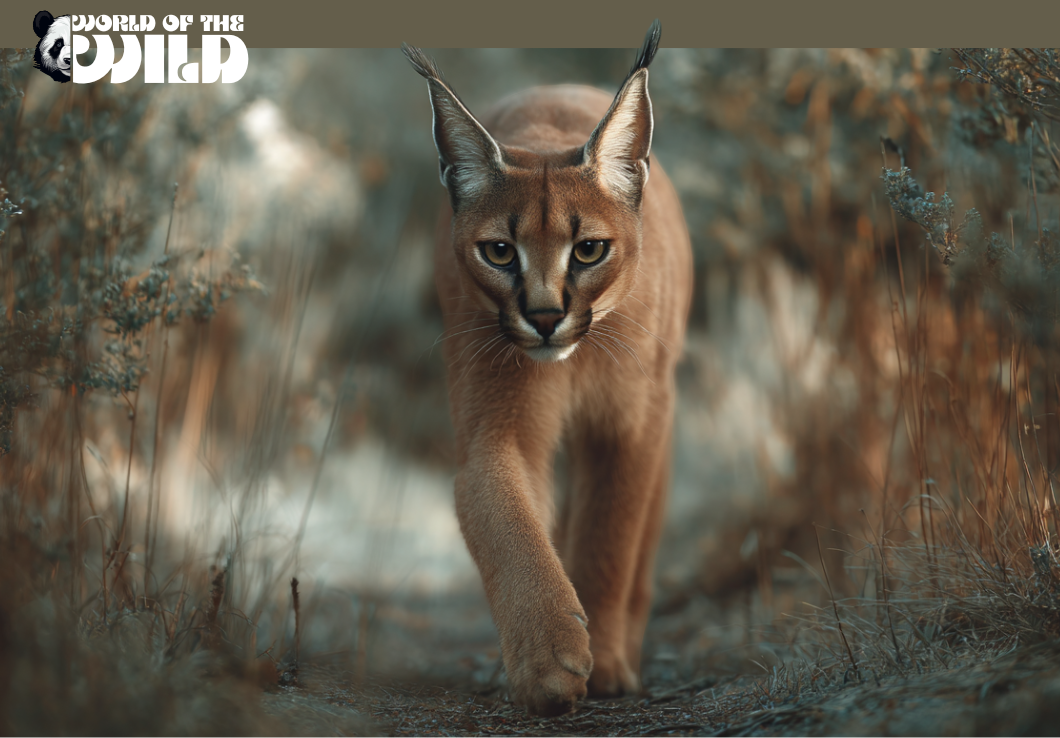

In the golden savannas and rocky outcrops of Africa and Asia, a sleek predator moves with the silence of a shadow and the precision of a gymnast. The caracal, with its distinctive black-tufted ears standing like exclamation points atop its tawny head, is one of nature’s most impressive—yet often overlooked—wild cats. Neither fully big cat nor small, this medium-sized feline occupies a unique niche in the animal kingdom, combining the agility of a house cat with the power of a predator capable of taking down prey twice its size. What makes the caracal truly fascinating isn’t just its striking appearance or its incredible athleticism; it’s the cat’s remarkable adaptability, thriving in environments ranging from semi-desert scrublands to mountain forests, all while maintaining an air of mystery that has captivated naturalists and wildlife enthusiasts for centuries.
Facts
- Vertical Leap Champions: Caracals can jump up to 10 feet straight into the air from a standing position, often snatching birds mid-flight with their powerful paws in a spectacular display of athleticism.
- Ear Tuft Mystery: While their iconic black ear tufts can grow up to 2 inches long, scientists still debate their exact purpose—theories range from enhanced hearing to communication signals between caracals.
- Speed Demons: Despite their stocky build, caracals can reach speeds of up to 50 miles per hour in short bursts, making them one of the fastest small cats on the planet.
- Desert Specialists: Caracals can survive for extended periods without water, obtaining most of their moisture from the prey they consume—an adaptation that allows them to thrive in arid environments.
- Ancient Egyptian Icons: These cats were revered in ancient Egypt, where they were trained to hunt birds for nobility and depicted in paintings and sculptures alongside pharaohs.
- Solitary Singers: Caracals produce an astonishing variety of vocalizations including hisses, growls, meows, and even a unique “wah-wah” sound used during mating season.
- Rotating Ears: Each of the caracal’s ears is controlled by approximately 20 muscles, allowing them to rotate independently like satellite dishes to pinpoint prey with remarkable accuracy.
Sounds of the Caracal
Species
The caracal belongs to a well-defined taxonomic classification that places it firmly within the carnivore family tree:
- Kingdom: Animalia
- Phylum: Chordata
- Class: Mammalia
- Order: Carnivora
- Family: Felidae
- Genus: Caracal
- Species: Caracal caracal
Historically, the caracal was considered closely related to the lynx species due to its tufted ears and similar body structure, leading to the now-obsolete name “desert lynx.” However, modern genetic studies have revealed that caracals are more closely related to the African golden cat and the serval, forming their own distinct lineage within the Felidae family.
Currently, taxonomists recognize three subspecies of caracal, though this classification continues to be refined through ongoing genetic research. The Nubian caracal (C. c. nubica) inhabits North Africa, the South African caracal (C. c. caracal) roams southern Africa, and the Asian caracal (C. c. schmitzi) ranges across the Middle East and Central Asia. These subspecies show subtle variations in size and coat coloration adapted to their specific environments, though all maintain the signature features that make caracals instantly recognizable.
Appearance
The caracal presents a portrait of muscular elegance wrapped in a coat of understated beauty. Adults typically measure 24 to 42 inches in body length, with an additional 9 to 12 inches of tail. Males are noticeably larger than females, weighing between 26 to 40 pounds, while females range from 18 to 35 pounds. Their build is robust and powerful, with particularly well-developed hind legs that account for their extraordinary jumping abilities.
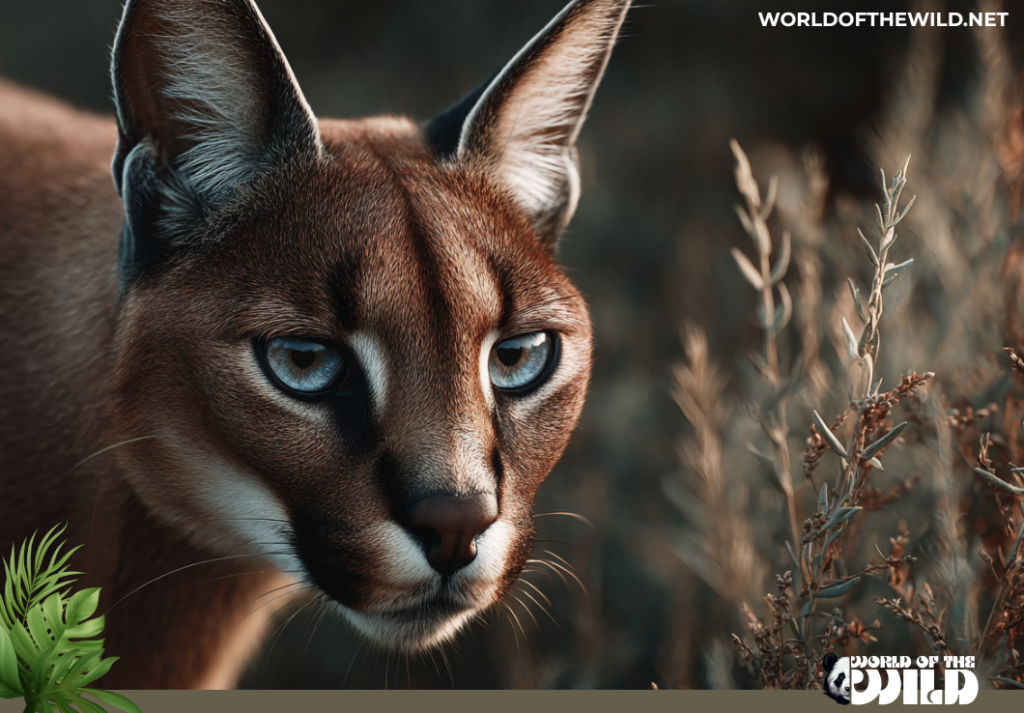
The caracal’s coat is short, dense, and uniformly colored, ranging from pale reddish-tan to brick-red or wine-red, depending on geographic location and individual variation. The belly and throat feature lighter cream or white coloring, while the backs of the ears are solid black—a striking contrast to the tawny face. Some caracals display faint spots or stripes on their underside, particularly as juveniles, though these typically fade with age.
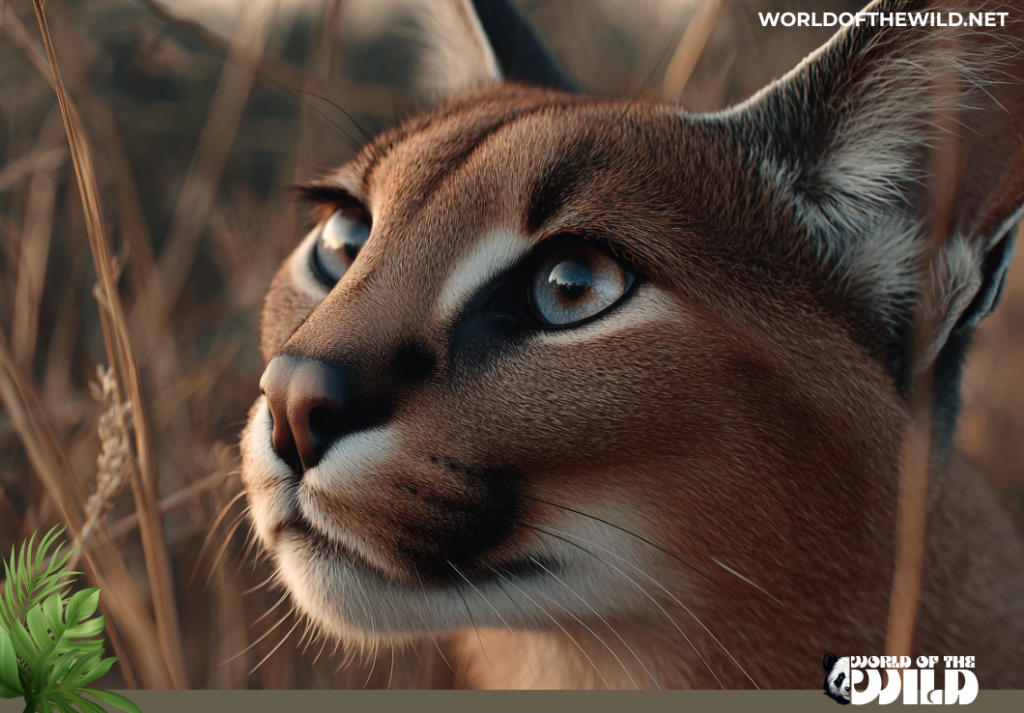
However, it’s the facial features that truly distinguish this cat. The caracal’s face is relatively short and broad, with large, almond-shaped eyes ranging from golden-yellow to copper in color. White markings frame the eyes and muzzle, creating a masked appearance that helps break up the face’s outline during hunts. The ears are tall, narrow, and pointed, crowned with those magnificent black tufts that can measure up to 2 inches in length. These tufts, along with about 20 muscles controlling each ear, give the caracal an almost regal bearing while serving crucial sensory functions.
The paws are large and equipped with fully retractable claws, providing both silent movement and lethal weapons when needed. The tail, while relatively short compared to many other cats, is thick and serves as an important counterbalance during the caracal’s acrobatic pursuits.
Behavior
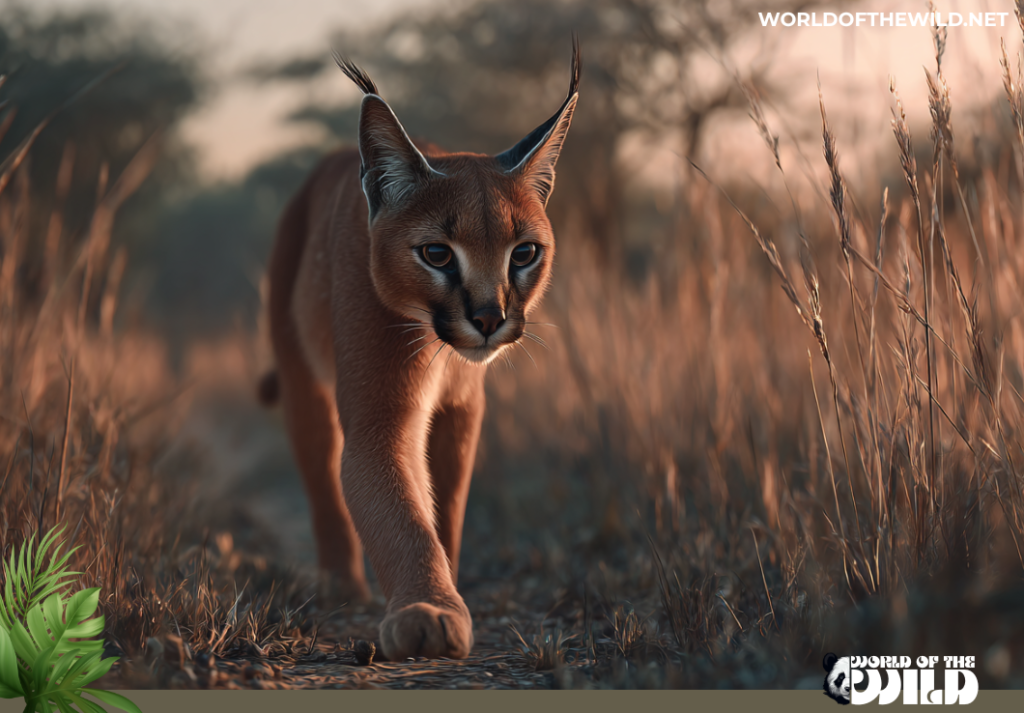
Caracals are predominantly solitary and crepuscular creatures, most active during the twilight hours of dawn and dusk, though they’ll adjust their schedule based on temperature and prey availability. In particularly hot regions, they may become almost entirely nocturnal to avoid the scorching midday sun. Each caracal maintains a well-defined territory marked through scent marking, scratch marks on trees, and strategic urine spraying. Males typically claim territories of 30 to 140 square miles, while females occupy smaller ranges that may overlap with male territories.
These cats are surprisingly vocal for solitary hunters, producing a rich repertoire of sounds. Beyond the typical feline hisses and growls, caracals make bird-like chirps, sharp barks, and a distinctive cough-like call. During breeding season, their vocalizations become particularly elaborate, with males producing loud, repeated “wah-wah” sounds that can carry across the landscape.
The caracal’s hunting behavior showcases remarkable intelligence and adaptability. They are opportunistic predators, employing different strategies depending on their target. For ground prey, they use a stalking approach, creeping close with belly low to the ground before launching an explosive sprint. For birds, they employ their famous vertical leap, often batting multiple birds from a flock in a single jump using both paws in rapid succession—a technique that seems almost choreographed in its precision.
One particularly fascinating behavior is the caracal’s habit of plucking feathers from bird prey and removing fur from larger mammals before consumption, displaying a level of food preparation unusual among wild cats. They’ve also been observed covering cached kills with vegetation or soil, returning to feed over several days.
Despite their solitary nature, caracals aren’t completely antisocial. Mothers and cubs maintain close bonds for months, and breeding pairs may spend several days together. They communicate through complex body language, with ear positions conveying different meanings—forward-facing ears indicate curiosity or aggression, while flattened ears signal fear or submission.
Evolution
The evolutionary story of the caracal stretches back approximately 1.5 to 2 million years to the Pleistocene epoch, though the Felidae family itself has a much more ancient lineage. Genetic evidence suggests that caracals diverged from their common ancestor with the African golden cat and serval during a period of significant climatic changes in Africa, when expanding savannas and shrinking forests created new ecological niches for specialized predators.
The caracal lineage appears to have evolved in response to the rise of medium-sized prey species in semi-arid environments. Their powerful hind legs, adapted for jumping, likely developed as an evolutionary response to the abundance of ground-dwelling birds in African grasslands. This adaptation gave them a unique competitive advantage over other small to medium-sized predators that couldn’t access aerial prey with the same efficiency.
Fossil evidence of caracal-like cats is relatively sparse, partly because these cats tend to inhabit environments where fossilization is less common. However, paleontological work in Africa has uncovered remains of ancient felids with similar morphological characteristics, suggesting that the caracal’s basic body plan has remained remarkably stable over hundreds of thousands of years—a testament to its evolutionary success.
The caracal’s closest living relatives, based on molecular phylogenetic studies, are the serval and the African golden cat, all three forming a distinct lineage within the Felidae family that split from other cat species approximately 8.5 million years ago. This finding overturned earlier classifications based on physical appearance that grouped caracals with lynxes, demonstrating how genetic analysis has revolutionized our understanding of carnivore evolution.
Interestingly, the caracal’s successful colonization of environments from Africa to Central Asia represents a relatively recent expansion in evolutionary terms, likely occurring during periods when climate corridors allowed movement between continents. Their remarkable adaptability—surviving in deserts, mountains, savannas, and even scrubby coastal areas—speaks to an evolutionary flexibility that has served the species exceptionally well.
Habitat
The caracal boasts one of the widest geographic distributions of any African cat, ranging across the entire African continent with the notable exception of the central rainforest belt and the most extreme desert regions of the Sahara. Their range extends beyond Africa through the Arabian Peninsula, the Middle East, and into Central Asia, reaching as far east as northwestern India and Pakistan. Small populations have historically existed in parts of Turkey and Turkmenistan, though some of these populations face severe pressure.
This extensive range reflects the caracal’s exceptional habitat versatility. While they’re most commonly associated with dry savannas, scrublands, and semi-arid regions, caracals have proven adaptable to a remarkable variety of environments. They inhabit woodland savannas dotted with acacia trees, rocky hillsides and mountainous terrain up to elevations of 10,000 feet, thornveld and dense scrub bushlands, and even the edges of more arid desert zones where prey density remains sufficient.
In southern Africa, caracals have adapted to fynbos shrubland and Mediterranean-type habitats along coastal regions. In parts of their Asian range, they occupy dry forests and agricultural areas. What unites these diverse habitats is relatively low rainfall (typically under 40 inches annually), availability of cover for stalking prey, and sufficient populations of small to medium-sized mammals and birds.
The caracal’s habitat preferences reflect their need for three key resources: adequate prey density, sufficient cover for hunting (tall grass, scattered bushes, rocky outcrops), and denning sites for raising young, such as rock crevices, abandoned burrows of other animals, or dense vegetation thickets. Unlike some wild cats that require pristine wilderness, caracals have shown a concerning ability to persist in human-modified landscapes, including the edges of agricultural areas and even near human settlements, though this proximity often leads to conflict.
Temperature extremes don’t seem to deter them. Caracals manage to survive in regions where daytime temperatures exceed 100°F and in mountainous areas where nighttime temperatures drop below freezing, adapting their activity patterns to avoid the most extreme conditions.
Diet
The caracal is an obligate carnivore with a diet as varied as its habitat range. These opportunistic hunters prey primarily on mammals and birds, with specific preferences varying by region and seasonal prey availability. Their typical prey menu includes rodents (particularly mice, rats, and ground squirrels), hyraxes (rock hyrax and bush hyrax are particular favorites), small antelope species like duikers and steenboks, young springbok and impala, hares and rabbits, and ground-dwelling birds including francolins, sandgrouse, doves, and larger species like guinea fowl and even young bustards.
What makes caracals exceptional hunters is their ability to take prey considerably larger than themselves. An adult caracal can successfully bring down animals weighing up to 90 pounds, including young antelope and even adult mountain reedbuck, demonstrating strength that belies their medium size. They’ve been documented killing livestock including young sheep, goats, and poultry, which unfortunately brings them into conflict with farmers.
The caracal’s bird-hunting prowess is legendary. They employ a spectacular hunting technique where they leap vertically into the air as much as 10 feet, using their paws like tennis rackets to swat multiple birds from a startled flock. This behavior is so characteristic that ancient nobility in Egypt and India trained caracals specifically for bird hunting, releasing them into flocks to demonstrate their acrobatic abilities.
Their hunting success rate is impressive, estimated at around 40-50% for most prey types. Caracals hunt primarily through stalking and ambush, using available cover to approach within striking distance before launching a explosive sprint or leap. Their powerful jaws can deliver a killing bite to the neck or skull of prey, while their sharp, retractable claws help maintain grip during struggles with larger animals.
Caracals typically consume their entire kill, including bones and fur, though they meticulously pluck feathers from birds and sometimes remove fur from mammals. They can survive extended periods without water, obtaining sufficient moisture from the blood and tissues of their prey—a crucial adaptation for life in arid environments. When water is available, they’ll drink, but they’re capable of going weeks relying solely on metabolic water from food.
Predators and Threats
As medium-sized predators, adult caracals face relatively few natural predators, though threats do exist. Large carnivores including lions, leopards, and hyenas will kill caracals when the opportunity arises, particularly targeting juveniles. In some regions, large eagles pose a threat to young caracals. However, the caracal’s greatest threats come not from other predators but from human activities.
Habitat loss represents a growing challenge across much of the caracal’s range. Agricultural expansion, particularly livestock farming, reduces available wild prey and brings caracals into direct competition with humans. Urban development fragments their habitat, creating isolated populations that suffer from reduced genetic diversity and increased vulnerability to local extinctions.
Human-wildlife conflict stands as the most immediate threat to caracal populations. Because caracals occasionally prey on domestic livestock—particularly poultry, young goats, and sheep—they’re often targeted by farmers who view them as vermin. In some regions, caracals are shot, poisoned, or trapped extensively. South Africa sees hundreds killed annually by livestock farmers, despite laws protecting the species. This persecution is often disproportionate to the actual damage caracals cause, as farmers may eliminate caracals preventatively rather than in response to confirmed predation events.
Road mortality has emerged as a significant threat in areas where caracal habitat intersects with highways and expanding road networks. These naturally secretive animals often move during low-light conditions, making vehicle strikes a common cause of death.
The illegal pet trade also impacts wild populations, particularly in Middle Eastern countries where caracals are sometimes captured for private collections. While captive breeding has reduced pressure on wild populations for this purpose, poaching still occurs.
Climate change presents an emerging long-term threat. As arid and semi-arid regions become more extreme, prey populations may decline, forcing caracals into increased conflict with humans in agricultural areas. Shifting rainfall patterns could also alter the distribution of suitable habitat.
Disease transmission from domestic animals poses another concern, particularly in areas where caracals live near farms. Exposure to diseases like rabies, canine distemper, and feline panleukopenia can impact local populations.
Reproduction and Life Cycle
Caracals don’t have a fixed breeding season, capable of reproducing year-round, though peak mating activity often correlates with periods of maximum prey abundance. In some regions, breeding shows seasonal peaks during the wet season when prey is most plentiful. Female caracals reach sexual maturity between 12 to 16 months of age, while males mature slightly later, around 14 to 18 months.
When a female enters estrus, which lasts approximately six days, she becomes increasingly vocal and marks her territory more frequently with scent. Males detect these chemical signals and may travel considerable distances to locate receptive females. Courtship involves elaborate vocalizations, with males producing their characteristic “wah-wah” calls. Multiple males may compete for access to a single female, sometimes engaging in aggressive displays or physical confrontations.
Mating pairs stay together for several days, copulating frequently—up to 30 times per day—with each act lasting only a few seconds. After mating, the male departs, playing no role in raising offspring. The female’s gestation period lasts approximately 69 to 81 days, averaging around 78 days.
As birth approaches, the female seeks out a secure den site, often selecting abandoned burrows of other animals, rock crevices, or dense thickets. Litters typically consist of one to four kittens, with two or three being most common. Kittens are born blind and helpless, weighing just 7 to 9 ounces. Their eyes open between 4 to 10 days after birth, revealing the blue-grey color typical of young cats, which gradually changes to the golden-yellow of adults.
Mother caracals are dedicated parents, nursing their young for approximately 10 weeks, though kittens begin eating solid meat as early as four to six weeks. The mother brings prey back to the den, initially consuming it and regurgitating for her kittens, later bringing intact small prey for them to practice killing techniques. She moves her kittens between several den sites during the first few weeks, likely to reduce the risk of predation and parasite accumulation.
Young caracals grow rapidly, playing vigorously with their siblings in games that hone hunting skills. By three months, they accompany their mother on hunting expeditions, observing her techniques. They remain with their mother for 9 to 12 months, gradually becoming more independent before finally dispersing to establish their own territories.
In the wild, caracals typically live 12 to 15 years, though many don’t reach this age due to various threats. Captive caracals have been documented living up to 20 years with proper care, suggesting that predation, disease, and human persecution are significant limiting factors on wild lifespan.
Population
The caracal is currently classified as “Least Concern” on the IUCN Red List of Threatened Species for its global population, reflecting the species’ wide distribution and relatively stable numbers across much of its range. However, this overall assessment masks significant regional variations and declining populations in specific areas.
Estimating the global caracal population proves challenging due to their elusive nature and vast geographic range. While no comprehensive census exists, experts estimate the worldwide population at tens of thousands of individuals, with the highest densities occurring in southern and eastern Africa. Some regional populations, particularly in Asia, face more severe pressure and warrant closer monitoring.
In Africa, caracal populations remain relatively robust in protected areas and regions with low human density. Countries like Botswana, Namibia, South Africa, and Tanzania support healthy populations. However, even in Africa, caracals have disappeared from some regions due to habitat conversion and persecution.
The Asian populations present a more concerning picture. Caracals are considered rare across much of their Asian range, with populations in Turkey, Syria, and parts of Central Asia showing significant declines. Some historical populations may already be locally extinct. India’s caracal population is particularly vulnerable, with fewer than 200 individuals estimated across fragmented habitats.
Population trends vary significantly by region. In well-protected areas with effective conservation management, populations remain stable or even show slight increases. Conversely, regions experiencing rapid agricultural expansion, particularly livestock farming, typically show declining caracal numbers due to persecution and habitat loss.
The biggest challenge for caracal conservation isn’t necessarily overall numbers but rather maintaining genetic connectivity between populations. As human development fragments habitats, isolated caracal populations face risks of inbreeding and reduced adaptive potential, even if local numbers seem adequate.
Conclusion
The caracal stands as a testament to feline adaptability and evolutionary success, a medium-sized predator that has carved out a unique niche across three continents. From their spectacular bird-hunting leaps to their mysterious ear tufts, caracals combine athletic prowess with understated beauty in a package that continues to fascinate anyone fortunate enough to observe them. Their ability to thrive in diverse environments—from mountain slopes to arid scrublands—speaks to their remarkable resilience.
Yet this resilience shouldn’t breed complacency. While caracals aren’t currently threatened with extinction, they face increasing pressure from habitat loss, human persecution, and the fragmenting landscape of the modern world. Their fate will largely depend on our ability to coexist with wildlife, particularly predators that occasionally conflict with human interests. Supporting protected areas, promoting livestock management practices that reduce caracal-human conflict, and maintaining habitat corridors that allow genetic flow between populations all contribute to ensuring these magnificent cats continue to leap through African grasslands and Asian scrublands for generations to come. The caracal reminds us that conservation success isn’t just about saving species from the brink of extinction—it’s about maintaining the wild places and ecological relationships that allow such remarkable animals to thrive.
Scientific Name: Caracal caracal
Diet Type: Obligate carnivore
Size: 24-42 inches (body length), plus 9-12 inch tail
Weight: Males 26-40 lbs; Females 18-35 lbs
Region Found: Africa (excluding central rainforests and extreme Sahara), Arabian Peninsula, Middle East, Central Asia to northwestern India