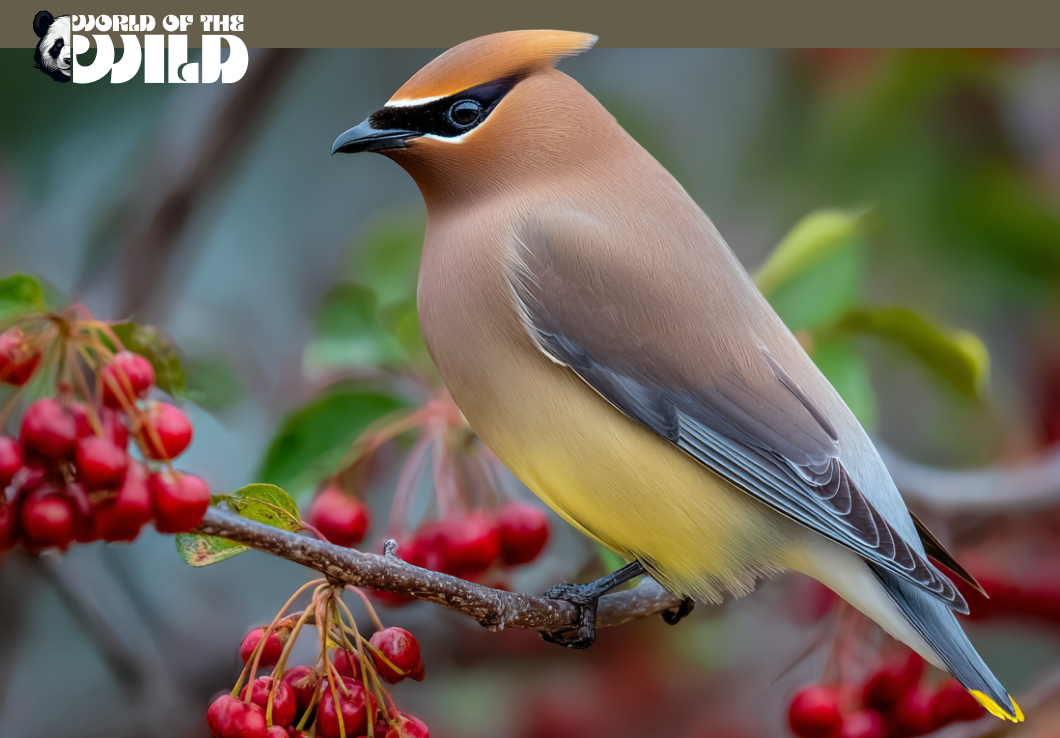

Picture a bird so sleek and pristine it appears to have been dipped in silk, with a jaunty crest atop its head and a tail dipped in brilliant yellow as if it had been painted by an artist’s careful hand. The cedar waxwing is one of North America’s most elegant songbirds, yet it remains something of a mystery to many casual birdwatchers. These nomadic fruit-eaters appear seemingly out of nowhere in backyards and parks, descending in chattering flocks to strip berry bushes bare before vanishing just as suddenly. What makes the cedar waxwing truly fascinating is not just its stunning appearance, but its remarkable social behavior, its unusual diet-driven lifestyle, and the curious red waxy appendages that give this bird its distinctive name—a feature found in only a handful of bird species worldwide.
Facts
- The red “wax” tips on their wing feathers are actually colored secretions from the feather shafts, and their exact purpose remains debated among scientists, though they may play a role in mate selection.
- Cedar waxwings can become intoxicated from eating overripe or fermented berries, sometimes leading to erratic flying, collisions with windows, and even death in severe cases.
- They’re one of the latest-nesting birds in North America, often not breeding until June or July when berry crops are most abundant to feed their young.
- Waxwings practice “polite passing” in which they pass berries down a line of birds sitting on a branch, with each bird offering it to the next until one finally eats it—a rare display of apparent generosity in the bird world.
- The yellow tail band can sometimes appear orange in birds that have consumed large amounts of berries from exotic honeysuckle plants, which contain a red pigment that gets incorporated into growing feathers.
- They have no true song, instead communicating through high-pitched trills and whistles that sound almost insect-like.
- Cedar waxwings can survive on fruit alone for several months, an unusual ability among songbirds that typically require protein-rich insects.
Species
Kingdom: Animalia
Phylum: Chordata
Class: Aves
Order: Passeriformes
Family: Bombycillidae
Genus: Bombycilla
Species: Bombycilla cedrorum
The cedar waxwing belongs to the Bombycillidae family, which contains only three species of waxwings worldwide. The cedar waxwing’s closest relatives are the Bohemian waxwing (Bombycilla garrulus), which is larger and breeds in northern boreal forests across North America, Europe, and Asia, and the Japanese waxwing (Bombycilla japonica), found only in northeast Asia. The Bohemian waxwing is the cedar waxwing’s most similar relative in North America, though it can be distinguished by its larger size, gray belly, and chestnut undertail coverts. Unlike many bird families, there are no recognized subspecies of the cedar waxwing—the species shows remarkable uniformity across its entire range, likely due to its highly nomadic nature that prevents geographic isolation and genetic divergence.
Appearance
The cedar waxwing is a medium-sized songbird measuring 6 to 7 inches in length with a wingspan of 8.7 to 11.8 inches. Adults typically weigh between 1.1 and 1.3 ounces, making them slightly smaller and more delicate than an American robin. The bird’s most striking feature is its silky, smooth plumage that appears almost painted on, giving it an unusually sleek profile. The overall coloration is a subtle blend of soft brown on the head and breast, transitioning to gray on the back and wings, and pale yellow on the belly.
The head features a prominent pointed crest that can be raised or lowered depending on the bird’s mood, and a distinctive black mask edged in white runs through the eyes, giving the waxwing a bandit-like appearance. The chin and throat are a rich brown color. Perhaps the most famous feature is the bright yellow band at the tip of the tail, which looks as though the bird dipped its tail in yellow paint. This yellow pigment comes from carotenoids in their fruit-heavy diet.
The red waxy appendages that give the species its name appear on the tips of the secondary wing feathers in adult birds. These look like drops of red sealing wax and are actually flattened extensions of the feather shaft. Not all cedar waxwings have these tips—they’re more common in older birds and can number anywhere from zero to nine per wing. Juveniles have streaky brown plumage and lack the sleek appearance and distinctive markings of adults, gradually acquiring adult plumage through their first year.

Behavior
Cedar waxwings are among the most social songbirds in North America, rarely seen alone and typically traveling in flocks ranging from a handful to several hundred individuals. These flocks are highly mobile and nomadic, wandering widely in search of fruiting trees and shrubs rather than maintaining defined territories. Their movements are unpredictable, making them appear in an area one year and be completely absent the next.
Communication among cedar waxwings is constant but subtle. They lack a true melodious song, instead producing high-pitched, thin whistles described as “seee” or “sree” that sound almost mechanical or insect-like. These calls help maintain flock cohesion as the birds move through trees and across landscapes. When feeding, waxwings often perch close together in remarkable displays of tolerance, with multiple birds crowding onto the same branch.
One of their most remarkable behaviors is the “fruit passing” ritual, where birds will pass a berry or insect back and forth down a line of perched individuals, sometimes making several passes before one bird finally consumes it. Scientists believe this behavior may strengthen social bonds or serve as a courtship display.
Cedar waxwings are acrobatic feeders, able to hover briefly while plucking berries from branches, catch flying insects mid-air like flycatchers, or hang upside-down to reach fruit. During the breeding season, they become more insectivorous to meet protein requirements, performing aerial sallies to catch mayflies, dragonflies, and other flying insects over water.
Their nomadic lifestyle and fruit-focused diet make them unpredictable visitors. They can descend on ornamental plantings in suburban areas in massive numbers, sometimes stripping a berry-laden tree or shrub completely bare in a matter of hours before moving on. Unlike many songbirds, they show little fear of humans and will often feed quite close to people who stand still.
Evolution
The evolutionary history of the Bombycillidae family remains somewhat mysterious due to a relatively sparse fossil record. The family is considered ancient, with molecular evidence suggesting waxwings diverged from other songbird lineages approximately 35-40 million years ago during the late Eocene or early Oligocene epochs. This makes them one of the older lineages of passerine birds still in existence.
Fossil evidence of waxwing relatives has been found in Europe from the Miocene epoch (about 23 to 5 million years ago), suggesting the family may have originated in the Old World before spreading to North America. The split between Old World and New World waxwings likely occurred during the Pliocene, around 3-5 million years ago, when climate changes and shifting geography created opportunities for species divergence.
The cedar waxwing’s specialization on fruit is believed to be a relatively recent evolutionary adaptation. Their unique ability to survive on fruit alone for extended periods required significant digestive adaptations, including a shorter gut passage time and specialized enzymes to quickly process the sugar-rich, low-protein diet. This dietary specialization evolved alongside the spread of fruit-bearing angiosperms (flowering plants) across North America during the Tertiary period.
The distinctive waxy wing tips appear to be an ancient trait shared among all three waxwing species, suggesting this feature evolved in a common ancestor. However, its exact function remains a subject of scientific debate—hypotheses include use in mate attraction, species recognition, or even as a visual signal of age and status within flocks.
Habitat
Cedar waxwings are found throughout North America, with a breeding range that extends from southeastern Alaska across southern Canada to Newfoundland, and south through the United States to northern California, northern Georgia, and South Carolina. Their winter range shifts southward, encompassing most of the United States, Mexico, Central America, and occasionally reaching northern South America.
Unlike many bird species that have specific habitat requirements, cedar waxwings are habitat generalists that can thrive anywhere fruiting trees and shrubs are abundant. They favor open woodlands, forest edges, old fields, hedgerows, riparian corridors, orchards, and suburban and urban areas with ornamental plantings. They’re particularly attracted to areas near water, as they require frequent drinking and bathing.
Their preferred breeding habitat includes open mixed forests, often near streams, rivers, or wetlands where insect populations are robust during nesting season. They avoid dense, unbroken forest interiors, preferring edge habitats where berry-producing shrubs are more common. In winter, they concentrate wherever fruit is abundant, which can include desert oases, tropical forests, coastal scrublands, and city parks.
Elevation is not a limiting factor—cedar waxwings can be found from sea level to mountain meadows up to 6,000 feet or higher, as long as fruiting plants are available. Their nomadic nature means they’re constantly evaluating food availability across broad landscapes, moving to wherever resources are currently most abundant. This can result in huge flocks appearing in one location while nearby seemingly suitable habitat remains completely unoccupied.
Diet
Cedar waxwings are primarily frugivores (fruit-eaters), with berries making up the majority of their diet for much of the year. This puts them in an exclusive group among North American songbirds, as most require substantial insect protein. Cedar waxwings can survive for months eating almost nothing but fruit, though they do consume insects, especially during breeding season when protein demands increase.
Their fruit preferences are broad and opportunistic. Favored natural foods include cedar berries (juniper), dogwood, serviceberry, hawthorn, mountain ash, madrone, mulberry, pokeweed, and wild cherries. They readily consume cultivated and ornamental fruits including crabapples, cotoneaster, pyracantha, and honeysuckle. Interestingly, they prefer smaller fruits that can be swallowed whole, as they don’t tear apart larger fruits like some other birds.
The feeding strategy is simple: perch, pluck, and swallow whole. Cedar waxwings have a wide gape that allows them to consume berries up to half an inch in diameter. They swallow fruits whole and digest them quickly—food can pass through their digestive system in as little as 30 minutes, allowing them to process large quantities. The seeds pass through undigested, making waxwings important seed dispersers for many plant species.
During spring and summer, particularly when nesting, their diet shifts to include more protein. They catch flying insects including mayflies, dragonflies, beetles, and other aerial insects using flycatcher-like sallies from perches. They’ll also glean caterpillars and other insects from foliage. Nestlings are fed almost exclusively insects for the first few days before gradually being introduced to fruit.
One quirk of their fruit-heavy diet is susceptibility to intoxication from fermented berries. Late in winter or early spring, when berries have been exposed to freeze-thaw cycles, the sugars ferment. Cedar waxwings eating these fermented fruits can become drunk, leading to impaired flying ability and increased collisions with windows and vehicles.

Predators and Threats
Natural predators of cedar waxwings include typical bird-hunting specialists. Sharp-shinned hawks and Cooper’s hawks are among their most significant avian predators, capable of pursuing the agile waxwings through trees. Merlins and American kestrels also take waxwings, particularly during migration. Nest predators include blue jays, American crows, black-billed magpies, tree squirrels, and snakes, which consume eggs and nestlings.
Domestic cats pose a significant threat, particularly in suburban and urban areas where waxwings frequently feed on ornamental plantings. The birds’ tendency to feed close to the ground on fallen fruit and their relative tameness around humans makes them vulnerable to cat predation.
The greatest human-caused threat to cedar waxwings is window collisions. Their habit of traveling in dense flocks and their attraction to fruiting ornamental plants near buildings results in frequent fatal strikes on reflective glass. Intoxication from fermented berries exacerbates this problem, as impaired birds are more likely to collide with structures.
Pesticide exposure represents another significant concern. Cedar waxwings feeding on fruit in orchards and agricultural areas may consume pesticide residues, and their consumption of large quantities of fruit can lead to bioaccumulation of toxic compounds. Additionally, their insectivorous period during breeding season exposes them to insecticides used to control flying insects.
Climate change may affect cedar waxwings by altering the timing and abundance of fruit crops, potentially causing mismatches between breeding timing and food availability. Changes in winter temperatures affect berry fermentation rates and availability, while shifts in precipitation patterns influence fruiting tree and shrub success.
Habitat loss has less impact on cedar waxwings than on many species due to their adaptability and willingness to use human-modified landscapes, but the loss of native fruiting shrubs and trees in favor of non-fruiting ornamentals can reduce food availability. Interestingly, the spread of exotic berry-producing plants has actually benefited waxwings in some areas, though this may have negative ecological consequences overall.
Reproduction and Life Cycle
Cedar waxwings are among the latest nesters of North American songbirds, typically not beginning to breed until June or July, well after most other species have finished. This late timing is directly linked to their diet—they wait until fruit crops are abundant enough to feed hungry nestlings. This strategy can fail in years when late spring frosts damage fruit crops, potentially causing nesting failure or forcing pairs to skip breeding entirely.
Courtship is a charming affair involving the famous fruit-passing ritual. A male approaches a female and hops toward her along a branch, offering her a berry, flower petal, or insect. She hops away, then hops back and accepts the gift, then passes it back to him. This exchange continues back and forth, sometimes for several minutes, strengthening the pair bond. Males may also perform a “dancing” display, hopping with raised crest and singing softly.
Nest building is a shared duty, though females do most of the construction. Nests are typically placed 6 to 50 feet above ground in the fork of a tree branch, often in deciduous or coniferous trees near the trunk. The nest is a sturdy cup constructed from twigs, grass, moss, and plant fibers, lined with fine grass and soft materials. Construction takes 5 to 6 days.
Females lay 3 to 5 eggs that are pale gray to bluish-gray with brown and black spots. Incubation lasts 12 to 13 days and is performed almost entirely by the female, though the male brings her food during this period. Hatchlings are altricial—blind, naked, and completely helpless.
Both parents feed the nestlings, initially providing almost exclusively insects before gradually introducing fruit. Young fledge at 14 to 18 days old but remain dependent on their parents for another week or two. Pairs typically raise only one brood per year, though second broods are possible if the first fails early.
Cedar waxwings can live up to 8 years in the wild, with the oldest recorded banded bird reaching 8 years and 2 months. However, most individuals likely live only 3 to 5 years. Sexual maturity is reached at one year of age.

Population
The cedar waxwing is currently listed as Least Concern by the International Union for Conservation of Nature (IUCN), indicating the species is not considered threatened. Population estimates suggest there are approximately 64 million individual cedar waxwings across North America, representing a healthy, stable population.
Long-term population trends show cedar waxwings have remained relatively stable over the past 50 years, with some regional variations. Data from the North American Breeding Bird Survey indicates slight increases in some areas and minor decreases in others, but overall the continental population appears secure. Unlike many songbird species that have experienced dramatic declines due to habitat loss, cedar waxwings have adapted well to human-modified landscapes.
Several factors contribute to their population stability. Their dietary flexibility and willingness to exploit both native and non-native fruit sources provide resilience against food scarcity. Their ability to thrive in suburban and urban areas with ornamental plantings has actually expanded available habitat in some regions. Additionally, their late nesting strategy, while risky in some ways, may reduce nest predation by avoiding the peak activity period of many nest predators.
However, localized threats persist. Window collisions kill thousands of cedar waxwings annually, though this doesn’t appear to affect overall population numbers significantly. Pesticide use in agricultural areas may impact regional populations. Climate change remains a long-term concern, as shifts in fruiting phenology could disrupt the carefully timed breeding strategy that depends on abundant fruit availability in mid-summer.
Conclusion
The cedar waxwing stands as a testament to the beauty and adaptability of North American wildlife. With its silken plumage, mysterious waxy wing tips, and remarkable social behaviors, this elegant bird offers endless fascination for both casual observers and dedicated birders. Its unique dietary specialization on fruit, late breeding strategy, and nomadic lifestyle set it apart from most other songbirds, while its willingness to visit suburban gardens brings wild beauty directly to our doorsteps.
While cedar waxwings currently enjoy stable populations, their future remains tied to the health of ecosystems that produce the fruits they depend upon. As we face accelerating environmental changes, protecting native fruiting plants, reducing pesticide use, and making our buildings safer for birds through window treatments become increasingly important. The next time a flock of these sleek, chattering birds descends on your neighborhood, take a moment to appreciate not just their beauty, but the complex ecological relationships they represent and the ancient evolutionary journey that created such a remarkable species. In protecting cedar waxwings and their habitat, we preserve not just a single species, but the intricate web of life that sustains us all.
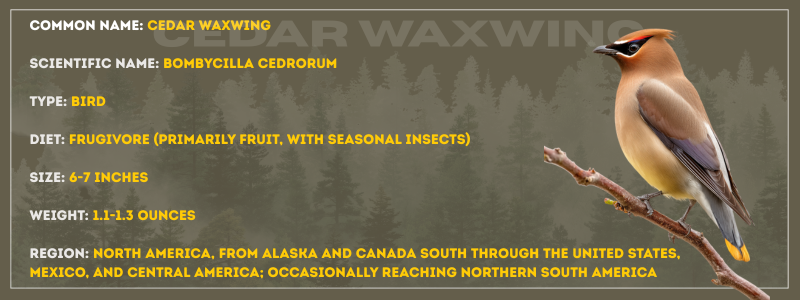
Scientific Name: Bombycilla cedrorum
Diet Type: Frugivore (primarily fruit, with seasonal insects)
Size: 6-7 inches (15-18 cm) in length
Weight: 1.1-1.3 ounces (30-40 grams)
Region Found: North America, from Alaska and Canada south through the United States, Mexico, and Central America; occasionally reaching northern South America