
In the dense forests of Central Africa, a mother tenderly cradles her infant while nearby, two adolescents engage in a spirited game of chase through the canopy. This scene could almost be mistaken for a human family, and that resemblance is no coincidence. Chimpanzees share approximately 98.8% of their DNA with humans, making them our closest living relatives in the animal kingdom. These remarkable great apes have captivated scientists and naturalists for generations, not only because of their genetic similarity to us, but because they exhibit behaviors once thought to be uniquely human: they use tools, engage in warfare, form complex political alliances, grieve their dead, and even display what appears to be a sense of humor. Understanding chimpanzees offers us a mirror into our own evolutionary past and reminds us of our profound connection to the natural world.
Facts
- Tool Innovation: Chimpanzees in different regions have developed distinct tool-using cultures, with some populations using up to 25 different types of tools, including “fishing” for termites with sticks, cracking nuts with stone hammers, and even fashioning spears to hunt smaller primates.
- Medicinal Knowledge: Wild chimpanzees have been observed self-medicating by consuming specific plants that have no nutritional value but contain compounds that treat parasitic infections and other ailments.
- Vocal Complexity: Chimpanzees can produce over 30 different vocalizations, and research suggests they may combine these sounds in specific sequences that could represent a rudimentary form of syntax.
- Facial Recognition: Chimpanzees can recognize individual faces in photographs and even identify other chimpanzees they haven’t seen in decades, demonstrating remarkable long-term memory.
- Strength Disparity: A chimpanzee is estimated to be 1.5 to 2 times stronger than an adult human of similar size, particularly in their upper body, due to different muscle fiber composition and skeletal structure.
- Cultural Transmission: Young chimpanzees learn behaviors through observation and practice over many years, and different communities maintain unique traditions passed down through generations, meeting the scientific definition of culture.
- Cooperative Hunting: Some chimpanzee populations engage in coordinated group hunts for red colobus monkeys, with individuals taking on specific roles such as drivers, blockers, and ambushers.
Species
Chimpanzees belong to the following taxonomic classification:
Kingdom: Animalia
Phylum: Chordata
Class: Mammalia
Order: Primates
Family: Hominidae (great apes)
Genus: Pan
Species: Pan troglodytes (Common Chimpanzee)
The genus Pan contains two species: the common chimpanzee (Pan troglodytes) and the bonobo (Pan paniscus). While bonobos are sometimes called pygmy chimpanzees, they are a distinct species with notable differences in behavior and social structure.
The common chimpanzee is further divided into four recognized subspecies, each inhabiting different regions of Africa:
- Western Chimpanzee (Pan troglodytes verus): Found in West Africa from Senegal to Ghana
- Nigeria-Cameroon Chimpanzee (Pan troglodytes ellioti): Inhabits the region between the Niger and Sanaga rivers
- Central Chimpanzee (Pan troglodytes troglodytes): The most numerous subspecies, ranging across Central Africa
- Eastern Chimpanzee (Pan troglodytes schweinfurthii): Distributed from the Central African Republic to western Tanzania and Uganda
Each subspecies exhibits subtle genetic and behavioral variations shaped by their specific environments and isolation from one another.
Appearance
Chimpanzees possess a robust and powerfully built physique that reflects their dual lifestyle of terrestrial and arboreal living. Adult males typically stand between 4 and 5.5 feet tall when upright and weigh between 88 and 130 pounds, though some individuals can exceed 150 pounds. Females are noticeably smaller, standing 3 to 4 feet tall and weighing between 60 and 110 pounds.
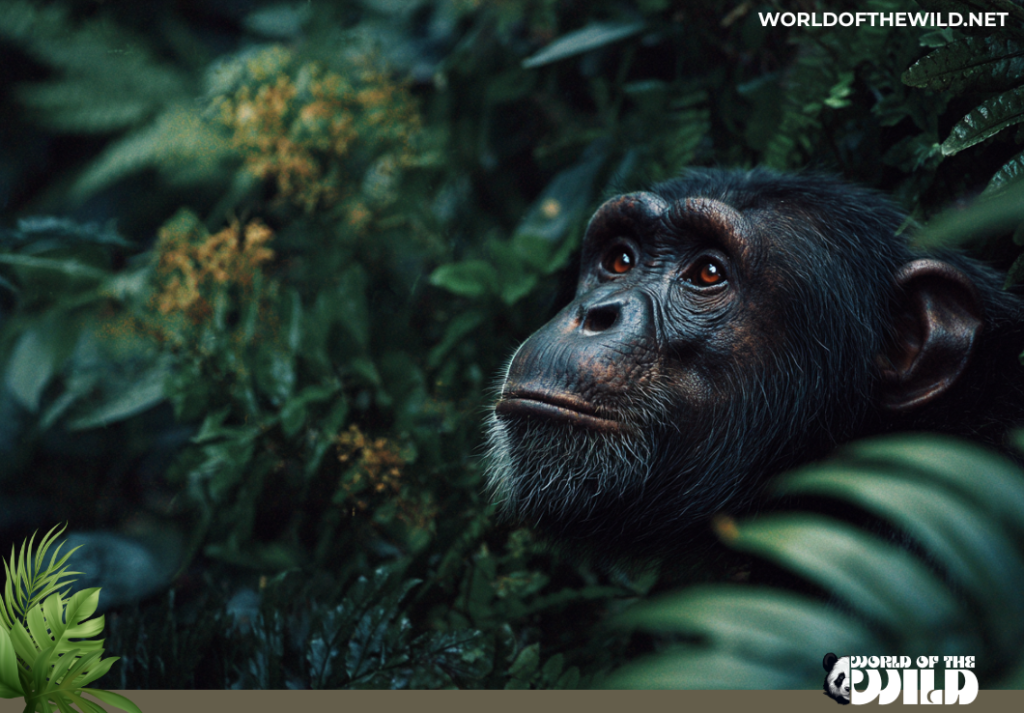
Their bodies are covered in coarse black or dark brown hair, though the density and length can vary among individuals and subspecies. Notably, their faces, ears, palms, and soles are bare and typically range from pink to brown or black, darkening with age. Infant chimpanzees often have lighter, pinkish faces that darken as they mature. A distinctive white beard sometimes develops around the face in older individuals.
Chimpanzees possess remarkably expressive faces with prominent brow ridges, forward-facing eyes that enable excellent depth perception, and relatively small noses with flat nostrils. Their ears are large and rounded, often protruding noticeably from the sides of their heads. One of their most distinctive features is their opposable thumbs on both hands and feet, though the foot thumbs are less developed than those on their hands.
Their arms are notably longer than their legs, an adaptation that facilitates brachiation (swinging through trees) and knuckle-walking on the ground. When moving terrestrially, chimpanzees walk on all fours, supporting their upper body weight on the knuckles of their hands rather than their palms. They possess incredible grip strength, with hands and feet perfectly adapted for grasping branches and manipulating objects with remarkable dexterity.
Behavior
Chimpanzees exhibit some of the most complex social behaviors in the animal kingdom, living in fluid, hierarchical communities called fission-fusion societies. These communities typically consist of 20 to 150 individuals, though members frequently split into smaller subgroups for foraging before reuniting. Unlike many primate species, chimpanzee communities are patriarchal, with males remaining in their birth community for life while females often migrate to neighboring groups upon reaching maturity.
Male chimpanzees establish dominance hierarchies through a combination of physical prowess, strategic alliances, and psychological intimidation. The alpha male leads the community, but his position is rarely secure without the support of coalition partners. Males engage in dramatic charging displays, where they hoot loudly, throw rocks, drag branches, and stamp their feet to assert dominance. Political maneuvering is constant, with males forming and breaking alliances as they jockey for status.
Communication among chimpanzees is remarkably sophisticated, incorporating vocalizations, facial expressions, gestures, and body postures. They greet one another with embraces and kisses, reconcile after conflicts through grooming and gentle touches, and comfort distressed individuals. Grooming serves not only hygienic purposes but also critical social functions, reinforcing bonds and alliances within the group. Chimpanzees spend several hours each day engaged in social grooming.
Perhaps most remarkably, chimpanzees display what can only be described as a theory of mind—the ability to understand that others have thoughts, intentions, and perspectives different from their own. They engage in tactical deception, deliberately misleading others to gain advantages, and show empathy toward injured or distressed companions.
Chimpanzees construct fresh sleeping nests each evening, typically in trees 15 to 40 feet above the ground. These nests are sophisticated structures, woven from branches and lined with softer vegetation for comfort. Mothers share nests with their infants, while older juveniles and adults sleep alone.
Their intelligence manifests in numerous ways beyond tool use. Chimpanzees can learn sign language, recognize themselves in mirrors (a test that most animals fail), solve complex puzzles, and plan for future events. They remember the locations of hundreds of fruit trees across their territory and time their visits to coincide with ripening seasons.
Evolution
The evolutionary story of chimpanzees is intimately intertwined with our own. The last common ancestor of humans and chimpanzees lived approximately 6 to 8 million years ago in Africa. Following this divergence, the lineage leading to modern chimpanzees and bonobos remained in the African forests, while the hominin lineage embarked on the evolutionary journey that would eventually lead to Homo sapiens.
The fossil record for chimpanzee evolution is frustratingly sparse, as the acidic soils of tropical forests rapidly decompose bones, leaving few traces. However, genetic evidence provides substantial insights into their evolutionary history. The split between common chimpanzees and bonobos occurred relatively recently, approximately 1 to 2 million years ago, likely when the Congo River formed a geographic barrier separating the populations.
Early ancestors of modern chimpanzees were likely more arboreal than their present-day descendants. Over millions of years, they evolved adaptations for a lifestyle that balanced time in the trees with terrestrial foraging. Their knuckle-walking gait represents a unique evolutionary solution to ground travel while maintaining the long arms beneficial for climbing.
Genetic studies reveal that chimpanzee populations have experienced several bottlenecks—periods when population sizes dramatically decreased—which reduced their genetic diversity. Despite this, different chimpanzee subspecies show more genetic variation among themselves than is found in the entire human species, reflecting their longer evolutionary history and geographic isolation.
The evolution of chimpanzee intelligence likely resulted from complex selective pressures, including the need to navigate intricate social relationships, locate dispersed food sources, and adapt to changing environments. Their capacity for culture—the transmission of learned behaviors across generations—may have co-evolved with their social intelligence, creating a feedback loop that drove increasing cognitive sophistication.
Habitat
Chimpanzees inhabit a discontinuous range across equatorial Africa, from Senegal in the west to Tanzania in the east. Their distribution once covered a much broader area, but habitat loss has fragmented their populations into isolated pockets.
These adaptable apes occupy diverse habitats, though they show a strong preference for tropical rainforests. Within these forests, they favor areas with a multilayered canopy structure that provides both food and travel routes through the trees. However, chimpanzees also inhabit drier woodland savannas, montane forests at elevations up to 9,000 feet, and even degraded secondary forests that have regrown after human disturbance.
The ideal chimpanzee habitat combines several key features: a reliable year-round water source, an abundance of fruit-bearing trees (particularly fig trees, which often fruit when other sources are scarce), sufficient tree cover for sleeping nest construction, and enough territory to support the community’s ranging needs. A typical chimpanzee community requires a home range of 5 to 30 square miles, depending on habitat quality and community size.
Different populations have adapted to their specific environments in remarkable ways. Western chimpanzees in the drier savannas of Senegal have developed strategies for surviving the harsh dry season, including digging for water and exploiting food sources that forest-dwelling chimpanzees ignore. Eastern chimpanzees in mountainous regions tolerate cooler temperatures and have been observed in areas where nighttime temperatures approach freezing.
Within their habitat, chimpanzees create a network of travel routes, connecting feeding sites, water sources, and favored resting areas. They possess detailed mental maps of their territories and remember the locations of resources with impressive accuracy across years.

Diet
Chimpanzees are omnivores with a diet that varies considerably by season, habitat, and local culture. Fruit constitutes the cornerstone of their nutrition, typically comprising 50 to 75% of their diet. They show particular fondness for figs, which are rich in sugar and available throughout much of the year. Chimpanzees have excellent color vision and can judge fruit ripeness from considerable distances.
Beyond fruit, their diet includes leaves, flowers, seeds, bark, pith, honey, and insects. During periods when fruit is scarce, they rely more heavily on fibrous vegetation and other fallback foods. They consume over 200 different plant species across their range, demonstrating remarkable botanical knowledge.
The protein component of their diet comes primarily from insects, particularly termites and ants, which they extract using sophisticated tool techniques. Some populations fish for termites by inserting specially prepared sticks into termite mounds, while others use different tools to access ant nests. These insects provide essential nutrients, including fats and proteins.
Chimpanzees also hunt vertebrate prey, particularly red colobus monkeys, young bushbucks, and wild piglets. Hunting is primarily a male activity, though females occasionally participate. Meat comprises only about 3 to 5% of their diet by weight, but it holds enormous social significance. Successful hunters share meat preferentially with allies, females, and others from whom they seek favor, making meat a valuable social currency.
The hunting process itself reveals their cognitive capabilities. Chimpanzees engage in coordinated group hunts where individuals assume specific roles. Some hunters drive prey toward others positioned to intercept escape routes, demonstrating forward planning and an understanding of their companions’ positions and intentions.
Chimpanzees occasionally exhibit cannibalistic behavior, though this is rare and typically involves the killing and consumption of infants from rival communities or, in disturbing cases, from within their own group during periods of extreme social upheaval.
Predators and Threats
Adult chimpanzees have relatively few natural predators due to their size, strength, intelligence, and group living. Leopards represent their primary natural threat and have been documented hunting both juvenile and occasionally adult chimpanzees, typically through ambush attacks. In some regions, lions and large crocodiles may opportunistically prey on chimpanzees, particularly individuals who venture into open areas or near water.
However, the greatest threat to chimpanzee survival comes not from wild predators but from humans. Habitat destruction represents the most pervasive danger, as tropical forests are cleared for agriculture, logging, and human settlement at alarming rates. The Congo Basin, which harbors the largest remaining chimpanzee populations, faces increasing pressure from palm oil plantations, mining operations, and infrastructure development.
Poaching poses another severe threat. Chimpanzees are hunted for bushmeat in many regions, despite legal protections. The commercial bushmeat trade, facilitated by logging roads that provide access to previously remote forests, has decimated populations in some areas. Additionally, infant chimpanzees are captured for the illegal pet trade, a process that typically involves killing the mother and other protective group members.
Disease represents an emerging and increasingly serious threat. Chimpanzees are susceptible to many human pathogens, and outbreaks of respiratory diseases, Ebola, and other illnesses have killed thousands of individuals in recent decades. As human populations expand into chimpanzee habitats, disease transmission from humans to apes increases.
Climate change compounds these threats by altering the distribution and availability of key food resources, increasing the frequency and severity of droughts, and potentially shifting the geographic ranges of both chimpanzees and their prey species.
Human-chimpanzee conflict also escalates as habitats shrink and the two species compete for space and resources. Chimpanzees occasionally raid crops, leading to retaliatory killings by farmers protecting their livelihoods.
Reproduction and Life Cycle
Chimpanzees do not have a specific breeding season; reproduction can occur year-round. Female chimpanzees reach sexual maturity at around 10 to 13 years of age, though they typically don’t give birth to their first infant until age 13 to 15. Males mature slightly later, around 12 to 15 years, though they may not successfully compete for mating opportunities until later due to the dominance hierarchy.
Females advertise their fertility through a conspicuous anogenital swelling that grows progressively larger during their monthly cycle, reaching maximum size during ovulation. This swelling signals reproductive readiness and attracts multiple males. Chimpanzees are promiscuous, with females mating with numerous males during their fertile period, though high-ranking males often monopolize access to the most desirable females.
The gestation period lasts approximately 8 months (230-240 days), after which a single infant is born. Twins are extremely rare, occurring in less than 2% of births. Newborn chimpanzees are nearly helpless, weighing around 4 pounds, with pale pink skin and sparse white hair that darkens within their first year.
The mother-infant bond is intense and enduring. For the first five to six months, infants cling constantly to their mother’s belly, later riding on her back. They begin sampling solid foods around six months but continue nursing for four to five years. Weaning is a gradual, sometimes contentious process.
Infants develop through distinct stages. During their first two years, they remain in almost constant physical contact with their mother. Between ages two and five, they become increasingly independent, spending more time playing with peers while still returning to their mother for nursing, comfort, and protection. From ages five to eight, they transition to a more independent juvenile phase, though they continue to associate closely with their mother and learn essential survival skills through observation.
The interbirth interval—the time between successive births—typically ranges from five to eight years, one of the longest among primates. This extended period allows mothers to invest heavily in each offspring’s development, teaching them the complex skills necessary for survival.
Female chimpanzees often remain fertile into their 40s, though their fertility declines with age. Males can remain reproductively active throughout their lives. Life expectancy in the wild averages 30 to 40 years, though some individuals live into their 50s or even early 60s. Captive chimpanzees, protected from predators, disease, and food scarcity, can live into their 60s or early 70s.

Population
The International Union for Conservation of Nature (IUCN) classifies the common chimpanzee as Endangered, a designation reflecting severe population declines and ongoing threats. The situation varies by subspecies: the Nigeria-Cameroon chimpanzee is listed as Critically Endangered, the western chimpanzee as Critically Endangered, the central chimpanzee as Endangered, and the eastern chimpanzee as Endangered.
Current population estimates suggest approximately 170,000 to 300,000 chimpanzees remain in the wild, a dramatic decrease from historical numbers. For perspective, there were likely over 1 million chimpanzees at the beginning of the 20th century. The vast majority of remaining individuals are central chimpanzees, with the Nigeria-Cameroon subspecies numbering fewer than 6,500 individuals and western chimpanzees perhaps fewer than 35,000.
Population trends are universally negative across all subspecies and geographic regions. Surveys indicate declines of 50% or more over the past 50 years in many areas, with some populations disappearing entirely. The rate of decline shows no signs of slowing without substantial conservation intervention.
Several factors contribute to this dire situation. Chimpanzees reproduce slowly, with females producing only a handful of offspring during their lifetime. This low reproductive rate means populations cannot quickly recover from declines. Their dependence on forest habitats makes them particularly vulnerable to deforestation, and their need for large home ranges means they require extensive protected areas to maintain viable populations.
Conservation efforts include establishing and enforcing protected areas, combating poaching through improved law enforcement and community engagement, rehabilitating orphaned chimpanzees (though captive individuals can rarely be reintroduced to the wild), and supporting sustainable development initiatives that reduce human-chimpanzee conflict. International agreements like CITES (Convention on International Trade in Endangered Species) prohibit commercial trade in chimpanzees and their parts, though illegal trafficking persists.
Conclusion
Chimpanzees stand as one of nature’s most remarkable creations—intelligent, complex, culturally rich beings whose existence is intricately linked with the health of Africa’s forests and, by extension, our planet’s ecological future. Their genetic proximity to humans makes them invaluable subjects for understanding our own evolution, behavior, and biology, while their cognitive abilities challenge our assumptions about what separates human from animal.
Yet these magnificent apes face an uncertain future. Every year, their numbers dwindle, their forests shrink, and another fragment of their ancient lineage faces extinction. The loss of chimpanzees would represent not only an ecological tragedy but also the severing of our closest living connection to our evolutionary heritage.
The fate of chimpanzees ultimately rests in human hands. We have the knowledge, resources, and technology to preserve them; what remains uncertain is whether we possess the collective will to do so. By supporting conservation organizations, making sustainable consumer choices, and advocating for the protection of tropical forests, each of us can contribute to ensuring that future generations inherit a world still graced by our remarkable cousins. The chimpanzee’s survival is not merely their concern—it is a test of our humanity, our wisdom, and our commitment to the irreplaceable diversity of life on Earth.
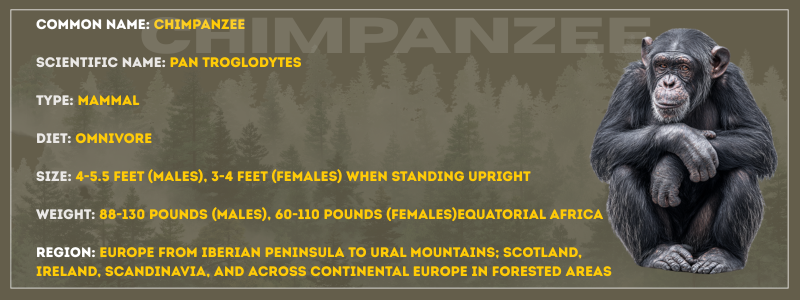
Scientific Name: Pan troglodytes
Diet Type: Omnivore
Size: 4-5.5 feet (males), 3-4 feet (females) when standing upright
Weight: 88-130 pounds (males), 60-110 pounds (females)
Region Found: Equatorial Africa (Senegal to Tanzania)