
On a crisp autumn evening, the sky above a quiet countryside transforms into a living canvas. Tens of thousands of small, dark birds twist and turn in perfect synchrony, creating fluid shapes that ripple across the horizon like smoke. This mesmerizing phenomenon, known as a murmuration, is one of nature’s most spectacular displays—and it’s orchestrated by one of the world’s most successful yet controversial birds: the European Starling.
The European Starling is far more than just another small black bird. This species represents a fascinating paradox in the natural world: simultaneously revered for its intelligence, vocal talents, and stunning murmurations, yet reviled as one of the most destructive invasive species on multiple continents. Whether you view them as pests or marvels, there’s no denying that starlings are among the most remarkable examples of avian adaptability, survival, and unintended consequences of human intervention in nature.
Facts
- Mozart’s Feathered Friend: Composer Wolfgang Amadeus Mozart kept a pet European Starling that could whistle part of his Piano Concerto No. 17. When the bird died, Mozart held a formal funeral and wrote a commemorative poem.
- Murmuration Mathematics: The stunning aerial displays of starlings follow a mathematical principle called “scale-free correlation,” where each bird responds to its seven nearest neighbors, creating perfectly coordinated movements without a leader.
- Shakespeare’s Legacy: All European Starlings in North America descended from approximately 100 birds released in New York’s Central Park in the 1890s by Eugene Schieffelin, who wanted to introduce every bird mentioned in Shakespeare’s works to America.
- Vocal Virtuosos: Starlings can mimic over 20 different species of birds and even replicate mechanical sounds like car alarms, ringtones, and human speech. Their syrinx (voice box) allows them to produce two different sounds simultaneously.
- Feather Transformation: European Starlings undergo a dramatic seasonal appearance change. In winter, they’re covered in white spots that gradually wear away to reveal the glossy, iridescent breeding plumage beneath—without molting.
- Population Powerhouse: The global population of European Starlings is estimated at over 310 million individuals, making them one of the most abundant bird species on Earth.
- Anti-Parasite Architects: Starlings incorporate fresh green plants with antimicrobial properties into their nests, effectively fumigating them to reduce parasite loads—a sophisticated form of self-medication.
Species
The European Starling belongs to the following taxonomic classification:
- Kingdom: Animalia
- Phylum: Chordata
- Class: Aves
- Order: Passeriformes
- Family: Sturnidae
- Genus: Sturnus
- Species: Sturnus vulgaris
The European Starling has several recognized subspecies that vary primarily in size and the intensity of their iridescent plumage:
Sturnus vulgaris vulgaris is the nominate subspecies found across most of continental Europe. Sturnus vulgaris zetlandicus inhabits the Shetland and Orkney Islands and tends to be darker with less pronounced spotting. Sturnus vulgaris faroensis from the Faroe Islands is even darker and slightly larger. Sturnus vulgaris granti from the Azores is the darkest subspecies with very little iridescence. Sturnus vulgaris tauricus ranges from southeastern Europe to western Asia and features more extensive white spotting in winter plumage.
The Sturnidae family includes approximately 120 species of starlings and mynas found across the Old World. Close relatives of the European Starling include the Common Myna, Spotless Starling (which lacks the characteristic spots), and the Rose-colored Starling. Despite superficial similarities, New World birds commonly called “blackbirds” (like grackles and red-winged blackbirds) belong to an entirely different family and are not closely related to true starlings.
Appearance
The European Starling is a compact, stocky bird measuring 19-23 centimeters in length with a wingspan of 31-44 centimeters. Adults typically weigh between 60-96 grams, roughly the weight of a deck of cards. Despite their relatively small size, starlings possess a robust build with a short, squared tail and pointed, triangular wings designed for agile flight.
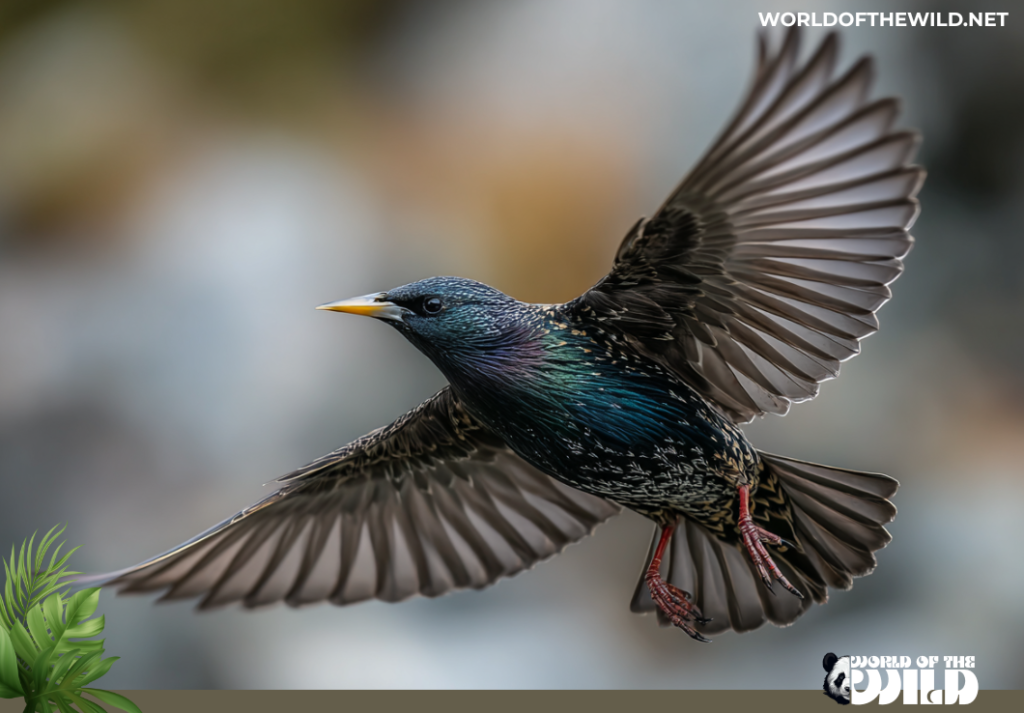
The most striking feature of the European Starling is its iridescent plumage, which shimmers with metallic greens, purples, bronzes, and blues when caught in sunlight. This iridescence results not from pigmentation but from the microscopic structure of the feathers, which refract light like tiny prisms. In breeding plumage during spring and summer, adult starlings appear almost entirely glossy black with a lustrous sheen, though close inspection reveals the subtle rainbow of colors shifting across their bodies.
During autumn and winter, starlings undergo a remarkable transformation. Fresh feathers grow with white or buff-colored tips, creating a heavily spotted or speckled appearance across the entire body. As winter progresses into spring, these pale tips gradually wear away through abrasion, revealing the sleek breeding plumage beneath—a change in appearance achieved without actually molting the feathers themselves.
Sexual dimorphism is subtle but present in European Starlings. Males tend to have longer throat feathers that create a shaggy appearance during courtship displays, and their iridescence is often more pronounced, particularly the purple and green hues on the throat and breast. Females are generally slightly duller with more brown tones in their iridescence. Both sexes sport bright yellow bills during the breeding season, which darken to gray or brown in winter. Their legs and feet are reddish-brown to pink.
Juvenile starlings look entirely different from adults, appearing plain grayish-brown with paler throats and lacking any iridescence or spotting. They molt into their first adult plumage by their first autumn, though they remain distinguishable from full adults by their browner, less iridescent feathers.
The starling’s bill deserves special mention—it’s straight, sharply pointed, and remarkably strong. This multipurpose tool allows starlings to probe soil for invertebrates, crack seeds, and even engage in “gaping,” a behavior where they insert their closed bill into the ground or bark and then force it open to expose hidden food items.
Behavior
European Starlings are quintessentially social birds, rarely found alone outside the breeding season. Their gregarious nature manifests most dramatically in their famous murmurations, where thousands or even hundreds of thousands of individuals gather at dusk to perform synchronized aerial ballets before roosting for the night. These displays serve multiple purposes: confusing predators like peregrine falcons, exchanging information about food sources, and providing warmth and protection through communal roosting.
The mechanics of murmurations reveal remarkable collective intelligence. Each starling monitors and responds to the movements of its seven nearest neighbors, creating a system where information propagates through the flock at speeds approaching 90 miles per hour. This decentralized decision-making allows the entire group to react to threats in a fraction of a second, creating the fluid, shape-shifting formations that captivate observers worldwide.
During the breeding season, European Starlings become more territorial, though they often nest in loose colonies. Males establish territories around suitable nesting cavities and engage in elaborate courtship displays. These performances include spreading their wings to flash iridescent plumage, puffing up their throat feathers, and delivering complex, rambling songs that can last several minutes.
The vocal abilities of starlings rank among the most impressive in the avian world. Their repertoire includes whistles, clicks, rattles, and an extraordinary capacity for mimicry. Individual starlings can learn and reproduce the songs of over 20 different bird species, as well as environmental sounds ranging from human speech to mechanical noises. Males sing most intensively during courtship, often incorporating sounds learned from their natal area, their current territory, and their travels in between. This vocal flexibility serves both to attract mates and establish territorial boundaries.
Starlings are highly intelligent and exhibit problem-solving abilities comparable to many larger birds. They can learn to operate complex mechanisms to access food, recognize individual humans, and adjust their behavior based on experience. They use tools in captivity and demonstrate an understanding of cause and effect. Their adaptability extends to their feeding behavior—starlings employ various techniques including probing, gaping, and even following plows or grazing animals to catch disturbed invertebrates.
Communal roosting reaches its peak in winter when millions of starlings may gather at traditional roosting sites, sometimes using the same locations for decades or even centuries. These roosts can be in reed beds, woodlands, or increasingly, on urban structures like bridges and buildings. The noise and mess created by such massive congregations often bring starlings into conflict with humans, particularly in urban areas.
Starlings are also notably aggressive competitors for nesting sites, often evicting other cavity-nesting birds from their holes. This behavior has contributed to population declines in some native species, particularly in areas where starlings have been introduced as invasive species.
Evolution
The European Starling’s evolutionary history traces back to the early Miocene epoch, approximately 20-25 million years ago, when the Sturnidae family first emerged in the region that is now Southeast Asia or Australia. The family subsequently radiated across the Old World, diversifying into the numerous species of starlings and mynas we see today.
The genus Sturnus, which includes the European Starling and its closest relatives, likely evolved in the Palearctic region during the Pliocene epoch, roughly 2-5 million years ago. Fossil evidence of starlings from this period is relatively sparse, as small passerine bones preserve poorly, but molecular phylogenetic studies have helped reconstruct their evolutionary relationships.
The European Starling’s ancestors evolved in temperate Eurasian environments, developing adaptations for seasonal migrations, omnivorous feeding strategies, and cavity nesting. The species’ remarkable vocal abilities likely evolved through sexual selection, with females preferring males capable of producing more complex and varied songs. The neural structures supporting their mimicry abilities represent a sophisticated evolutionary development, requiring expanded brain regions dedicated to vocal learning and production.
One of the most significant aspects of the European Starling’s evolution is its incredible adaptability—a trait that has allowed it to successfully colonize new continents when introduced by humans. This adaptability isn’t merely behavioral but has genetic underpinnings. Recent genomic studies have revealed that starling populations can undergo rapid evolutionary changes in response to new environments. North American starlings, for instance, have already shown genetic divergence from their European ancestors in the mere 130 years since their introduction, particularly in genes related to metabolism and disease resistance.
The starling’s iridescent plumage evolved through structural coloration rather than pigmentation, a feature shared with many other members of the Sturnidae family. This structural iridescence results from nanoscale arrangements of melanin granules within the feathers, which has evolved independently in several bird lineages as a sexually selected trait.
The evolution of the starling’s social behavior, particularly their spectacular murmurations, represents an adaptation to predation pressure. The mathematical precision of their flocking behavior likely evolved over millions of years, refined by the constant threat from aerial predators. Those individuals better able to coordinate with their neighbors survived to pass on their genes, gradually perfecting the system we observe today.
Habitat
The European Starling’s native range spans a vast territory across Europe and western Asia, extending from Iceland and the British Isles in the west to Lake Baikal in Siberia in the east, and from Scandinavia in the north to the Mediterranean coast in the south. Northern populations are migratory, traveling south and west for winter, while southern populations tend to be more sedentary. However, the starling’s story isn’t confined to its native range—thanks to human introduction, it has now colonized North America, South Africa, Australia, New Zealand, and several Pacific islands.
In its native habitat, the European Starling thrives in a variety of open and semi-open environments. They prefer landscapes that combine short grasslands or agricultural fields for feeding with scattered trees, cliffs, or structures providing nesting cavities. This habitat preference makes them particularly well-suited to human-modified landscapes, including farmland, parks, gardens, and urban areas.
Starlings favor temperate climates but have proven remarkably adaptable to diverse conditions. They inhabit regions from near sea level to elevations over 1,500 meters in mountainous areas. In their native range, they’re commonly found in deciduous and mixed woodlands, agricultural regions with hedgerows, coastal cliffs, and increasingly, urban and suburban environments.
The specific features that make a habitat suitable for starlings include access to short-cropped grassland or bare soil where they can probe for invertebrates, availability of cavity nest sites (either natural holes in trees or artificial structures), water sources for drinking and bathing, and communal roosting sites such as reed beds, dense shrubbery, or woodland. During winter, starlings often concentrate in areas with abundant food resources, creating large roosting aggregations.
In North America, where they were introduced in 1890-1891, starlings have spread across the entire continent from coast to coast and from northern Canada to Central America. They occupy similar habitats as in Europe, showing particular affinity for agricultural areas, suburbs, and cities. Their adaptability to human-dominated landscapes has been key to their success, allowing them to exploit resources from croplands, livestock facilities, and urban waste.
The global spread of European Starlings represents one of the most successful biological invasions in history. In Australia and New Zealand, they’ve colonized extensively since their introduction in the 1850s-1880s. In South Africa, populations established from releases in the 1890s. In each case, starlings have thrived in human-modified habitats, demonstrating their extraordinary flexibility in habitat requirements.
Climate change may affect starling habitats in the future, potentially shifting their range northward in response to warming temperatures. However, their adaptability suggests they’ll likely adjust their ranges and behaviors to accommodate changing conditions, as they’ve done throughout their evolutionary history and during their rapid expansion into non-native territories.

Diet
The European Starling is an opportunistic omnivore with a diet that varies significantly by season, location, and food availability. This dietary flexibility has been crucial to their success across diverse environments and is one reason they’ve thrived as an invasive species in multiple regions.
During spring and summer, starlings consume primarily invertebrates, making them valuable in controlling agricultural pests. Their diet includes beetles, caterpillars, earthworms, spiders, snails, millipedes, centipedes, and various insect larvae. They’re particularly fond of leather jackets (crane fly larvae), wireworms (click beetle larvae), and cutworms (moth larvae)—all significant agricultural pests. A single starling can consume its body weight in invertebrates daily during peak breeding season, when protein demands are highest for feeding growing chicks.
Starlings employ several sophisticated foraging techniques. Their most characteristic method is probing, where they insert their sharp, closed bill into soil, turf, or leaf litter and then use powerful jaw muscles to force the bill open—a behavior called “gaping.” This action exposes hidden invertebrates and allows the starling to visually locate prey underground, a technique few other birds can match. Their yellow breeding-season eye color may help them see into these small excavated holes.
As autumn approaches and invertebrate populations decline, starlings shift toward a more plant-based diet. They consume a wide variety of fruits and berries, including cherries, grapes, olives, figs, elderberries, and various wild fruits. This seasonal fruit consumption has brought them into conflict with fruit growers, particularly in grape-growing regions where large flocks can cause significant economic damage. However, they also help disperse seeds, contributing to plant reproduction across their range.
Winter diet becomes even more varied, incorporating seeds, grains, and food waste. Starlings will feed on wheat, oats, corn, and other grains, both from agricultural fields and from animal feed at livestock facilities. In urban areas, they readily exploit human food waste, scavenging from garbage bins, bird feeders, and outdoor dining areas. They’ve even been observed drinking nectar from flowers and consuming suet from bird feeders designed for other species.
Starlings are social feeders, often foraging in flocks that can number in the thousands. This group foraging provides several advantages: increased vigilance against predators, more efficient location of patchy food resources, and the ability to overwhelm the defenses of swarming insects. When one starling locates a productive feeding area, others quickly join, creating a feeding frenzy.
Their impact on agriculture is complex and controversial. While they consume enormous quantities of pest insects, potentially saving farmers money on pesticides, they also damage fruit crops and grain stores, and their massive flocks can contaminate livestock feed. Studies attempting to calculate whether starlings provide a net benefit or detriment to agriculture have yielded mixed results, with the answer depending heavily on local circumstances and farming practices.
Predators and Threats
Despite their abundance and success, European Starlings face predation from various sources throughout their lives. The starling’s primary natural predators vary by life stage, habitat, and geographic location, but several species pose consistent threats.
Avian predators represent the most significant natural threat to adult starlings. Peregrine falcons are perhaps their most formidable adversary, capable of reaching speeds exceeding 200 miles per hour in a hunting dive. The starling’s murmuration behavior evolved partly as a defense against such aerial predators, creating a confusing, shifting target that makes it difficult for raptors to isolate and strike individual birds. Other birds of prey that regularly hunt starlings include sparrowhawks, merlins, goshawks, and various owl species that catch roosting birds at night.
Mammalian predators threaten starlings primarily at their nests and roosts. Domestic and feral cats are significant predators of both adult and juvenile starlings, particularly in urban and suburban environments. Weasels, stoats, and pine martens can access tree cavities and consume eggs, nestlings, and occasionally incubating adults. Rats may also raid nests for eggs and young birds. At communal roosts, ground predators such as foxes, raccoons (in North America), and genets (in parts of Europe) catch birds that roost too low or fall to the ground.
Nest predation by other birds is also common. Starlings compete fiercely with other cavity-nesting species, but they can fall victim to larger competitors. Great spotted woodpeckers sometimes excavate into starling nests, and corvids such as crows and magpies may take eggs and nestlings when accessible.
Anthropogenic threats present a more complex and significant challenge to starling populations than natural predation. In their native European range, starling populations have experienced alarming declines in recent decades, with numbers dropping by approximately 50% since the 1980s. This decline has resulted in the species being red-listed (of highest conservation concern) in the United Kingdom and several other European countries—a surprising status for a bird considered an invasive pest elsewhere.
Agricultural intensification is the primary driver of European starling declines in their native range. Modern farming practices, including the shift from pastureland to arable crops, increased pesticide use, and the removal of hedgerows and nesting sites, have severely reduced both food availability and breeding habitat. The timing of grass cutting and crop harvesting has also changed, reducing the availability of invertebrate prey during the critical breeding season. The loss of mixed farming operations, particularly those combining livestock with crops, has eliminated many high-quality foraging areas.
Climate change poses an emerging threat, potentially disrupting the phenological synchrony between starling breeding cycles and peak invertebrate abundance. Warmer springs may cause insects to emerge earlier, creating a mismatch when starling chicks need the most food. However, climate effects are complex and may benefit starlings in some regions while harming them in others.
In areas where starlings are invasive species, they face deliberate human persecution. In North America, Australia, and New Zealand, starlings are often targeted for population control due to their impacts on agriculture, native bird species, and human infrastructure. Control methods include shooting, trapping, nest destruction, and the use of avicides (bird poisons). These efforts have had limited success in controlling overall populations, though they may reduce localized problems.
Disease poses another threat, particularly in areas where starlings concentrate in large numbers. Avian influenza, West Nile virus, and various bacterial infections can spread rapidly through dense roosting populations. The stress of overcrowding in some urban roosts may also increase susceptibility to disease and parasite infestations.
Collisions with human structures, particularly glass windows and buildings, kill significant numbers of starlings annually. Their habit of roosting on and near buildings in urban areas increases exposure to this threat. Vehicle collisions also take a toll, especially during the breeding season when birds are actively foraging along roadways.
Despite these various threats, European Starlings remain remarkably resilient. Their adaptability, high reproductive rate, and ability to exploit human-modified environments have allowed populations to persist even under pressure. However, the dramatic decline in their native range serves as a reminder that even highly successful species can be vulnerable to environmental change.

Reproduction and Life Cycle
The European Starling’s reproductive cycle is characterized by high productivity, fierce competition for nesting sites, and intensive parental care that enables them to raise multiple broods in a single season.
Breeding season typically begins in early spring, with exact timing varying by latitude and climate. In temperate regions, courtship starts in March or April, though some southern populations may begin as early as February. The breeding cycle is triggered by increasing day length, which stimulates hormonal changes that lead to the development of breeding plumage and reproductive behavior.
Male starlings initiate the breeding process by claiming cavity nest sites, which they defend vigorously from competitors. These cavities can be natural holes in trees, crevices in cliffs, spaces under roof tiles, nest boxes, or various artificial structures. Males advertise their territories through song, performing from prominent perches near their chosen cavity. Their courtship songs are extended, complex performances incorporating mimicked sounds, original phrases, and mechanical notes, often lasting several minutes.
When a female approaches, the male intensifies his display, entering and exiting the nest hole repeatedly while singing and fluttering his wings to flash the iridescent patterns in his plumage. He may also present nesting material to the female. If the female accepts both the male and the site, pair formation occurs, though starling pair bonds are generally weak and extra-pair copulations are common.
Both sexes participate in nest building, though the female does most of the work. The nest is a loose construction of grass, twigs, leaves, and other plant materials, lined with finer grasses, feathers, and sometimes fresh green plants that have antimicrobial properties. This incorporation of aromatic herbs like wild carrot, yarrow, and fleabane appears to reduce parasite loads in the nest—a form of self-medication that may improve chick survival.
The female lays 4-6 eggs, typically one per day, though clutch size can vary from 3-8 eggs depending on the female’s condition and environmental factors. The eggs are pale blue, blue-green, or occasionally white, measuring approximately 30 x 21 millimeters. Incubation begins after the last egg is laid and lasts 11-13 days. The female does most of the incubation, though males may occasionally sit on the eggs, particularly later in the incubation period.
Nestlings hatch altricial—naked, blind, and completely helpless. Both parents feed the chicks intensively, making dozens of feeding trips daily. The nestling diet consists primarily of invertebrates, providing the protein necessary for rapid growth. Young starlings grow quickly, developing from helpless hatchlings to fully feathered fledglings in just 20-22 days.
Fledging is a dramatic affair, with young birds leaving the nest almost simultaneously, often in the early morning. Newly fledged juveniles can barely fly and are vulnerable to predation during their first days out of the nest. Parents continue to feed fledglings for another 1-2 weeks until the young birds become independent.
After the first brood fledges, many pairs immediately begin a second nesting attempt, sometimes using the same nest site or occasionally moving to a new location. In favorable conditions, pairs may successfully raise three broods in a single season, though two broods are more typical. This high reproductive output allows starling populations to grow rapidly and recover quickly from losses.
Juvenile starlings initially gather in large juvenile flocks, often roosting separately from adults. They undergo a post-juvenile molt in late summer or early autumn, replacing their plain brown plumage with their first adult-type feathers. These first-winter birds can be distinguished from older adults by their browner, less iridescent plumage.
European Starlings can potentially breed in their first year, though many wait until their second year to attempt reproduction. Sexual maturity is reached at approximately 10-11 months of age.
The average lifespan of a European Starling in the wild is relatively short—approximately 2-3 years—though this reflects high mortality rates rather than physiological limitations. The maximum recorded lifespan for wild European Starlings is over 22 years, with one ringed individual in Europe recovered at 22 years and 11 months old. In captivity, where predation, disease, and environmental stressors are minimized, starlings can live 15-20 years, demonstrating their potential longevity.
Mortality is highest during the first year of life, with estimates suggesting that 50-80% of juveniles die before reaching breeding age. For adults, annual survival rates typically range from 40-60%, varying by environmental conditions, predation pressure, and food availability. Harsh winters can significantly reduce survival, particularly for first-year birds that lack experience in finding food under difficult conditions.
Population
The European Starling’s conservation status presents a paradoxical situation that illustrates the complexities of modern conservation. Globally, the species is classified as “Least Concern” by the International Union for Conservation of Nature (IUCN) due to its enormous range and total population size. The global population is estimated at 310 million individual birds, making it one of the most abundant bird species on the planet.
However, this global abundance masks dramatic regional variations and concerning trends. In the species’ native European range, populations have declined precipitously over the past three decades. Since 1980, European starling numbers have fallen by approximately 50% across much of Europe, with some countries experiencing even steeper declines. In the United Kingdom, breeding populations have decreased by more than 60%, resulting in the species being added to the Red List of Birds of Conservation Concern—the highest level of conservation priority for British birds.
These European declines appear to be driven primarily by agricultural intensification, which has reduced both the availability of invertebrate prey during the breeding season and the availability of suitable nesting sites. The loss of permanent pasture, increased pesticide use, and changes in farming practices have all contributed to creating less favorable breeding conditions. Winter survival may also be affected by reduced food availability in agricultural landscapes.
In contrast, populations in areas where the species was introduced as an invasive have exploded. North America hosts an estimated 200 million European Starlings—all descended from approximately 100 birds released in New York in 1890-1891. The North American population expanded at a rate of approximately 3,400 square kilometers per year during the 20th century, representing one of the most successful biological invasions in recorded history. Similarly successful invasions have occurred in Australia (population in the tens of millions), New Zealand (several million), South Africa (millions), and various Pacific islands.
Population trends vary by region. In Europe, most populations continue to decline or remain stable at reduced levels, though a few areas have shown recent stabilization or modest recovery. In North America, the starling population appears to have stabilized after decades of growth, though numbers remain extraordinarily high. Some evidence suggests slight recent declines in North American populations, possibly due to competition with native cavity-nesting species that have recovered from their own historical lows, or changes in agricultural practices that affect food availability.
In Australia and New Zealand, starling populations remain high but have also shown signs of stabilization after initial explosive growth. Control efforts in these countries have had limited impact on overall population numbers, though they may reduce localized problems in specific areas such as vineyards or urban centers.
Seasonal population movements add complexity to population estimates. European populations show varied migratory patterns, with northern and eastern populations being strongly migratory, western populations showing partial migration, and southern populations being largely sedentary. During winter, birds from across northern Europe concentrate in western and southern Europe, creating fluctuations in regional numbers that can make population monitoring challenging.
The species’ demographic characteristics—high fecundity, adaptability to diverse habitats, and ability to exploit human-modified environments—suggest that populations are likely to remain high in areas where they’ve been introduced, while the prognosis for native European populations depends on changes in agricultural policy and land management practices. Several European countries have implemented agri-environment schemes designed to benefit farmland birds, including starlings, though the effectiveness of these programs in reversing population declines remains under evaluation.
Climate change may influence future population trends, potentially benefiting starlings in some regions while harming them in others. Warmer temperatures could expand suitable habitat northward, but phenological mismatches between breeding cycles and prey availability could reduce reproductive success in traditional breeding areas.
Conclusion
The European Starling embodies a fundamental paradox of the modern natural world: a species simultaneously threatened in its native range yet overwhelmingly successful as an invader in foreign ecosystems. This dual status challenges simple narratives about conservation and forces us to confront the complex consequences of human impact on global biodiversity.
In Europe, where starlings evolved and belong, their precipitous decline signals broader problems in agricultural ecosystems—the loss of invertebrate diversity, the degradation of farmland habitat quality, and the disconnection between food production and ecological health. The starling’s red-list status in the United Kingdom should serve as a wake-up call about the collateral damage of industrial agriculture, even to species we once considered common and unremarkable.
Yet in North America, Australia, and elsewhere, these same adaptable qualities that made starlings vulnerable to agricultural change have enabled them to become one of history’s most successful invasive species. Their displacement of native cavity-nesting birds, damage to agriculture, and impacts on urban infrastructure demonstrate how a species well-suited to human-modified environments can fundamentally alter ecosystems when transported beyond its native range.
Perhaps the starling’s greatest legacy is the lesson it teaches about unintended consequences. Eugene Schieffelin’s romantic dream of populating America with Shakespeare’s birds unleashed an ecological transformation that continues to reverberate 130 years later. Every murmuration, every mimicked car alarm, every bluebird evicted from a nest box represents both natural wonder and human hubris—the breathtaking capabilities of an extraordinary bird and our own limited ability to predict the outcomes of our interventions in nature.
As we face accelerating biodiversity loss and ecosystem disruption, the European Starling reminds us that conservation cannot be reduced to simple categorizations of “good” or “bad” species. We must work to protect starlings in Europe while managing their impacts where they’ve been introduced, all while recognizing that the real solution lies not in the birds themselves but in addressing the human activities—agricultural intensification, habitat destruction, and reckless species introductions—that created these problems in the first place.
The next time you witness a murmuration transforming the evening sky into fluid art, or hear a starling perfectly mimic sounds from its urban environment, take a moment to appreciate this remarkable bird’s talents while contemplating the complex web of ecological relationships we continue to reshape, often without fully understanding the consequences.
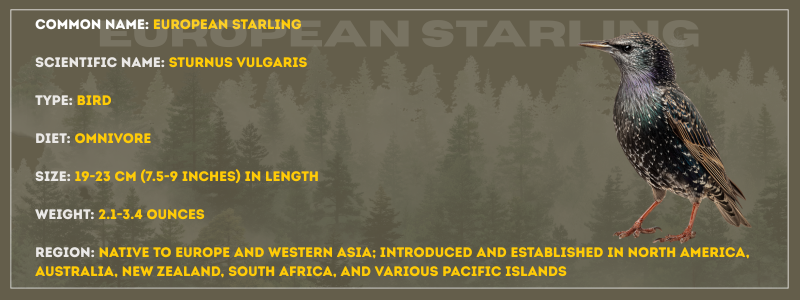
Scientific Name: Sturnus vulgaris
Diet Type: Omnivore (primarily invertebrates in breeding season, supplemented with fruits, seeds, and grains)
Size: 19-23 cm (7.5-9 inches) in length
Weight: 60-96 grams (2.1-3.4 ounces)
Region Found: Native to Europe and western Asia; introduced and established in North America, Australia, New Zealand, South Africa, and various Pacific islands