
Imagine an army millions strong, each soldier armed with a venomous weapon and an unwavering commitment to their queen. Now imagine accidentally stepping on their fortress. Within seconds, you’ll understand why Solenopsis invicta earned the name “fire ant.” The burning sensation from their coordinated attack feels remarkably like touching flame, a defensive strategy so effective it has helped these tiny warriors conquer entire continents.
Fire ants represent one of nature’s most successful—and most feared—social insects. Beyond their painful reputation, these remarkable creatures have revolutionized our understanding of collective intelligence, ecological invasion, and the delicate balance between human development and insect adaptation. They’re biological marvels that build floating rafts during floods, farm fungus, and maintain complex cities beneath our feet, all while being smaller than a grain of rice.
Facts
- Living Rafts: When floods threaten their colonies, fire ants link their bodies together to form waterproof rafts that can float for weeks, keeping the queen and brood safely above water while individual ants take turns being submerged.
- Superorganism Behavior: A fire ant colony functions as a single organism, with different castes performing specialized roles so seamlessly that scientists classify the entire colony, not individual ants, as the functional unit of life.
- Chemical Sophistication: Fire ants use over 40 different pheromones to communicate everything from food locations to alarm signals, creating an invisible language that orchestrates millions of individuals.
- Temperature Warriors: Fire ant venom contains a unique class of alkaloids called solenopsins that cause the characteristic burning sensation and create sterile pustules, distinguishing them from other ant species.
- Decapitating Defense: Some fire ant colonies are targeted by phorid flies that lay eggs in the ants’ heads; the larvae then consume the brain and cause the head to fall off—nature’s most gruesome form of biological control.
- Agricultural Engineers: Fire ants actively alter soil composition and drainage in ways that can benefit some plant species while harming others, essentially farming their environment to suit their needs.
- Speed Colonizers: A single mated queen can establish a colony that grows to contain over 250,000 workers in just one year under optimal conditions.
Species
Kingdom: Animalia
Phylum: Arthropoda
Class: Insecta
Order: Hymenoptera
Family: Formicidae
Genus: Solenopsis
Species: Multiple, with S. invicta being the most notorious
The term “fire ant” encompasses several species within the genus Solenopsis, though the name most commonly refers to the red imported fire ant (Solenopsis invicta). This South American native has become the poster child for invasive species worldwide. The black imported fire ant (Solenopsis richteri) shares similar characteristics and invasive tendencies, and in some regions, these two species have hybridized, creating populations with traits from both parent species.
Other notable fire ant species include the tropical fire ant (Solenopsis geminata), which has a wider natural distribution across the Americas, and the southern fire ant (Solenopsis xyloni), native to the southern United States. Each species exhibits slight variations in color, size, and behavior, but all share the characteristic aggressive defense and painful sting that defines the fire ant experience.
Appearance
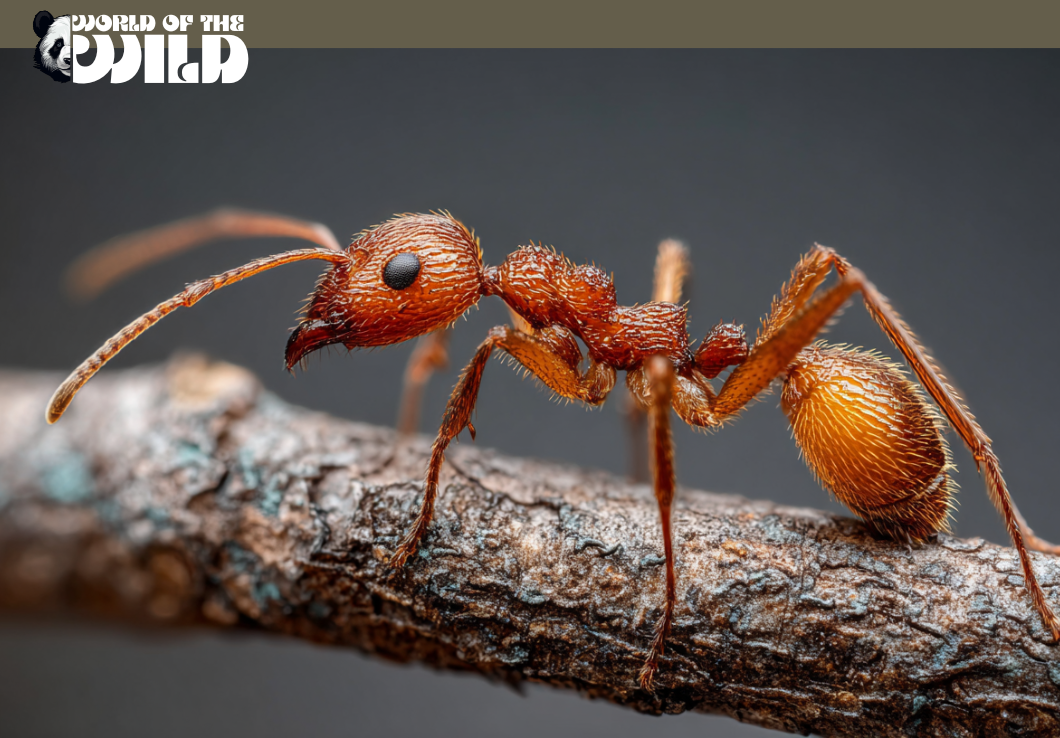
Fire ants are relatively small insects, with workers ranging from 2 to 6 millimeters in length depending on their caste within the colony. Their coloration varies by species, with red imported fire ants displaying a distinctive reddish-brown to copper color, while black imported fire ants are darker, ranging from dark brown to black. The tropical fire ant often shows a two-toned appearance with a darker head and thorax.
The body plan follows the typical ant architecture: a segmented structure divided into the head, thorax, and gaster (the bulbous rear portion often mistakenly called the abdomen). Fire ants possess elbowed antennae with ten segments, ending in a distinctive two-segmented club that houses their sophisticated chemoreceptors. Their mandibles are strong and sharply toothed, capable of gripping skin before the stinger strikes.
Perhaps most importantly, fire ants possess a smooth, curved stinger extending from the tip of their gaster, connected to venom sacs that produce their notorious alkaloid-based venom. Unlike bees, fire ants can sting repeatedly without losing their stinger. Under magnification, their exoskeletons reveal a subtle, waxy sheen that helps them resist water—a crucial adaptation for their flooding survival strategy.
Queens are significantly larger than workers, measuring 8 to 9 millimeters in length, with a more robust thorax adapted for their founding flight and massive egg-laying capacity. Males are similar in size to queens but possess wings and large eyes, as their sole purpose is reproduction during nuptial flights.

Behavior
Fire ants exhibit some of the most complex social behaviors in the insect world. Their colonies operate 24 hours a day, with different worker castes performing specialized tasks based on their age and size. Smaller workers typically tend to the brood and queen inside the nest, medium-sized workers maintain the nest and forage nearby, while the largest workers serve as soldiers and long-range foragers.
Communication within the colony relies heavily on chemical signals. When a fire ant discovers food, it lays a pheromone trail back to the nest, recruiting hundreds of sisters to help transport the bounty. When threatened, workers release alarm pheromones that trigger aggressive swarming behavior, which is why disturbing a fire ant mound results in hundreds of ants simultaneously attacking.
Their hunting strategy is brutally efficient. Fire ants are opportunistic predators that overwhelm prey through sheer numbers. They can kill small vertebrates, raid other insect nests, and scavenge dead animals. Once they locate a target, workers use their mandibles to anchor themselves to skin or exoskeleton, then curl their gasters under their bodies to drive their stingers home repeatedly, creating the characteristic circular pattern of stings around a central bite point.
Fire ants also display remarkable problem-solving abilities. They build elaborate underground nests with multiple chambers for different purposes: nurseries for larvae, fungus gardens, food storage, and waste disposal areas. When environmental conditions change, colonies can reorganize their architecture within hours. During hot weather, workers move brood to deeper, cooler chambers; during floods, they evacuate to higher ground or form their famous living rafts.
Social structure varies by species and region. Some colonies are monogyne (single queen), while others are polygyne (multiple queens), with the latter creating interconnected supercolonies that can spread across vast areas without the territorial aggression typical between different colonies.
Evolution
The genus Solenopsis has ancient roots stretching back millions of years, though pinpointing exact evolutionary origins proves challenging due to the sparse fossil record of small insects. Molecular evidence suggests that fire ants diverged from other ant lineages approximately 20-25 million years ago during the Miocene epoch, when South America was still relatively isolated.
Fire ants evolved in the river basins of South America, particularly in the Paraná River region of Brazil and Argentina. This flood-prone environment shaped many of their most distinctive adaptations, including their remarkable buoyancy strategy and aggressive territorial behavior. The periodic flooding of their native habitat created strong selective pressure for ants that could survive water inundation, leading to the evolution of their hydrophobic exoskeletons and collective rafting behavior.
The evolution of their venom represents a fascinating biochemical arms race. Unlike most ant venoms that contain primarily proteins and peptides, fire ant venom is dominated by piperidine alkaloids, which may have evolved as a defense against the numerous parasites and pathogens in their humid, soil-based environment. These alkaloids have both antimicrobial properties and potent effects on the nervous systems of potential predators.
The social evolution of fire ants follows the path of many successful hymenopteran insects, with increasing caste specialization and colony integration over evolutionary time. The development of polygyne (multiple queen) colonies represents a more recent evolutionary innovation, possibly emerging as populations adapted to disturbed habitats where rapid colony expansion provides competitive advantages.
Their recent evolutionary history has been shaped by human activity. The introduction of fire ants to new continents in the 20th century created an inadvertent evolutionary experiment, with invasive populations adapting to new climates, developing resistance to control measures, and in some cases, hybridizing with related species to create new genetic combinations.
Habitat
Fire ants originally evolved in the lowland regions of South America, particularly in Brazil, Paraguay, and Argentina, where they inhabited river floodplains, grasslands, and disturbed areas. These habitats experience seasonal flooding, periodic droughts, and high temperatures—conditions that shaped the ants’ remarkable adaptability.
Today, the red imported fire ant has spread far beyond its native range, establishing invasive populations across the southern United States, Mexico, the Caribbean, Australia, China, Taiwan, and parts of Southeast Asia. They thrive in warm, temperate, and subtropical climates, generally unable to survive in areas where the ground freezes deeply during winter, though some northern populations have shown increasing cold tolerance.
Fire ants are habitat generalists with a preference for disturbed environments. They excel in areas of human activity—agricultural fields, lawns, parks, roadsides, and urban spaces—where their aggressive nature and rapid reproduction give them advantages over native ant species. Their mounds are architectural marvels, typically dome-shaped structures built from excavated soil that can reach 40 centimeters in height, though many colonies build less conspicuous flat or underground nests.
The mound serves multiple purposes: it provides protection from flooding, acts as a solar collector that regulates internal temperature, and creates a defensible fortress with numerous entry and exit holes. Below ground, the colony extends through an intricate network of tunnels and chambers that can reach depths of over 1.5 meters in search of moisture and stable temperatures.
Fire ants demonstrate remarkable environmental plasticity. In dry regions, they nest near water sources and forage primarily during cooler morning and evening hours. In humid areas, they build higher mounds to improve drainage. Urban populations have even been found nesting in unusual locations like electrical equipment boxes, attracted by the warmth and shelter these structures provide.

Diet
Fire ants are omnivorous opportunists with dietary habits that shift based on colony needs and environmental availability. This dietary flexibility has been key to their success as invasive species, allowing them to exploit food resources that native ants might overlook.
The protein component of their diet comes from hunting and scavenging. Worker fire ants actively prey on insects, spiders, ticks, earthworms, and other small invertebrates. They’re particularly effective at overwhelming larger prey through coordinated group attacks. Fire ants can kill small vertebrates including ground-nesting birds, lizard hatchlings, and newborn rodents, especially when the prey is vulnerable or unable to escape. They’re also enthusiastic scavengers, quickly locating and processing dead animals.
Carbohydrates come primarily from plant sources and insect honeydew. Fire ants harvest seeds, fruit, and plant sap, and they maintain symbiotic relationships with honeydew-producing insects like aphids and scale insects, protecting these “livestock” in exchange for their sugary secretions. Workers collect honeydew and nectar, storing these energy sources in their crops to share with nestmates through trophallaxis—mouth-to-mouth feeding.
Foraging strategies are highly organized. Scout ants search randomly until they locate food, then recruit massive numbers of workers through pheromone trails. The food is broken into transportable pieces, with different-sized workers carrying appropriately sized loads back to the nest in an efficient assembly line operation.
The colony’s diet shifts seasonally and based on developmental needs. When the colony is raising large numbers of larvae (which require protein for growth), workers focus more heavily on hunting. During periods of colony expansion or preparation for reproductive flights, carbohydrate collection increases to fuel the energy demands of workers and developing reproductives.
Predators and Threats
Despite their fierce reputation, fire ants face numerous natural predators, though few creatures can prey on them without suffering consequences. In their native South American range, phorid flies serve as specialized parasitoids, hovering over fire ant mounds and injecting eggs into passing workers. The larvae develop inside the ant’s head, eventually causing decapitation—a bizarre but effective form of biological control that scientists have attempted to introduce in invaded regions.
Armadillos dig into fire ant mounds to feast on the larvae and pupae, their thick skin providing protection against stings. Various bird species, including woodpeckers and quail, prey on fire ants, and some birds even use a behavior called “anting,” where they allow fire ants to crawl over their feathers, possibly using the formic acid to control parasites. Horned lizards in the southwestern United States consume fire ants despite their defensive weaponry, though the ants’ venomous stings have contributed to declining lizard populations in some areas.
Other ant species compete directly with fire ants for resources and territory. In their native range, ecological balance limits fire ant dominance, but in invaded territories, native ant biodiversity often collapses in the face of fire ant aggression.
The greatest threats to fire ant populations are anthropogenic, though ironically, most human activities actually favor fire ants rather than harm them. However, intensive chemical control efforts in invaded regions do suppress local populations. Climate change presents complex implications: warming temperatures may allow fire ants to expand their range northward, while extreme weather events could stress colonies in other regions.
Habitat destruction in their native South American range potentially threatens fire ant genetic diversity, as does the loss of co-evolved predators and parasites that keep populations in check. Perhaps the most significant threat comes from genetic homogenization in invasive populations, where founder effects and bottlenecks reduce genetic diversity, potentially limiting long-term adaptability.
In invaded regions, fire ants themselves become a threat to native ecosystems, preying on ground-nesting wildlife, displacing native ant species, and altering soil composition and seed dispersal patterns.
Reproduction and Life Cycle
Fire ant reproduction follows a complex pattern centered around nuptial flights—spectacular aerial mating events that occur in warm weather, typically following rainfall. Virgin queens and males emerge from mature colonies simultaneously, triggered by environmental cues, and take to the air in swarms that can number in the thousands. Males die shortly after mating, having fulfilled their only biological function.
A newly mated queen lands, sheds her wings by rubbing them against substrates, and immediately seeks a suitable nesting site. She excavates a small chamber and seals herself inside, beginning what will become her life’s work: egg production. During this founding phase, she relies entirely on stored body reserves, metabolizing her wing muscles to survive while producing her first batch of eggs.
The queen’s first eggs develop into small worker ants that take approximately 25-45 days to progress from egg through larva and pupa to adult, depending on temperature. These pioneer workers are smaller than average due to the queen’s limited resources during founding. They immediately begin foraging, nest expansion, and brood care, allowing the queen to focus exclusively on egg-laying.
As the colony grows, the queen’s egg production accelerates dramatically. A mature fire ant queen can lay up to 1,500 eggs per day, producing an estimated 200,000 to 300,000 offspring during her lifespan. Queens can live 6-7 years under optimal conditions, though 2-3 years is more typical.
Worker ants live much shorter lives, typically 30-90 days depending on workload and environmental stress. Larger workers generally live longer than smaller ones, and worker longevity increases during winter when activity levels decrease.
Polygyne colonies (those with multiple queens) reproduce through budding, where a queen and workers leave the main colony to establish a satellite nest nearby. This creates interconnected supercolonies that spread differently than monogyne colonies, which rely solely on nuptial flights.
The colony life cycle follows predictable patterns: establishment, growth, maturation (when reproductive males and queens are produced), and eventual senescence or death, though successful colonies can persist for many years by replacing aging queens in polygyne systems.

Population
The conservation status of fire ants presents an unusual paradox in conservation biology. In their native South American range, fire ant species are abundant and face no threat of extinction, though specific population data remains limited. These species would be classified as “Least Concern” from a conservation perspective, as they occupy stable populations across appropriate habitats.
However, in invaded regions, fire ants are considered one of the world’s most problematic invasive species. The red imported fire ant (Solenopsis invicta) alone has established populations estimated in the trillions of individuals across the southern United States, where they infest over 350 million acres. In Texas alone, fire ant populations are estimated to exceed 1 trillion workers distributed across billions of mounds.
Australian fire ant populations, while smaller than those in the United States, continue to expand despite intensive eradication efforts costing hundreds of millions of dollars. Chinese invasive populations have grown exponentially since their discovery in the early 2000s, now affecting multiple provinces.
Population trends in invaded regions show continued expansion despite control efforts. Fire ant range in the United States has gradually crept northward, with climate change potentially accelerating this expansion. The development of polygyne colonies and hybrid populations has created “superinvasions” in some areas where control becomes nearly impossible due to the interconnected nature of multi-queen colonies.
Economic impact estimates exceed $6 billion annually in the United States alone, encompassing agricultural losses, damage to infrastructure (fire ants are attracted to electrical equipment), medical costs from sting-related injuries, and control efforts. Ecological impacts are harder to quantify but include documented declines in native ant diversity, ground-nesting bird populations, and small mammal abundance in heavily infested areas.
From a global biodiversity perspective, fire ants represent a cautionary tale about invasive species management. Their populations are not declining anywhere and continue to threaten ecosystems far from their native range, making them a conservation concern not for their own survival but for the survival of the ecosystems they invade.
Conclusion
Fire ants stand as testament to the incredible success possible when evolutionary adaptations meet ecological opportunity. These tiny insects, weighing mere milligrams, have conquered continents through collective intelligence, chemical weaponry, and behavioral flexibility that rivals any species on Earth. They build floating cities, wage coordinated warfare, farm their environment, and communicate through invisible chemical languages—all while being small enough to slip through the smallest cracks in our homes and landscapes.
Yet their success story is also a warning. The same traits that make fire ants fascinating—their adaptability, aggression, and reproductive prowess—make them one of the planet’s most destructive invasive species. They remind us that success in nature often comes at the expense of others and that human activity can unleash ecological consequences that ripple across continents for generations.
As climate patterns shift and global trade continues to accelerate, the fire ant’s domain may yet expand further. Understanding these remarkable insects—their biology, behavior, and ecological impact—becomes crucial not just for managing their invasive populations but for appreciating the delicate balance that exists within ecosystems. In their native South American habitats, fire ants play important ecological roles, kept in check by co-evolved predators and competitors. In invaded lands, they serve as a powerful reminder that no species exists in isolation and that biodiversity’s true strength lies not in any single organism’s dominance but in the complex web of relationships that allows thousands of species to coexist.
The fire ant’s story is far from over. Whether we view them as pests, ecological disasters, or marvels of evolutionary engineering, they command our respect and demand our attention to the intricate connections that bind all life together.
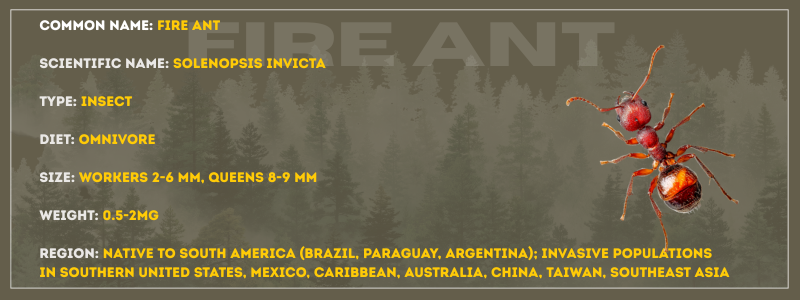
Scientific Name: Solenopsis invicta (Red Imported Fire Ant), Solenopsis spp. (Fire Ants generally)
Diet Type: Omnivore
Size: Workers 2-6 mm, Queens 8-9 mm
Weight: Individual workers approximately 0.5-2 mg
Region Found: Native to South America (Brazil, Paraguay, Argentina); invasive populations in southern United States, Mexico, Caribbean, Australia, China, Taiwan, Southeast Asia