
Deep in the ancient forests of Madagascar, a creature moves through the shadows with the fluid grace of a cat and the cunning of a fox. Its eyes catch the moonlight, its body coils around a tree trunk with unsettling ease, and before its prey even registers the danger, it’s already too late. This is the fossa — an animal so unusual that naturalists who first encountered it struggled to classify it, and so captivating that it has become the defining emblem of Madagascar’s extraordinary wildlife.
The fossa is not particularly well known outside of conservation circles, yet it is nothing short of extraordinary. As the largest carnivorous mammal endemic to Madagascar, it sits at the very top of the island’s food chain, a position it has held for millions of years. But the fossa is more than just a predator. It is a living artifact of evolution, a species that defies easy categorization, and a creature whose fate is deeply intertwined with the future of one of the most biodiverse and endangered ecosystems on Earth. To know the fossa is to understand just how strange, precious, and fragile life on our planet truly can be.
Facts
Here are some quick, fascinating facts that you might not know about the fossa:
- Despite looking remarkably like a small cougar, the fossa is actually most closely related to the mongoose family, not to any cat species.
- The fossa has semi-retractable claws, meaning it shares this trait with both cats and some climbing mammals, allowing it to descend trees headfirst like a squirrel.
- Female fossas temporarily develop male-like genitalia during a stage of adolescence, a phenomenon called transient masculinization that is exceptionally rare in the mammal world.
- The fossa produces a pungent secretion from scent glands near its tail that it uses for territory marking and communication — a smell that local Malagasy people have described as powerful enough to detect from a significant distance.
- Fossas are capable of vocalizations ranging from low growls and hisses to loud, almost haunting screaming calls during mating season, which can carry for miles through the forest.
- A fossa’s tail is roughly as long as its entire body, and it uses it as a balancing rod while leaping between trees — a feature more reminiscent of a lemur than a predator.
- Local Malagasy folklore portrays the fossa as a fearsome, almost supernatural creature that enters homes to steal chickens and children, giving it a near-mythological reputation among rural communities.
Species
The fossa belongs to a precise and fascinating classification in the tree of life:
Kingdom: Animalia Phylum: Chordata Class: Mammalia Order: Carnivora Family: Eupleridae Genus: Cryptoprocta Species: Cryptoprocta ferox
The genus name Cryptoprocta comes from the Greek words for “hidden anus,” a reference to a pouch-like structure that partially conceals its anal scent glands — a somewhat unglamorous but taxonomically useful detail. The species epithet ferox simply means “fierce” in Latin, which is far more evocative.
The fossa is the sole living member of its genus, making it monotypic. However, there is an extinct giant relative worth noting: Cryptoprocta spelea, sometimes called the giant fossa or subfossil fossa. This prehistoric species went extinct within the last thousand years, likely due to a combination of climate shifts and human arrival on Madagascar. It was significantly larger than the modern fossa — some estimates suggest it weighed nearly twice as much — and would have preyed on the now-extinct giant lemurs that once roamed the island.
The fossa belongs to the family Eupleridae, a group of carnivorous mammals found exclusively on Madagascar. This family includes other Malagasy predators such as the falanouc (Eupleres goudotii), the ring-tailed mongoose (Galidia elegans), and the Malagasy civet (Fossa fossivora). Confusingly, that last species shares part of its common name with the fossa we’re discussing but is a very different and considerably smaller animal.
Appearance
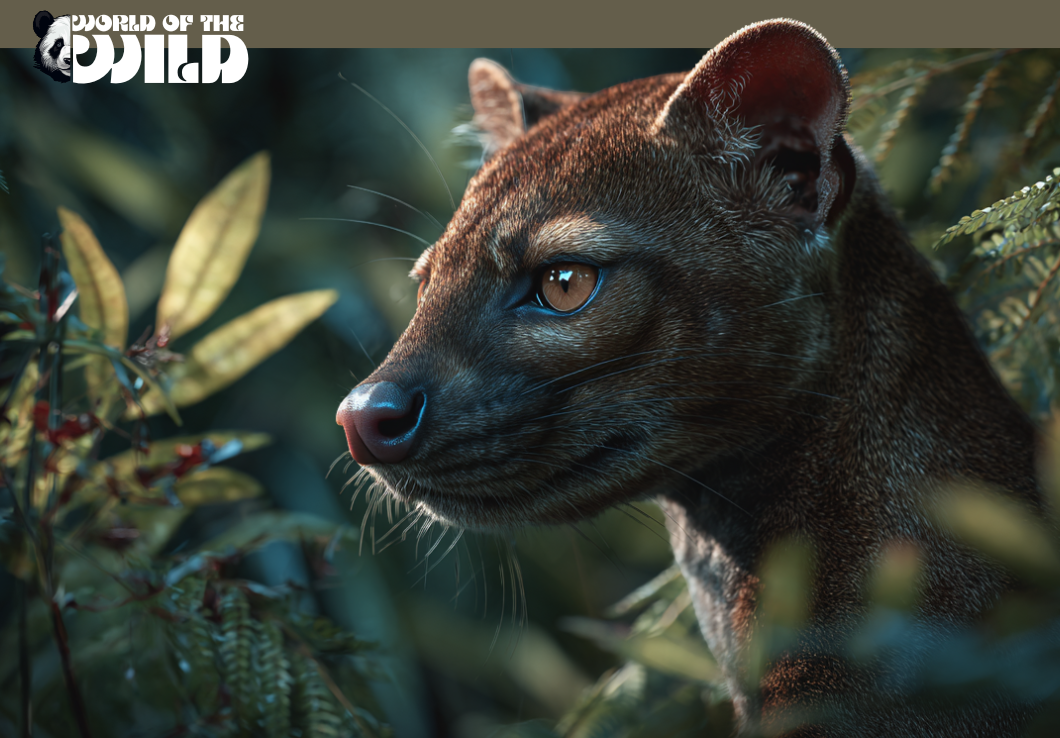
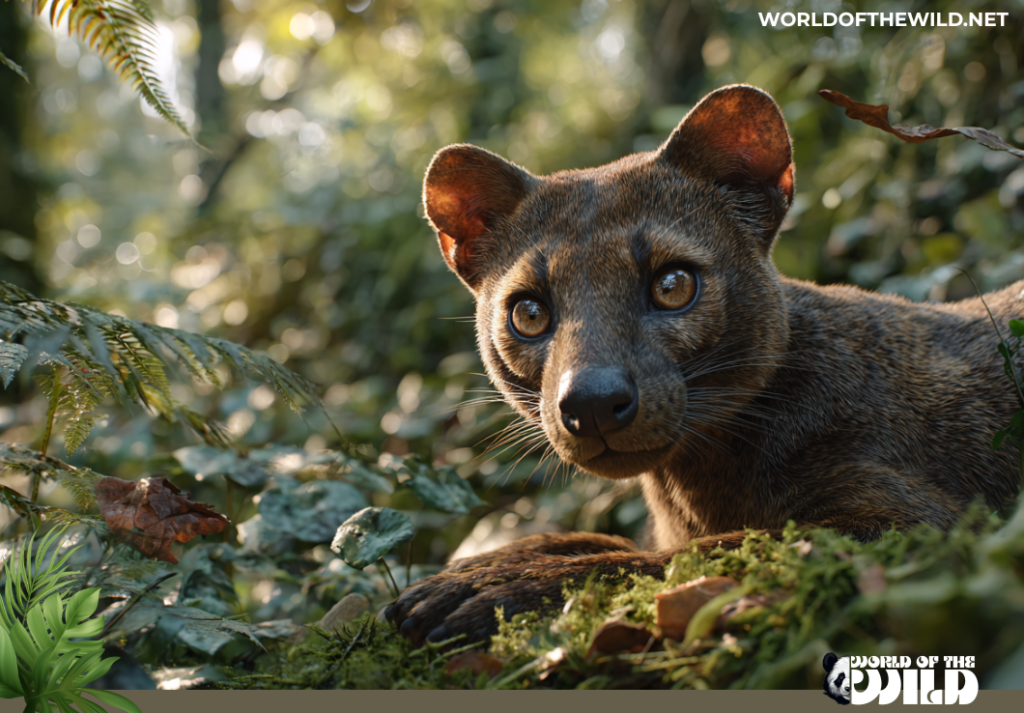
The fossa is a strikingly sleek and muscular animal that looks, at first glance, like something between a mountain lion and a very large domestic cat. Adults typically measure between 28 and 31 inches from head to base of tail, with the tail adding an additional 27 to 35 inches — meaning the tail alone can be as long as the body. Standing roughly 12 inches at the shoulder, the fossa is compact but powerfully built.
Adult fossas weigh between 13 and 26 pounds, with males being noticeably larger than females, a trait known as sexual dimorphism that is relatively common among carnivores. The body is long and low-slung, built for speed and agility rather than raw power, though the fossa is deceptively strong for its size.
The coat is short, dense, and uniformly reddish-brown to dark brown on the back and sides, fading to a paler, sometimes cream-colored underbelly. There is no striking pattern, no spots or stripes — the fossa’s camouflage relies on uniform tone rather than disruptive coloration, blending seamlessly into the dappled light of the forest floor and canopy.
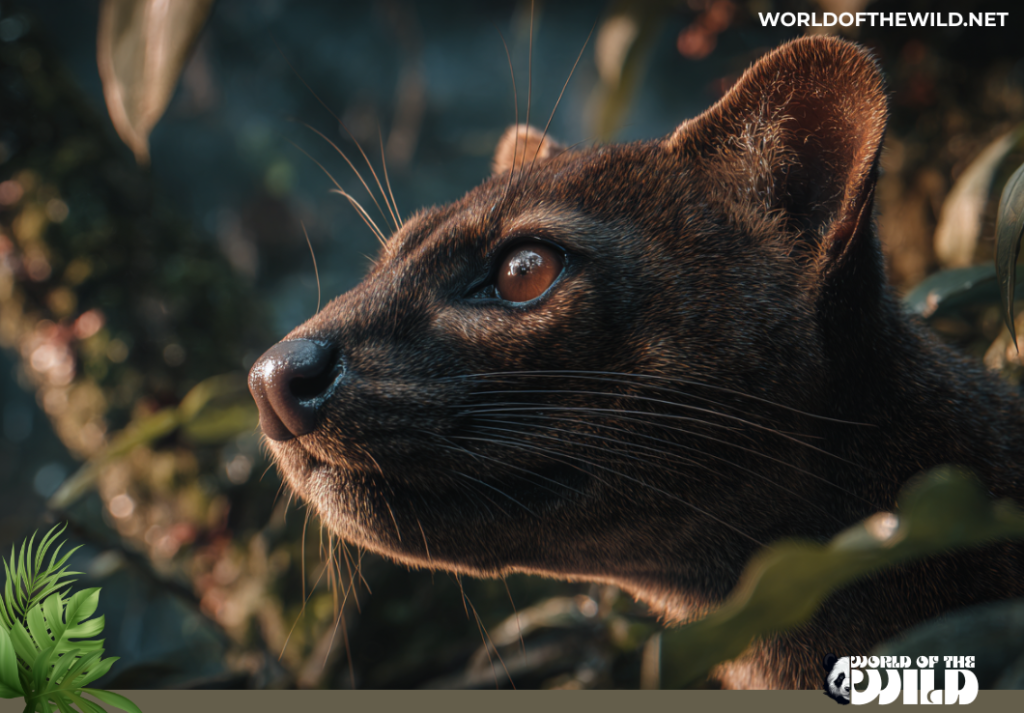
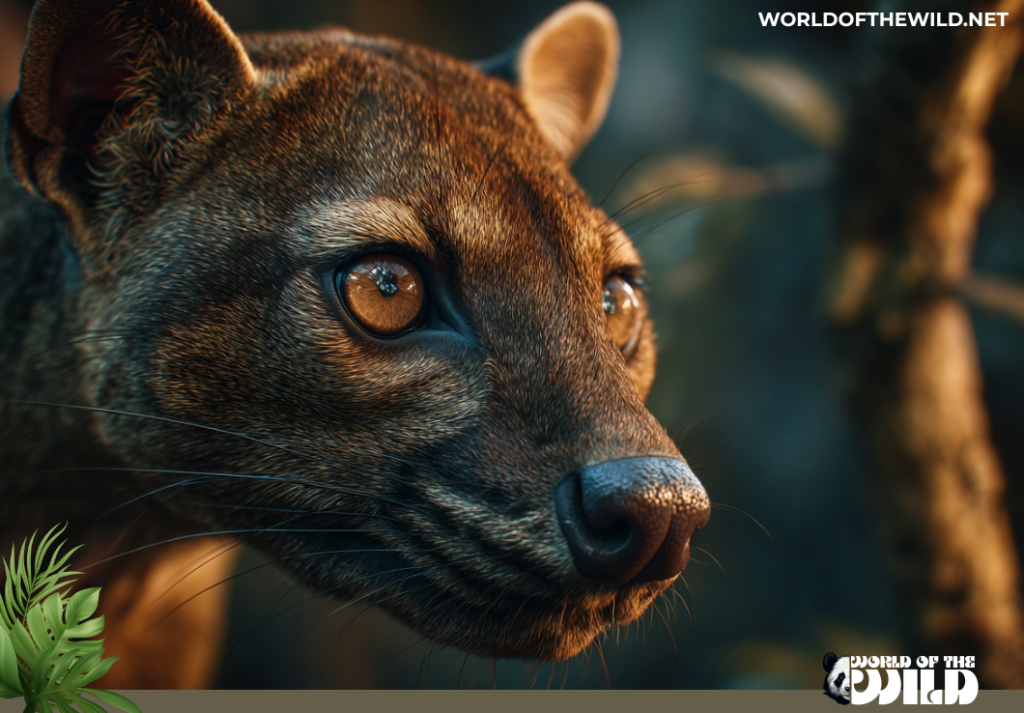
The face is broad and somewhat cat-like, with a short muzzle, large forward-facing eyes that provide excellent binocular vision for judging distances during leaps, and rounded ears that sit wide on the head. The paws are large and broad relative to the body, equipped with flexible ankles that can rotate backward — a remarkable anatomical feature that allows the fossa to descend trees headfirst, gripping bark with retractable claws on the descent just as it would on the ascent.
Behavior
The fossa is a primarily solitary animal, spending the vast majority of its life alone. Adults maintain large home ranges that they mark aggressively with scent secretions from glands near the base of the tail, on the throat, and on the chest. Males tend to have larger territories than females, and these ranges often overlap with those of multiple females while remaining mostly exclusive among males.
One of the most remarkable things about the fossa’s behavior is that it is equally comfortable on the ground and high in the forest canopy. Unlike most carnivores of comparable size, which are primarily terrestrial, the fossa regularly hunts and travels through the trees, using its long tail for balance and its flexible ankles to navigate even the most demanding vertical surfaces. It is, in the truest sense, a three-dimensional predator.
The fossa is largely cathemeral, meaning it is active at any time of day or night, though it tends toward crepuscular and nocturnal activity, particularly in areas where it encounters human disturbance. This behavioral flexibility has helped it persist in degraded habitats where strictly nocturnal or diurnal species might struggle.
Communication among fossas involves a rich blend of scent marking, vocalizations, and body language. Threat displays involve arching the back, puffing the tail, and producing low growls that can escalate into sharp, percussive barks. During interactions between individuals, particularly at mating aggregations, their vocal repertoire expands dramatically.
Perhaps the most astonishing behavioral quirk of the fossa is its mating system. Females establish “mating trees” — specific large trees in the forest to which they return annually during breeding season. A female will climb high into the tree and call loudly to attract males. Multiple males gather at the base and compete vocally and physically for the right to mate. The female may mate with several males over several days, remaining in the tree for the entire period. This is known as a lek-like mating system and is extraordinarily rare among carnivorous mammals.
Evolution
The story of the fossa’s evolution begins with one of the most extraordinary biogeographic events in the history of life on Earth. Madagascar separated from the African mainland approximately 160 million years ago during the breakup of Gondwana, but the ancestors of the Eupleridae — the family to which the fossa belongs — didn’t arrive on the island until roughly 18 to 24 million years ago. The prevailing theory is that a small group of mongoose-like ancestors from Africa somehow crossed the Mozambique Channel, a distance of roughly 250 miles, likely on floating vegetation rafts.
This single colonization event, known as a “sweepstakes dispersal,” gave rise to the entire Eupleridae family. Over millions of years of isolation, these colonists diversified to fill ecological niches that on mainland Africa are occupied by a wide variety of unrelated predators — from civets and genets to small cats and even larger felids. The fossa itself evolved to occupy the niche of an apex predator, growing significantly larger than its mongoose ancestors and developing the anatomical tools — powerful jaws, flexible ankles, semi-retractable claws — needed to hunt the diverse and often arboreal lemur fauna of Madagascar.
This process, in which unrelated animals evolve similar traits to occupy similar ecological roles, is known as convergent evolution, and the fossa is one of its most compelling examples. Its cat-like appearance is not a sign of close relation to cats — it is a product of independent evolution arriving at a similar solution to the same ecological problem.
The extinction of the giant fossa (Cryptoprocta spelea) within the last millennium is a sobering reminder of how recently this evolutionary story could have ended — and how fragile it remains.
Habitat
The fossa is endemic to Madagascar, meaning it is found nowhere else on Earth. Within the island, it has a relatively broad distribution, historically spanning most of the forested regions from the humid rainforests of the east coast to the drier deciduous forests of the west and the spiny forests of the south. However, its range has contracted significantly due to deforestation, and it is now most reliably found in the larger remaining forest blocks.
The species is strongly forest-dependent. It is rarely found in open grasslands, agricultural areas, or heavily degraded secondary vegetation, though it may pass through such areas while traveling between forest fragments. The fossa requires large, intact tracts of forest to maintain viable home ranges — males may patrol territories of up to 10 square miles or more.
Key protected areas where fossas are found include Ranomafana National Park, Kirindy Mitea National Park, and the Bemaraha Tsingy Reserve. The Kirindy dry deciduous forest in western Madagascar is often cited as one of the best places in the world to observe fossas in the wild, particularly during mating season when animals congregate and are more active during daylight hours.
At its core, the fossa’s habitat requirements are simple but demanding: large areas of relatively undisturbed native forest with adequate prey. As that habitat shrinks, the fossa’s world shrinks with it.
Diet
The fossa is an obligate carnivore, meaning its diet consists entirely of animal prey. As the apex predator of Madagascar’s forest ecosystem, it is an opportunistic and wide-ranging hunter, capable of taking a remarkable variety of prey.
Lemurs form the cornerstone of the fossa’s diet. It preys on species ranging from small mouse lemurs barely larger than a human fist to mid-sized lemurs such as brown lemurs and sifakas that may weigh several pounds. This flexibility makes the fossa a uniquely important ecological force — it is the only predator on Madagascar capable of controlling lemur populations across such a wide size range.
Beyond lemurs, the fossa readily takes reptiles including chameleons, lizards, and snakes; birds and their eggs; small mammals such as tenrecs and rodents; and occasionally domestic animals such as chickens and ducks in areas near human settlements, which unfortunately contributes to retaliatory killings by local communities.
The fossa’s hunting strategy combines stealth and speed. On the ground, it stalks prey with cat-like patience before launching an explosive burst of acceleration. In the trees, it relies on its extraordinary agility to pursue arboreal lemurs through the canopy, outmaneuvering them on both horizontal branches and vertical trunks. It kills with a bite to the back of the skull or neck — clean, efficient, and instantly lethal.
Predators and Threats
As an apex predator, the adult fossa has no significant natural predators on Madagascar. Large birds of prey such as the Madagascar harrier-hawk may occasionally take young or juvenile fossas, and large boas have been documented attacking fossa young, but for a healthy adult, the dangers of predation are minimal. Its primary threats come not from within the natural world, but from outside it.
Habitat loss is by far the most critical threat facing the fossa today. Madagascar has lost more than 90% of its original forest cover since humans first arrived on the island approximately 2,000 years ago. The primary drivers of this loss are slash-and-burn agriculture (known locally as tavy), charcoal production, logging, and the expansion of cattle grazing land. As forests disappear, fossa populations become fragmented into isolated pockets, reducing genetic diversity and making local extinctions more likely.
Direct persecution by humans is a significant secondary threat. Because the fossa occasionally preys on domestic poultry, it is widely viewed as a pest by rural Malagasy communities. Retaliatory killing — trapping, snaring, and direct hunting — takes a measurable toll on fossa populations, particularly near forest edges.
Cultural taboos and mythology, ironically, both help and hurt the fossa. In some regions, fady (traditional taboos) protect the animal from being hunted. In others, its fearsome reputation leads to active persecution.
Climate change poses a longer-term threat by altering rainfall patterns, shifting forest composition, and reducing the prey base that the fossa depends on — particularly lemur populations already stressed by habitat loss.
Reproduction and Life Cycle
The fossa’s mating season typically falls between September and November, during the Southern Hemisphere spring. As described earlier, the species practices a remarkable lek-like system in which females attract multiple males to a designated mating tree and may mate with several partners over a period of one to six days. Researchers believe this multi-male mating strategy may help ensure fertilization while allowing females some degree of mate choice.
After mating, the female retires to a secluded den — often a hollow tree, a rock crevice, or a dense tangle of roots — where she undergoes a gestation period of approximately 90 days. Litters typically consist of two to four cubs, born blind, helpless, and covered in sparse pale fur. They are entirely dependent on their mother for warmth, protection, and nutrition.
The cubs develop slowly by carnivore standards. Their eyes open at around two to three weeks, and they begin exploring outside the den at roughly four months of age. Weaning occurs at around four and a half months, but young fossas remain with their mothers and learn essential hunting skills until they are approximately one year old, at which point they disperse to establish their own territories.
Sexual maturity is reached at around three to four years of age. Females experience that unusual period of transient masculinization — in which they develop enlarged, spiny genitalia resembling those of males — during subadulthood, which researchers believe may help young females avoid unwanted male attention until they are mature enough to reproduce.
In the wild, fossas typically live between 15 and 20 years. In captivity, individuals have been recorded living past 20 years, though the wild lifespan is likely somewhat shorter due to the demands of territorial competition, injury, and environmental challenges.
Population
The fossa is currently classified as Vulnerable on the IUCN Red List of Threatened Species, a designation that reflects a genuine and ongoing population decline driven primarily by habitat loss. Precise population counts are notoriously difficult for a wide-ranging, secretive, low-density predator in heavily forested terrain, but current estimates place the total wild fossa population at somewhere between 2,500 and 8,500 individuals, with the true number likely toward the lower end of that range.
Population trend data points consistently downward. As forest cover continues to decline across Madagascar, carrying capacity for fossas shrinks proportionally, and the fragmentation of remaining populations increases the risk of local extinctions across the island. Some researchers have expressed concern that without significant conservation intervention, the fossa could qualify for an Endangered status within the coming decades.
A small number of fossas are held in zoological institutions around the world, and coordinated captive breeding programs exist to maintain a genetically diverse insurance population. However, captive breeding alone cannot substitute for the conservation of Madagascar’s wild forests, which remain the fossa’s only true home.
Conclusion
The fossa is, in almost every sense of the word, irreplaceable. It is the product of tens of millions of years of isolated evolution, a carnivore that convergently arrived at cat-like perfection through an entirely different evolutionary path, and the ecological linchpin of an island ecosystem unlike any other on Earth. Without the fossa, Madagascar’s forests would lose their apex regulator — lemur populations would boom, forest dynamics would shift, and the cascading effects would ripple through one of the world’s most biodiverse and endangered ecosystems.
But the fossa’s story is not yet over. Madagascar still has forests worth protecting. Conservation organizations working on the ground — from community-based forest management programs to corridor restoration projects — are making measurable progress in slowing deforestation. Protected areas where fossas thrive still exist and can be expanded. With sufficient global attention and resources, the trajectory of this remarkable animal can be changed.
The fossa asks nothing of us except that we leave its forests standing. In a world where we have already lost so much, that should not be too much to give.
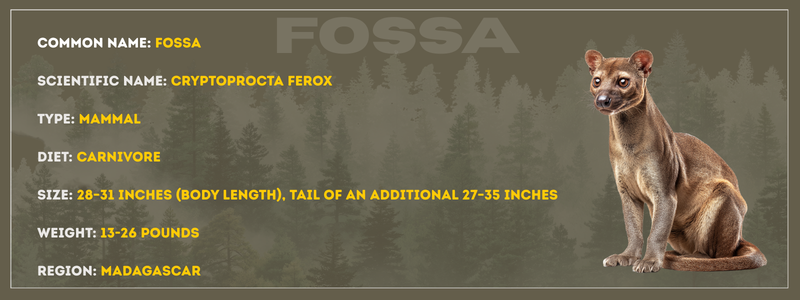
Scientific Name: Cryptoprocta ferox
Diet Type: Carnivore
Size: 28–31 inches (body length), with a tail of an additional 27–35 inches
Weight: 13–26 pounds
Region Found: Madagascar (endemic — found nowhere else on Earth)