
Standing motionless at the edge of a still pond, barely distinguishable from the tangle of roots and reeds around it, the Green Heron waits. It could be mistaken for a moss-covered branch, a forgotten shadow — until, in a single explosive movement, it strikes. In the blink of an eye, a fish disappears from the water and the heron resumes its statuesque pose, unbothered, unhurried, and utterly magnificent.
The Green Heron (Butorides virescens) is one of North America’s most underappreciated waterbirds. Overshadowed by its larger, more theatrical cousins like the Great Blue Heron, this compact and secretive species rewards patient observers with something far more extraordinary: a level of intelligence and behavioral sophistication that is genuinely rare in the bird world. From its use of tools to its mastery of camouflage, the Green Heron is proof that greatness often comes in small, quietly brilliant packages.
Facts
- The Green Heron is one of the very few bird species on Earth known to use tools. It has been observed dropping objects — insects, feathers, bread crumbs, and small twigs — onto the water’s surface as bait to lure fish within striking distance, a behavior that places it in the company of only the most cognitively advanced animals.
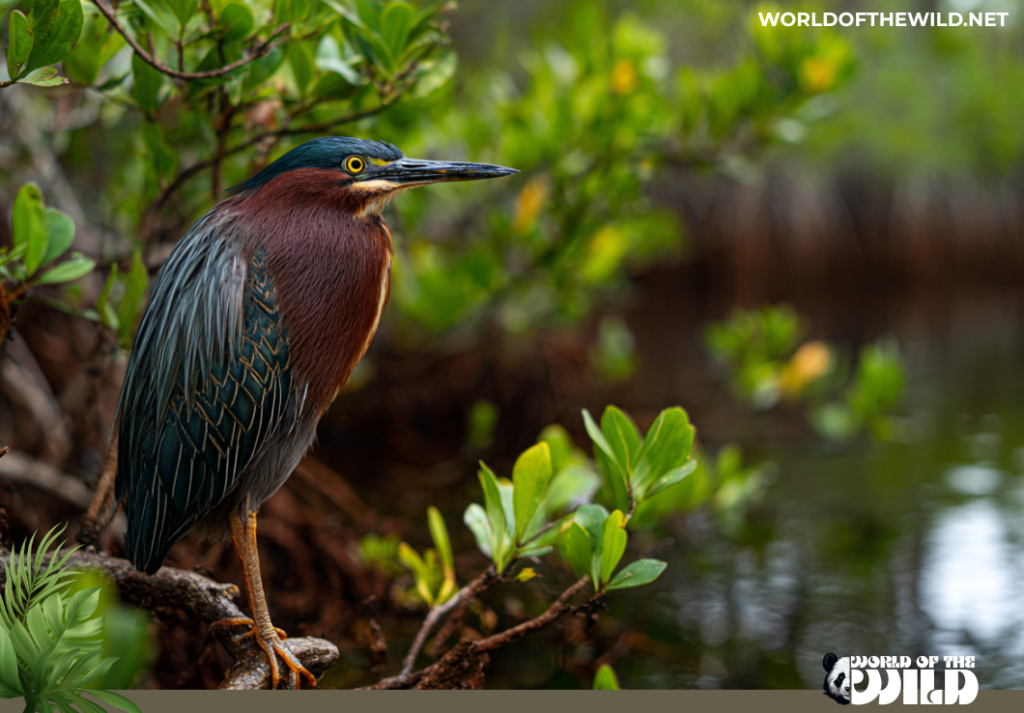
- Despite its name, the Green Heron appears more chestnut and slate-blue than green in most lighting conditions. The “green” refers to a subtle iridescent sheen on its back and wings that shimmers in direct sunlight.
- The Green Heron can compress and extend its neck dramatically. At rest, it looks almost neckless and stocky, but when striking at prey, it can shoot its neck forward with shocking speed and reach.
- Rather than calling at length like many wading birds, the Green Heron communicates with sharp, explosive “skeow!” alarm calls that can startle even seasoned birdwatchers walking a quiet trail.
- Green Herons have been documented defecating forcefully when startled or flushed from their perch — a behavior believed to reduce body weight for a faster takeoff and potentially deter predators.
- Unlike the colonial nesting habits of many herons, Green Herons often nest as solitary pairs, aggressively defending their chosen territory from rivals.
- The species shows remarkable site fidelity, with individuals returning to the same wetland patches and even the same perch locations year after year.
Species
The Green Heron belongs to the following taxonomic classification:
Kingdom: Animalia Phylum: Chordata Class: Aves Order: Pelecaniformes Family: Ardeidae Genus: Butorides Species: Butorides virescens
The genus Butorides contains three closely related species that were, until relatively recently, considered a single species under the umbrella name “Green-backed Heron.” Today, the three are recognized as distinct species. The Striated Heron (Butorides striata) is the most widespread of the trio, found across South America, Africa, Asia, and Australia. The Galapagos Heron (Butorides sundevalli), sometimes called the Lava Heron, is an endemic species found only on the Galapagos Islands and is distinguished by its darker, more uniform slate-gray plumage — an adaptation that helps it blend into the volcanic lava fields it inhabits.
Within Butorides virescens itself, several subspecies are recognized across its range, though the differences between them are subtle and primarily involve slight variations in plumage tone and size. The nominate subspecies B. v. virescens covers most of the continental North American range, while B. v. maculatus and others inhabit island and peripheral populations across the Caribbean and Central America.
Appearance
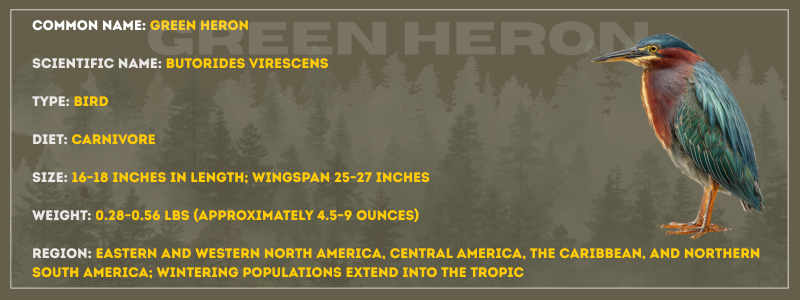
The Green Heron is a compact, stocky bird that measures between 16 and 18 inches in length, making it one of the smaller herons in North America. It has a wingspan of roughly 25 to 27 inches and typically weighs between 4.5 and 9 ounces — small enough to perch comfortably on a slender tree branch overhanging the water.
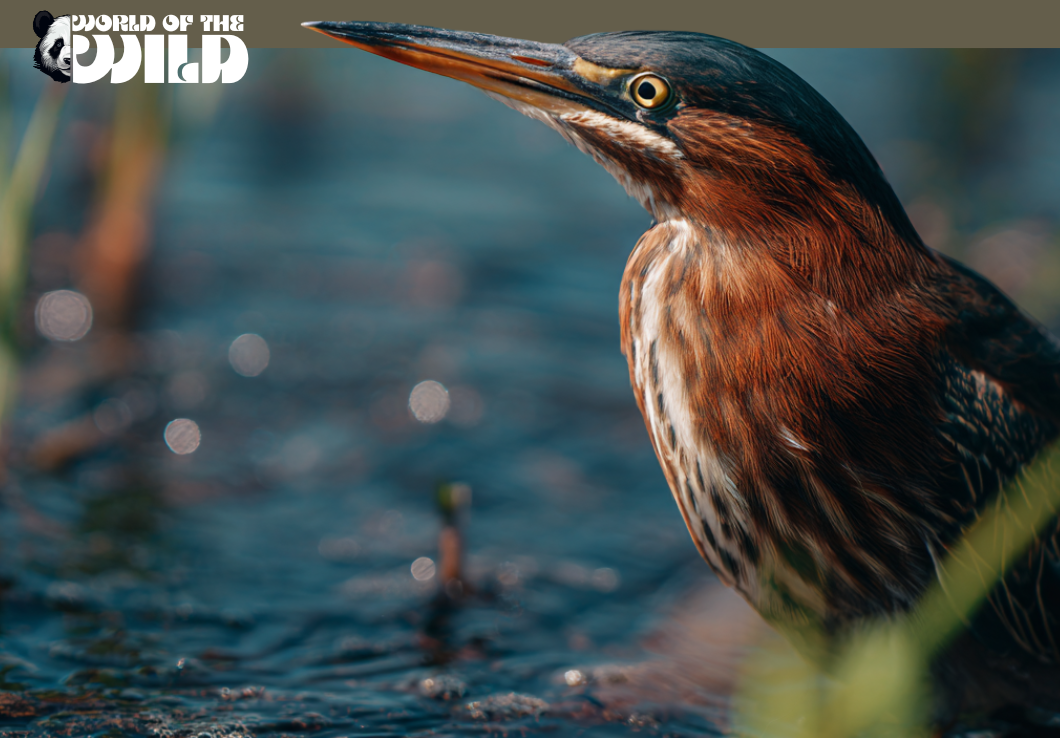
Its back and wings are a deep, glossy blue-green that can appear almost teal in bright sunlight, contrasting with a rich chestnut-rufous neck and breast. The underparts are streaked with white and buff tones. The face is marked with a white throat that stands out against the warm chestnut cheeks and a dark crown that can be raised into a small, dramatic crest when the bird is alarmed or displaying. The bill is long, dark, and dagger-shaped — a precision instrument evolved for split-second strikes — and the eyes are a vivid yellow-orange. The legs are relatively short for a heron, appearing orange to yellow-green, and they become brighter and more intensely colored during the breeding season.
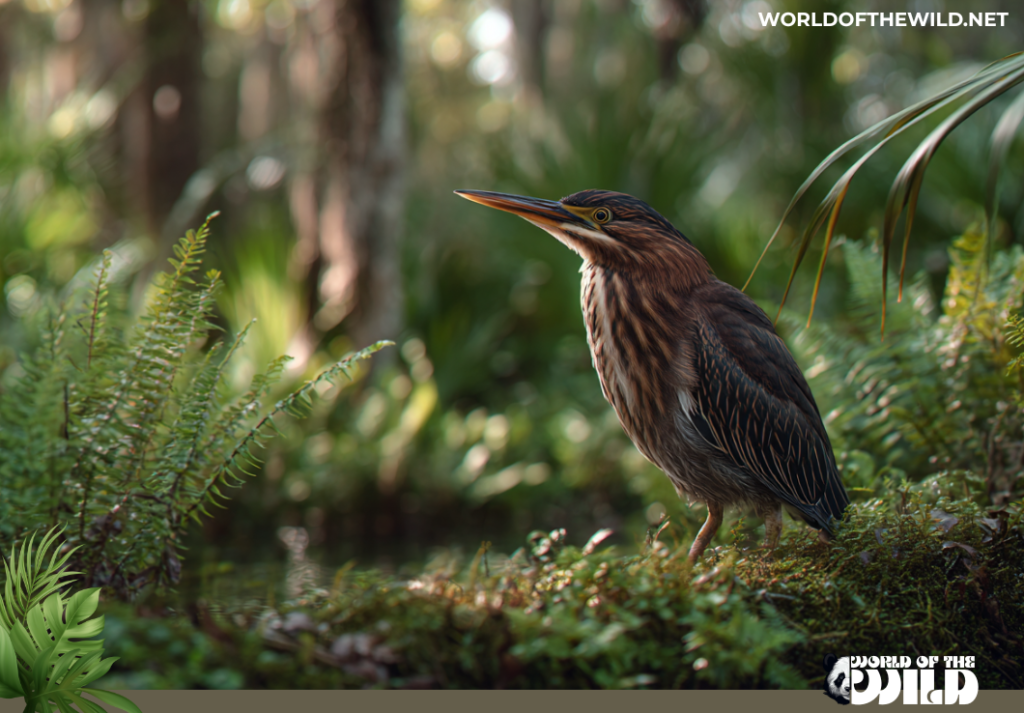
Juvenile Green Herons look quite different from adults, sporting heavily streaked brown and buff plumage that provides excellent camouflage in their early months of life before they molt into adult coloration.
Behavior
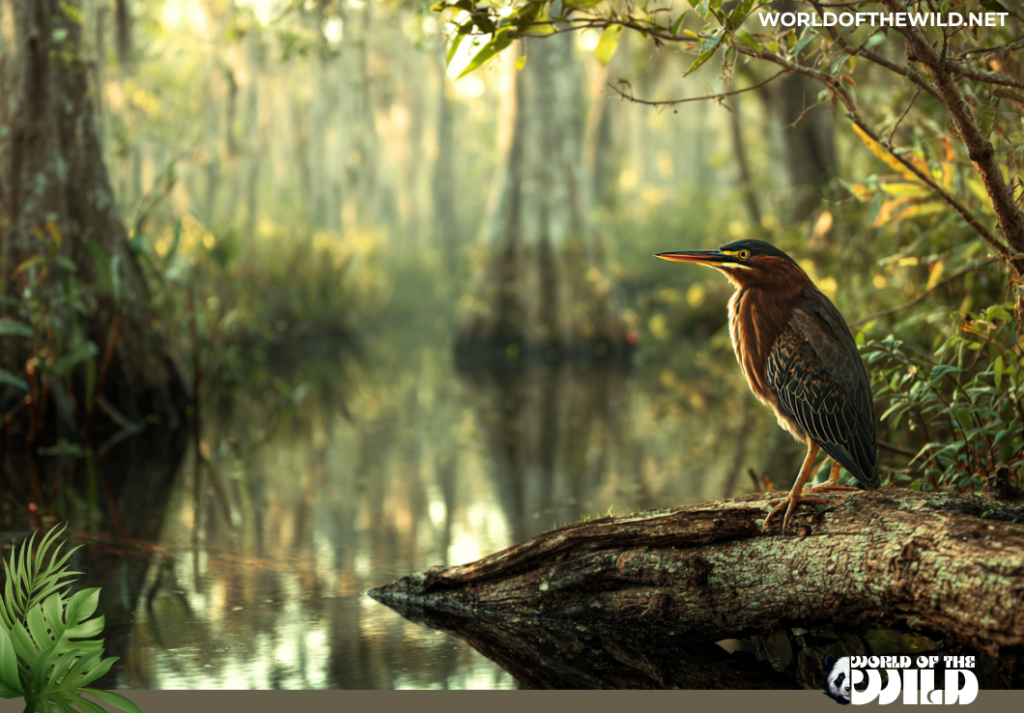
The Green Heron is predominantly a solitary creature, spending much of its time alone along the edges of slow-moving or still water, perched low and hunched in a posture of focused patience. It is most active during the early morning and late afternoon, though it will also forage at dusk and, in some locations, at night when artificial lighting illuminates the water.
Its hunting strategy is a masterclass in stillness and precision. The bird will stand or crouch at the water’s edge for extended periods, watching for the slightest movement below the surface before lunging with explosive speed, seizing prey in its bill rather than spearing it as some larger herons do. This method requires exceptional visual acuity and the ability to compensate for the way water refracts light, distorting the apparent position of underwater prey.
The tool-use behavior deserves particular attention. Documented in wild populations across its range, the practice of bait fishing suggests a level of planning and problem-solving that goes beyond simple instinct. Individual birds have been observed selecting specific objects, discarding those that don’t attract fish, and returning repeatedly to the same successful baiting spot — evidence of learning, memory, and adaptive strategy.
When threatened or disturbed, the Green Heron raises its crest, stretches its neck upward, and may perform a vigorous tail-flicking or bobbing motion before issuing its sharp alarm call and flushing from the scene. During courtship, males perform elaborate displays that include crest raising, wing spreading, and a slow, exaggerated “snap display” where the bill is snapped audibly while the bird bows and stretches.
Evolution
Herons belong to the family Ardeidae, which has a fossil record extending back approximately 60 million years, placing the early ancestors of today’s herons in the Paleocene epoch, not long after the mass extinction event that ended the age of the dinosaurs. The modern ardeids, however, diversified substantially during the Miocene and Pliocene epochs, roughly 5 to 23 million years ago, as global climates shifted and wetland and riparian habitats expanded and contracted across the continents.
The genus Butorides is considered one of the more ancestral or basal lineages within the heron family, retaining several features that link it to the evolutionary roots of the group. The relatively small size, the tendency toward solitary behavior, and the short-legged, crouching hunting posture are all thought to represent earlier adaptations compared to the tall, long-legged, often colonial herons that evolved later.
The relatively recent split between the Green Heron, Striated Heron, and Lava Heron is estimated to have occurred within the last few million years, driven by geographic isolation — the separation of populations by ocean barriers, the rise of the Isthmus of Panama, and the formation of island chains — which allowed distinct evolutionary lineages to develop independently from a common ancestor.
Habitat
The Green Heron is found across a broad geographic range, breeding throughout most of the eastern United States, the Pacific Coast, parts of the interior West, and into southern Canada. Its wintering range extends through Central America, the Caribbean, and the northern edge of South America. Some populations in the southernmost parts of the United States are year-round residents.
Within this range, the Green Heron shows a strong affinity for densely vegetated freshwater and brackish wetlands. It favors locations where overhanging trees, shrubs, or tall grasses provide cover at the water’s edge — wooded stream corridors, beaver ponds, lake margins lined with willows and alders, mangrove swamps, and tidal marshes are all prime habitat. It is notably adaptable and will make use of drainage ditches, suburban retention ponds, and golf course water features when natural wetlands are unavailable.
The species tends to avoid large, open bodies of water, preferring the intimate, sheltered margins of smaller water bodies where it can perch low and close to the surface. Dense riparian vegetation is essential not just for foraging cover but for nesting, and the loss or degradation of this vegetation along waterways is one of the most significant pressures the species faces.
Diet
The Green Heron is a carnivore with a diet dominated by small fish, which form the backbone of its nutritional intake across most of its range. Beyond fish, it consumes a wide variety of aquatic and semi-aquatic prey including frogs, tadpoles, crayfish, aquatic insects, earthworms, small snakes, and even small rodents on occasion.
It is an opportunistic and flexible feeder, adjusting its diet based on seasonal availability and local abundance. The hunting technique varies depending on conditions: the bird may employ a classic “stand-and-wait” strategy, a slow stealthy walk along the shoreline, or an active chase in shallow water. In deeper water, it occasionally dives partially from a low perch. Its remarkable bait-fishing behavior represents perhaps the most sophisticated variant of its foraging repertoire — a behavior that requires not just instinct but active problem-solving, making the Green Heron one of only a handful of bird species known to use lures to attract prey.
Predators and Threats
In the wild, Green Herons face predation primarily at the nest stage, when eggs and chicks are vulnerable to a range of opportunistic predators. Raccoons, snakes (particularly rat snakes and black racers), crows, and jays are among the most common nest predators. Adult birds face fewer predators but are occasionally taken by larger raptors, including Red-tailed Hawks, Great Horned Owls, and Peregrine Falcons.
On the human-caused side of the equation, habitat degradation represents the most pervasive long-term threat. The draining, filling, and development of wetlands has significantly reduced suitable habitat across much of the species’ range over the past century. Agricultural runoff, pesticide contamination of aquatic ecosystems, and pollution that reduces fish populations and water quality all undermine the food resources the species depends upon.
Climate change introduces additional complexity — shifting precipitation patterns alter wetland hydrology, and earlier springs can create mismatches between the timing of nesting and the peak availability of prey. Collisions with vehicles and buildings, particularly during nocturnal migration, also represent a significant but poorly quantified mortality source.
Reproduction and Life Cycle
Green Herons typically arrive at breeding grounds in spring, with males establishing territories and beginning courtship displays before females arrive. The male selects a general nesting area and performs elaborate displays to attract a mate, including the iconic “snap display” — a bowing, wing-spreading performance accompanied by a snapping of the bill — as well as flights intended to demonstrate territory ownership.
Once a pair bonds, nest construction is a collaborative effort, though the female does most of the building while the male supplies sticks and plant material. The nest is a relatively flimsy, flat platform of sticks built in a dense shrub or tree, typically 5 to 20 feet above the water or ground. Both deciduous and evergreen trees are used, and nests are often placed in overhanging vegetation directly above water.
The female lays a clutch of three to five pale green eggs, and both parents share incubation duties over a period of approximately 19 to 21 days. Chicks hatch altricial — helpless, with sparse down, and entirely dependent on parental care for warmth and food. Both parents provision the chicks by regurgitating partially digested prey directly into the nest. Young birds fledge at around 35 days of age but may continue to receive some parental care for a short period after leaving the nest. Most Green Herons breed for the first time at one year of age.
In the wild, Green Herons typically live 7 to 8 years, though individuals have been recorded surviving well beyond a decade in favorable conditions.
Population
The Green Heron is currently classified as Least Concern on the IUCN Red List of Threatened Species, reflecting a global population that, while subject to local pressures, remains relatively robust. Population estimates across North America suggest several hundred thousand to over one million individuals, though precise counts are challenging given the species’ secretive habits and preference for dense vegetated habitats that make systematic surveying difficult.
Long-term monitoring data from the North American Breeding Bird Survey suggests that Green Heron populations have experienced moderate declines over recent decades in parts of their range, particularly in areas where wetland loss has been most severe. However, the species has also demonstrated notable adaptability, colonizing suburban and modified landscapes in ways that buffer some of these losses.
Conservation of riparian and wetland habitats — particularly through programs that protect wooded stream corridors and restore degraded wetlands — remains the most important action for ensuring stable Green Heron populations into the future.
Conclusion
The Green Heron is a bird that rewards those willing to slow down and look closely. In a world that tends to celebrate the spectacular — the flamingo’s blush, the eagle’s wingspan, the peacock’s iridescence — the Green Heron offers something quieter and, in many ways, more profound: the intelligence to use a tool, the patience to outwait its prey, and the adaptability to thrive at the margins of human-altered landscapes.
It is a reminder that the natural world’s most remarkable stories are not always told loudly. Sometimes they unfold in the hush of a marsh at dawn, where a small, dark-backed bird drops a feather onto still water, waits, and strikes.
Protect the wetlands. Restore the riparian corridors. And next time you pass a weedy pond or overgrown drainage ditch, take a moment to look — because the Green Heron is almost certainly looking back.
Scientific Name: Butorides virescens
Diet Type: Carnivore
Size: 16–18 inches in length; wingspan 25–27 inches
Weight: 0.28–0.56 lbs (approximately 4.5–9 ounces)
Region Found: Eastern and western North America, Central America, the Caribbean, and northern South America; wintering populations extend into the tropic