
There is a moment, common on the African savanna, that never loses its magic — a flash of tawny gold, a suspended arc through the air, and then silence, as though the animal never existed at all. That moment belongs to the impala. Elegant, swift, and devastatingly agile, the impala is one of Africa’s most recognizable antelopes, yet it remains one of the most underappreciated. Tourists on safari often scan past the herds in search of lions and elephants, not realizing they are overlooking an animal of extraordinary complexity and resilience.
The impala is far more than a pretty face in the grass. It occupies a critical position in the African ecosystem, serving as one of the primary links between vegetation and the continent’s most iconic predators. It is an animal shaped by millions of years of pressure — biological, ecological, and evolutionary — and it has emerged from that crucible as something close to perfect for its environment. To understand the impala is to understand a great deal about how life on the African savanna truly works.
Facts
- Impalas can leap up to 10 feet high and 33 feet in length in a single bound — one of the most impressive escape jumps of any animal relative to its body size.
- The impala’s scientific name, Aepyceros melampus, translates to “high-horned black-footed” in Greek — a nod to the male’s dramatic horns and the dark glands on its hind legs.
- Impalas have scent glands on their foreheads, between their hooves, and on their hind legs, giving them a multi-channel chemical communication system that rivals many other mammals.
- Female impalas can delay the birth of their young by up to a month through a process called embryonic diapause, allowing them to synchronize births with the most favorable environmental conditions.
- During the rut, male impalas make a loud, guttural roar that sounds more like a lion than an antelope — startling and powerful enough to carry across the savanna.
- Impalas are “mixed feeders,” meaning they switch seamlessly between grazing on grasses and browsing on shrubs and leaves depending on the season — a dietary flexibility that gives them a survival edge over more specialized species.
- The black tufts on the hind legs of impalas conceal metatarsal glands that release a distinctive scent when the animal runs, possibly helping scattered herd members track one another in the chaos of a predator chase.
Species
Classification:
| Rank | Classification |
|---|---|
| Kingdom | Animalia |
| Phylum | Chordata |
| Class | Mammalia |
| Order | Artiodactyla |
| Family | Bovidae |
| Genus | Aepyceros |
| Species | Aepyceros melampus |
The impala belongs to its own monotypic genus, Aepyceros, meaning it has no close living relatives — it is the sole surviving member of its evolutionary line. Within the species, two recognized subspecies exist:
Common Impala (Aepyceros melampus melampus): By far the more numerous and widespread of the two, the common impala ranges across eastern and southern Africa. It is the subspecies most frequently encountered in national parks and wildlife reserves from Kenya to South Africa.
Black-faced Impala (Aepyceros melampus petersi): A critically limited subspecies found only in northwestern Namibia and southwestern Angola, the black-faced impala is distinguished by the striking dark markings on its face. Significantly rarer than its common cousin, it is classified as Vulnerable and faces mounting pressure from habitat encroachment and competition with livestock.
Appearance
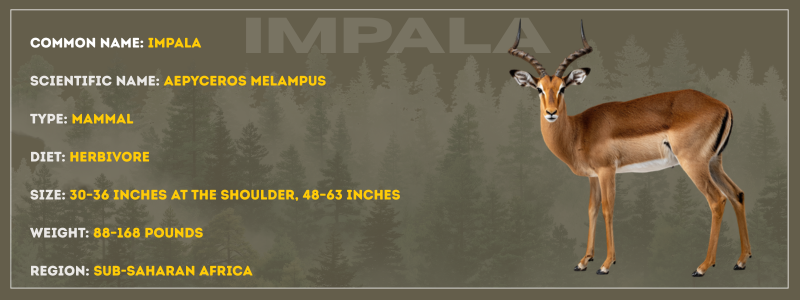
The impala cuts a slender, athletic figure that seems purpose-built for speed. Adult males typically stand between 30 and 36 inches at the shoulder and weigh between 117 and 168 pounds, while females are noticeably smaller and lighter, generally ranging from 88 to 117 pounds.
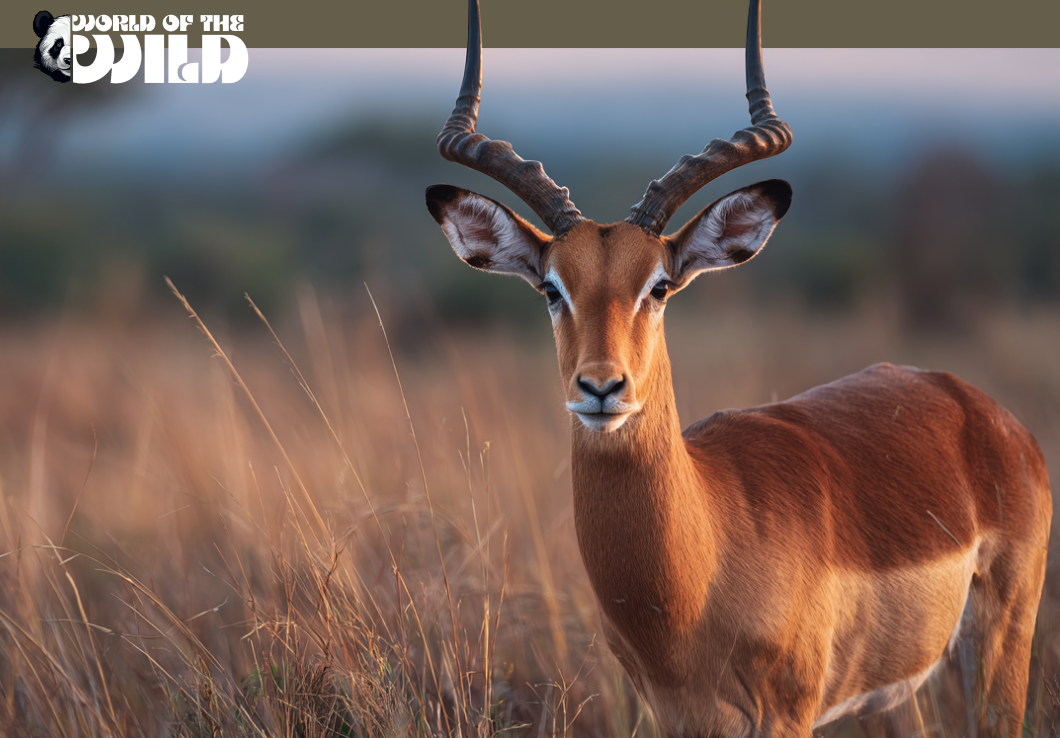
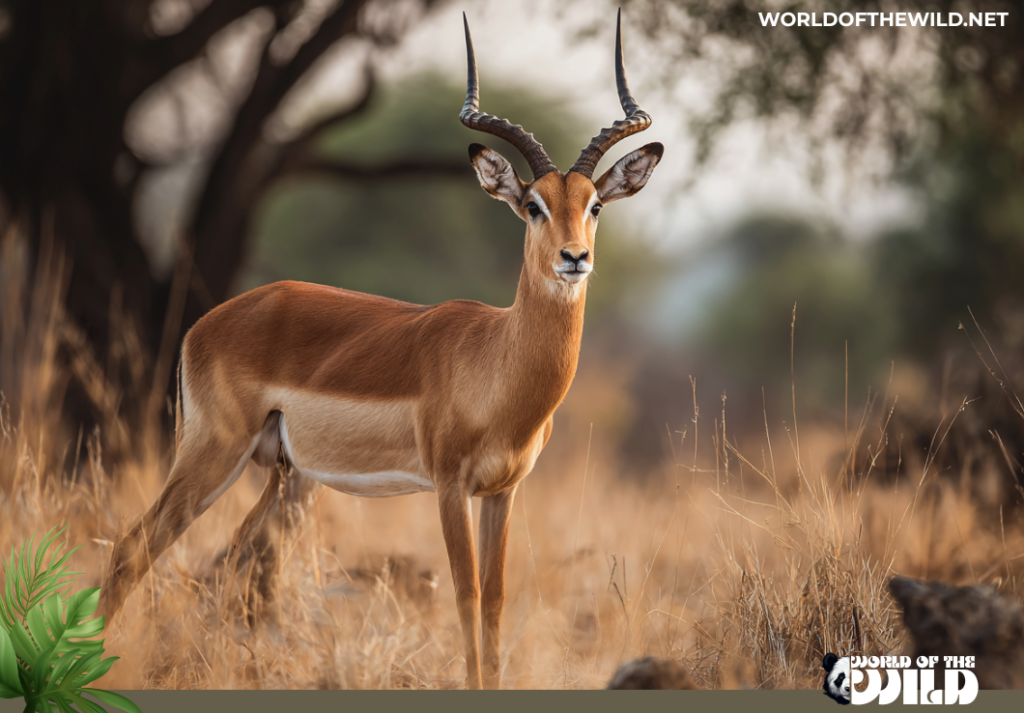
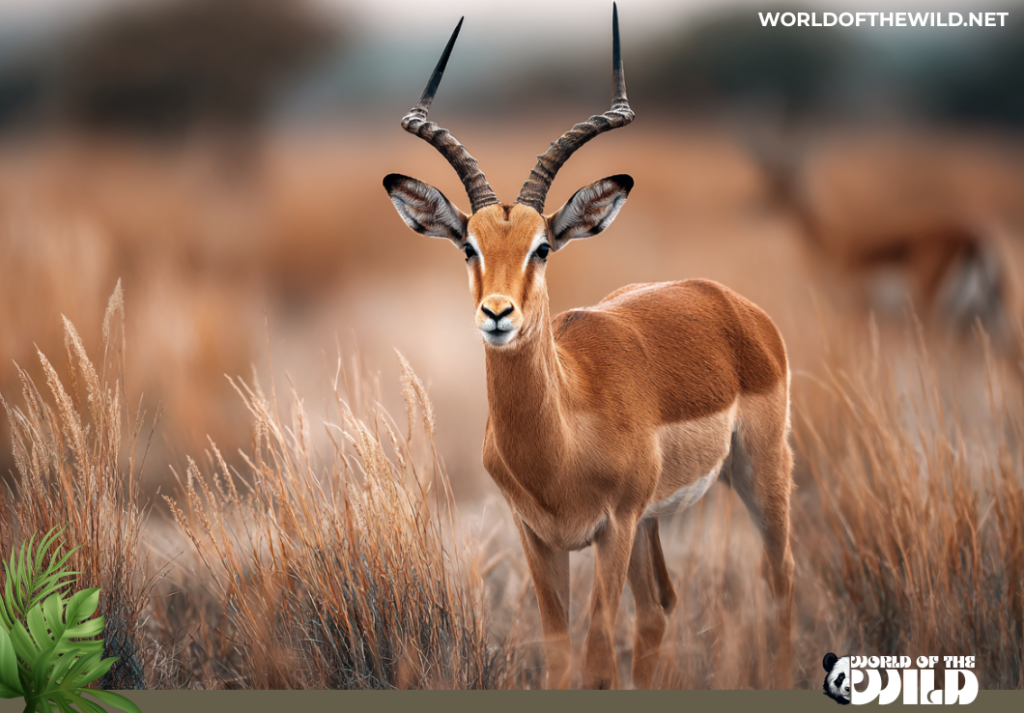
The coat is a warm reddish-brown on the back, fading to a lighter tan on the sides and cream-white on the underbelly — a gradient that provides effective counter-shading camouflage in the dappled light of woodland and savanna edges. The face is refined and alert, with large, dark eyes designed to detect motion across wide fields of view, and prominent ears that swivel independently to locate sound.
Perhaps the most iconic feature of the male impala is its horns — long, lyre-shaped structures that sweep dramatically backward and then curve upward and inward at their tips. These horns can reach lengths of 18 to 36 inches and are used in combat during the breeding season. Females are hornless.
Along the hindquarters, a distinctive vertical black stripe runs down each buttock, flanked by the characteristic black-tufted metatarsal glands on the rear legs. The tail is white on the underside and framed by black edges — when raised during flight from predators, it acts as a visual alarm signal to the rest of the herd.
Behavior
Impalas are intensely social animals, and their group structure shifts with the seasons and the demands of reproduction. For most of the year, herds fall into three basic types: bachelor groups of young and non-dominant males, female-and-juvenile nursery herds, and the harems controlled by dominant territorial males during the rut.
Nursery herds can number anywhere from 10 to over 100 individuals and move as a coordinated unit, constantly alert to danger. Communication within the herd is rich and multi-modal — impalas use vocalizations, body posture, ear positioning, scent, and the visual signal of the raised tail to share information about threats and group cohesion.
One of the most visually arresting behaviors the impala displays is its “stotting” or “pronking” — explosive, seemingly random leaps in multiple directions when fleeing a predator. Unlike a single-direction sprint, this behavior confuses predators and may also signal to them that the individual has been spotted and pursuit will be costly. It is a form of honest signaling: only a healthy, fast animal can afford the energy of such leaps under pressure.
Impalas are also meticulous groomers. They use a specially adapted set of lower incisors and canine teeth — called a dental comb — to comb through their coats, and will often groom one another in a mutual behavior that reinforces social bonds within the herd.
Intelligence-wise, impalas display strong spatial memory, learning the locations of water sources, salt licks, and safe corridors within their home ranges, and adapting their behavior quickly to new threats.
Evolution
The evolutionary story of the impala stretches back to the Pliocene epoch, approximately 5 to 2.5 million years ago, when the genus Aepyceros first appears in the African fossil record. The earliest known ancestor, Aepyceros shungurae, was similar in many respects to the modern impala but inhabited a more forested environment, suggesting that the lineage progressively adapted as African forests gave way to open grassland and savanna ecosystems.
The impala belongs to the family Bovidae — the same family that includes cattle, sheep, and goats — and diverged from this broader group during a period of dramatic climate change in Africa that saw the continent’s forests contract and grasslands expand. This transition was a crucible for evolution, and many of today’s most recognizable African ungulates, including wildebeest, buffalo, and gazelles, emerged and diversified during this same period.
What makes the impala’s evolutionary trajectory particularly interesting is its persistence as a monotypic genus. While other bovid lineages radiated into many species, Aepyceros produced and retained only one. This could reflect the impala’s exceptional adaptability as a mixed feeder, meaning it never needed to specialize — and therefore never split into ecologically distinct forms. Its dietary flexibility may, paradoxically, be the reason it remained singular.
Fossil evidence suggests that during the Pleistocene, impala populations were geographically more widespread than they are today, reaching into North Africa. As climates shifted and habitats changed, the species retreated to the sub-Saharan range it currently occupies.
Habitat
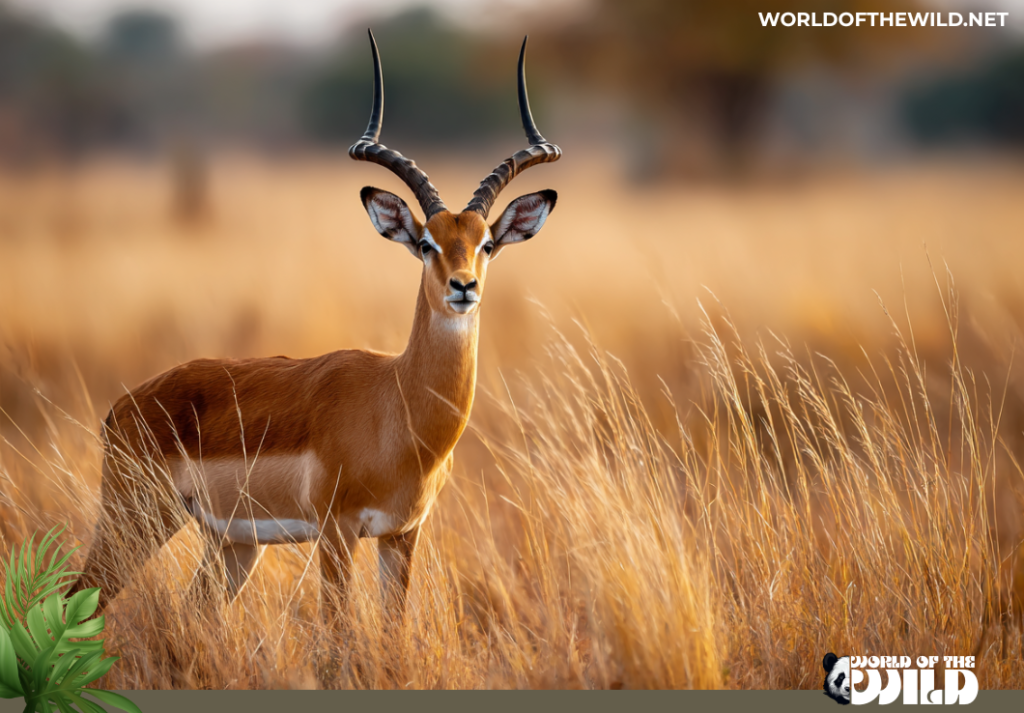
The impala is an animal of ecotones — the transitional zones where different ecosystems meet. It thrives most abundantly at the edges of woodland and open savanna, where both browse and grass are available within a small foraging radius. This habitat preference for mixed environments reflects the species’ dietary versatility.
Geographically, the common impala ranges across a broad swath of eastern and southern Africa, including Kenya, Tanzania, Uganda, Rwanda, Mozambique, Zimbabwe, Zambia, Botswana, and South Africa. Stronghold populations are found in iconic protected areas such as the Serengeti, Kruger National Park, the Okavango Delta, and the Masai Mara.
Impalas are notably water-dependent and are rarely found more than a few miles from a permanent water source. They drink daily when water is available, though they can reduce their intake during the dry season if succulent vegetation provides enough moisture. Altitude is also a limiting factor — the species tends to stay below 8,200 feet, favoring lower-elevation plains and valleys.
The black-faced subspecies, A. m. petersi, is restricted to the rugged, arid terrain of northwestern Namibia’s Kaokoveld and the Cunene region of Angola — a significantly harsher environment than the one its common cousin occupies, and one that has shaped subtle differences in behavior and physiology.
Diet
The impala is a herbivore and, more specifically, an opportunistic mixed feeder — a distinction that sets it apart from many of the specialized grazers and browsers that share its range. This dietary flexibility is one of the most critical factors in its ecological success.
During the wet season, when grasses are green, nutritious, and abundant, impalas graze heavily, cropping short grasses with their lower incisors. As the dry season progresses and grasses become tough and low in nutrition, they shift to browsing — eating leaves, shoots, seed pods, and woody vegetation from shrubs and low-hanging trees. Favored food plants include species of Acacia, Combretum, and a variety of forbs and herbs.
This seasonal dietary shift means impalas do not compete directly with strict grazers like zebras and wildebeest during the dry season, effectively reducing resource conflict and expanding the ecological niches they can occupy. They are also known to consume the nutritious seed pods of acacia trees when they fall during certain seasons, an important supplemental food source high in protein.
Unlike some other antelope species, impalas do not migrate. Their feeding flexibility means they can sustain themselves year-round within a defined home range, moving locally to track food and water availability rather than undertaking the mass movements that define species like wildebeest.
Predators and Threats
Few animals on the African savanna face a more diverse array of predators than the impala. It is preyed upon by virtually every major carnivore in its range, earning it the nickname “the McDonald’s of the African bush” among guides and wildlife biologists — a reflection of how universally it is targeted.
Natural Predators: Lions, leopards, cheetahs, African wild dogs, spotted hyenas, Nile crocodiles, and pythons all regularly prey on impalas. Even large raptors such as the martial eagle have been recorded taking young fawns. The impala’s predator suite is essentially a list of Africa’s apex hunters, and its survival depends on maintaining constant vigilance and superior escape mechanics.
Anthropogenic Threats: Despite the impala’s robust population overall, it faces a constellation of human-caused pressures:
- Habitat loss and fragmentation driven by agricultural expansion and human settlement reduces available range and disrupts traditional movement corridors.
- Bushmeat poaching remains a significant pressure in parts of East and West Africa, where wire snares set for other species often catch impalas indiscriminately.
- Competition with livestock is particularly damaging for the black-faced impala, whose restricted Namibian and Angolan range overlaps increasingly with pastoral communities.
- Disease transmission from domestic cattle, including corridor disease and bovine tuberculosis, poses an emerging risk in areas where wildlife and livestock share habitat.
- Climate change is altering rainfall patterns across sub-Saharan Africa, threatening the water availability and vegetation dynamics that impalas depend upon.
Reproduction and Life Cycle
The impala’s reproductive calendar is one of its most fascinating features, marked by a short but explosive breeding season and a remarkable ability to time births with precision.
The Rut: The breeding season, known as the rut, typically occurs over a two-to-three-week window each year, timed to coincide with the end of the rainy season. During this period, dominant males become intensely territorial, using their loud, roaring calls — audible up to a mile away — to advertise their presence and warn off rivals. Males compete vigorously for access to female herds through ritualized displays, parallel walking, and, when neither animal backs down, clashing horn combat that can be violent and exhausting.
A dominant male may mate with dozens of females during the rut but will be so depleted by constant fighting, chasing, and vigilance that he often loses his territory to a fresher rival within a matter of weeks.
Gestation and Birth: Following mating, the gestation period lasts approximately 194 to 200 days — about six and a half months. Remarkably, females have the ability to delay implantation of the fertilized egg for up to a month, a form of embryonic diapause that allows them to synchronize births within a narrow window when conditions are optimal. The result is a birth pulse — a concentrated explosion of new fawns that overwhelms local predator populations through sheer numbers, improving any individual fawn’s chances of survival.
Females typically give birth to a single fawn. The newborn is hidden in vegetation for its first few weeks of life, with the mother returning only to nurse before the fawn joins the nursery herd. Fawns grow rapidly and are weaned at around four to six months.
Lifespan: Impalas can live up to 12 to 15 years in the wild, though most individuals in predator-rich environments do not reach old age. In captivity, some individuals have survived beyond 17 years.
Population
The common impala (Aepyceros melampus melampus) is currently classified as Least Concern on the IUCN Red List — the strongest conservation status an animal can hold — and for good reason. Global population estimates place the number of common impalas at approximately 2 million individuals, making it one of the most abundant antelopes on the African continent.
Population numbers are considered stable across much of the species’ range, with healthy strongholds in protected areas throughout East and Southern Africa. The species has also proven adaptable to a variety of disturbed and semi-protected landscapes, and thrives in game reserves and private conservancies outside of formal national parks.
The picture is considerably grimmer for the black-faced impala, which is classified as Vulnerable. Fewer than 1,000 individuals are estimated to remain in the wild, confined to a fragmented range in northwestern Namibia and southwestern Angola. Conservation efforts, including translocation programs to establish new populations in protected reserves, have made some progress but the subspecies remains at risk.
Conclusion
The impala is a study in the beauty of evolutionary refinement. Every aspect of its biology — its mixed diet, its synchronized births, its explosive escape leaps, its complex social structure — speaks to an animal that has been relentlessly optimized by millions of years of pressure. It is not the biggest animal on the savanna, nor the rarest, nor the most dangerous. But it may be, in many ways, the most elegantly engineered.
To dismiss the impala as a common sight is to misunderstand the savanna entirely. These animals are the connective tissue of the African ecosystem, feeding the predators, dispersing seeds, and providing a living barometer of ecosystem health. Where impalas thrive in large numbers, the habitat is intact. Where they disappear, something has gone wrong.
The good news is that the impala’s future — particularly for the common subspecies — is not currently in crisis. But the story of the black-faced impala reminds us that no species’ security can be taken for granted. Continued investment in habitat protection, anti-poaching enforcement, and community-based conservation is what stands between the current stability and a very different future.
The next time you find yourself on the African savanna, resist the urge to look past the impala. Watch it instead — the flick of its ear, the explosive launch of a leaping escape, the roar of a rutting male echoing across the grass at dusk. In that moment, you are watching one of evolution’s great success stories, still unfolding in real time.
Quick Reference
| Scientific Name | Aepyceros melampus |
| Diet Type | Herbivore (mixed grazer and browser) |
| Height | 30–36 inches at the shoulder |
| Body Length | 48–63 inches |
| Weight | 88–168 pounds |
| Region Found | Sub-Saharan Africa (East and Southern Africa; limited range in Southwest Africa for black-faced subspecies) |