
In the remote volcanic islands of Indonesia, a creature straight from prehistoric nightmares still stalks the earth. The Komodo dragon, with its forked yellow tongue flicking through the air and its serrated teeth dripping with bacteria-laden saliva, embodies both beauty and terror in equal measure. These magnificent reptiles aren’t merely large lizards—they’re apex predators that have evolved hunting strategies sophisticated enough to take down prey ten times their size, and they’ve done so for millions of years.
What makes the Komodo dragon truly fascinating isn’t just its fearsome reputation or its status as the world’s largest living lizard. It’s the combination of ancient lineage, surprising intelligence, remarkable adaptations like venom production, and even the ability to reproduce without males. In an age where megafauna have largely vanished, the Komodo dragon stands as a living connection to a wilder, more primal world—and a sobering reminder of what we stand to lose if conservation efforts fail.
Facts
Here are some remarkable facts about these incredible reptiles that go beyond their famous size and bite:
Venom, Not Just Bacteria: For decades, scientists believed Komodo dragons relied solely on bacteria in their mouths to kill prey. Research has since revealed they actually possess venom glands that produce anticoagulants, preventing blood clotting and inducing shock in their victims.
Virgin Births: Female Komodo dragons can reproduce through parthenogenesis, a form of asexual reproduction where eggs develop without fertilization. This produces only male offspring and likely evolved as a survival mechanism for colonizing new islands.
Super Smellers: Komodo dragons can detect carrion from up to six miles away using their highly sensitive forked tongues, which they flick up to 15 times per minute to sample airborne molecules.
Iron-Coated Teeth: Unlike most reptiles that replace teeth throughout their lives, Komodo dragons have teeth edged with iron, making them incredibly resistant to wear and exceptionally sharp for slicing flesh.
Ancient Swimmers: Despite their bulk, Komodo dragons are excellent swimmers and have been recorded traveling between islands, which explains their distribution across multiple Indonesian islands.
Cannibalistic Youth: Young Komodo dragons spend their first years in trees to avoid being eaten by larger adults, including their own parents. Cannibalism accounts for up to 10% of the Komodo dragon diet.
Speed Demons: These massive lizards can run in short bursts of up to 13 miles per hour, fast enough to chase down deer and even humans if threatened or hunting.
Species
The Komodo dragon belongs to the following taxonomic classification:
Kingdom: Animalia
Phylum: Chordata
Class: Reptilia
Order: Squamata
Family: Varanidae
Genus: Varanus
Species: Varanus komodoensis
The Komodo dragon is part of the monitor lizard family, which includes approximately 80 species distributed across Africa, Asia, and Oceania. Its closest living relatives are other large monitor lizards, particularly the lace monitor (Varanus varius) of Australia and the crocodile monitor (Varanus salvadorii) of New Guinea. Recent genetic studies suggest that Komodo dragons share a common ancestor with Australian monitors, supporting the theory that their lineage originated from Australia before dispersing to Indonesia.
While Varanus komodoensis is a single species with no recognized subspecies, there is some genetic variation between populations on different islands. The dragons on Komodo Island show slight genetic differences from those on Flores or Rinca, though these variations are not significant enough to warrant subspecies designation. All Komodo dragons alive today descend from a relatively small founder population, making them genetically less diverse than many other widespread species.
Appearance
The Komodo dragon is an imposing creature that commands respect through sheer physical presence alone. Adults typically measure between 8 to 10 feet in length, though some exceptional males have been recorded at over 10 feet. Their weight is equally impressive, with males averaging 175 to 200 pounds, while the heaviest individuals can exceed 300 pounds. Females are considerably smaller, usually reaching only about 6 feet in length and weighing up to 150 pounds.
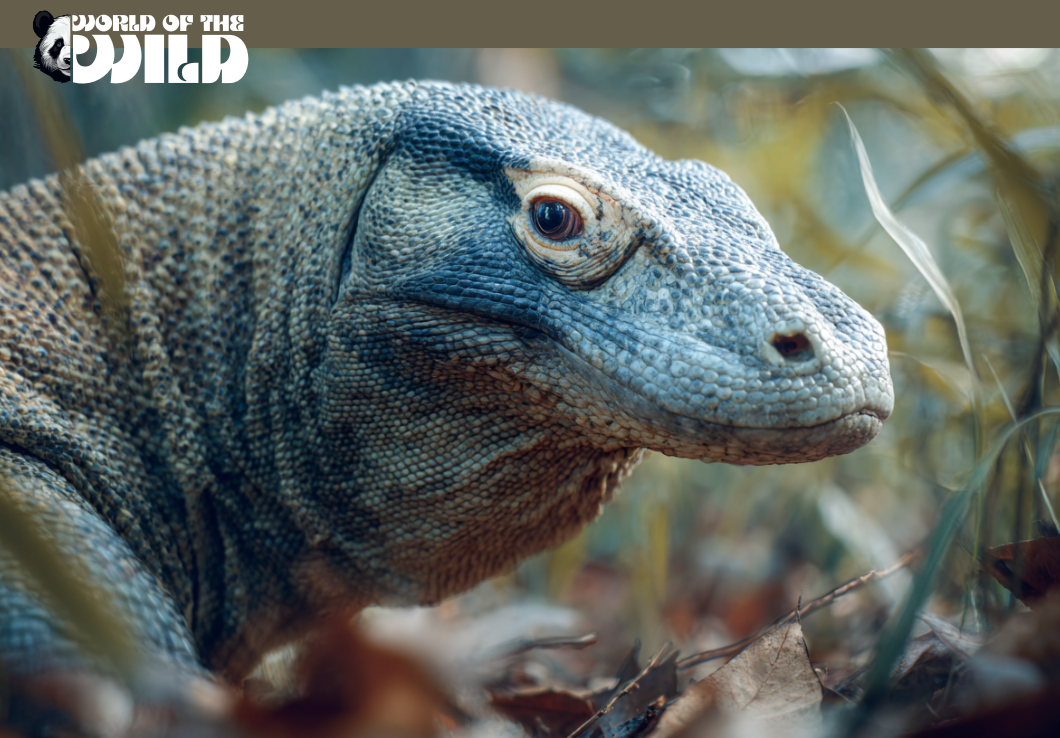
The dragon’s body is covered in rough, reinforced scales that range from dark gray to reddish-brown, often with a dusty, earthy appearance that provides excellent camouflage against the volcanic soil and savanna grasslands of their habitat. Younger dragons display a more vibrant coloration, featuring yellow and greenish bands or spots that fade as they mature. This juvenile coloration may serve to differentiate young dragons from adults, potentially reducing cannibalism—though clearly not eliminating it entirely.
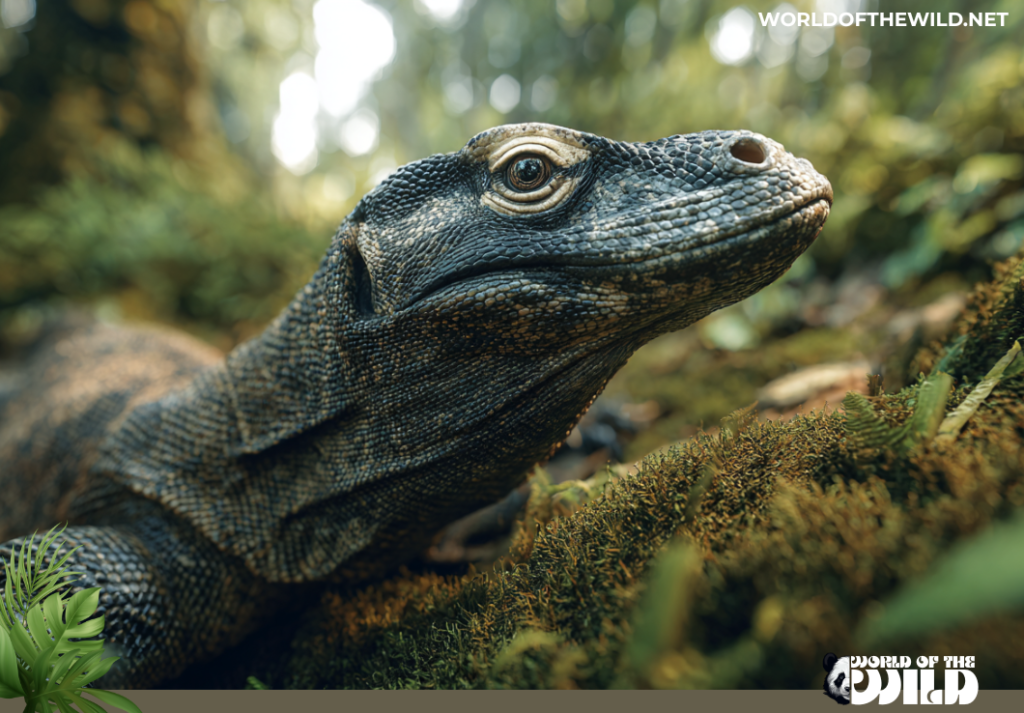
Their heads are flat and broad, equipped with a rounded snout and powerful jaws that can open remarkably wide. The teeth are perhaps their most distinctive feature: curved, serrated, and numbering up to 60, they resemble those of carnivorous dinosaurs. Each tooth measures up to an inch in length and is designed for tearing and cutting flesh rather than chewing. The tongue is long, forked, and bright yellow, creating a striking visual contrast against their darker coloration.
Komodo dragons possess strong, muscular limbs with sharp, curved claws perfect for gripping prey and climbing when young. Their tails are as long as their bodies and serve multiple purposes: balance while running, defense when whipped at threats, and even as a weapon during territorial disputes. The skin around their necks and throats appears loose and folded, expanding significantly when they feed on large meals.
Behavior
Komodo dragons are primarily solitary creatures, coming together only for feeding frenzies at carcasses or during the breeding season. They are diurnal hunters, most active during the day when temperatures are optimal for their cold-blooded metabolism. Each dragon maintains a home range of approximately 0.7 to 1.2 square miles, which they patrol regularly using well-worn paths through their territory.
Despite their solitary nature, Komodo dragons have established a dominance hierarchy based on size. When multiple dragons converge on a carcass, the largest individuals feed first while smaller ones wait their turn or attempt to snatch scraps. During these encounters, they display a remarkable awareness of social structure, with subordinate dragons approaching cautiously and using submissive body language to avoid confrontation. Communication occurs through hissing, body posturing, and even ritualized combat between males, where they wrestle while standing on their hind legs—a spectacle that resembles sumo wrestling.
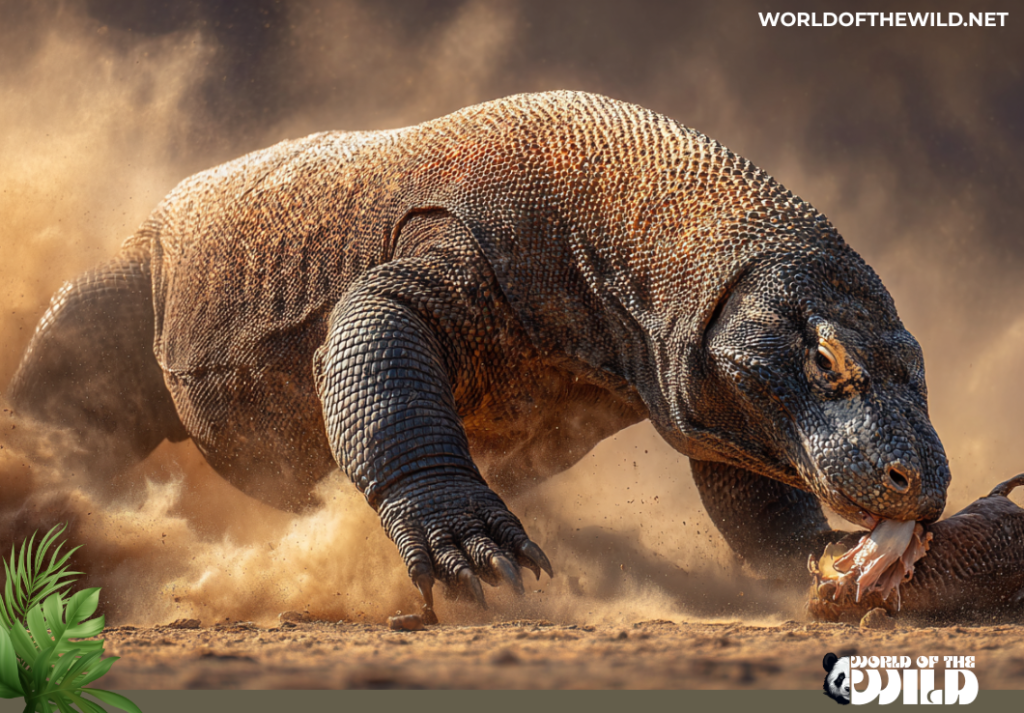
Their hunting strategy demonstrates surprising intelligence and patience. Komodo dragons employ a “bite-and-wait” technique: they inflict a devastating bite on large prey, then follow the wounded animal for hours or even days until venom and blood loss cause collapse. Their keen sense of smell allows them to track victims over considerable distances. They also demonstrate opportunistic intelligence, positioning themselves along game trails where prey regularly passes, or lurking near water sources during dry seasons.
One of their most remarkable adaptations is behavioral thermoregulation. Unable to generate their own body heat, Komodo dragons carefully manage their temperature throughout the day. They emerge from burrows at dawn to bask in the sun, positioning themselves perpendicular to the sun’s rays for maximum heat absorption. During midday heat, they retreat to shade or burrows, then resume activity in the late afternoon. This careful temperature management is crucial for digestion, as they require body temperatures between 95-100°F to properly digest large meals.
Young dragons exhibit dramatically different behavior, spending their first year of life in trees to avoid predation by adults. They feed primarily on insects, geckos, and bird eggs until they grow large enough—around four feet—to descend permanently and transition to ground-dwelling life. This arboreal period is critical for survival, as studies show that adult dragons will readily cannibalize juveniles.
Evolution
The evolutionary history of the Komodo dragon is a tale of island gigantism, ancient dispersal, and surprising connections to Australia’s vanished megafauna. Contrary to popular belief, Komodo dragons are not prehistoric relics that have remained unchanged for millions of years. Instead, they represent a relatively recent evolutionary development in the grand timeline of life on Earth.
Fossil evidence suggests that monitor lizards of the genus Varanus first appeared in Central Asia approximately 40 million years ago during the Eocene epoch. From there, they radiated across Asia, Africa, and eventually reached Australia. The direct ancestors of Komodo dragons likely evolved in Australia during the Pleistocene epoch, approximately 4 million years ago. These proto-Komodo dragons would have shared their environment with Australia’s famous megafauna, including giant marsupials and massive reptiles.
The most significant discovery in understanding Komodo dragon evolution came from fossil sites in Queensland, Australia, where researchers found remains of Varanus priscus (formerly known as Megalania), a giant monitor lizard that grew up to 20 feet long and weighed over 1,000 pounds. While not a direct ancestor, this extinct mega-lizard was closely related to modern Komodo dragons and demonstrates the potential for extreme gigantism in the varanid lineage.
Scientists believe that ancestors of the Komodo dragon dispersed from Australia to Indonesia approximately 900,000 years ago, during periods when sea levels were lower and island-hopping was more feasible. Once isolated on the Indonesian islands, these populations evolved into the species we recognize today. The island environment provided the perfect conditions for their size to flourish—a phenomenon known as island gigantism, where species isolated on islands with few predators and limited competition often evolve to larger sizes than their mainland relatives.
Interestingly, recent studies suggest that Komodo dragons may actually be more closely related to Australian monitors than to other Indonesian lizards, supporting the theory of their Australian origin. The development of their sophisticated venom system likely evolved as these lizards grew larger and began hunting increasingly dangerous prey, providing a competitive advantage that allowed them to become apex predators on their limited island ranges.
Habitat
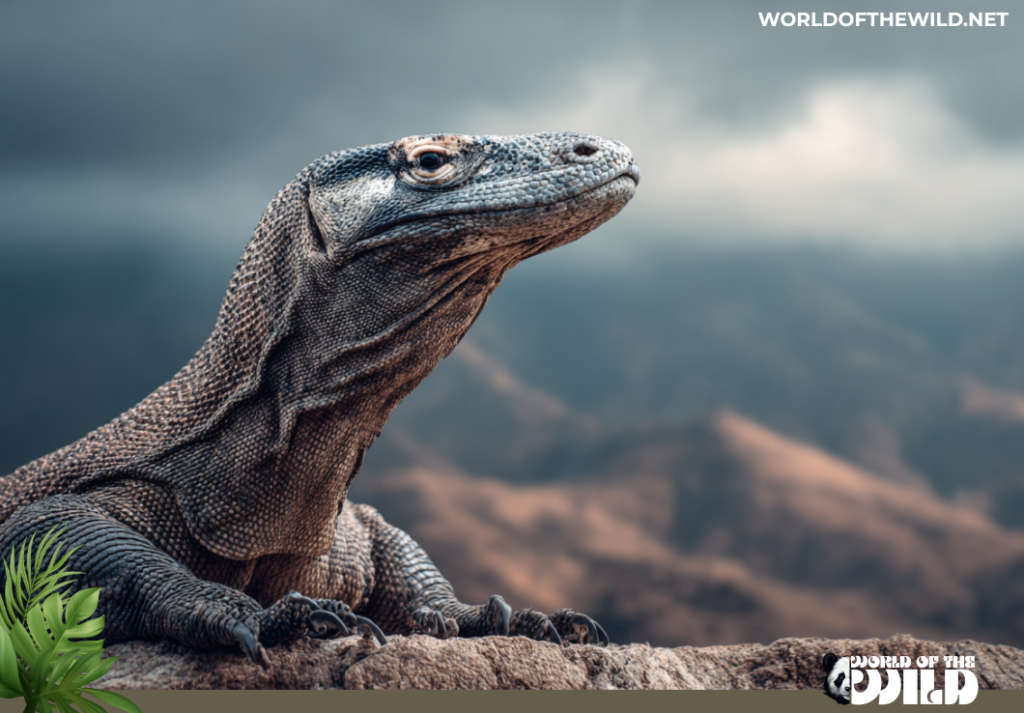
The Komodo dragon has one of the most restricted ranges of any large predator on Earth. These remarkable reptiles are endemic to Indonesia, found naturally on only five islands in the Lesser Sunda Islands: Komodo, Rinca, Flores, Gili Motang, and Gili Dasami. The total area of their natural range covers approximately 1,800 square kilometers, making them one of the world’s most geographically limited apex predators.
Within these islands, Komodo dragons inhabit a diverse range of environments, though they show strong preferences for certain habitat types. They thrive in hot, dry savanna grasslands dotted with acacia and lontar palm trees, which dominate the landscape during the lengthy dry season. These open areas provide excellent hunting grounds where dragons can spot prey from a distance and utilize their surprising bursts of speed to chase down victims.
The dragons also frequent tropical deciduous forests, particularly along the ecotones where forest meets grassland. These transitional zones offer the best of both worlds: shade during the intense midday heat and access to prey animals that venture from forest cover. Coastal beaches and mangrove forests represent another important habitat, especially for dragons seeking marine turtle eggs or carrion washed ashore. Dragons have been observed swimming between islands through these coastal waters, demonstrating their comfort in marine environments.
The volcanic nature of the islands creates a varied topography of hills, valleys, and rocky outcrops that dragons incorporate into their territories. They dig burrows or commandeer existing ones—sometimes appropriating those created by other animals—for shelter during the night and the hottest parts of the day. These burrows maintain more stable temperatures than the surface and provide refuge from the extreme temperature fluctuations common in tropical savanna environments.
Water sources are critical to dragon habitat, particularly during the dry season that lasts from April to December. Dragons regularly visit rivers, waterholes, and seasonal pools, not only for drinking but also for thermoregulation. The availability of water influences dragon distribution across the islands, with higher densities occurring in areas with reliable water sources.
The habitat is characterized by a monsoonal climate, with a pronounced dry season and a brief but intense wet season from January to March. During the wet season, the landscape transforms from brown and dusty to lush and green, but dragons seem to prefer the drier conditions when prey animals are forced to congregate around limited water sources.
Diet
The Komodo dragon is an apex carnivore with a diet as varied as it is gruesome. These formidable predators are opportunistic feeders, meaning they’ll consume virtually any meat they can acquire, whether through active hunting or scavenging. Their reputation as both efficient hunters and patient scavengers makes them ecological keystone species in their island habitats.
Large ungulates form the cornerstone of the adult Komodo dragon diet. They regularly hunt Timor deer, which were introduced to the islands and now represent their primary prey species. Water buffalo, particularly young or weakened individuals, also fall victim to dragon attacks. Wild boar provide another substantial food source, though their aggressive nature and formidable tusks make them more dangerous prey. A single Komodo dragon can consume up to 80% of its body weight in one feeding, gorging itself when a large kill or carcass becomes available.
The hunting technique employed by Komodo dragons is a masterpiece of patient predation. They typically ambush prey along well-traveled game trails, lying motionless for hours until an animal passes within striking distance. The attack itself is swift and brutal: the dragon lunges forward, using its powerful neck muscles to drive its serrated teeth deep into the victim’s flesh. The venom delivered through specialized glands in the lower jaw contains anticoagulant proteins that prevent blood clotting, vasodilators that lower blood pressure, and compounds that induce shock.
After inflicting this devastating bite, the dragon doesn’t engage in a prolonged struggle. Instead, it follows the wounded animal from a safe distance, sometimes for days, waiting for venom and blood loss to do their work. The dragon’s extraordinary sense of smell allows it to track dying prey over vast distances, and multiple dragons may converge on a weakened animal, competing for the opportunity to feed first.
Scavenging represents an equally important component of their diet. Komodo dragons can smell rotting flesh from up to six miles away and will travel significant distances to reach a carcass. They’re not picky eaters—carrion in various stages of decomposition is readily consumed, and their powerful stomach acid can digest bones, horns, and hide. This ability to extract maximum nutrition from carcasses makes them incredibly efficient users of available food resources.
Smaller prey items supplement the diet of all dragons but are particularly important for juveniles and subadults. These include rodents, birds and their eggs, smaller reptiles including other lizards and snakes, and even insects. Young dragons living in trees feed almost exclusively on insects, geckos, and bird eggs until they’re large enough to hunt ground-dwelling prey.
Perhaps most disturbingly, cannibalism is not uncommon among Komodo dragons. Larger individuals will readily consume smaller dragons, including juveniles and eggs. This predatory pressure from their own species is why young dragons spend their early years in trees and why they roll in fecal matter—the scent disguises them from larger dragons that might otherwise view them as prey.
Komodo dragons can survive on surprisingly little food when necessary. Their slow metabolism allows them to subsist on as few as 12 meals per year, though they certainly eat more frequently when food is available. They can go for months without eating, living off fat stores accumulated during times of plenty.
Predators and Threats
Adult Komodo dragons sit atop their island food chains with virtually no natural predators. Their size, powerful build, venomous bite, and aggressive nature make them formidable enough to deter any potential threats. However, the story is quite different for young dragons, and the species as a whole faces significant challenges to its survival.
Juvenile Komodo dragons face predation pressure from multiple sources. Their greatest threat comes from their own species—adult Komodo dragons readily cannibalize juveniles, which is why young dragons exhibit their distinctive tree-dwelling behavior for the first year of life. Other predators of young dragons include large snakes, particularly pythons, and birds of prey such as eagles and hawks. Wild boar and feral dogs also pose threats to small dragons when the opportunity arises.
The anthropogenic threats facing Komodo dragons are far more serious and wide-reaching than natural predation. Habitat loss represents the most pressing concern. Human settlement expansion on Flores Island, the largest island in their range, has resulted in significant habitat fragmentation. Agricultural development, particularly for rice cultivation and palm plantations, has reduced and divided dragon territory. As human communities expand, the buffer zones between villages and dragon habitat shrink, leading to increased human-wildlife conflict.
Climate change poses an existential threat to these cold-blooded reptiles. Rising temperatures and changing rainfall patterns affect both the dragons directly and their prey species. Extended droughts reduce the populations of deer and other herbivores, creating food scarcity for dragons. Rising sea levels, predicted to accelerate in coming decades, threaten to inundate low-lying coastal areas where dragons hunt and nest. Some projections suggest that climate change could render significant portions of current dragon habitat unsuitable within the next 50-100 years.
Prey depletion through human hunting significantly impacts dragon populations. Local communities hunt deer and wild boar for food, directly competing with dragons for the same prey base. In areas where human hunting pressure is high, dragons struggle to find sufficient food, leading to reduced body condition, lower reproductive success, and increased territorial conflict as dragons compete for limited resources.
Tourism, while economically important for conservation funding, creates its own set of problems. Irresponsible tourism practices can disturb nesting sites, alter dragon behavior, and create dangerous situations for both humans and dragons. The practice of baiting dragons with live goats for tourist viewing has been phased out due to concerns about creating artificial feeding behaviors and dependencies.
Illegal poaching, though less common than other threats, still occurs. Dragons have been captured for the illegal wildlife trade, though international protections have made this less frequent. More commonly, poachers target the dragons’ prey species, indirectly threatening dragon populations through resource depletion.
Genetic concerns also threaten long-term survival. The naturally small population size and geographic isolation of Komodo dragons result in low genetic diversity. This genetic bottleneck makes the population more vulnerable to disease, reduces adaptive potential in changing environments, and can lead to inbreeding depression. Should disease sweep through one island population, the limited genetic diversity could prevent effective immune responses.
Finally, introduced species pose ongoing challenges. Feral dogs compete with dragons for food and prey on juveniles. Invasive plant species alter habitat structure, potentially reducing prey populations or changing the savanna ecosystems dragons depend on.
Reproduction and Life Cycle
The reproductive biology of Komodo dragons is as fascinating as it is unusual, featuring complex mating rituals, remarkable parental strategies, and the extraordinary ability to reproduce without males.
The breeding season typically occurs between May and August, coinciding with the dry season. Males become highly territorial during this period, competing intensely for access to females. Territorial disputes involve ritualized combat where males rear up on their hind legs, grasp each other with their forelimbs, and attempt to throw their opponent to the ground. These wrestling matches can last for hours and occasionally result in injuries, though serious wounds are relatively rare. The victor gains mating rights and maintains dominance over a territory that may include several females.
Courtship itself is a surprisingly gentle affair given the dragon’s fearsome reputation. Males approach females with caution, flicking their tongues frequently to assess the female’s receptivity. If she’s receptive, the male will stroke the female’s back and head with his claws and tongue. Mating can last for several hours, with the male using his strong limbs to maintain position.
Approximately one month after mating, females begin seeking suitable nesting sites. They show strong preferences for abandoned megapode bird nests, which are large mounds of decomposing vegetation that provide stable temperatures and humidity. If megapode nests aren’t available, females will excavate their own burrows or use natural caves. The female may dig several false nests to confuse potential predators before selecting the final nesting site.
Egg-laying occurs between August and September, roughly three months after mating. A typical clutch contains 20 to 30 eggs, though clutches of up to 40 have been recorded. The eggs are large, leathery, and roughly the size of a grapefruit. After laying, the female guards the nest for several weeks to several months, a behavior unusual among monitor lizards. However, even this parental protection is temporary—by the time the eggs hatch, the mother has typically abandoned the nest.
The incubation period lasts approximately 7 to 8 months, with eggs hatching between April and May, just as the wet season brings abundant insects and small prey. Hatchlings emerge weighing about 100 grams and measuring roughly 16 inches long. They are immediately independent and receive no parental care. Their first instinct is to run for the nearest tree, where they’ll spend most of the next year.
Here is where Komodo dragon reproduction becomes truly extraordinary: females are capable of parthenogenesis, or virgin birth. In the absence of males, females can produce viable eggs that develop into offspring without fertilization. This asexual reproduction produces only male offspring due to the ZW sex-determination system in reptiles. Several documented cases in zoos have confirmed this ability, and scientists believe it evolved as a mechanism for colonizing new islands. A single pregnant female washing up on an uninhabited island could theoretically establish an entire population by producing male offspring, which could then breed with her in subsequent seasons.
The juvenile stage is perilous. Young dragons spend 1 to 3 years in trees, descending only to feed on insects, small lizards, and bird eggs. They roll in feces and carrion to mask their scent from larger dragons. Mortality during this stage is extremely high, with estimates suggesting that fewer than 10% of hatchlings survive to adulthood.
As they grow, dragons gradually transition to terrestrial life. By age 3 to 5, they’re too large for effective climbing and become permanent ground dwellers. They reach sexual maturity between 8 to 10 years old, though growth continues throughout life, just at a slower rate after maturity.
In the wild, Komodo dragons can live 30 to 40 years, though many don’t reach this age due to competition, injury, or food scarcity. In captivity, where food is regular and threats are minimal, they’ve been known to live beyond 50 years. The oldest confirmed Komodo dragon in captivity lived to 54 years.
The dragon’s life cycle represents a remarkable balance of r-selected traits (high offspring numbers, minimal parental care) and k-selected traits (late maturity, long lifespan). This mixed strategy has served them well for millennia, though it makes them vulnerable to rapid environmental changes since populations cannot rebound quickly from declines.
Population
The Komodo dragon is currently classified as Endangered on the International Union for Conservation of Nature (IUCN) Red List, having been uplisted from Vulnerable in 2021. This classification reflects growing concerns about climate change impacts, habitat loss, and the species’ extremely limited range. The uplisting sparked international attention and renewed conservation efforts, though the challenges remain substantial.
Estimating the precise population of Komodo dragons is difficult due to their remote habitat and elusive nature. The most recent comprehensive surveys estimate the total wild population at approximately 3,000 to 5,000 individuals, though these numbers come with significant uncertainty. Some conservation organizations cite more conservative figures of around 3,000 mature adults.
The population is distributed unevenly across the five islands where dragons naturally occur. Komodo Island hosts the largest population, estimated at roughly 1,700 individuals. Rinca Island, the second-largest population center, supports approximately 1,300 dragons. Flores Island, despite being the largest landmass, has a fragmented population of about 300 to 500 individuals due to extensive human settlement. The small islands of Gili Motang and Gili Dasami each support populations of fewer than 100 individuals.
Population trends present a complex and concerning picture. While total numbers have remained relatively stable or even slightly increased in protected areas over the past few decades, this stability masks deeper problems. Genetic analysis reveals declining genetic diversity, suggesting population isolation is increasing. The Flores population, in particular, shows signs of fragmentation into smaller, isolated subpopulations that may not be demographically viable in the long term.
Several factors contribute to population vulnerability beyond absolute numbers. The entire species exists within an area smaller than Rhode Island, making them extraordinarily vulnerable to catastrophic events. A single disease outbreak, natural disaster, or rapid climate change event could devastate the entire species. Additionally, the male-biased sex ratio observed in some populations—potentially a result of temperature-dependent sex determination influenced by rising temperatures—could affect long-term reproductive success.
Climate change projections paint a particularly dire picture for future populations. Models suggest that rising sea levels could reduce dragon habitat by up to 30% by 2050, with some low-lying areas essential for nesting becoming completely inundated. Rising temperatures may also affect prey availability and alter the sex ratios of hatchlings, potentially creating a feedback loop of declining populations.
Conservation efforts have shown some success in stabilizing populations within Komodo National Park, established in 1980 specifically to protect the species. The park protects approximately 60% of the dragon’s range and has successfully reduced poaching and habitat destruction within its boundaries. Outside the park, however, dragons face continued pressure from human encroachment and resource competition.
Captive populations provide some insurance against extinction. Approximately 60 institutions worldwide maintain Komodo dragons in captivity, with the global captive population numbering around 200 individuals. Breeding programs have been moderately successful, though many captive dragons are descended from a limited number of founders, constraining genetic diversity in captive populations as well.
The Indonesian government, in partnership with international conservation organizations, monitors dragon populations through regular surveys and has implemented programs to reduce human-wildlife conflict and protect critical habitat. However, limited funding, political challenges, and the competing needs of local human communities make conservation a constant struggle.
The situation remains precarious. While Komodo dragons are not on the immediate brink of extinction, their endangered status reflects the very real threats they face and their limited ability to adapt to rapidly changing conditions.
Conclusion
The Komodo dragon stands as one of nature’s most extraordinary predators, a living testament to the power of island evolution and the remarkable diversity of life on Earth. From their iron-coated teeth and sophisticated venom system to their ability to reproduce without males and their complex social behaviors, these ancient reptiles challenge our understanding of what it means to be a “simple” lizard. They are intelligent, adaptable, and fearsome—creatures that command both our respect and our protection.
Yet for all their evolutionary success and formidable adaptations, Komodo dragons face an uncertain future. Confined to a handful of Indonesian islands totaling less than 700 square miles, their entire species could be devastated by events beyond their control. Climate change, habitat loss, and human encroachment threaten to unravel millions of years of evolutionary refinement in mere decades. The 2021 uplisting to Endangered status serves as both a warning and a call to action.
The story of the Komodo dragon is ultimately our story too. These magnificent reptiles survived the extinction events that claimed countless other species, persisted through ice ages and volcanic eruptions, and continued to thrive in their island kingdoms long after humanity’s closest evolutionary relatives appeared on Earth. Their survival now depends not on their strength or their venom or their ability to smell prey from miles away, but on our willingness to prioritize their continued existence.
Supporting Komodo dragon conservation means protecting not just a single species, but entire island ecosystems. It means respecting the boundaries between human development and wild spaces. It means acting on climate change before rising seas swallow the beaches where future generations of dragons might otherwise nest. The dragons have done their part—they’ve survived for millions of years. The question is whether we’ll do ours.
Every species we save is a victory against the tide of extinction sweeping across our planet. The Komodo dragon deserves to be one of those victories. The dragons are still here, still hunting, still ruling their volcanic island kingdoms. Let’s ensure they always will be.
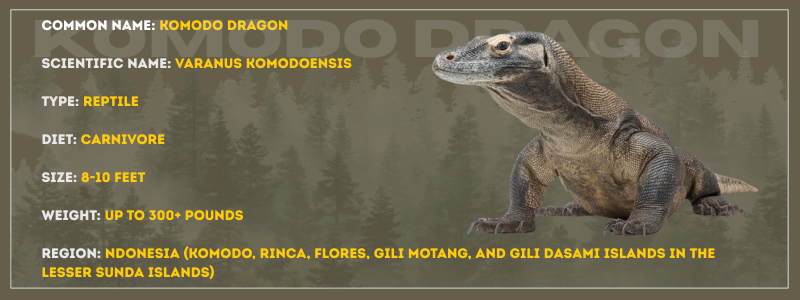
Scientific Name: Varanus komodoensis
Diet Type: Carnivore
Size: 8-10 feet in length (up to 10+ feet for exceptional individuals)
Weight: 175-200 pounds (males average); up to 300+ pounds (largest individuals)
Region Found: Indonesia (Komodo, Rinca, Flores, Gili Motang, and Gili Dasami islands in the Lesser Sunda Islands)