
In the frigid waters of the Arctic, where ice floes drift across steel-gray seas and temperatures plunge far below freezing, one creature reigns supreme as the undisputed heavyweight champion of these frozen realms. The walrus, with its drooping mustache of bristles and magnificent ivory tusks that can grow longer than a yardstick, is among the most distinctive and charismatic mammals on Earth. These massive pinnipeds are living relics of the ice age, perfectly adapted to survive in one of the planet’s harshest environments. Beyond their immediately recognizable appearance, walruses play a crucial role in Arctic marine ecosystems and hold deep cultural significance for Indigenous peoples who have coexisted with them for millennia. As climate change reshapes the polar regions at an alarming pace, understanding these remarkable animals has never been more important.
Facts
- Tusks Never Stop Growing: A walrus’s tusks continue to grow throughout its entire life, with the longest recorded tusk measuring an astounding 39 inches. These are actually elongated canine teeth that grow through the upper lip.
- Vacuum-Powered Feeders: Walruses can create powerful suction with their mouths, allowing them to suck clams right out of their shells. They’ve been observed eating up to 6,000 clams in a single feeding session.
- Color-Changing Skin: Walruses appear to change color from brownish-pink to nearly white. In cold water, blood vessels constrict to conserve heat, making their skin appear pale. When basking in the sun, increased blood flow makes them appear pink or even reddish.
- Impressive Divers: Despite their bulk, walruses can dive to depths of over 500 feet and hold their breath for up to 30 minutes while foraging on the ocean floor.
- Air Bag Sleepers: Walruses have pharyngeal pouches (air sacs in their throat) that they can inflate to act like built-in life preservers, allowing them to sleep vertically in the water with their heads bobbing above the surface.
- Sensitive Whiskers: Their distinctive mustaches consist of 400-700 highly sensitive whiskers called vibrissae, which help them detect prey in dark, murky waters and can even determine the size and shape of objects without seeing them.
- Heavyweight Champions: Pacific walruses are among the largest pinnipeds, with males occasionally exceeding 4,000 pounds—heavier than most automobiles.
Species
The walrus belongs to the following taxonomic classification:
- Kingdom: Animalia
- Phylum: Chordata
- Class: Mammalia
- Order: Carnivora
- Family: Odobenidae
- Genus: Odobenus
- Species: Odobenus rosmarus
The scientific name Odobenus derives from Greek words meaning “tooth walker,” referring to how walruses use their tusks to haul themselves onto ice. The species name rosmarus likely comes from old Norse words for “whale-horse.”
Walruses are unique within their family—they are the only living members of Odobenidae, making them taxonomically distinct from seals (Phocidae) and sea lions (Otariidae), though all three groups belong to the larger clade of pinnipeds.
There are two recognized subspecies of walrus:
Pacific Walrus (Odobenus rosmarus divergens): The larger of the two subspecies, inhabiting the Bering and Chukchi Seas. Pacific walruses have slightly longer tusks and broader snouts compared to their Atlantic cousins.
Atlantic Walrus (Odobenus rosmarus rosmarus): Found in the Atlantic Arctic, from northeastern Canada to western Russia. This subspecies is generally smaller and has experienced more significant population declines due to historical hunting.
Some researchers have proposed a third subspecies, the Laptev Walrus (Odobenus rosmarus laptevi), which would inhabit the Laptev Sea, but this classification remains controversial and is not universally accepted.
Appearance
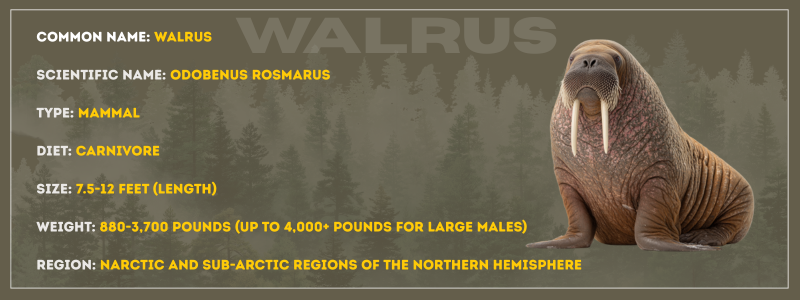
The walrus is an unmistakable giant of the Arctic, built like a massive, blubbery torpedo designed for life in icy waters. Adult males (bulls) are significantly larger than females (cows), with bulls weighing between 1,700 to 3,700 pounds and reaching lengths of 10 to 12 feet. Exceptional males can exceed 4,000 pounds. Females are more modest in size, typically weighing 880 to 2,750 pounds and measuring 7.5 to 10 feet in length.
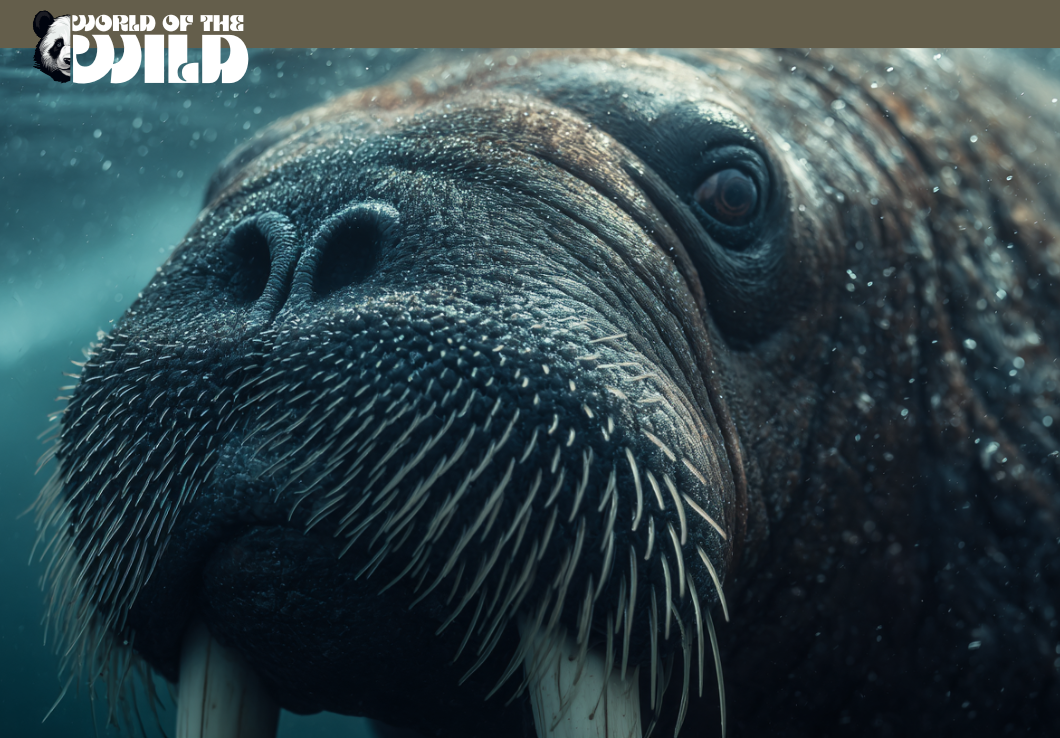
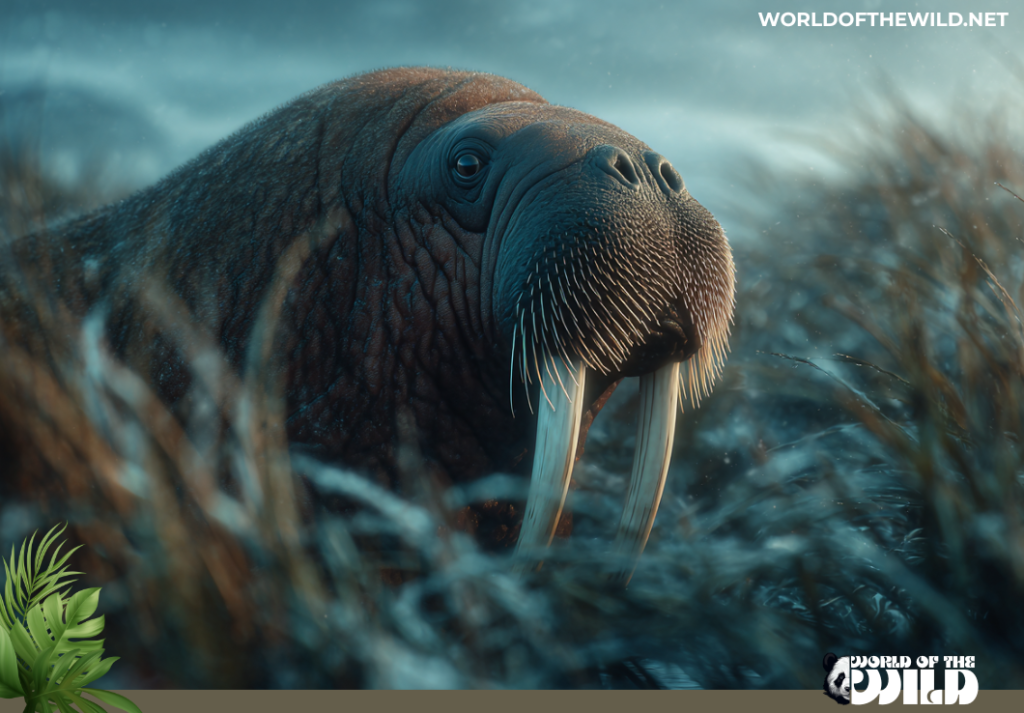
The walrus’s most famous feature is undoubtedly its impressive tusks, which are present in both sexes but generally larger in males. These elongated upper canine teeth can reach lengths of three feet in males and slightly shorter in females. The tusks emerge through the upper lip and curve slightly backward. Bulls with the longest, thickest tusks often achieve higher social status within their groups.
Their thick skin, which can be up to two inches thick in places, provides both protection and insulation. Beneath this leathery hide lies a layer of blubber up to six inches thick, crucial for maintaining body temperature in Arctic waters. The skin appears wrinkled and folded, particularly around the neck and shoulders, and is covered with short, sparse reddish-brown hair that becomes sparser with age. Older individuals may appear nearly bald.
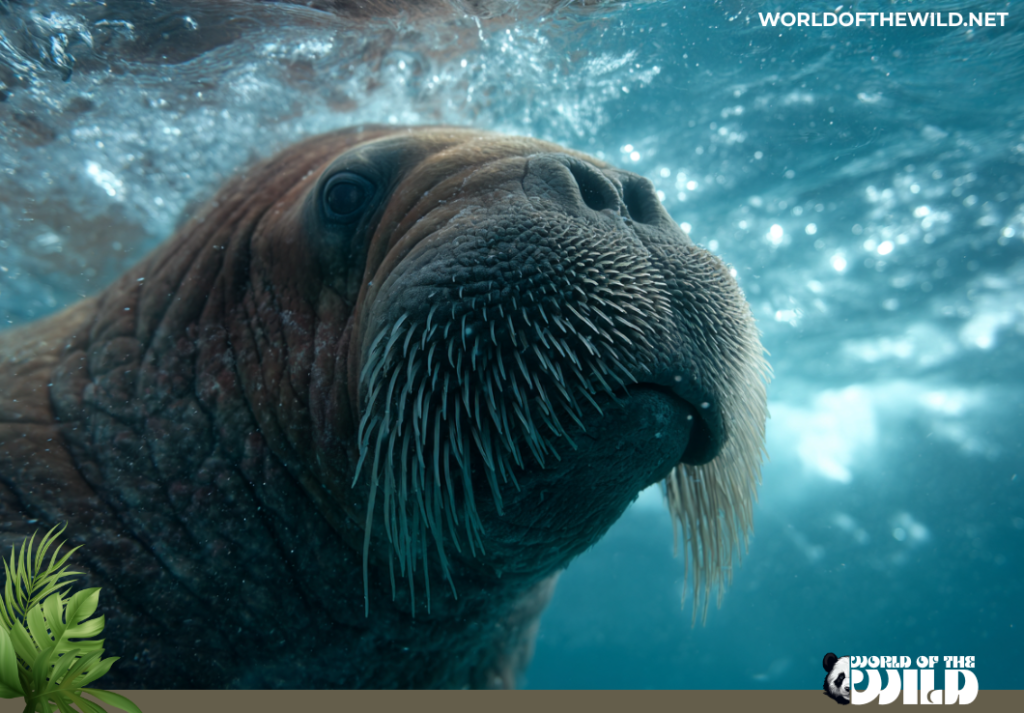
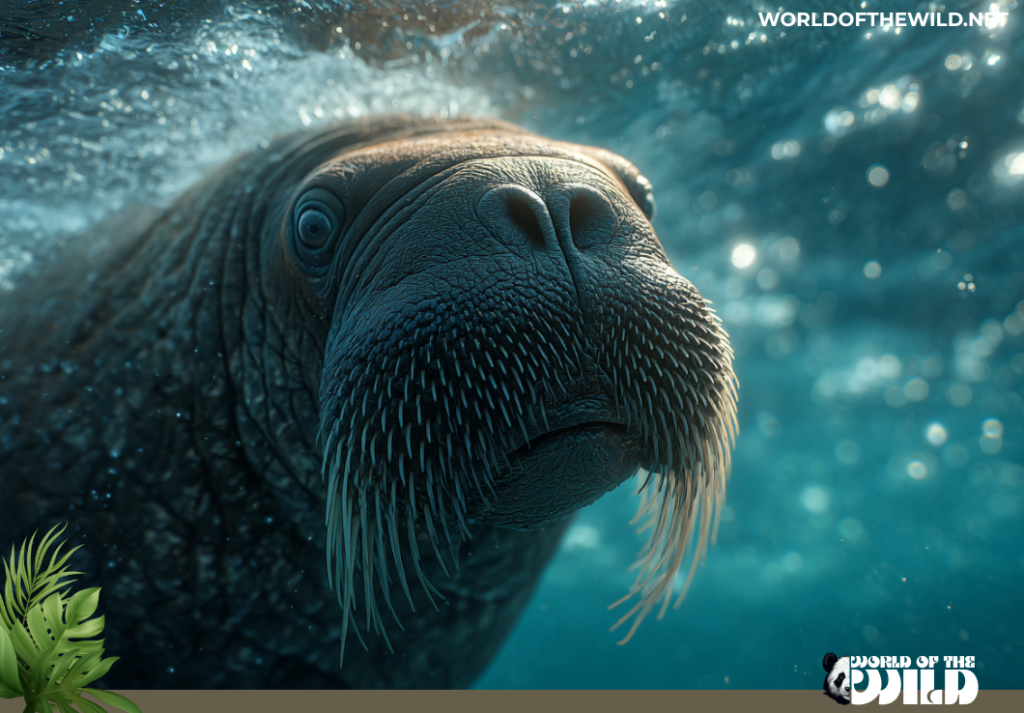
One of the walrus’s most endearing features is its abundant mustache of 400-700 stiff whiskers (vibrissae). These thick bristles, which can be as wide as a pencil, protrude from the broad, blunt snout and are highly sensitive tactile organs. The whiskers are usually pale or white and create the appearance of a distinguished, mustachioed elder statesman.
Walruses have small, bloodshot-looking eyes positioned on the sides of their head, giving them a somewhat perpetually tired expression. Their external ear flaps are barely visible, reduced to small skin folds. They possess four flippers: the front flippers are paddle-shaped and relatively small for their body size, while the hind flippers are larger and can be rotated forward, allowing the walrus to use all four flippers for locomotion on land or ice.
Males develop large skin bosses (thick, warty-looking bumps) around their neck and shoulders as they mature, providing armor during aggressive encounters with rivals. These thick shields can be up to four inches thick and protect vital areas during tusk battles.
Behavior
Walruses are highly social creatures with complex behavioral patterns that reflect their adaptation to the harsh Arctic environment. They are rarely solitary, instead congregating in large groups called “haulouts” when resting on ice or coastal beaches. These gatherings can number in the hundreds or even thousands of individuals, packed together in densely crowded masses. The proximity serves practical purposes: it conserves heat, provides protection from predators, and facilitates social bonds.
Within these groups, a strict hierarchy exists, particularly among males. Dominance is established through visual displays, vocalizations, and physical combat. Bulls with the largest tusks and most prominent body size typically hold the highest rank. During the breeding season, males become especially territorial and aggressive, engaging in spectacular displays of dominance that include loud bellowing, tusk clashing, and inflating their pharyngeal air sacs to create resonating chamber effects for underwater songs.
Communication among walruses is sophisticated and multi-faceted. They produce a remarkable array of sounds both above and below water, including bell-like tones, knocking sounds, roars, barks, whistles, and clicking noises. Males are particularly vocal during breeding season, creating complex underwater songs that can last several minutes and serve to attract females and warn off competing males. These songs include repeated sequences of knocks and bell-like tones that can be heard both underwater and above the ice.
Tactile communication is equally important. Walruses frequently touch each other with their sensitive whiskers and use their tusks to establish personal space or assert dominance. The whiskers serve as remarkable sensory organs, allowing walruses to “see” with touch in the dark, murky waters where they feed. They can detect vibrations and textures with incredible precision, enabling them to locate buried clams and other prey items in muddy sediment.
Walruses demonstrate surprising intelligence and problem-solving abilities. They’ve been observed using tools (using their tusks to break through ice), exhibiting play behavior, and showing evidence of learned behaviors passed between individuals. Young walruses are particularly playful, engaging in mock fights, sliding games on ice, and aquatic acrobatics that may help develop skills needed in adulthood.
Their daily routine revolves around tidal cycles and the availability of sea ice. They typically spend about two-thirds of their time in the water or on ice, with the remaining time devoted to digestion and rest on haulouts. They are most active in feeding during nighttime hours, though this can vary based on tidal conditions. When diving for food, they use their powerful hind flippers for propulsion and their front flippers for steering, moving with surprising grace through the water despite their bulk.
One of the most remarkable behavioral adaptations is their ability to sleep vertically in the water. By inflating their pharyngeal air sacs, they create buoyancy that keeps their head above water while they doze, bobbing peacefully at the surface for hours at a time.
Evolution
The evolutionary journey of the walrus stretches back millions of years, revealing a fascinating story of adaptation to increasingly extreme polar environments. Walruses belong to the pinniped lineage, marine mammals that evolved from terrestrial carnivorous ancestors approximately 23 to 33 million years ago during the Oligocene epoch.
The family Odobenidae (walruses) diverged from other pinnipeds—seals and sea lions—around 20 million years ago. Early odobenids were quite different from modern walruses, being smaller and lacking the massive tusks that define the modern species. The fossil record reveals that the family was once far more diverse, with at least 16 species distributed across the Northern Hemisphere, including along the Pacific and Atlantic coasts and even extending to warmer waters.
One of the most significant evolutionary developments was the emergence of the walrus’s signature tusks. Early proto-walruses had much shorter canine teeth, but over millions of years, these teeth grew increasingly elongated. The tusks evolved multiple functions: breaking through ice, establishing dominance hierarchies, hauling out onto ice (hence “tooth walker”), defending against predators, and potentially helping to maintain breathing holes in ice.
The direct ancestor of the modern walrus appeared approximately 8 to 10 million years ago during the Miocene epoch. The genus Odobenus itself is relatively young in evolutionary terms, appearing around 3 to 5 million years ago. During the Pliocene and Pleistocene epochs, several species of Odobenus existed, including some that lived in warmer climates along the coasts of what is now California and Japan.
The modern walrus, Odobenus rosmarus, evolved during the late Pleistocene, adapting to the expanding polar ice caps. The split between the Pacific and Atlantic subspecies is estimated to have occurred between 400,000 and 800,000 years ago, when populations became geographically isolated by ice sheet expansion and contraction cycles during glacial periods.
Several evolutionary adaptations define the modern walrus: the development of specialized vibrissae (whiskers) for bottom feeding, the extraordinary diving capabilities achieved through increased myoglobin in muscles (allowing extended oxygen storage), the pharyngeal air sacs for buoyancy control, and the massive blubber layer for thermal insulation. These adaptations enabled walruses to exploit the benthic (bottom-dwelling) food resources of the Arctic continental shelves, a niche that was relatively underutilized by other marine mammals.
The evolutionary history of walruses is intimately tied to the formation and dynamics of Arctic sea ice. As climate change now threatens this habitat, walruses face evolutionary pressures unlike any they’ve experienced in recent millennia, challenging their ability to adapt at the pace required.
Habitat
Walruses are exclusively Arctic and sub-Arctic animals, distributed in a circumpolar pattern around the top of the Northern Hemisphere. They are creatures of the margins—the transitional zones where ocean meets ice, and ice meets land. Their distribution is closely tied to the seasonal advance and retreat of sea ice and the presence of shallow continental shelf waters where they can access their benthic prey.
Pacific Walrus Range: Pacific walruses inhabit the Bering Sea, Chukchi Sea, and occasionally venture into the East Siberian Sea and Beaufort Sea. During winter months, they concentrate in the Bering Sea, where relatively thin pack ice provides suitable habitat. As spring arrives and ice begins to retreat northward, walruses migrate north through the Bering Strait into the Chukchi Sea, following the receding ice edge. Some individuals travel over 1,800 miles during these seasonal migrations. In recent years, with diminishing sea ice, increasing numbers of Pacific walruses have been forced to haul out on coastal beaches in Alaska and Russia, sometimes creating enormous aggregations of tens of thousands of animals.
Atlantic Walrus Range: Atlantic walruses occupy a more fragmented range across the Atlantic Arctic, including areas around eastern Canada (Labrador, Nunavut, Quebec), Greenland, Svalbard (Norway), and the Barents Sea region of northwestern Russia. Their distribution is more coastal and sedentary compared to Pacific walruses, with different populations showing relatively limited mixing. Key populations exist around Foxe Basin, Hudson Bay, northern Baffin Bay, and Franz Josef Land.
The ideal walrus habitat shares several key characteristics. First and foremost is the presence of pack ice or landfast ice that serves as a platform for resting between feeding bouts. The ice must not be too thick (walruses need to be able to break through it to breathe) or too unstable. Second, walruses require relatively shallow waters—generally less than 260 feet deep, though they can dive deeper—over continental shelves where benthic invertebrates are abundant. These productive feeding grounds are typically found where ocean currents and upwelling bring nutrients that support rich bottom communities.
The substrate of these feeding grounds is equally important. Walruses prefer soft, muddy, or sandy bottoms where bivalves (clams and mussels) can burrow. Rocky bottoms are less suitable for their feeding strategy. Temperature is another factor; while walruses are superbly adapted to cold, they rely on sea ice or access to cool waters and regular haulouts to prevent overheating, as their thick blubber makes them vulnerable to heat stress.
Haulout sites—whether on ice floes or coastal beaches—must meet specific criteria. They need to be relatively protected from extreme weather, close to productive feeding areas (ideally within 15-20 miles), and have easy water access for quick escape from land-based predators. Ice floes are preferred because they provide access to food throughout a broader area and offer better protection from terrestrial threats like polar bears.
The habitat requirements of walruses make them particularly vulnerable to climate change. As Arctic sea ice extent and duration decline, walruses lose their preferred ice-based haulout platforms and may be forced to travel greater distances to feed or crowd onto limited coastal haulout sites, which can lead to stampedes and crushing deaths, particularly of young calves.
Diet
Walruses are specialized carnivores with a highly specific diet focused on benthic (bottom-dwelling) invertebrates. They are what scientists call “benthic suction feeders,” employing a unique foraging strategy that sets them apart from most other marine mammals.
The foundation of the walrus diet consists overwhelmingly of bivalve mollusks—clams, mussels, and cockles—which make up approximately 90% of their food intake. A single adult walrus can consume 3,000 to 6,000 clams in one feeding session, processing them with remarkable efficiency. Their preferred species include soft-shell clams (Mya species), tellin clams, and various other bivalves that burrow in soft sediment.
The feeding process itself is a marvel of adaptation. When a walrus reaches the ocean floor, it doesn’t simply grab food with its mouth. Instead, it uses its extraordinarily sensitive whiskers (vibrissae) to probe the muddy or sandy bottom, detecting buried clams through touch. The whiskers can sense the slightest vibrations and textures, allowing the walrus to essentially “see” with touch in the dark, murky waters where visibility is often near zero.
Once prey is located, the walrus employs powerful suction to extract the soft body of the clam from its shell. It creates a seal with its mobile, muscular lips and retracts its large tongue, generating negative pressure that can exceed 30 times atmospheric pressure—strong enough to suck a clam right out of its shell. The walrus then uses its tongue to separate the nutritious soft body from the shell, spitting out the empty shell fragments. This technique allows them to process mollusks at a rapid pace without breaking and swallowing the shells.
While bivalves dominate their diet, walruses are opportunistic and will consume a broader menu when available. This supplementary diet includes:
- Marine worms (polychaetes)
- Sea cucumbers
- Various crustaceans (shrimp, crabs)
- Soft corals and tunicates
- Gastropod mollusks (snails)
- Occasionally small fish such as Arctic cod and sculpin
- In rare instances, seals (particularly ringed seal pups), though this behavior is exceptional and not typical
Evidence suggests that some individual walruses, particularly older males, may develop a taste for seal meat and become specialized seal hunters. This behavior has been documented but represents a small minority of individuals and is not characteristic of the species as a whole.
Walruses must consume enormous quantities of food to maintain their massive body weight and fuel their energy-intensive lifestyle in frigid waters. An adult walrus typically eats about 3 to 6 percent of its body weight daily, which translates to 100 to 150 pounds of food for a large male. To accumulate this much food, they may spend 24 to 48 hours feeding continuously during optimal conditions, followed by extended periods of rest and digestion on ice floes or coastal haulouts.
The feeding areas they exploit are remarkably productive zones, and walruses themselves contribute to the ecology of these regions. Their intensive bottom feeding—stirring up sediments and creating “feeding pits”—redistributes nutrients and creates habitat heterogeneity that other species utilize.
Predators and Threats
Despite their formidable size and impressive tusks, walruses face threats from both natural predators and increasingly from human activities and environmental change.
Natural Predators:
The walrus’s most significant natural predators are killer whales (orcas) and polar bears, though adult walruses are formidable prey and predation attempts carry significant risk for the predator.
Killer Whales: Orcas are perhaps the most effective natural predators of walruses, particularly targeting them in the water where walruses lose their defensive advantages. Hunting in coordinated pods, orcas can separate individuals from the group and overwhelm even large adults. However, orcas typically prefer easier prey and walrus predation appears to be opportunistic rather than a dietary staple.
Polar Bears: On ice or land, polar bears pose a significant threat, particularly to young calves and juveniles. Adult male walruses can successfully defend themselves against polar bears using their tusks, and there are documented cases of walruses killing polar bears in combat. However, calves and juveniles are vulnerable, and polar bears have been observed hunting walruses at haulout sites. As sea ice diminishes and both species are increasingly forced to coastal haulouts, encounters between polar bears and walruses may become more frequent.
Historically, before they were hunted to near extinction in most walrus range, the great white shark and Greenland shark likely preyed on walruses in certain areas, though evidence for this is limited.
Anthropogenic Threats:
Human activities pose far more significant threats to walrus populations than natural predation.
Climate Change: This represents the most severe long-term threat to walrus survival. The rapid loss of Arctic sea ice is fundamentally altering walrus habitat. As summer sea ice retreats farther north over deep waters beyond the continental shelf, walruses lose access to both their preferred resting platforms and productive feeding areas. This forces increasing numbers of animals to crowd onto coastal beaches, sometimes creating enormous aggregations of 10,000 to 40,000 individuals. These massive coastal haulouts are dangerous: stampedes triggered by aircraft, predators, or human disturbance can kill hundreds of walruses, particularly vulnerable calves, in a single event. Additionally, warming waters may shift the distribution of prey species and reduce productivity in some key feeding areas.
Disturbance: Walruses are easily disturbed at haulout sites, particularly the large coastal haul outs. Aircraft noise, boat traffic, hunters, polar bears, or even unfamiliar sounds can trigger panic stampedes where animals crush each other in the rush to reach the water. Such events have caused the deaths of dozens to hundreds of walruses in single incidents in recent years.
Historical Overhunting: Commercial hunting in the 18th, 19th, and early 20th centuries devastated walrus populations, particularly Atlantic walruses. Hunted for their ivory tusks, hides, oil, and meat, walrus numbers plummeted. While protections have allowed some recovery, Atlantic walrus populations remain far below historical levels, and some local populations were completely extirpated.
Current Hunting: Indigenous peoples of the Arctic have hunted walruses sustainably for thousands of years, and this subsistence hunting continues today and is culturally important and generally sustainable. However, illegal hunting still occurs in some areas, and the demand for ivory creates markets that can drive poaching.
Industrial Development: Increased shipping traffic through Arctic waters, oil and gas exploration and development, and other industrial activities in the Arctic pose threats through habitat degradation, pollution (particularly oil spills, which would be catastrophic), noise pollution, and increased disturbance.
Pollution: Walruses accumulate persistent organic pollutants (POPs), heavy metals, and other contaminants in their blubber. The long-term health effects of these contaminants are not fully understood but may affect reproduction and immunity.
Reproduction and Life Cycle
Walruses have a slow reproductive rate characteristic of long-lived, large mammals, which makes populations vulnerable to over-exploitation and slow to recover from declines.
Mating and Reproduction:
The breeding season for walruses occurs during the winter months, typically from January through March. Males reach sexual maturity around 7 to 10 years of age but rarely achieve social dominance necessary for successful mating until they are at least 15 years old. Females reach sexual maturity earlier, at around 4 to 6 years, but typically don’t have their first calf until age 6 to 10.
Male walruses engage in elaborate courtship displays to attract females. These displays are both visual and acoustic, taking place primarily in the water. Males establish and defend aquatic territories near female groups, inflating their pharyngeal air sacs to enhance the resonance of their vocalizations. They produce complex songs—sequences of knocks, bells, whistles, and other sounds—that can continue for hours. These underwater concerts, combined with physical displays of tusk size and body mass, advertise male quality to discerning females.
Dominant males establish harems and may mate with multiple females, though the actual mating system is not fully understood and likely includes elements of both male competition and female choice. Physical combat between males occurs, with tusks used as weapons in battles that can cause serious injuries, though deaths are rare.
Mating occurs in the water, and fertilization is followed by delayed implantation—the fertilized egg doesn’t immediately implant in the uterine wall but floats freely for 3 to 4 months. This mechanism allows females to time the birth optimally. The total gestation period, including delayed implantation, lasts approximately 15 to 16 months, one of the longest among pinnipeds.
Birth and Calf Development:
Calves are born from April through June, timed to coincide with the availability of stable ice. Female walruses typically give birth to a single calf; twins are extremely rare. At birth, calves weigh 100 to 165 pounds and measure about 3.5 to 4.5 feet in length. They are born with a thick coat of short, silvery-gray hair and can swim immediately, though they remain dependent on their mothers.
The mother-calf bond is exceptionally strong and long-lasting. Calves nurse for at least 18 months and often for up to 2.5 years, though they begin supplementing with solid food around 6 months of age. Walrus milk is extremely rich, containing 30-35% fat (compared to 3-4% in cow’s milk), providing the abundant calories necessary for rapid growth in the Arctic environment.
Young walruses grow rapidly, but they remain with their mothers for 2 to 3 years, learning essential skills such as how to find and process food, where to find suitable feeding areas, migration routes, and social behaviors. This extended maternal care is unusual among pinnipeds and results in a long interbirth interval—females typically give birth only once every 2 to 3 years, and sometimes longer.
Juveniles remain in female-calf groups for several years after weaning, gradually becoming more independent. Male calves eventually leave to join bachelor groups, while females may remain in their mother’s social group for life.
Lifespan:
Walruses are long-lived animals. In the wild, they can live for 30 to 40 years, with females often outliving males. The maximum documented lifespan for wild walruses is around 40 to 45 years. In captivity, where they face no predation and receive veterinary care, walruses have lived into their early forties.
Age can be determined by examining growth layers in the teeth (similar to tree rings), which has helped researchers understand walrus population dynamics and longevity.
The combination of late sexual maturity, long gestation periods, extended maternal care, and long interbirth intervals means that walrus populations have low reproductive potential and cannot quickly recover from population declines. This demographic profile makes them particularly vulnerable to overhunting and rapid environmental changes.
Population
The current conservation status and population dynamics of walruses vary significantly between the two subspecies, reflecting different historical pressures and current threats.
Conservation Status:
The walrus is not currently listed as globally endangered. The International Union for Conservation of Nature (IUCN) lists the walrus as “Data Deficient” globally due to uncertainties in population estimates, though they note that the species is vulnerable to climate change impacts. However, different populations have different trajectories and risk profiles.
The Pacific walrus has not been listed under the U.S. Endangered Species Act, though petitions to list it have been submitted and denied, with the determination that listing was “warranted but precluded” by higher priority species. The primary concern for Pacific walruses is the rapid loss of sea ice habitat due to climate change.
The Atlantic walrus is more fragmented and several populations are of significant conservation concern. Some local populations were extirpated by commercial hunting and have not recovered. The species receives various levels of protection across its range.
Population Estimates:
Estimating walrus populations is extremely challenging due to their remote habitat, extensive movements, and the logistical difficulties of surveying across the Arctic. Current best estimates suggest:
Pacific Walrus: The population is estimated at approximately 200,000 to 300,000 individuals, though estimates vary widely and uncertainty is high. This population represents the vast majority of living walruses. Historical evidence suggests populations were likely higher before commercial exploitation, possibly numbering in the hundreds of thousands to low millions. The population crashed due to commercial hunting in the 1800s and early 1900s but has partially recovered under management.
Atlantic Walrus: Total population estimated at 25,000 to 30,000 individuals, distributed across multiple isolated populations:
- Foxe Basin population (northern Hudson Bay, Canada): ~5,500-6,000
- North and Central West Greenland: ~3,000-4,000
- Baffin Bay: ~1,500
- East Greenland: ~3,000
- Svalbard-Franz Josef Land (Barents Sea): ~5,000-8,000
- Laptev Sea population: ~4,000-5,000
Some historically significant populations, such as those in the Gulf of St. Lawrence, Sable Island, and southern Greenland, were hunted to local extinction and have not reestablished.
Population Trends:
Pacific walrus: The population appears to be relatively stable but faces significant threats from rapid habitat loss. Recent dramatic sea ice declines have forced unprecedented numbers of walruses onto coastal haul outs, and the long-term impacts of this habitat shift are uncertain. Climate models predict continued and accelerating sea ice loss, which could lead to population declines in coming decades.
Atlantic walrus: Population trends vary by region. Some populations (like those in Svalbard) appear to be slowly recovering from historical over-hunting, while others remain depleted or show unclear trends. The fragmented nature of Atlantic walrus populations makes them particularly vulnerable, as small isolated populations face greater risks from environmental stochasticity and reduced genetic diversity.
Key Threats to Populations:
Climate change represents the most significant emerging threat, with projections suggesting substantial loss of suitable walrus habitat over the coming decades. The transition from ice-based to land-based haul outs carries risks including increased disturbance, stampedes, greater energetic costs for traveling to feeding areas, and potential changes in food availability.
Subsistence harvest by Indigenous communities continues at levels generally considered sustainable (roughly 3,000-5,000 Pacific walruses and 500-800 Atlantic walruses annually), though monitoring is important to ensure harvest levels remain sustainable as environmental conditions change and populations potentially decline.
Industrial development in the Arctic, including shipping, oil and gas exploration, and increased human activity, poses growing threats through habitat disruption, pollution risk, and disturbance.
Conclusion
The walrus stands as one of the Arctic’s most magnificent and iconic mammals—a creature of superlatives with its massive tusks, sensitive whiskers, powerful suction feeding, and remarkable adaptations to one of Earth’s most extreme environments. These gentle giants of the ice have survived and thrived through millennia of climatic changes, but they now face their greatest challenge: the rapid transformation of their frozen world.
What makes the walrus’s plight particularly poignant is that these animals are so intimately tied to sea ice—not just as a platform for rest, but as a way of life that has defined their ecology and evolution. As summer sea ice extent reaches record lows year after year, walruses are forced to adapt to circumstances unlike any they’ve encountered in tens of thousands of years. The images of tens of thousands of walruses crowded onto remote Alaskan and Russian beaches, where stampedes can kill hundreds in moments of panic, serve as stark visual evidence of an ecosystem under stress.
Yet there is hope. Walrus populations, particularly in the Pacific, remain relatively robust. They have shown resilience in recovering from severe commercial overhunting in the past. Indigenous communities who have coexisted with walruses for millennia continue to advocate for their protection while maintaining sustainable cultural harvest practices. International cooperation through agreements like the Marine Mammal Protection Act and various indigenous management authorities provides frameworks for conservation.
The fate of the walrus is inextricably linked to humanity’s response to climate change. Reducing greenhouse gas emissions, limiting warming, and preserving what remains of Arctic sea ice may be the most important conservation actions we can take—not just for walruses, but for the entire suite of Arctic species and communities that depend on ice. Additionally, minimizing disturbance at haulout sites, particularly the massive coastal aggregations, protecting critical feeding habitat from industrial development, and maintaining sustainable harvest practices are all essential.
The walrus reminds us that we share this planet with remarkable creatures whose continued existence depends on choices we make today. In protecting walruses and their icy realm, we preserve not only a magnificent species but an entire ecosystem and a part of our planet’s natural heritage. The question remains: will we act with the urgency and commitment necessary to ensure that these tusked behemoths continue to haul out on Arctic shores for generations to come?
Scientific Name: Odobenus rosmarus
Diet Type: Carnivore (specialized benthic invertebrate feeder)
Size: 7.5-12 feet (length)
Weight: 880-3,700 pounds (up to 4,000+ pounds for large males)
Region Found: Arctic and sub-Arctic regions of the Northern Hemisphere (Bering Sea, Chukchi Sea, North Atlantic Arctic, coastal Arctic Russia, Greenland, Svalbard, northern Canada)