
In the dusty scrublands of Africa and Asia, a small, elongated creature darts between rocks with lightning-fast reflexes, its keen eyes scanning for danger—or opportunity. This is the mongoose, an animal that has captured human imagination for centuries, particularly for its legendary ability to battle venomous snakes and emerge victorious. Far more than just snake-fighters, mongooses are highly intelligent, socially complex, and ecologically important carnivores that have adapted to thrive in some of the world’s most challenging environments. From their sophisticated alarm calls to their surprising immunity to snake venom, these charismatic mammals continue to fascinate scientists and wildlife enthusiasts alike.
Facts
- Venom Resistance: Many mongoose species possess a modified acetylcholine receptor that makes them partially resistant to snake venom, allowing them to survive bites from cobras and other venomous serpents.
- Meerkats Are Mongooses: The famous meerkats of southern Africa are actually a species of mongoose, belonging to the family Herpestidae.
- Ancient Pest Controllers: Mongooses were intentionally introduced to Hawaii, the Caribbean, and other islands in the 19th century to control rat populations in sugarcane fields, though this often had devastating ecological consequences.
- Egg Cracking Experts: Mongooses have developed the remarkable technique of throwing eggs against rocks to crack them open, demonstrating impressive problem-solving abilities.
- Cooperative Sentries: Some mongoose species post sentries while others forage, with specific alarm calls to indicate different types of predators approaching from air or ground.
- Lightning Reflexes: A mongoose can dodge a striking snake with reaction times faster than a human can blink, moving at speeds up to 20 miles per hour in short bursts.
- Sophisticated Communication: Dwarf mongooses use at least 12 different vocalizations to communicate, each conveying specific information about food, danger, or social coordination.
Species
Classification:
- Kingdom: Animalia
- Phylum: Chordata
- Class: Mammalia
- Order: Carnivora
- Family: Herpestidae
- Genus: Multiple genera including Herpestes, Mungos, Suricata, and others
- Species: Approximately 34 recognized species
The mongoose family is remarkably diverse, with species ranging from the solitary Egyptian mongoose to the highly social meerkat. The most well-known species include the Indian grey mongoose (Herpestes edwardsii), famous for its snake-fighting prowess; the banded mongoose (Mungos mungo), which lives in large social groups across sub-Saharan Africa; the yellow mongoose (Cynictis penicillata) of southern Africa; and the dwarf mongoose (Helogale parvula), the smallest of all carnivores. The ring-tailed mongoose of Madagascar and the white-tailed mongoose, Africa’s largest mongoose species, represent the family’s geographic and physical diversity. Each species has evolved specific adaptations to their particular ecological niches, from forest-dwelling to desert-adapted varieties.
Appearance
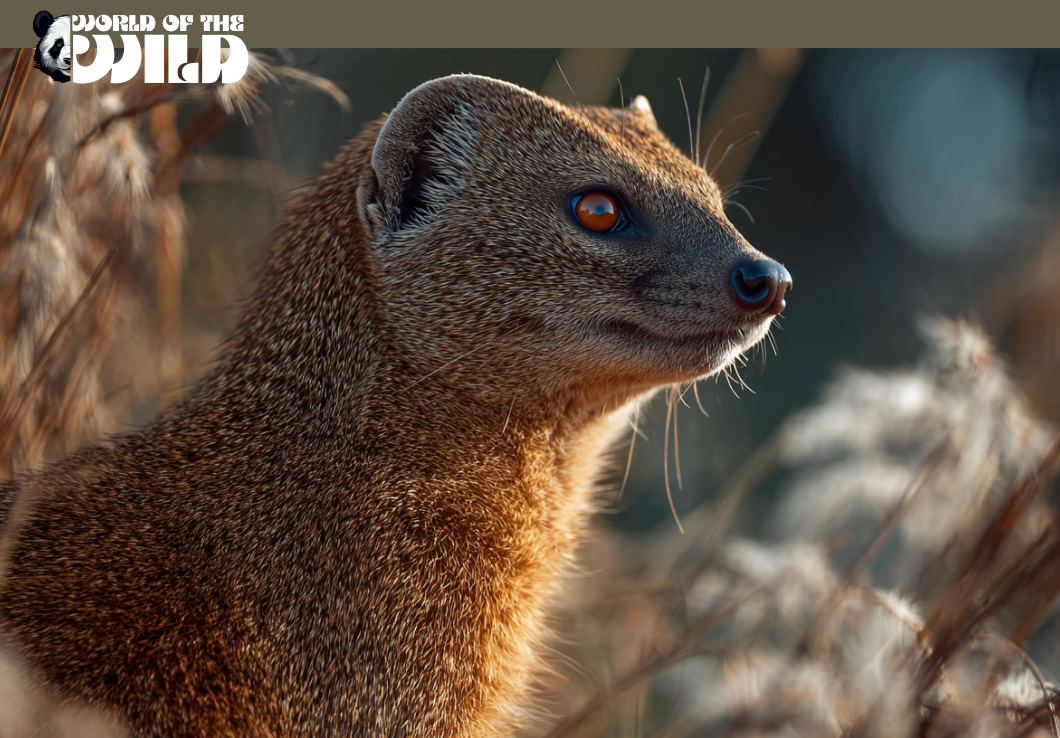
Mongooses are small to medium-sized carnivores with elongated, sleek bodies built for agility and speed. Most species measure between 7 to 25 inches in body length, with tails adding another 6 to 21 inches. Their weight varies considerably by species, ranging from less than a pound in dwarf mongooses to over 11 pounds in the white-tailed mongoose.
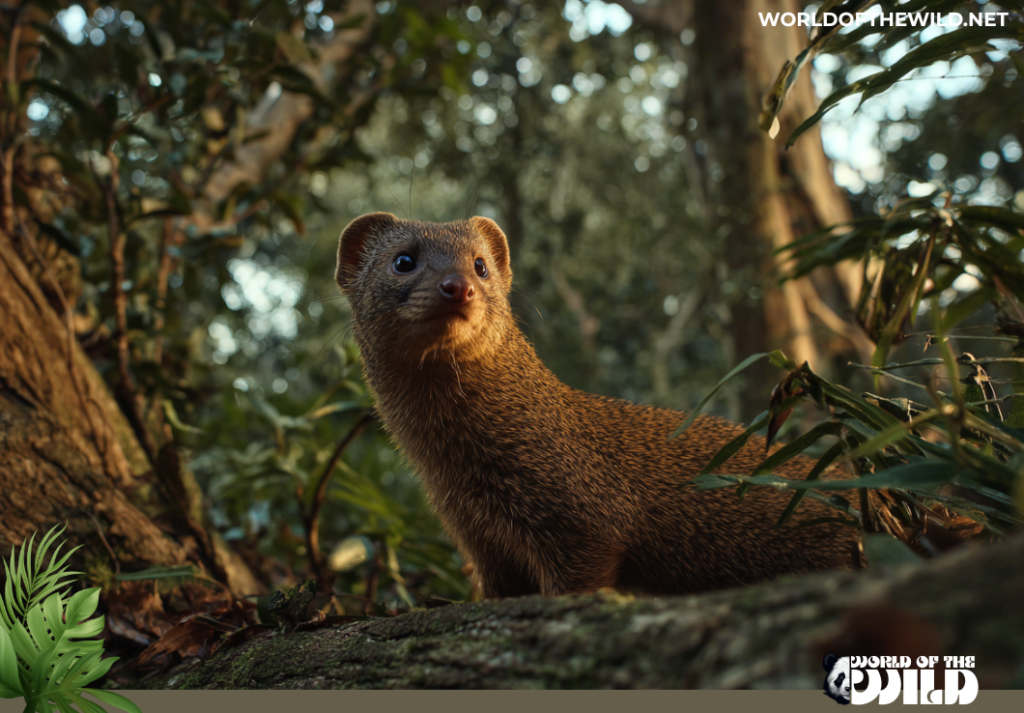
These animals possess small, rounded ears that can close to keep out dirt while digging, and their faces are pointed with small eyes that provide excellent vision. Their coats vary from grizzled grey and brown to reddish-brown or yellowish, often with banding or speckling that provides excellent camouflage. Some species, like the banded mongoose, display distinct dark bands across their backs, while others have relatively uniform coloration.
Mongooses have non-retractile claws designed for digging, and their legs are relatively short but powerful, giving them a distinctive low-slung gait. Their teeth are sharp and well-suited for their carnivorous diet, with powerful jaws capable of crushing bones and cracking shells. Many species have scent glands near their anus used for marking territory, and their thick, coarse fur provides protection from both harsh environments and snake bites.
Behavior
Synthesized comprehensive mongoose behavioral and biological information.
The user wants information about mongoose behavior, including daily and social behaviors, communication methods, intelligence, and notable adaptations or unique actions.
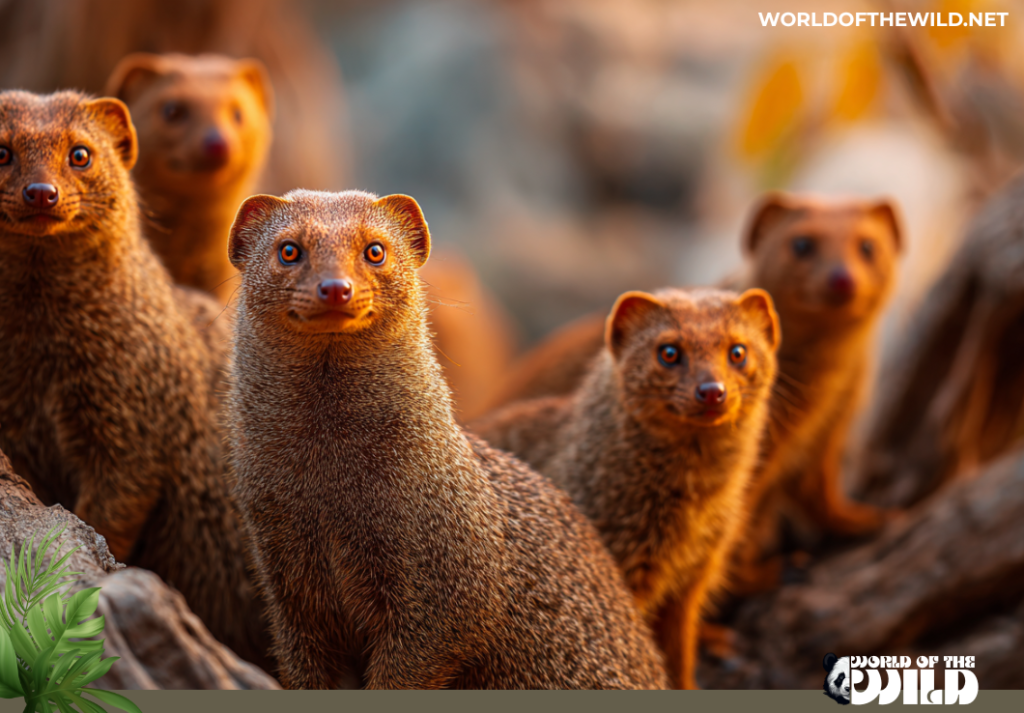
Mongoose behavior varies dramatically between species, ranging from strictly solitary to highly social. Social species like banded mongooses and meerkats live in groups called “mobs” or “gangs” that can number up to 50 individuals, while solitary species like the Egyptian mongoose maintain individual territories and only come together to mate.
Diurnal by nature, most mongooses are active during daylight hours, spending their time foraging for food, sunbathing, grooming, and maintaining their burrows or dens. Social mongooses engage in cooperative behaviors including group hunting, shared pup-rearing, and coordinated sentry duty where individuals take turns watching for predators while others feed. Their alarm calls are remarkably sophisticated, with different vocalizations indicating whether a threat is aerial (like an eagle) or terrestrial (like a jackal), allowing group members to respond appropriately.
Mongooses are exceptionally intelligent and display impressive problem-solving abilities. They can learn to open containers, work together to achieve goals, and even use tools in captive settings. Their famous snake-hunting technique involves dancing around the serpent, making quick feints and dodges to tire it out before delivering a fatal bite to the head. This behavior requires not just speed but strategic thinking and precise timing.
Communication extends beyond vocalizations to include scent marking, visual displays, and physical grooming, which serves both hygienic and social bonding purposes. Dominant individuals in social groups maintain their status through subtle behavioral cues rather than overt aggression, and cooperative breeding systems mean subordinate adults help raise offspring that aren’t their own.
Evolution
The mongoose family Herpestidae has an evolutionary history dating back approximately 21 to 26 million years to the Early Miocene epoch. Mongooses evolved in Africa, where the majority of species still reside today, before dispersing into southern Asia and Europe.
Molecular and fossil evidence suggests that mongooses share a common ancestor with the cat-like carnivores (Feliformia), making them distant relatives of cats, hyenas, and civets. The family diverged early from other feliform carnivores, developing their distinctive elongated body form and specialized hunting techniques.
During the Miocene, mongooses underwent significant radiation, diversifying into the various genera we see today. Their evolution was shaped by the expansion of grasslands and savannas in Africa, which created ideal habitats for small, quick-moving predators. The development of venom resistance in several species represents a remarkable evolutionary adaptation, likely arising through natural selection as mongooses that could survive snake encounters had better access to food resources and territories.
The colonization of Madagascar by mongoose ancestors led to the evolution of unique endemic species, while those that reached Asia diversified into species adapted to tropical forests and subtropical regions. The relatively recent evolution of highly social behavior in some mongoose species, such as meerkats and banded mongooses, demonstrates the family’s continued evolutionary innovation in response to environmental pressures and predation risks.
Habitat
Mongooses exhibit remarkable habitat versatility, occupying a wide range of environments across Africa, southern Asia, and southern Europe. The greatest diversity of mongoose species is found in sub-Saharan Africa, from the Cape of Good Hope to the Sahara’s southern edge. In Asia, mongooses range from the Middle East through the Indian subcontinent to Southeast Asia, with introduced populations established on various islands worldwide.
These adaptable carnivores thrive in diverse ecosystems including savannas, grasslands, woodlands, scrublands, semi-deserts, and tropical forests. Some species, like the marsh mongoose, are semi-aquatic and inhabit wetland areas and riverbanks, while others, such as meerkats, have become highly specialized for life in arid environments like the Kalahari Desert. The Egyptian mongoose can be found in habitats ranging from coastal dunes to agricultural areas and even urban environments.
Most mongooses require areas with adequate cover such as rocky outcrops, termite mounds, dense vegetation, or abandoned burrows where they can shelter from predators and extreme temperatures. Social species often modify existing burrows or dig extensive tunnel systems with multiple entrances, creating complex underground networks that provide safety and temperature regulation. These den systems can be occupied by successive generations over many years.
The specific habitat requirements vary by species, but common elements include access to water, adequate prey availability, and suitable denning sites. Some mongooses have adapted to live alongside humans in agricultural and suburban areas, while others remain restricted to pristine wilderness areas.
Diet
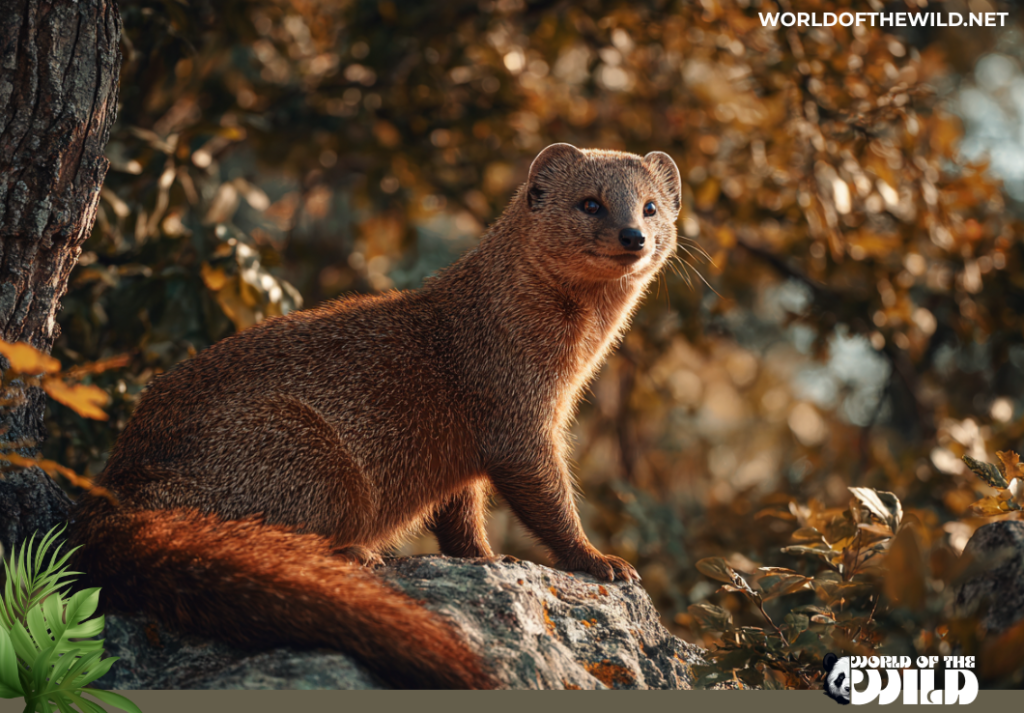
Mongooses are carnivorous opportunistic feeders, though some species incorporate plant matter into their diets, technically making them omnivores. Their diet is remarkably varied and includes insects, small rodents, birds and their eggs, reptiles (including snakes and lizards), frogs, crabs, and occasionally fruits and berries.
Insects, particularly beetles, grasshoppers, and termites, form a substantial portion of the diet for many species, especially smaller mongooses. These are typically hunted by scratching through leaf litter or digging into soil and rotting wood. Larger prey items such as rodents, ground-dwelling birds, and reptiles are stalked and captured with quick pouncing attacks or brief chases.
The mongoose’s legendary snake-hunting ability is real but often exaggerated; while they do kill and eat snakes, these reptiles typically represent only a small fraction of their overall diet. When confronting a snake, mongooses use their incredible agility to avoid strikes while gradually wearing down the serpent before delivering a killing bite to the head or neck. Their partial immunity to venom provides an additional safety margin in these dangerous encounters.
Social mongoose species often forage together, turning over rocks and logs and digging for prey. Some species have learned to crack hard-shelled prey items like eggs and mollusks by throwing them against rocks, demonstrating remarkable behavioral flexibility. They hunt primarily by scent and sound, using their acute hearing to detect prey moving beneath the ground or in dense vegetation.
Predators and Threats
Despite their fierce reputation, mongooses face predation from various larger carnivores and raptors. Large birds of prey, including martial eagles, crowned eagles, and hawk-eagles, are significant predators, particularly of smaller mongoose species and juveniles. Terrestrial predators include leopards, lions, hyenas, jackals, and large snakes such as pythons and cobras (ironically, the very animals some mongooses hunt can also prey upon them).
Natural predation, however, pales in comparison to the threats mongooses face from human activities. Habitat destruction through agriculture, urban development, and deforestation has reduced available territory for many species. Mongooses are often persecuted by farmers and poultry keepers who view them as pests that raid chicken coops and destroy eggs, leading to deliberate poisoning and trapping.
Road mortality has become an increasing threat as human infrastructure expands into mongoose habitats. Vehicle strikes kill significant numbers of mongooses, particularly in areas where roads bisect their territories. In some regions, mongooses are hunted for their fur or for traditional medicine purposes.
The historical introduction of mongooses to islands has proven catastrophic both for native species and for the mongooses themselves. In Hawaii, the Caribbean, and other locations, introduced mongoose populations have devastated ground-nesting birds, reptiles, and native mammals, while the mongooses often face persecution and control efforts. Climate change poses an emerging threat, particularly for species in arid regions where changing rainfall patterns affect prey availability.
Disease transmission, both among mongooses and between mongooses and humans, presents another concern. Mongooses can carry rabies and serve as reservoir hosts for various parasites, leading to conflict with human populations.
Reproduction and Life Cycle
Identified comprehensive mongoose article requirements across multiple sections.
The user wants details about mating rituals, gestation period, offspring description, parental care, general life cycle, and average lifespan for mongooses.
Mongoose reproductive strategies vary significantly between species. Most mongooses breed seasonally, with timing coinciding with periods of maximum prey availability. In social species, mating systems range from monogamous pairs to polygamous breeding where dominant individuals produce most offspring.
Mating rituals typically involve scent marking, vocalizations, and physical displays. Males may engage in aggressive competition for access to females, though in social species, dominance hierarchies often determine breeding rights without overt fighting. The gestation period varies from approximately 42 to 105 days depending on species, with most falling between 60 to 70 days.
Litter sizes range from one to six pups, with most species producing two to four offspring per litter. Pups are born helpless, blind, and nearly hairless in underground dens or hidden nesting sites. Their eyes open after approximately two to four weeks, and they begin venturing outside the den around three to four weeks of age.
Maternal care is intensive, with mothers nursing their young for six to nine weeks. In social species, cooperative breeding is common, with non-breeding adults (both male and female) helping to guard, groom, and feed the pups. This “helper” system increases pup survival rates and is particularly well-developed in species like meerkats and dwarf mongooses. Pups learn hunting skills through play and by accompanying adults on foraging trips, gradually developing the speed and coordination necessary for successful predation.
Sexual maturity is typically reached between 9 months to 2 years, depending on the species and social structure. In the wild, mongooses generally live 6 to 10 years, though larger species may reach 12 to 15 years. Captive mongooses often live significantly longer, with some individuals exceeding 20 years. Mortality is highest in the first year of life, with predation, disease, and starvation being the primary causes of death.
Population
The conservation status of mongoose species varies considerably across the family. Many species, including the Egyptian mongoose, Indian grey mongoose, and banded mongoose, are classified as Least Concern by the International Union for Conservation of Nature (IUCN), indicating stable populations with no immediate extinction risk. These species remain widespread and adaptable, maintaining healthy numbers despite human pressures.
However, several mongoose species face more precarious situations. The Liberian mongoose is listed as Vulnerable due to habitat loss in West African forests, while the narrow-striped mongoose of Madagascar faces similar threats. Some island-endemic species have restricted ranges that make them inherently vulnerable to habitat changes or invasive species.
Estimating global mongoose populations is challenging due to their often secretive nature and vast geographic ranges. The most abundant species likely number in the hundreds of thousands to millions of individuals, while rarer species may have populations in the low thousands. Population trends vary by species and region, with some experiencing declines due to habitat loss while others expand into human-modified landscapes.
Introduced mongoose populations on islands present a complex conservation paradox. While these populations often thrive numerically, they’re considered invasive species causing ecological damage, and control programs actively work to reduce their numbers. In Hawaii, for example, the introduced small Indian mongoose population is estimated at hundreds of thousands, yet they’re targeted for eradication due to their devastating impact on native birds.
Climate change represents an emerging threat that could shift population trends, particularly for species in arid regions where changing precipitation patterns may affect prey availability and habitat suitability. Overall, the mongoose family demonstrates resilience, but continued monitoring and habitat protection remain essential for long-term survival.
Conclusion
The mongoose stands as a testament to evolutionary ingenuity—a small carnivore that has conquered diverse habitats through intelligence, adaptability, and remarkable physical prowess. From their legendary battles with venomous snakes to their sophisticated social structures and cooperative behaviors, mongooses embody the complexity and wonder of the natural world. These animals serve vital ecological roles as both predators and prey, helping maintain balanced ecosystems across Africa and Asia.
Yet the mongoose’s story also serves as a cautionary tale about human intervention in nature. While some species thrive, others face mounting pressures from habitat destruction and human persecution, and the disastrous consequences of misguided introductions remind us that even the most impressive adaptations can become liabilities in the wrong context. As we move forward, protecting mongoose habitats, respecting their ecological roles, and learning from past mistakes in wildlife management will be crucial. The mongoose has survived for millions of years through change and challenge—ensuring they continue to dart through the undergrowth for millions more depends on the choices we make today.
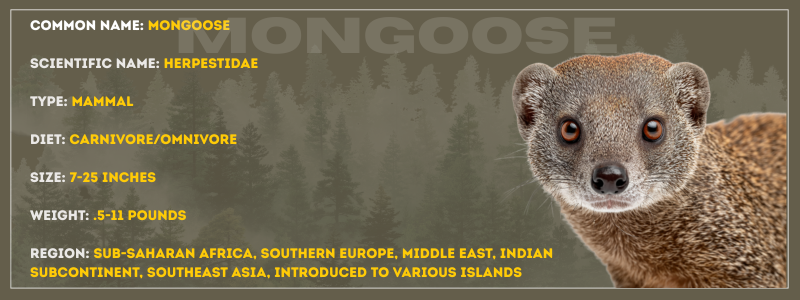
Scientific Name: Herpestidae (family); multiple genera and species including Herpestes, Mungos, Suricata
Diet Type: Carnivore/Omnivore
Size: 7-25 inches (body length, varies by species)
Weight: 0.5-11 pounds (varies by species)
Region Found: Sub-Saharan Africa, southern Europe, Middle East, Indian subcontinent, Southeast Asia, introduced to various islands