
There is something undeniably magnetic about a raccoon. Perhaps it is the bandit mask etched across its face, giving it the permanent appearance of a creature up to no good. Or maybe it is the way it methodically dunks its food in water, turning even a mundane meal into a deliberate ritual. Whatever the reason, the raccoon (Procyon lotor) has carved out a reputation as one of North America’s most recognizable, adaptable, and downright clever wild animals.
Far from being just a trash-raiding nuisance, the raccoon is a biological marvel — an animal that has not only survived the relentless march of human expansion but has, in many ways, thrived because of it. From dense forests to downtown alleyways, this masked mammal lives on its own terms, and the more you learn about it, the harder it becomes not to admire it.
Facts
- Raccoons have highly sensitive front paws containing four times more sensory receptors than their hind paws, making touch their dominant sense for exploring and identifying objects — even in complete darkness.
- The word “raccoon” derives from the Powhatan word aroughcun, meaning “animal that scratches with its hands,” recorded by Captain John Smith in the early 1600s.
- Raccoons do not truly hibernate, but they can enter a state of torpor during harsh winter months, sleeping for weeks at a time while living off stored fat reserves — sometimes losing up to half their body weight.
- Raccoons have demonstrated the ability to remember solutions to tasks for up to three years, outperforming cats and performing comparably to monkeys in certain problem-solving studies.
- In Japan, raccoons were imported as exotic pets following the popularity of a 1977 anime series — and after many were released into the wild, they became an invasive species, now numbering in the tens of thousands and causing significant damage to historical temples and agricultural land.
- Raccoons can rotate their hind feet nearly 180 degrees, allowing them to descend trees headfirst — a rare ability among mammals.
- A group of raccoons is called a gaze, though in practice, adults tend to operate more independently than their social reputation might suggest.
Species
Classification:
- Kingdom: Animalia
- Phylum: Chordata
- Class: Mammalia
- Order: Carnivora
- Family: Procyonidae
- Genus: Procyon
- Species: Procyon lotor
The raccoon family, Procyonidae, is a New World family that also includes coatis, ringtails, cacomistles, olingos, olinguitos, and kinkajous — a diverse group of mostly arboreal and semi-arboreal mammals found across the Americas.
Within the common raccoon species itself, taxonomists have historically recognized over 20 subspecies, though modern genetic analysis has consolidated many of these. Among the most notable subspecies are the Eastern raccoon (Procyon lotor lotor), the most widespread form across the eastern United States and Canada; the Florida raccoon (Procyon lotor elucus), slightly smaller and adapted to subtropical environments; the Upper Mississippi Valley raccoon (Procyon lotor hirtus), notably larger due to colder climate pressures; and the Cozumel raccoon (Procyon pygmaeus), now considered a distinct species endemic to Cozumel Island, Mexico, and listed as Critically Endangered.
The crab-eating raccoon (Procyon cancrivorus) is another closely related species found in Central and South America, distinguished by its shorter, coarser fur and strong preference for aquatic prey.
Appearance
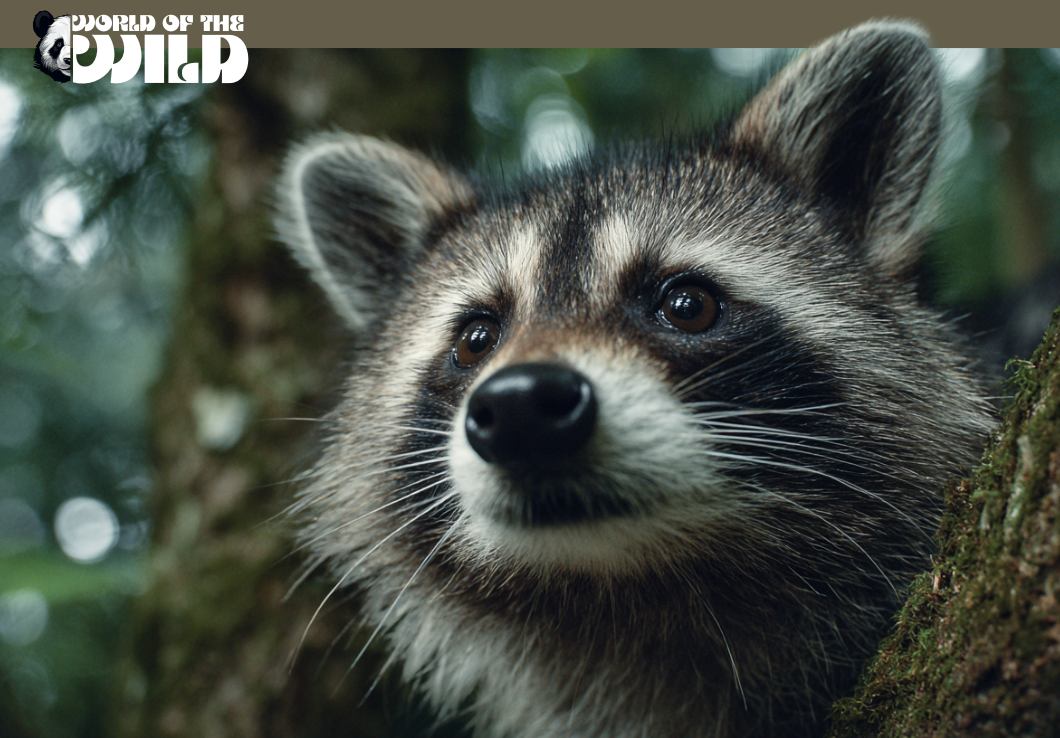
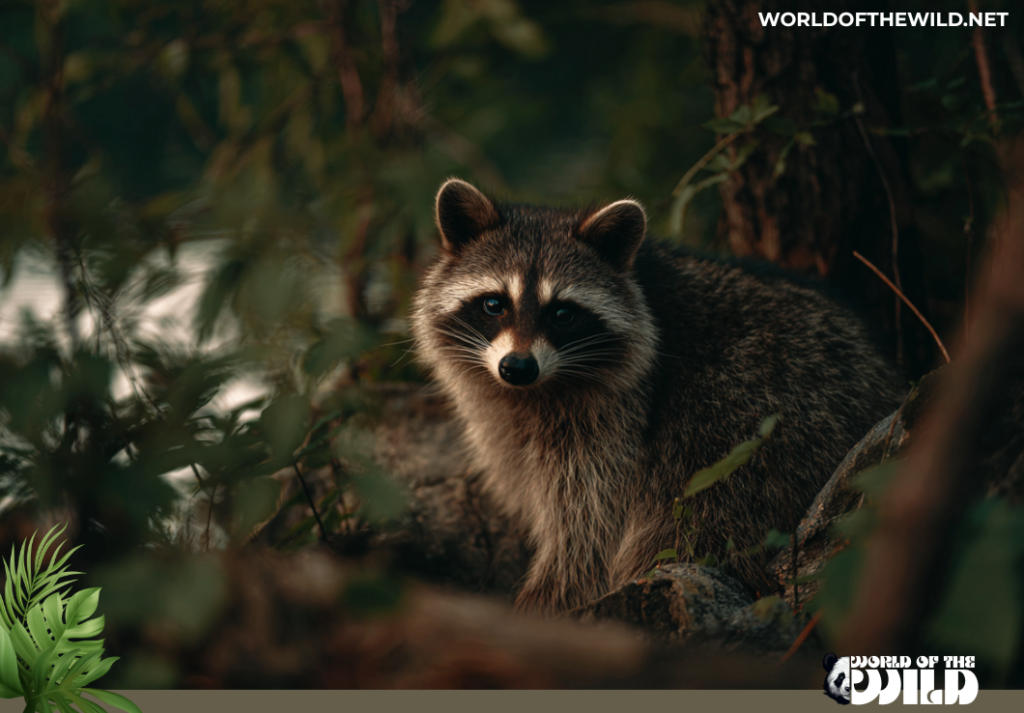
The raccoon is immediately recognizable by the bold black mask of fur that stretches across its eyes and cheeks, contrasting sharply against the paler fur of its face. This distinctive facial marking is not merely for show — it is believed to reduce glare and enhance the animal’s night vision, much like the eye black used by athletes.
Its body is stocky and rounded, covered in dense, grizzled fur that ranges in color from gray to brown, with individual hairs banded in alternating colors that give the coat a salt-and-pepper shimmer. The tail is bushy and prominently ringed with alternating bands of dark and light fur — typically five to seven rings — ending in a dark tip. This tail serves both as a communication tool and as a fat-storage reserve during leaner months.
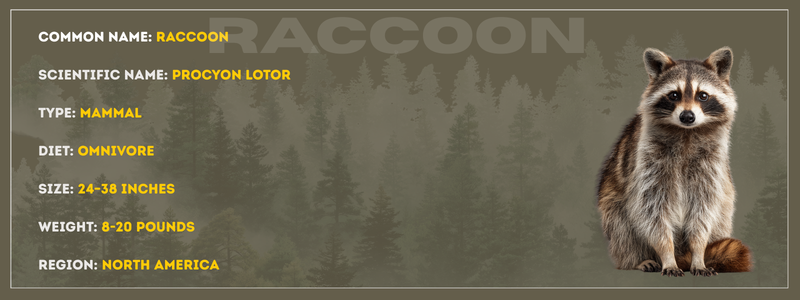
Adult raccoons typically measure between 24 and 38 inches in total body length, with the tail adding an additional 8 to 12 inches. They stand roughly 9 to 12 inches at the shoulder. Weight varies considerably by region and season — most adults fall between 8 and 20 pounds, though northern individuals can reach 30 pounds or more heading into winter, packed with fat reserves. Their front paws are remarkably hand-like, with five slender, nimble fingers capable of extraordinary dexterity, while their hind feet are longer and more plantigrade, giving them a somewhat waddling gait on the ground.
Behavior
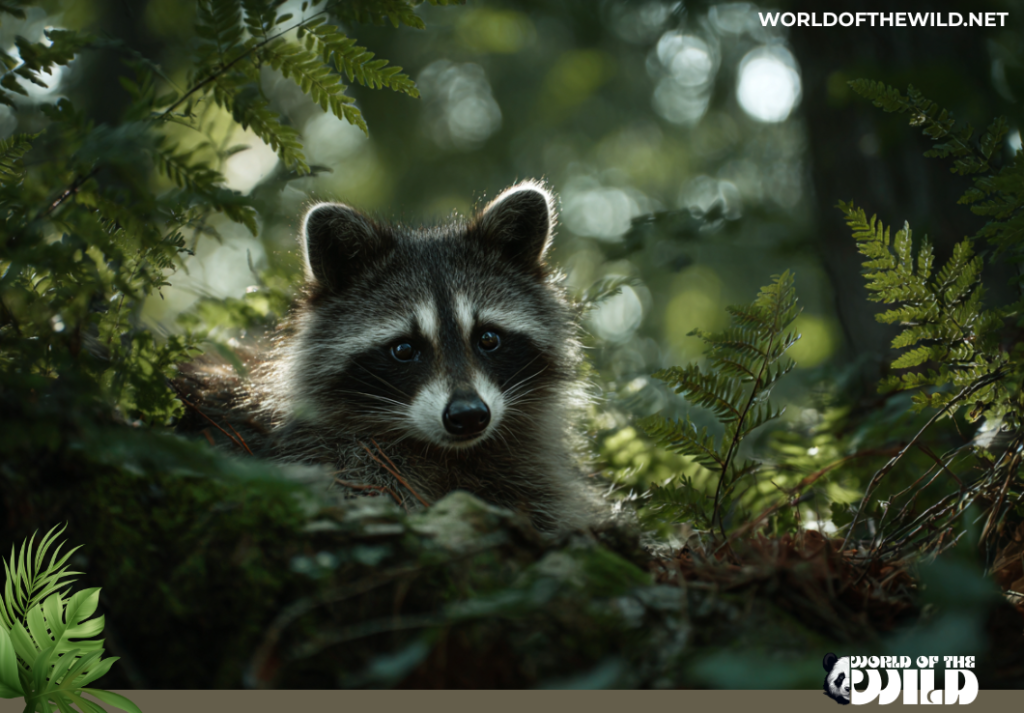
Raccoons are primarily nocturnal, becoming most active in the hours between dusk and dawn. During the day, they rest in tree hollows, dense brush, rock crevices, or — in urban environments — attics, crawl spaces, and storm drains. They are excellent climbers and capable swimmers, at ease navigating both the vertical world of the forest canopy and the surface of streams and ponds.
Socially, raccoons occupy an interesting middle ground. Adults are largely solitary foragers, but they are not entirely antisocial. Female raccoons raise their young communally in some areas and maintain overlapping home ranges with other females. Males, particularly outside of mating season, may form loose social groups called coalitions, which appear to offer some protection against rival males. These social bonds are maintained through a rich vocabulary of vocalizations — researchers have documented over 200 distinct sounds raccoons use to communicate, ranging from chittering and purring between mothers and young to hissing and growling when threatened.
Perhaps the raccoon’s most famous behavior is its apparent “washing” of food in water. This act, known as dousing, is not actually cleaning — raccoons will dunk food even in dirty water. The current understanding is that water dramatically enhances the sensitivity of their paws, allowing them to better assess and manipulate the object they are handling. Their paws are covered in specialized nerve endings that become even more finely attuned when wet.
Raccoons are also impressively adaptable problem-solvers. Studies have shown they can unlock latches, open jars, and remember complex multi-step solutions to puzzles. Their capacity to generalize learning — to apply lessons from one context to another — places them among the more cognitively flexible mammals in the wild.
Evolution
The evolutionary story of the raccoon begins not in North America, but in the tropics. The family Procyonidae originated in what is now Central America and the northern parts of South America during the Oligocene epoch, roughly 25 to 35 million years ago. Early procyonids were small, arboreal creatures, and the family flourished in the warm, forested environments of the early Americas before some lineages later dispersed northward.
The genus Procyon itself emerged several million years ago as North America’s climate shifted and forest types diversified. Fossil evidence suggests that early raccoon-like animals were already present across much of North America during the Pliocene, and the species we recognize today, Procyon lotor, had become well-established by the Pleistocene epoch.
One of the most intriguing evolutionary threads in raccoon history is the family’s relationship with the red panda. For a time, the red panda (Ailurus fulgens) was classified within Procyonidae based on shared physical traits, but modern genetic analysis has confirmed that these similarities are the result of convergent evolution rather than close shared ancestry. The red panda now resides in its own family, Ailuridae. The raccoon family’s relationship to bears, weasels, and dogs is part of the broader superfamily Musteloidea, a rich evolutionary radiation of carnivoran mammals.
The raccoon’s remarkable adaptability — its omnivorous diet, generalist habitat preferences, and cognitive flexibility — are themselves evolutionary achievements honed over millions of years of navigating a continent of shifting climates and ecosystems.
Habitat
The common raccoon’s native range spans most of North America, from southern Canada through the contiguous United States and into Central America as far south as Panama. Over the twentieth century, raccoons were intentionally introduced to parts of Europe, the former Soviet Union, and Japan, and feral populations are now established and growing in Germany, France, Spain, the Netherlands, and several other countries.
Within their native range, raccoons are quintessential generalists. They thrive in mixed deciduous forests, where proximity to streams and wetlands provides both water access and rich foraging opportunities. They are equally at home in marshes, prairies, coastal areas, and riparian corridors. What raccoons need most is access to water and adequate denning sites — requirements that are met just as readily by a culvert under a city street as by a hollow oak in an old-growth forest.
Indeed, urban and suburban environments have become some of the most densely populated raccoon habitats in the world. Cities provide a virtually unlimited food supply, relatively few predators, and abundant shelter. Studies in Toronto, Chicago, and other major metropolitan areas have found urban raccoon densities dramatically higher than those observed in undisturbed natural habitats, sometimes exceeding 100 individuals per square mile.
Diet
The raccoon is an omnivore of extraordinary breadth, and this dietary flexibility is one of the central pillars of its success. Seasonally and opportunistically, raccoons consume whatever is most available and most calorie-dense, shifting their diet fluidly across the year.
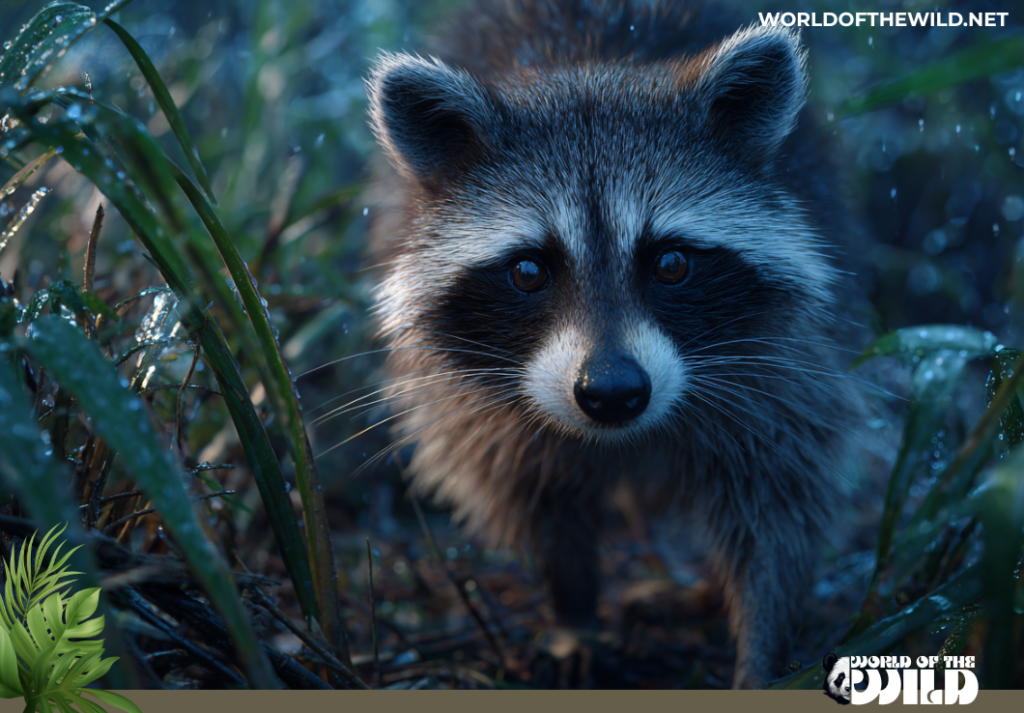
In spring and early summer, raccoons focus heavily on protein-rich animal matter — crayfish, frogs, fish, insects, earthworms, bird eggs, and small mammals all feature prominently. They are highly skilled at hunting aquatic prey, using their sensitive forepaws to probe under rocks and debris in shallow water with a speed and precision that belies the apparent casualness of the behavior.
As summer progresses into fall, raccoons pivot toward high-calorie plant material — wild berries, nuts (especially acorns and hickory nuts), corn, grapes, and various fruits. This hyperphagia phase is critical for building fat reserves before winter. A raccoon in late autumn may consume as many as 20,000 calories in a single day.
In urban environments, the raccoon’s diet expands to include virtually anything humans discard — garbage, pet food, compost, and garden produce. Far from being indiscriminate, urban raccoons often demonstrate learned preferences and sophisticated foraging routes, returning nightly to reliable food sources with impressive consistency.
Predators and Threats
Despite their adaptability, raccoons are not without natural enemies. In wild habitats, their primary predators include coyotes, bobcats, great horned owls, and — where their ranges overlap — mountain lions, wolves, and alligators. Young raccoons, before they develop adult size and wariness, are particularly vulnerable, and mortality in the first year of life is high across most populations.
Humans represent the single greatest source of raccoon mortality. Vehicle collisions kill an enormous number of raccoons annually, particularly in suburban and rural areas where habitat is fragmented by roads. Hunting and trapping, both for fur and for population management, remain significant in many parts of the range, though commercial fur demand has declined substantially from its peak in the mid-twentieth century.
Disease is another major threat, operating both as a natural limiting factor and as a growing conservation concern. Raccoons are the primary reservoir host of raccoon roundworm (Baylisascaris procyonis), canine distemper, and — critically — rabies. The eastern United States hosts one of the most extensive wildlife rabies outbreaks in the world, centered largely in raccoon populations. Mange, caused by mites, is also widespread and can be devastating to individual animals.
Beyond direct threats, habitat fragmentation remains a concern for rural and suburban populations, limiting genetic connectivity between groups and reducing access to natural food sources and denning sites, even as the species as a whole continues to thrive.
Reproduction and Life Cycle
Raccoon mating season runs primarily from January through March, though the exact timing varies by latitude — populations in warmer southern regions may breed earlier, while northern raccoons may delay until February or March. Males become notably more active and wide-ranging during this period, traveling considerable distances in search of receptive females and competing vigorously with rival males.
Females, which are seasonally polyestrous, will accept multiple mates over a brief receptive window. After a gestation period of approximately 63 to 65 days, the female gives birth in a secure den — a tree hollow, burrow, or in urban areas, an attic or chimney. Litters typically contain between two and five kits, though litters of seven have been recorded. The kits are born with their eyes and ears closed, covered in faint fur, and weighing only about 2 to 3 ounces each.
The mother raises her offspring entirely alone — males provide no parental care after mating. The kits open their eyes at around three weeks, begin eating solid food at around seven weeks, and follow their mother on foraging excursions by the time they are eight to ten weeks old. Family groups remain together through the first summer and often into the first winter, with young raccoons gradually dispersing the following spring.
In the wild, raccoons typically live between two and three years on average, with most mortality occurring in the first year of life. Individuals that survive to adulthood may live five to seven years. In captivity, raccoons can exceed twenty years of age.
Population
The common raccoon is currently listed as Least Concern on the IUCN Red List, a designation that reflects its enormous range, high reproductive rate, and remarkable adaptability to human-altered environments. There is no precise global population estimate, but the species is considered abundant to the point of overabundance in many parts of its range.
In North America, raccoon populations expanded dramatically throughout the twentieth century, aided by the reduction of large predator populations, the proliferation of suburban and agricultural environments, and legal protection from unregulated trapping. Urban raccoon populations in particular have grown steadily and show no sign of declining.
The picture is more complicated for some island subspecies. The Cozumel raccoon (Procyon pygmaeus), limited to a single small island off Mexico’s Yucatán Peninsula, is Critically Endangered, with a population estimated at fewer than 500 individuals and facing ongoing pressure from habitat loss, feral dogs, hurricanes, and tourism development. It serves as a sharp reminder that even within a thriving species, distinct populations and subspecies can teeter on the edge of extinction.
Conclusion
The raccoon is many things at once — a wild animal and a city dweller, a problem-solver and an opportunist, a biological success story with a complicated relationship to the human world. Its masked face has made it an icon of wildlife in North America, and its intelligence and adaptability have allowed it to navigate a rapidly changing planet with a flexibility that most species can only envy.
But there is more to the raccoon than resilience. It is a creature of genuine ecological importance, serving as prey for larger predators, as a seed disperser, and as an indicator of the health of aquatic and riparian ecosystems. Its fate is bound up in ours in ways both practical and philosophical — a daily reminder that wildness persists even in the most human of landscapes.
As we continue to reshape the natural world, the raccoon challenges us to think carefully about what it means for a species to “succeed.” It is thriving in our cities, yes — but that success comes at the cost of a more fragmented, less biodiverse world in which the generalists win and the specialists lose. The raccoon’s adaptability is a gift. What it reveals about the ecosystems we are losing is a warning.
Quick Reference
| Scientific Name | Procyon lotor |
| Diet Type | Omnivore |
| Body Size | 24–38 inches (body); tail adds 8–12 inches |
| Weight | 8–20 pounds (up to 30+ lbs in northern populations) |
| Region Found | North America (native); Europe, Japan, former Soviet Union (introduced) |