
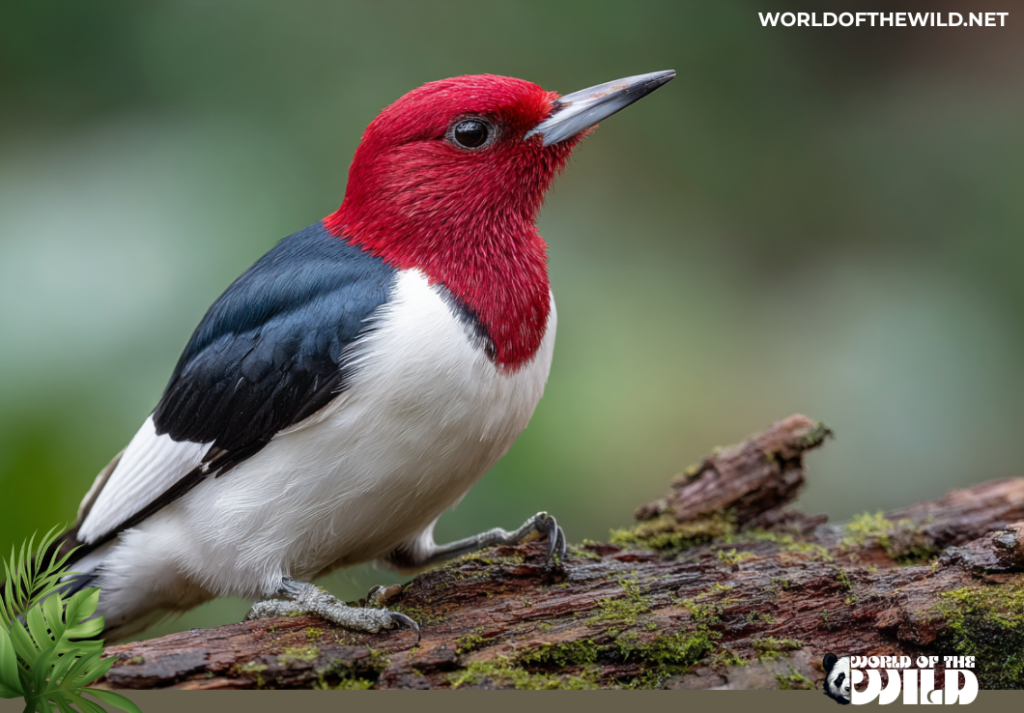
Few birds command attention quite like the Red-headed Woodpecker, a striking aviator whose crimson crown blazes like a flame against the bark of North American trees. Unlike its more subtly adorned woodpecker cousins, this species wears its namesake with unmistakable pride—the entire head and neck draped in brilliant scarlet plumage that seems almost impossibly vivid in the dappled forest light. But this bird is far more than just a pretty face. The Red-headed Woodpecker represents a fascinating intersection of beauty, adaptability, and ecological importance, serving as both a skilled insect hunter and a crucial creator of tree cavities that countless other species depend upon for survival. Once abundant across eastern North America, this charismatic bird now faces mounting challenges that make understanding and appreciating it more important than ever.
Facts
- Aerial Acrobat: Unlike most woodpeckers that primarily cling to tree trunks, Red-headed Woodpeckers are exceptional flycatchers, snatching insects out of mid-air with remarkable agility and performing aerial maneuvers that rival those of specialized flycatcher species.
- Food Hoarders Extraordinaire: These woodpeckers are meticulous storers, wedging grasshoppers, nuts, and seeds into tree bark crevices with such force that they sometimes cover their cache with wood or bark pieces to conceal it from thieves—a behavior called “lardering.”
- Surprisingly Omnivorous: While many woodpeckers stick to insects and grubs, Red-headed Woodpeckers have one of the most varied diets in the family, consuming everything from acorns and beechnuts to bird eggs, mice, and even occasionally other birds.
- Historical Decline: The Red-headed Woodpecker population has plummeted by approximately 70% since the 1960s, making it one of the most dramatically declining woodpecker species in North America despite not yet being listed as endangered.
- Nomadic Tendencies: Unlike many woodpecker species that maintain year-round territories, Red-headed Woodpeckers are somewhat nomadic, moving unpredictably in response to food availability, particularly acorn and beechnut crops.
- Nest Cavity Recyclers: They often reuse the same nesting cavity for multiple years, and their abandoned cavities become prime real estate for secondary cavity nesters like bluebirds, chickadees, flying squirrels, and even small owls.
- Bold Defenders: These birds are famously aggressive in defending their territories and food stores, readily attacking much larger birds, squirrels, and even humans who venture too close to their nests.
Species
The Red-headed Woodpecker belongs to a well-defined taxonomic lineage that places it among the New World woodpeckers:
- Kingdom: Animalia
- Phylum: Chordata
- Class: Aves
- Order: Piciformes
- Family: Picidae
- Genus: Melanerpes
- Species: Melanerpes erythrocephalus
The Red-headed Woodpecker is one of approximately 23 species in the genus Melanerpes, which includes other distinctive North American woodpeckers. Unlike some widespread bird species, Melanerpes erythrocephalus has no recognized subspecies—the entire population is considered a single cohesive species with minimal geographic variation across its range.
Its closest relatives within the genus include the Acorn Woodpecker (Melanerpes formicivorus) of western North America, which shares the food-storing behavior but lacks the complete red head, and the Red-bellied Woodpecker (Melanerpes carolinus), which is often confused with the Red-headed despite having only a red cap and nape rather than a fully red head. The Lewis’s Woodpecker (Melanerpes lewis) is another North American relative, notable for its dark greenish-black plumage and salmon-pink belly.
Appearance
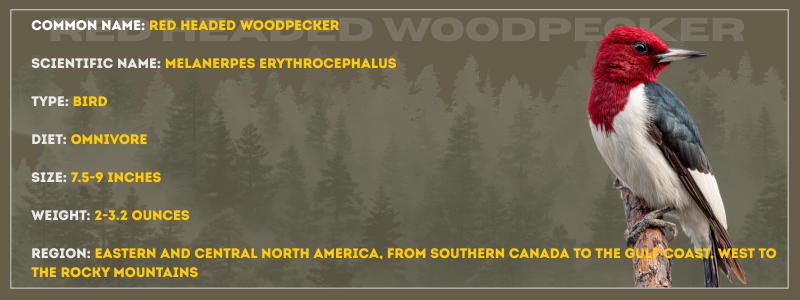
The Red-headed Woodpecker is a medium-sized woodpecker measuring 19 to 23 centimeters in length with a wingspan of 42 to 43 centimeters. Adults typically weigh between 56 and 91 grams, with males averaging slightly larger than females, though the sexes are otherwise identical in appearance—a rarity among woodpeckers.
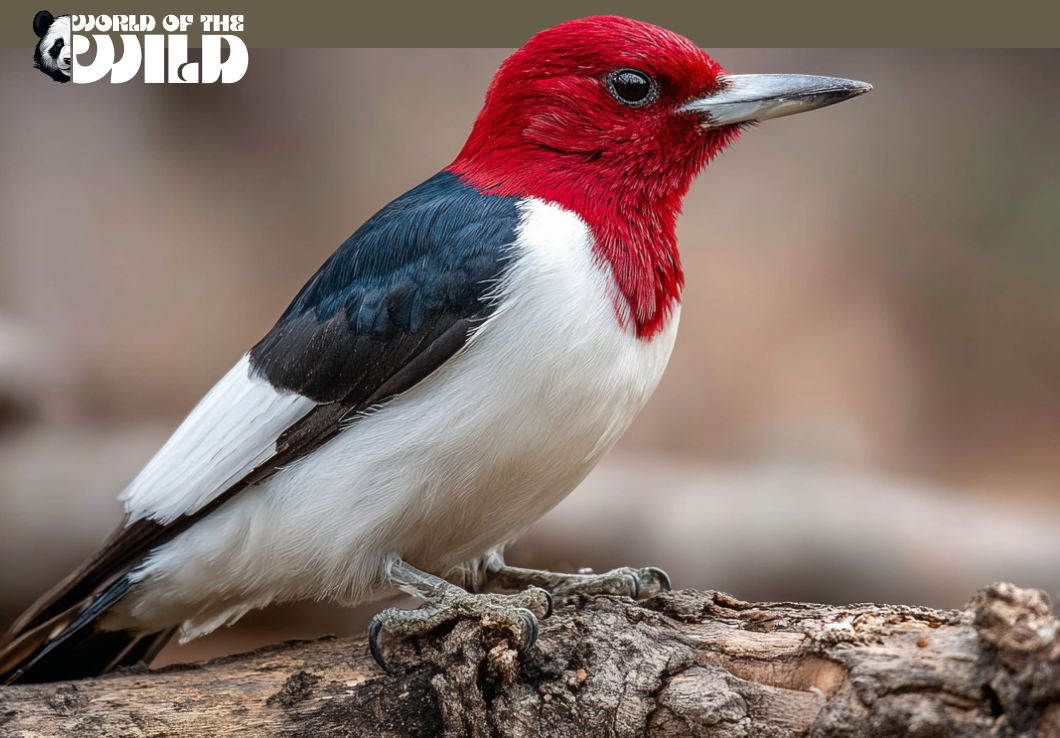
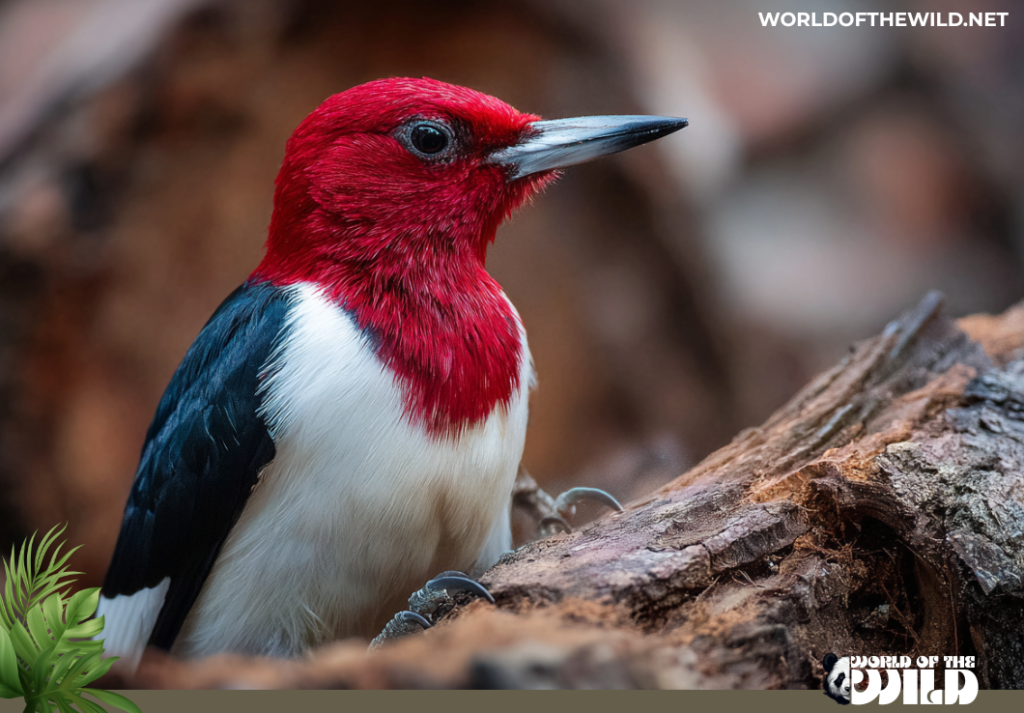
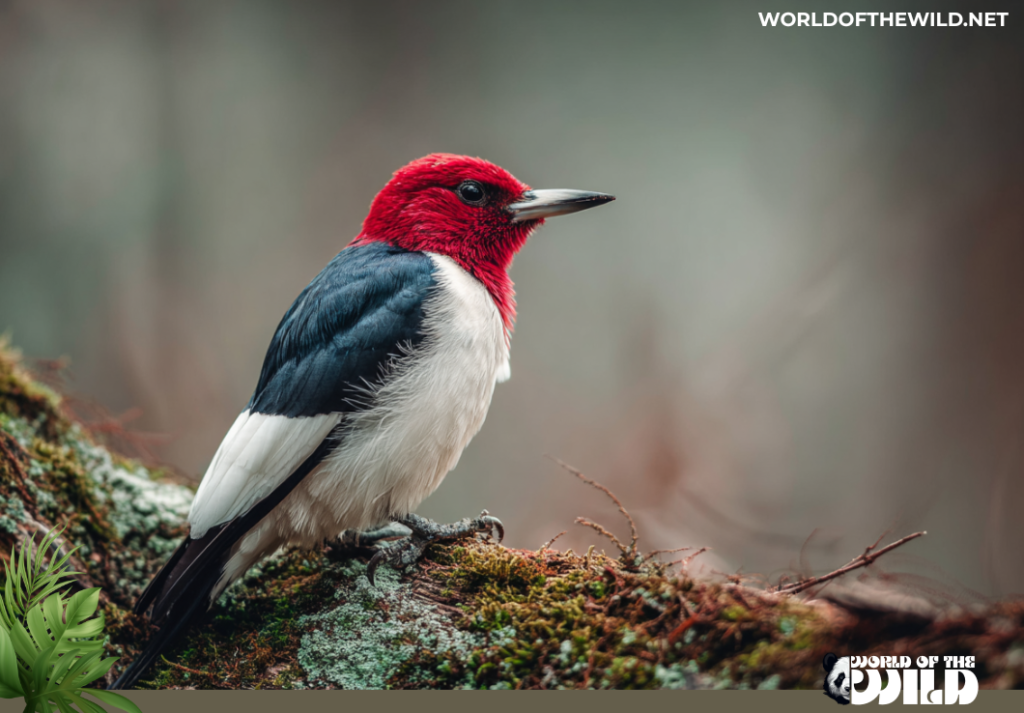
The adult plumage is strikingly tricolored and unmistakable. The entire head, neck, and throat are covered in solid, bright crimson-red feathers with no streaking or variation—a feature that gives the species its name and distinguishes it from all other North American woodpeckers. The back, wings, and tail are a deep, glossy blue-black that can appear almost iridescent in bright sunlight. The underparts, rump, and secondary wing feathers are pure white, creating a bold contrast against the darker plumage. In flight, the large white wing patches are particularly conspicuous, making the bird easily identifiable even at a distance.
The bill is relatively long, straight, and chisel-tipped, colored in dark gray to black. The eyes are dark brown, and the legs and feet are gray. One of the most distinctive features is the lack of any barring, streaking, or spotting on the plumage—the colors are presented in solid, unbroken blocks.
Juvenile Red-headed Woodpeckers look dramatically different from adults. Young birds have brown heads instead of red, with brownish-gray backs and wings that are barred with darker markings. The white areas are often dingy or grayish. This juvenile plumage is retained through their first fall and winter, with the transformation to adult plumage occurring during their first spring, typically between December and April of their first year.
Behavior
Red-headed Woodpeckers exhibit a fascinating array of behaviors that set them apart from their woodpecker relatives. While they certainly engage in the typical woodpecker behavior of drilling into tree bark to excavate insects and create nest cavities—producing the characteristic drumming sound that echoes through woodlands—they spend considerably more time behaving like flycatchers.
These birds are exceptional aerial hunters, launching from exposed perches to snatch flying insects in mid-air with remarkable precision. They hover, swoop, and perform acrobatic turns that seem uncharacteristic of woodpeckers, pursuing everything from dragonflies to grasshoppers with impressive agility. This flycatching behavior is most pronounced during spring and summer when insect populations peak.
Socially, Red-headed Woodpeckers are generally solitary or found in pairs during the breeding season, though they may gather in small groups at abundant food sources, particularly during fall and winter when nuts and acorns are plentiful. They are highly territorial and exceptionally aggressive in defending their claimed areas, engaging in vigorous chasing and vocal disputes with intruders. They’ve been observed attacking and even killing other bird species that attempt to use their nest cavities or raid their food stores.
Their food-storing behavior is particularly sophisticated. During autumn, they collect enormous quantities of acorns, beechnuts, and other seeds, methodically wedging them into bark crevices, fence posts, and tree cavities. Some individuals create hundreds of storage sites, sometimes covering their caches with bits of wood to hide them. They also store live grasshoppers, which they first stun or kill before caching. These stores are vigorously defended throughout winter and serve as critical food reserves when other sources are scarce.
Communication involves a variety of vocalizations including loud, rattling “querrr” or “queer” calls, chattering sounds, and drumming on resonant wood surfaces. Unlike some woodpecker species that drum primarily for territorial purposes, Red-headed Woodpeckers drum less frequently and rely more on vocal calls.
Intelligence is evident in their problem-solving abilities and food-caching strategies. They remember the locations of hundreds of food stores and can adapt their foraging techniques to different food sources and seasonal availability, demonstrating considerable cognitive flexibility.
Evolution
The Red-headed Woodpecker belongs to the family Picidae, which first emerged approximately 25 to 30 million years ago during the Oligocene epoch. The woodpecker family diversified rapidly across the globe, with members eventually found on every continent except Australia, Antarctica, and Madagascar.
The genus Melanerpes is considered one of the more recently evolved woodpecker lineages, emerging in the New World roughly 5 to 10 million years ago during the late Miocene to Pliocene epochs. This genus appears to have originated in Central or South America before expanding northward into North America. The Melanerpes woodpeckers are characterized by their relatively omnivorous diets and their tendency toward more open woodland habitats compared to the deep forest preference of some older woodpecker lineages.
The Red-headed Woodpecker specifically appears to have evolved adaptations for exploiting the oak-hickory forests that expanded across eastern North America during climatic shifts of the Pleistocene epoch. Its strong association with oak mast (acorn) crops and its specialized food-storing behaviors likely developed during this period as adaptations to seasonal food scarcity.
Fossil evidence of woodpeckers is relatively sparse due to their small, hollow bones, but specimens from the Pleistocene closely resembling modern Melanerpes species have been found in cave deposits and tar pits, suggesting that the genus has maintained relatively consistent morphology for hundreds of thousands of years.
The evolutionary success of Red-headed Woodpeckers, like other woodpeckers, relies on several key adaptations: a reinforced skull with shock-absorbing tissues that protect the brain during drilling, a long, barbed tongue for extracting insects from crevices, zygodactyl feet (two toes forward, two back) for gripping vertical surfaces, and stiff tail feathers that serve as a prop during climbing.
Habitat
The Red-headed Woodpecker inhabits a broad swath of eastern and central North America, with its range extending from southern Canada through the eastern United States west to the Rocky Mountains, and south to the Gulf Coast states and northern Florida. Historically, the species was found as far west as New Mexico and Colorado, though populations in these western extremes have largely disappeared.
These woodpeckers show a marked preference for open woodlands rather than dense, closed-canopy forests. Their ideal habitat consists of mature trees with plenty of dead wood (snags) for nesting and foraging, interspersed with open areas that provide good visibility for flycatching. Prime habitats include oak-hickory forests, especially those with scattered clearings; woodland edges along rivers and wetlands; agricultural areas with scattered groves of trees; parks, golf courses, and cemeteries with mature trees; and bottomland hardwood forests.
The presence of dead or dying trees is critical, as Red-headed Woodpeckers require these for excavating nest cavities and finding wood-boring beetle larvae. They also favor areas with oak and beech trees, which provide the acorn and beechnut crops essential to their winter survival. In recent decades, they’ve shown some adaptability to human-modified landscapes, occasionally nesting in wooden fence posts, utility poles, and even the sides of buildings when natural sites are scarce.
Seasonal movements occur in response to food availability. Northern populations may migrate south during harsh winters, particularly when mast crops fail, while southern populations tend to be more sedentary. However, even within stable populations, individuals may move considerable distances to locate areas with abundant acorn crops, showing an unpredictable, almost nomadic pattern that makes population monitoring challenging.
During breeding season, they tend to favor more forested areas with larger trees, while in fall and winter they may move to more open habitats where scattered oaks and agricultural fields provide abundant seeds and nuts.
Diet
The Red-headed Woodpecker is decidedly omnivorous, boasting one of the most diverse diets among North American woodpeckers. This dietary flexibility has allowed the species to exploit a wide range of food sources across different seasons and habitats, though it also makes them vulnerable when multiple food sources simultaneously decline.
During spring and summer, their diet consists primarily of animal matter, with insects and other arthropods comprising about two-thirds of their food intake. They consume beetles (particularly wood-boring species like bark beetles and long-horned beetles), ants, wasps, bees, cicadas, grasshoppers, crickets, caterpillars, and spiders. Their flycatching prowess allows them to catch fast-moving aerial insects that other woodpeckers cannot easily obtain.
The foraging technique varies by prey type. For wood-boring insects, they use the traditional woodpecker method of drilling into bark and dead wood, using their long, sticky tongue to extract larvae from galleries. For flying insects, they adopt a sit-and-wait strategy, perching on exposed branches or fence posts and launching into aerial pursuits when prey flies past. They also glean insects from foliage and bark surfaces and occasionally probe into leaf litter on the ground.
In fall and winter, their diet shifts dramatically toward plant material. Acorns become the primary food source when available, supplemented by beechnuts, pecans, various seeds, and fruits such as wild grapes, cherries, blackberries, and sumac berries. Approximately one-third of their annual diet consists of plant material, though this proportion increases significantly during winter months.
Remarkably, Red-headed Woodpeckers also prey on small vertebrates and bird eggs with surprising regularity. They’ve been documented raiding the nests of other birds to consume eggs and nestlings, catching and eating small rodents like mice, and even occasionally taking small fish from shallow water. This opportunistic carnivory is unusual among woodpeckers and reflects the species’ adaptable foraging strategy.
Their food-storing behavior means they’re constantly balancing immediate consumption with long-term caching, creating winter reserves that can sustain them through periods of scarcity.
Predators and Threats
In their natural environment, Red-headed Woodpeckers face predation from a variety of animals. Aerial predators include hawks, particularly Cooper’s Hawks and Sharp-shinned Hawks, which hunt adult woodpeckers in flight or when perched. Great Horned Owls and Barred Owls pose threats during nighttime roosting. Eggs and nestlings are vulnerable to nest predators including rat snakes, black racers, and other climbing snakes; raccoons, which can reach into cavity nests; eastern gray squirrels and fox squirrels; European Starlings, which sometimes evict woodpecker families to usurp their cavities; and American Crows and Blue Jays, which occasionally raid nests.
However, the most severe threats facing Red-headed Woodpeckers are anthropogenic—caused by human activities. Habitat loss stands as the primary driver of population decline. The removal of dead trees (snags) through forestry practices, urban development, and misguided “forest health” initiatives eliminates essential nesting sites. The conversion of open woodlands and savanna habitats to dense forests (through fire suppression), agricultural intensification, or suburban development reduces available foraging areas.
Vehicle collisions represent a significant and underappreciated threat. Red-headed Woodpeckers frequently forage along roadsides for insects and often fly low across roads, making them particularly susceptible to being struck by cars. Studies suggest this may be one of the leading direct causes of adult mortality.
Competition with invasive species, particularly European Starlings, has intensified. Starlings aggressively compete for nest cavities and frequently succeed in evicting woodpeckers, sometimes even killing incubating adults or destroying eggs. This competition is especially problematic in fragmented habitats where cavity trees are scarce.
Pesticide use reduces insect populations that woodpeckers depend upon, particularly during breeding season when protein-rich arthropods are essential for raising young. The decline of American Chestnut trees due to chestnut blight and the ongoing loss of oak and beech trees to diseases and pests has reduced the availability of crucial nut crops.
Climate change poses emerging threats through altered precipitation patterns that affect mast crop production, shifts in insect emergence timing that may create mismatches with breeding schedules, and increased frequency of extreme weather events. The species’ dependence on unpredictable mast crops makes them particularly vulnerable to climate-induced changes in tree reproduction.
Reproduction and Life Cycle
Red-headed Woodpeckers typically form monogamous pairs during the breeding season, which extends from May through July across most of their range, beginning slightly earlier in southern populations. Pair formation involves courtship displays where both sexes perform aerial chases, engage in mutual bobbing and swaying while clinging to tree trunks, and produce soft courtship calls quite different from their typical harsh vocalizations.
Both members of the pair collaborate in excavating the nest cavity, which they chisel into dead trees or dead portions of living trees, typically at heights ranging from 2 to 24 meters above ground, though most nests are positioned between 3 and 12 meters. The excavation process takes approximately two weeks, with the pair working together to create a cavity 25 to 30 centimeters deep with an entrance hole about 5 centimeters in diameter. Unlike some woodpecker species that line their nests, Red-headed Woodpeckers lay their eggs directly on wood chips at the cavity bottom.
The female typically lays a clutch of 4 to 5 eggs, though clutches can range from 3 to 7 eggs. The eggs are pure white, smooth, and slightly glossy, measuring approximately 25 by 19 millimeters. Both parents share incubation duties, with the male typically incubating at night and both sexes alternating during the day. The incubation period lasts 12 to 14 days.
Hatchlings emerge naked, blind, and completely helpless. Both parents feed the nestlings by regurgitation, initially providing soft-bodied insects and gradually introducing harder prey as the young develop. The nestlings grow rapidly, developing feathers and opening their eyes within the first week. They remain in the nest cavity for approximately 24 to 27 days before fledging.
Upon leaving the nest, fledglings still depend on their parents for food and protection for an additional 2 to 3 weeks while they develop foraging skills. Young birds retain their brownish juvenile plumage through their first fall and winter, molting into adult plumage the following spring. They typically reach sexual maturity and begin breeding at one year of age, though some may delay breeding until their second year.
Most Red-headed Woodpeckers produce only one brood per year, though pairs that lose early clutches to predation may attempt to renest. In rare cases, particularly in southern populations with longer breeding seasons, pairs may successfully raise two broods.
Average lifespan in the wild is difficult to determine precisely, but banding studies suggest that many birds live 5 to 7 years, with the oldest recorded individual reaching at least 9 years and 11 months in the wild. Mortality is highest during the first year of life, with many young birds succumbing to predation, starvation, or vehicle collisions before their first breeding season.
Population
The Red-headed Woodpecker is currently listed as Near Threatened on the IUCN Red List and as a species of Moderate Concern in the North American Bird Conservation Initiative. While not yet classified as endangered, the species’ dramatic population decline has raised significant conservation alarms.
Global population estimates suggest approximately 1.2 to 3.5 million individual Red-headed Woodpeckers remain, though these numbers come with considerable uncertainty due to the species’ nomadic tendencies and irregular distribution. The North American Breeding Bird Survey, which has tracked populations since 1966, documents a catastrophic decline of approximately 70% over this period—one of the steepest declines among North American woodpecker species.
Population trends vary regionally, but declines have been documented across virtually all portions of the range. The species has been extirpated from many areas where it was once common, particularly at the western and northern edges of its historical range. Some of the most severe declines have occurred in the Midwest and Great Plains states, where agricultural intensification and removal of scattered woodlots have eliminated habitat.
A few localized populations have remained relatively stable or shown modest increases, typically in areas where active habitat management preserves open woodlands with standing dead trees. Wildlife refuges, state parks, and military installations with prescribed burning programs and snag retention policies have become important strongholds.
The combination of continuing habitat loss, competition with invasive species, and the species’ low reproductive rate (typically one brood of 4-5 young per year) means that populations cannot quickly recover from declines. Additionally, the Red-headed Woodpecker’s dependence on unpredictable mast crops creates natural population fluctuations that can mask or complicate trend assessments.
Partners in Flight, a collaborative organization focused on bird conservation, estimates that the species could decline by an additional 50% over the next few decades if current trends continue, potentially pushing it into threatened or endangered status.
Conclusion
The Red-headed Woodpecker stands as a vivid emblem of North America’s open woodland ecosystems—a bold, resourceful bird whose striking appearance masks an even more remarkable suite of behaviors and adaptations. From its aerial insect-catching prowess to its meticulous food-storing strategies, this species exemplifies the intricate ecological relationships that make healthy forests function. Yet the same characteristics that make this woodpecker so fascinating—its dependence on dead trees, open woodlands, and fluctuating mast crops—also render it vulnerable to the dramatic landscape changes humans have wrought across eastern North America.
The 70% population decline witnessed over recent decades serves as a sobering reminder that even adaptable, widespread species can spiral toward endangerment when multiple threats converge. The Red-headed Woodpecker’s plight is particularly poignant because the solutions are well understood: preserve standing dead trees, maintain open woodland structure through prescribed burning or selective thinning, protect existing mature forests, and reduce vehicle collisions through strategic road planning.
The fate of the Red-headed Woodpecker ultimately rests not with complex technological interventions but with simple shifts in how we value our shared landscape. Every dead tree left standing, every oak grove preserved, every roadside managed with wildlife in mind represents a small victory for this crimson-crowned survivor. If we choose to act, the distinctive sight of that brilliant red head moving through dappled sunlight can remain a common pleasure for generations to come. If we do not, we risk relegating one of North America’s most stunning birds to the realm of rare sightings and fading memories.
Scientific Name: Melanerpes erythrocephalus
Diet Type: Omnivore
Size: 19-23 cm (7.5-9 inches) in length; 42-43 cm wingspan
Weight: 56-91 grams (2-3.2 ounces)
Region Found: Eastern and central North America, from southern Canada to the Gulf Coast, west to the Rocky Mountains