
Beneath the murky surface of a quiet pond, a prehistoric-looking creature waits with infinite patience. Its massive head, jagged shell, and powerful jaws belong to one of North America’s most misunderstood reptiles: the snapping turtle. With a lineage stretching back millions of years, these formidable freshwater dwellers have remained virtually unchanged, a living testament to evolutionary success. Often feared for their defensive bite and grumpy disposition, snapping turtles are actually vital ecosystem engineers that keep aquatic habitats healthy and balanced. From their dinosaur-like appearance to their surprising longevity, these ancient survivors command both respect and fascination, representing a direct connection to the age of reptiles that once dominated our planet.
Facts
- Bite Force Champions: Common snapping turtles can generate a bite force of around 209 newtons (47 pounds), while their larger cousin, the alligator snapping turtle, can exceed 1,000 newtons—powerful enough to sever fingers.
- Underwater Breathing: Snapping turtles can extract oxygen from water through specialized tissues in their throat and cloaca, allowing them to remain submerged for months during winter brumation without surfacing for air.
- Temperature-Dependent Sex: The sex of snapping turtle hatchlings is determined by the temperature of the nest during a critical period of incubation—warmer temperatures produce females, while cooler temperatures produce males.
- Marathon Nesters: Female snapping turtles will travel up to a mile from water to find the perfect nesting site, often crossing busy roads and highways, which makes them vulnerable to vehicle strikes.
- Living Fossils: The snapping turtle family has existed for over 90 million years, with fossil evidence showing they shared the Earth with dinosaurs during the Cretaceous period.
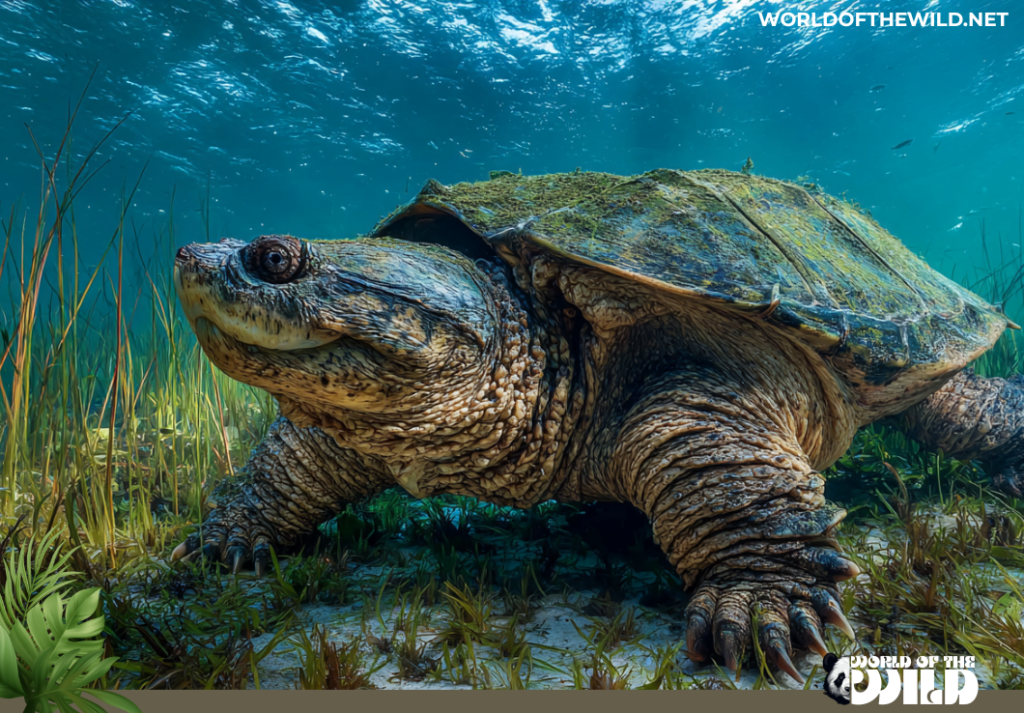
- Algae Camouflage: Wild snapping turtles often have algae growing on their shells, which provides natural camouflage and makes them nearly invisible to both prey and predators in their murky habitats.
- Impressive Longevity: Snapping turtles can live for over 100 years in the wild, with some documented individuals estimated to be well over a century old.
Species
Taxonomic Classification:
- Kingdom: Animalia
- Phylum: Chordata
- Class: Reptilia
- Order: Testudines
- Family: Chelydridae
- Genus: Chelydra (Common Snapping Turtle) and Macrochelys (Alligator Snapping Turtle)
- Species: Chelydra serpentina (Common Snapping Turtle) and Macrochelys temminckii (Alligator Snapping Turtle)
The family Chelydridae contains two distinct genera representing the snapping turtles of the Americas. The Common Snapping Turtle (Chelydra serpentina) is the most widespread and familiar, with four recognized subspecies distributed across North, Central, and South America. These include the Eastern Snapping Turtle, Florida Snapping Turtle, Central American Snapping Turtle, and South American Snapping Turtle, though recent genetic studies suggest some of these may warrant species status.
The Alligator Snapping Turtle (Macrochelys temminckii) represents a separate genus and is considerably larger and more specialized. Recent research has identified three distinct species within this group, including the Suwannee Alligator Snapping Turtle and the Apalachicola Alligator Snapping Turtle, both found in specific river systems in the southeastern United States. These giants of the turtle world are exclusively freshwater dwellers and are among the heaviest freshwater turtles on Earth.
Appearance
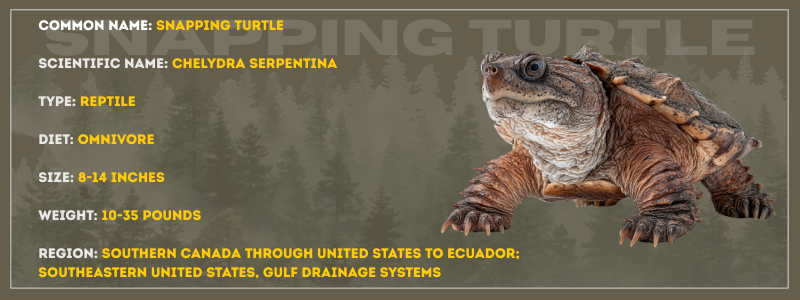
The Common Snapping Turtle presents a formidable and prehistoric appearance perfectly suited to its predatory lifestyle. Adults typically measure 8 to 14 inches (20 to 36 centimeters) in carapace length, though exceptional individuals can reach 19 inches (49 centimeters). Their weight ranges from 10 to 35 pounds (4.5 to 16 kilograms), with occasional specimens exceeding 70 pounds (32 kilograms).
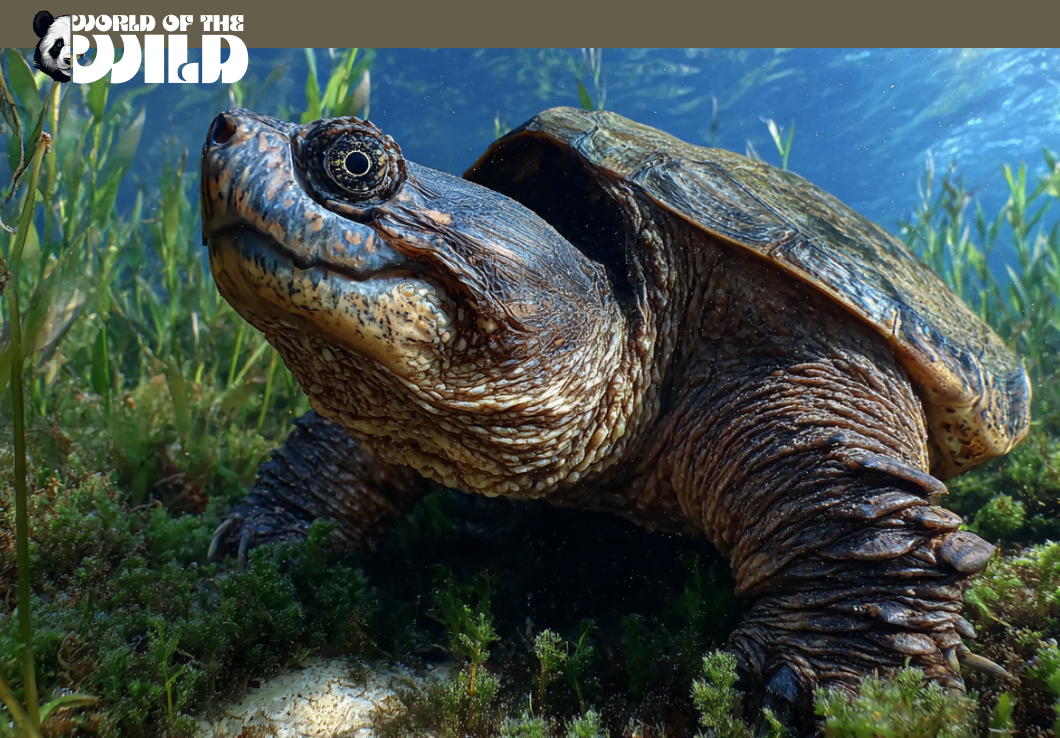
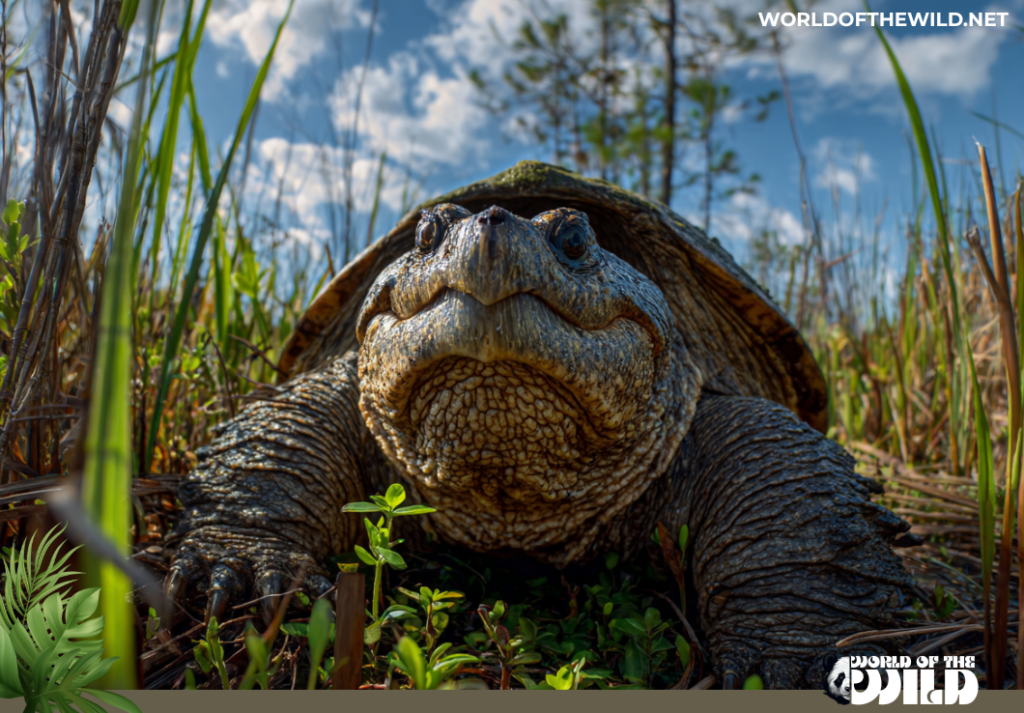
The turtle’s carapace is characterized by three prominent ridges, or keels, running lengthwise along the shell, giving it a distinctly rugged, saw-toothed appearance. The shell color varies from tan or olive to dark brown or black, often covered with algae and sediment in wild individuals. Unlike many turtles, snapping turtles cannot fully retract into their shells—their plastron (bottom shell) is notably reduced and cross-shaped, leaving their limbs, tail, and head exposed.
The head is perhaps their most distinctive feature: large, blocky, and equipped with powerful hooked jaws that resemble a bird’s beak. Their eyes are positioned high on the head, allowing them to scan for threats while remaining mostly submerged. The skin is rough and covered in tubercles (small bumps), typically gray-brown to olive in coloration. Their tail is remarkably long—often as long as the carapace itself—and covered in triangular, serrated scales that give it a dinosaur-like appearance.
The Alligator Snapping Turtle dwarfs its common cousin, with adults weighing 155 to 175 pounds (70 to 80 kilograms) and reaching carapace lengths of 26 inches (66 centimeters) or more. The largest recorded specimen weighed 316 pounds (143 kilograms). These massive turtles have an even more primitive appearance, with heavily ridged shells, larger heads, and a unique pink, worm-like appendage on their tongue used to lure fish.
Behavior
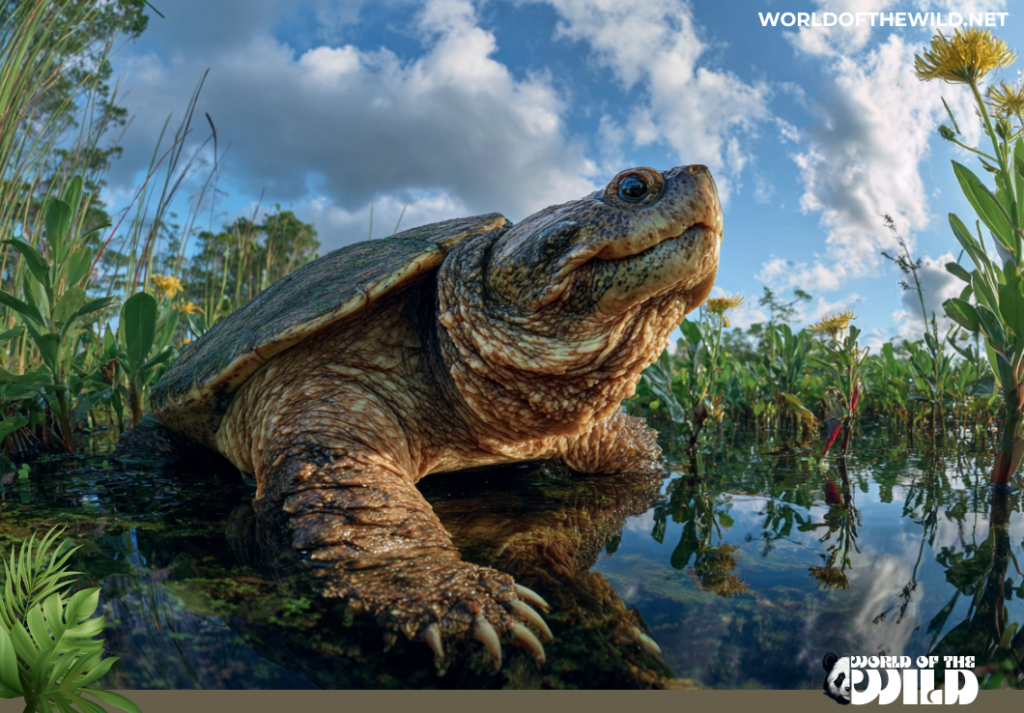
Snapping turtles are primarily solitary and largely aquatic creatures, spending most of their lives on lake and river bottoms. Despite their fearsome reputation, they are actually quite docile underwater, preferring to avoid confrontation by remaining still or slowly walking away. Their aggressive reputation stems from their behavior when encountered on land, where their inability to retreat into their shell forces them to rely on intimidation and powerful defensive bites.
These turtles are most active during dawn and dusk, exhibiting crepuscular behavior patterns. They spend much of the day buried in mud or sediment with only their eyes and nostrils exposed, ambush-style, waiting for prey to pass by. Their excellent camouflage and patience make them highly effective hunters. When threatened, they produce a distinctive hissing sound by rapidly expelling air from their lungs, often accompanied by lunging movements and open-mouth displays.
Communication among snapping turtles is limited, primarily occurring during mating season when males may engage in aggressive displays toward rivals. They navigate their environment using a combination of vision, chemical detection through their Jacobson’s organ, and tactile sensing. Despite their seemingly slow and clumsy appearance, snapping turtles can move with surprising speed when motivated, both in water and on land.
One fascinating behavioral adaptation is their ability to brumate (reptilian hibernation) during cold winters. They settle into the muddy bottom of ponds and lakes, dramatically slowing their metabolism and remaining inactive for months. During this time, they absorb oxygen directly from the water through specialized tissues, eliminating the need to surface for air.
Intelligence studies have shown that snapping turtles possess spatial memory and can learn to navigate mazes and remember the location of food sources. They demonstrate problem-solving abilities and can distinguish between different human individuals, suggesting a more complex cognitive capacity than previously assumed.
Evolution
The evolutionary history of snapping turtles extends deep into the Mesozoic Era, making them true living fossils. The family Chelydridae emerged approximately 90 million years ago during the Late Cretaceous period, when dinosaurs still dominated terrestrial ecosystems. Fossil evidence suggests that the ancestral snapping turtles were already remarkably similar to modern species, indicating that their body plan was highly successful early on.
The oldest confirmed chelydrid fossils date back to the Campanian stage of the Cretaceous, found in formations across western North America. These ancient relatives already possessed the characteristic reduced plastron, powerful jaws, and robust build that define modern snapping turtles. The family survived the mass extinction event 66 million years ago that wiped out non-avian dinosaurs, demonstrating remarkable resilience.
During the Paleocene and Eocene epochs, chelydrid diversity was actually greater than today, with multiple genera and species distributed across North America, Europe, and Asia. Climate changes and competition with other turtle families eventually restricted their range primarily to the Americas. The split between the Common Snapping Turtle lineage (Chelydra) and the Alligator Snapping Turtle lineage (Macrochelys) occurred approximately 40 million years ago during the Eocene.
One fascinating evolutionary aspect is the snapping turtle’s retention of primitive turtle features, including the inability to fully retract into their shell—a trait shared with some of the earliest known turtles from over 200 million years ago. This suggests that the aggressive defensive behavior observed in modern snappers may have been an alternative evolutionary strategy to shell retraction.
The relatively unchanged morphology over millions of years indicates that snapping turtles reached an evolutionary optimum early in their history. Their generalist diet, aquatic lifestyle, and formidable defenses have allowed them to persist through multiple climate shifts and extinction events that eliminated many of their contemporaries.
Habitat
Common Snapping Turtles have an extensive geographic range, inhabiting regions from southern Canada throughout the eastern United States, extending westward to the Rocky Mountains and southward through Mexico and Central America to Ecuador in South America. This makes them one of the most widespread freshwater turtle species in the Western Hemisphere.
These adaptable reptiles thrive in almost any permanent or semi-permanent body of freshwater, showing a remarkable tolerance for varying environmental conditions. They inhabit slow-moving rivers, streams, lakes, ponds, marshes, swamps, and even brackish waters where freshwater meets saltwater. They have been found in everything from pristine wilderness waters to highly polluted urban ponds, demonstrating impressive environmental flexibility.
Snapping turtles prefer habitats with soft, muddy bottoms where they can easily bury themselves, and abundant aquatic vegetation that provides cover and attracts prey. They favor water depths ranging from a few inches to many feet, though they tend to stay in shallower areas where they can easily reach the surface for air. Ideal habitats include slow currents, ample basking logs or vegetation, and areas with submerged structures like fallen trees, which provide hiding spots and ambush points.
The Alligator Snapping Turtle has a more restricted range, found exclusively in river systems draining into the Gulf of Mexico, from the Suwannee River in Florida westward to eastern Texas, and northward in the Mississippi River drainage to Iowa and Illinois. They prefer deeper, larger rivers and lakes compared to their common cousins, often inhabiting ancient river systems with stable thermal conditions.
Temperature tolerance in snapping turtles is impressive, with activity occurring in water temperatures from just above freezing to over 90°F (32°C). However, they prefer temperatures between 68-82°F (20-28°C) for optimal activity and feeding. Their ability to survive frozen ponds by brumating in the mud below ice level demonstrates their remarkable physiological adaptations.
Diet
Snapping turtles are omnivorous opportunists with a diet that shifts based on availability, age, and habitat. They are not purely predatory despite their fearsome appearance; studies of stomach contents reveal that aquatic vegetation and carrion make up significant portions of their diet, particularly in adult turtles.
As carnivores and scavengers, snapping turtles consume a diverse menu of animal matter including fish, frogs, salamanders, small snakes, young waterfowl, crayfish, aquatic insects, mollusks, and even small mammals that venture into the water. They are important scavengers in aquatic ecosystems, feeding on dead fish and other carrion, which helps maintain water quality. Younger snapping turtles tend to be more carnivorous, while adults incorporate more plant material including algae, aquatic plants, fallen fruits, and seeds.
Their hunting strategy relies primarily on ambush predation. A snapping turtle will settle into the muddy bottom, remaining motionless for hours or even days, with only its eyes visible above the sediment. When prey swims or walks within range, the turtle strikes with surprising speed, extending its long neck and snapping its powerful jaws shut in milliseconds. The attack is so fast that slow-motion cameras are required to capture the full sequence.
While they can actively pursue prey, snapping turtles are more efficient as sit-and-wait predators. Their excellent camouflage and infinite patience make this strategy highly successful. They hunt primarily by sight but also rely on detecting vibrations in the water and chemical cues to locate food.
The Alligator Snapping Turtle employs a unique and highly specialized hunting technique: it possesses a pink, worm-like appendage on its tongue that it wiggles to lure curious fish directly into its mouth. This remarkable adaptation transforms the turtle into a living fish trap.
Predators and Threats
Adult snapping turtles have few natural predators due to their size, armored shell, and aggressive defensive behavior. However, large alligators, bears, and otters have been known to prey on adult snappers, particularly when the turtles are traveling overland to nesting sites. Coyotes and foxes may also attack turtles on land, though the risk is substantial given the turtle’s bite.
Eggs and hatchlings face much greater predation pressure. Raccoons, skunks, foxes, crows, and snakes are major nest predators, often destroying 90% or more of nests in areas with high predator populations. Once hatched, young turtles are vulnerable to herons, large fish, bullfrogs, water snakes, and even adult snapping turtles. This high juvenile mortality rate is offset by the species’ longevity and extended reproductive lifespan.
The greatest threats to snapping turtle populations are anthropogenic. Road mortality is significant, as nesting females must leave water and often cross roads, making them vulnerable to vehicles. Thousands of snapping turtles are killed on roads annually, with gravid (egg-bearing) females particularly impacted, representing a double loss to the population.
Habitat loss and degradation pose ongoing challenges. Wetland drainage, water pollution, and shoreline development destroy critical nesting habitat and reduce prey availability. Water pollution from agricultural runoff, industrial chemicals, and urban stormwater affects water quality and can bioaccumulate in turtle tissues over their long lifespans.
Commercial harvesting for the food market, particularly for turtle soup, historically decimated populations in some areas, though regulations now protect the species in many jurisdictions. Climate change presents emerging threats through altered sex ratios (warmer temperatures produce more females), changes in brumation patterns, and increased nest flooding from severe weather events. Boat propeller strikes also injure and kill turtles in recreational waterways.
Reproduction and Life Cycle
Snapping turtles exhibit fascinating reproductive behaviors and a life cycle characterized by late maturity and exceptional longevity. Sexual maturity is reached relatively late, typically between 15 and 20 years of age, though this varies by geography and food availability. In northern populations, maturity may not occur until age 20 or beyond.
Mating occurs in spring and early summer, from April through November depending on latitude, with peak activity in May and June. Courtship is brief and somewhat aggressive, with males approaching females and grasping their shells with their claws. Males may bite at the female’s head and neck during mating. A unique feature of snapping turtle reproduction is the female’s ability to store viable sperm for several years, allowing her to produce fertile eggs long after her last mating.
Nesting occurs in late spring and early summer, typically May through July. Gravid females undertake remarkable overland journeys, sometimes traveling more than a mile from water to find suitable nesting sites. They prefer sandy or loamy soil in areas with sun exposure—often road shoulders, gravel paths, fields, or sand banks. The female digs a flask-shaped cavity 4 to 7 inches deep using her hind feet, a process that can take several hours.
A clutch typically contains 20 to 40 spherical, leathery eggs about the size of ping-pong balls, though clutches of over 100 eggs have been documented. Larger, older females generally produce larger clutches. After depositing her eggs and carefully covering the nest, the female provides no further parental care and returns to the water. The buried eggs are left to incubate in the warmth of the sun.
Incubation lasts approximately 75 to 95 days, with temperature determining both development rate and offspring sex. Nest temperatures of 73-79°F (23-26°C) produce males, while temperatures above 84°F (29°C) produce females. Intermediate temperatures produce mixed-sex clutches. Hatchlings emerge in late summer or fall, measuring about 1.25 inches in carapace length.
Remarkably, many hatchlings choose to overwinter in the nest, remaining frozen solid during winter and emerging the following spring. Research has shown these tiny turtles can survive being frozen, with ice crystals forming in their body cavity, through specialized adaptations including elevated glucose levels that act as antifreeze.
Life expectancy in the wild is difficult to determine precisely, but snapping turtles regularly live 30 to 50 years, with many individuals reaching 70 to 100 years or more. Growth continues throughout life, though it slows dramatically after maturity. The oldest documented Common Snapping Turtle lived 47 years in captivity, though wild individuals are believed to exceed this significantly. Alligator Snapping Turtles may live even longer, with estimates suggesting lifespans of 80 to 120 years.
Population
The Common Snapping Turtle is currently classified as “Least Concern” by the International Union for Conservation of Nature (IUCN), reflecting its wide distribution and relatively stable populations across most of its range. However, this broad classification masks significant regional variations and concerning population declines in certain areas.
Estimating global population numbers is challenging due to the species’ aquatic lifestyle and extensive range, but populations number in the millions across North America. Despite this seemingly healthy status, localized population declines have been documented in areas experiencing intense development, road mortality, and commercial harvesting. In some northeastern states, populations have declined by 20-50% over recent decades.
Several U.S. states and Canadian provinces have implemented protective regulations ranging from limited harvest seasons to complete protection. The species is listed as a species of special concern in several states, including Indiana, and is protected in Iowa, where collection is prohibited. International trade is not currently regulated under CITES (Convention on International Trade in Endangered Species).
The Alligator Snapping Turtle faces more serious conservation challenges. Once abundant throughout southern river systems, populations have declined by an estimated 80% or more from historical levels due to overharvesting and habitat degradation. Several states now classify it as threatened or endangered, and a recent petition seeks federal protection under the Endangered Species Act. Population estimates suggest only tens of thousands remain across their entire range, a dramatic reduction from historical numbers.
Population trends for Common Snapping Turtles vary regionally but show overall stability in rural areas with intact wetland habitats, while suburban and urban populations are declining. The species’ late maturity and high juvenile mortality mean that populations are slow to recover from impacts, making sustained conservation efforts essential. Demographic studies indicate that even modest increases in adult mortality rates can drive populations toward decline.
Conclusion
The snapping turtle stands as a remarkable testament to evolutionary success, a living link to the age of dinosaurs that continues to thrive in waterways across the Americas. These armored survivors have witnessed the rise and fall of countless species, persisting through climate shifts, extinction events, and now the challenges of the Anthropocene. Their role as both predator and scavenger makes them essential architects of healthy aquatic ecosystems, maintaining the delicate balance that supports countless other species.
Yet despite their prehistoric resilience, snapping turtles now face unprecedented challenges from human activities. Road mortality, habitat destruction, and commercial exploitation threaten populations that took millions of years to evolve. As we continue to modify landscapes and waterways, we must remember that these ancient creatures cannot adapt at the pace we demand of their environment.
The future of snapping turtles depends on our willingness to coexist with wildlife that evolved long before us and deserves to persist long after. Simple actions—slowing down during turtle nesting season, preserving wetland habitats, and supporting conservation regulations—can ensure that future generations will still encounter these magnificent reptiles in the wild. The snapping turtle’s survival is not just about preserving a single species; it’s about honoring the intricate web of life that makes our planet extraordinary and maintaining our connection to the deep history of life on Earth.
Scientific Name: Chelydra serpentina (Common Snapping Turtle); Macrochelys temminckii (Alligator Snapping Turtle)
Diet Type: Omnivore (opportunistic carnivore and scavenger)
Size: Common: 8-14 inches (20-36 cm) carapace length; Alligator: 16-26 inches (41-66 cm) carapace length
Weight: Common: 10-35 pounds (4.5-16 kg); Alligator: 155-175 pounds (70-80 kg)
Region Found: Common: Southern Canada through United States to Ecuador; Alligator: Southeastern United States, Gulf drainage systems