
Deep in the emerald canopy of Central and South American rainforests, a flash of brilliant color catches the eye—a bird so improbably designed it seems almost cartoon-like. The toucan, with its oversized, rainbow-hued bill that can measure nearly half its body length, stands as one of nature’s most recognizable and charismatic creatures. These remarkable birds have captivated humans for centuries, appearing in everything from ancient indigenous art to modern breakfast cereal boxes. Yet behind their flamboyant appearance lies a sophisticated survivor perfectly adapted to the complex world of the tropical forest canopy. Toucans represent a stunning example of evolutionary innovation, social intelligence, and ecological importance, serving as both seed dispersers vital to rainforest health and ambassadors for conservation in some of the world’s most threatened ecosystems.
Facts
- Thermoregulators Extraordinaire: A toucan’s massive bill functions as a highly efficient radiator, allowing the bird to regulate its body temperature by adjusting blood flow to the bill’s surface—releasing heat when too warm and conserving it when cool, changing bill temperature by as much as 10°C (18°F) in minutes.
- Surprising Lightweights: Despite appearing heavy and unwieldy, a toucan’s bill is remarkably light, composed of hollow bone struts covered by keratin, with an internal honeycomb structure that makes it both strong and feather-light—weighing only about 4% of the bird’s total body weight.
- Acrobatic Sleepers: Toucans sleep in a fascinating contortionist position, rotating their heads 180 degrees and tucking their bills along their backs, then folding their tail forward over their heads to create a compact feather ball that helps conserve heat and fits into small tree cavities.
- Playful Fencers: Toucans engage in bill fencing—a ritualized behavior where two birds will toss fruit to each other or gently joust with their bills, serving both as play and as a way to establish social bonds and dominance hierarchies without actual combat.
- Surprisingly Carnivorous: While primarily fruit-eaters, toucans are opportunistic omnivores that regularly raid other birds’ nests to eat eggs and nestlings, using their long bills to reach deep into tree cavities and making them significant nest predators in their ecosystems.
- Ancient Family Ties: Toucans are closely related to woodpeckers and share a common ancestor, with both groups having zygodactyl feet (two toes pointing forward, two backward) perfectly designed for gripping branches.
- Built-In Bread Knife: The edges of a toucan’s bill have serrations similar to a serrated knife, which help them grip and tear fruit, and the tip has a sharp point useful for puncturing tough fruit skins.
Species
Classification:
- Kingdom: Animalia
- Phylum: Chordata
- Class: Aves
- Order: Piciformes
- Family: Ramphastidae
- Genera: Five genera including Ramphastos, Andigena, Aulacorhynchus, Selenidera, and Pteroglossus
- Species: Approximately 40 distinct species
The toucan family encompasses a diverse array of species divided into several groups. The largest and most iconic are the true toucans of the genus Ramphastos, which includes the Toco Toucan (Ramphastos toco), the largest member of the family, with its striking orange bill and white throat. The Keel-billed Toucan (Ramphastos sulfuratus), also known as the rainbow-billed toucan, sports a spectacular multicolored bill and serves as Belize’s national bird.
Mountain toucans (Andigena species) inhabit high-altitude cloud forests in the Andes, featuring more subdued coloration adapted to cooler climates. The emerald toucanets (Aulacorhynchus species) are smaller, predominantly green birds with less dramatic bills. Aracaris (Pteroglossus species) represent the smallest toucans, characterized by their slender builds, long tails, and often jagged bill patterns in multiple colors. Dichromatic toucans (Selenidera species) show pronounced sexual dimorphism, with males and females displaying distinctly different plumage patterns—a rarity among toucans.
Appearance
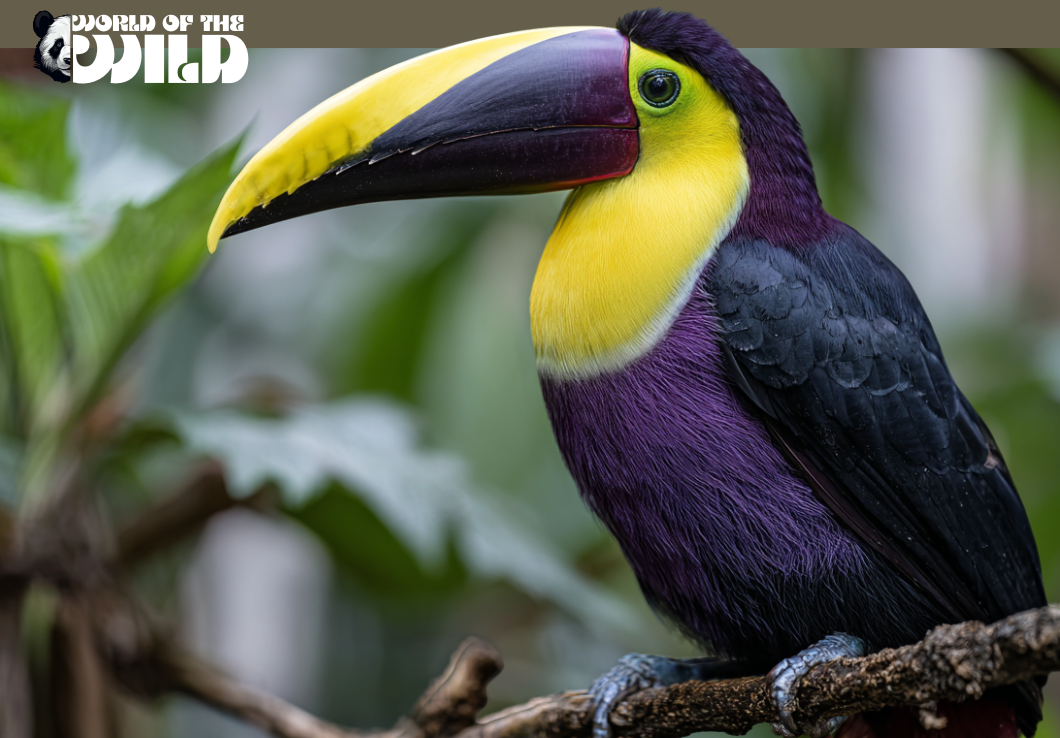
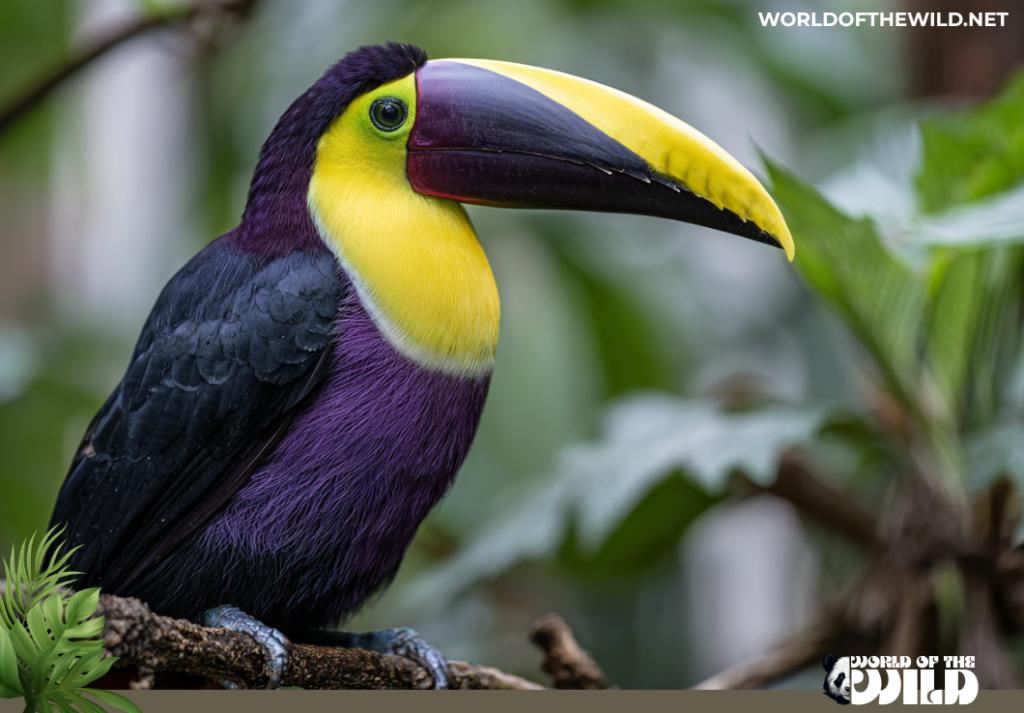
Toucans are immediately recognizable by their disproportionately large, vibrantly colored bills, which represent one of the most distinctive features in the avian world. These bills can measure 15-23 cm (6-9 inches) in length, accounting for roughly one-third to one-half of the bird’s total length. The bill’s coloration varies dramatically by species, ranging from solid black or yellow to spectacular combinations of orange, red, green, blue, and yellow, often with contrasting patterns and bands.
The body plumage typically features bold blocks of color rather than intricate patterns. Most species display predominantly black plumage with strategic splashes of bright colors: white, yellow, or red throat patches (called bibs), colorful rumps, and occasionally vivid undertail coverts. Some species, particularly the toucanets, deviate from this pattern with predominantly green or blue-green plumage.
Adult toucans range in size from the diminutive Tawny-tufted Toucanet, measuring around 30 cm (12 inches) and weighing approximately 125 grams (4.4 ounces), to the impressive Toco Toucan, which can reach 63 cm (25 inches) in length and weigh up to 860 grams (30 ounces). Their eyes are typically surrounded by patches of brightly colored bare skin in shades of blue, green, yellow, or red, adding to their striking appearance.
The birds possess short, broad wings adapted for brief bursts of flight rather than sustained soaring. Their strong, zygodactyl feet—with two toes facing forward and two backward—provide an excellent grip on branches. The tail is typically rounded and proportionally long, used for balance while perching and maneuvering through the canopy.
Behavior
Toucans are highly social birds that typically live in small flocks of 6-15 individuals, though they may gather in larger groups at abundant food sources. Within these flocks, they engage in complex social interactions including mutual preening, playing games with fruit, and the aforementioned bill fencing. These behaviors strengthen social bonds and establish hierarchies without violent conflict.
Communication is multifaceted and noisy. Toucans produce a variety of vocalizations including deep, croaking calls, yelps, and rattling sounds that carry through the forest canopy. Their calls serve to maintain flock cohesion, establish territory, and communicate alarm. The large bill actually acts as a resonating chamber that amplifies these vocalizations. They also use visual communication through bill movements, head bobbing, and displaying their colorful plumage.
Despite their social nature, toucans can be surprisingly territorial and aggressive, particularly during breeding season. They will defend fruit trees and nesting sites vigorously, using their impressive bills for intimidation and occasionally for actual combat.
Their flight pattern is distinctive—alternating between several rapid wing beats and a glide, creating an undulating trajectory. They prefer to hop from branch to branch rather than fly when moving short distances through the canopy. Toucans are primarily diurnal, most active during early morning and late afternoon feeding periods, resting during the hottest parts of the day.
These birds demonstrate notable intelligence and problem-solving abilities. They can manipulate objects with their bills and tongues with impressive dexterity, have been observed using tools in captivity, and show the ability to learn from watching other birds. Their playful behavior extends beyond social bonding—young toucans engage in extensive play that appears to serve educational purposes, helping them develop foraging and social skills.
Evolution
The evolutionary history of toucans traces back approximately 50-60 million years to the early Paleocene and Eocene periods, shortly after the extinction event that wiped out non-avian dinosaurs. Fossil evidence suggests that the toucan family diverged from their closest relatives, the woodpeckers and barbets, during this period of rapid avian diversification.
The oldest known toucan fossil, dating to about 50 million years ago, was discovered in Germany—intriguingly far from their current tropical American range. This suggests that early toucan ancestors had a much wider distribution before becoming restricted to the New World tropics. The distinctive enlarged bill characteristic of modern toucans evolved gradually, with intermediate forms showing progressively larger bill sizes over millions of years.
The evolution of the toucan’s remarkable bill represents a fascinating example of natural selection acting on multiple beneficial traits simultaneously. The bill evolved not for a single purpose but as a multipurpose tool serving thermoregulation, feeding, social signaling, and display. The honeycomb internal structure developed as a solution to the engineering challenge of creating a large, lightweight appendage that wouldn’t throw the bird off balance or require excessive neck musculature.
The diversification of toucan species appears to have accelerated during the Miocene epoch (23-5 million years ago) as South American rainforests expanded and became more complex. Geographic isolation in different mountain ranges and river basins led to the development of distinct species adapted to specific altitudinal zones and forest types. The mountain toucans, for instance, evolved specialized adaptations for life in cooler, high-altitude cloud forests, while lowland species remained adapted to hot, humid rainforests.
Genetic studies suggest that the smaller aracaris and toucanets represent more ancient lineages, while the larger Ramphastos toucans are more recently evolved, possibly representing an evolutionary trend toward larger body and bill size.
Habitat
Toucans inhabit the Neotropical realm, with their range extending from southern Mexico through Central America and across most of tropical South America. Their distribution follows the band of lowland and montane forests, reaching as far south as northern Argentina. Different species occupy distinct elevational zones, from sea level to over 3,000 meters (10,000 feet) in the Andes.
The primary habitat for most toucan species is tropical and subtropical moist broadleaf forest—the classic South American rainforest. They are quintessential canopy dwellers, spending most of their time in the upper and middle stories of the forest, typically 10-30 meters (33-100 feet) above the ground. They rarely descend to the forest floor, preferring the complex three-dimensional environment of the canopy where fruit is abundant and aerial predators are easier to spot.
Within this broad habitat type, toucans show preferences for specific microhabitats. They favor areas with large, mature fruit trees, particularly figs, which provide reliable food sources. Forest edges, river margins, and gaps created by fallen trees attract toucans due to the increased fruiting of pioneer species in these disturbed areas. However, they also require mature forest with large, old trees containing natural cavities for nesting.
Mountain-dwelling species like the Andean toucans inhabit cloud forests characterized by persistent fog, moss-covered trees, and cooler temperatures. These high-altitude specialists have adapted to environments with different fruiting patterns and seasonal variations compared to their lowland relatives.
Some toucan species demonstrate surprising adaptability, occurring in secondary forests, plantations, and even suburban parks and gardens where sufficient tree cover and food sources remain. However, most species are sensitive to habitat fragmentation and require relatively large, continuous forest tracts to maintain viable populations.
The gallery forests along rivers serve as important corridors for toucan movement and gene flow between forest patches. Palm groves also provide important habitat for some species, offering both food and nesting sites.
Diet
Toucans are primarily frugivorous, with fruit comprising 75-95% of their diet depending on the species and season. They are particularly fond of berries, drupes, and arillate fruits, playing a crucial ecological role as seed dispersers for dozens of plant species. Their large bills allow them to reach fruits at the ends of thin branches where heavier birds cannot venture and to harvest fruits that other animals cannot access or process.
The bill’s serrated edges and powerful jaw muscles enable toucans to handle a wide variety of fruit types, from soft, pulpy berries to fruits with tougher skins. They typically pluck fruit with the tip of their bill, toss it in the air, and catch it in their throat, swallowing it whole. The long tongue, which can be up to 15 cm (6 inches) long and has a brush-like tip, helps manipulate food and may aid in tasting.
However, toucans are opportunistic omnivores that supplement their frugivorous diet with significant animal protein. They actively raid the nests of smaller birds, consuming both eggs and nestlings. They will also capture and eat insects, spiders, small lizards, tree frogs, and occasionally even small snakes. This protein supplementation is particularly important during breeding season when adults need extra nutrition for egg production and feeding chicks.
Feeding typically occurs in the early morning and late afternoon. Toucans may travel several kilometers from their roosting sites to productive fruiting trees, returning to the same trees repeatedly when they are in fruit. They are gregarious feeders, with multiple individuals often feeding in the same tree, though dominant birds will claim the best positions.
Interestingly, toucans appear to require significant amounts of water and are frequently observed drinking, either from tree hollows filled with rainwater or by tilting their heads back to catch raindrops during storms.

Predators and Threats
In their natural habitat, adult toucans face predation primarily from large raptors including Ornate Hawk-Eagles, Harpy Eagles, and various forest falcons. These aerial predators can strike swiftly through the canopy, though the toucan’s acute vision and alarm calling system within flocks provide significant protection. At night, roosting toucans may fall prey to tree-climbing carnivores such as tayras, margays, and ocelots.
Nestlings and eggs face greater threats from a variety of predators including snakes (particularly large constrictors like boa constrictors and tree boas), coatis, opossums, toucans of other species, and monkeys. The cavity-nesting habit provides some protection, but eggs and young remain vulnerable during the lengthy nesting period.
Anthropogenic threats pose far more significant dangers to toucan populations than natural predation. Habitat loss through deforestation for agriculture, cattle ranching, and logging represents the primary threat to most toucan species. The Amazon basin loses thousands of square kilometers of forest annually, fragmenting toucan habitat and reducing available food sources and nesting sites. As many toucan species require large, old trees with natural cavities for breeding, selective logging of these trees specifically impacts reproductive success.
The illegal pet trade continues to threaten certain toucan species, particularly the more colorful and charismatic varieties. Poachers target nests to collect chicks for the exotic pet market, where toucans command high prices despite legal protections. This practice not only removes individuals from wild populations but often requires cutting down entire trees to access nests.
Climate change presents an emerging threat, particularly for montane species adapted to narrow temperature ranges in cloud forests. Shifting rainfall patterns affect fruit availability, while rising temperatures force some species to move to higher elevations where suitable habitat may be limited.
Additionally, toucans face threats from human-wildlife conflict in agricultural areas, where they may be killed for raiding fruit crops, despite their important role as seed dispersers. Pollution, including pesticide use in plantations adjacent to forests, poses additional risks.
Reproduction and Life Cycle
Toucan courtship is an elaborate affair involving a variety of displays and rituals. Males court females through bill fencing, fruit tossing (where the male tosses pieces of fruit to the female, which she catches and eats), and synchronized head movements. Pairs engage in mutual preening and vocalizations. Once bonded, most toucan species form monogamous pairs that may remain together for multiple breeding seasons or even for life.
Toucans are cavity nesters, utilizing natural holes in trees, abandoned woodpecker nests, or occasionally excavating their own cavities in rotting wood—though their bills are not as well-adapted for excavation as their woodpecker cousins. Both members of the pair may participate in preparing the nest cavity, which they line with regurgitated seeds and fruit pits. Competition for suitable nest cavities can be intense, and toucans will aggressively defend their chosen sites from other cavity-nesting species.
The breeding season varies by species and location but generally coincides with periods of peak fruit abundance. Females typically lay 2-4 glossy white eggs, which both parents incubate in alternating shifts. The incubation period lasts approximately 16-20 days depending on species. During incubation, the adults rarely leave the eggs unattended, demonstrating dedicated parental care.
Toucan chicks hatch completely naked and blind, requiring intensive parental care. Their development is relatively slow compared to many other birds of similar size. The chicks develop specialized heel pads that help them grip the cavity floor. Both parents share feeding duties, making numerous trips daily to provision the rapidly growing nestlings with regurgitated fruit and animal prey. The chicks develop their first feather coat at around 4 weeks of age.
The fledging period extends from 43-52 days, depending on species, which is notably long for birds of this size. Even after fledging, juveniles remain dependent on their parents for several weeks while they learn foraging skills and how to navigate the complex canopy environment. Young toucans can be identified by their duller plumage and shorter bills, which take several months to reach full adult size and coloration.
Sexual maturity is reached at 3-4 years of age. In the wild, toucans can live 12-20 years, though individuals in captivity with proper care have been known to survive beyond 25 years. Mortality is highest in the first year of life due to predation, accidents, and the challenges of learning to forage independently.

Population
The conservation status of toucan species varies considerably across the family. The International Union for Conservation of Nature (IUCN) classifies most toucan species as “Least Concern,” indicating stable populations with no immediate extinction risk. These include common and widespread species like the Toco Toucan and Keel-billed Toucan, which maintain robust populations throughout their ranges.
However, several species face more precarious situations. The Yellow-browed Toucanet is classified as “Near Threatened” due to habitat loss in its restricted range in the Peruvian Andes. The Saffron Toucanet, endemic to the Atlantic Forest of southeastern Brazil, is considered “Near Threatened” with a population estimated at fewer than 10,000 individuals and declining due to severe habitat fragmentation. Some localized populations of otherwise common species face regional declines due to habitat loss.
Estimating global toucan populations remains challenging due to their canopy-dwelling habits and the difficulty of surveying dense tropical forests. The Toco Toucan, likely the most numerous species, is estimated to have a population in the hundreds of thousands, possibly exceeding one million individuals. However, for many rarer species, population estimates are uncertain, with some montane specialists potentially numbering only in the thousands.
Population trends vary by species and region. Widespread lowland species in relatively protected areas maintain stable populations, while those restricted to rapidly developing regions face declines. The overall trend for the toucan family shows local population decreases corresponding with deforestation rates in Central and South America. Between 2000 and 2020, some regions lost 15-20% of their forest cover, directly impacting toucan habitat quality and connectivity.
Encouragingly, toucans adapt moderately well to secondary forests and regenerating habitats if sufficient forest cover and food sources remain. Protected areas throughout their range, including national parks and biological reserves, harbor significant toucan populations and provide crucial refugia against habitat loss.
Conclusion
The toucan stands as one of nature’s most remarkable achievements—a bird that combines flamboyant beauty with sophisticated adaptation to life in the tropical canopy. From their impossibly large yet feather-light bills that serve as Swiss Army knives of the forest, to their critical role as seed dispersers maintaining rainforest diversity, toucans exemplify the intricate connections binding tropical ecosystems together. These charismatic birds have captivated human imagination for millennia, yet they face an uncertain future as chainsaws and bulldozers steadily diminish their forest homes.
The fate of toucans ultimately rests in human hands. Every choice we make about tropical products, from the coffee we drink to the wood we purchase, ripples through the forest canopy where toucans live. Supporting sustainable forestry, choosing certified products that protect habitat, and advocating for rainforest conservation provides hope for these spectacular birds. The sight of a toucan’s rainbow bill gleaming in dappled sunlight represents more than just natural beauty—it symbolizes the health and vitality of some of Earth’s most biodiverse ecosystems. Ensuring that future generations can marvel at these extraordinary creatures requires action today. The rainforest is calling; the toucan’s survival depends on whether we answer.
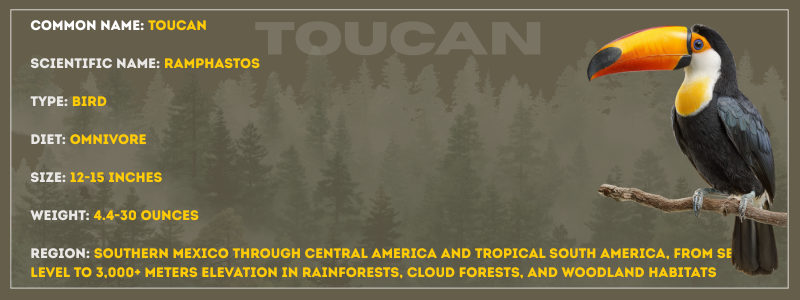
Scientific Name: Ramphastos (true toucans), Family Ramphastidae
Diet Type: Omnivore (primarily frugivorous)
Size: 30-63 cm (12-25 inches) depending on species
Weight: 125-860 grams (4.4-30 ounces) depending on species
Region Found: Southern Mexico through Central America and tropical South America, from sea level to 3,000+ meters elevation in rainforests, cloud forests, and woodland habitats