
Imagine a bird no larger than a sparrow embarking on a journey of over 6,000 miles, crossing continents and oceans with unwavering determination. Meet the Western Sandpiper, a diminutive shorebird whose epic migrations and remarkable adaptations make it one of nature’s most compelling endurance athletes. These unassuming gray-and-rust birds might scurry past your feet on a coastal beach, but don’t let their small size fool you—Western Sandpipers are evolutionary marvels that navigate hemispheres with pinpoint accuracy, refuel their bodies at critical stopover sites, and play a vital role in coastal ecosystems from the Arctic to South America. Their story is one of survival against the odds, a testament to the extraordinary capabilities hidden within the smallest of feathered frames.
Facts
- Marathon Migrants: Western Sandpipers can fly non-stop for over 72 hours during migration, covering distances of 3,000 miles or more without rest or food.
- Rapid Refueling: During stopovers, these birds can double their body weight in just two weeks, transforming themselves into flying fuel tanks by gorging on biofilm (a nutrient-rich layer of algae, bacteria, and diatoms).
- Synchronized Feeding Frenzies: Hundreds of thousands of Western Sandpipers sometimes gather at single stopover sites, creating spectacular feeding aggregations where birds blanket mudflats like living carpets.
- Extreme Breeders: They nest in the harsh Arctic tundra where summer days last nearly 24 hours, allowing parents to feed their chicks almost continuously during the brief breeding season.
- Bill Dimorphism: Female Western Sandpipers have noticeably longer bills than males, which reduces competition for food between sexes and allows them to exploit different prey at different depths in the mud.
- Ancient Pathways: Western Sandpipers follow migration routes established over thousands of years, with some populations using the same critical stopover sites generation after generation.
- Population Powerhouse: Despite their small size, Western Sandpipers are one of the most abundant shorebirds in the Americas, with millions making the journey between breeding and wintering grounds each year.
Species
The Western Sandpiper belongs to a lineage of birds exquisitely adapted for life at the water’s edge. Its complete taxonomic classification is:
- Kingdom: Animalia
- Phylum: Chordata
- Class: Aves
- Order: Charadriiformes
- Family: Scolopacidae (Sandpipers, Snipes, and Phalaropes)
- Genus: Calidris
- Species: Calidris mauri
The Western Sandpiper is part of the diverse genus Calidris, which includes approximately 24 species of small sandpipers commonly called “peeps” due to their high-pitched calls. Close relatives include the Semipalmated Sandpiper (Calidris pusilla), with which the Western Sandpiper is often confused, the Least Sandpiper (Calidris minutilla), and the Dunlin (Calidris alpina). These species share similar body plans and ecological niches, though each has evolved specific adaptations to its preferred habitats and food sources.
The Western Sandpiper does not have recognized subspecies, though some genetic variation exists between breeding populations in different regions of Alaska. The species was first described scientifically in 1813 and named mauri in honor of Italian botanist Ernesto Mauri, though why a shorebird received this particular dedication remains somewhat mysterious.
Appearance
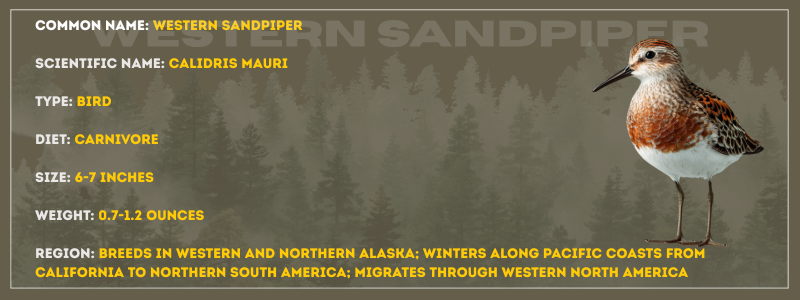
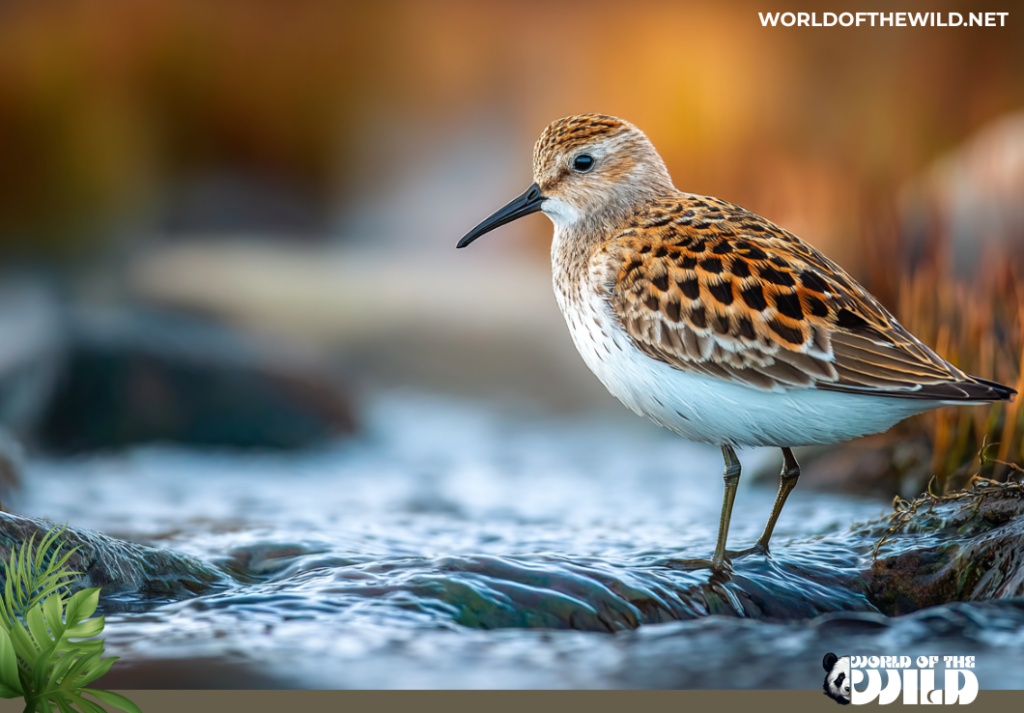
The Western Sandpiper is a study in understated elegance. Adults stand approximately 6 to 7 inches tall and weigh a mere 0.7 to 1.2 ounces—lighter than two AA batteries. Their wingspan stretches 14 to 17 inches, appearing disproportionately long relative to their compact bodies, an adaptation crucial for their long-distance flights.
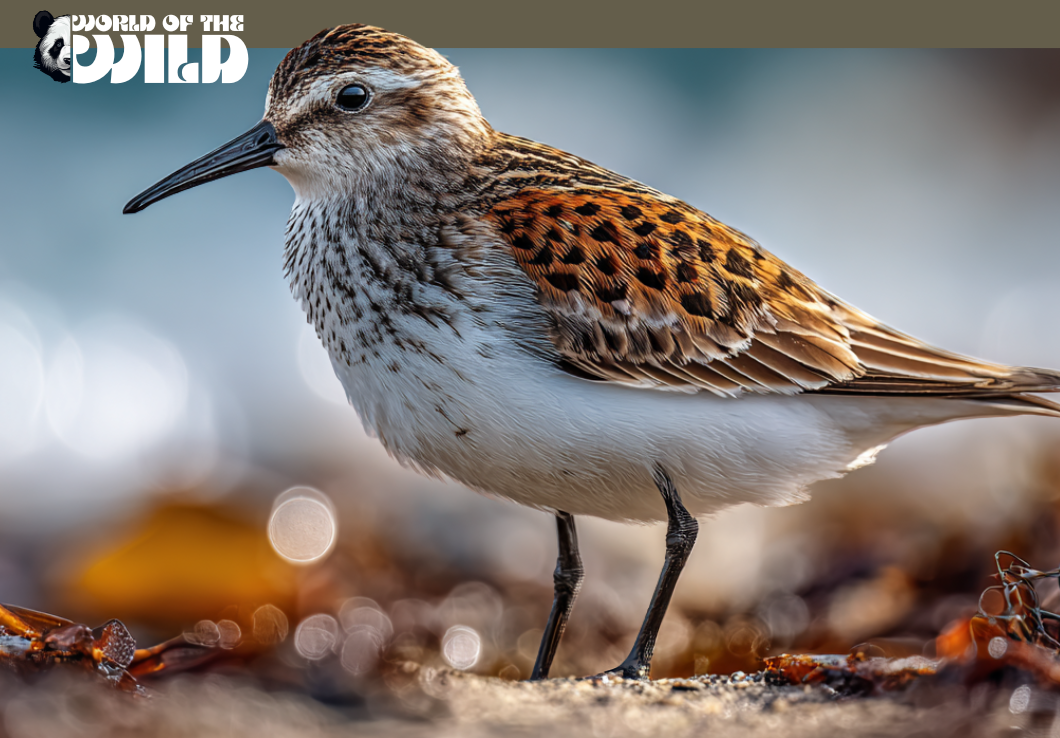
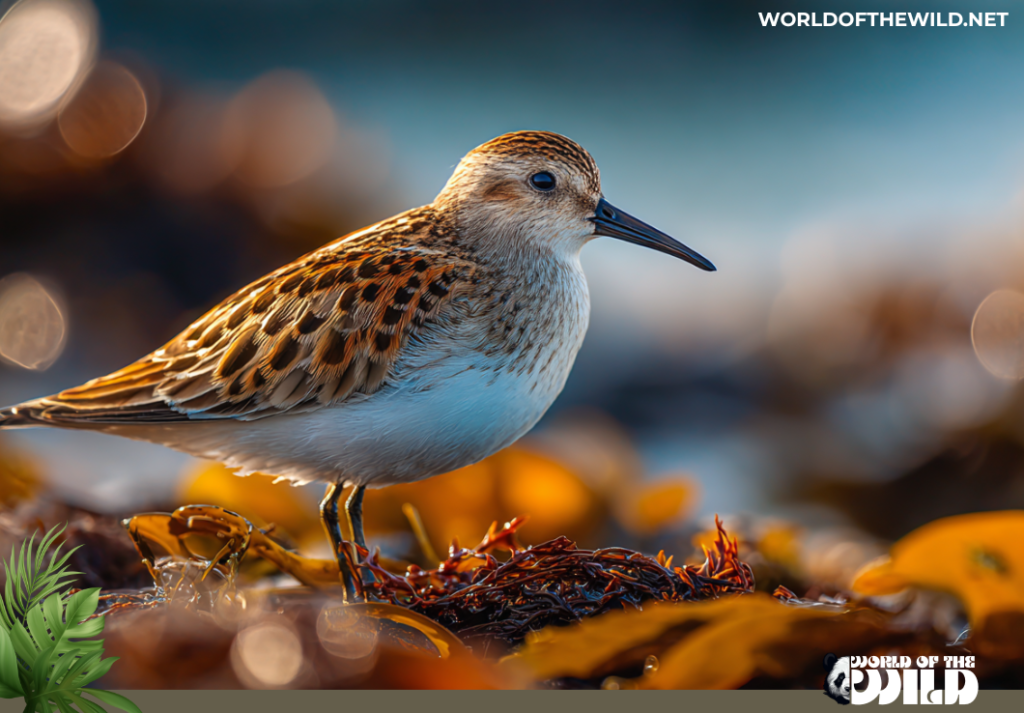
During breeding season, Western Sandpipers display their most colorful plumage. The crown, ear coverts, and mantle feathers show rich rufous (reddish-brown) tones, creating a warm, rusty appearance that contrasts beautifully with their white underparts. Fine black streaking adorns the breast and flanks, creating a speckled effect. The scapular feathers feature intricate patterns of black, rufous, and white edging that serve as excellent camouflage against the mottled Arctic tundra.
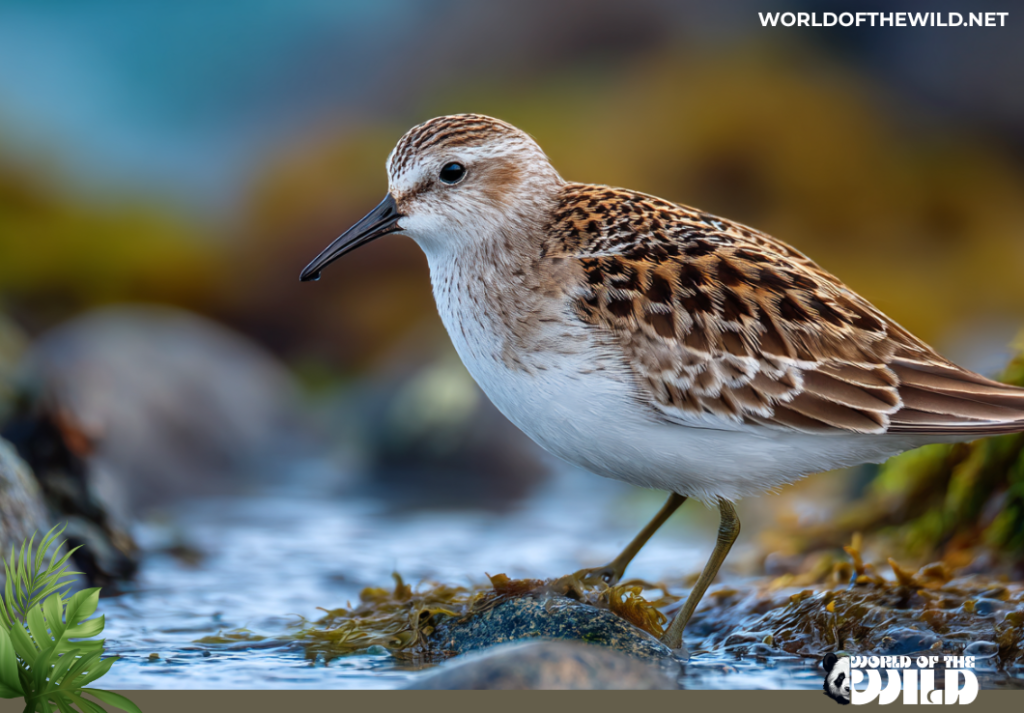
In non-breeding plumage, which most birdwatchers encounter, Western Sandpipers become more subdued. The rufous tones fade to gray-brown, and the birds take on a “cleaner” appearance with less distinct streaking. The breast becomes whiter, though a subtle wash of gray often persists across the upper chest.
The Western Sandpiper’s bill is black, relatively long, and slightly drooped at the tip—a key identification feature. As mentioned earlier, females possess noticeably longer bills than males, sometimes by as much as 10-15%. The legs are black and appear stilt-like, perfectly proportioned for wading through shallow water and navigating mudflats. The eyes are dark and positioned to provide excellent peripheral vision, essential for detecting both food and predators.
Perhaps most remarkable is what you cannot easily see: the internal adaptations that allow these birds to accomplish their extraordinary migrations. Before migration, their flight muscles expand significantly while digestive organs temporarily shrink, creating biological machinery optimized for sustained flight.
Behavior
Western Sandpipers are creatures of motion, rarely still for more than a few moments. Their feeding behavior is perhaps their most characteristic activity—they scurry across mudflats and beaches with remarkable speed, their legs moving in a blur as they probe the substrate with rapid, sewing-machine-like pecks. This technique, called “stitching,” allows them to sample large areas quickly, detecting tiny invertebrates with sensitive nerve endings in their bill tips.
These birds are highly gregarious outside the breeding season, forming flocks that can number in the tens or even hundreds of thousands. Within these massive aggregations, complex social dynamics play out. Birds maintain individual spacing while feeding but tolerate close proximity, and the flock moves with apparent coordination, wheeling and turning in synchronized flight displays that confuse predators. Communication occurs primarily through high-pitched “cheep” or “jeet” calls that allow flock members to maintain contact.
The Western Sandpiper’s intelligence manifests in its remarkable navigational abilities and learning capacity. Young birds on their first migration often travel separately from adults, yet they successfully navigate thousands of miles to wintering grounds they’ve never seen, suggesting both innate compass orientation and the ability to learn landscape features and star patterns.
During the breeding season, behavior shifts dramatically. Males become territorial, establishing and defending small areas on the Arctic tundra. They perform elaborate courtship displays, including aerial “song flights” where they hover and descend while vocalizing, their wings held in a distinctive V-shape. Once paired, both parents participate in nest building, incubation, and chick-rearing, though females sometimes depart before chicks are fully independent, leaving final care to the male.
Western Sandpipers exhibit a fascinating adaptation called “jump migration”—they don’t gradually work their way south but instead make massive leaps between specific stopover sites. This strategy minimizes time spent in transit and maximizes time at productive feeding areas, though it makes them heavily dependent on the quality of those few critical locations.
Evolution
The evolutionary story of the Western Sandpiper is intimately connected with the glacial cycles that shaped the Northern Hemisphere over the past several million years. Shorebirds in the family Scolopacidae originated approximately 50-60 million years ago, shortly after the extinction of the dinosaurs, but the genus Calidris is much younger, emerging during the Pliocene epoch around 3-5 million years ago.
The ancestors of modern Western Sandpipers likely evolved in Beringia—the land bridge and surrounding regions between Asia and North America—during periods when glacial advances created new Arctic and subarctic habitats. As ice sheets advanced and retreated, populations became isolated and diverged. The Western Sandpiper’s closest relatives are found in Eurasia, suggesting a relatively recent split, possibly within the last million years.
Key evolutionary adaptations in the Western Sandpiper lineage include:
The development of extreme migratory behavior, driven by the highly seasonal nature of Arctic breeding grounds. Only species capable of traveling thousands of miles could exploit the brief but productive Arctic summer while escaping harsh winters.
Bill morphology evolved for probing soft substrates, with the slightly drooped tip providing mechanical advantage for detecting and extracting buried invertebrates. The sexual dimorphism in bill length likely evolved to reduce competition between mated pairs and allow more efficient resource partitioning.
Physiological flexibility became paramount—the ability to rapidly gain and metabolize fat, to reconfigure body organ systems between migration and breeding, and to survive on minimal sleep during the extended Arctic daylight represents a suite of adaptations fine-tuned over countless generations.
Genetic studies reveal that Western Sandpipers have relatively low genetic diversity compared to some other widespread species, suggesting either recent population bottlenecks during ice ages or rapid population expansion from a small founding population. Despite this, the species has proven remarkably resilient and adaptive.
The Western Sandpiper’s evolution also reflects co-evolution with its prey. The invertebrates that dominate their diet have their own seasonal cycles synchronized with sandpiper migration, and the biofilm communities at stopover sites represent complex ecosystems that have evolved alongside their avian harvesters.
Habitat
The Western Sandpiper is a bird of two worlds—Arctic tundra breeder and coastal wanderer. Understanding its habitat requirements means following its annual cycle across a hemisphere.
Breeding Habitat: Western Sandpipers breed exclusively in western and northern Alaska, from the Yukon-Kuskokwim Delta north to the Arctic coastal plain. They favor wet, lowland tundra characterized by sedge meadows, dwarf shrub communities, and abundant shallow ponds. The landscape appears desolate to human eyes—flat, treeless expanses where permafrost lies just inches below the surface—but for nesting sandpipers, it offers everything: abundant insect life for feeding chicks, tussocks and hummocks for nest placement, and 20+ hours of daily sunlight for round-the-clock foraging.
Migration Stopover Habitat: The migration journey depends critically on coastal wetlands and estuaries. The most important stopover site in the world for Western Sandpipers is the Copper River Delta in Alaska, where up to 80% of the entire global population stops to refuel during northward migration. Other vital sites include the Fraser River estuary in British Columbia, San Francisco Bay, and various locations along the Pacific coast of Mexico. These areas share common features: extensive mudflats exposed at low tide, rich invertebrate populations, and protection from predators and human disturbance.
Wintering Habitat: From October through March, Western Sandpipers occupy coastal habitats from California south through Mexico, Central America, and into northern South America, with the highest concentrations along the Pacific coast. They favor sandy beaches, mudflats, salt marshes, lagoons, and estuaries. Unlike some shorebird species that penetrate inland, Western Sandpipers remain almost exclusively coastal during winter, rarely venturing more than a mile from tidal zones.
The specific microhabitat preferences vary by tidal cycle. At low tide, birds spread across exposed mudflats and sandbars. As tides rise, they concentrate on remaining beaches or retreat to adjacent fields and salt marsh edges. They show remarkable site fidelity, with individual birds often returning to the same wintering beaches year after year, and even defending small feeding territories within their preferred zones.
Climate and habitat type create a narrow ecological niche. Western Sandpipers require soft substrates for probing, abundant small invertebrates, and the predictable tidal cycles that concentrate food resources. This specialization makes them highly efficient in their chosen habitats but also vulnerable to habitat degradation.
Diet
The Western Sandpiper is a carnivore, sustaining itself almost entirely on small invertebrates. Their diet shifts seasonally and geographically, reflecting the available prey in different habitats and life stages.
Coastal Diet: Along coasts, Western Sandpipers consume a diverse array of tiny creatures found in mud and sand. Primary prey items include:
- Small crustaceans: amphipods, isopods, and tiny crabs
- Marine worms: polychaetes and oligochaetes
- Mollusks: especially tiny clams and snails (less than 5mm)
- Insect larvae: particularly midge and fly larvae
The birds employ different foraging strategies depending on prey type. For surface-active prey like amphipods, they use visual hunting, snapping up visible targets. For buried prey, they rely on tactile sensation, probing rapidly and detecting vibrations or textures through sensitive receptors in their bill tips called Herbst corpuscles.
Biofilm Consumption: One of the most fascinating dietary revelations about Western Sandpipers is their heavy reliance on biofilm during migration. Biofilm is a thin layer of microorganisms—diatoms, algae, bacteria—that coats mudflat surfaces. Recent research has revealed that Western Sandpipers can obtain up to 50% of their energy intake from biofilm at certain stopover sites. They “skim” the surface layer with rapid, shallow probes, essentially farming the microbial mat. This strategy provides rapid energy intake with minimal effort, crucial for the time-limited refueling period.
Breeding Season Diet: On Arctic breeding grounds, the diet shifts to terrestrial invertebrates. Adults feed heavily on emerging midges, mosquitoes, crane flies, and spiders. Chicks receive a protein-rich diet of small insects and their larvae, delivered by both parents throughout the extended daylight hours.
Foraging Efficiency: Western Sandpipers are extraordinarily efficient feeders. During peak foraging periods, an individual may make 10,000-15,000 probes per day. The success rate varies but can reach 20-30% at productive sites. The drooped bill tip acts like a tiny shovel, flipping aside surface particles and exposing buried prey.
Sexual dimorphism in bill length creates dietary partitioning between males and females. Longer-billed females can reach deeper-dwelling prey, while shorter-billed males focus on surface and shallow-dwelling invertebrates. This division reduces competition and may allow pairs to exploit a broader range of available food resources together than either could alone.
Predators and Threats
Natural Predators: Western Sandpipers face predation throughout their annual cycle, though vulnerability varies by life stage and location.
On breeding grounds, the primary nest and chick predators include Arctic foxes, jaegers (especially Parasitic and Long-tailed Jaegers), gulls, ravens, and occasionally ermine. These predators are constantly searching the tundra for eggs and vulnerable chicks. Adult sandpipers attempt to distract predators with “broken wing” displays and alarm calling, but the camouflaged eggs and chicks must rely primarily on cryptic coloration and freezing behavior.
During migration and winter, aerial predators pose the greatest threat. Peregrine Falcons and Merlins actively hunt sandpiper flocks, using their superior speed to single out and capture individuals. The spectacular synchronized flock movements of thousands of sandpipers represent an anti-predator adaptation—the “confusion effect” makes it difficult for predators to focus on a single target.
Anthropogenic Threats: Human activities pose increasingly serious challenges to Western Sandpiper populations:
Habitat Loss and Degradation: Coastal development has eliminated or degraded many historical stopover and wintering sites. Wetlands have been drained, estuaries filled, and beaches developed. The loss of even a single critical stopover site can affect hundreds of thousands of birds that depend on it for refueling.
Climate Change: Rising temperatures are altering the timing of insect emergence on Arctic breeding grounds. If sandpipers cannot adjust their migration timing accordingly, chicks may hatch after peak food availability. Sea level rise threatens coastal habitats, while changing storm patterns may increase the frequency of catastrophic weather events during migration.
Pollution: Oil spills, agricultural runoff, and industrial contamination affect the invertebrate communities that sandpipers depend upon. Biofilm quality can be degraded by excessive nutrients or toxins.
Disturbance: Human recreation, off-road vehicles, and unleashed dogs on beaches force sandpipers to expend precious energy fleeing rather than feeding. During critical migration periods, this disturbance can prevent birds from accumulating sufficient fat reserves.
Reduced Prey Availability: Climate change, ocean acidification, and pollution are altering marine invertebrate communities. Some studies suggest declining availability of key prey species at important stopover sites.
The interconnected nature of these threats means Western Sandpipers face a cumulative burden. A bird that survives predators on the breeding ground must still navigate degraded stopover habitats, avoid pollution, and find sufficient food in changing ecosystems—a gauntlet that becomes more challenging each year.
Reproduction and Life Cycle
The reproductive cycle of the Western Sandpiper is compressed into a brief but intense Arctic summer, a race against time to produce the next generation before winter returns.
Mating and Nesting: Males arrive on breeding grounds in late May or early June, typically before females. They immediately establish territories and begin courtship displays. Once females arrive, pair formation occurs quickly. The male’s aerial display is accompanied by a repeated “tree-tree-tree” song. Pairs are generally monogamous for a single breeding season, though extra-pair copulations occur.
Nest construction is a simple affair—a shallow scrape on the ground, lined with leaves, grass, and bits of lichen. Nests are placed among low vegetation, often beside a tussock or raised hummock that provides minimal shelter. The cryptic placement and minimal structure reflect the need for speed and the reliance on camouflage rather than fortification.
Eggs and Incubation: Females typically lay four eggs, though clutches of three or five occasionally occur. The eggs are pyriform (pear-shaped), allowing them to fit together efficiently in the small nest scrape. They’re buff-colored with dark brown blotches and spots, blending remarkably well with tundra vegetation and pebbles.
Both parents share incubation duties, which last 21 days. The tight incubation schedule means that adults must feed efficiently during brief breaks to maintain their own body condition. The timing is critical—eggs must hatch when insect populations peak.
Chick Development: Western Sandpiper chicks are precocial, meaning they emerge from eggs covered in downy feathers and capable of walking and feeding themselves within hours. The down is mottled brown and buff, providing excellent camouflage. Despite being able to feed themselves, chicks are still dependent on parental care for brooding (warmth and protection) and guidance to food-rich areas.
Both parents initially tend chicks, leading them to productive feeding areas and brooding them during cold periods. However, females often abandon the brood when chicks are 7-10 days old, beginning their southward migration while chicks are still developing. Males remain for an additional week or more before they too depart, leaving fledglings to complete development and undertake their first migration independently.
Chicks fledge (achieve flight) at approximately 17-21 days old. Within days of fledging, they begin their solo migration south, guided by innate compass directions and perhaps celestial cues, an extraordinary feat of navigation for a bird less than a month old.
Lifespan: Western Sandpipers face high first-year mortality, with only 30-40% of fledglings surviving to breeding age. However, birds that survive to adulthood can live surprisingly long lives. The average adult lifespan is 4-6 years, but banded individuals have been documented living 15+ years. The oldest known Western Sandpiper survived at least 19 years, an impressive achievement for such a small bird undertaking such demanding migrations.
Most individuals first breed at one year old, though some may not breed until their second year. Successful breeders often return to the same general breeding area year after year, showing strong site fidelity.
Population
The Western Sandpiper is currently classified as Least Concern by the International Union for Conservation of Nature (IUCN), but this designation masks concerning trends that warrant attention.
Population Estimates: The global population is estimated at approximately 3.5 million individuals, making Western Sandpipers one of the most numerous shorebird species in the Americas. However, this abundance is deceptive—the population is highly concentrated, with massive numbers depending on a small number of critical sites.
Population Trends: Long-term monitoring data reveals troubling declines. Christmas Bird Count data and breeding bird surveys suggest the population may have declined by 30-50% since the 1970s. Some regional populations have experienced even steeper declines. The rate of decline appears to have accelerated in recent decades, potentially linked to habitat changes at key stopover sites and climate-driven mismatches between migration timing and food availability.
The concentrated nature of the population makes Western Sandpipers vulnerable to catastrophic events. A single oil spill, disease outbreak, or habitat loss event at a critical stopover site could affect hundreds of thousands of individuals simultaneously.
Conservation Efforts: Several initiatives aim to protect Western Sandpipers:
- Protection of critical stopover sites through designation as Important Bird Areas (IBAs) and hemispheric shorebird reserve network sites
- Research programs monitoring population trends and identifying limiting factors
- Habitat restoration projects at degraded wetlands
- International cooperation through flyway agreements that recognize the species’ dependence on habitats spanning multiple countries
- Public education programs to reduce disturbance at sensitive sites
Despite these efforts, Western Sandpiper populations continue to face challenges. The species’ dependence on coastal habitats makes it particularly vulnerable to sea level rise, and the remote nature of breeding grounds complicates monitoring and conservation.
Conclusion
The Western Sandpiper reminds us that greatness comes in small packages. This diminutive shorebird, weighing less than two batteries, accomplishes feats of endurance and navigation that rival any animal on Earth. From the Arctic tundra where summer sun barely sets to the tropical mudflats where it winters, the Western Sandpiper connects hemispheres and ecosystems, serving as both predator and prey in the intricate web of life.
Yet for all their remarkable adaptations, Western Sandpipers face an uncertain future. Declining populations signal that the delicate balance sustaining their transcontinental lifestyle is fraying. The coastal wetlands they depend upon are disappearing beneath development and rising seas. The climate they’ve evolved to track is shifting faster than perhaps any time in their evolutionary history.
But there is hope. Every protected mudflat, every restored estuary, every beach where humans respect roosting shorebirds represents a lifeline for these extraordinary travelers. The Western Sandpiper’s story is not yet finished. Whether future generations witness massive flocks swirling over coastal bays or only read about them in history books depends on choices we make today. The next time you see a small gray bird scurrying at the water’s edge, consider the epic journey it has undertaken, the ancient instincts guiding it, and the fragile thread of habitat connecting continents. The Western Sandpiper asks us for nothing more than the wild coastal spaces it has always known—surely that is not too much to preserve.
Scientific Name: Calidris mauri
Diet Type: Carnivore (invertebrates)
Size: 6-7 inches (15-18 cm) in length
Weight: 0.7-1.2 ounces (20-35 grams)
Region Found: Breeds in western and northern Alaska; winters along Pacific coasts from California to northern South America; migrates through western North America