

The Contenders
In the emerald depths of Central and South American rainforests, two of nature’s most visually stunning amphibians reign supreme—but which would survive a deadly encounter?
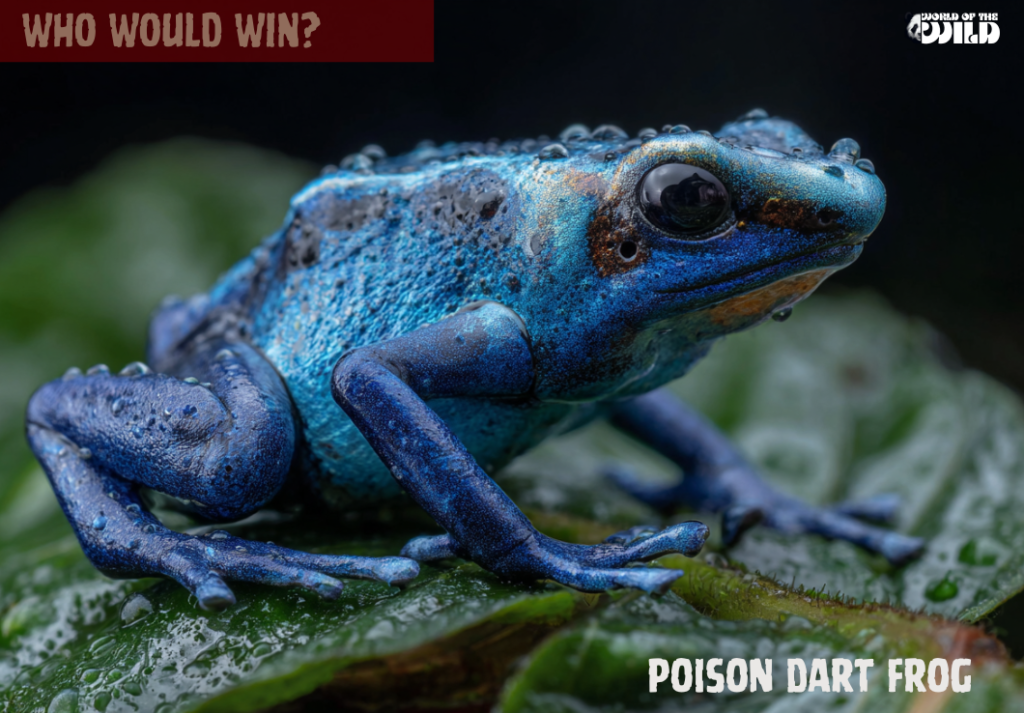
In the blue corner: The Poison Dart Frog (Dendrobatidae family)—a pint-sized biochemical weapon that carries enough toxins to drop a jaguar! These jewel-toned terrors of the forest floor advertise their deadliness with electric blues, screaming yellows, and warning reds that scream “DO NOT TOUCH!”
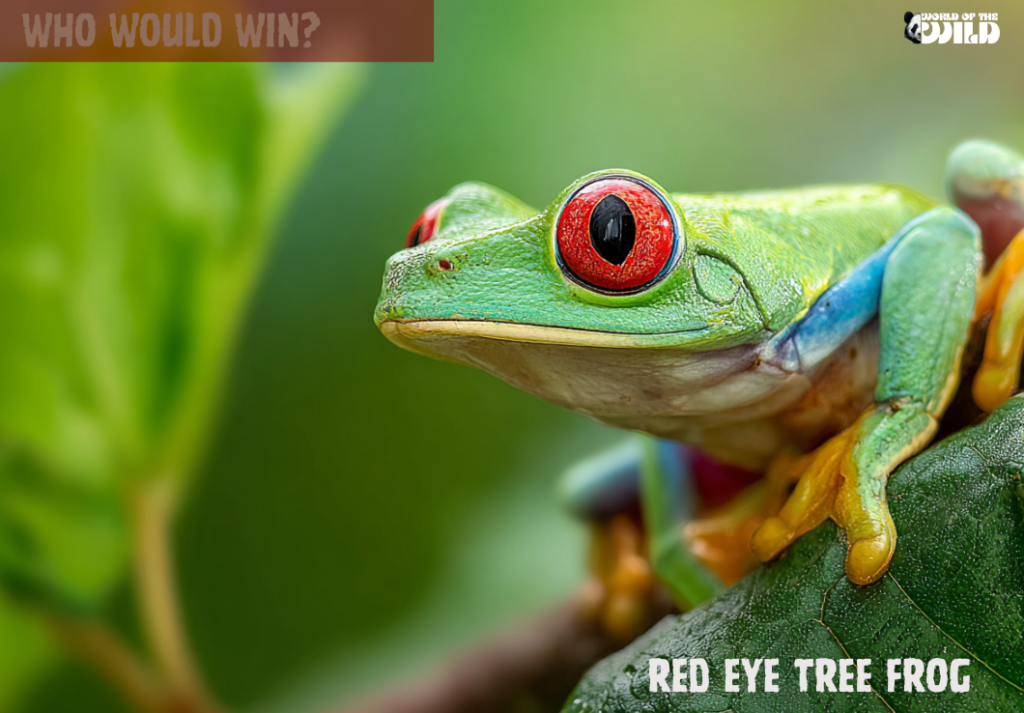
In the red corner: The Red-Eyed Tree Frog (Agalychnis callidryas)—the acrobatic daredevil of the canopy! With eyes like burning embers and a bag of visual tricks that would make a magician jealous, this master of misdirection has turned survival into performance art!
Who wins when chemistry meets athletics? Let’s find out!
Tale of the Tape
| Category | Poison Dart Frog | Red-Eyed Tree Frog |
|---|---|---|
| Size/Weight | 0.75-2.5 inches / 1 oz | 2-3 inches / 0.2-0.5 oz |
| Speed | Moderate (terrestrial hopper) | Excellent (explosive jumper, 150x body length!) |
| Weaponry | Batrachotoxin skin toxins (potentially lethal) | None—pure defense |
| Special Abilities | Toxic skin secretions, aposematic warning colors | Startle coloration, adhesive toe pads, nocturnal vision, camouflage mastery |
Physical Advantages
Poison Dart Frog’s Arsenal:
- Chemical Warfare: The golden poison dart frog (Phyllobates terribilis) carries enough batrachotoxin to kill 10 grown men—this neurotoxin causes paralysis, heart failure, and death
- Warning System: Brilliant aposematic coloration tells predators “I’m poison—remember this!”
- Fearless Confidence: Diurnal lifestyle and bold behavior—they don’t need to hide
- Ground Control: Terrestrial dominance with superior knowledge of forest floor terrain
- Dietary Arsenal: Toxicity comes from their diet of toxic ants and mites—they’re literally what they eat!
Red-Eyed Tree Frog’s Arsenal:
- Size Advantage: Significantly larger body mass and reach
- Olympic-Class Agility: Can leap up to 150 times its body length in a single bound
- Startle Defense: Flash those crimson eyes and neon side colors to shock and confuse
- Vertical Escape: Specialized toe pads allow instant retreat into the canopy
- Superior Vision: Large eyes optimized for night hunting—excellent motion detection
- Camouflage Expert: Green skin provides perfect leaf mimicry when resting
The Battle Scenario
The encounter happens at dusk on a fallen log bridging the forest floor and lower canopy—neutral ground where both frogs find themselves trapped by a sudden downpour. The poison dart frog, completing its daily territorial patrol, spots the larger tree frog attempting to descend. In the amphibian world, there’s no negotiation—only survival.
The red-eyed tree frog makes the first move, its powerful legs coiling like springs. It launches toward the smaller frog with shocking speed, hoping to use its weight advantage to simply bowl over the opponent. But the dart frog doesn’t flinch—it can’t afford to. Instead, it stands its ground, its cobalt-blue skin practically glowing in the fading light. The tree frog lands short, perhaps some ancient instinct screaming WARNING at the sight of those colors. It freezes, flashes its bulging red eyes in a defensive display, and that hesitation is everything. The poison dart frog hops forward with surprising aggression, closing the distance. The moment its toxic skin makes contact—even the slightest brush—the battle is over.
The red-eyed tree frog recoils instantly, its mucous membranes already absorbing trace amounts of the deadly alkaloids. Within seconds, muscle spasms begin. The tree frog makes one desperate leap toward the canopy, its natural escape route, but its coordination is already failing. It crashes back down to the log, limbs twitching as the neurotoxins flood its nervous system. The poison dart frog simply watches, motionless, as nature’s chemical warfare claims another victim.
The Verdict: POISON DART FROG WINS
Scientific Reasoning: While this would never happen in nature (these species occupy different ecological niches and don’t compete), in a forced encounter, the poison dart frog wins decisively—roughly 95 out of 100 hypothetical encounters.
Here’s why: The red-eyed tree frog’s entire survival strategy is built around avoiding predators, not fighting them. Its speed, agility, and startle displays are magnificent escape tools, but they’re worthless against an opponent that doesn’t need to chase. The poison dart frog’s batrachotoxin is an instant, contact-based kill mechanism. Even a grazing touch transfers enough toxin through the tree frog’s permeable skin to cause paralysis and death within minutes.
The tree frog’s size advantage means nothing when it can’t afford a single moment of contact. Its only path to victory would be using its superior jumping ability to completely avoid the dart frog until one of them retreats—but on a confined battlefield with limited escape routes, the odds favor the patient, toxic hunter who simply needs to wait for one mistake.
The brutal truth: Evolution gave the poison dart frog a “press here to kill” button on its entire body. Against that level of biochemical defense, even the most athletic tree frog never stood a chance.
Nature’s lesson: In the wild, sometimes the smallest package contains the deadliest punch!