
There is something almost mythological about a Grey Heron standing motionless at the edge of a misty lake at dawn. Tall, slate-grey, and impossibly still, it looks less like a living creature and more like a statue carved by someone who had never quite seen a bird but had heard one described in a dream. And yet, the moment a fish darts within range, that stillness explodes into a strike so fast the eye can barely follow it. In that single, violent instant, you understand everything about this bird — the patience, the precision, and the power.
The Grey Heron (Ardea cinerea) is one of Europe’s largest and most recognizable birds, a master of wetland ecosystems found from the British Isles to Japan. It is a bird of contradictions: graceful yet predatory, solitary yet colonial, ancient yet thriving in modern landscapes. Whether you’ve spotted one hunched over a garden pond in suburban England or standing sentinel along a reed-fringed African river, the Grey Heron commands attention. This is its story.
Facts
- Deadly accuracy in the dark: Grey Herons are capable of hunting at night, using their highly sensitive eyes to detect movement in low-light conditions — making them formidable 24-hour predators.
- The neck is a loaded spring: A Grey Heron’s neck contains a specially adapted set of vertebrae that allow it to coil like a compressed spring and strike forward with explosive speed — a mechanism similar to a spear thrower.
- They swallow prey whole: Herons do not chew. They toss prey into the air, reorient it head-first, and swallow it in one fluid gulp — even animals as large as small rabbits, rats, and juvenile ducks.
- Surprisingly cold-tolerant: Grey Herons have been recorded fishing through holes in frozen lakes and rivers, enduring temperatures that would send most birds south.
- Ancient cultural significance: In ancient Egypt, the heron was the physical incarnation of Bennu, a solar deity associated with creation and rebirth — believed to be the inspiration for the mythological Phoenix.
- Nests can weigh hundreds of pounds: Over years of repeated use and renovation, Grey Heron nests (called heronries) can grow into enormous stick platforms weighing over 200 pounds (90 kg).
- They oil their feathers with powder: Grey Herons have specialized “powder-down” feathers on their chest that continuously crumble into a fine, waterproofing powder — a built-in grooming system unlike anything found in most birds.
Species
The Grey Heron occupies a well-defined position in the tree of life, belonging to one of the most ancient and widespread groups of waterbirds on the planet.
Full Taxonomic Classification:
| Rank | Classification |
|---|---|
| Kingdom | Animalia |
| Phylum | Chordata |
| Class | Aves |
| Order | Pelecaniformes |
| Family | Ardeidae |
| Genus | Ardea |
| Species | Ardea cinerea |
The family Ardeidae contains roughly 64 species of herons, egrets, and bitterns distributed globally. Within this family, the genus Ardea holds the largest members — the so-called “great herons” — and the Grey Heron is one of its most prominent representatives.
Subspecies of Ardea cinerea include:
- Ardea cinerea cinerea — The nominate subspecies, the most widespread, found across Europe, Africa, and much of Asia.
- Ardea cinerea jouyi — Found in eastern Asia, including China, Japan, and Southeast Asia; slightly paler overall than the nominate form.
- Ardea cinerea firasa — Resident in Madagascar and nearby islands; a somewhat smaller island variant.
- Ardea cinerea monicae — A rare and isolated subspecies restricted to islands off the coast of Mauritania in West Africa; notably paler and smaller than the nominate race.
The Grey Heron’s closest relatives within the genus Ardea include the Great Blue Heron (Ardea herodias) of North America — so similar in form and ecology that the two species are often considered ecological equivalents — and the Goliath Heron (Ardea goliath) of sub-Saharan Africa, the largest heron on Earth. The Purple Heron (Ardea purpurea) is another close relative that shares much of the Grey Heron’s European and Asian range, though it favors denser reed bed habitats.
Appearance
The Grey Heron is a bird built for one purpose: standing, waiting, and striking. Everything about its body is engineered for ambush predation at the water’s edge.
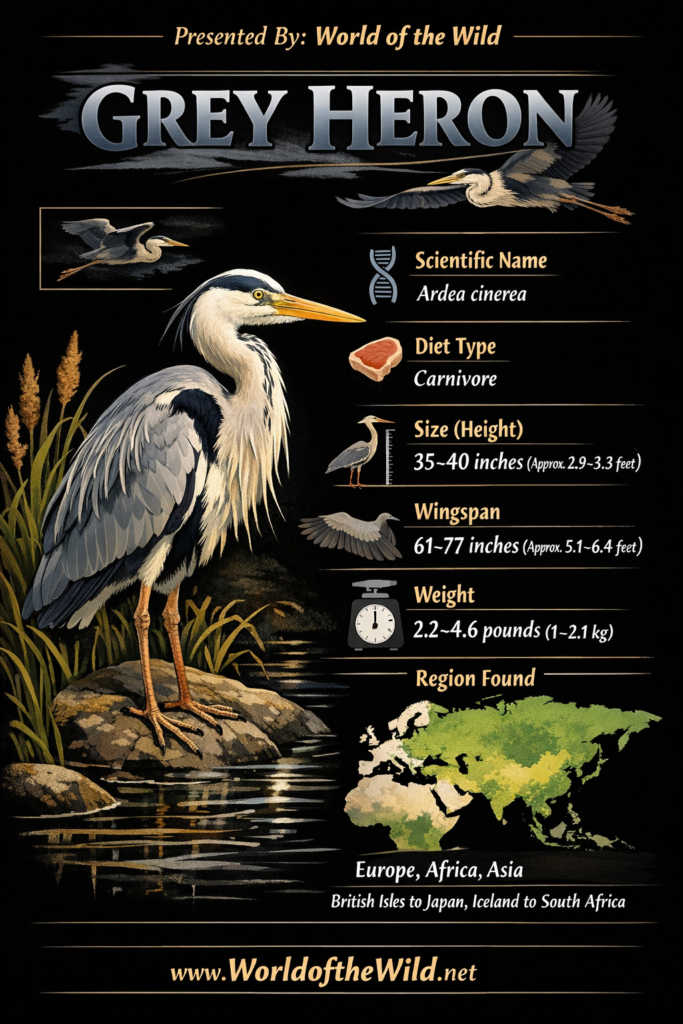
In terms of sheer size, it is an imposing creature. Adults stand between 35 and 40 inches (approximately 3 feet) tall, with a wingspan that stretches between 61 and 77 inches (roughly 5 to 6.4 feet) — broad, rounded wings that give it a prehistoric silhouette in flight. Despite this large frame, the Grey Heron is surprisingly lightweight, typically weighing between 2.2 and 4.6 pounds, a testament to the hollow bone structure shared by all birds.
The plumage is a study in understated elegance. The back, wings, and much of the body are draped in soft, ash-grey feathers, while the neck is a streaked white and buff with a line of dark blotches running down the front. The head is strikingly marked — white on the crown with a bold black stripe running from above each eye backward into a long, drooping black crest of elongated plumes that trail behind the head like a dark ribbon. During breeding season, this crest becomes particularly pronounced.
The face is unfeathered and pale, and the eye is a vivid yellow, giving the bird a sharp, almost reptilian intensity. The bill is long, straight, and dagger-like — typically around 5 to 6 inches in length — and yellow-orange in color, flushing to a brighter orange-pink during the breeding season. The long legs are yellow-brown and ideal for wading in shallow water.
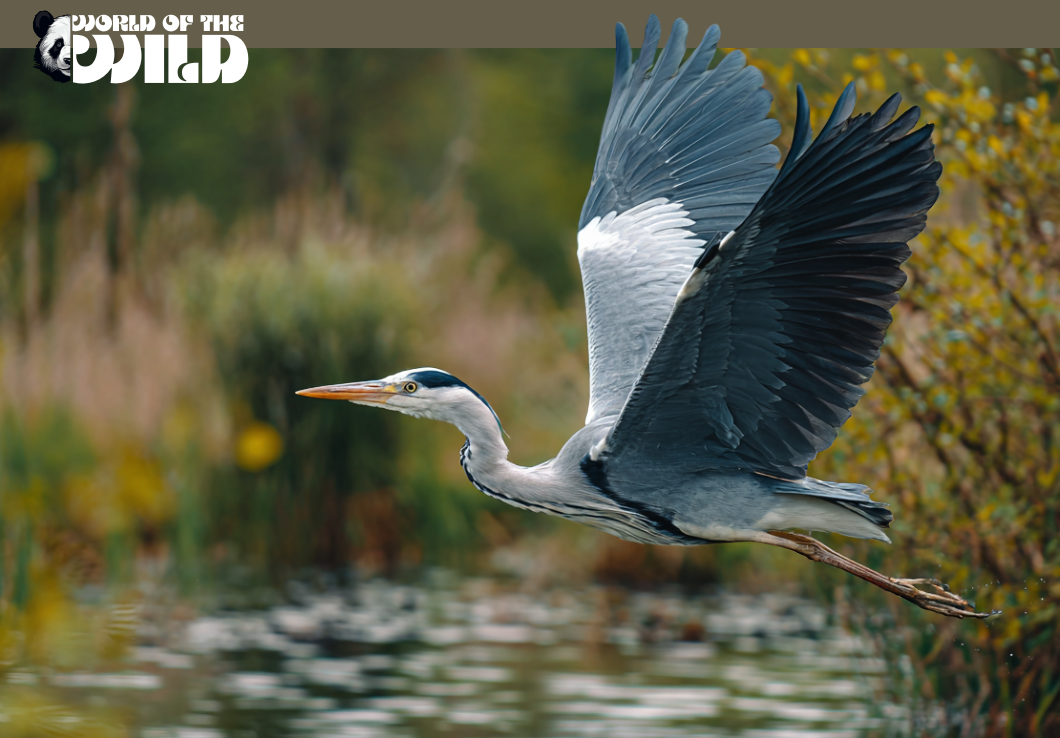
In flight, the Grey Heron tucks its neck back into a characteristic S-shaped fold against its shoulders — a feature that immediately distinguishes herons from cranes and storks, which fly with necks extended. The slow, deep wingbeats and hunched silhouette make it unmistakable against the sky.

Behavior
The Grey Heron is, at its core, a creature of extraordinary patience. The defining image of this bird — standing motionless for minutes on end at the edge of the water — is not a pose of rest. It is an act of calculated, high-stakes concentration. When prey comes within range, the neck uncoils and the bill drives forward in a strike that takes just half a second from initiation to impact.
Grey Herons are largely solitary foragers, each defending a favored fishing spot or territory along a waterway with remarkable tenacity. They are known to return to the same feeding areas day after day, season after season, developing an intimate knowledge of local fish movements and water conditions. Disputes between individuals at good fishing spots are settled through a repertoire of threat displays — bill-pointing, raised crests, and harsh, grating alarm calls that can carry considerable distances.
Despite being solitary when feeding, Grey Herons are colonial nesters (see Reproduction), gathering in large communal rookeries called heronries. This contradiction between solitary feeding and social breeding reflects a pragmatic relationship with each behavior’s risks and rewards.
Communication in Grey Herons is vocal and visual. Their calls are harsh and prehistoric in character — a loud, guttural “fraank” or “kraak” uttered in flight or alarm. During courtship, they produce softer, more complex vocalizations accompanied by elaborate physical displays including plume-fanning and bill-clapping.
One of the most fascinating behavioral adaptations of the Grey Heron is active lure fishing. Individuals have been observed dropping feathers or small objects onto the water surface to attract curious fish — a form of tool-adjacent behavior that suggests a degree of cognitive flexibility uncommon in birds.
Grey Herons are also highly adaptable in their foraging strategies. While the classic still-hunting stance is most common, they also stalk slowly through shallow water, use their wings as shade canopies to reduce surface glare (a technique called canopy feeding), or actively chase prey through water. In urban areas, they have famously learned to visit garden ponds and even fish markets, demonstrating a bold opportunism that has served them well in human-altered landscapes.
Evolution
The herons and their relatives in the family Ardeidae are ancient birds, with a fossil record stretching back approximately 50 million years to the Eocene epoch. Ancestral heron-like forms appear in the fossil record of Europe and North America, suggesting the group arose shortly after the extinction of the non-avian dinosaurs and rapidly diversified across wetland habitats worldwide.
The genus Ardea itself — the lineage to which the Grey Heron belongs — is estimated to have diverged from other heron lineages roughly 25 to 30 million years ago, during the Oligocene. The modern Grey Heron as a recognizable species likely took its current form sometime in the Pleistocene, refined by the ice-age cycles that repeatedly restructured European and Asian habitats and isolated populations into distinct refugia.
A significant evolutionary milestone in heron evolution was the development of the specialized cervical vertebrae that enable the explosive striking motion. This adaptation, shared across the Ardeidae, represents one of the most elegant solutions in vertebrate evolution to the challenge of capturing fast-moving aquatic prey. The kinking structure of the sixth cervical vertebra acts as a trigger mechanism, storing elastic potential energy and releasing it in a fraction of a second.
The powder-down patches found in herons — including the Grey Heron — represent another evolutionary novelty. Unlike the preen gland found in most birds, which produces oil for feather maintenance, powder-down feathers grow continuously and disintegrate at the tips into a fine keratin powder that the bird spreads through its plumage with its comb-like middle claw. This adaptation is thought to have evolved partly in response to the fish slime and oils that herons regularly encounter and need to remove from their feathers.
Molecular phylogenetic studies have confirmed that the Grey Heron and the Great Blue Heron of North America are sister species — closely related descendants of a common ancestor — that diverged after Eurasia and North America became geographically separated. The two species are so similar that where their ranges approach one another in the Pacific, hybridization is occasionally reported.
Habitat
The Grey Heron is one of the most habitat-flexible large wading birds in the world. Its range is vast, spanning Europe, Africa, and Asia — from Iceland and the British Isles in the west to the islands of Japan and Indonesia in the east, and from Norway in the north to the Cape of Good Hope at Africa’s southern tip.
At its core, the Grey Heron is a wetland bird, and almost any shallow body of water can serve as suitable foraging habitat. Rivers, lakes, marshes, estuaries, coastal mudflats, flooded meadows, rice paddies, irrigation canals, fish ponds, and even drainage ditches are all used with equal comfort. What the bird requires is access to shallow water — typically no more than 12 to 18 inches deep — where it can wade and see prey clearly.
In Europe, Grey Herons are year-round residents across most of the continent, though northern populations may shift southward during severe winters when freshwater habitats freeze. In the tropics and subtropics, they are largely sedentary, with permanent access to open water ensuring food availability throughout the year.
What is perhaps most striking about the Grey Heron’s habitat use is its tolerance of human environments. Suburban parks, urban rivers, and ornamental garden ponds are all regularly visited. In cities like London, Amsterdam, and Tokyo, Grey Herons have become familiar and beloved fixtures of the urban wildlife scene, fishing alongside joggers and commuters without apparent concern. This boldness in humanized landscapes has made the Grey Heron one of the most commonly encountered large wild birds in Europe and Asia.
Nesting habitat (see Reproduction) is slightly more specific — Grey Herons prefer mature woodland near water for their colonial rookeries, often using tall trees such as oaks, Scots pines, beeches, or herons, though they will also nest in reedbeds and on cliff ledges where trees are unavailable.

Diet
The Grey Heron is a carnivore and an apex predator within its aquatic niche. It is an extraordinarily versatile hunter, and the breadth of its diet is one of the key reasons for its success across such a wide range of habitats.
Fish form the core of the diet in most populations. Common prey species include perch, roach, bream, tench, trout, eels, and sticklebacks — whatever is most abundant and accessible in the local water body. Individual herons develop preferences and specializations based on their home territory, and a bird holding a productive stretch of chalk stream may feed almost exclusively on trout and grayling.
However, the menu extends far beyond fish. Grey Herons are known to take:
- Amphibians — frogs, toads, and newts are important prey, especially in spring when amphibians gather to breed in large, accessible numbers.
- Small mammals — water voles, field mice, shrews, and young rats are regularly taken, particularly in winter when aquatic prey becomes scarce.
- Large invertebrates — crayfish, large insects, and earthworms supplement the diet opportunistically.
- Birds — ducklings, moorhen chicks, and occasionally adult small birds are taken, making the Grey Heron a significant though often overlooked avian predator.
- Reptiles — small snakes and lizards are taken where available.
The hunting technique most associated with the Grey Heron is stand-and-wait predation: the bird positions itself at the water’s edge or in shallow water, holds completely still, and waits — sometimes for 30 minutes or more — until prey passes within striking distance. When the moment comes, the neck uncoils in a strike of devastating speed and precision.
Prey is typically grabbed — not speared — in the bill, though impalement of larger, slippery fish does occur. Smaller items are swallowed immediately; larger prey may be shaken, beaten against a hard surface, or repositioned before being swallowed headfirst to prevent fins or limbs from catching in the throat.
An adult Grey Heron needs roughly 10 to 14 ounces (300–400 grams) of food per day to maintain its body condition, though this increases significantly during cold weather and the breeding season.
Predators and Threats
Despite its size and wariness, the Grey Heron is not without enemies. Natural predation, however, is relatively modest for such a large bird.
Natural Predators:
Adult Grey Herons have few regular predators, but eggs, chicks, and occasionally injured adults fall victim to:
- White-tailed Eagles and Golden Eagles — large raptors that occasionally take adult herons in dramatic aerial pursuits.
- Peregrine Falcons and Goshawks — capable of taking young or weakened birds.
- Red Foxes — a significant predator at heronries, raiding nests on the ground or climbing to low nests to take eggs and chicks.
- Corvids (crows, ravens, and rooks) — opportunistic nest raiders that steal eggs and young chicks from unguarded nests in colonies.
- Otters and Mink — in water and at the nest site, these mustelids pose occasional threats.
Human-Caused Threats:
The Grey Heron faces a more significant and varied suite of threats from human activity:
- Habitat loss and degradation — drainage of wetlands, channelization of rivers, and conversion of floodplains to agricultural land reduces both nesting and foraging habitat.
- Water pollution — contamination from agricultural runoff, industrial discharge, and urban sewage degrades water quality and reduces fish populations, directly impacting food availability.
- Bioaccumulation of toxins — as a top predator in aquatic food chains, Grey Herons are particularly vulnerable to the accumulation of pesticides, heavy metals (especially mercury and lead), and other persistent pollutants in their body tissues.
- Persecution by fish farmers and anglers — historically shot, trapped, and poisoned at fish farms and private fishing waters across Europe; while legal protection has reduced this significantly, illegal killing continues.
- Collision with power lines and fences — a cause of mortality, particularly in young, inexperienced birds during their first winter.
- Climate change — altering precipitation patterns, shifting fish distributions, and increasing the frequency of extreme cold events that freeze foraging habitat can all affect local populations.
Reproduction and Life Cycle
The breeding biology of the Grey Heron is one of the most spectacular aspects of its natural history. It is an early breeder by any standard — nesting activity begins in January and February in much of Europe, often while frost still grips the ground and the trees where they nest are bare of leaves.
Colonial Nesting: Grey Herons nest in heronries — sometimes called rookeries — which are colonial nesting sites located in tall trees near water. These heronries are traditional and can be used continuously for decades or even centuries. Some heronries in the UK have documented histories stretching back over 400 years. Colony sizes range from just a handful of pairs to several hundred nests in a single stand of trees.
Courtship and Pair Formation: Males arrive at the heronry first and claim nest sites, which they advertise and defend with elaborate displays — raising their crests, fanning their ornamental back plumes, stretching their necks upward, and producing a range of croaking, hissing, and clicking vocalizations. Females are attracted to males at established nest sites. Once a pair bond is formed — which lasts for a single breeding season in most cases — both birds engage in mutual display, bill-clapping, and allopreening to cement the bond.
Eggs and Incubation: The female typically lays 3 to 5 pale blue-green eggs, deposited at intervals of two days. Both parents share incubation duties over a period of 25 to 26 days. The eggs are laid asynchronously, meaning chicks hatch at different times, creating a size hierarchy within the brood.
Chick Rearing: Newly hatched chicks are helpless and covered in sparse grey down. Both parents feed them by regurgitating partially digested fish and other prey directly into the nest or into the open bill of the chick. Competition among siblings is intense, and in poor food years, the smallest chicks may be outcompeted and starve — a form of natural brood reduction that ensures the strongest chicks survive.
Chicks fledge — taking their first flights — at approximately 50 to 55 days after hatching. They remain dependent on their parents for a short period before dispersing, typically in July or August.
Lifespan: In the wild, Grey Herons typically live for 5 to 10 years, though individuals reaching 20 or more years have been recorded. Mortality is highest in the first year of life — inexperienced young birds struggling to establish feeding territories, particularly during cold winters, account for a significant proportion of annual deaths. Adults that survive their first winter have substantially improved survival prospects.

Population
The Grey Heron carries a reassuringly secure conservation status. The International Union for Conservation of Nature (IUCN) currently lists it as Least Concern, reflecting a large, stable, and in some regions growing global population.
Global population estimates vary, but current assessments suggest there are approximately 700,000 to 1,000,000 individual Grey Herons across the species’ range in Europe, Africa, and Asia, with the European population alone estimated at between 220,000 and 350,000 breeding pairs.
Population trends are broadly positive in much of the species’ core range. In Western Europe, numbers declined sharply in the mid-20th century due to widespread wetland drainage, water pollution, and heavy persecution at fish farms. However, the passage of legal protections — including full protection under the EU Birds Directive and the UK’s Wildlife and Countryside Act — has allowed populations to recover significantly since the 1970s and 1980s. The British Grey Heron population, which is one of the best-monitored in the world through the British Trust for Ornithology’s long-running Heronries Census (begun in 1928), has shown a broadly positive trend over the past several decades, though numbers fluctuate considerably in response to severe winters.
Urbanization, counterintuitively, has benefited Grey Herons in many areas. The proliferation of garden ponds stocked with ornamental fish, along with the reduced persecution in urban settings, has opened up substantial new foraging territory for the species.
Regional populations in parts of Southeast Asia and Africa are less well-monitored, but there is currently no evidence of significant large-scale decline across the global range.
Conclusion
The Grey Heron is, in many ways, a success story — a large, specialized predator that has navigated centuries of human landscape transformation not merely by surviving, but by adapting and, in places, thriving. From the reed-fringed lakes of Eastern Europe to the garden ponds of English suburbs and the tropical rivers of sub-Saharan Africa, it has proven itself one of nature’s most flexible and formidable hunters.
But the Grey Heron’s story is also a mirror. It reflects the health of the aquatic ecosystems it depends on — polluted rivers, overfished lakes, and drained wetlands all leave their mark on heron populations. As a top predator in freshwater food chains, it bioaccumulates whatever toxins we put into our waterways, making it, quite literally, a living indicator of environmental quality.
To protect the Grey Heron is to protect the rivers, lakes, and wetlands that sustain countless other species — including our own. Next time you see one standing alone at the water’s edge, perfectly still and ancient-looking in the morning light, take a moment to appreciate what it represents: not just a remarkable bird, but the fragile, irreplaceable world of water that it calls home. That world deserves our attention, our respect, and our action.
Quick Reference
| Field | Details |
|---|---|
| Scientific Name | Ardea cinerea |
| Diet Type | Carnivore |
| Size (Height) | 35–40 inches (approx. 2.9–3.3 feet) |
| Wingspan | 61–77 inches (approx. 5.1–6.4 feet) |
| Weight | 2.2–4.6 pounds |
| Region Found | Europe, Africa, Asia (from British Isles to Japan; Iceland to South Africa) |