
Picture this: a sleek, whiskered creature floating serenely on its back in the cool Pacific waters, a flat rock balanced on its chest, methodically cracking open a sea urchin for breakfast. It pauses, glances around with soulful dark eyes, then tucks the stone under its arm like a furry little accountant safeguarding a prized possession. This is the sea otter — and it is, without question, one of the most captivating animals on Earth.
Sea otters (Enhydra lutris) occupy a unique and vital niche in marine ecosystems along the North Pacific rim. They are the heaviest members of the weasel family and the only marine mammals that lack a blubber layer for insulation — a seemingly fatal design flaw that nature compensated for with the densest fur of any animal alive. But beyond their undeniable charm and viral-video appeal, sea otters are ecological powerhouses. As a keystone species, they regulate populations of sea urchins and other invertebrates, allowing kelp forests to flourish. Remove the otters, and entire underwater ecosystems can unravel in a matter of years.
Hunted nearly to extinction during the maritime fur trade of the 18th and 19th centuries, sea otters are now a conservation success story — and an ongoing challenge. Their remarkable recovery, fragile vulnerabilities, and the outsized role they play in ocean health make them a compelling symbol of what we stand to lose, and what we can save, when we choose to act.
Quick Facts
- Sea otters have up to one million hair follicles per square inch of skin, giving them the densest fur of any mammal on Earth.
- They are one of the very few non-primate animals known to use tools, regularly employing rocks as hammers and anvils to break open hard-shelled prey.
- To keep from drifting apart while sleeping, groups of sea otters — called ‘rafts’ — hold hands while floating on the surface.
- A sea otter must eat approximately 25–30% of its body weight every single day simply to generate enough body heat to survive in cold Pacific waters.
- Sea otters groom themselves obsessively; their fur traps tiny air bubbles that serve as both insulation and buoyancy, so keeping it clean is literally a matter of life and death.
- Mothers carry pups on their chests while floating, and when they need to dive for food, they wrap their pup in kelp to keep it from drifting away like a tiny, furry buoy.
- Despite spending nearly their entire lives in the ocean, sea otters rarely dive deeper than 300 feet and prefer shallow nearshore waters where prey is accessible.
Species & Taxonomy
The sea otter belongs to the following taxonomic classification:
- Kingdom: Animalia
- Phylum: Chordata
- Class: Mammalia
- Order: Carnivora
- Family: Mustelidae
- Genus: Enhydra
- Species: Enhydra lutris
The sea otter is the sole living member of the genus Enhydra, making it evolutionarily distinct from all other living mustelids (the weasel family). Three subspecies are currently recognized:
Northern Sea Otter (Enhydra lutris kenyoni) — Found along the coasts of Alaska and the Pacific Northwest. This is the most numerous subspecies and tends to be slightly larger than its southern cousin.
Southern (California) Sea Otter (Enhydra lutris nereis) — Found along the central California coastline. It is listed as threatened under the U.S. Endangered Species Act and is the most studied subspecies, with a population closely monitored by wildlife agencies.
Russian Sea Otter (Enhydra lutris lutris) — Inhabits the waters of Russia’s Kamchatka Peninsula, the Kuril Islands, and parts of Japan. It is the nominate subspecies and the largest of the three.
Appearance
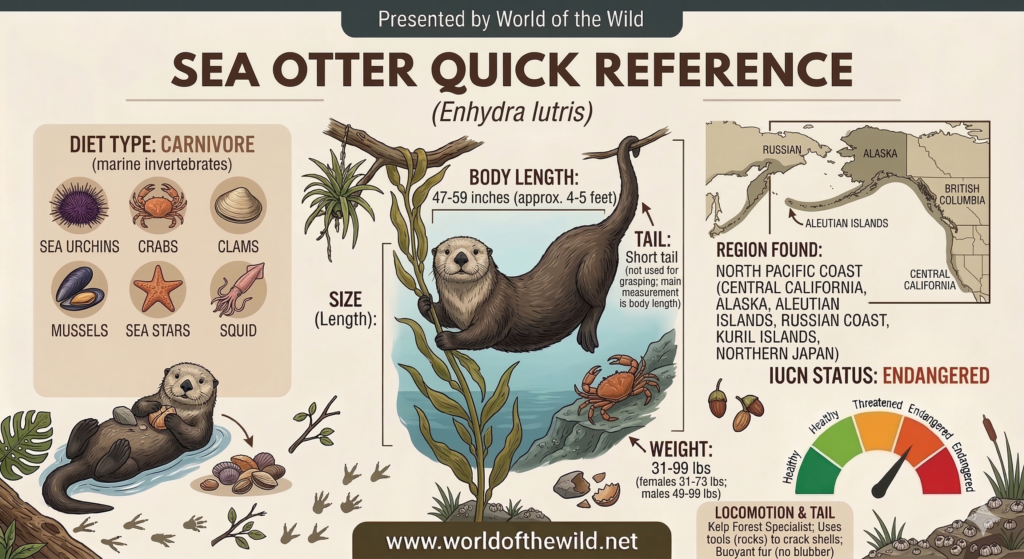
The sea otter’s appearance is a masterclass in evolutionary problem-solving. Adults typically measure between 47 and 59 inches (about 4 to 5 feet) in total body length, with males generally larger than females. Males weigh between 49 and 99 pounds, while females typically range from 31 to 73 pounds — making them the largest mustelid in North America but the smallest marine mammal in the world.
Their fur is their most iconic feature. It ranges in color from reddish-brown to dark chocolate-brown, often lighter around the head, throat, and chest, particularly in older individuals. Older males can develop a distinctly grizzled, almost white appearance around the face. The fur itself consists of a coarse outer guard layer and an extraordinarily dense underfur — up to one million fibers per square inch — that traps air to provide insulation and buoyancy.
Their bodies are streamlined for aquatic life, with a slightly flattened tail that aids in propulsion. Their hind feet are large, webbed, and flipper-like, perfectly designed for swimming. Their forepaws, by contrast, are small and dexterous, equipped with semi-retractable claws for gripping prey and tools. A loose patch of skin under each foreleg forms a natural pocket where otters store food and tools while diving — a convenient built-in rucksack.
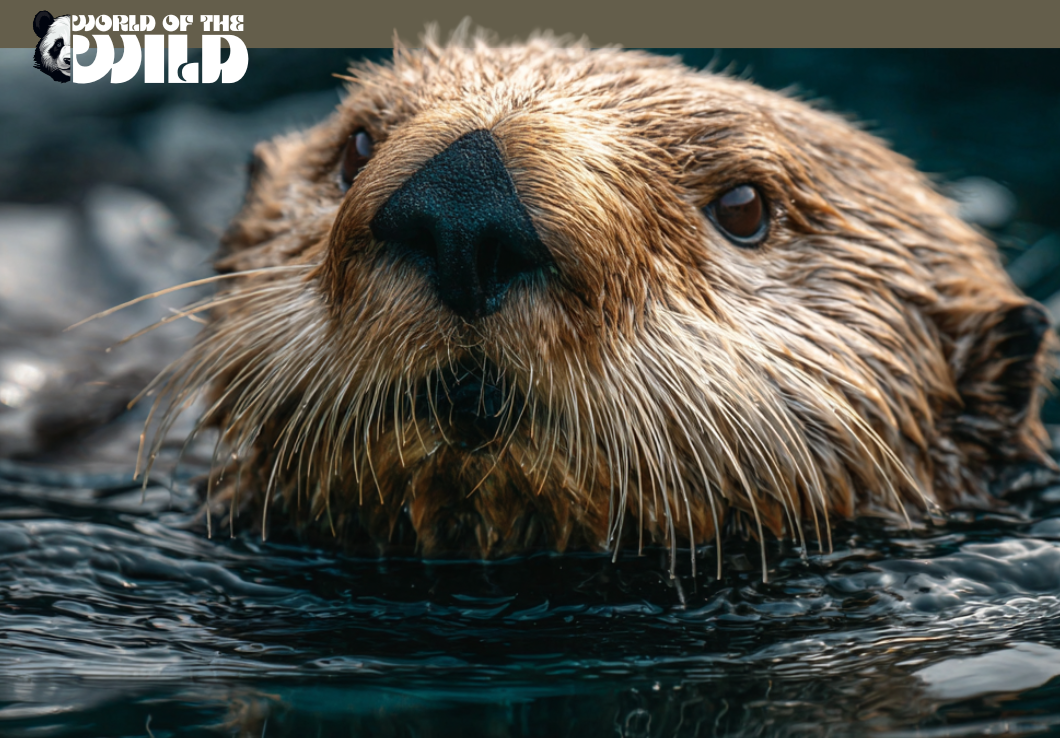
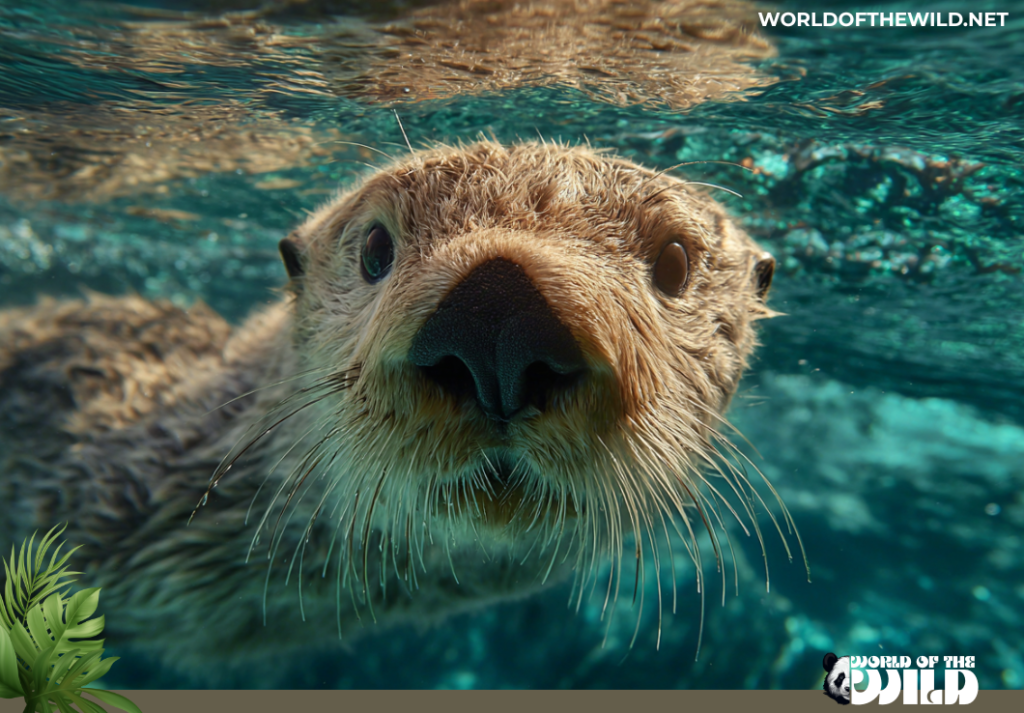
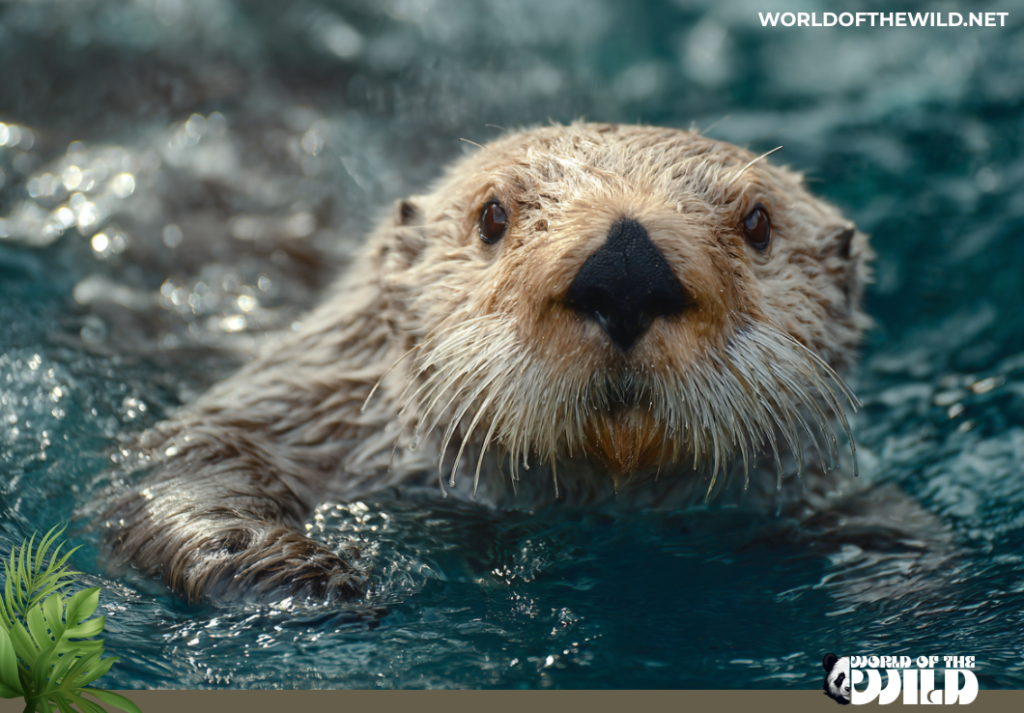
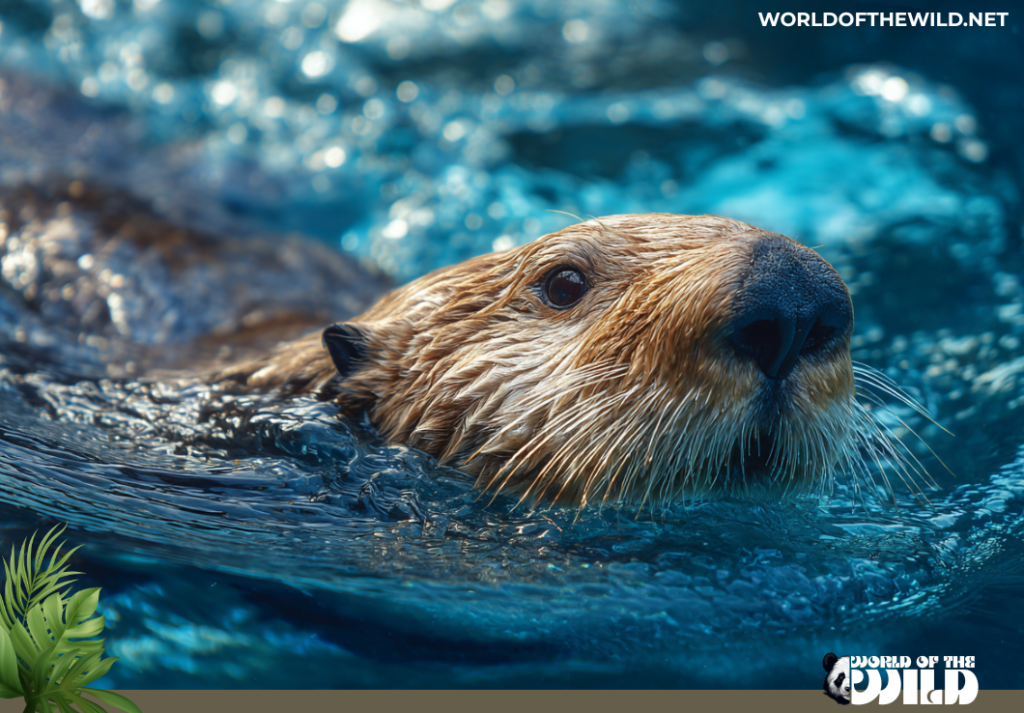
Their faces are broad and flat with prominent, sensitive whiskers (vibrissae) that help them detect prey in murky water. Large, dark, forward-facing eyes give them excellent vision both above and below the waterline, and their nostrils and small ears can close tightly when submerged.
Behavior
Sea otters are highly social animals, though they tend to segregate by sex outside of mating. Groups of females with their pups often form tight-knit rafts, sometimes numbering in the dozens, while males congregate in their own separate groups. A raft of sleeping otters holding paws is one of nature’s most endearing sights — a behavior that prevents individuals from drifting away from the group or into dangerous surf.
Tool use is perhaps the sea otter’s most celebrated behavioral trait. They routinely use rocks as both hammers and anvils, placing prey on a flat rock on their chest and striking it with another to crack open shells. Individual otters develop preferred tools and techniques, and there is strong evidence of learned tool-use behavior passed down from mothers to pups. Some otters have even been observed using man-made objects such as glass bottles as improvised tools.
Grooming is not merely cosmetic — it is an existential necessity. Sea otters spend several hours each day meticulously cleaning and fluffing their fur, using their paws and teeth to work out debris and redistribute natural oils. A soiled coat loses its insulating air pockets, and an otter that cannot groom effectively risks hypothermia and death. This is why oil spills are so catastrophically lethal to sea otter populations.
Sea otters are primarily diurnal, foraging most actively during daylight hours and resting at the surface during the night. They are capable divers, holding their breath for up to five minutes and reaching depths of around 300 feet, though most dives are shallower. Their metabolism is remarkably high — nearly three times that of a terrestrial mammal of comparable size — a necessary trade-off for thermoregulation in cold Pacific waters.
Vocalizations include high-pitched whines and squeals, particularly between mothers and pups. Pups emit a distinctively loud, piercing cry when separated from their mothers — a sound that sea otter biologists often describe as impossible to ignore.
Evolution
The sea otter’s evolutionary story is one of the most dramatic transitions in mammalian history: the return from land to sea. Fossil evidence suggests that the mustelid family originated on land approximately 30–40 million years ago during the Eocene epoch. The ancestors of modern otters began colonizing aquatic environments sometime during the late Miocene, around 5–10 million years ago.
The closest extinct relative of the sea otter is Enhydritherium terraenovae, a large, semi-aquatic mustelid that lived in North America and Europe during the late Miocene and Pliocene epochs (roughly 5–3 million years ago). Fossil records suggest it inhabited freshwater and coastal environments, representing a transitional stage between the fully terrestrial mustelid ancestors and the completely marine modern sea otter.
Enhydra lutris appears to have diverged from its closest relatives and become fully marine during the Pleistocene, adapting rapidly to a wholly oceanic lifestyle. This required significant physiological changes: the loss of functional hind legs for walking, the enlargement and webbing of the hind feet into flippers, the development of extraordinarily dense fur in the absence of blubber, an elevated metabolic rate to compensate for heat loss in cold water, and the evolution of specialized dentition and crushing molars suited for hard-shelled prey.
Their evolutionary history reflects both remarkable adaptability and the inherent fragility of highly specialized species in rapidly changing environments.
Habitat
Sea otters inhabit a narrow band of shallow, nearshore waters along the North Pacific rim, from the coasts of central California in the east, northward through the Pacific Northwest, across the Aleutian Islands, and westward along the Russian coast to the Kuril Islands and the northern Japanese island of Hokkaido. Their range is entirely tied to the shallow continental shelf, as they depend on diving to the seafloor for food and require proximity to shoreline kelp beds or rocky substrate.
Their preferred habitat is shallow coastal ocean typically less than 130 feet (40 meters) deep, though they can occasionally be found in waters up to 300 feet. They are most strongly associated with kelp forest ecosystems, which provide shelter, feeding grounds, and anchoring points for resting. Kelp itself is a major beneficiary of the otter’s presence: by controlling sea urchin populations, otters prevent urchin barrens — vast stretches of seafloor stripped bare by uncontrolled urchin grazing — and allow kelp forests to grow and thrive.
Sea otters rarely venture onto land. Unlike many other marine mammals, they are extraordinarily poorly adapted for terrestrial life, and they move awkwardly in the rare instances they do haul out. Key habitat features include rocky reefs and outcroppings that support shellfish and urchin populations, kelp forest canopy for shelter, and protection from strong open-ocean swells. Estuaries and protected bays are also important, particularly for mothers raising pups.
Diet
Sea otters are obligate carnivores with a remarkably varied and opportunistic diet. They are generalist predators of marine invertebrates, with the specific composition of their diet varying significantly by geographic location, season, and individual specialization. Documented prey items include sea urchins, abalone, clams, mussels, snails, crabs, octopus, squid, marine worms, and occasionally slow-moving fish.
Individual sea otters often develop strong dietary specializations — a phenomenon known as individual dietary specialization (IDS) that is relatively rare in the animal kingdom. One otter might spend its entire life focusing almost exclusively on clams, while its neighbor in the same kelp bed becomes an expert urchin hunter. These specializations are often passed from mothers to pups through observational learning, effectively creating culinary traditions within otter families.
Their foraging strategy relies heavily on their sensitive forepaws and whiskers to detect prey on or under the seafloor. After a successful dive, the otter surfaces, rolls onto its back, and uses its chest as a dining table — a charming and eminently practical adaptation.
The daily caloric requirement is staggering. A sea otter must consume roughly 25–30% of its body weight each day to maintain body temperature without blubber. For a 60-pound male, that translates to 15 to 18 pounds of food per day. This enormous energetic demand makes sea otters significant ecosystem engineers, exerting powerful top-down pressure on invertebrate communities with profound cascading effects throughout the kelp forest food web.
Predators & Threats
In the wild, sea otters face a limited but significant suite of natural predators. Great white sharks are the most well-documented predator of sea otters along the California coast. Interestingly, sharks rarely consume the otters they bite — most attacks appear to be investigatory bites that are nonetheless frequently fatal due to the severity of the wounds. Killer whales are the primary predator of sea otters in Alaskan waters, and a shift in killer whale predation pressure following the collapse of Alaskan fish stocks in the 1990s is thought to have contributed to significant sea otter declines in that region. Bald eagles and Steller sea lions occasionally prey on pups.
Human-caused threats, however, have been and remain the most existential challenge the species faces:
Historical Hunting — The maritime fur trade of the 1700s and 1800s hunted sea otters to the brink of extinction across their entire range, reducing a population estimated at 150,000–300,000 animals to fewer than 2,000 by the early 20th century. The International Fur Seal Treaty of 1911 provided the first legal protection, initiating a slow recovery.
Oil Spills — Sea otters are devastatingly vulnerable to oil contamination. Oil mats down their fur, destroying its insulating properties and leading to rapid hypothermia. The 1989 Exxon Valdez oil spill killed an estimated 2,800 sea otters in Prince William Sound, Alaska, and affected populations in that region for decades.
Entanglement — Commercial and recreational fishing gear, including gillnets and crab pots, can entangle and drown sea otters. This is a significant source of mortality in California, where the southern sea otter population inhabits heavily fished coastal waters.
Disease — Infectious diseases, including toxoplasmosis (a parasitic disease transmitted via cat feces entering the ocean through stormwater runoff) and various bacterial infections, are leading causes of mortality in southern sea otters. These diseases highlight the unexpected ways in which human land use affects marine ecosystems.
Climate Change — Ocean warming, acidification, and the associated disruption of marine invertebrate populations threaten the food security of sea otters. Changes in the range and abundance of prey species are already being observed across their range.
Reproduction & Life Cycle
Sea otters do not have a strictly defined mating season; breeding can occur year-round, though peaks are observed in spring and fall in different parts of their range. Mating is polygynous: males establish and defend temporary territories during the breeding season, mating with multiple females.
Female sea otters exhibit a fascinating reproductive adaptation known as delayed implantation (embryonic diapause). After fertilization, the blastocyst can remain in a dormant state for one to three months before implanting in the uterine wall, allowing females to time births to optimal environmental and nutritional conditions. The total gestation period, including the delay, ranges from approximately four to twelve months.
Females almost invariably give birth to a single pup; twins are extremely rare and, when they occur, one pup typically does not survive due to the mother’s inability to care for two simultaneously while foraging. Pups are born weighing between three and five pounds, with a thick, buoyant natal coat of fur so light and airy that young pups cannot dive at all and float like corks on the surface.
Maternal care is among the most intensive of any marine mammal. For the first one to three months of life, the pup rides continuously on the mother’s chest as she floats on her back. She grooms it obsessively, fluffing its fur to maintain its buoyancy, and dives frequently to obtain her own food — a grueling dual demand that can push females to their nutritional limits. Pups are weaned at around six months of age and become independent between six months and one year.
Sexual maturity is reached at three to five years for females and five to six years for males. In the wild, sea otters typically live 10 to 15 years, with females often living longer — up to 20 years or beyond. In managed care, individuals have lived into their late twenties.
Population & Conservation Status
The sea otter is currently listed as Endangered on the IUCN Red List, reflecting the species’ precarious global situation despite significant recovery from the lows of the fur trade era. The global population is estimated at approximately 125,000–150,000 individuals — a remarkable increase from the fewer than 2,000 animals that survived into the early 20th century. However, this recovery is uneven across the species’ range, and significant regional vulnerabilities remain.
The Alaska population accounts for the vast majority of the global total, though certain subpopulations — particularly in the Aleutian Islands and southwestern Alaska — experienced dramatic declines in the 1990s and early 2000s, attributed largely to killer whale predation. Recovery in these areas has been slow and incomplete.
The southern California sea otter population is the most precarious and most closely monitored, currently standing at approximately 3,000–3,500 individuals confined to a narrow strip of California coastline. This subspecies is listed as Threatened under the U.S. Endangered Species Act, and population growth has been slow due to white shark bites, disease, and the constraints of a small, geographically restricted gene pool.
Russian populations are thought to be recovering, with strongholds in Kamchatka and the Kuril Islands. Reintroduction efforts have helped re-establish otters in parts of their former range, including Oregon, Washington, and British Columbia, where populations are growing steadily. The species’ overall trajectory is cautiously optimistic — but urgency remains.
Conclusion
The sea otter is far more than an internet sensation or an emblem of Pacific Coast charm. It is a keystone species whose presence or absence can determine the fate of entire kelp forest ecosystems, a conservation success story that testifies to the power of legal protection and dedicated stewardship, and a sobering reminder of how quickly a species can be brought to the edge of oblivion by human greed.
From its astonishing fur to its tool-using ingenuity, from its devoted maternal care to its outsized ecological influence, the sea otter demands our attention and earns our admiration. It has clawed its way back from near-extinction once. Whether it continues to thrive depends entirely on choices we make — about pollution, climate, fisheries management, and how much value we place on the intricate, interdependent web of life that sustains our oceans.
The kelp forests need the sea otters. The sea otters need us. The equation, at its core, is that simple — and that profound. Support sea otter conservation organizations, advocate for clean oceans, and if you’re ever lucky enough to spot a raft of otters bobbing in the Pacific surf, hands clasped and whiskers twitching, take a moment to appreciate one of evolution’s most improbable and irreplaceable wonders.
Quick Reference
| Field | Details |
|---|---|
| Scientific Name | Enhydra lutris |
| Diet Type | Carnivore (marine invertebrates) |
| Size | 47–59 inches (approx. 4–5 feet) |
| Weight | 31–99 lbs (females 31–73 lbs; males 49–99 lbs) |
| Region Found | North Pacific coast: Central California north through Alaska, across the Aleutian Islands, and west along the Russian coast to the Kuril Islands and northern Japan |