

Few birds command the waterside with quite the same regal authority as a heron. Tall, patient, and almost impossibly still, these ancient hunters have patrolled the world’s wetlands, rivers, coastlines, and forests for tens of millions of years. Today, the family Ardeidae — which encompasses herons, egrets, and bitterns — numbers around 72 species distributed across every continent except Antarctica. They range from the towering Goliath Heron of sub-Saharan Africa, which can stand nearly 1.5 metres tall, to compact, secretive species that spend their lives hidden in dense reedbeds and jungle streams. Among these, we highlight the 10 Heron Species That Dominate Every Wetland on Earth.
What unites them is a suite of remarkable adaptations: those long dagger-like bills perfectly engineered for spearing fish; sinuous S-curved necks that coil and strike with explosive speed; specialized powder-down feathers that absorb fish slime and oils; and a stillness in the hunt that borders on the supernatural. Herons don’t merely wait — they calculate. Each frozen pose is an act of precision, and the strike that follows is one of nature’s fastest reflexes.
In this guide, we take a close look at ten of the world’s most fascinating heron species — from familiar backyard visitors to rarely glimpsed tropical rarities. Whether you’re a seasoned birdwatcher or simply someone who has paused to admire a grey silhouette standing alone at the river’s edge, there is always more to discover about these extraordinary birds.
Exploring the 10 Heron Species That Dominate Every Wetland on Earth reveals not just their diversity, but also the critical roles they play in their ecosystems.
1. Great Blue Heron (Ardea herodias)
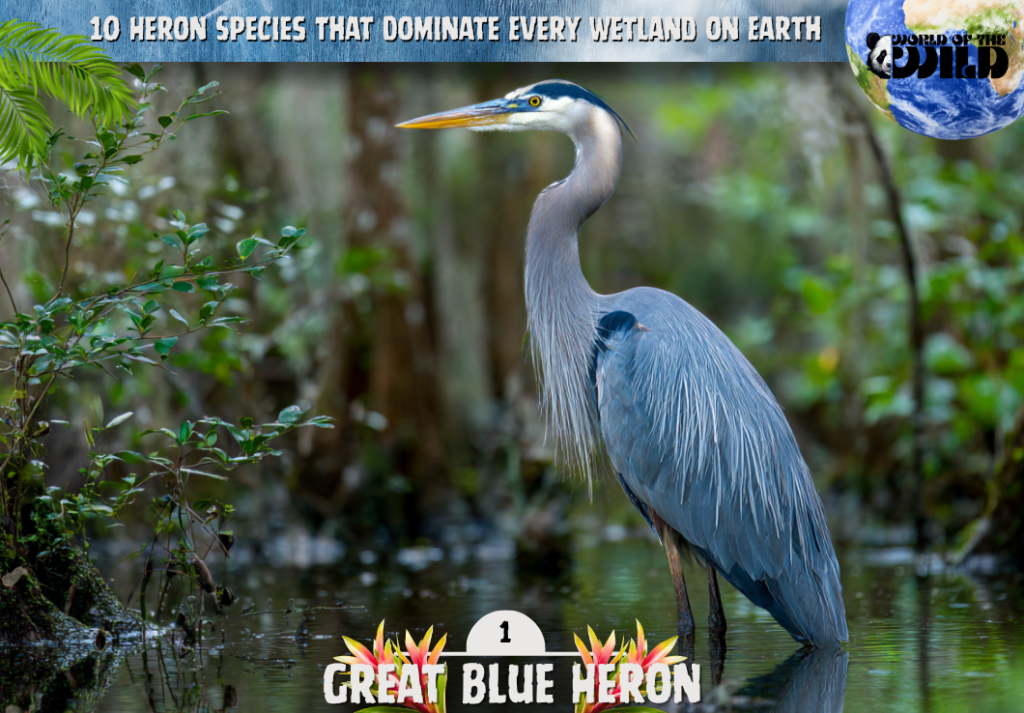
Length: 91–137 cm Wingspan: 167–201 cm Weight: 2.1–3.6 kg Range: North America, Central America, northern South America, Caribbean Habitat: Wetlands, rivers, lakes, coastal shores, marshes
The Great Blue Heron is the undisputed icon of North American wetlands — a towering, slate-blue giant that can be found standing motionless at the edge of virtually any body of water, from Alaskan tidal flats to Florida mangroves. It is the largest heron in North America, and its sheer size alone makes it an imposing presence. Adults sport a distinctive white face framed by a broad black stripe that sweeps back into long, drooping plumes, while the neck is a warm rusty-buff streaked with white and black. In flight, the Great Blue is instantly recognizable by the way it folds its neck into a tight S-curve, its broad wings beating in slow, deliberate strokes.
Opportunistic and adaptable, the Great Blue Heron preys primarily on fish, but it will readily take frogs, small mammals, reptiles, insects, and even other birds. It hunts by wading slowly through shallow water or standing absolutely still, waiting for prey to stray within striking distance. That strike — a lightning-fast lunge of the neck — is so quick the human eye can barely track it. In winter, some individuals hunt in farm fields and meadows, where voles and shrews make a worthy substitute for fish.
Breeding colonies, called heronries or rookeries, can be spectacular affairs. Some colonies number in the hundreds of nests, built high in the canopy of tall trees, creating a raucous city of squawking, jostling birds. Great Blue Herons are largely monogamous within a season, with elaborate courtship displays involving plume-spreading, bill-snapping, and neck-stretching rituals. Their deep, prehistoric-sounding croak — a loud, guttural ‘frahnk’ — often announces their presence long before they come into view.
Learn more in-depth information about the amazing Great Blue Heron here at World of the Wild
2. Grey Heron (Ardea cinerea)
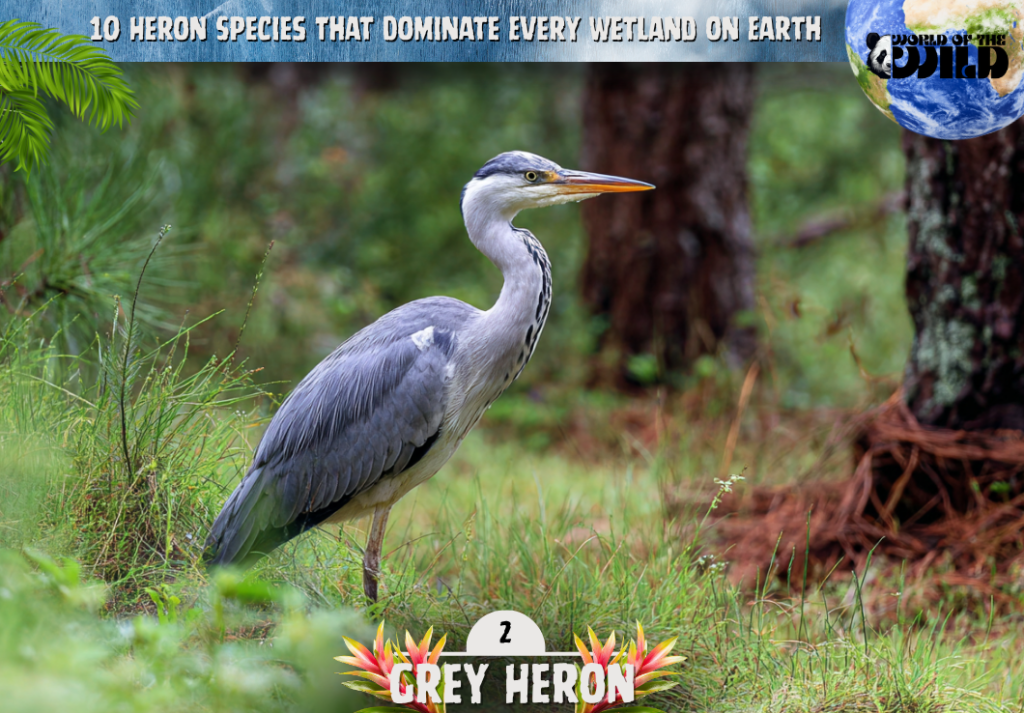
Length: 84–102 cm Wingspan: 155–175 cm Weight: 1.0–2.1 kg Range: Europe, Asia, Africa Habitat: Rivers, lakes, estuaries, fish ponds, flooded fields
The Grey Heron is Europe’s most familiar large wading bird and the Old World ecological equivalent of its North American cousin. Found from Iceland to Japan and from the British Isles to South Africa, this silver-grey hunter is a ubiquitous presence along rivers, lakeshores, and even urban park ponds. Adults have white heads with bold black crests that trail into elongated plumes, a white neck streaked with dark spots, and pale grey wings edged in black. Like all large herons, it carries its neck retracted in flight — a key field mark that separates it from storks and cranes.
Grey Herons are famously patient hunters. They will stand motionless at the water’s edge for extraordinary lengths of time, waiting for a fish, frog, or water vole to venture close enough to strike. This patience serves them well in cold European winters when fish are sluggish and food is scarce. They have adapted well to human environments and can often be seen in city parks, fishing in ornamental ponds and garden water features, a habit that brings them into occasional conflict with koi-keepers and fish farmers.
In Britain alone, it is estimated that Grey Herons consume tens of thousands of tonnes of fish each year. Yet their role in ecosystem balance is positive overall — they help control fish populations, remove weak and diseased individuals, and their large stick nests, often built in tall trees or even electricity pylons, provide structure that other species later colonize. Grey Heron colonies, typically established in late winter, are noisily dramatic events, with birds returning faithfully to the same trees year after year.
Learn more in-depth information about the amazing Grey Heron here at World of the Wild
3. Goliath Heron (Ardea goliath)
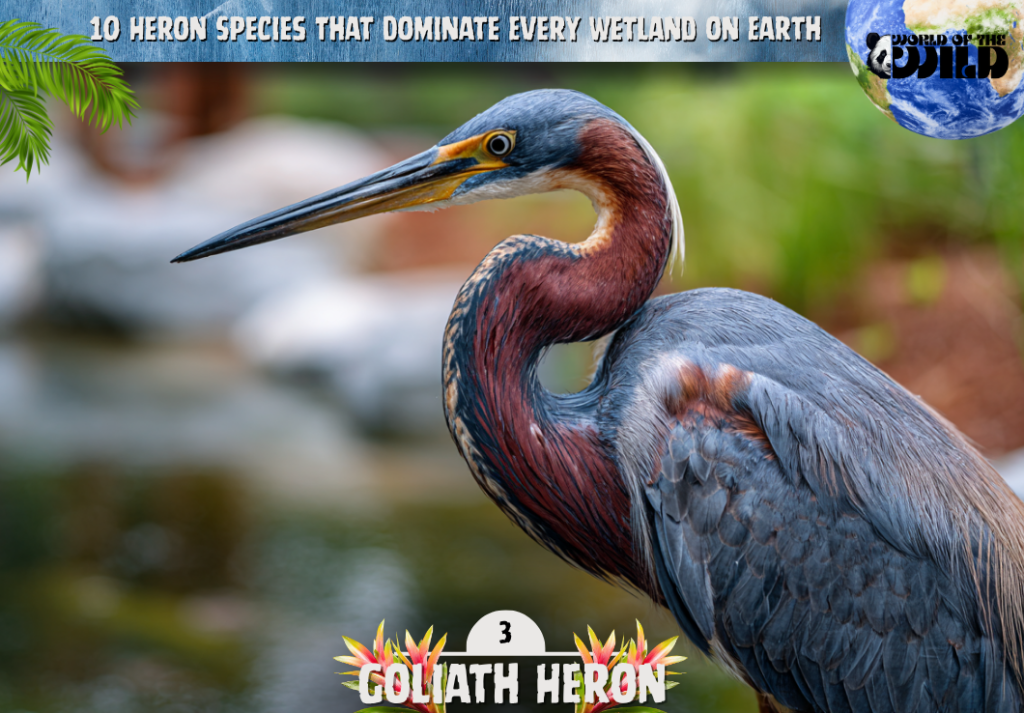
Length: 120–152 cm Wingspan: 185–230 cm Weight: 4.0–5.0 kg Range: Sub-Saharan Africa, parts of South and Southeast Asia Habitat: Large lakes, rivers, swamps, mangroves, coastal lagoons
The Goliath Heron is a bird of superlatives. It is the world’s largest living heron — and arguably the most impressive wading bird on Earth. Standing up to 1.52 metres tall with a wingspan approaching 2.3 metres, encountering a Goliath Heron at the water’s edge is genuinely breathtaking. The bird is dramatically coloured: a rich chestnut crown and neck, slate-grey upperparts, and a cream-white underside streaked with bold black markings. Its bill is enormous — as long as a human hand — a tool perfectly engineered for seizing large, slippery prey.
Goliath Herons are specialized hunters, feeding almost exclusively on large fish that smaller herons would be unable to tackle. They frequently hunt in water up to a metre deep and have been recorded taking fish weighing over 1 kilogram. They tend to be territorial birds, often defending stretches of river or lakeshore against other herons and even crocodiles. Their distinctive deep, loud bark — often likened to a baying dog or a lion’s cough — carries across wide expanses of water and serves both as a territorial declaration and contact call.
Because of their low population density and dependence on undisturbed, productive wetlands, Goliath Herons are sensitive indicators of wetland health. They occur across much of sub-Saharan Africa wherever suitable habitat exists, from the Okavango Delta in Botswana to the great lakes of the East African Rift Valley. Populations also exist in South and Southeast Asia, though these are sparser and less well-studied. Nesting pairs tend to nest alone rather than in colonies, building enormous stick platforms in trees, on cliffs, or in reed beds.
Learn more in-depth information about the amazing Goliath Heron here at World of the Wild
4. Little Egret (Egretta garzetta)
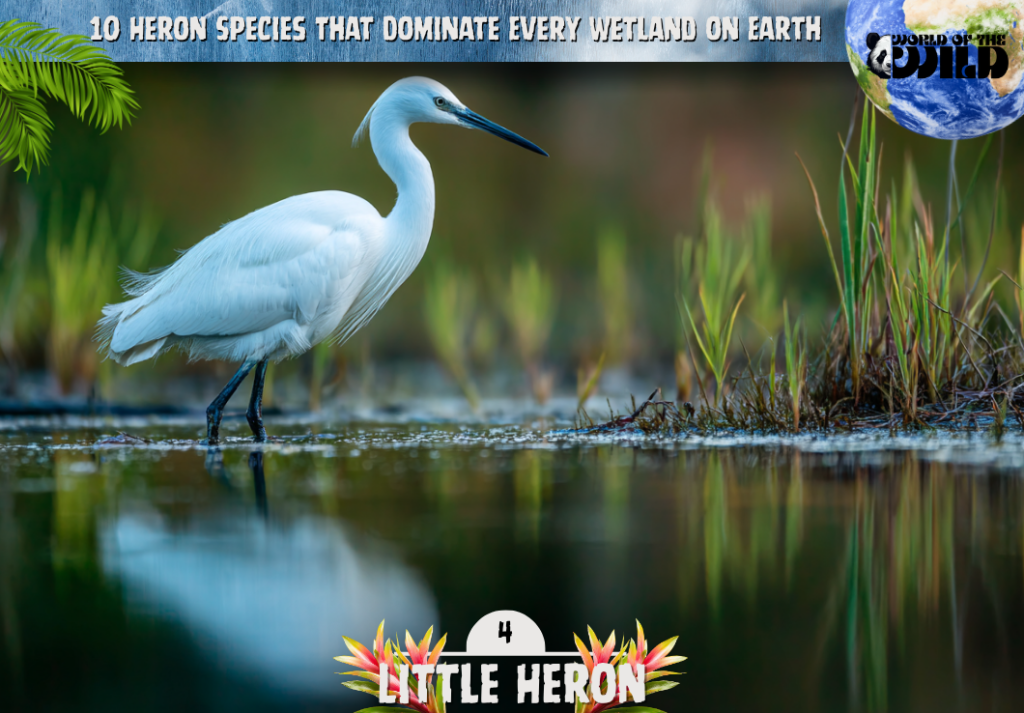
Length: 55–65 cm Wingspan: 83–95 cm Weight: 300–600 g Range: Europe, Africa, Asia, Australia Habitat: Estuaries, wetlands, rivers, coastal lagoons, rice fields
Dazzlingly white and delicately built, the Little Egret is one of the most elegant members of the heron family. It is a medium-sized, all-white heron distinguished by its black bill, black legs, and conspicuous bright yellow feet — a field mark so distinctive that birders often quip it appears to be wearing yellow Wellington boots. During the breeding season, adults grow long, wispy ornamental plumes on their backs, chest, and head. These aigrettes, as they are called, were once so highly prized as hat decorations that the species was hunted to near-extinction across much of Europe and Asia in the late 19th century. Conservation efforts and legal protection brought the species back, and today it is once again common and expanding its range.
The Little Egret is an active and energetic hunter, very different in style from the patient stillness of the Grey or Great Blue Heron. It frequently uses its bright yellow feet to stir up mud and disturb prey, then dashes after the fleeing fish or invertebrates with quick, nimble strikes. It can often be seen running through shallow water, wings half-raised to create shade that attracts fish. This active hunting style makes it entertaining to watch, and its striking white plumage makes it easy to spot from a distance.
The species has undergone a remarkable expansion into northwestern Europe over the past few decades, colonizing Britain in the 1990s and now breeding widely across England and Wales. Climate change, habitat creation, and legal protection have all contributed to this success story. Today the Little Egret is a familiar sight along British estuaries, wetland reserves, and river valleys — a conservation success that was unimaginable fifty years ago.
Learn more in-depth information about the amazing Little Egret here at World of the Wild
5. Black-crowned Night Heron (Nycticorax nycticorax)
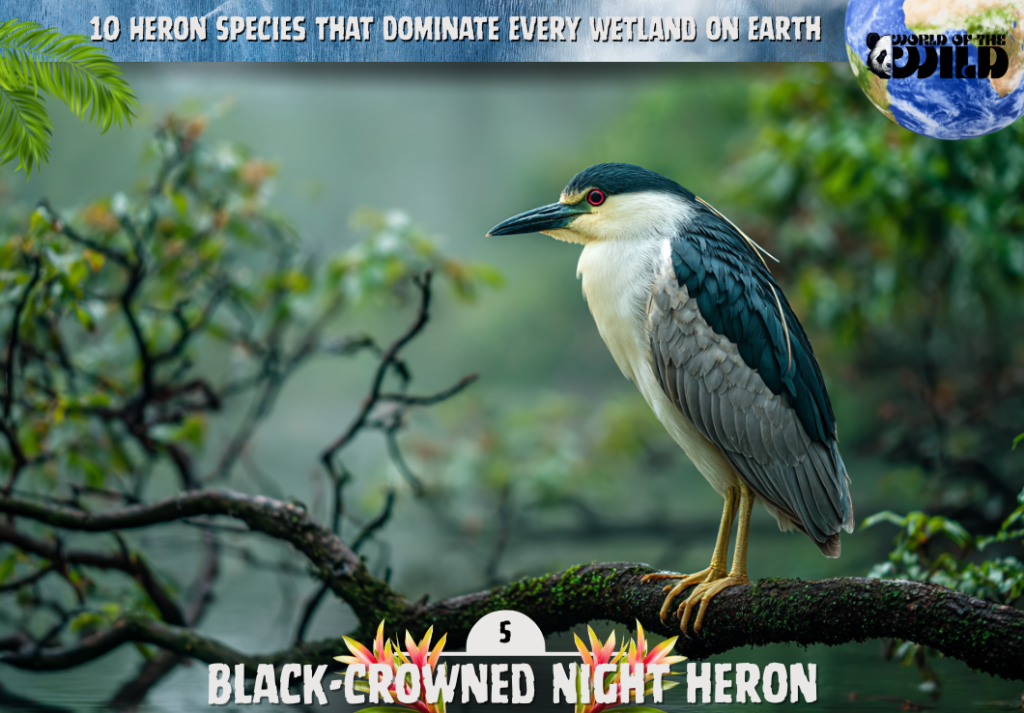
Length: 58–65 cm Wingspan: 105–112 cm Weight: 727–1,014 g Range: Almost worldwide except Australia and polar regions Habitat: Wetlands, mangroves, rice paddies, riverine forest, urban waterfronts
The Black-crowned Night Heron is one of the most widespread herons in the world, found on every continent except Australia and Antarctica. It is a compact, stocky bird with a distinctive appearance: a glossy black cap and back, pale grey wings, and clean white underparts, with striking red eyes that glow in low light. Two or three long, white head plumes trail down the neck during the breeding season, adding a touch of elegance to an otherwise chunky silhouette. As its name suggests, this heron is primarily crepuscular and nocturnal, doing most of its hunting at dusk, through the night, and at dawn.
By day, Black-crowned Night Herons roost in dense trees and shrubs, often in large groups, making them easy to miss despite being locally abundant. As darkness falls, they become active, flying to wetlands and shorelines to hunt fish, frogs, crustaceans, insects, and even eggs and chicks of other waterbirds. Their distinctive call — a sharp, barking ‘kwok’ or ‘woc’ — is a familiar night sound near wetlands across much of the world, and many people who live near water hear them without ever seeing them.
Night herons are colonial breeders, often nesting in mixed colonies alongside other heron and egret species. They choose dense vegetation — bamboo thickets, willows, or mangroves — that provides cover and protection from predators. Their adaptability to urban environments is remarkable; breeding colonies exist in city parks, botanical gardens, and harbour-side trees in many of the world’s major cities, from San Francisco to Shanghai, making them one of the few large wild birds that many city-dwellers encounter regularly.
6. Purple Heron (Ardea purpurea)
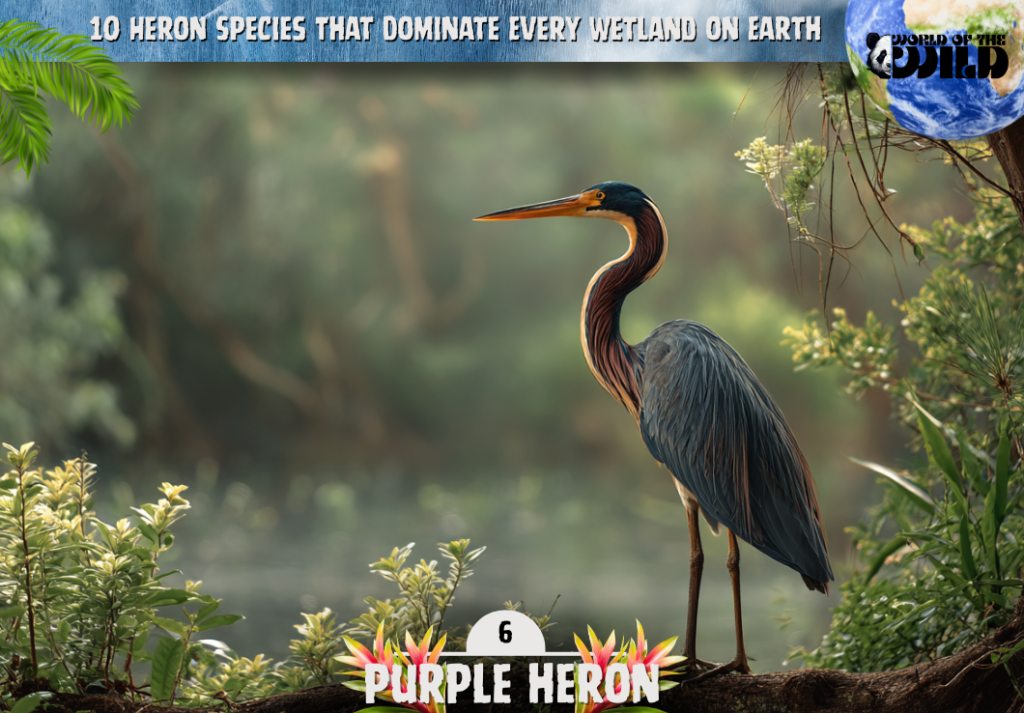
Length: 78–90 cm Wingspan: 120–150 cm Weight: 525–1,045 g Range: Europe, Africa, Asia Habitat: Dense reedbeds, marshes, swamps, rice paddies
The Purple Heron is a darker, more secretive relative of the Grey Heron, and to many observers it is the more beautiful of the two. Its plumage is a rich tapestry of deep slate-grey, reddish-chestnut, and purplish tones — a colouration that provides exceptional camouflage among the reedbeds it favours. The neck is long and sinuous, striped in chestnut, black, and buff, and is often held in a dramatically kinked S-shape. The head is narrow and snake-like compared to the broader-faced Grey Heron, giving it an intense, angular look.
Purple Herons are specialist birds of dense wetland vegetation. Unlike the Grey Heron, which will hunt in open water and even fields, the Purple Heron prefers the cover of tall reedbeds and emergent marsh plants, moving through them with a surprising stealth and agility for such a large bird. When disturbed, it will often freeze with its neck extended and bill pointing skyward, relying on its striped plumage to blend seamlessly with the surrounding reeds — a defensive posture called ‘bittering up’ shared with its relative the Eurasian Bittern.
In Europe, the Purple Heron is a long-distance migrant, wintering in West Africa and returning to breed in southern and central European wetlands each spring. It is shyer and more difficult to observe than the Grey Heron, and its preference for dense habitat means that populations can be difficult to survey and monitor. Drainage of marshes and degradation of reedbeds have impacted this species across much of its European range, making wetland conservation critical to its long-term future.
7. Green Heron (Butorides virescens)
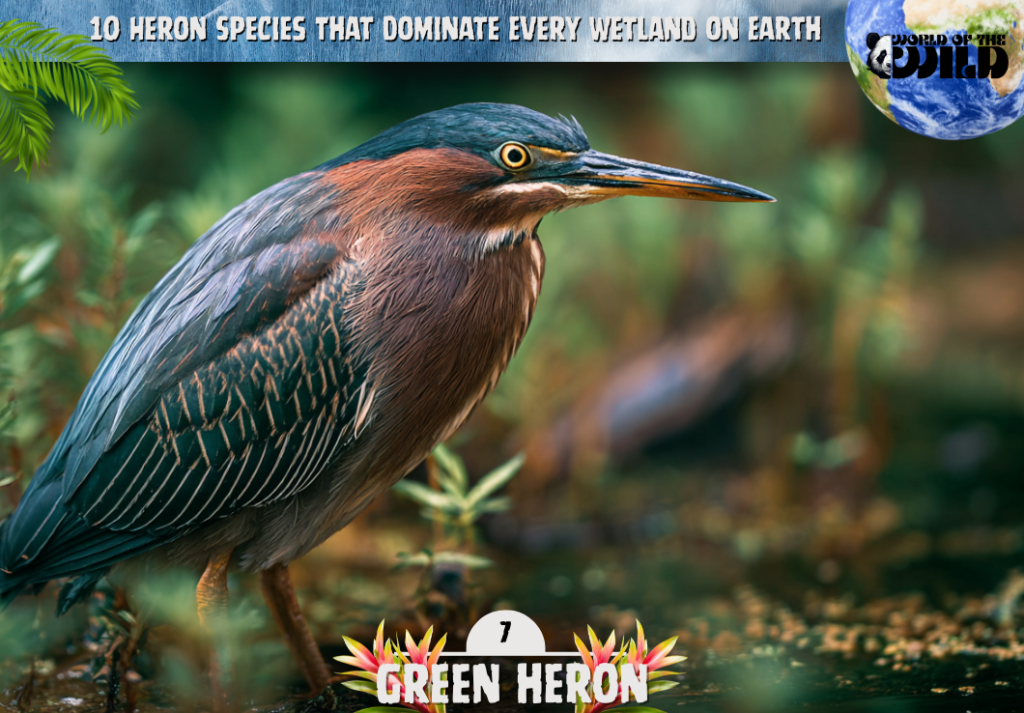
Length: 41–46 cm Wingspan: 52–60 cm Weight: 135–240 g Range: North America, Central America, Caribbean Habitat: Streams, ponds, wetland edges, mangroves, forest streams
Small, cryptic, and deceptively plain-looking at first glance, the Green Heron is one of nature’s most underestimated birds. At roughly the size of a crow, it lacks the dramatic stature of its larger relatives, but on close inspection it reveals itself to be a beautifully patterned bird: dark greenish-grey upperparts that shimmer with an iridescent sheen in good light, a rich chestnut neck and breast, and a jaunty dark cap that it can raise into a shaggy crest when alarmed. Its legs, normally yellow-green, flush to bright orange during breeding season.
What makes the Green Heron truly remarkable, however, is its intelligence. It is one of the very few bird species known to use tools. Green Herons have been documented deliberately placing objects — small sticks, feathers, insects, pieces of bread, or other items — on the surface of the water as lures to attract curious fish. When a fish investigates the floating bait, the heron strikes. This behaviour, observed in wild birds independently in many locations, places the Green Heron among a very exclusive group of non-human tool users, alongside crows, apes, and octopuses.
Green Herons are solitary hunters that favour streams, ponds, and wetland edges densely bordered by overhanging vegetation. They can be difficult to spot when perched motionless among roots and branches, but their sharp alarm call — a loud, explosive ‘skeow’ — often gives them away when they take flight. They nest singly or in small, loose colonies, building platform nests in shrubs and trees near water. Unlike many herons, they are not committed long-distance migrants; birds in milder climates often remain year-round.
Learn more in-depth information about the Green Heron here at World of the Wild
8. Tricolored Heron (Egretta tricolor)
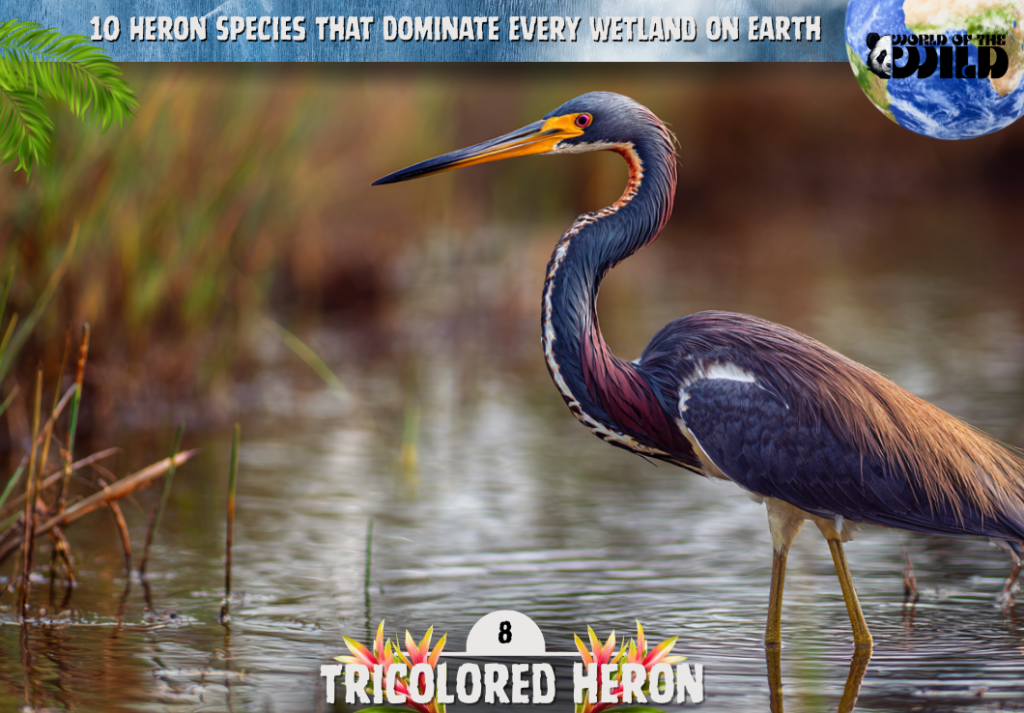
Length: 56–76 cm Wingspan: 91–96 cm Weight: 300–450 g Range: Southeastern USA, Central America, South America, Caribbean Habitat: Salt marshes, mangroves, lagoons, tidal flats, coastal wetlands
Formerly known as the Louisiana Heron, the Tricolored Heron is one of the most distinctively patterned members of the heron family — and one of the most animated hunters. Its name describes its plumage perfectly: slate-blue and purple upperparts, a white belly, and reddish-brown and buff streaking on the neck and chest. A bright white stripe runs down the front of the neck, making it instantly identifiable. During breeding season, the base of the bill turns bright blue, the lores flush lavender, and long white plumes decorate the back.
The Tricolored Heron is a bird in constant motion. Where the Great Blue Heron hunts with stoic patience, the Tricolored is an energetic, almost frantic pursuer, dashing through shallow water with wings raised and spread to create a canopy of shadow that both frightens fish into moving and reduces glare for the hunting bird. It often runs, twists, and lunges repeatedly, covering wide stretches of water in its pursuit of small fish. This high-energy hunting style makes it one of the most entertaining herons to watch in action.
The Tricolored Heron is closely associated with coastal and estuarine habitats, particularly mangroves and salt marshes along the Gulf of Mexico, the southeastern Atlantic seaboard of the United States, and down through Central and South America. It nests colonially, often in mixed heronries alongside Little Blue Herons, Snowy Egrets, and Cattle Egrets. Like many coastal waterbirds, it is sensitive to habitat degradation, sea-level rise, and pollution, making the health of America’s coastal wetlands critical to this species’ future.
9. Striated Heron (Butorides striata)
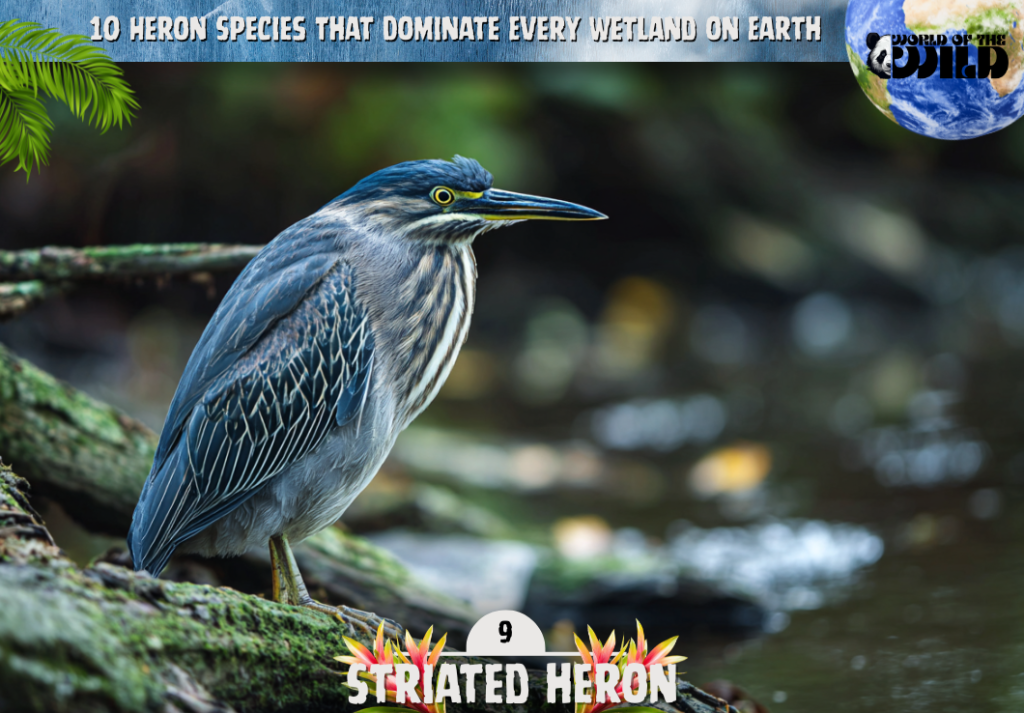
Length: 40–48 cm Wingspan: 52–60 cm Weight: 130–215 g Range: Central and South America, Sub-Saharan Africa, South and Southeast Asia, Australia Habitat: Mangroves, streams, paddy fields, coastal rocks, forest streams
The Striated Heron — also known as the Mangrove Heron or Little Heron depending on the region — is among the most widely distributed small herons in the world, found across tropical and subtropical regions of every inhabited continent. It is a compact, hunched bird with greenish-grey upperparts, a dark cap, and pale underparts washed with buff. Its streaked neck, from which it takes its name, provides excellent camouflage among the woody stems and tangled roots of the mangrove forests it so often inhabits.
Like its North American cousin the Green Heron (with which it was previously lumped as a single species), the Striated Heron is also known to engage in tool-use behaviour. Multiple populations on different continents have been observed independently placing objects on the water’s surface as fishing lures — a striking example of convergent cultural behaviour in birds. This suggests that tool use may be a deep-seated cognitive trait in the Butorides genus rather than a learned behaviour restricted to a single population.
Striated Herons are solitary and often cryptic birds, favouring dense vegetation and rocky shorelines. They freeze at the slightest disturbance and their mottled plumage makes them extremely difficult to spot even at close range. In coastal Asia and Australia, they are common birds of mangrove fringes and tidal creeks, often the first heron species a visiting birdwatcher will encounter. Their adaptability to a wide range of tropical wetland habitats — from Pacific island streams to African river banks to Indian rice paddies — makes them one of the heron family’s great ecological generalists.
10. Yellow-crowned Night Heron (Nyctanassa violacea)
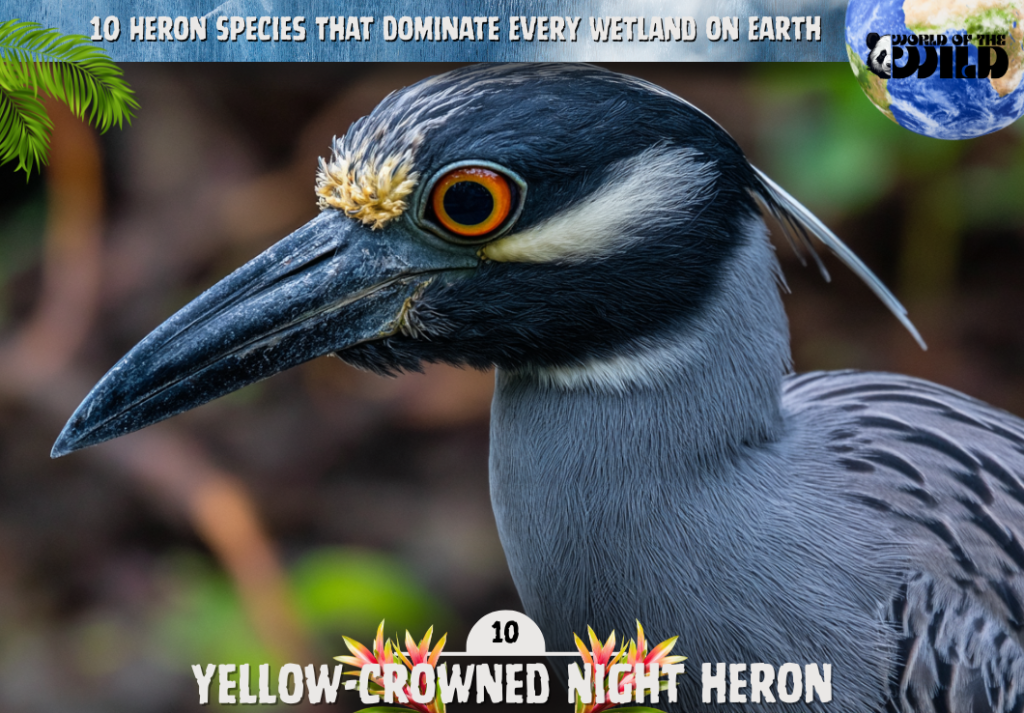
Length: 55–70 cm Wingspan: 101–112 cm Weight: 600–800 g Range: Eastern USA, Central America, South America, Caribbean Habitat: Mangroves, coastal marshes, wooded swamps, suburban trees near water
The Yellow-crowned Night Heron is arguably the most strikingly marked of all the world’s nocturnal herons. Its body is a cool blue-grey, but the head is a study in bold contrast: a creamy-yellow crown, a brilliant white cheek patch, and a jet-black face that together create a graphic, almost Art Deco pattern. Long white head plumes trail back from the crown of breeding adults, adding elegance to what is already a handsome bird. The bill is heavier and more robust than that of the Black-crowned Night Heron — a feature related to its specialized diet.
Unlike its Black-crowned cousin, which has a generalist appetite, the Yellow-crowned Night Heron is a specialist crustacean hunter. Crabs and crayfish form the bulk of its diet, and its powerful bill is ideally suited for crushing their shells. It hunts in shallow water and among the roots of mangroves, systematically working through crab habitats with deliberate, methodical movements. This dietary specialization makes it a key predator in many coastal ecosystems, and its presence or absence can influence the structure of crab communities in mangrove forests.
Yellow-crowned Night Herons are more solitary in their habits than the Black-crowned species, though they do breed in loose colonies. In the Caribbean and along the Gulf Coast, they are familiar birds of mangrove forests and waterfront neighbourhoods, nesting in ornamental trees in gardens and parks. They share the nocturnal habits of their relatives, becoming most active at dusk and through the night. Their soft, barking calls drifting through the darkness of a tropical night are among the most evocative sounds of the Americas’ coastal wetlands.
In Conclusion: Guardians of the Waterline
The ten heron species profiled in this guide represent only a fraction of the extraordinary diversity within the family Ardeidae, yet they illustrate beautifully the range of sizes, strategies, habitats, and adaptations that have made herons so successful across the globe. From the tremendous Goliath Heron wading chest-deep in an African lake to the diminutive Green Heron deploying its fishing lures on a Massachusetts pond, from the sociable Little Egret brightening a British estuary to the phantom-like Purple Heron vanishing into a European reedbed, these birds are endlessly fascinating and endlessly surprising.
They are also, in a very real sense, the guardians of the world’s wetlands. As apex predators of the waterline, herons signal the health of the ecosystems they inhabit. Where herons thrive, the water is clean, the fish are plentiful, and the habitat is intact. Where they disappear, something has gone profoundly wrong. Watching a heron is never just an act of birdwatching — it is a window into the vitality of the living world around us.
Whether you encounter them as a flash of white on a flooded estuary, a still blue silhouette at the edge of a winter river, or a ghostly form passing in the darkness overhead, herons reward attention and patience — the very qualities they themselves embody. The next time one holds its ground at the water’s edge, unhurried and unwavering, take a moment to watch. You are looking at a design that has survived and flourished for tens of millions of years, and it has much to teach us about stillness, precision, and the art of waiting for exactly the right moment.