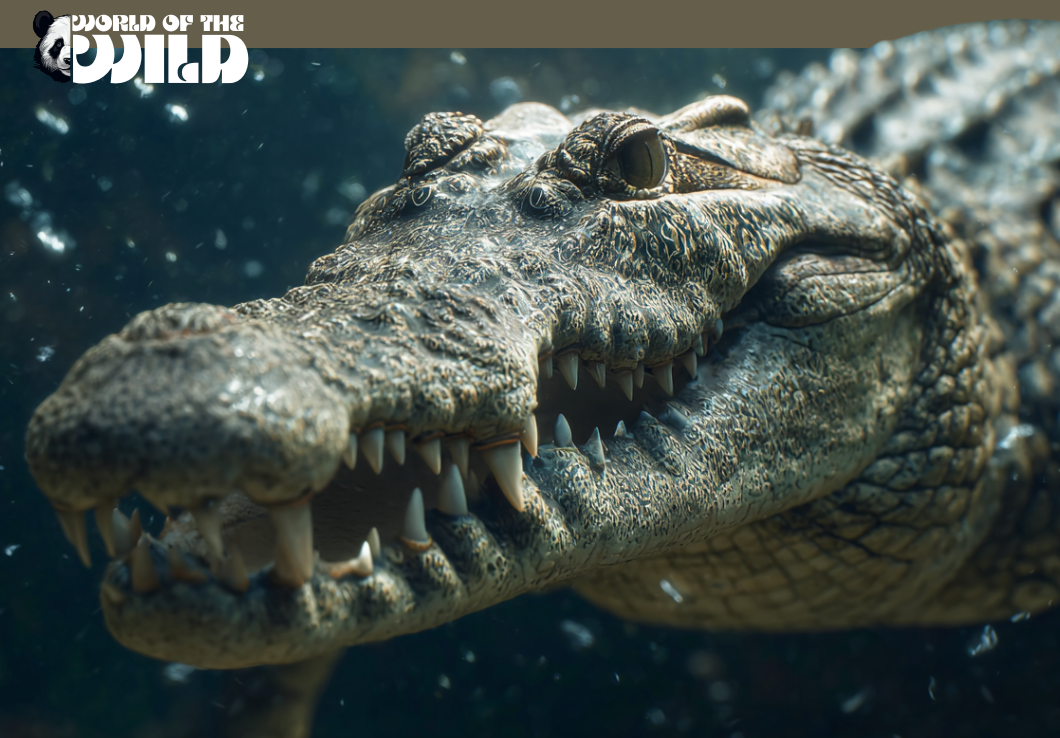

There are creatures on this planet that command respect not because of myth or legend, but because of cold, hard biological fact. The saltwater crocodile is one of them. Stretching longer than a pickup truck, weighing as much as a grand piano, and packing the most powerful bite ever measured in the animal kingdom, Crocodylus porosus is the undisputed apex predator of the coastal tropics. It has outlasted the dinosaurs, survived mass extinctions, and watched empires rise and fall — all while barely changing its winning formula. This is not an animal that nature has needed to improve upon. It got it right the first time.
But beyond the fear and spectacle, the saltwater crocodile is a biological marvel — a living window into deep evolutionary time, an ecological keystone, and, surprisingly, a devoted parent. Whether you encounter it in the murky tidal rivers of northern Australia, the mangrove swamps of Southeast Asia, or the remote coastal wilderness of the Indian subcontinent, one thing is certain: the saltwater crocodile demands your full attention.
Facts
- Bite force world record: The saltwater crocodile generates a bite force of approximately 3,700 pounds per square inch (psi) — the most powerful bite ever recorded for any living animal, surpassing even the great white shark.
- Salt-filtering superpowers: Unlike most reptiles, saltwater crocodiles possess lingual salt glands on their tongues that actively excrete salt, allowing them to thrive in marine environments that would dehydrate other reptiles.
- Stone cold survivors: Fossils show that Crocodylus ancestors existed over 85 million years ago, meaning these animals coexisted with non-avian dinosaurs.
- Speed on water: Despite their bulk, saltwater crocodiles can sprint through water at speeds of up to 18 mph (29 km/h) in short bursts — faster than an Olympic swimmer.
- Natural fasting champions: Saltwater crocodiles can survive for over a year without eating by slowing their metabolism to near dormancy, converting stored fat and even muscle tissue into energy.
- Galvanic skin sensors: Their entire body is studded with tiny dome pressure receptor (DPR) organs that detect minute vibrations and pressure changes in the water, acting as a hyper-sensitive early-warning and hunting system.
- Temperature-determined sex: The sex of saltwater crocodile hatchlings is not determined by chromosomes but by the temperature inside the nest — a single degree of difference can shift an entire clutch from male to female.
Species
Full Taxonomic Classification:
| Rank | Classification |
|---|---|
| Kingdom | Animalia |
| Phylum | Chordata |
| Class | Reptilia |
| Order | Crocodylia |
| Family | Crocodylidae |
| Genus | Crocodylus |
| Species | Crocodylus porosus |
The saltwater crocodile belongs to the family Crocodylidae, which contains the “true crocodiles” — distinguished from alligators and gharials by their narrower snouts and the visibility of their lower fourth tooth when the jaw is closed. The genus Crocodylus contains around 14 recognized species, and C. porosus is the giant of the group.
No formally recognized subspecies of Crocodylus porosus exist, though populations across its enormous geographic range do show measurable variation in body size, skull morphology, and behavior. Its closest living relatives include the Nile crocodile (Crocodylus niloticus) of sub-Saharan Africa and the Mugger crocodile (Crocodylus palustris) of South Asia — both formidable predators in their own right, but neither matches the saltwater crocodile in size or range. The Indo-Pacific crocodile is another common name used for C. porosus, reflecting its sprawling presence across the Indo-Pacific region.
Appearance
The saltwater crocodile is built like a siege weapon. Adult males are the largest living reptiles on Earth, routinely reaching lengths of 14 to 17 feet (4.3 to 5.2 meters), with confirmed record specimens exceeding 20 feet (6 meters) in length. Females are considerably smaller, typically measuring 8 to 10 feet (2.4 to 3 meters). In terms of weight, mature males generally range between 400 and 1,000 pounds (180 to 450 kg), with exceptionally large individuals surpassing 2,200 pounds (1,000 kg).
The body is unmistakably crocodilian — broad, massively muscled, and low-slung. The skin is armored with osteoderms, bony plates embedded beneath the scales that act as natural chainmail. Coloration in adults tends toward olive-green to grayish-brown on the dorsal (upper) surface, fading to a pale yellow or cream on the underside. Juveniles display more vibrant patterning, with irregular dark bands and spots across a lighter background — a camouflage that matures into the drab, utilitarian tones of adulthood.
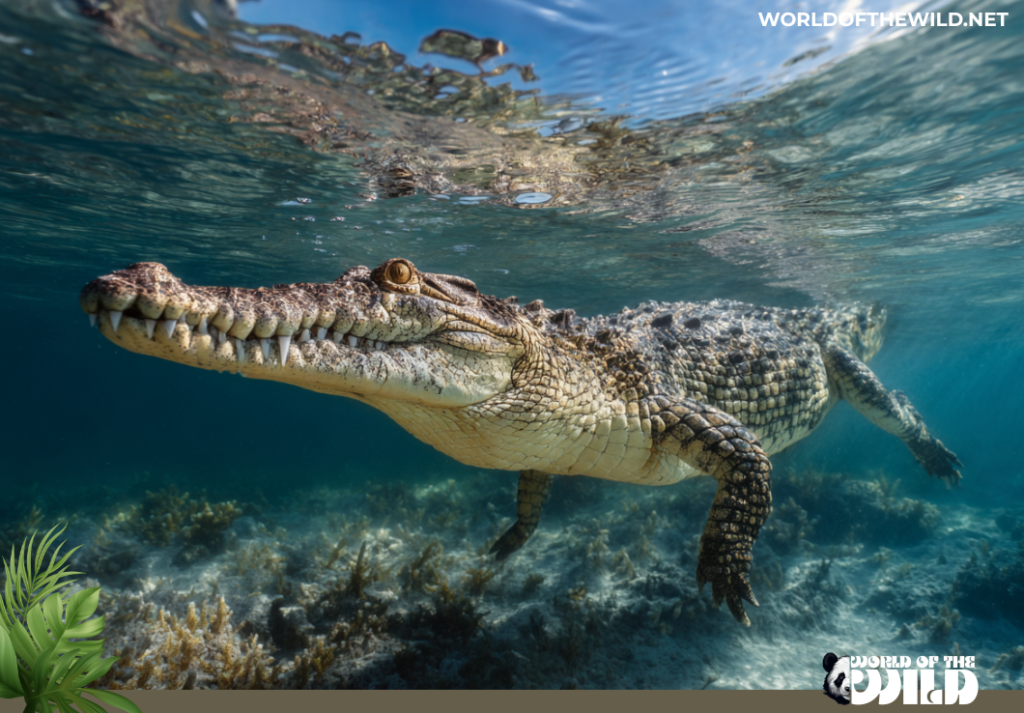
The skull is the defining feature. Wide and heavily reinforced, it houses rows of conical interlocking teeth — not designed to chew, but to seize and hold. The eyes, ears, and nostrils are all positioned along the top of the head, a supremely adapted configuration that allows the animal to float nearly invisible at the surface while remaining fully alert. The powerful laterally flattened tail serves as the primary propulsion organ in water, capable of generating explosive thrust. Short, sturdy legs allow surprisingly quick movement on land in the classic “high walk” posture, with the belly lifted clear of the ground.
Behavior
The saltwater crocodile is largely solitary and territorial, particularly among adult males. Large males establish and aggressively defend prime stretches of river, estuary, and coastal habitat. Confrontations between rival males can be violent and occasionally fatal, involving powerful biting, body slamming, and extended wrestling in the water.
Despite their reputation as mindless killing machines, saltwater crocodiles display a surprising degree of cognitive complexity. Research has documented tool use — crocodilians have been observed balancing sticks on their snouts during bird nesting season, potentially luring nest-building birds within striking range. They engage in play behavior, including water-surfing in currents — a trait previously thought to be exclusive to warm-blooded animals. Communication occurs through a sophisticated array of vocalizations, body postures, infrasound vibrations, and head slaps on the water surface, all used to signal dominance, readiness to mate, or danger.
Their hunting strategy is defined by one word: patience. Saltwater crocodiles are ambush predators of exceptional discipline, capable of remaining motionless for hours — sometimes days — waiting for prey to approach the water’s edge. When they strike, the attack is launched with explosive, almost incomprehensible speed. The famous “death roll” — a rapid spinning of the entire body — is used to disorient prey, tear off manageable pieces of flesh, and drown larger animals that have been dragged into the water.
Thermoregulation is managed behaviorally: crocodiles bask in the sun to raise body temperature and retreat to water or shade to cool down. Their metabolism is extraordinarily efficient, allowing prolonged periods of inactivity between large meals.
Evolution
The evolutionary story of the saltwater crocodile is one of remarkable continuity. The order Crocodylia traces its origins back approximately 95 to 100 million years, making crocodilians among the oldest surviving vertebrate lineages on Earth. Their ancestors, the archosaurs, shared the planet with dinosaurs during the Mesozoic Era, and the two groups — birds and crocodilians — are actually the only living representatives of that ancient archosaurian clade.
Early crocodilians were far more diverse than today’s representatives. Some were terrestrial sprinters, others were fully marine, and some were enormous — the fearsome Sarcosuchus imperator, nicknamed “SuperCroc,” lived approximately 112 million years ago and may have reached lengths of 40 feet (12 meters). The lineage that would lead to modern crocodiles gradually refined toward the semi-aquatic ambush-predator body plan that has proven so spectacularly successful.
The genus Crocodylus itself appears in the fossil record around 12 to 15 million years ago, during the Miocene epoch. The saltwater crocodile’s specific lineage is believed to have originated in the Indo-Pacific region and spread across its current range through coastal dispersal — a testament to its remarkable adaptability to saltwater environments that other crocodilians could never exploit. The species represents one of evolution’s most elegant solutions: a body plan so well-suited to its niche that 100 million years of trial and error resulted in only marginal refinements.
Habitat
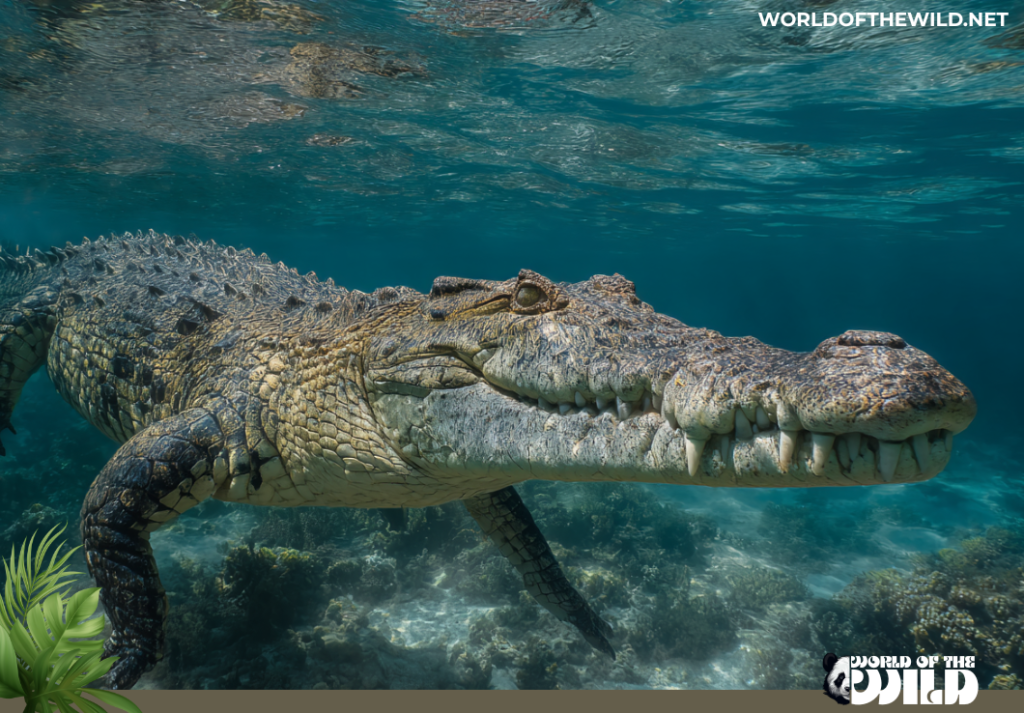
The saltwater crocodile boasts the widest geographic range of any crocodilian species, spanning from the eastern coast of India and Sri Lanka, through Southeast Asia (including Thailand, Malaysia, Indonesia, the Philippines, and Papua New Guinea), and extending south to the northern coast of Australia. Isolated populations exist across various Pacific islands. Historically, the range extended further — populations were once found in the Seychelles, and vagrants have been recorded as far west as the Persian Gulf.
Within this vast range, C. porosus occupies a diverse set of coastal and estuarine environments. As the name “saltwater” implies, it tolerates salinity levels that would kill other crocodilian species, thriving in mangrove swamps, tidal rivers, estuaries, coastal lagoons, and brackish wetlands. Despite the name, individuals regularly move inland along freshwater river systems, particularly during the wet season, sometimes traveling hundreds of kilometers from the coast.
The habitat is typically characterized by tropical and subtropical climates, warm year-round temperatures, dense vegetation along riverbanks, and abundant prey. Mangrove forests are particularly important, offering concealment for hunting, nesting sites, and protection for juveniles. In Australia’s Northern Territory and Queensland, the combination of protected wilderness areas and robust conservation programs has created some of the healthiest saltwater crocodile populations remaining anywhere in the world.
Diet
The saltwater crocodile is a carnivore of the highest order — an opportunistic apex predator whose diet shifts dramatically across its life stages. Juveniles, measuring less than three feet, subsist primarily on insects, small crustaceans, frogs, small fish, and lizards. As they grow, their ambitions — and their prey — scale accordingly.
Adult saltwater crocodiles will attempt to consume virtually any animal they can overpower and swallow. Their diet includes fish, turtles, water monitors, snakes, birds, wild boar, deer, water buffalo, banteng, orangutans, and even sharks in coastal waters. In Australia, documented prey items include cattle, horses, and dingoes. There are credible historical and modern records of attacks on humans, confirming that C. porosus does not make exceptions for our species.
The hunting method relies on the ambush from the waterline. A crocodile will drift silently to within striking range of an unsuspecting animal drinking or crossing at the water’s edge, then launch with explosive force — the initial lunge covering several body lengths in fractions of a second. The prey is seized, dragged underwater to drown, and either swallowed whole (for smaller items) or consumed after being torn apart through the death roll. Crocodiles lack the jaw musculature to chew; everything is swallowed in chunks. Powerful stomach acids dissolve bone, hide, and hoof with efficiency that would make a vulture envious.
Predators and Threats
Adult saltwater crocodiles have no natural predators. They sit at the absolute apex of every food web they inhabit. Juveniles and hatchlings, however, face a gauntlet of threats — monitor lizards, large predatory fish, herons, birds of prey, wild pigs, and even larger crocodiles all prey on the young. It is estimated that fewer than 1% of hatchlings survive to adulthood, a mortality rate that underscores the importance of the species’ impressive reproductive output.
The gravest threats facing the saltwater crocodile today are human-caused:
Habitat loss remains the single biggest long-term threat. Mangrove forests — critical nursery and nesting habitat — are being cleared at alarming rates for aquaculture, coastal development, and agriculture across Southeast Asia and South Asia. Tidal rivers are increasingly polluted, degraded, or dammed, fragmenting and diminishing suitable habitat.
Hunting and poaching devastated populations throughout the 20th century. The saltwater crocodile’s skin is among the most commercially valuable of any reptile, prized for luxury leather goods. Unregulated hunting between the 1940s and 1970s drove the species to near-extinction across much of its range, with Australian populations estimated to have fallen to as low as 3,000 individuals.
Human-wildlife conflict is an ongoing challenge. As human populations expand into crocodile habitat, lethal encounters increase, leading to retaliatory killings and culling programs that place additional pressure on local populations.
Climate change poses emerging risks, including sea-level rise that may inundate nesting sites, shifts in prey availability, and alteration of temperature-dependent sex ratios in hatchling populations.
Reproduction and Life Cycle
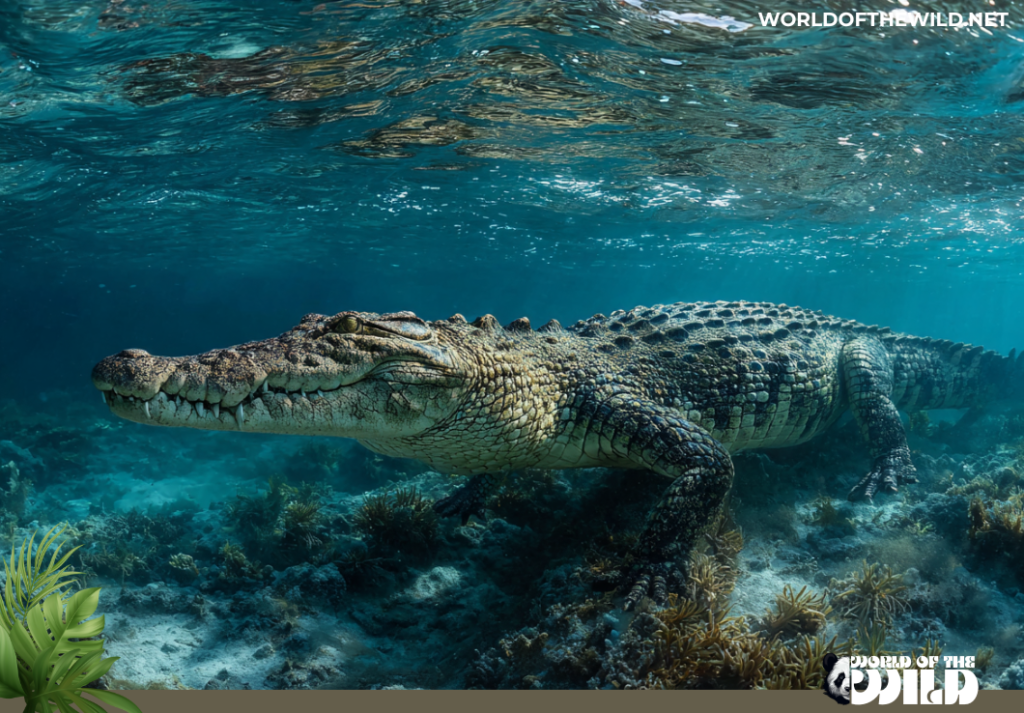
The saltwater crocodile’s reproductive biology is as impressive as its hunting prowess. The mating season coincides with the onset of the wet season (typically November through March in the Southern Hemisphere), when water levels rise and food is abundant.
Males engage in intense ritualized combat and courtship displays — roaring, head-slapping, blowing bubbles, and physical wrestling — to establish dominance and win mating rights. A dominant male may mate with several females within his territory.
Females construct large mound nests from vegetation, soil, and debris, typically placed near water but above the flood line. A clutch consists of 40 to 90 eggs, laid in a cavity within the mound. The female then performs a remarkable duty: she remains near the nest for the entire 80 to 90-day incubation period, aggressively guarding it against predators and adjusting nest material to regulate temperature. Given that nest temperature determines hatchling sex — temperatures around 31.6°C (89°F) produce predominantly males, while cooler or warmer temperatures produce predominantly females — this maternal vigilance has direct consequences for population demographics.
When hatchlings begin vocalizing from inside the eggs, the mother excavates the nest and gently carries the hatchlings to water in her mouth — a tender image wildly at odds with the animal’s fearsome reputation. She continues to guard the hatchlings for several weeks to months. Despite this care, juvenile mortality remains exceptionally high.
Saltwater crocodiles grow slowly and reach sexual maturity at approximately 10 to 16 years of age. Their lifespan is extraordinary — individuals in the wild regularly live 70 years or more, with some captive animals surviving well past that. One famous resident of the Australia Zoo, a large male named Cassius, is believed to be over 100 years old.
Population
The saltwater crocodile is currently listed as Least Concern on the IUCN Red List — a conservation success story built on the back of determined legal protection and management programs. Global population estimates place the total number of wild saltwater crocodiles at approximately 200,000 to 300,000 individuals, though this figure varies across sources due to the difficulty of surveying animals across such a vast and remote range.
Australia holds the largest and healthiest populations, with the Northern Territory alone estimated to support over 100,000 individuals — a number that has rebounded dramatically since the species received full legal protection in 1971. Populations in parts of Southeast Asia, including Indonesia and Papua New Guinea, remain significant but are more difficult to assess and face greater ongoing pressure from habitat loss and poaching.
Populations in South Asia — particularly India, Bangladesh (the Sundarbans), and Sri Lanka — are far smaller and more fragmented, classified as endangered at the regional level despite the global Least Concern status. The Philippines and other island nations have seen populations decimated by centuries of hunting and habitat conversion.
The population trend overall is considered stable to increasing in well-protected regions, but declining across much of Southeast and South Asia. The species’ recovery where protections have been enforced stands as a powerful case study in what conservation legislation — rigorously applied — can achieve.
Conclusion
The saltwater crocodile is many things at once: a prehistoric relic and a modern predator; a feared man-eater and an attentive mother; a species that teetered on the edge of extinction and, in some regions, roared back. It is perhaps the closest thing our living world has to a biological constant — a creature so ruthlessly well-designed that evolution has seen little reason to tinker with it for tens of millions of years.
Its recovery in Australia is one of the great wildlife conservation triumphs of the 20th century. But that success is geographically uneven, and across much of its Southeast Asian and South Asian range, the saltwater crocodile faces mounting pressure from habitat destruction, human encroachment, and illegal trade. The story is not over, and its ending is not guaranteed.
To protect the saltwater crocodile is not merely to preserve a spectacular animal — it is to safeguard an entire ecosystem. As a keystone apex predator, it structures the communities around it, controlling prey populations, shaping the behavior of other species, and maintaining the ecological integrity of some of the most biodiverse coastal habitats on Earth. If we lose the saltwater crocodile, we do not lose one species. We lose a living thread stitched through hundreds of millions of years of life on this planet. That thread is worth every effort to preserve.
Quick Reference
| Scientific Name | Crocodylus porosus |
| Diet Type | Carnivore (apex predator) |
| Size | 96–204 inches (8–17 feet); record individuals exceed 240 inches (20 feet) |
| Weight | 400–2,200+ pounds (180–1,000+ kg) |
| Region Found | India, Sri Lanka, Southeast Asia (Thailand, Malaysia, Indonesia, Philippines), Papua New Guinea, northern Australia, and scattered Pacific islands |