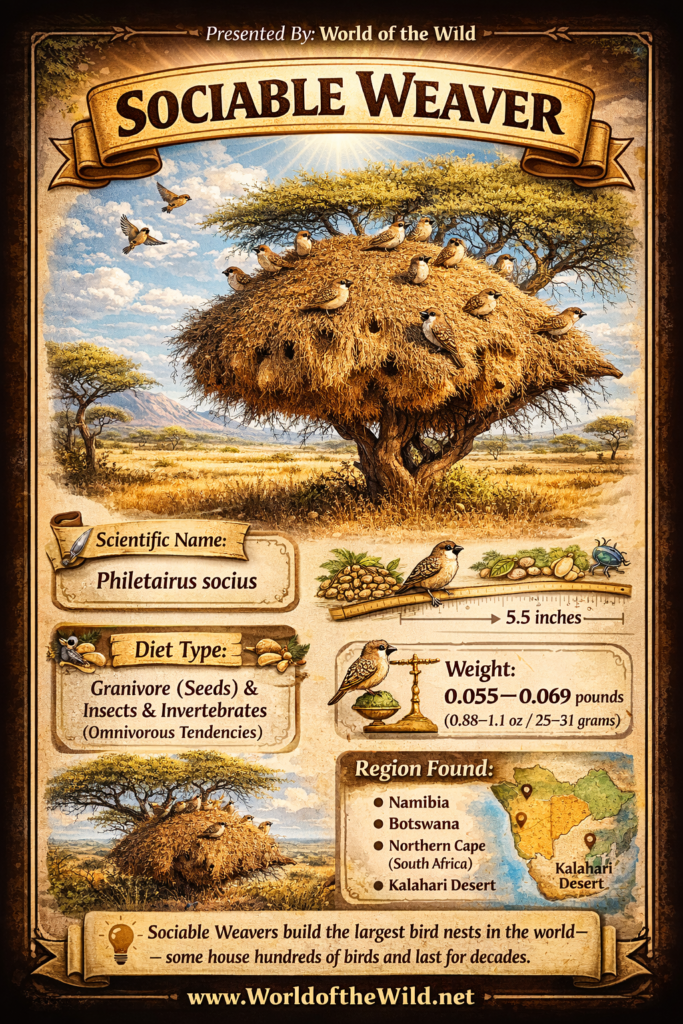

Imagine stumbling upon what appears to be a massive, thatched haystack perched impossibly high in a camelthorn acacia tree, stretching wider than a family car and weighing as much as a small truck. You’d be forgiven for thinking it was some kind of unusual rock formation or abandoned human structure — until you noticed the constant flutter of hundreds of tiny wings darting in and out of its dozens of tunneled entrances. Welcome to the world of the Sociable Weaver (Philetairus socius), one of the most extraordinary avian engineers on the planet.
This small, unassuming bird of southern Africa’s arid Kalahari region has accomplished something no other bird species has managed: it constructs the largest communal nest of any bird in the world — a permanent, multi-generational apartment complex that can house over 500 individuals at once. Far from being a novelty, this architectural marvel is a survival masterpiece, a testament to the power of cooperation, and a window into one of nature’s most fascinating social experiments. In a landscape defined by scorching days and freezing nights, the Sociable Weaver has engineered its way to resilience. This is its story.
Facts
Here are some quick, fascinating facts that reveal just how remarkable the Sociable Weaver truly is:
- Their nests are centuries old. Some Sociable Weaver nest complexes have been in continuous use for over 100 years, with generations of birds adding to and maintaining the same structure.
- They are natural thermostats. The interior chambers of their nests maintain a temperature of around 69–79°F (21–26°C) even when outside temperatures swing from 7°F (−14°C) at night to over 104°F (40°C) during the day.
- Pygmy falcons use them as hotels. The Pygmy Falcon (Polihierax semitorquatus) — Africa’s smallest raptor — regularly nests in the outer chambers of Sociable Weaver colonies, often living alongside (and occasionally preying on) its hosts.
- A single nest can weigh over a ton. The largest known Sociable Weaver nest structures have been estimated to weigh more than 2,000 pounds (roughly 907 kg), occasionally causing the host tree to collapse under the weight.
- They use “guard hairs” as an anti-predator mechanism. The entrance tunnels to each individual chamber are lined with sharp, stiff grass spikes pointing downward, making it extremely difficult for snakes to slither through.
- They are non-migratory homebodies. Unlike many African birds, Sociable Weavers are entirely sedentary, spending their entire lives within a very small geographic range — often less than a few kilometers from where they were born.
- Their nests double as rain catchers. The thatched outer roof of the nest is constructed at an angle that channels rainfall away from the chambers, functioning as an effective waterproofing system.
Species
Full Taxonomic Classification:
| Rank | Classification |
|---|---|
| Kingdom | Animalia |
| Phylum | Chordata |
| Class | Aves |
| Order | Passeriformes |
| Family | Ploceidae |
| Genus | Philetairus |
| Species | Philetairus socius |
The Sociable Weaver is the sole member of the genus Philetairus, making it a monotypic genus — there is no other species in the world that shares its genus. It belongs to the family Ploceidae, the true weavers, a family renowned for their impressive nest-building skills found predominantly across Africa and Asia.
Three subspecies of Philetairus socius are currently recognized, each occupying a slightly different portion of the species’ range:
- Philetairus socius socius — Found in the central Kalahari region of Botswana and northwestern South Africa. This is the nominate subspecies and the most well-studied.
- Philetairus socius lepidus — Distributed in the Orange River valley and surrounding arid zones of South Africa. It is sometimes distinguished by subtle plumage differences.
- Philetairus socius xericus — Inhabits the drier, more western regions of Namibia and the Namib desert margins. It tends to occupy harsher, more extreme environments than the other subspecies.
While no closely related species share the genus, the Sociable Weaver is most closely affiliated with other members of Ploceidae, including the well-known Southern Masked Weaver (Ploceus velatus) and the Red-billed Quelea (Quelea quelea), though it is evolutionarily distinct from both in its communal nesting strategy and social structure.
Appearance
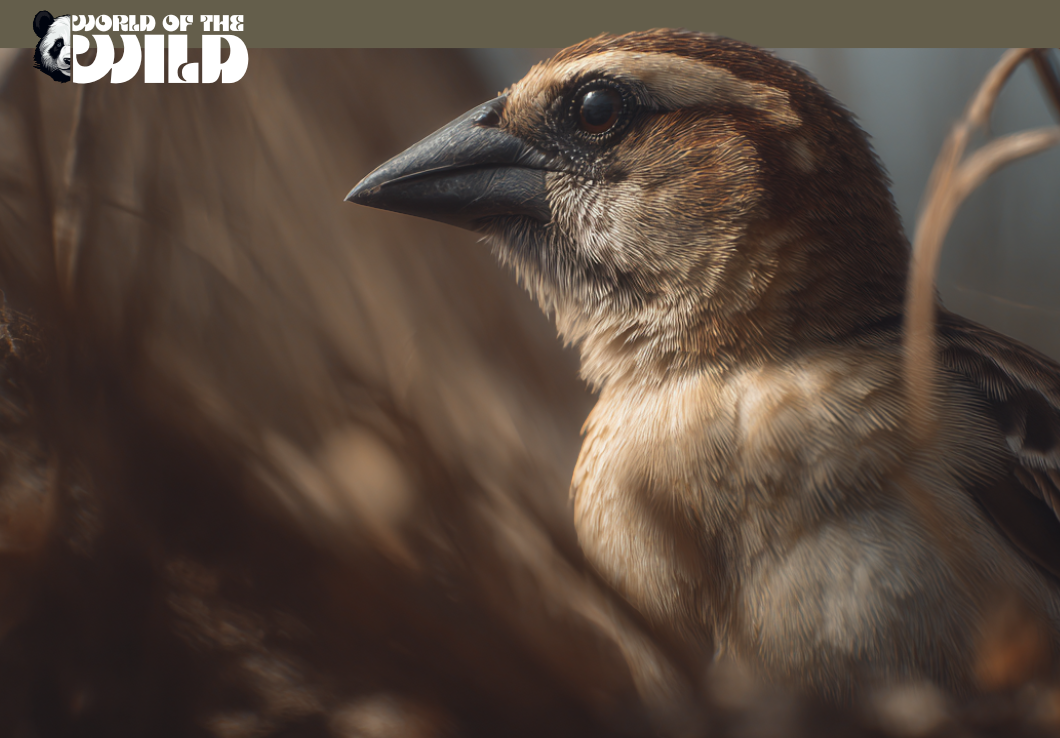
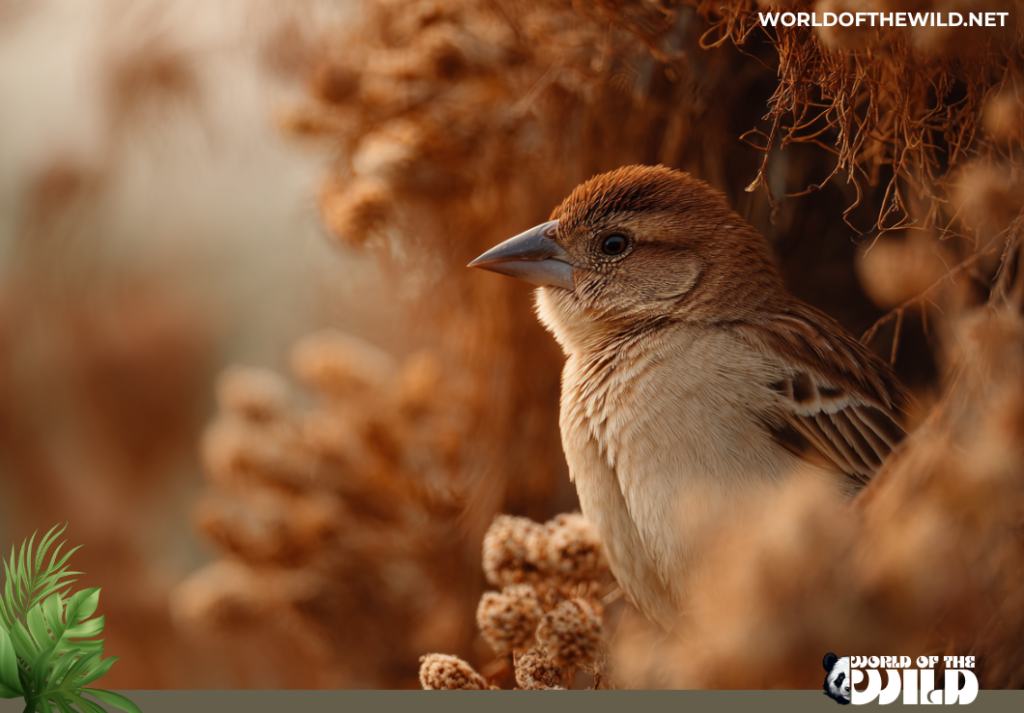
The Sociable Weaver is a compact, stocky little bird, and at first glance, it could be mistaken for any number of small, sparrow-like African passerines. But look a little closer and its distinct markings become apparent.
Size and Weight: Adults measure approximately 5.5 inches (14 cm) in length and weigh between 0.88 and 1.1 ounces (25–31 grams). Males and females are nearly identical in size, making the species sexually monomorphic in terms of body dimensions.
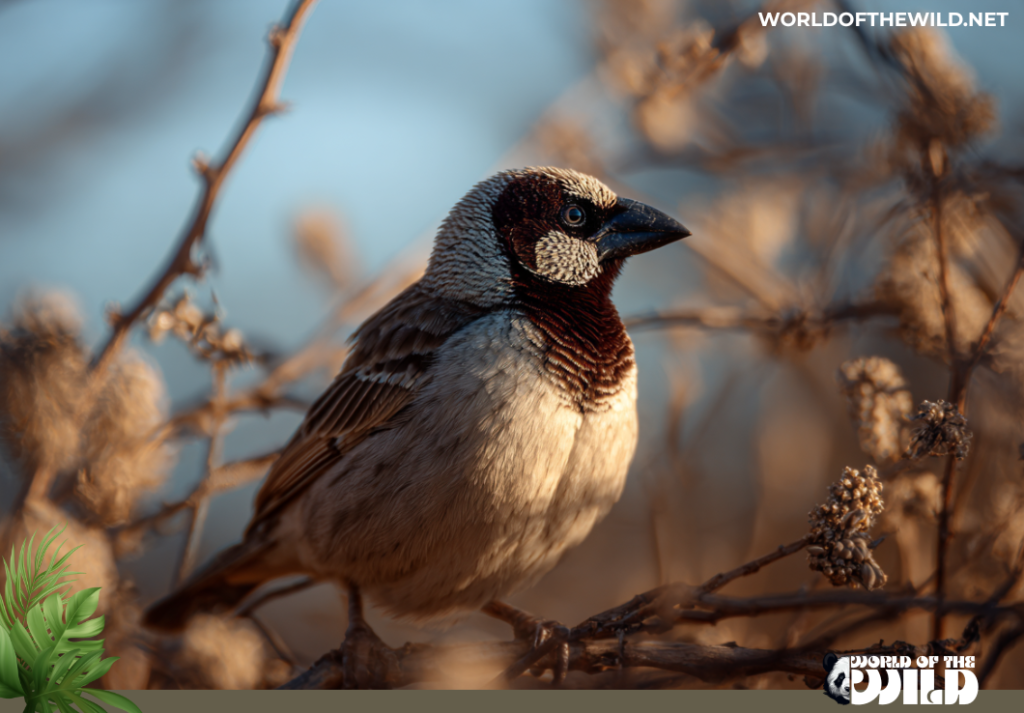
Plumage and Coloration: The Sociable Weaver’s upperparts — its back, wings, and crown — are a warm, streaked brown, providing excellent camouflage against the dry savanna grasses and sandy soils of its habitat. The underparts are a pale buff or creamy white. One of the most distinctive features is the bold, black scalloped or barred pattern that runs along the flanks, giving it a slightly “scaled” appearance from the side.
Perhaps its most striking feature is the sharply demarcated black bib or throat patch, which stands in stark contrast to the pale face and underparts. This dark patch extends from the chin down to the upper chest and is present in both sexes, though it tends to be slightly more defined in adult males.
Bill and Eyes: The bill is short, stout, and conical — a classic seed-cracker design perfectly suited to its granivorous diet. It is a pale, horn-colored gray. The eyes are dark brown and surrounded by a plain, unadorned face lacking any eye-ring or supercilium that might be found on related species.
Wings and Tail: The wings are relatively short and rounded, suited to the quick, darting flight style of a bird that spends much of its life moving between the nest and foraging grounds a short distance away. The tail is squared-off and relatively short.
Behavior
What makes the Sociable Weaver truly remarkable is not its appearance but the richness and complexity of its social life. These birds are, as their name suggests, extraordinarily social animals whose survival is inextricably linked to the colony.
Colonial Living: Colonies typically consist of between 100 and 500 individuals, though larger aggregations have been recorded. The colony is centered entirely on the communal nest, which functions not just as a sleeping and breeding site but as the social hub of the birds’ entire existence. Birds forage together in flocks, return together, and maintain the nest cooperatively throughout the year.
Daily Routines: Sociable Weavers are diurnal (active during the day). Their daily routine begins before sunrise, when birds emerge from the warm nest chambers to begin foraging. They return periodically throughout the day to rest, escape the midday heat, and engage in social interactions. By evening, the colony reconvenes in the nest, where the shared body heat of hundreds of birds keeps the internal temperature stable through the cold desert night.
Nest Maintenance: One of the colony’s ongoing social activities is nest maintenance. Birds continually gather dry grass stems, leaves, and other plant material to repair and expand the structure. This is not just a breeding-season activity — it goes on year-round, making the nest a permanent, ever-growing structure.
Communication: Sociable Weavers are highly vocal. Their calls include a series of rapid, chattering notes and a distinctive, dry churring sound. These vocalizations are used for contact calls between individuals, alarm signals when predators are detected, and social coordination within the colony. The noise of a large, active colony can be heard from a surprisingly long distance.
Helpers at the Nest: One of the most studied aspects of Sociable Weaver behavior is the presence of “helpers” — non-breeding individuals, typically younger birds, who assist breeding pairs in raising chicks. This cooperative breeding system means that nests attended by helpers tend to produce more surviving offspring, underscoring the adaptive value of the colony’s social structure.
Intelligence and Problem-Solving: While not on par with corvids or parrots, Sociable Weavers display a notable level of behavioral flexibility. They have been observed identifying and responding to specific types of predator threats differently — for example, reacting with distinct alarm calls to the presence of a Cape Cobra versus that of a Pygmy Falcon — suggesting a degree of cognitive discrimination.
Evolution
The Sociable Weaver belongs to the family Ploceidae, an Old World bird family with deep roots in Africa. The evolutionary history of weavers stretches back tens of millions of years, with the family diversifying primarily during the Miocene and Pliocene epochs as African grasslands expanded and climate became more arid. It was during this period of ecological transformation that the ancestral weaver lineages radiated outward, adapting to a variety of niches.
The genus Philetairus is thought to represent an early divergence within the Ploceidae lineage, with molecular studies suggesting it is a basal or near-basal branch of the weaver family tree. This means the Sociable Weaver’s lineage may be one of the older surviving offshoots of the ancestral weaver group, diverging before the great diversification of the Ploceus weavers that today dominates African savannas and forests.
The evolution of communal nesting in Philetairus is thought to be a response to the specific environmental pressures of the arid, semi-desert environment the species inhabits. In landscapes where trees suitable for nesting are scarce and temperature extremes are severe, cooperative nest construction confers enormous thermoregulatory and predator-detection advantages. Over evolutionary time, those individuals with stronger tendencies toward cooperative behavior would have experienced higher survival and reproductive success, gradually selecting for the intensely social colony structure we see today.
The sharp, downward-pointing grass spikes lining nest tunnels are also thought to be an evolved anti-predator adaptation, specifically in response to selection pressure from snake predation — one of the most persistent threats the species faces. The stiff, angled architecture of these tunnel guards has been refined over generations to optimize protection.

Habitat
The Sociable Weaver is a quintessential resident of southern Africa’s arid and semi-arid zones. Its range is centered on the Kalahari Desert and its surroundings, encompassing large portions of:
- Namibia — particularly the central and southern parts of the country
- Botswana — especially the southern Kalahari region
- South Africa — primarily in the Northern Cape province, including the Kalahari Gemsbok National Park (part of the Kgalagadi Transfrontier Park)
The species strongly favors open, semi-arid savanna and thornveld habitats dominated by hardy, drought-tolerant trees. Camelthorn Acacia (Vachellia erioloba) trees are especially important nest sites, as their massive, horizontal canopies provide the structural support needed to bear the enormous weight of colony nests. Telephone poles and other man-made structures are also used in areas where suitable trees are scarce.
Annual rainfall in the core of their range typically falls between 150–400 mm per year, meaning these birds have evolved to thrive in conditions of chronic water stress. They obtain much of their water requirements not from standing water but from the food they consume — a remarkable adaptation to desert living.
The landscape is typically flat to gently undulating, with sandy soils, sparse grass cover, and scattered trees. It is a harsh environment defined by extremes: searing summer heat, cold winter nights, and unpredictable rainfall. The Sociable Weaver’s entire existence is organized around meeting the challenges this landscape presents.
Diet
The Sociable Weaver is primarily a granivore — a seed eater — though it supplements this diet with animal matter, particularly during the breeding season when protein demand is higher.
Primary Food Sources:
- Grass seeds form the backbone of the diet. The birds forage almost exclusively on the ground, using their stout bills to crack open the tough husks of a wide variety of dry savanna grass species.
- Insects and invertebrates — including beetles, termites, ants, caterpillars, and grasshoppers — are consumed opportunistically and are especially important for feeding chicks, which require high-protein food to grow.
- Small invertebrate larvae found in the soil or under bark may also be taken.
Foraging Behavior: Sociable Weavers forage in loose flocks, typically within a few kilometers of the communal nest. They move quickly across the ground in a hopping, pecking motion, covering large areas of open ground in search of seeds. During foraging, the flock maintains constant vocal contact, and individuals are highly alert to the alarm calls of others — one sentinel’s warning sends the entire flock back to the safety of the nest or into cover.
Because the Kalahari can experience extended dry spells when seeds are scarce, the Sociable Weaver’s ability to exploit insects and other invertebrates provides an important dietary buffer against food scarcity.
Predators and Threats
Life in the Kalahari is never without danger, and the Sociable Weaver faces threats from both the natural world and human activity.
Natural Predators:
- Cape Cobra (Naja nivea) — Perhaps the most feared natural predator. Cape Cobras are accomplished climbers and regularly enter Sociable Weaver nests to consume eggs, chicks, and even roosting adults. Entire chambers can be wiped out in a single cobra raid, and their visits cause tremendous alarm throughout the colony.
- Boomslang (Dispholidus typus) — Another tree-climbing snake species known to predate nests.
- Pygmy Falcon (Polihierax semitorquatus) — While often living symbiotically within the nest structure, Pygmy Falcons do occasionally prey on Sociable Weaver chicks and adults, representing a uniquely complex predator-prey relationship.
- Gabar Goshawk (Micronisus gabar) and other raptors may take adults on the wing.
- Honey Badgers (Mellivora capensis) and African Wild Cats may raid nests that are accessible from the ground or fallen branches.
Human-Caused Threats:
Despite being a relatively common species, Sociable Weavers face a growing set of human-related pressures:
- Habitat loss and land conversion — The conversion of native Kalahari scrubland to agriculture and livestock farming reduces the availability of large, mature nesting trees.
- Removal of host trees — Mature Camelthorn Acacias are sometimes felled for firewood or cleared as “nuisance” trees near farms and properties.
- Electrocution — Birds nesting on electrical infrastructure (telephone poles, power pylons) are at risk of electrocution, and nest structures on live equipment can cause power outages, sometimes leading to the deliberate destruction of nests.
- Climate change — Projected increases in aridity and temperature in the Kalahari region may intensify drought conditions, reduce food availability, and increase thermal stress on colonies.
- Pesticide use — Agricultural pesticides may reduce insect availability, impacting the protein resources birds need during breeding.
Reproduction and Life Cycle
The Sociable Weaver’s breeding biology is as fascinating as its architecture, reflecting a highly cooperative social system in which raising young is a community endeavor.
Breeding Season: Breeding can occur throughout much of the year but peaks during the wet season, roughly from October to March in southern Africa’s summer, when food availability is highest. In favorable years, multiple clutches may be raised in quick succession.
Mating and Pair Bonds: Sociable Weavers form long-term monogamous pair bonds within the colony. However, because the communal nest is occupied year-round by large numbers of birds, pairs maintain their individual chamber within the nest as a territory, defending it against other colony members.
Nest Chambers: Individual breeding pairs occupy a private chamber within the larger communal structure. Each chamber is a rounded interior space roughly the size of a grapefruit, lined with soft plant material, animal fur, and fine grasses. The entrance is via a downward-angled tunnel, 6–10 inches long, that provides both insulation and anti-predator protection.
Eggs and Incubation: Females typically lay 2–4 eggs per clutch. The eggs are pale white to pale greenish, lightly spotted with brown. Both parents share incubation duties, with the incubation period lasting approximately 13–14 days.
Chick Rearing: Chicks are altricial — born blind, naked, and entirely helpless. They grow rapidly, and are brooded in the warm nest chamber for their first weeks of life. The feeding of chicks is where cooperative breeding becomes most visible: in addition to the breeding pair, helper birds (typically non-breeding colony members, often previous offspring of the pair) assist in bringing food to the nestlings. Nests with more helpers tend to produce better outcomes in terms of chick survival.
Chicks fledge at approximately 21–24 days after hatching. Young birds remain with the colony after fledging and often begin contributing to nest maintenance and helper duties before they are old enough to breed themselves.
Lifespan: Sociable Weavers typically live for 3–7 years in the wild, though some banded individuals have been recorded living beyond 10 years. Mortality is highest in the first year of life, with snake predation and harsh weather events being leading causes of juvenile death.
Population
IUCN Conservation Status: Least Concern
The Sociable Weaver is currently assessed as Least Concern on the IUCN Red List of Threatened Species, indicating that the species is not considered at immediate risk of global extinction.
Global Population Estimate: Precise global population figures are difficult to determine given the remote and dispersed nature of many colonies, but estimates suggest a total population in the range of hundreds of thousands to low millions of individuals. Some assessments put the number of mature individuals at well over 500,000.
Population Trends: The overall population trend is considered stable, though localized declines have been noted in areas where large-scale habitat conversion, tree felling, or agricultural intensification has occurred. The species’ stronghold remains the Kalahari ecosystem, particularly within and around protected areas such as the Kgalagadi Transfrontier Park, where populations appear robust.
The species’ sedentary nature and dependence on specific host trees for nesting makes certain subpopulations vulnerable to localized threats. While the species is not globally threatened, conservationists and ornithologists continue to monitor colony health, particularly in the context of climate projections for southern Africa, which suggest continued aridification of the Kalahari biome.
Conclusion
The Sociable Weaver is, by almost any measure, one of the most extraordinary birds on Earth. In a landscape that seems designed to defeat life — sweltering, parched, predator-rich, and merciless in its extremes — this small brown bird has responded with an act of collective genius: building a living fortress that shelters hundreds, regulates temperature through sheer architectural ingenuity, and grows more formidable with every passing generation.
What the Sociable Weaver teaches us goes far beyond ornithology. It is a lesson in the transformative power of cooperation — that individuals acting together can create something vastly greater than any one of them could alone. Their nests are not just structures; they are the physical manifestation of community, trust, and evolutionary wisdom.
Yet even this most resilient of species faces the slow creep of threats that come with a changing world: rising temperatures, disappearing trees, and the encroachment of human land use into the Kalahari’s ancient rhythms. The Sociable Weaver is not on the brink — but it is a reminder that no species exists in isolation, and that the landscapes we alter ripple outward in ways we do not always anticipate.
The next time you see a photograph of a vast, golden nest structure sagging under its own centuries of growth in the fork of a Kalahari Acacia, take a moment to consider what it represents. A hundred years of family. A thousand tiny acts of building. An entire civilization, feathered and fierce, thriving against all odds. That is worth protecting.
Quick Reference Table
| Scientific Name | Philetairus socius |
| Diet Type | Primarily granivore (seeds); supplemented with insects and invertebrates (omnivorous tendencies) |
| Size | Approximately 5.5 inches (0.46 feet) in length |
| Weight | 0.055–0.069 pounds (0.88–1.1 oz / 25–31 grams) |
| Region Found | Southern Africa — Namibia, Botswana, and Northern Cape Province of South Africa; core range within the Kalahari Desert ecosystem |