
In the golden savannas and rustling grasslands of sub-Saharan Africa, a small but remarkable creature darts through the undergrowth with lightning speed and surprising intelligence. The Striped Grass Mouse (Lemniscomys striatus) may not command the same spotlight as lions or elephants, but this pint-sized rodent punches well above its weight in ecological importance, behavioral complexity, and sheer survivability. With its striking coat of alternating stripes and spots, its curious and bold temperament, and its outsized role in the food web, the Striped Grass Mouse is one of Africa’s most underappreciated wildlife stars. Once you take a closer look at this tiny mammal, you may find yourself completely captivated.
Facts
- Despite its small size, the Striped Grass Mouse is diurnal — meaning it is active during the day — which is relatively unusual among rodents, most of which are nocturnal to avoid predators.
- These mice are known to engage in “dust bathing,” rolling in dry soil as a grooming behavior to maintain their fur and skin health.
- The Striped Grass Mouse has been extensively studied in laboratory settings due to its calm temperament and daytime activity patterns, making it a valuable model organism in neuroscience and circadian rhythm research.
- Unlike many rodents, Striped Grass Mice can be surprisingly bold around humans in the wild, sometimes pausing to observe rather than immediately fleeing.
- Their striped and spotted coat is not just ornamental — the pattern provides exceptional camouflage among the dappled light and shadow of tall grass.
- In some regions, these mice construct elaborate runways through dense grass, creating a network of mini-highways they use to navigate their territory swiftly and safely.
- They are capable of rapid population explosions following periods of high rainfall, which temporarily increases food availability and triggers accelerated breeding cycles.
Species
The Striped Grass Mouse belongs to the following taxonomic hierarchy:
- Kingdom: Animalia
- Phylum: Chordata
- Class: Mammalia
- Order: Rodentia
- Family: Muridae
- Genus: Lemniscomys
- Species: Lemniscomys striatus
The genus Lemniscomys contains approximately 13 to 15 recognized species, collectively referred to as striped grass mice or zebra mice, spread across the African continent. Among the closest relatives and notable members of this genus are:
Lemniscomys barbarus (Barbary Striped Grass Mouse) — found in North Africa and parts of the Iberian Peninsula, making it the only Lemniscomys species to extend into Europe. It is slightly smaller and has a more subdued stripe pattern.
Lemniscomys rosalia (Single-Striped Mouse) — found in southern Africa, this species is notable for having a single, bold dorsal stripe rather than the multi-striped pattern typical of L. striatus.
Lemniscomys bellieri — a more obscure species restricted to West African forests, less studied than its savanna-dwelling relatives.
Lemniscomys macculus (Heuglin’s Striped Mouse) — found in East Africa, particularly in Uganda and Ethiopia, and sometimes considered a subspecies of L. striatus by some taxonomic frameworks.
The taxonomy within Lemniscomys remains a subject of ongoing revision, as advances in molecular genetics continue to clarify the boundaries between what were once thought to be regional subspecies and what are now recognized as distinct species.
Appearance
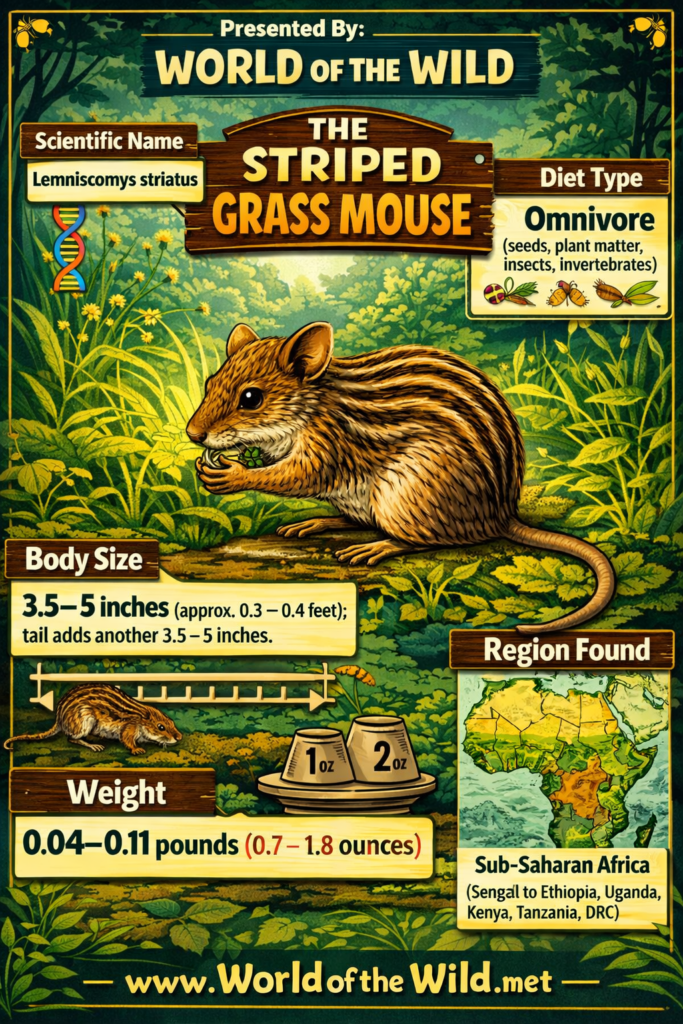
The Striped Grass Mouse is a visually distinctive small rodent that immediately stands out due to its ornate coat pattern. Adults typically measure between 3.5 and 5 inches in body length, with a tail of roughly equal or slightly greater length, adding another 3.5 to 5 inches. They are lightweight animals, generally weighing between 0.7 and 1.8 ounces, though well-fed individuals in captivity can reach slightly higher weights.
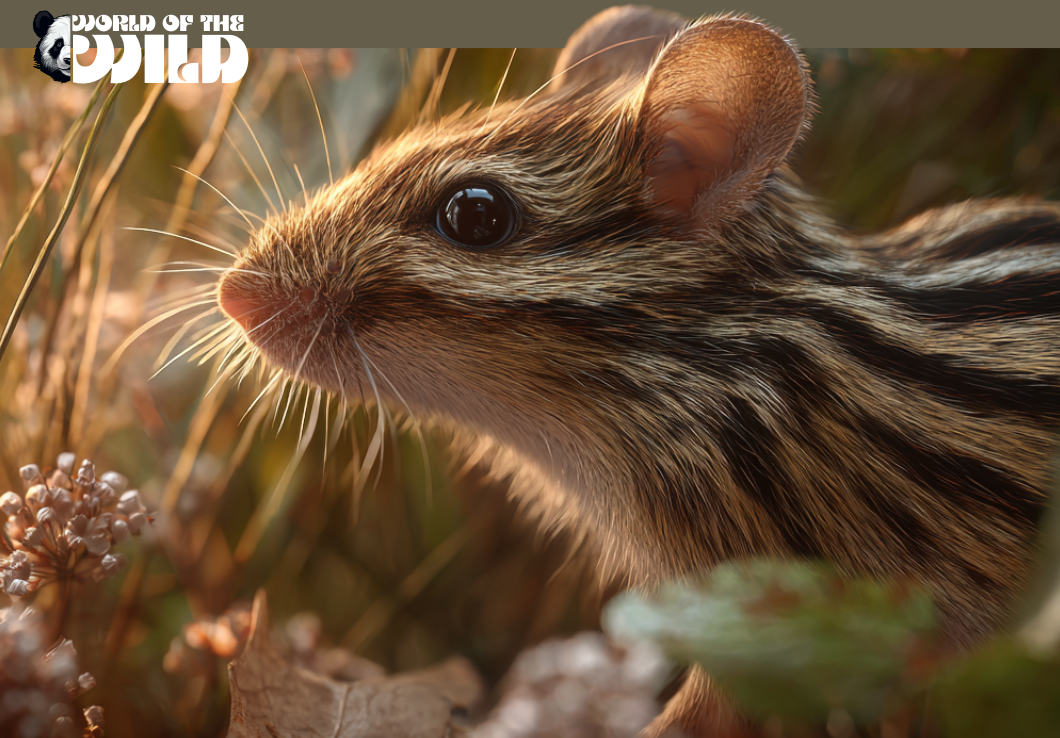
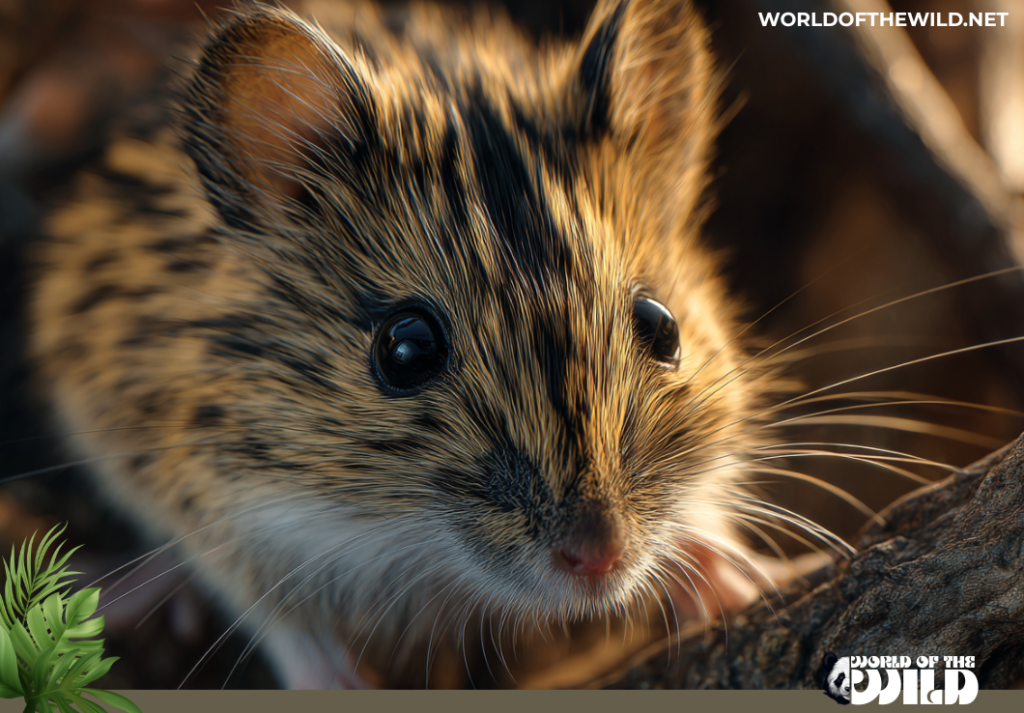
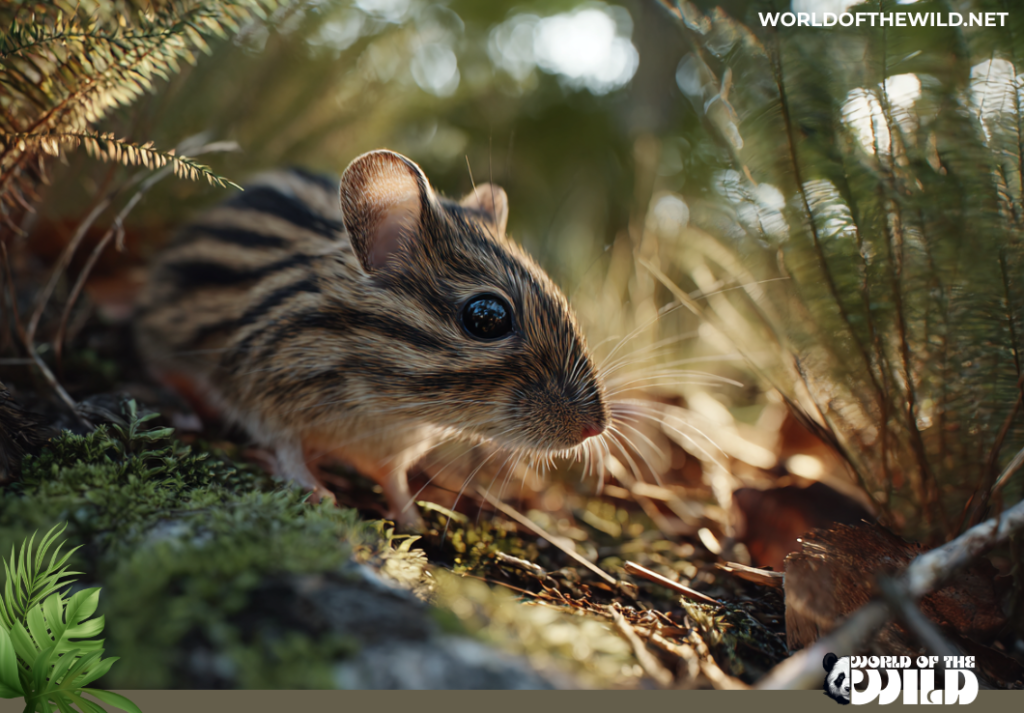
The coat is the animal’s most arresting feature. The dorsal (upper) surface is covered in a series of alternating light and dark longitudinal stripes running from the neck to the base of the tail. These stripes are interspersed with rows of pale spots or broken lines, giving the fur a complex, almost zebra-like quality when viewed up close. The background coloration is typically tawny brown to yellowish-ochre, while the stripes themselves range from dark brown to nearly black. The underside is pale, usually cream or white, providing the classic countershading that helps reduce the appearance of shadow and makes the animal harder to detect from below.
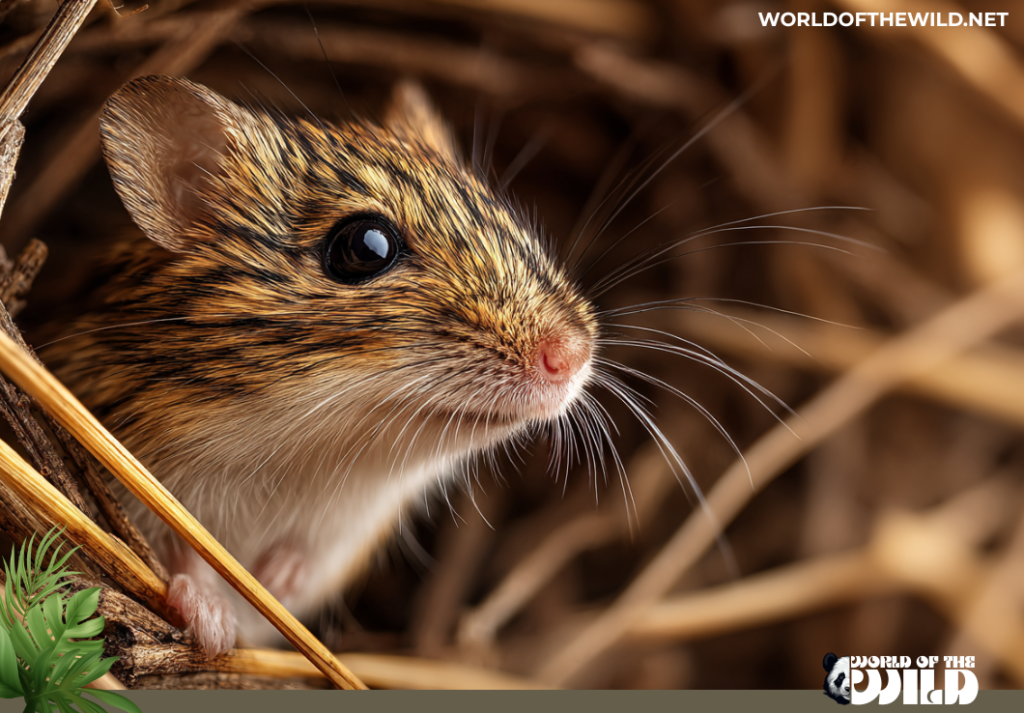
The ears are moderately large and rounded, contributing to their sharp sense of hearing. The eyes are bright, dark, and prominent — an adaptation consistent with a diurnal lifestyle that requires good visual acuity. The tail is slender and lightly furred, somewhat scaly in texture, and serves as a balancing aid during rapid movement through uneven terrain. The feet are elongated and well-adapted for gripping grass stems, allowing the mouse to climb with surprising agility.
Behavior
The Striped Grass Mouse leads a remarkably active and socially nuanced life. As a diurnal species, it peaks in activity during the morning and late afternoon, often retreating during the hottest midday hours to rest in a grass nest or burrow. This schedule aligns with lower predator activity during certain windows and maximizes foraging time in cooler temperatures.
Socially, these mice are somewhat flexible. They can be found living alone or in loose groups, particularly in areas where food is abundant. Within social groupings, there is a degree of hierarchy, with dominant individuals having preferential access to food and nesting sites. Communication is multifaceted — they use vocalizations including ultrasonic calls that are inaudible to human ears, scent marking via specialized glands to delineate territories and signal reproductive status, and tactile interactions during grooming and social bonding.
One of the most fascinating behavioral traits is their relative boldness. Unlike nocturnal rodents that instinctively flee at any disturbance, Striped Grass Mice frequently pause and observe potential threats, seemingly weighing risk before deciding whether to flee. This inquisitive nature has made them popular subjects for behavioral research.
They are also accomplished nest builders, weaving intricate spherical nests from grass stems and leaves, typically concealed within dense vegetation or tucked below ground level. These nests serve as sleeping quarters, refuges from weather, and nurseries for their young. The runway systems they maintain through tall grass are another remarkable behavioral feature — these well-worn paths reduce travel time, limit direct exposure to predators, and provide consistent access to foraging areas.
Evolution
The evolutionary story of the Striped Grass Mouse is woven into the broader history of the family Muridae — the largest family of mammals on Earth, encompassing over 700 species of rats, mice, and their relatives. Murids originated in Asia during the Miocene epoch, approximately 14 to 12 million years ago, before diversifying explosively and colonizing Africa, Europe, and eventually the rest of the world.
The genus Lemniscomys is believed to have diverged within Africa as grassland biomes expanded during the late Miocene and Pliocene epochs, roughly 10 to 3 million years ago. The spread of C4 grasses across Africa during this period created vast new ecological niches, and several rodent lineages, including the ancestors of Lemniscomys, rapidly diversified to exploit these open-grassland habitats. The distinctive striping pattern seen in the genus is considered a convergent adaptation with other grassland animals — an evolutionary solution to the problem of being a small, soft-bodied animal in an environment full of visually acute predators.
Molecular phylogenetic studies place Lemniscomys within the tribe Murini alongside many familiar African rodents. The diversification of the genus into its current 13–15 species appears to have been driven largely by geographic isolation across Africa’s varied and fragmented landscape, where river systems, forests, and deserts acted as barriers that promoted speciation over millennia.
Habitat
The Striped Grass Mouse is primarily a resident of sub-Saharan Africa, with a range extending from Senegal and Gambia in the west, through Central Africa, and into parts of East Africa including Uganda, Kenya, Tanzania, and Ethiopia. Some populations also occur in Sudan and the northern reaches of the Democratic Republic of Congo.
True to its name, this species favors grassy environments above all others. Its preferred habitats include open savannas, tall-grass meadows, forest edges, scrubland margins, riparian grasslands along rivers and streams, and agricultural land where crops or weedy vegetation provide cover and food. Elevational range is broad — populations are found from sea level up to elevations of around 6,500 feet in highland grasslands.
The key habitat requirements are the presence of dense grass cover for shelter and nest construction, access to seeds and plant material, and sufficient structural complexity to support their runway systems. Areas near water sources are particularly favored, as these zones tend to support denser, more productive vegetation. The species is also notably adaptable to human-modified landscapes, regularly colonizing farms, roadsides, and gardens — a flexibility that has helped it maintain healthy populations even in areas with significant human activity.
Diet
The Striped Grass Mouse is an omnivore, though it leans predominantly toward plant-based foods. The bulk of its diet consists of grass seeds, which are collected and consumed in large quantities, especially during the dry season when other food sources are scarce. It also readily eats the green shoots, leaves, and stems of a variety of grasses and forbs, as well as berries, fruits, and roots when available.
Animal protein is an important dietary supplement, particularly for reproducing females and growing young. Insects — including beetles, grasshoppers, caterpillars, and termites — are actively hunted and consumed. Worms and other small invertebrates are also taken opportunistically. This dietary flexibility allows the Striped Grass Mouse to thrive across a range of seasons and habitat conditions.
Foraging typically takes place along established runway paths, where the mouse moves efficiently between feeding sites. Seeds are sometimes carried back to the nest and cached for later consumption, demonstrating a degree of food planning behavior. In agricultural areas, these mice will readily consume stored grain crops, sometimes coming into conflict with farmers as a result.
Predators and Threats
Living in the open grasslands of Africa means sharing territory with an impressive array of predators, and the Striped Grass Mouse sits squarely near the base of the food web. Its natural predators include a wide range of raptors such as African marsh harriers, black-shouldered kites, and various owl species that hunt at dusk. Ground-based predators include snakes — particularly grass snakes and small constrictors — as well as mongooses, genets, African wildcats, and large spiders that may ambush juveniles.
The mouse’s diurnal habits make it particularly vulnerable to aerial attack, and much of its behavioral strategy — the use of covered runways, quick sprints between cover, and frequent pauses to scan the sky — represents an evolved response to raptor predation pressure.
In terms of human-caused threats, the Striped Grass Mouse is not currently considered at serious risk, largely due to its adaptability and wide range. However, localized threats exist. Habitat degradation through agricultural expansion, overgrazing by livestock, and the burning of grasslands can reduce available cover and food sources. The use of rodenticides in agricultural areas poses a direct toxicological threat, particularly where the species is considered a crop pest. Climate variability affecting rainfall patterns may also alter the productivity of grassland ecosystems in ways that could impact population dynamics over the long term.
Reproduction and Life Cycle
Reproduction in the Striped Grass Mouse is closely tied to environmental conditions, particularly rainfall and the availability of food. In stable equatorial environments, breeding can occur year-round, while populations in more seasonal climates tend to peak in reproductive activity during and immediately after the wet season, when food is most abundant.
Females reach sexual maturity rapidly — often within 5 to 6 weeks of birth — and gestation lasts approximately 21 to 23 days. Litter sizes typically range from 2 to 7 pups, with an average of around 4. This relatively short reproductive cycle means that under favorable conditions, populations can grow very quickly.
Newborn pups are altricial — born blind, hairless, and entirely dependent on maternal care. The mother nurses the young within the grass nest, and the pups develop rapidly. Eyes open at around 2 weeks of age, and by 3 to 4 weeks, juveniles begin to venture outside the nest and start transitioning to solid food. Weaning is typically complete by 3 to 4 weeks of age.
In the wild, Striped Grass Mice generally live between 1 and 2 years, with predation and environmental hazards being the primary mortality factors. In captivity, with access to consistent food and shelter and free from predation, individuals have been recorded living up to 4 years. There is limited evidence of strong paternal investment, with most parental care being provided by the mother.
Population
The Striped Grass Mouse (Lemniscomys striatus) is currently classified as Least Concern on the IUCN Red List of Threatened Species. This designation reflects the species’ wide geographic distribution, its high reproductive rate, and its demonstrated ability to adapt to human-modified landscapes.
Precise global population estimates are not available, as is common for small, widespread rodent species that are difficult to census reliably. However, the species is considered common to abundant across much of its range, with stable populations in protected areas, savannas, and agricultural zones throughout sub-Saharan Africa.
There are no major range-wide population declines currently documented, though localized reductions may occur in areas subject to intensive land use change or heavy rodenticide application. The species’ population can fluctuate dramatically on a seasonal basis in response to rainfall and food availability — numbers may spike sharply during favorable years and contract during droughts. These boom-and-bust dynamics are a natural feature of small mammal ecology and do not currently represent a conservation concern for the species as a whole.
Conclusion
The Striped Grass Mouse may be small, but its story is anything but. From its beautifully evolved camouflage coat to its complex social behaviors, its ecological versatility, and its surprising importance as both prey and insect controller in African grassland systems, this diminutive rodent deserves far more recognition than it typically receives. It is a species that reminds us that not all of nature’s wonders come in large packages — sometimes the most fascinating creatures are the ones darting unseen beneath our feet.
As Africa’s grasslands continue to face pressure from agricultural expansion, climate change, and land conversion, maintaining healthy populations of species like the Striped Grass Mouse matters. These animals are the invisible threads in the ecological fabric, sustaining the predators above them and regulating plant and insect communities below them. The next time you look out across a field of waving grass, remember that somewhere in there, a sharp-eyed, stripe-coated little mouse is watching the world with just as much curiosity as you are watching it.
Quick Reference
| Scientific Name | Lemniscomys striatus |
| Diet Type | Omnivore (seeds, plant matter, insects, invertebrates) |
| Body Size | 3.5 – 5 inches (approx. 0.3 – 0.4 feet); tail adds another 3.5 – 5 inches |
| Weight | 0.04 – 0.11 pounds (0.7 – 1.8 ounces) |
| Region Found | Sub-Saharan Africa (Senegal to Ethiopia, Uganda, Kenya, Tanzania, DRC) |