

THE CONTENDERS
In the sun-scorched landscapes of Africa, two prehistoric predators stalk their territories with reptilian precision. In one corner, we have the Savannah Monitor (Varanus exanthematicus)—the stocky, ground-pounding powerhouse of the African grasslands. Built like an armored tank with a jaw that can crack open snail shells like walnuts, this terrestrial bruiser has earned its reputation as a relentless hunter of the savannah floor.
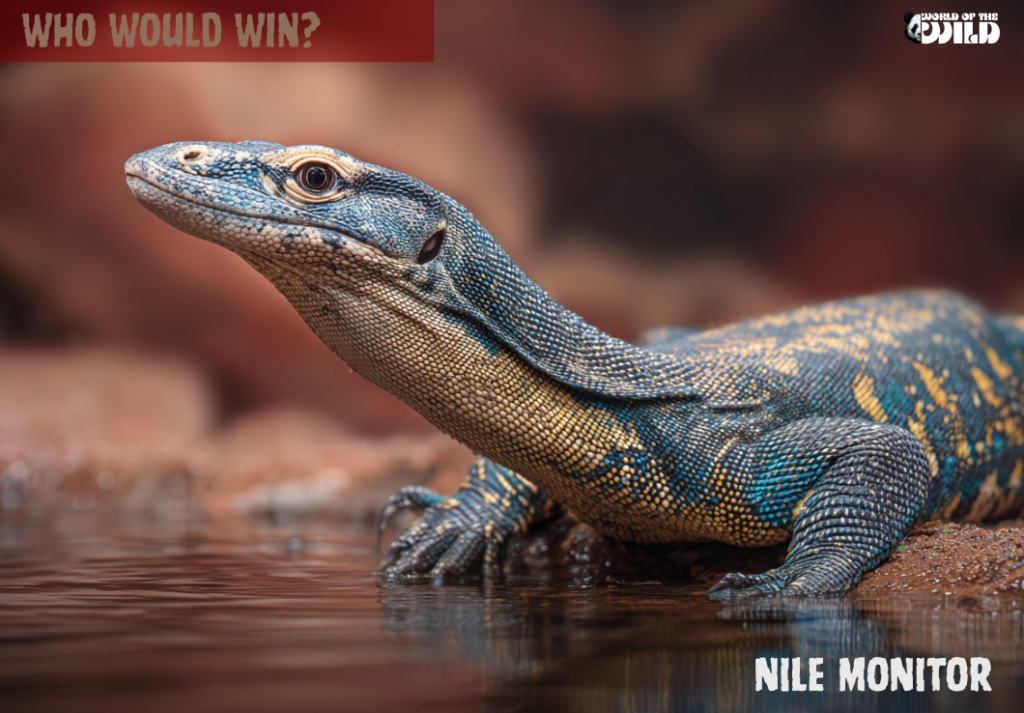
In the opposite corner, meet the Nile Monitor (Varanus niloticus)—Africa’s sleek, semi-aquatic assassin! This is one of the continent’s largest lizards, a muscular predator equally at home in water or on land, with a temperament as fierce as a honey badger and a tail that strikes like a bullwhip. When these two ancient lineages of monitor lizards cross paths, only one will hold the territory. Let’s break down this clash of the titans!
TALE OF THE TAPE
| Category | Savannah Monitor | Nile Monitor |
|---|---|---|
| Size/Weight | 2.5-4 feet / 3-13 lbs | 4-7+ feet / 10-30+ lbs |
| Speed | Moderate (ground bursts to 15 mph) | Fast (20+ mph on land, excellent swimmer) |
| Bite Force/Weaponry | Powerful crushing jaws, blunt teeth, thick skull | Sharp recurved teeth, powerful jaws, whip-like tail |
| Special Abilities | Thick armored skin, burrowing expert, defensive body inflation | Semi-aquatic adaptability, superior intelligence, venomous saliva with bacteria |
PHYSICAL ADVANTAGES
SAVANNAH MONITOR’S ARSENAL: The Savannah Monitor is built for durability and power. Its thick, pebbly scales provide exceptional armor protection, particularly around the neck and back—like wearing natural chainmail. This species has evolved crushing jaw strength specifically designed to break through hard-shelled prey like snails and beetles. Their stocky, low-to-the-ground build gives them a lower center of gravity, making them harder to flip or topple. When threatened, they can inflate their bodies with air, making themselves appear larger and more difficult to bite effectively. Their burrowing lifestyle has also gifted them with powerful limbs capable of explosive short-range attacks.
NILE MONITOR’S ARSENAL: The Nile Monitor is where size meets savagery. With often double the body length and up to three times the weight advantage, this reptilian athlete dominates in pure physicality. Its recurved, shark-like teeth are designed for gripping and tearing flesh—not crushing shells—making them far more effective against vertebrate opponents. The Nile monitor’s legendary tail is perhaps its most devastating weapon: muscular, whip-like, and capable of delivering strikes that can break bones or stun prey. Their semi-aquatic lifestyle has honed exceptional agility and stamina. Perhaps most importantly, Nile monitors possess superior intelligence among reptiles, capable of problem-solving and tactical hunting strategies. Their saliva contains a toxic mix of bacteria and mild venom that causes rapid infection in bite wounds.

THE BATTLE SCENARIO
The confrontation begins at the edge of a dried riverbed where territories overlap. The Savannah Monitor, foraging for beetles, suddenly finds itself face-to-face with a six-foot Nile Monitor that has emerged from a nearby pool. The Savannah Monitor immediately puffs up its body and hisses, backing toward its burrow—but the Nile Monitor isn’t intimidated. With surprising speed, the larger lizard rushes forward, its body undulating in that characteristic monitor serpentine run. The Savannah Monitor lunges, managing to clamp its jaws onto the Nile Monitor’s shoulder, but the size difference becomes immediately apparent. The Nile Monitor barely registers the bite through its tough hide.
What happens next is brutally decisive. The Nile Monitor twists its powerful body, leveraging its superior size to break the Savannah Monitor’s grip, then retaliates with its primary weapon—that devastating tail. CRACK! The tail whips around with the force of a metal cable, striking the smaller lizard’s ribs. Dazed, the Savannah Monitor tries to retreat, but the Nile Monitor is relentless. It pins its opponent with superior weight and delivers a crushing bite to the back of the neck—those recurved teeth finding purchase where they’re designed to hold struggling prey. The Savannah Monitor thrashes and attempts to roll, but at half the size, it simply cannot generate the force needed to escape.
Within minutes, it’s over. The Nile Monitor’s combination of size, speed, weaponry, and sheer aggression proves overwhelming. The Savannah Monitor, built for a different ecological niche, was simply outmatched in direct combat from the start.
THE VERDICT: NILE MONITOR WINS
Winner: Nile Monitor (85-90% of encounters)
The scientific reality is that this matchup is heavily weighted toward the Nile Monitor, and the primary reason is simple: size matters tremendously in reptilian combat. In the cold-blooded world of lizards, where metabolic output and muscular strength scale directly with body mass, a 25-pound Nile Monitor brings nearly three times the raw power of a 10-pound Savannah Monitor to the fight.
But it’s not just about weight. The Nile Monitor has evolved as a more aggressive, predatory species. While Savannah Monitors primarily hunt invertebrates and small prey, Nile Monitors regularly tackle dangerous game—crocodile eggs (defended by mother crocs), birds, fish, and even small mammals. This difference in lifestyle has produced a far more combative temperament and a more diverse arsenal adapted for subduing struggling vertebrate prey.
The Nile Monitor’s tail weapon gives it a reach advantage that’s devastating in lizard warfare—it can damage and stun an opponent from a distance the Savannah Monitor simply cannot match. Add to this superior speed, greater intelligence, and semi-aquatic adaptability, and you have a reptile that dominates in nearly every measurable combat category.
Could a particularly large Savannah Monitor defeat a juvenile or undersized Nile Monitor? Absolutely. But when comparing adult specimens of average size, the Nile Monitor’s combination of size, weaponry, aggression, and tactical intelligence makes it the clear victor in this prehistoric showdown. In the harsh calculus of nature, the Nile Monitor is simply built for battle in a way its savannah cousin is not.
ADVANTAGE: NILE MONITOR 🦎👑