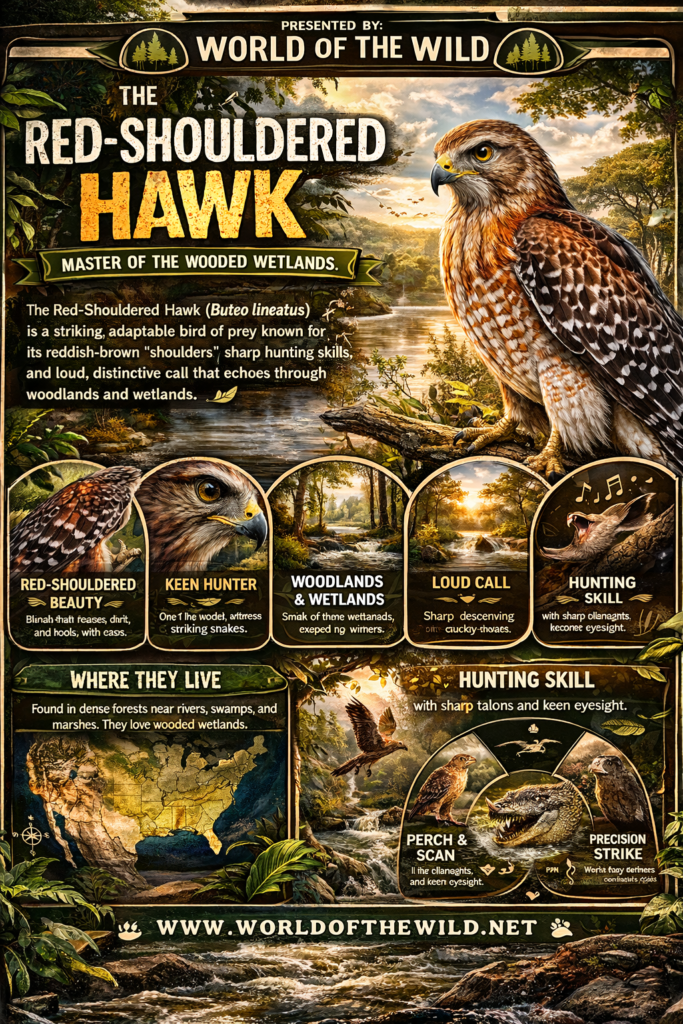

Somewhere deep in a sun-dappled woodland, a sharp, piercing cry cuts through the rustling of leaves — kee-aah, kee-aah, kee-aah — repeated with an urgency that seems almost human in its insistence. Look up, and you might catch a flash of russet and white, a broad-winged silhouette banking effortlessly between the oaks. That is the Red-Shouldered Hawk, one of North America’s most striking and charismatic birds of prey, and a creature that rewards every patient observer who takes the time to know it.
Unlike the celebrated Bald Eagle or the ubiquitous Red-tailed Hawk, the Red-Shouldered Hawk occupies a quieter, more intimate corner of the raptor world — haunting the damp woodlands, river bottoms, and forest edges of the continent with a fierce, watchful elegance. It is a bird deeply connected to healthy, mature forests, and its presence — or absence — tells us something profound about the ecosystems we share. Part hunter, part sentinel, and entirely captivating, the Red-Shouldered Hawk is a species that deserves a place in every nature lover’s imagination.
Facts
- Vocal ventriloquist: The Red-Shouldered Hawk is so vocal and distinctive in its call that Blue Jays have learned to mimic it almost perfectly — a behavior scientists believe jays use to scare other birds away from food sources.
- Deeply loyal to home: Mated pairs of Red-Shouldered Hawks are known to return to the exact same nesting territory — sometimes the same tree — year after year for decades, with some territories documented to have been continuously occupied for over 45 years.
- Ancient forest specialists: Unlike many generalist raptors, Red-Shouldered Hawks require mature, closed-canopy forests for nesting, making them one of the more sensitive indicators of old-growth forest health in eastern North America.
- Crows as unlikely allies: Red-Shouldered Hawks frequently harass and mob Great Horned Owls, their chief nest competitors. Interestingly, they sometimes form loose, temporary alliances with American Crows — another Great Horned Owl enemy — to drive the larger owls away.
- Built for low-light hunting: Their eyes are positioned to maximize depth perception in cluttered forest environments, allowing them to track and strike fast-moving prey through dense undergrowth with remarkable precision.
- California’s divergent population: The California subspecies has adapted so distinctly to its warmer, drier environment that it behaves almost as a separate ecological entity — with different prey preferences, a year-round non-migratory lifestyle, and slightly different plumage.
- Surprisingly amphibian-focused: While many people assume hawks eat mostly birds and rodents, crayfish, frogs, salamanders, and other amphibians make up a significant — sometimes dominant — portion of the Red-Shouldered Hawk’s diet in many regions.
Sounds of the Red-Shouldered Hawk
Species
The Red-Shouldered Hawk sits within the great continuum of life as follows:
- Kingdom: Animalia
- Phylum: Chordata
- Class: Aves
- Order: Accipitriformes
- Family: Accipitridae
- Genus: Buteo
- Species: Buteo lineatus
The genus Buteo contains some of the world’s most recognizable hawks — the soaring, broad-winged raptors often called “buzzards” in Europe. Within this group, Buteo lineatus is a mid-sized member with a notably strong association with forested wetlands.
Five subspecies are recognized, each occupying a distinct geographic range and exhibiting subtle variations in size, coloration, and behavior:
- Buteo lineatus lineatus — The nominate subspecies, found across the northeastern United States and southeastern Canada. It is the most migratory of the five.
- Buteo lineatus alleni — Occupies the southeastern United States, from the Carolinas to Florida and westward to Texas. It tends to be paler than the nominate form.
- Buteo lineatus extimus — Found in the southernmost tip of Florida, including the Florida Keys. It is the palest and smallest of the subspecies.
- Buteo lineatus texanus — Restricted primarily to Texas, it represents a transitional form between the eastern and western populations.
- Buteo lineatus elegans — The California subspecies, representing the most distinct and geographically isolated population. It is the most richly colored of all, with deep, saturated rufous tones and is entirely non-migratory.
The Red-Shouldered Hawk’s closest relatives include the Broad-winged Hawk (Buteo platypterus) and the Red-tailed Hawk (Buteo jamaicensis), both of which share portions of its range. Where these species overlap, habitat partitioning generally keeps them from competing directly — Red-shouldered Hawks prefer the wetter, denser woodlands while Red-tailed Hawks dominate open and edge habitats.
Appearance
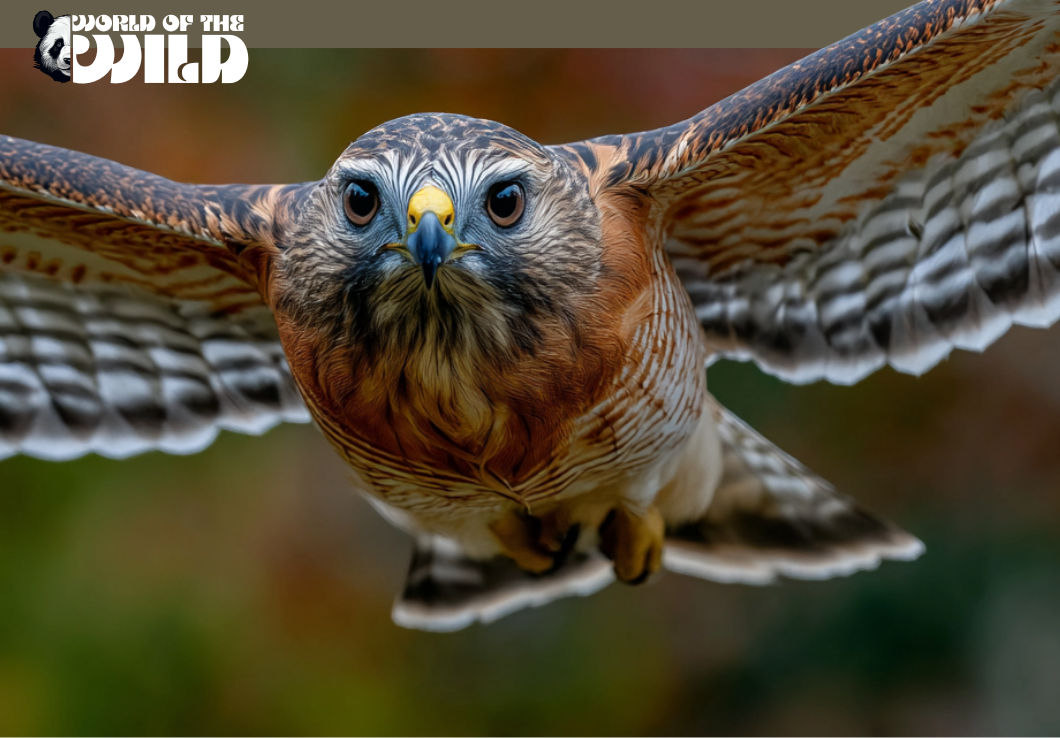
The Red-Shouldered Hawk is, by almost any measure, a breathtaking bird. Adults measure between 15 and 24 inches in length, with a wingspan stretching 35 to 50 inches — making them medium-sized by buteo standards, noticeably smaller than a Red-tailed Hawk but larger than a Cooper’s Hawk. Females, following the standard raptor pattern of reverse sexual dimorphism, are substantially larger than males, sometimes by as much as 25%.
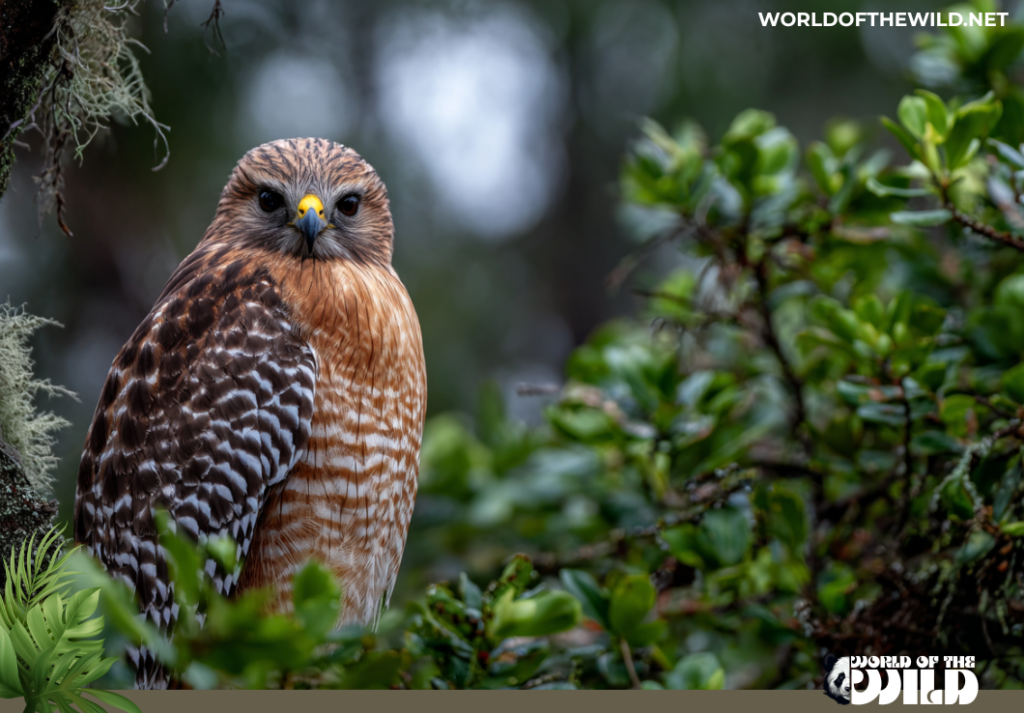
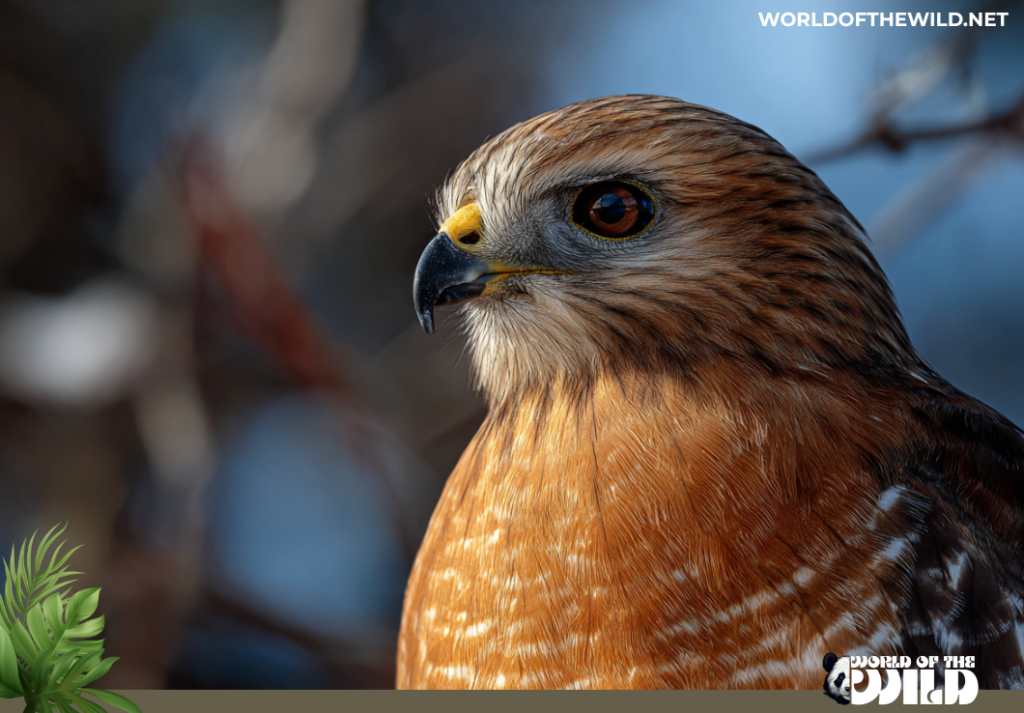
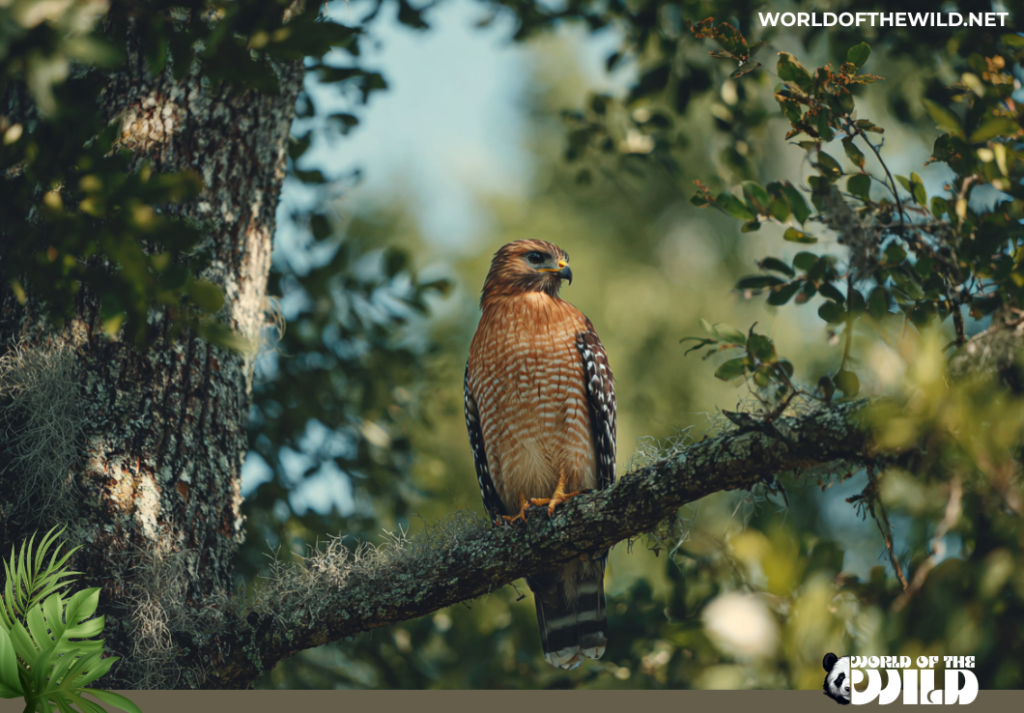
The bird’s most immediately striking feature is the rich, warm coloration of its underparts. The breast and belly are barred in a beautiful pattern of rusty-orange and white — horizontal, clean, precise — like hand-painted tilework. The upperparts are a rich dark brown, and the wings show a distinctive checkered black-and-white pattern both above and below, most visible in flight as translucent crescents near the wingtips — a field mark so reliable it can be spotted at considerable distance.
The “red shoulder” that gives the species its name refers not to a literal red patch but to the warm rufous coloration on the lesser wing coverts — the forward edge of the folded wing — visible when the bird is perched. This rusty shoulder epaulet is one of the most reliable identifying features at rest.
The tail is dark brown with narrow white bands, and the eyes of adults are a striking warm amber or yellow-brown. The beak is the classic curved, hook-tipped weapon of the accipitrid raptors — dark gray above, lighter below, with a yellow cere at the base.
Juveniles present a notably different appearance: streaked brown and white on the underparts rather than barred, with a less vivid shoulder patch and a brownish-yellow eye that deepens to amber as they mature through their first two years. This streaked juvenile plumage can cause confusion with several other young buteos in the field.
The California subspecies (elegans) deserves special mention for its exceptional coloration — the rufous tones across its breast and underparts are so deep and saturated that it appears almost orange compared to its eastern counterparts, a difference striking enough to make subspecies identification straightforward in the field.
Behavior
The Red-Shouldered Hawk is, above almost all else, a bird defined by its voice. Few North American raptors are as consistently and persistently vocal. Throughout the year — but especially during the breeding season from late winter through spring — pairs engage in prolonged bouts of calling that echo through the forest. The classic call is a repeated, insistent kee-aah delivered in series, a sound so evocative of wild woodland that it is frequently used as stock audio in film and television to convey a sense of wilderness, sometimes anachronistically placed in scenes set in habitats the bird would never actually inhabit.
These hawks are largely solitary outside of the breeding season, each individual maintaining a well-defined home range that it patrols regularly. Territorial defense is vigorous — pairs will mob intruding hawks, owls, and even large crows with determined aerial pursuit and relentless calling. Great Horned Owls are treated with particular hostility, as they are major nest predators and direct competitors for nest sites.
Despite their fierce territorial behavior, Red-Shouldered Hawks are not long-range aerial hunters. They are sit-and-wait predators, typically hunting from a low to mid-height perch within the forest interior, watching the ground below with intense concentration before dropping swiftly onto prey. This hunting style differs markedly from the high-soaring, open-country hunting of Red-tailed Hawks, and reflects the Red-shouldered Hawk’s intimate adaptation to the cluttered, complex environment of closed-canopy forest.
In terms of intelligence, these birds show notable cognitive flexibility. They have been observed responding to the calls of other species that might indicate the presence of prey or predators, and their consistent exploitation of the Blue Jay mimicry relationship suggests a behavioral awareness of their acoustic environment that goes beyond simple instinct. Individuals in suburban areas have been documented adapting to human presence with remarkable composure, occasionally hunting from backyard fences and garden edges.
Wintering behavior differs between subspecies. Eastern populations, particularly lineatus, are partially migratory — northern birds move southward in autumn, though the movement is less dramatic than that of species like the Broad-winged Hawk. Southern and California populations are largely sedentary throughout the year.
Evolution
The hawks of the genus Buteo represent one of the great evolutionary success stories among birds of prey. The family Accipitridae — which includes eagles, hawks, kites, and Old World vultures — diverged from other birds of prey approximately 40–50 million years ago during the Eocene epoch, when the world’s forests were expanding and diversifying following the extinction of the non-avian dinosaurs. The buteos, as a group, likely radiated significantly during the Miocene and Pliocene, as changing climate patterns created a patchwork of open and forested environments across North America and Eurasia that favored adaptable, broad-winged soaring hunters.
The North American Buteo species — the Red-tailed, Red-shouldered, Broad-winged, Swainson’s, and others — appear to have diverged from a common ancestor, with molecular studies suggesting that the Red-Shouldered Hawk’s lineage split from its closest relatives sometime in the Pliocene or early Pleistocene, between roughly 2 and 5 million years ago. This timing aligns well with the major glacial cycles of the Pleistocene, which repeatedly fragmented North American forests, likely driving the geographic isolation and subsequent differentiation of the subspecies we recognize today.
The pronounced difference between the California subspecies (elegans) and the eastern populations is thought to reflect a long period of geographic isolation — potentially since the end of the last major glaciation, approximately 10,000–15,000 years ago, when conditions in the intervening Great Basin and desert Southwest became too inhospitable for the species to maintain connectivity between eastern and western populations.
Fossil evidence for Buteo lineatus specifically is limited, as hawk bones are fragile and rarely preserve well, but the broader buteo lineage has left fossil traces in Pleistocene deposits across North America, suggesting that closely related forms occupied the continent through multiple glacial cycles. The modern Red-Shouldered Hawk, in this sense, is a survivor — a species that has navigated dramatic climatic upheaval and emerged with a refined, specialist ecology superbly suited to the forested landscapes of a post-glacial continent.
Habitat
The Red-Shouldered Hawk is, at its core, a creature of the forest — and not just any forest. It shows a strong preference for mature, moist, deciduous or mixed deciduous-coniferous woodlands, particularly those associated with rivers, streams, swamps, and wet bottomlands. Throughout its range, you are most likely to find it in the kind of places that feel genuinely ancient and undisturbed: river floodplains draped with towering oaks and sycamores, cypress swamps in the Deep South, and wooded ravines where the canopy closes overhead and the forest floor stays perpetually damp.
The species’ eastern range extends from southern Canada — particularly Ontario and Quebec — southward through the entire eastern United States to Florida and the Gulf Coast, and westward to the edge of the Great Plains. A separate and geographically isolated population occupies much of California, particularly in the coastal ranges, the Central Valley, and the foothills of the Sierra Nevada, where riparian corridors of oak and sycamore provide the mature forest structure the species requires.
Within these broad geographic areas, the bird is highly selective about microhabitat. Studies have consistently found that Red-Shouldered Hawks favor territories with large, old trees for nesting — particularly those with substantial canopy cover and proximity to standing or moving water. The presence of amphibians, which are strongly associated with wet habitats, is thought to be a key driver of habitat selection, since frogs, salamanders, and crayfish are so central to the species’ diet.
In recent decades, the species has shown some capacity to adapt to suburban and exurban environments where mature trees are preserved, and it is now not uncommon in well-treed residential neighborhoods, parks, and golf courses — provided sufficient canopy and some proximity to water remain. This urban adaptation has been especially pronounced in California, where the species has become a familiar sight in the suburban sprawl of the San Francisco Bay Area, Los Angeles foothills, and San Diego.
Diet
The Red-Shouldered Hawk is a carnivore with a diet that is remarkably eclectic compared to many of its buteo relatives. While the iconic Red-tailed Hawk is often described as a small mammal specialist, the Red-Shouldered Hawk is best understood as a generalist predator of the forest floor and wetland edge — a hunter that takes whatever the damp woodland floor offers in abundance.
Small mammals — voles, mice, shrews, moles, and young rabbits — form an important component of the diet, but they share the menu with an impressive array of other prey. Amphibians are frequently the dominant food source in many parts of the range, particularly where forests border wetlands. Frogs, toads, salamanders, and even the occasional small snake or lizard are taken readily. Crayfish, particularly in the southern portions of the range, are eaten in surprising quantities. Snakes — including both harmless species and occasionally venomous ones — are tackled with apparent confidence. Small birds, large insects (particularly grasshoppers and beetles), and earthworms round out a diet that shifts seasonally and regionally based on availability.
Hunting technique is primarily the sit-and-wait method. The hawk selects a perch — usually a branch 10 to 30 feet above the ground, within or at the edge of the forest — and scans the substrate below with exceptional visual acuity. When prey is detected, the bird drops in a swift, angled strike, using its talons to seize and kill. Unlike falcons, which often strike prey in mid-air at high speed, the Red-Shouldered Hawk’s hunting is an exercise in patience and precision — a deliberate ambush from above.
During the breeding season, when protein demands are highest, prey delivery to the nest is frequent and varied, and pairs have been observed actively coordinating hunting efforts in the vicinity of the nest — one bird calling and flushing prey while the other strikes.
Predators and Threats
In the natural world, the Red-Shouldered Hawk faces threats from a handful of formidable predators. The Great Horned Owl is perhaps the most significant — a powerful, nocturnal hunter that is one of the few North American raptors capable of taking an adult hawk. Because Great Horned Owls begin nesting in late winter, often before Red-Shouldered Hawks return or begin their own nesting efforts, they will readily commandeer active or historical Red-Shouldered Hawk nests. Eggs and nestlings are particularly vulnerable to owl predation in the dark hours.
Raccoons are persistent nest raiders and will climb to hawk nests to consume eggs or small chicks. Other large raptors — including Red-tailed Hawks and Northern Goshawks — may occasionally take juveniles or compete intensively for territory. Bobcats and foxes pose a risk to young hawks still on the ground during the post-fledgling period.
Human-caused threats, however, dwarf natural predation in terms of long-term population impact. Habitat loss remains the primary concern. Because the species requires mature, closed-canopy forest — particularly in association with wetlands — it is directly harmed by logging, land clearing, wetland drainage, and suburban development. The conversion of bottomland hardwood forests in the southeastern United States has been especially damaging historically.
Secondary poisoning from rodenticides is an increasingly documented threat. When hawks consume prey animals that have ingested anticoagulant rodenticides — commonly used in suburban and agricultural settings — the toxins accumulate in the hawk’s body, causing internal bleeding, weakness, and death. Vehicle strikes are an additional mortality source, particularly for birds hunting in road-adjacent environments. Collisions with windows — a pervasive problem for birds generally — kill an unknown but potentially significant number each year.
Climate change poses longer-term, systemic risks. Shifts in precipitation patterns that alter the character of bottomland forests, changes in amphibian populations driven by warming and drought, and the northward compression of suitable habitat all represent genuine future concerns for a species so closely tied to specific ecological conditions.
Reproduction and Life Cycle
The Red-Shouldered Hawk is a monogamous species, and pairs that succeed in raising young tend to maintain long-term pair bonds, returning together to the same breeding territory year after year. Courtship begins in late winter — as early as January in southern parts of the range, February to March farther north — and involves spectacular aerial displays in which paired birds soar together in wide circles above the forest, calling repeatedly, sometimes diving and swooping in coordinated sequences that signal both pair bonding and territorial advertisement.
Nest construction or refurbishment begins shortly after pair bonds are confirmed. Nests — called eyries — are built in the main fork of a large deciduous tree, typically 20 to 60 feet above the ground within the forest interior. They are substantial structures of sticks, bark, and leafy twigs, lined with softer materials including moss, lichen, bark strips, and freshly broken green sprigs — the latter behavior is thought by some researchers to have possible anti-parasitic functions. Pairs often add fresh green vegetation throughout the nesting season.
The female lays a clutch of 2 to 5 eggs — most commonly 3 — that are pale bluish-white with irregular brown spotting. Incubation lasts approximately 33 days, with both parents sharing incubation duties, though the female takes the larger share. Hatching is asynchronous, meaning eggs hatch over a period of several days, which can create size disparities among siblings.
Chicks are altricial — helpless at hatching, covered in white down, and entirely dependent on parental care. The female broods the young almost constantly for the first two weeks while the male provides virtually all food. As the chicks grow and thermoregulate more effectively, the female begins to hunt as well. Young hawks fledge at approximately 6 weeks of age but remain dependent on their parents for an additional 8 to 10 weeks as they develop hunting proficiency.
Most pairs raise a single brood per year, though re-nesting after early clutch failure is documented. Juveniles disperse from their natal territory by autumn and must spend their first year finding suitable habitat and honing survival skills. Sexual maturity is reached at approximately one year of age, though many birds do not secure a breeding territory until their second year.
Lifespan in the wild averages around 10 to 15 years for successful adults, though the oldest recorded individual — a banded bird — survived to at least 19 years and 11 months.
Population
The Red-Shouldered Hawk is currently listed as a species of Least Concern on the IUCN Red List, reflecting the fact that it maintains a broad range and a sufficiently large global population to avoid qualification for a threatened category under standard criteria.
Estimating precise population numbers for a forest-interior species is inherently difficult, but surveys and modeling suggest a total North American population somewhere in the range of 1.5 to 2 million individuals, with the eastern population substantially larger than the isolated California population. The North American Breeding Bird Survey, which tracks long-term population trends across the continent, has shown a general pattern of population stability or modest increase in many parts of the range over recent decades — a trend thought to reflect both a degree of successful adaptation to suburban environments and the recovery of eastern forests from the heavy logging of the 19th and early 20th centuries.
The California subspecies (elegans), however, occupies a much smaller and more fragmented range and faces more acute pressures from urban expansion, particularly in Southern California. Some regional populations have shown declines as riparian corridors and oak woodlands continue to be lost to development.
Despite the relatively positive overall status, the species’ strong dependence on mature forest and wetland habitats means that its population health is directly linked to the fate of these ecosystems. Continued wetland drainage, deforestation, and the intensification of rodenticide use in suburban landscapes all have the potential to reverse current positive trends. Conservation attention, while not urgently required on a global scale, remains important at regional and subspecies levels, particularly for the California population.
Conclusion
The Red-Shouldered Hawk is far more than a beautiful bird perched in a forest. It is a living indicator of ecological health — a species whose presence in a woodland tells you that the trees are old enough, the water clean enough, and the amphibians plentiful enough to sustain a top predator. Where Red-Shouldered Hawks thrive, forests are functioning. Where they disappear, something essential has been lost.
In a world where environmental loss is often measured in statistics — acres of forest cleared, species pushed toward extinction — the Red-Shouldered Hawk offers something more personal and immediate: a voice. That insistent, piercing kee-aah ringing through a sunlit woodland is an invitation to pay attention, to look up, to recognize that the wild and the wonderful persist in places we might overlook if we aren’t listening.
The next time you walk through a mature woodland near a stream and hear that call — urgent, clear, impossibly alive — stop. Look up. Let yourself be reminded that the forests still have their sentinels, still have their hunters, still have their hawks. And then do something to make sure that remains true.
Quick Reference
| Scientific Name | Buteo lineatus |
| Diet Type | Carnivore (amphibians, small mammals, reptiles, invertebrates, small birds) |
| Size | 15–24 inches (1.25–2 feet); wingspan 35–50 inches (approx. 3–4.2 feet) |
| Weight | 0.6–1.9 lbs (adult; females larger than males) |
| Region Found | Eastern North America (Canada to Florida and Gulf Coast); isolated population in California and Baja California |