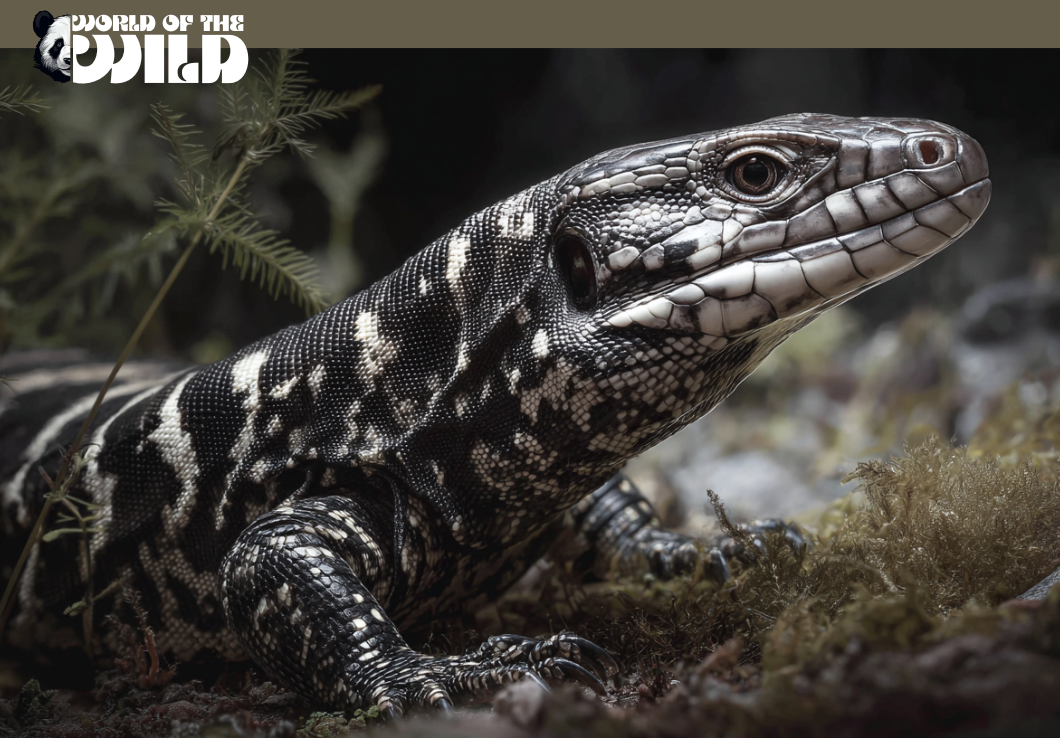

In the sun-dappled forests and grasslands of South America, a magnificent reptile prowls with the confidence of a creature that has perfected its craft over millions of years. The Argentine Black and White Tegu, with its striking monochrome pattern and keen intelligence, stands as one of the continent’s most remarkable lizards. Growing to impressive lengths and displaying problem-solving abilities that rival many mammals, this tegu has captured the fascination of herpetologists and nature enthusiasts alike. Beyond its imposing presence and beautiful appearance, this species offers a window into the complex world of reptilian intelligence and adaptation, challenging our preconceptions about cold-blooded creatures and their capabilities in the natural world.
Facts
- Seasonal Sleepers: Unlike most tropical reptiles, Argentine Black and White Tegus undergo brumation (reptilian hibernation) during cooler months, retreating into burrows for up to five months where their metabolism slows dramatically.
- Surprisingly Warm: These tegus can raise their body temperature up to 18°F above ambient temperature during breeding season through metabolic heat generation, a rare ability among lizards.
- Tool Users: Observations have documented tegus using their powerful claws and snouts to dig elaborate burrows exceeding ten feet in length, demonstrating sophisticated spatial reasoning.
- Omnivorous Opportunists: Their diet shifts seasonally, with younger tegus consuming more protein while adults incorporate significantly more fruit and vegetation as they age.
- Invasive Success: Escaped or released pet tegus have established breeding populations in Florida, where they threaten native wildlife and have been the subject of extensive removal programs.
- Long-Lived Companions: In captivity, Argentine Black and White Tegus can live 15-20 years, with some individuals reportedly exceeding 20 years with proper care.
- Intelligent Hunters: Tegus have demonstrated the ability to learn complex tasks, recognize their keepers, and even respond to basic training, displaying cognitive abilities uncommon among reptiles.
Species
The Argentine Black and White Tegu belongs to a fascinating lineage of New World lizards with the following taxonomic classification:
Kingdom: Animalia
Phylum: Chordata
Class: Reptilia
Order: Squamata
Family: Teiidae
Genus: Salvator
Species: Salvator merianae
Formerly classified as Tupinambis merianae, this species underwent taxonomic revision in 2012 when genetic studies revealed sufficient differences to warrant placement in the genus Salvator. The tegu family includes several closely related species that share similar characteristics. The Red Tegu (Salvator rufescens) inhabits drier regions of Argentina and features reddish coloration rather than the black and white pattern. The Gold Tegu (Tupinambis teguixin), found in northern South America, displays yellow and black banding and occupies more tropical environments. The Colombian Black and White Tegu represents a distinct population with subtle morphological differences. These species collectively form a group of large, intelligent, ground-dwelling lizards that have successfully radiated across South America, adapting to diverse ecological niches from rainforests to semi-arid scrublands.
Appearance
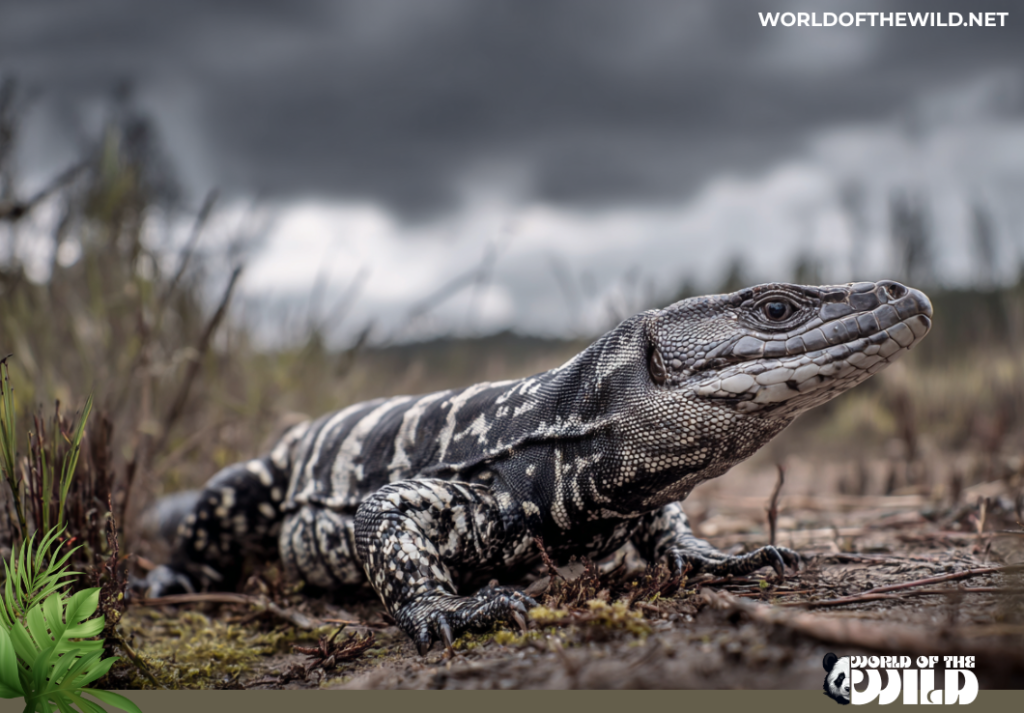
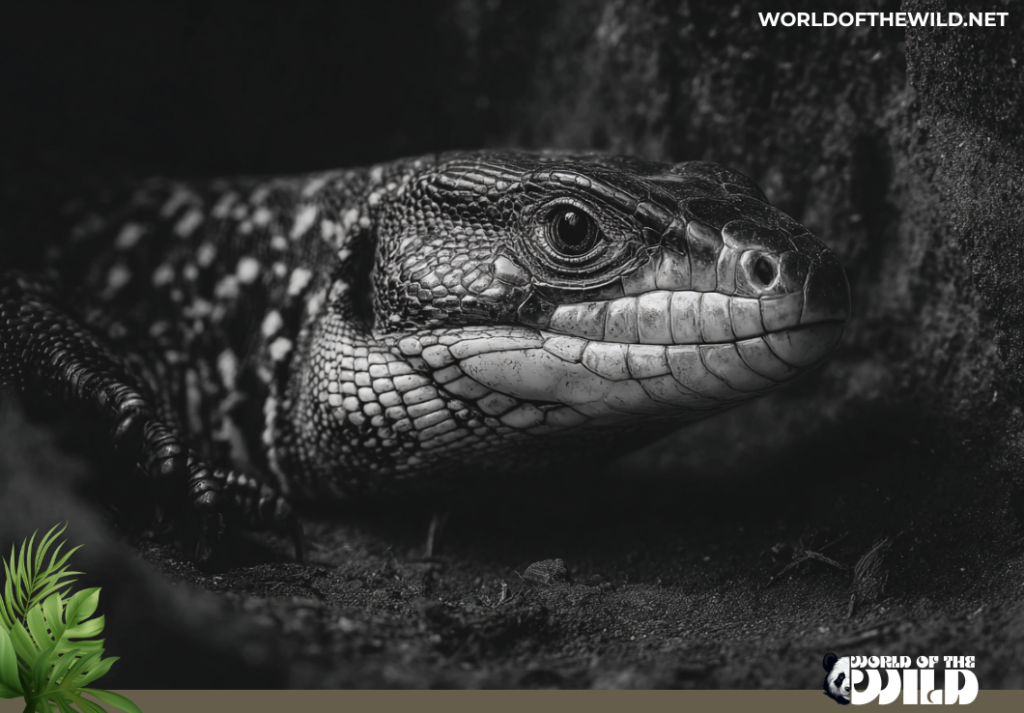
The Argentine Black and White Tegu presents a striking appearance that makes it instantly recognizable. Adults typically reach lengths of 3 to 4.5 feet from snout to tail tip, though exceptional specimens may approach 5 feet. Males generally grow larger and more robust than females, with mature males weighing between 7 and 12 pounds, while females typically range from 5 to 8 pounds. The most distinctive feature is their bold pattern of black and white bands that create irregular, almost beaded stripes running across the body from head to tail.
Hatchlings emerge with bright emerald green heads and brilliant white markings against jet-black backgrounds, a coloration that gradually transitions to the adult pattern as they mature. The skin itself consists of small, bead-like scales that give the tegu a textured appearance, different from the smooth scales of many other lizards. Their heads are triangular and powerful, housing strong jaw muscles capable of delivering a significant bite. The jowls, particularly in adult males, become thick and pronounced, giving them a bulldog-like appearance.
Their limbs are muscular and powerful, ending in sharp, curved claws designed for digging and climbing. The tail accounts for roughly half of the total body length and serves as both a fat storage organ and a defensive weapon that can deliver painful strikes. During breeding season, males develop a subtle blue-gray tint to their throats and bellies. The eyes are dark and alert, positioned to provide good binocular vision for hunting, and they possess a third eyelid that helps protect their eyes while burrowing.
Behavior
Orchestrated comprehensive tegu article structure across multiple behavioral and biological dimensions.
Let me detail the behavior of Argentine Black and White Tegus, covering their daily activities, social behaviors, intelligence, and unique adaptations.
Argentine Black and White Tegus are primarily diurnal hunters, emerging from their burrows shortly after sunrise to bask and raise their body temperature to optimal levels. They are largely solitary creatures outside of breeding season, maintaining territories that they patrol with methodical determination. Communication occurs through a combination of visual displays, chemical signals, and body language. Males engage in head-bobbing displays to establish dominance, while aggressive encounters may involve tail whipping, open-mouth threats, and ritualized combat that rarely results in serious injury.
These lizards demonstrate remarkable intelligence for reptiles, showing problem-solving abilities, spatial memory, and the capacity to learn from experience. They can navigate complex environments, remember the locations of food sources and burrows, and even recognize individual humans. In captivity, tegus have been trained to respond to their names, come when called, and tolerate handling, though they remain wild animals with individual personalities ranging from docile to defensive.
Their foraging behavior showcases their opportunistic nature. Tegus actively hunt by using their keen sense of smell, flicking their forked tongues to detect chemical cues in the air and on surfaces. They investigate crevices, overturn debris, and dig extensively to uncover prey. When threatened, juveniles may flee to the nearest cover, while adults often stand their ground, inflating their bodies, hissing loudly, and preparing to defend themselves with powerful bites and tail strikes.
One of their most fascinating adaptations is brumation. As temperatures drop in autumn, tegus gradually reduce their activity, stop feeding, and retreat into burrows where they remain dormant for several months. During this period, their metabolic rate plummets, and they survive on stored fat reserves. This ability to endure extended periods without food or water represents a sophisticated physiological adaptation uncommon among tropical and subtropical reptiles.
Evolution
The evolutionary history of tegus traces back to the broader radiation of teiid lizards, a family that emerged during the late Cretaceous period approximately 80-90 million years ago. The Teiidae family likely originated in South America when the continent was still isolated, allowing these lizards to evolve in relative geographic isolation and diversify into numerous ecological niches without competition from similar Old World lizard families.
Fossil evidence suggests that the ancestors of modern tegus were present by the Paleocene epoch, following the mass extinction that ended the age of dinosaurs. These early teiids were already displaying characteristics that would define their descendants: powerful limbs, omnivorous tendencies, and active foraging behaviors. The separation of the genus Salvator from Tupinambis represents a more recent evolutionary divergence, likely occurring several million years ago as populations adapted to different environments across South America.
The evolution of larger body size in tegus reflects an ecological strategy favoring strength and versatility over speed alone. Unlike some smaller lizard species that rely primarily on quick movements to escape predators, tegus developed a more robust build that allows them to access a wider variety of food sources, defend themselves more effectively, and even become predators of smaller animals. Their intelligence likely evolved as an adaptation to their omnivorous lifestyle, as successfully exploiting diverse food sources requires cognitive flexibility and learning ability.
The capacity for endothermic heat generation during breeding season represents a remarkable evolutionary development. This trait, unusual among squamates, may have evolved to provide reproductive advantages, allowing males to remain active and competitive during cooler periods when rivals cannot maintain optimal body temperatures. The evolution of brumation in tegus demonstrates how these animals adapted to environments with seasonal temperature fluctuations, despite their tropical origins.
Habitat
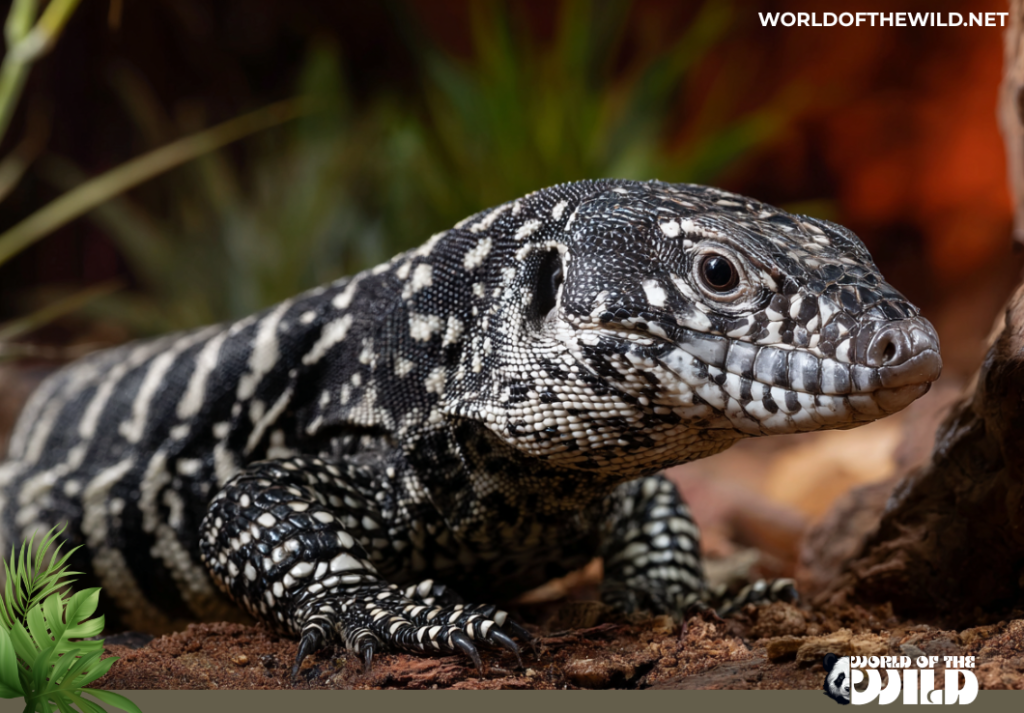
The Argentine Black and White Tegu inhabits a broad swath of eastern South America, with its range extending across central and northern Argentina, Paraguay, eastern Bolivia, southern Brazil, and Uruguay. This distribution covers an impressive variety of climatic zones, from subtropical regions near the Tropic of Capricorn to more temperate areas in southern Argentina, demonstrating the species’ remarkable adaptability.
Within this range, tegus occupy diverse habitats including tropical and subtropical forests, savannas, semi-arid scrublands, and even agricultural areas where they have learned to coexist with human activity. They show a particular preference for areas with abundant ground cover, fallen logs, dense vegetation, and access to water sources. Forest edges, where dense woodland meets open grassland, provide ideal conditions that offer both hunting opportunities and protective cover.
These lizards are accomplished burrowers, either excavating their own underground retreats or appropriating burrows created by other animals. Their burrows serve multiple critical functions: shelter from extreme temperatures, protection from predators, sites for egg-laying, and brumation chambers for surviving winter months. In tropical portions of their range, tegus may remain active year-round, while populations in more temperate zones undergo seasonal brumation.
The habitat typically features a mosaic of microenvironments. Open areas provide basking sites where tegus can thermoregulate efficiently, while dense vegetation offers hunting grounds rich with insects, small vertebrates, and fruit. Proximity to water is important, as tegus are capable swimmers and will readily enter streams and ponds to hunt, escape danger, or cool down during hot weather. The soil composition matters significantly, with sandy or loamy soils being preferred for burrow construction over hard clay or rocky substrates.
Diet
The Argentine Black and White Tegu is a highly adaptable omnivore whose diet shifts with age, season, and availability. This dietary flexibility represents one of the species’ greatest evolutionary advantages, allowing it to thrive across varied environments and fluctuating conditions.
Juvenile tegus are primarily carnivorous, requiring high protein intake to fuel their rapid growth. Their diet consists largely of invertebrates including crickets, beetles, earthworms, snails, and spiders. They also consume small vertebrates such as rodents, nestling birds, lizards, and frogs. Young tegus are active and aggressive hunters, using speed and persistence to chase down mobile prey.
As tegus mature, their diet gradually incorporates more plant matter. Adult tegus become true omnivores, with roughly 40-60% of their diet consisting of fruits, flowers, seeds, and tender vegetation, particularly during late summer and autumn when fruits ripen. They show particular fondness for sweet fruits and will travel considerable distances to exploit abundant fruit sources. The remaining portion of their diet consists of animal protein: carrion, eggs (including sea turtle and ground-nesting bird eggs), small mammals, reptiles, amphibians, fish, and various invertebrates.
Their foraging strategy combines active hunting with opportunistic scavenging. Tegus use their keen sense of smell to locate food, often digging extensively to uncover buried prey or hidden nests. They have powerful jaws capable of crushing snail shells, cracking eggs, and processing tough plant materials. When hunting live prey, they employ a combination of stealth and sudden rushes, using their speed and strength to overwhelm victims. They are not above raiding chicken coops, pet food bowls, and garbage when living near human settlements, demonstrating their adaptability and willingness to exploit novel food sources.
Predators and Threats
In their native South American habitat, Argentine Black and White Tegus face predation primarily during their younger, more vulnerable stages. Hatchlings and juveniles fall prey to a variety of predators including birds of prey such as hawks and caracaras, large snakes including boas and caimans, wild cats like ocelots and jaguarundis, and even other large tegus and carnivorous mammals. Adult tegus, thanks to their size, strength, and defensive capabilities, have fewer natural predators, though large caimans, anacondas, and jaguars may occasionally take them. Their powerful bite, sharp claws, and whip-like tail provide effective defenses against most potential predators.
The primary threats to tegu populations stem from human activities. Habitat destruction ranks as the most significant concern, with deforestation for agriculture, urban development, and cattle ranching fragmenting and reducing suitable tegu habitat throughout their range. The conversion of native forests and savannas to soybean fields and cattle pastures has been particularly impactful in countries like Brazil and Argentina.
The international pet trade represents both a threat and a conservation concern. While captive breeding programs provide most animals for the legal pet market, wild-caught tegus still enter trade channels, putting pressure on some wild populations. More problematically, the escape or intentional release of pet tegus in regions outside their native range has created invasive populations, most notably in Florida. These invasive tegus threaten native wildlife by predating on ground-nesting birds, sea turtle eggs, and small mammals, while also competing with native species for resources.
Road mortality affects tegu populations in areas where their habitat intersects with human infrastructure. Domestic dogs and cats kill tegus, particularly juveniles, in areas where human development encroaches on natural habitat. Climate change poses an emerging threat, potentially altering the temperature and rainfall patterns that tegus depend on for successful reproduction and brumation cycles. Persecution by humans who view tegus as pests or threats to poultry also results in direct killing, though tegus are generally tolerated better than many reptiles due to their role in controlling rodent populations.
Reproduction and Life Cycle
The reproductive cycle of Argentine Black and White Tegus is intricately tied to seasonal changes. Breeding season typically begins in spring (September to November in the Southern Hemisphere) as tegus emerge from brumation. Males become increasingly territorial and aggressive, engaging in elaborate courtship displays and ritualized combat with rivals. Dominant males patrol larger territories and gain access to multiple females.
Courtship involves persistent pursuit, with males following females while bobbing their heads, extending their dewlaps, and emitting low-frequency sounds. Males may nudge, lick, and gently bite females during courtship. Receptive females signal their willingness to mate through specific body postures. Copulation can last from several minutes to over an hour, with males using hemipenes (paired reproductive organs) for internal fertilization.
Following successful mating, females undergo a gestation period of approximately 40-60 days. During this time, they increase their food intake substantially to provision their developing eggs. Gravid females become noticeably swollen and may become more defensive of their territories. As egg-laying approaches, females seek suitable nesting sites, typically excavating burrows in sunny, well-drained locations or appropriating existing burrows.
A clutch typically contains 15-40 eggs, though larger females may produce up to 50 eggs. The eggs are white, leathery-shelled, and elongated, measuring approximately 1.5 to 2 inches in length. After depositing her eggs, the female covers the nest and, remarkably for a reptile, remains nearby to guard it against predators. This maternal behavior, unusual among lizards, involves the female staying close to the nest site and actively defending it against potential threats for several weeks, though she does not provide constant brooding like birds.
Incubation lasts approximately 60-75 days, depending on temperature. The eggs are temperature-dependent for sex determination, with warmer temperatures generally producing more males and cooler temperatures favoring females. Hatchlings emerge at about 7-10 inches in length, sporting their characteristic bright green heads and vivid black-and-white coloration. They are independent from birth and receive no parental care after hatching.
Young tegus grow rapidly, reaching sexual maturity at approximately 2-3 years of age, though full adult size may take 3-5 years to achieve. In the wild, tegus likely live 10-15 years, though predation, disease, and environmental challenges mean many do not reach their full potential lifespan. In captivity, where these threats are minimized, tegus regularly live 15-20 years, with exceptional individuals exceeding 20 years.
Population
The Argentine Black and White Tegu is currently classified as “Least Concern” by the International Union for Conservation of Nature (IUCN), reflecting its relatively stable population status and wide distribution across South America. Unlike many reptile species facing critical endangerment, tegus have demonstrated remarkable resilience and adaptability, even thriving in human-modified landscapes when conditions allow.
Estimating the global population of tegus remains challenging due to their extensive range and the difficulty of surveying reptile populations across diverse habitats. However, scientists believe that several hundred thousand to potentially millions of individuals exist across their native range. Population densities vary considerably based on habitat quality, with prime habitat supporting higher numbers while marginal areas host sparser populations.
Population trends vary by region. In some areas of their core range, particularly in Brazil and Argentina, tegu populations appear stable or even increasing in certain localities. Their ability to exploit agricultural areas and tolerate moderate habitat modification has allowed them to persist where other species have declined. However, in heavily deforested regions or areas with intense human development, local populations have experienced declines or extirpations.
The establishment of invasive tegu populations in Florida has created an unusual situation where the species is simultaneously stable in its native range while becoming a conservation concern elsewhere. Florida’s tegu population, established through the exotic pet trade, has grown rapidly and prompted extensive control efforts to prevent further expansion and protect native wildlife.
Trade in tegus for the pet market is regulated under CITES (Convention on International Trade in Endangered Species) Appendix II, which requires monitoring of international trade to ensure it does not threaten wild populations. Most tegus in the pet trade now come from captive breeding operations, reducing pressure on wild populations while creating economic incentives for sustainable management.
Conclusion
The Argentine Black and White Tegu stands as a testament to the remarkable adaptability and intelligence that reptiles can achieve. From its striking appearance and impressive size to its cognitive abilities and complex behaviors, this species challenges our preconceptions about cold-blooded animals and their capabilities. As an omnivore that bridges multiple trophic levels, a burrower that shapes its environment, and an opportunist that thrives alongside humans, the tegu plays important ecological roles across its South American range.
While the species currently enjoys stable population status, its story carries important lessons about the delicate balance between wildlife and human development. The invasion of tegus into Florida serves as a cautionary tale about the exotic pet trade and the unintended consequences of releasing non-native species. Meanwhile, habitat loss in South America reminds us that even adaptable species face limits to their resilience.
As we continue to study these magnificent lizards, we gain not only scientific knowledge but also appreciation for the intricate web of life that sustains our planet. The tegu’s future depends on our commitment to preserving natural habitats, managing the pet trade responsibly, and recognizing the intrinsic value of all species. By protecting the forests, grasslands, and ecosystems that tegus call home, we ensure that future generations can marvel at these intelligent, beautiful creatures thriving in the wild where they belong.
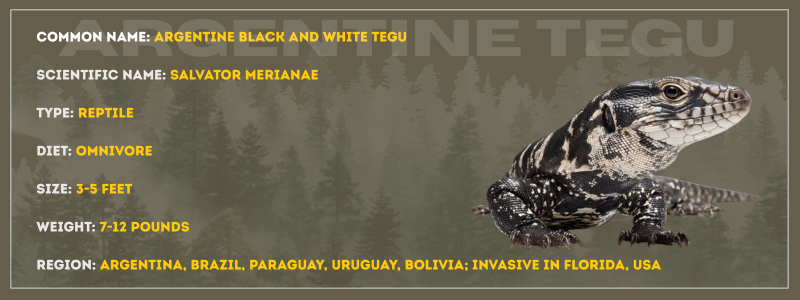
Scientific Name: Salvator merianae
Diet Type: Omnivore
Size: 3-4.5 feet (up to 5 feet)
Weight: 7-12 pounds (males), 5-8 pounds (females)
Region Found: Argentina, Brazil, Paraguay, Uruguay, Bolivia; invasive in Florida, USA